
Case Presentation
Done By: Dr. Hadeel Almasri
Supervised By:
Dr. Ahmad Al-Tarawneh
Dr. Raed Al-Rbata
Dr. Anwar Al-Rahamneh
Personal Data
 Patient’s Name : T.M
 Gender: Female
 Age: 15 years, 7 months
 Occupation: Student
 Nationality: Jordanian
History
 Trauma: No History of Trauma
 Habits: No Habits
 Growth status: Non-grower
Medical and Dental History
 Medical History: Medically fit
 Dental History: Routine dental treatment
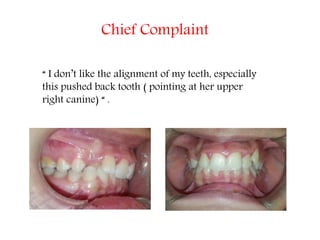
Chief Complaint
“ I don’t like the alignment of my teeth, especially
this pushed back tooth ( pointing at her upper
right canine) “ .
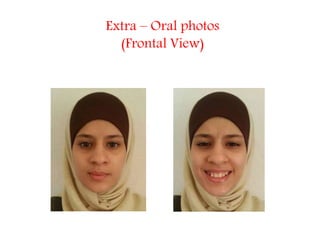
Extra – Oral photos
(Frontal View)
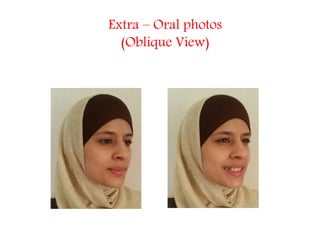
Extra – Oral photos
(Oblique View)
Extra – Oral photos
(Profile View)
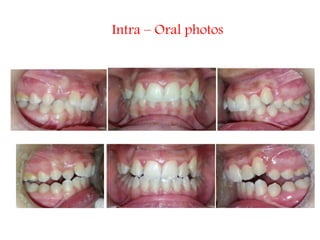
Intra – Oral photos
Intra – Oral photos
Extra – Oral Examination
Skeletal Assessment
Antero-posterior assessment:
Straight profile
Extra – Oral Examination
Skeletal Assessment
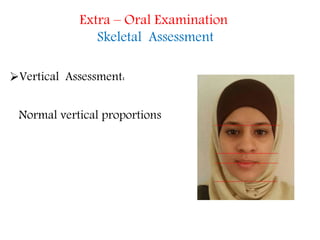
Vertical Assessment:
Normal vertical proportions
Extra – Oral Examination
Skeletal Assessment
 Transverse Assessment:
The chin is slightly deviated
to the right side
Soft tissue Examination
Equal thirds of the face
The upper lip is in the upper
third of the lower part
The lower lip is in the lower
two thirds of the lower part
Soft tissue Examination
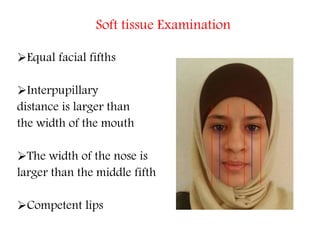
Equal facial fifths
Interpupillary
distance is larger than
the width of the mouth
The width of the nose is
larger than the middle fifth
Competent lips
Soft tissue Examination
Frontonasial angle : 149
“ normal 115 – 135 “
Naso labial angle : 108
“ normal 90 – 110 “
Labiomental angle: 102
“ normal 114 – 140 “
Soft tissue Examination
 Excessive gingival
show on smiling
(Gummy Smile)
Intra oral Examination
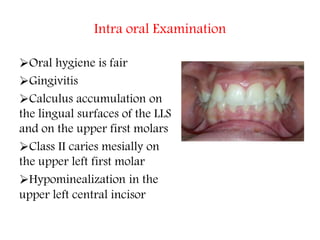
Oral hygiene is fair
Gingivitis
Calculus accumulation on
the lingual surfaces of the LLS
and on the upper first molars
Class II caries mesially on
the upper left first molar
Hypominealization in the
upper left central incisor
Teeth Present
7654321 1234567
7654321 1234567
Lower arch
U-shaped symmetrical arch
Well-aligned
 The right and left buccal
segments are lingually
tipped
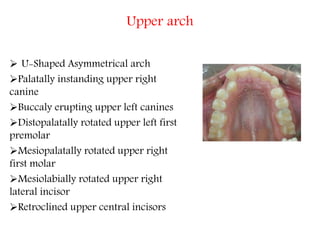
Upper arch
 U-Shaped Asymmetrical arch
Palatally instanding upper right
canine
Buccaly erupting upper left canines
Distopalatally rotated upper left first
premolar
Mesiopalatally rotated upper right
first molar
Mesiolabially rotated upper right
lateral incisor
Retroclined upper central incisors
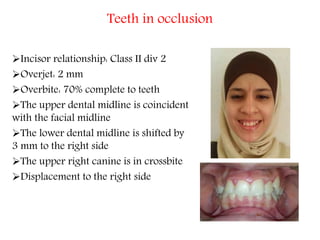
Teeth in occlusion
Incisor relationship: Class II div 2
Overjet: 2 mm
Overbite: 70% complete to teeth
The upper dental midline is coincident
with the facial midline
The lower dental midline is shifted by
3 mm to the right side
The upper right canine is in crossbite
Displacement to the right side
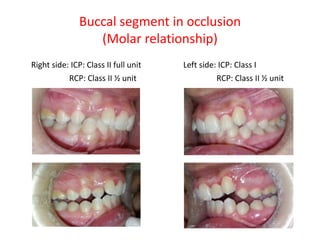
Buccal segment in occlusion
(Molar relationship)
Right side: ICP: Class II full unit Left side: ICP: Class I
RCP: Class II ½ unit RCP: Class II ½ unit
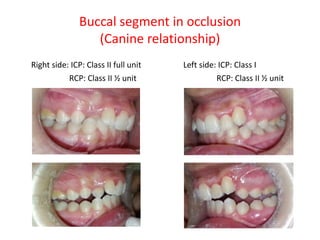
Buccal segment in occlusion
(Canine relationship)
Right side: ICP: Class II full unit Left side: ICP: Class I
RCP: Class II ½ unit RCP: Class II ½ unit
Study model analysis in occlusion
Right Left
-Molar: Cl II full unit
-Canine: Cl II full unit
-Molar: Cl I
-Canine: Cl I
OJ: 2 mm
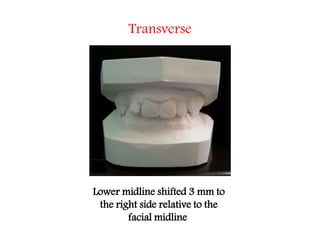
Transverse
Lower midline shifted 3 mm to
the right side relative to the
facial midline
Vertical
Overbite 70% complete to teeth
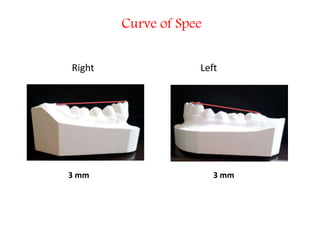
Curve of Spee
Right Left
3 mm 3 mm
Upper arch
- U- shaped arch.
- symmetrical arch.
- Intercanine width:
29 mm ( Reduced)
- Intermolar width :
48 mm (Increased)
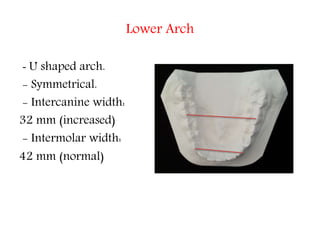
Lower Arch
- U shaped arch.
- Symmetrical.
- Intercanine width:
32 mm (increased)
- Intermolar width:
42 mm (normal)
Radiographical examination
Orthopantomogram “OPT” Analysis:
No pathology
All teeth are present including the tooth buds of all 8 ‘s
Class II caries mesially in the upper left first molar
Dilaceration in the lower left first premolar root
Cephalometric Analysis
83 ( 81 ) + - 3SNA
78 ( 78 ) + - 3SNB
5 ( 3 ) + - 1ANB
4.5 ( 3 ) + - 1ANB*
101 ( 109 ) + -6UI- MAX
97 ( 93 ) + - 6LI- MAN
139 ( 135 ) + - 10IIA
7.5 ( 8 ) + - 3SN- MAX
0.56 (0.55) + - 2LFH
25 ( 27 ) + -4MMPA
2.5 ( 0 ) + - 1.77WITS
Appraisal
Skeletal relationship: CL II
Space Analysis
Lower arch:
Space needed: 67 mm
Space available: 67 mm
(No crowding)
Upper arch:
Space needed:77 mm
Space available:73 mm
(4 mm crowding-mild)
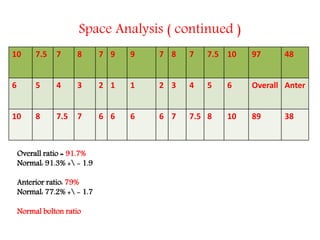
Space Analysis ( continued )
4897107.5787997877.510
AnterOverall654321123456
38891087.57666677.5810
Overall ratio = 91.7%
Normal: 91.3% + - 1.9
Anterior ratio: 79%
Normal: 77.2% + - 1.7
Normal bolton ratio
Pre – treatment (IOTN)
Aesthetic Component
Figure 2
Mild treatment need
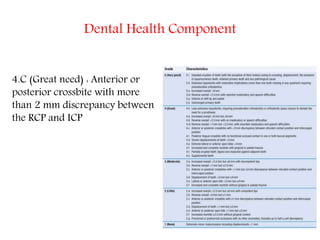
Dental Health Component
4.C (Great need) : Anterior or
posterior crossbite with more
than 2 mm discrepancy between
the RCP and ICP
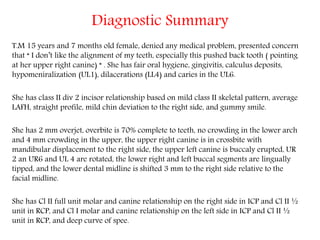
Diagnostic Summary
T.M 15 years and 7 months old female, denied any medical problem, presented concern
that “ I don’t like the alignment of my teeth, especially this pushed back tooth ( pointing
at her upper right canine) “ . She has fair oral hygiene, gingivitis, calculus deposits,
hypomeniralization (UL1), dilacerations (LL4) and caries in the UL6.
She has class II div 2 incisor relationship based on mild class II skeletal pattern, average
LAFH, straight profile, mild chin deviation to the right side, and gummy smile.
She has 2 mm overjet, overbite is 70% complete to teeth, no crowding in the lower arch
and 4 mm crowding in the upper, the upper right canine is in crossbite with
mandibular displacement to the right side, the upper left canine is buccaly erupted, UR
2 an UR6 and UL 4 are rotated, the lower right and left buccal segments are lingually
tipped, and the lower dental midline is shifted 3 mm to the right side relative to the
facial midline.
She has Cl II full unit molar and canine relationship on the right side in ICP and Cl II ½
unit in RCP, and Cl I molar and canine relationship on the left side in ICP and Cl II ½
unit in RCP, and deep curve of spee.
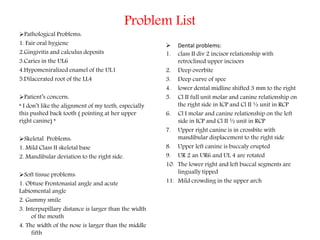
Problem List
Pathological Problems:
1. Fair oral hygiene
2.Gingivitis and calculus deposits
3.Caries in the UL6
4.Hypomeniralized enamel of the UL1
5.Dilacerated root of the LL4
Patient’s concern:
“ I don’t like the alignment of my teeth, especially
this pushed back tooth ( pointing at her upper
right canine) “
Skeletal Problems:
1. Mild Class II skeletal base
2. Mandibular deviation to the right side.
Soft tissue problems:
1. Obtuse Frontonasial angle and acute
Labiomental angle
2. Gummy smile
3. Interpupillary distance is larger than the width
of the mouth
4. The width of the nose is larger than the middle
fifth
 Dental problems:
1. class II div 2 incisor relationship with
retroclined upper incisors
2. Deep overbite
3. Deep curve of spee
4. lower dental midline shifted 3 mm to the right
5. Cl II full unit molar and canine relationship on
the right side in ICP and Cl II ½ unit in RCP
6. Cl I molar and canine relationship on the left
side in ICP and Cl II ½ unit in RCP
7. Upper right canine is in crossbite with
mandibular displacement to the right side
8. Upper left canine is buccaly erupted
9. UR 2 an UR6 and UL 4 are rotated
10. The lower right and left buccal segments are
lingually tipped
11. Mild crowding in the upper arch
Treatment Aims
- Improve patient’s oral hygiene
- Referral to periodontics department for stabilization of periodontal health
- Referral to conservative department for treatment of the carious UL6
-Accept dilacerated LL4 and hypomineralization
- correction of patient’s complaint
- Accept skeletal class II base
- Accept soft tissue problems
- Improve smile aesthetics
- Alignment and leveling of teeth
- Correct crossbite on the UR canine and mandibular displacement
- Correct lower midline shift
- Correction of deep overbite and flatten curve of spee
- Relieve crowding
- Achieve class I incisor relationship
- Achieve class I canine and molar relationship
- Finishing and detailing of occlusion
- Retain the corrected results
Treatment Plan
( Camouflage, Non-Extraction case)
- OHI
- Referral to periodontics department for stabilization of periodontal health
- Referral to conservative department for treatment of the carious UL6
- Straight pull Headgear for bilateral molar distalization and for anchorage
- Bite turbos on the upper central incisors
- Upper and lower fixed appliance ( SWA , MBT(for the upper arch and lower buccal
segments),Roth(for the lower labial segment), slot 0.022 )
-Retention.
Retention protocol
 Short term:
Upper and lower Hawley retainers (full time wear for 6 months, and night time wear
for another 6 months)
 Long term:
Upper and lower permanent retainer 3-3 (Multistrand SS wire 17.5 mil)
Justification
1. Camouflage:
- Patient chief complaint
-Mild skeletal discrepancy
-Average vertical facial proportions
-Patient passed the peak of growth spurt
2. Non – extraction:
- No crowding in the lower arch, average inclination of the lower incisors, and space
needed for leveling curve of spee is 1 mm each side, and this can be provided by
uprighting of the lingually tipped lower buccal segment.
-Mild crowding in upper arch and space can be gained by molar distalization, arch
wire expansion, proclination of upper incisors, and correction of rotated teeth.
-Presence of displacement that complicates the relation
Justification
3.Straight pull headgear for bilateral distalization:
-Average LAFH
-Deep overbite
-Class II ½ unit molar relationship
-Mild crowding in the upper arch
-For anchorage: to preserve cl I molar relationship
4.Bite turbos on the upper central incisors:
-For correction of crossbite on the UR canine
-To free the occlusion posteriorly to allow lower posterior segment uprighting and
some extrusion for correction of deep overbite and COS
-Some incisor intrusion ( aid in correction of deep overbite)
-Allow bonding of brackets on the lower incisors
Justification
5. Fixed appliance:
- 3-D tooth movement
- Bodily teeth movement needed
- Semi customized appliance:
 MBT for the upper labial segment : for more palatal root torque, and to counteract
the effect of retraction of the ULS ( to prevent retroclination)
 MBT for the lower buccal segment: to reduce lingual crown torque
 Roth for the lower labial segment: average root torque needed
 For the palatally displaced UR canine use inverted lower contra-lateral canine
bracket Roth prescription (-11 torque)
Justification
6. Retention:
 Hawley retainers: for more settling and stability of incisor relationship and other
posterior teeth.
 Lower permanent retainer: to stabilize the position of lower anterior teeth and
prevent late mandibular crowding.
 Upper permanent retainer: to stabilize the position of the upper incisors and for
the rotated UR lateral incisor
Treatment details and mechanics
1. Full records
2. Separators around upper and lower 6’s
3. Bands selection and cementation
4. Straight pull headgear fitting+ give instructions to the patient about it (use it for
distalization first and then for anchorage)
5. Composite bite turbos on the upper central incisors
6. Direct bonding of brackets ( place the upper incisors brackets more incisally for
some intrusion that helps in reducing the deep overbite and improving gummy
smile, and also increase the mesial tip of the upper canines to help in reducing
overbite)
7. Levelling and alignment:
0.014 niti superelastic
0.016 niti superelastic
0.018 niti superelastic
0.017*0.025 niti superelastic
Treatment details and mechanics
0.019*0.025 SS wire , start retraction of the upper labial segment and space closure.
Here I will consider adding torque by 3rd order bend to avoid retroclination of the
upper labial segment with retraction ( since the more incisal position of the bracket I
used can reduce torque expression)
8. Finishing and detailing
TMA 0.021*0.025 wire
Settling
9. Debonding
impression for retainers
short term: U&L Hawley
Long term : U&L permanent .0175 inch multistrand wire
Dr hadeel almasri case presentation

Dr hadeel almasri case presentation

  • 1.
    Case Presentation Done By:Dr. Hadeel Almasri Supervised By: Dr. Ahmad Al-Tarawneh Dr. Raed Al-Rbata Dr. Anwar Al-Rahamneh
  • 2.
    Personal Data  Patient’sName : T.M  Gender: Female  Age: 15 years, 7 months  Occupation: Student  Nationality: Jordanian
  • 3.
    History  Trauma: NoHistory of Trauma  Habits: No Habits  Growth status: Non-grower
  • 4.
    Medical and DentalHistory  Medical History: Medically fit  Dental History: Routine dental treatment
  • 5.
    Chief Complaint “ Idon’t like the alignment of my teeth, especially this pushed back tooth ( pointing at her upper right canine) “ .
  • 6.
    Extra – Oralphotos (Frontal View)
  • 7.
    Extra – Oralphotos (Oblique View)
  • 8.
    Extra – Oralphotos (Profile View)
  • 9.
  • 10.
  • 11.
    Extra – OralExamination Skeletal Assessment Antero-posterior assessment: Straight profile
  • 12.
    Extra – OralExamination Skeletal Assessment Vertical Assessment: Normal vertical proportions
  • 13.
    Extra – OralExamination Skeletal Assessment  Transverse Assessment: The chin is slightly deviated to the right side
  • 14.
    Soft tissue Examination Equalthirds of the face The upper lip is in the upper third of the lower part The lower lip is in the lower two thirds of the lower part
  • 15.
    Soft tissue Examination Equalfacial fifths Interpupillary distance is larger than the width of the mouth The width of the nose is larger than the middle fifth Competent lips
  • 16.
    Soft tissue Examination Frontonasialangle : 149 “ normal 115 – 135 “ Naso labial angle : 108 “ normal 90 – 110 “ Labiomental angle: 102 “ normal 114 – 140 “
  • 17.
    Soft tissue Examination Excessive gingival show on smiling (Gummy Smile)
  • 18.
    Intra oral Examination Oralhygiene is fair Gingivitis Calculus accumulation on the lingual surfaces of the LLS and on the upper first molars Class II caries mesially on the upper left first molar Hypominealization in the upper left central incisor
  • 19.
  • 20.
    Lower arch U-shaped symmetricalarch Well-aligned  The right and left buccal segments are lingually tipped
  • 21.
    Upper arch  U-ShapedAsymmetrical arch Palatally instanding upper right canine Buccaly erupting upper left canines Distopalatally rotated upper left first premolar Mesiopalatally rotated upper right first molar Mesiolabially rotated upper right lateral incisor Retroclined upper central incisors
  • 22.
    Teeth in occlusion Incisorrelationship: Class II div 2 Overjet: 2 mm Overbite: 70% complete to teeth The upper dental midline is coincident with the facial midline The lower dental midline is shifted by 3 mm to the right side The upper right canine is in crossbite Displacement to the right side
  • 23.
    Buccal segment inocclusion (Molar relationship) Right side: ICP: Class II full unit Left side: ICP: Class I RCP: Class II ½ unit RCP: Class II ½ unit
  • 24.
    Buccal segment inocclusion (Canine relationship) Right side: ICP: Class II full unit Left side: ICP: Class I RCP: Class II ½ unit RCP: Class II ½ unit
  • 25.
    Study model analysisin occlusion Right Left -Molar: Cl II full unit -Canine: Cl II full unit -Molar: Cl I -Canine: Cl I OJ: 2 mm
  • 26.
    Transverse Lower midline shifted3 mm to the right side relative to the facial midline
  • 27.
  • 28.
    Curve of Spee RightLeft 3 mm 3 mm
  • 29.
    Upper arch - U-shaped arch. - symmetrical arch. - Intercanine width: 29 mm ( Reduced) - Intermolar width : 48 mm (Increased)
  • 30.
    Lower Arch - Ushaped arch. - Symmetrical. - Intercanine width: 32 mm (increased) - Intermolar width: 42 mm (normal)
  • 32.
    Radiographical examination Orthopantomogram “OPT”Analysis: No pathology All teeth are present including the tooth buds of all 8 ‘s Class II caries mesially in the upper left first molar Dilaceration in the lower left first premolar root
  • 33.
    Cephalometric Analysis Cephalometric Analysis 83( 81 ) + - 3SNA 78 ( 78 ) + - 3SNB 5 ( 3 ) + - 1ANB 4.5 ( 3 ) + - 1ANB* 101 ( 109 ) + -6UI- MAX 97 ( 93 ) + - 6LI- MAN 139 ( 135 ) + - 10IIA 7.5 ( 8 ) + - 3SN- MAX 0.56 (0.55) + - 2LFH 25 ( 27 ) + -4MMPA 2.5 ( 0 ) + - 1.77WITS Appraisal Skeletal relationship: CL II
  • 34.
    Space Analysis Lower arch: Spaceneeded: 67 mm Space available: 67 mm (No crowding) Upper arch: Space needed:77 mm Space available:73 mm (4 mm crowding-mild)
  • 35.
    Space Analysis (continued ) 4897107.5787997877.510 AnterOverall654321123456 38891087.57666677.5810 Overall ratio = 91.7% Normal: 91.3% + - 1.9 Anterior ratio: 79% Normal: 77.2% + - 1.7 Normal bolton ratio
  • 36.
    Pre – treatment(IOTN) Aesthetic Component Figure 2 Mild treatment need
  • 37.
    Dental Health Component 4.C(Great need) : Anterior or posterior crossbite with more than 2 mm discrepancy between the RCP and ICP
  • 38.
    Diagnostic Summary T.M 15years and 7 months old female, denied any medical problem, presented concern that “ I don’t like the alignment of my teeth, especially this pushed back tooth ( pointing at her upper right canine) “ . She has fair oral hygiene, gingivitis, calculus deposits, hypomeniralization (UL1), dilacerations (LL4) and caries in the UL6. She has class II div 2 incisor relationship based on mild class II skeletal pattern, average LAFH, straight profile, mild chin deviation to the right side, and gummy smile. She has 2 mm overjet, overbite is 70% complete to teeth, no crowding in the lower arch and 4 mm crowding in the upper, the upper right canine is in crossbite with mandibular displacement to the right side, the upper left canine is buccaly erupted, UR 2 an UR6 and UL 4 are rotated, the lower right and left buccal segments are lingually tipped, and the lower dental midline is shifted 3 mm to the right side relative to the facial midline. She has Cl II full unit molar and canine relationship on the right side in ICP and Cl II ½ unit in RCP, and Cl I molar and canine relationship on the left side in ICP and Cl II ½ unit in RCP, and deep curve of spee.
  • 39.
    Problem List Pathological Problems: 1.Fair oral hygiene 2.Gingivitis and calculus deposits 3.Caries in the UL6 4.Hypomeniralized enamel of the UL1 5.Dilacerated root of the LL4 Patient’s concern: “ I don’t like the alignment of my teeth, especially this pushed back tooth ( pointing at her upper right canine) “ Skeletal Problems: 1. Mild Class II skeletal base 2. Mandibular deviation to the right side. Soft tissue problems: 1. Obtuse Frontonasial angle and acute Labiomental angle 2. Gummy smile 3. Interpupillary distance is larger than the width of the mouth 4. The width of the nose is larger than the middle fifth  Dental problems: 1. class II div 2 incisor relationship with retroclined upper incisors 2. Deep overbite 3. Deep curve of spee 4. lower dental midline shifted 3 mm to the right 5. Cl II full unit molar and canine relationship on the right side in ICP and Cl II ½ unit in RCP 6. Cl I molar and canine relationship on the left side in ICP and Cl II ½ unit in RCP 7. Upper right canine is in crossbite with mandibular displacement to the right side 8. Upper left canine is buccaly erupted 9. UR 2 an UR6 and UL 4 are rotated 10. The lower right and left buccal segments are lingually tipped 11. Mild crowding in the upper arch
  • 40.
    Treatment Aims - Improvepatient’s oral hygiene - Referral to periodontics department for stabilization of periodontal health - Referral to conservative department for treatment of the carious UL6 -Accept dilacerated LL4 and hypomineralization - correction of patient’s complaint - Accept skeletal class II base - Accept soft tissue problems - Improve smile aesthetics - Alignment and leveling of teeth - Correct crossbite on the UR canine and mandibular displacement - Correct lower midline shift - Correction of deep overbite and flatten curve of spee - Relieve crowding - Achieve class I incisor relationship - Achieve class I canine and molar relationship - Finishing and detailing of occlusion - Retain the corrected results
  • 41.
    Treatment Plan ( Camouflage,Non-Extraction case) - OHI - Referral to periodontics department for stabilization of periodontal health - Referral to conservative department for treatment of the carious UL6 - Straight pull Headgear for bilateral molar distalization and for anchorage - Bite turbos on the upper central incisors - Upper and lower fixed appliance ( SWA , MBT(for the upper arch and lower buccal segments),Roth(for the lower labial segment), slot 0.022 ) -Retention.
  • 42.
    Retention protocol  Shortterm: Upper and lower Hawley retainers (full time wear for 6 months, and night time wear for another 6 months)  Long term: Upper and lower permanent retainer 3-3 (Multistrand SS wire 17.5 mil)
  • 43.
    Justification 1. Camouflage: - Patientchief complaint -Mild skeletal discrepancy -Average vertical facial proportions -Patient passed the peak of growth spurt 2. Non – extraction: - No crowding in the lower arch, average inclination of the lower incisors, and space needed for leveling curve of spee is 1 mm each side, and this can be provided by uprighting of the lingually tipped lower buccal segment. -Mild crowding in upper arch and space can be gained by molar distalization, arch wire expansion, proclination of upper incisors, and correction of rotated teeth. -Presence of displacement that complicates the relation
  • 44.
    Justification 3.Straight pull headgearfor bilateral distalization: -Average LAFH -Deep overbite -Class II ½ unit molar relationship -Mild crowding in the upper arch -For anchorage: to preserve cl I molar relationship 4.Bite turbos on the upper central incisors: -For correction of crossbite on the UR canine -To free the occlusion posteriorly to allow lower posterior segment uprighting and some extrusion for correction of deep overbite and COS -Some incisor intrusion ( aid in correction of deep overbite) -Allow bonding of brackets on the lower incisors
  • 45.
    Justification 5. Fixed appliance: -3-D tooth movement - Bodily teeth movement needed - Semi customized appliance:  MBT for the upper labial segment : for more palatal root torque, and to counteract the effect of retraction of the ULS ( to prevent retroclination)  MBT for the lower buccal segment: to reduce lingual crown torque  Roth for the lower labial segment: average root torque needed  For the palatally displaced UR canine use inverted lower contra-lateral canine bracket Roth prescription (-11 torque)
  • 46.
    Justification 6. Retention:  Hawleyretainers: for more settling and stability of incisor relationship and other posterior teeth.  Lower permanent retainer: to stabilize the position of lower anterior teeth and prevent late mandibular crowding.  Upper permanent retainer: to stabilize the position of the upper incisors and for the rotated UR lateral incisor
  • 47.
    Treatment details andmechanics 1. Full records 2. Separators around upper and lower 6’s 3. Bands selection and cementation 4. Straight pull headgear fitting+ give instructions to the patient about it (use it for distalization first and then for anchorage) 5. Composite bite turbos on the upper central incisors 6. Direct bonding of brackets ( place the upper incisors brackets more incisally for some intrusion that helps in reducing the deep overbite and improving gummy smile, and also increase the mesial tip of the upper canines to help in reducing overbite) 7. Levelling and alignment: 0.014 niti superelastic 0.016 niti superelastic 0.018 niti superelastic 0.017*0.025 niti superelastic
  • 48.
    Treatment details andmechanics 0.019*0.025 SS wire , start retraction of the upper labial segment and space closure. Here I will consider adding torque by 3rd order bend to avoid retroclination of the upper labial segment with retraction ( since the more incisal position of the bracket I used can reduce torque expression) 8. Finishing and detailing TMA 0.021*0.025 wire Settling 9. Debonding impression for retainers short term: U&L Hawley Long term : U&L permanent .0175 inch multistrand wire