

• Presented by-
• ABHIJEET KAMBLE
FINAL YEAR
Photo by
2.CASE HISTROY FORMET
3.HISTORY RECORDING
• A case history is defined as a planned professional
conversation that enables the patient to communicate
his/her symptoms, feelings, fears and sequence of
events leading to problem for which the patient seeks
professional assistance ,to the clinician so that
patient’s real or suspected illness & mental attitude
can be determined.
DEFINATION:
Objectives:-
 To establish a positive professional relationship.
 To provide the clinician with information concerning the
patient’s past dental, medical & personal history.
 To provide the clinician with the information that may be
necessary for making a diagnosis.
 To provide information that aids the clinician in making
decisions concerning the treatment of the patient.
COMPONENTS-
 General information
 Chief complaint
 History of present illness
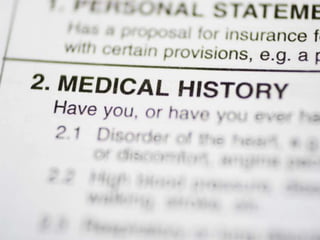
 Medical history
 Past dental history
 Personal history
 General examination
 Extraoral examination
 Intraoral examination
 Provisional diagnosis
 Investigations
 Final diagnosis
 Treatment plan
GENERAL INFORMATION
 Patient registration number
 Date
 Name
 Age
 Sex
 Address
 Income
 Occupation
 Marital status
 Religion
 Patient registration number
Useful for-
1. maintaining a record,
2. billing purposes,
3. medico legal aspects.
 Date
Useful for-
1. Time of admission
2. reference during follow up visits
3. Record maintenance.
NAME
 to communicate with the patient
 to establish a rapport with the patient
 Record maintenance
 Psychological benefits
AGE
 For diagnosis
 Treatment planning
 Behavioral management techniques
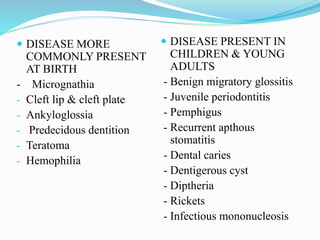
 DISEASE MORE
COMMONLY PRESENT
AT BIRTH
- Micrognathia
- Cleft lip & cleft plate
- Ankyloglossia
- Predecidous dentition
- Teratoma
- Hemophilia
 DISEASE PRESENT IN
CHILDREN & YOUNG
ADULTS
- Benign migratory glossitis
- Juvenile periodontitis
- Pemphigus
- Recurrent apthous
stomatitis
- Dental caries
- Dentigerous cyst
- Diptheria
- Rickets
- Infectious mononucleosis
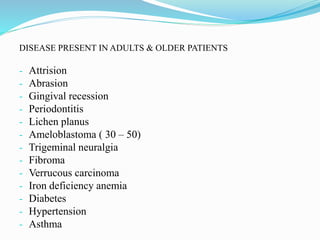
DISEASE PRESENT IN ADULTS & OLDER PATIENTS
- Attrision
- Abrasion
- Gingival recession
- Periodontitis
- Lichen planus
- Ameloblastoma ( 30 – 50)
- Trigeminal neuralgia
- Fibroma
- Verrucous carcinoma
- Iron deficiency anemia
- Diabetes
- Hypertension
- Asthma
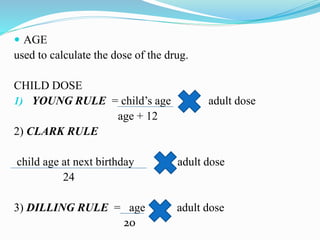
 AGE
used to calculate the dose of the drug.
CHILD DOSE
1) YOUNG RULE = child’s age adult dose
age + 12
2) CLARK RULE
child age at next birthday adult dose
24
3) DILLING RULE = age adult dose
20
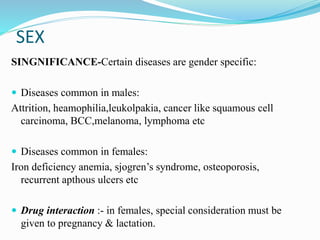
SEX
SINGNIFICANCE-Certain diseases are gender specific:
 Diseases common in males:
Attrition, heamophilia,leukolpakia, cancer like squamous cell
carcinoma, BCC,melanoma, lymphoma etc
 Diseases common in females:
Iron deficiency anemia, sjogren’s syndrome, osteoporosis,
recurrent apthous ulcers etc
 Drug interaction :- in females, special consideration must be
given to pregnancy & lactation.
Gender also helps analyze:
1. Treatment planning in case of orthodontics pts as timing
of growth spurts is different in males and females.
2. Esthetics: Girls are more conscious about their esthetics.
3. Dosage of drugs:
 Females requires low dosage of drugs than males.
 Long term use of antihypertensive drugs can lead to
impotency in males
 Gynecomestia may be caused in males due to madications
like;ketoconazole,chlorpromazine
4.Most of the times, sex is linked to occupation and in turn,
to occupational hazards.
EDUCATION
 Tells about patient’s attitude
 Helps while giving health education and motivation.
 INCOME
 Helps determine socio-economic status of patient.
 Helps to find out affordability towards treatment
 Certain diseases are more common in certain
socioeconomic status patients
PERCAPITA INCOME
 Total income of family divided by total number of
family members.
 It is the measure of amount of money recived per
head by every individual in family of total income
ADDRESS
 For future correspondence/recall
 Gives a view of socio-economic status -to know about the
nourishment, hygiene & payment capacity of the patient
 Prevalence of diseases like fluorosis as a result of increase level of
fluorides in water are spread differently in various parts of the
country.
 For hospital records/administrative purposes.
.
 OCCUPATION
 To asses the socioeconomic status.
 Predilection of diseases in different occupations for eg:
hepatitis B is common in dentists & surgeons.
 Bakers, candy makers ---- caries
 Bismuth handlers ----- blue pigmentation of
gingiva
 Musicians, carpenters ----- localized abrasion
 Also helps in planning appointments as per occupation
and also determines their affordability.
 MARITAL STATUS
 To see any history of consanguineous marriages.
 The high consanguinity rates, coupled by the large family
size in some communities, could induce the expression of
autosomal recessive diseases.
RELIGION
 Identifying the festival periods when religious people
are reluctant to undergo treatment procedures.
 Predilection of diseases in specific religion.
CHIEF COMPLAINT
 The chief complaint is established by asking patient to
describe problem for which he/she is seeking
treatment or help.
 It is stated in patient’s own words in chronological
order of their appearance & their severity.
 The chief complaint aids in diagnosis & treatment
therefore should be given utmost priority.
COMMON CHIEF COMPLAINTS
 Pain
 Swelling
 Ulcer
 Loose teeth
 Hypersensitivity
HISTORY OF PRESENT ILLNESS
 Elaborate on the chief complaint in detail
 Ask relevant associated symptoms
 The symptoms can be elaborated in terms of:-
 Mode & cause of onset
 Duration
 Location-localized ,diffuse ,referred, radiating.
 Progression- continous or intermittent.
 Aggravating & relieving factors
 Treatment taken
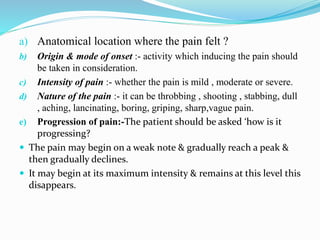
PAIN
 Original Site of pain
 Origin & mode of onset
 Severity
 Nature of pain
 Progression of pain
 Duration of pain
 Movement of pain
 Periodicity of pain
 Effect of functional activity
 Precipitating factors
 Relieving factors
 Associated symptoms
 Treatment taken
a) Anatomical location where the pain felt ?
b) Origin & mode of onset :- activity which inducing the pain should
be taken in consideration.
c) Intensity of pain :- whether the pain is mild , moderate or severe.
d) Nature of the pain :- it can be throbbing , shooting , stabbing, dull
, aching, lancinating, boring, griping, sharp,vague pain.
e) Progression of pain:-The patient should be asked ‘how is it
progressing?
 The pain may begin on a weak note & gradually reach a peak &
then gradually declines.
 It may begin at its maximum intensity & remains at this level this
disappears.
f)Duration of pain-Duration of pain means the period from the time of
onset to the time of pain disappearance.
g)Movement of the pain :- referred, radiating , shifting or migration of
pain.
h)Periodicity of pain-Sometimes an interval of days , weeks , months or
even years may elapse between two painful attack.
i) Effect on functional activity :- the effect of various activity such as
brushing , shaving , washing the face, turning the head , lying down
etc. should be noted.
i)Aggrevating & relieving factor- whether it aggrevates or relieved with
chewing or any other factors.
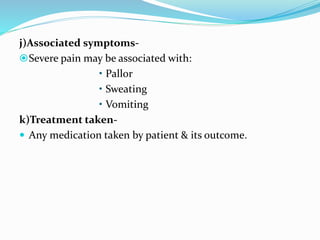
j)Associated symptoms-
Severe pain may be associated with:
• Pallor
• Sweating
• Vomiting
k)Treatment taken-
 Any medication taken by patient & its outcome.
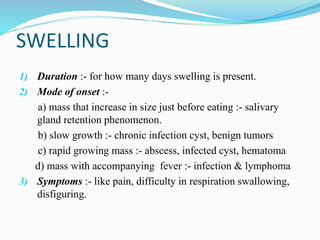
SWELLING
1) Duration :- for how many days swelling is present.
2) Mode of onset :-
a) mass that increase in size just before eating :- salivary
gland retention phenomenon.
b) slow growth :- chronic infection cyst, benign tumors
c) rapid growing mass :- abscess, infected cyst, hematoma
d) mass with accompanying fever :- infection & lymphoma
3) Symptoms :- like pain, difficulty in respiration swallowing,
disfiguring.
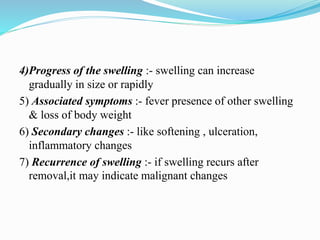
4)Progress of the swelling :- swelling can increase
gradually in size or rapidly
5) Associated symptoms :- fever presence of other swelling
& loss of body weight
6) Secondary changes :- like softening , ulceration,
inflammatory changes
7) Recurrence of swelling :- if swelling recurs after
removal,it may indicate malignant changes
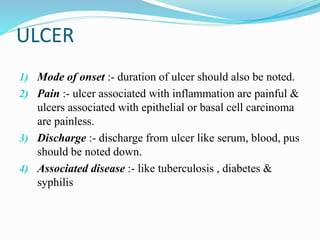
ULCER
1) Mode of onset :- duration of ulcer should also be noted.
2) Pain :- ulcer associated with inflammation are painful &
ulcers associated with epithelial or basal cell carcinoma
are painless.
3) Discharge :- discharge from ulcer like serum, blood, pus
should be noted down.
4) Associated disease :- like tuberculosis , diabetes &
syphilis
PAST DENTAL HISTORY
 Tells investigator about attitude of patient towards dentistry.
 Provides dentist with valuable prognostic and diagnostic
information.
 Frequency of visit to dentist: tells about interest of patient
 Frequency of dental prophylaxsis: helps evaluate periodontal
conditions.
 Past experience following and during LA:
 Past periodontal therapy: helps evaluate present status of
periodontal structures and planning of future treatment.
MEDICAL HISTORY
MEDICAL HISTORY
 The medical history includes the information about past &
present illness.
 Includes:
 Conditions/diseases contraindicated in certain dental treatment.
 Diseases that require special precautions or premedication prior
to dental treatment eg; heamophilia , M.I ,radiation.
 diseases under treatment of a physician with medications that
contraindicates use of additional medications.eg:
anticoagulatens, steroids therapy.
 Diseases endanger the dentist and other patients.
 Medical history usually organized into the following
subdivisions : -
1) Serious or significant illness :-In the dental context, ask
about any history of heart, kidney, liver or lung disease.
History of any infection disease, immunologic disorders
radiation or cancer chemotherapy & psychiatric
treatment.
2) Hospitalization :- a record of hospital admission along
with the history of any major surgery.
3) Transfusion :- a history of blood transfusions, including
the date of each transfusion & the number of transfused
blood units. In some instances ,transfusion can be a
source of a persistent transmissible disease.
All diseases suffered by patient should be recorded in chronological
order.
Check list of medical history-
-Anemia
-Bleeding disorders
-Cardio respiratory disorders
-Drug treatment and allergies
-Endocrine disorders
-Fits and faints
-Gastrointestinal disorders
-Hospital admissions and surgeries
-Infections
-Jaundice
-Kidney disease
4)Allergy :- the patient’s record should document any history of
classic allergic reactions such as urticaria, hay fever, asthma as
well as any other adverse drug reaction.
Events reported by the patient as fainting, stomachache,
weakness ,flushing ,rash etc should be noted.
5) Medications :- an essential component of a medication history
is a record of all the medication a patient is taking.
Identification of medications helps in the recognition of drug
induced disease and oral disorders associated with different
medication.
6) Pregnancy :- knowing whether or not a women of following
age is pregnant is particularly important when deciding to
administer or prescribe any medication & procedure involving
exposure of the pregnant patient to ionization radiation.
Diseases affecting treatment
 Postpone treatment if suffering form acute illness like
mumps or chickenpox.
 Patient with cardiac defects needs to get a physician’s
report patients on anticoagulant therapy.
 If ASTHMATIC then NSAIDs are contraindicated.
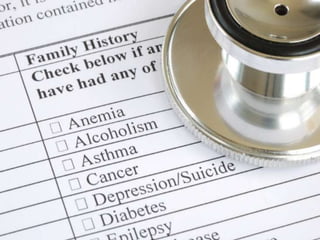
FAMILY HISTORY
 Family members share their genes, as well as their
environment, lifestyles and habits.
 Risks for diseases such as asthma, diabetes, cancer, and
heart disease also run in families.
 There are also several inherited anomalies & abnormalities
that can affect the oral cavity such as congenitally missing
lateral incisors, amelogenesis imperfecta , ectodermal
dysplasia & cleft lip & cleft palate.
 It includes:
 No. of siblings and their age
 Gives an idea about
 -size of family and socioeconomic status
 -whether pt. can afford for time and treatment
 - to know child’s psychology which affects his behavior.
PERSONAL HISTORY
 It includes:-
 Diet history
 Oral hygiene habits
 Oral habits
 Adverse habits
1) DIET :- whether the diet is vegetarian , mixed or spicy
food.
-A 5 day diet diary is recommended.
a) soft diet :- adhere tenaciously to the teeth because of
lack of rough edges leading to more dental caries.
b) coarse diet :- cause more amount of attrition.
c) carbohydrate & vitamin diet :- increase carbohydrate
contents leads to increase risk for dental caries , while
diet deficient in vitamin may cause enamel hypoplasia.
Habits
a)Oral hygiene habit-
-helps determine level of hygiene maintained by pt.
Includes:
-Frequency and method of brushing
-Type of brush and how often it is changed
-Use of other oral hygiene aids.
b) oral habits :- pressure habit like thumb sucking lip sucking
leads to anterior proclination of maxillary incisors.Tongue
thrusting habit leads to anterior n posterior open bite. Mouth
breathing leads to anterior marginal gingivitis & dental caries.
c) Adverse habits :- tobacco, smoking & drinking habit should
be asked as these patient having high risk for cancer
development.
 THUMB SUCKING:
 -Diagnosis:
 History
 Extraoral examination –
 1.Digit – will appear reddened, clean, short nails with
callus formation.
 2. Lip –short, hypotonic upper lip, hyperactive lower
lip.
 Intraoral examination –
 Increased overjet, lingual tipping of lower anteriors.
 Speech problems.
Tongue thrusting
 Note –
 Intensity, duration, frequency and type of tongue thrust
 Extraoral :
 Speech disorders, lip separation
 Intraoral :
 Anterior open bite
 Malocclusion
 Proclination of max. anteriors
 Generalized spacing
 Posterior cross bite
Mouth breathing
 Diagnosis;
 History
 Clinical examination-
 Mirror test
 Cotton test
 Water test
 Rhinomenometry
 Others –
 Lip biting
 Cheek biting
 Nail biting
 Bruxism
 REFERENCES:
 BURKETS ORAL MEDICINE: GREEN BERG, GLICK SHIP- 11TH
EDITION
 PRINCIPAL OF PRACTICAL ORAL MEDICINE & PATIENT
EVALUATION BY PRAMOD JHON R
 CLINICAL MANUAL ON GENERAL SURGERY, S, DAS,3RDEDITION.
THANK YOU

Case history-Abhijeet kamble

  • 1.
    • Presented by- •ABHIJEET KAMBLE FINAL YEAR
  • 2.
    Photo by 2.CASE HISTROYFORMET 3.HISTORY RECORDING
  • 3.
    • A casehistory is defined as a planned professional conversation that enables the patient to communicate his/her symptoms, feelings, fears and sequence of events leading to problem for which the patient seeks professional assistance ,to the clinician so that patient’s real or suspected illness & mental attitude can be determined. DEFINATION:
  • 4.
    Objectives:-  To establisha positive professional relationship.  To provide the clinician with information concerning the patient’s past dental, medical & personal history.  To provide the clinician with the information that may be necessary for making a diagnosis.  To provide information that aids the clinician in making decisions concerning the treatment of the patient.
  • 5.
    COMPONENTS-  General information Chief complaint  History of present illness  Medical history  Past dental history  Personal history  General examination  Extraoral examination  Intraoral examination  Provisional diagnosis  Investigations  Final diagnosis  Treatment plan
  • 6.
    GENERAL INFORMATION  Patientregistration number  Date  Name  Age  Sex  Address  Income  Occupation  Marital status  Religion
  • 7.
     Patient registrationnumber Useful for- 1. maintaining a record, 2. billing purposes, 3. medico legal aspects.  Date Useful for- 1. Time of admission 2. reference during follow up visits 3. Record maintenance.
  • 8.
    NAME  to communicatewith the patient  to establish a rapport with the patient  Record maintenance  Psychological benefits AGE  For diagnosis  Treatment planning  Behavioral management techniques
  • 9.
     DISEASE MORE COMMONLYPRESENT AT BIRTH - Micrognathia - Cleft lip & cleft plate - Ankyloglossia - Predecidous dentition - Teratoma - Hemophilia  DISEASE PRESENT IN CHILDREN & YOUNG ADULTS - Benign migratory glossitis - Juvenile periodontitis - Pemphigus - Recurrent apthous stomatitis - Dental caries - Dentigerous cyst - Diptheria - Rickets - Infectious mononucleosis
  • 10.
    DISEASE PRESENT INADULTS & OLDER PATIENTS - Attrision - Abrasion - Gingival recession - Periodontitis - Lichen planus - Ameloblastoma ( 30 – 50) - Trigeminal neuralgia - Fibroma - Verrucous carcinoma - Iron deficiency anemia - Diabetes - Hypertension - Asthma
  • 11.
     AGE used tocalculate the dose of the drug. CHILD DOSE 1) YOUNG RULE = child’s age adult dose age + 12 2) CLARK RULE child age at next birthday adult dose 24 3) DILLING RULE = age adult dose 20
  • 12.
    SEX SINGNIFICANCE-Certain diseases aregender specific:  Diseases common in males: Attrition, heamophilia,leukolpakia, cancer like squamous cell carcinoma, BCC,melanoma, lymphoma etc  Diseases common in females: Iron deficiency anemia, sjogren’s syndrome, osteoporosis, recurrent apthous ulcers etc  Drug interaction :- in females, special consideration must be given to pregnancy & lactation.
  • 13.
    Gender also helpsanalyze: 1. Treatment planning in case of orthodontics pts as timing of growth spurts is different in males and females. 2. Esthetics: Girls are more conscious about their esthetics. 3. Dosage of drugs:  Females requires low dosage of drugs than males.  Long term use of antihypertensive drugs can lead to impotency in males  Gynecomestia may be caused in males due to madications like;ketoconazole,chlorpromazine 4.Most of the times, sex is linked to occupation and in turn, to occupational hazards.
  • 14.
    EDUCATION  Tells aboutpatient’s attitude  Helps while giving health education and motivation.  INCOME  Helps determine socio-economic status of patient.  Helps to find out affordability towards treatment  Certain diseases are more common in certain socioeconomic status patients
  • 15.
    PERCAPITA INCOME  Totalincome of family divided by total number of family members.  It is the measure of amount of money recived per head by every individual in family of total income
  • 16.
    ADDRESS  For futurecorrespondence/recall  Gives a view of socio-economic status -to know about the nourishment, hygiene & payment capacity of the patient  Prevalence of diseases like fluorosis as a result of increase level of fluorides in water are spread differently in various parts of the country.  For hospital records/administrative purposes. .
  • 17.
     OCCUPATION  Toasses the socioeconomic status.  Predilection of diseases in different occupations for eg: hepatitis B is common in dentists & surgeons.  Bakers, candy makers ---- caries  Bismuth handlers ----- blue pigmentation of gingiva  Musicians, carpenters ----- localized abrasion  Also helps in planning appointments as per occupation and also determines their affordability.
  • 18.
     MARITAL STATUS To see any history of consanguineous marriages.  The high consanguinity rates, coupled by the large family size in some communities, could induce the expression of autosomal recessive diseases.
  • 19.
    RELIGION  Identifying thefestival periods when religious people are reluctant to undergo treatment procedures.  Predilection of diseases in specific religion.
  • 20.
    CHIEF COMPLAINT  Thechief complaint is established by asking patient to describe problem for which he/she is seeking treatment or help.  It is stated in patient’s own words in chronological order of their appearance & their severity.  The chief complaint aids in diagnosis & treatment therefore should be given utmost priority.
  • 21.
    COMMON CHIEF COMPLAINTS Pain  Swelling  Ulcer  Loose teeth  Hypersensitivity
  • 22.
    HISTORY OF PRESENTILLNESS  Elaborate on the chief complaint in detail  Ask relevant associated symptoms  The symptoms can be elaborated in terms of:-  Mode & cause of onset  Duration  Location-localized ,diffuse ,referred, radiating.  Progression- continous or intermittent.  Aggravating & relieving factors  Treatment taken
  • 23.
    PAIN  Original Siteof pain  Origin & mode of onset  Severity  Nature of pain  Progression of pain  Duration of pain  Movement of pain  Periodicity of pain  Effect of functional activity  Precipitating factors  Relieving factors  Associated symptoms  Treatment taken
  • 24.
    a) Anatomical locationwhere the pain felt ? b) Origin & mode of onset :- activity which inducing the pain should be taken in consideration. c) Intensity of pain :- whether the pain is mild , moderate or severe. d) Nature of the pain :- it can be throbbing , shooting , stabbing, dull , aching, lancinating, boring, griping, sharp,vague pain. e) Progression of pain:-The patient should be asked ‘how is it progressing?  The pain may begin on a weak note & gradually reach a peak & then gradually declines.  It may begin at its maximum intensity & remains at this level this disappears.
  • 25.
    f)Duration of pain-Durationof pain means the period from the time of onset to the time of pain disappearance. g)Movement of the pain :- referred, radiating , shifting or migration of pain. h)Periodicity of pain-Sometimes an interval of days , weeks , months or even years may elapse between two painful attack. i) Effect on functional activity :- the effect of various activity such as brushing , shaving , washing the face, turning the head , lying down etc. should be noted. i)Aggrevating & relieving factor- whether it aggrevates or relieved with chewing or any other factors.
  • 26.
    j)Associated symptoms- Severe painmay be associated with: • Pallor • Sweating • Vomiting k)Treatment taken-  Any medication taken by patient & its outcome.
  • 27.
    SWELLING 1) Duration :-for how many days swelling is present. 2) Mode of onset :- a) mass that increase in size just before eating :- salivary gland retention phenomenon. b) slow growth :- chronic infection cyst, benign tumors c) rapid growing mass :- abscess, infected cyst, hematoma d) mass with accompanying fever :- infection & lymphoma 3) Symptoms :- like pain, difficulty in respiration swallowing, disfiguring.
  • 28.
    4)Progress of theswelling :- swelling can increase gradually in size or rapidly 5) Associated symptoms :- fever presence of other swelling & loss of body weight 6) Secondary changes :- like softening , ulceration, inflammatory changes 7) Recurrence of swelling :- if swelling recurs after removal,it may indicate malignant changes
  • 29.
    ULCER 1) Mode ofonset :- duration of ulcer should also be noted. 2) Pain :- ulcer associated with inflammation are painful & ulcers associated with epithelial or basal cell carcinoma are painless. 3) Discharge :- discharge from ulcer like serum, blood, pus should be noted down. 4) Associated disease :- like tuberculosis , diabetes & syphilis
  • 30.
    PAST DENTAL HISTORY Tells investigator about attitude of patient towards dentistry.  Provides dentist with valuable prognostic and diagnostic information.  Frequency of visit to dentist: tells about interest of patient  Frequency of dental prophylaxsis: helps evaluate periodontal conditions.  Past experience following and during LA:  Past periodontal therapy: helps evaluate present status of periodontal structures and planning of future treatment.
  • 31.
  • 32.
    MEDICAL HISTORY  Themedical history includes the information about past & present illness.  Includes:  Conditions/diseases contraindicated in certain dental treatment.  Diseases that require special precautions or premedication prior to dental treatment eg; heamophilia , M.I ,radiation.  diseases under treatment of a physician with medications that contraindicates use of additional medications.eg: anticoagulatens, steroids therapy.  Diseases endanger the dentist and other patients.
  • 33.
     Medical historyusually organized into the following subdivisions : - 1) Serious or significant illness :-In the dental context, ask about any history of heart, kidney, liver or lung disease. History of any infection disease, immunologic disorders radiation or cancer chemotherapy & psychiatric treatment. 2) Hospitalization :- a record of hospital admission along with the history of any major surgery. 3) Transfusion :- a history of blood transfusions, including the date of each transfusion & the number of transfused blood units. In some instances ,transfusion can be a source of a persistent transmissible disease.
  • 34.
    All diseases sufferedby patient should be recorded in chronological order. Check list of medical history- -Anemia -Bleeding disorders -Cardio respiratory disorders -Drug treatment and allergies -Endocrine disorders -Fits and faints -Gastrointestinal disorders -Hospital admissions and surgeries -Infections -Jaundice -Kidney disease
  • 35.
    4)Allergy :- thepatient’s record should document any history of classic allergic reactions such as urticaria, hay fever, asthma as well as any other adverse drug reaction. Events reported by the patient as fainting, stomachache, weakness ,flushing ,rash etc should be noted. 5) Medications :- an essential component of a medication history is a record of all the medication a patient is taking. Identification of medications helps in the recognition of drug induced disease and oral disorders associated with different medication. 6) Pregnancy :- knowing whether or not a women of following age is pregnant is particularly important when deciding to administer or prescribe any medication & procedure involving exposure of the pregnant patient to ionization radiation.
  • 36.
    Diseases affecting treatment Postpone treatment if suffering form acute illness like mumps or chickenpox.  Patient with cardiac defects needs to get a physician’s report patients on anticoagulant therapy.  If ASTHMATIC then NSAIDs are contraindicated.
  • 38.
    FAMILY HISTORY  Familymembers share their genes, as well as their environment, lifestyles and habits.  Risks for diseases such as asthma, diabetes, cancer, and heart disease also run in families.  There are also several inherited anomalies & abnormalities that can affect the oral cavity such as congenitally missing lateral incisors, amelogenesis imperfecta , ectodermal dysplasia & cleft lip & cleft palate.
  • 39.
     It includes: No. of siblings and their age  Gives an idea about  -size of family and socioeconomic status  -whether pt. can afford for time and treatment  - to know child’s psychology which affects his behavior.
  • 40.
    PERSONAL HISTORY  Itincludes:-  Diet history  Oral hygiene habits  Oral habits  Adverse habits
  • 41.
    1) DIET :-whether the diet is vegetarian , mixed or spicy food. -A 5 day diet diary is recommended. a) soft diet :- adhere tenaciously to the teeth because of lack of rough edges leading to more dental caries. b) coarse diet :- cause more amount of attrition. c) carbohydrate & vitamin diet :- increase carbohydrate contents leads to increase risk for dental caries , while diet deficient in vitamin may cause enamel hypoplasia.
  • 42.
    Habits a)Oral hygiene habit- -helpsdetermine level of hygiene maintained by pt. Includes: -Frequency and method of brushing -Type of brush and how often it is changed -Use of other oral hygiene aids. b) oral habits :- pressure habit like thumb sucking lip sucking leads to anterior proclination of maxillary incisors.Tongue thrusting habit leads to anterior n posterior open bite. Mouth breathing leads to anterior marginal gingivitis & dental caries. c) Adverse habits :- tobacco, smoking & drinking habit should be asked as these patient having high risk for cancer development.
  • 43.
     THUMB SUCKING: -Diagnosis:  History  Extraoral examination –  1.Digit – will appear reddened, clean, short nails with callus formation.  2. Lip –short, hypotonic upper lip, hyperactive lower lip.  Intraoral examination –  Increased overjet, lingual tipping of lower anteriors.  Speech problems.
  • 44.
    Tongue thrusting  Note–  Intensity, duration, frequency and type of tongue thrust  Extraoral :  Speech disorders, lip separation  Intraoral :  Anterior open bite  Malocclusion  Proclination of max. anteriors  Generalized spacing  Posterior cross bite
  • 45.
    Mouth breathing  Diagnosis; History  Clinical examination-  Mirror test  Cotton test  Water test  Rhinomenometry
  • 46.
     Others – Lip biting  Cheek biting  Nail biting  Bruxism
  • 47.
     REFERENCES:  BURKETSORAL MEDICINE: GREEN BERG, GLICK SHIP- 11TH EDITION  PRINCIPAL OF PRACTICAL ORAL MEDICINE & PATIENT EVALUATION BY PRAMOD JHON R  CLINICAL MANUAL ON GENERAL SURGERY, S, DAS,3RDEDITION.
  • 48.