CASE
HISTORY
A. Suma Madhuri
Intern
INTRODUCTION
 Case history is an important and integral part of the treatment, a treatment of the disease
or condition starts with its proper diagnosis and this can be done successfully only by
taking down on a paper.
 Aimed to arrive at accurate diagnosis .
DEFINITION
 Case history is defined as a planned professional conversation between the patient and
clinician where the patient expresses his symptoms, fears and feelings to the clinician so
that the nature of real and suspected illness and mental attitude may be determined.
- Malcolm A Lynch
objective's
 I. To establish a positive professional relationship.
 2. To provide the dentist with information concerning the patient's past and present
medical, dental, and personal history.
 3. To provide the dentist with information that may be necessary for making a diagnosis
 4. To provide information that aids the dentist in making decisions concerning
treatment.
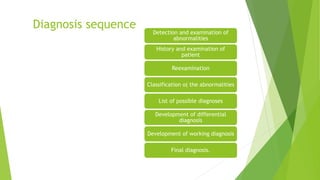
Diagnosis sequence
Detection and examination of
abnormalities
History and examination of
patient
Reexamination
Classification o( the abnormalities
List of possible diagnoses
Development of differential
diagnosis
Development of working diagnosis
Final diagnosis.
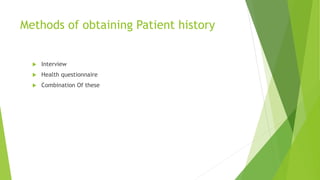
Methods of obtaining Patient history
 Interview
 Health questionnaire
 Combination Of these
COMPONENTS
 DEMOGRAPHIC DATA
 CHIEF COMPLAINT
 HISTORY OF PRESENT ILLNESS
 MEDICAL HISTORY
 DENTAL HSTORY
 FAMILY HISTRY
ENERAL EXAMINATION
• EXTRA ORAL EXAMINATION
• INTRA ORAL EXAMINATION
• PROVISIONAL DIAGNOSIS
• INVESTIGATIONS
• FINAL DIAGNOSIS
• TREATMENT PLAN
Demographic data
 Patient Registration Number
 Date
 Name
 Age
 Sex
 Address
 Occupation
 Marital Status
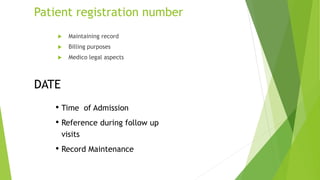
Patient registration number
 Maintaining record
 Billing purposes
 Medico legal aspects
• Time of Admission
• Reference during follow up
visits
• Record Maintenance
DATE
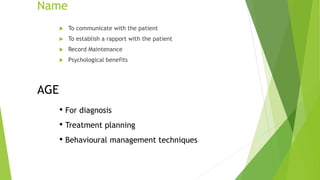
Name
 To communicate with the patient
 To establish a rapport with the patient
 Record Maintenance
 Psychological benefits
• For diagnosis
• Treatment planning
• Behavioural management techniques
AGE
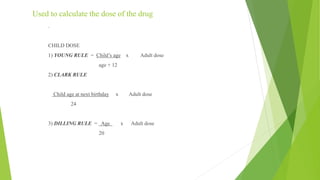
Used to calculate the dose of the drug
.
CHILD DOSE
1) YOUNG RULE = Child’s age x Adult dose
age + 12
2) CLARK RULE
Child age at next birthday x Adult dose
24
3) DILLING RULE = Age x Adult dose
20
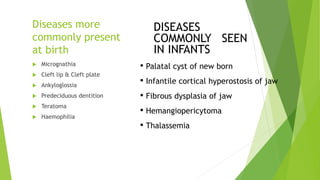
Diseases more
commonly present
at birth
 Micrognathia
 Cleft lip & Cleft plate
 Ankyloglossia
 Predeciduous dentition
 Teratoma
 Haemophilia
DISEASES
COMMONLY SEEN
IN INFANTS
• Palatal cyst of new born
• Infantile cortical hyperostosis of jaw
• Fibrous dysplasia of jaw
• Hemangiopericytoma
• Thalassemia
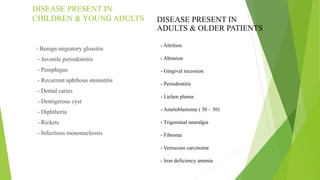
DISEASE PRESENT IN
CHILDREN & YOUNG ADULTS
- Benign migratory glossitis
- Juvenile periodontitis
- Pemphigus
- Recurrent aphthous stomatitis
- Dental caries
- Dentigerous cyst
- Diphtheria
- Rickets
- Infectious mononucleosis
- Attrition
- Abrasion
- Gingival recession
- Periodontitis
- Lichen planus
- Ameloblastoma ( 30 – 50)
- Trigeminal neuralgia
- Fibroma
- Verrucous carcinoma
- Iron deficiency anemia
DISEASE PRESENT IN
ADULTS & OLDER PATIENTS
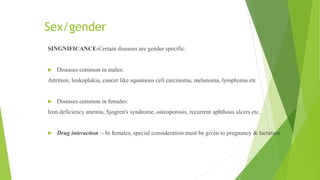
Sex/gender
SINGNIFICANCE-Certain diseases are gender specific:
 Diseases common in males:
Attrition, leukoplakia, cancer like squamous cell carcinoma, melanoma, lymphoma etc
 Diseases common in females:
Iron deficiency anemia, Sjogren's syndrome, osteoporosis, recurrent aphthous ulcers etc.
 Drug interaction :- In females, special consideration must be given to pregnancy & lactation.
address
 For future correspondence
 Gives a view of socio-economic status -to know about the nourishment, hygiene & payment capacity
of the patient
 Prevalence of diseases like fluorosis as a result of increase level of fluorides in water are spread
differently in various parts of the country.
 Dental caries is more common in the industrial areas where as periodontal diseases are more common
in rural areas.
OCCUPATION
 To asses the socioeconomic status.
 Predilection of diseases in different occupations
 E.g.: Hepatitis B is common in dentists & surgeons , blood bank personnel.
 Attrition - Seen in workers exposed to an atmosphere of abrasive dust.
 Gingival staining – Seen in people who works with lead, bismuth and
cadmium.
Chief complaint
 It is usually the reason for the patients visit which is established by asking the patient
 Should be stated in patients own words
 Record in chronological order of their appearance and in the order of their severity
 It aids in the diagnosis and treatment planning and should be given the first priority
 Pain
 Swelling
 Bleeding sensation
 Sores
 Loose teeth
 Delayed tooth eruption
 Dry mouth
 Excessive salivation
 Halitosis
 Paresthesia/ numbness
Common chief complaints
are
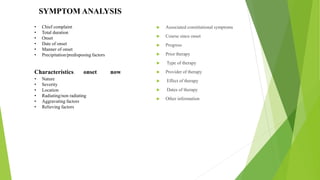
 Associated constitutional symptoms
 Course since onset
 Progress
 Prior therapy
 Type of therapy
 Provider of therapy
 Effect of therapy
 Dates of therapy
 Other information
• Chief complaint
• Total duration
• Onset
• Date of onset
• Manner of onset
• Precipitation/predisposing factors
Characteristics: onset now
• Nature
• Severity
• Location
• Radiating/non radiating
• Aggravating factors
• Relieving factors
SYMPTOM ANALYSIS
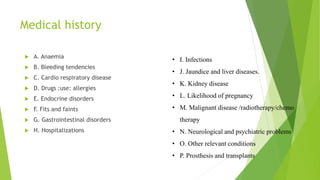
Medical history
 A. Anaemia
 B. Bleeding tendencies
 C. Cardio respiratory disease
 D. Drugs :use: allergies
 E. Endocrine disorders
 F. Fits and faints
 G. Gastrointestinal disorders
 H. Hospitalizations
• I. Infections
• J. Jaundice and liver diseases.
• K. Kidney disease
• L. Likelihood of pregnancy
• M. Malignant disease /radiotherapy/chemo
therapy
• N. Neurological and psychiatric problems
• O. Other relevant conditions
• P. Prosthesis and transplants
Dental history
 Gives the attitude of the patient towards dentistry
 Gives general view about how the patient is aware about pursuing oral health
 If the history of bad experience is present, then the molding behavior is done during
behavior management techniques
 Significant knowledge can be drawn about patients previous treatment, procedures
and can be helpful towards present situation
Family history
 Family members share their genes, as well as their environment, lifestyles and habits.
 Risks for diseases such as asthma, diabetes, cancer, and heart disease also run in families.
 There are also several inherited anomalies & abnormalities that can affect the oral cavity
such as congenitally missing lateral incisors, amelogenesis imperfecta, ectodermal dysplasia &
cleft lip & cleft palate.
Personal history
HABITS: A tendency towards an act that has become repeated performance relatively
fixed, consistent, easy to perform by any individual
Various types of habits:
 Personal habits
 Para functional habits
 Adverse habits
 Masochistic habits/ self destructive habits
Personal history
Patient’s appetite includes diet:
 Bowel and micturition habit
 Sleep
 Social status
 Menstrual and obstetric history
 Marital history.
Case history

Case history

  • 1.
  • 2.
    INTRODUCTION  Case historyis an important and integral part of the treatment, a treatment of the disease or condition starts with its proper diagnosis and this can be done successfully only by taking down on a paper.  Aimed to arrive at accurate diagnosis .
  • 3.
    DEFINITION  Case historyis defined as a planned professional conversation between the patient and clinician where the patient expresses his symptoms, fears and feelings to the clinician so that the nature of real and suspected illness and mental attitude may be determined. - Malcolm A Lynch
  • 4.
    objective's  I. Toestablish a positive professional relationship.  2. To provide the dentist with information concerning the patient's past and present medical, dental, and personal history.  3. To provide the dentist with information that may be necessary for making a diagnosis  4. To provide information that aids the dentist in making decisions concerning treatment.
  • 5.
    Diagnosis sequence Detection andexamination of abnormalities History and examination of patient Reexamination Classification o( the abnormalities List of possible diagnoses Development of differential diagnosis Development of working diagnosis Final diagnosis.
  • 6.
    Methods of obtainingPatient history  Interview  Health questionnaire  Combination Of these
  • 7.
    COMPONENTS  DEMOGRAPHIC DATA CHIEF COMPLAINT  HISTORY OF PRESENT ILLNESS  MEDICAL HISTORY  DENTAL HSTORY  FAMILY HISTRY ENERAL EXAMINATION • EXTRA ORAL EXAMINATION • INTRA ORAL EXAMINATION • PROVISIONAL DIAGNOSIS • INVESTIGATIONS • FINAL DIAGNOSIS • TREATMENT PLAN
  • 8.
    Demographic data  PatientRegistration Number  Date  Name  Age  Sex  Address  Occupation  Marital Status
  • 9.
    Patient registration number Maintaining record  Billing purposes  Medico legal aspects • Time of Admission • Reference during follow up visits • Record Maintenance DATE
  • 10.
    Name  To communicatewith the patient  To establish a rapport with the patient  Record Maintenance  Psychological benefits • For diagnosis • Treatment planning • Behavioural management techniques AGE
  • 11.
    Used to calculatethe dose of the drug . CHILD DOSE 1) YOUNG RULE = Child’s age x Adult dose age + 12 2) CLARK RULE Child age at next birthday x Adult dose 24 3) DILLING RULE = Age x Adult dose 20
  • 12.
    Diseases more commonly present atbirth  Micrognathia  Cleft lip & Cleft plate  Ankyloglossia  Predeciduous dentition  Teratoma  Haemophilia DISEASES COMMONLY SEEN IN INFANTS • Palatal cyst of new born • Infantile cortical hyperostosis of jaw • Fibrous dysplasia of jaw • Hemangiopericytoma • Thalassemia
  • 13.
    DISEASE PRESENT IN CHILDREN& YOUNG ADULTS - Benign migratory glossitis - Juvenile periodontitis - Pemphigus - Recurrent aphthous stomatitis - Dental caries - Dentigerous cyst - Diphtheria - Rickets - Infectious mononucleosis - Attrition - Abrasion - Gingival recession - Periodontitis - Lichen planus - Ameloblastoma ( 30 – 50) - Trigeminal neuralgia - Fibroma - Verrucous carcinoma - Iron deficiency anemia DISEASE PRESENT IN ADULTS & OLDER PATIENTS
  • 14.
    Sex/gender SINGNIFICANCE-Certain diseases aregender specific:  Diseases common in males: Attrition, leukoplakia, cancer like squamous cell carcinoma, melanoma, lymphoma etc  Diseases common in females: Iron deficiency anemia, Sjogren's syndrome, osteoporosis, recurrent aphthous ulcers etc.  Drug interaction :- In females, special consideration must be given to pregnancy & lactation.
  • 15.
    address  For futurecorrespondence  Gives a view of socio-economic status -to know about the nourishment, hygiene & payment capacity of the patient  Prevalence of diseases like fluorosis as a result of increase level of fluorides in water are spread differently in various parts of the country.  Dental caries is more common in the industrial areas where as periodontal diseases are more common in rural areas.
  • 16.
    OCCUPATION  To assesthe socioeconomic status.  Predilection of diseases in different occupations  E.g.: Hepatitis B is common in dentists & surgeons , blood bank personnel.  Attrition - Seen in workers exposed to an atmosphere of abrasive dust.  Gingival staining – Seen in people who works with lead, bismuth and cadmium.
  • 17.
    Chief complaint  Itis usually the reason for the patients visit which is established by asking the patient  Should be stated in patients own words  Record in chronological order of their appearance and in the order of their severity  It aids in the diagnosis and treatment planning and should be given the first priority
  • 18.
     Pain  Swelling Bleeding sensation  Sores  Loose teeth  Delayed tooth eruption  Dry mouth  Excessive salivation  Halitosis  Paresthesia/ numbness Common chief complaints are
  • 19.
     Associated constitutionalsymptoms  Course since onset  Progress  Prior therapy  Type of therapy  Provider of therapy  Effect of therapy  Dates of therapy  Other information • Chief complaint • Total duration • Onset • Date of onset • Manner of onset • Precipitation/predisposing factors Characteristics: onset now • Nature • Severity • Location • Radiating/non radiating • Aggravating factors • Relieving factors SYMPTOM ANALYSIS
  • 20.
    Medical history  A.Anaemia  B. Bleeding tendencies  C. Cardio respiratory disease  D. Drugs :use: allergies  E. Endocrine disorders  F. Fits and faints  G. Gastrointestinal disorders  H. Hospitalizations • I. Infections • J. Jaundice and liver diseases. • K. Kidney disease • L. Likelihood of pregnancy • M. Malignant disease /radiotherapy/chemo therapy • N. Neurological and psychiatric problems • O. Other relevant conditions • P. Prosthesis and transplants
  • 21.
    Dental history  Givesthe attitude of the patient towards dentistry  Gives general view about how the patient is aware about pursuing oral health  If the history of bad experience is present, then the molding behavior is done during behavior management techniques  Significant knowledge can be drawn about patients previous treatment, procedures and can be helpful towards present situation
  • 22.
    Family history  Familymembers share their genes, as well as their environment, lifestyles and habits.  Risks for diseases such as asthma, diabetes, cancer, and heart disease also run in families.  There are also several inherited anomalies & abnormalities that can affect the oral cavity such as congenitally missing lateral incisors, amelogenesis imperfecta, ectodermal dysplasia & cleft lip & cleft palate.
  • 23.
    Personal history HABITS: Atendency towards an act that has become repeated performance relatively fixed, consistent, easy to perform by any individual Various types of habits:  Personal habits  Para functional habits  Adverse habits  Masochistic habits/ self destructive habits
  • 24.
    Personal history Patient’s appetiteincludes diet:  Bowel and micturition habit  Sleep  Social status  Menstrual and obstetric history  Marital history.