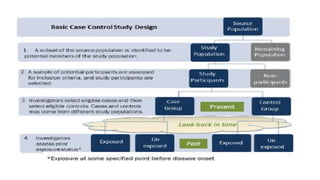
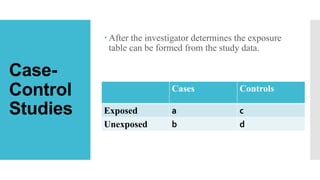
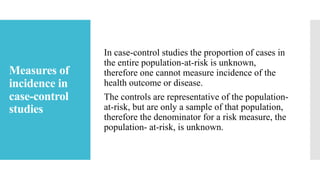
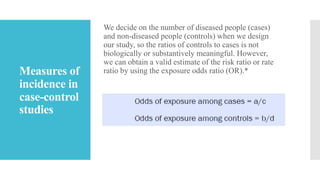
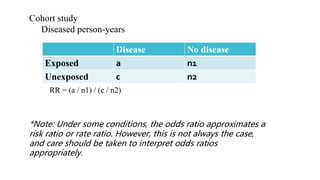
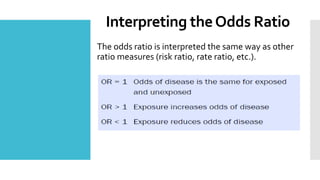
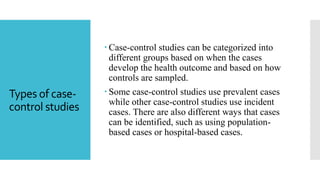
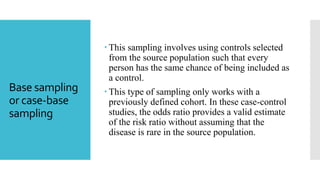
Case-control studies aim to determine if an exposure is associated with a specific disease by comparing the proportion of exposed and unexposed individuals among cases and controls. Cases are individuals who have the disease of interest, while controls are randomly selected individuals without the disease. The odds ratio from a case-control study provides a valid estimate of the risk ratio if incidence density sampling is used to select controls, who are representative of the population at risk. Careful selection of appropriate cases and controls is important for obtaining valid results in case-control studies.