Amity School Of Architecture & Planning
Amity University, Uttar Pradesh
Sustainability – Masdar City, Abu Dhabi (U.A.E)
Jatin Garg
B.PLAN (2011-15)
Overview
 Sustainability
 Principles of Sustainability
 Introduction to Masdar City
 Land Use Plan
 Design & Plan
 Energy Management
 Water Management
 Transportation
 Construction
 Landscaping
 Conclusion
Sustainability… capacity to endure
• The term describes how biological
systems remain diverse and
productive over time.
• Sustainable development, basically,
refers to the development that
takes place without effecting the
needs of future generation.
• A sustainable city (eco-city) is a city
designed with consideration of
environmental impact, inhabited by
people dedicated to minimization
of required inputs of energy, water
and food, and waste output of
heat, air pollution - CO2, methane,
and water pollution.
Sustainable Principles
Masdar (the source)
• Masdar City is an arcology project in Abu Dhabi, in the U.A.E.
• It is being built by Masdar (Abu Dhabi Future Energy Company) &
planned to be completed by 2030.
• Designed by the British architectural firm Foster and Partners and
engineering and environmental consultancy Mott MacDonald, the city
will rely entirely on solar energy and other renewable energy sources,
with a zero waste ecology.
• The city is designed to be a hub for cleantech companies.
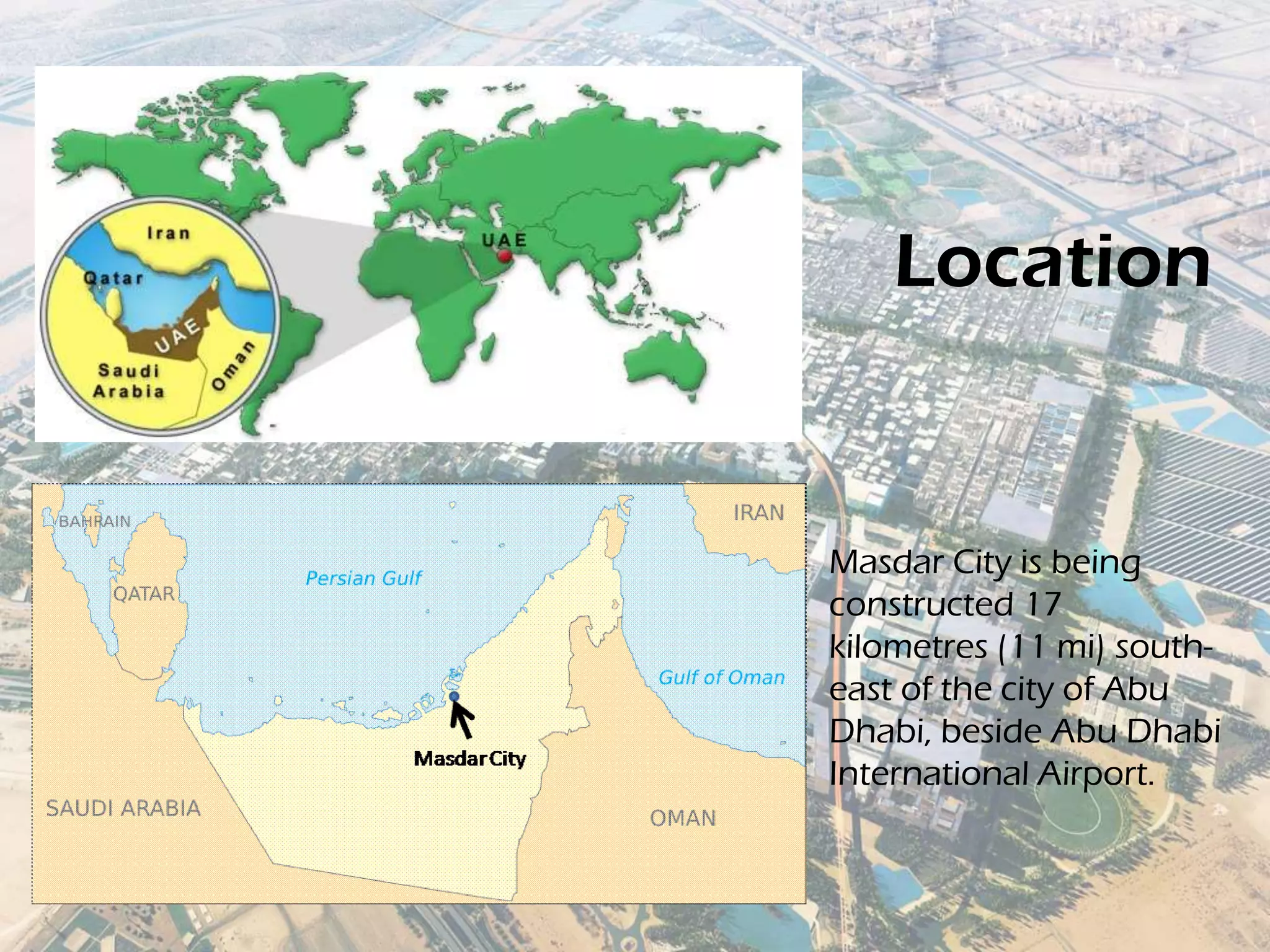
Location
Masdar City is being
constructed 17
kilometres (11 mi) south-
east of the city of Abu
Dhabi, beside Abu Dhabi
International Airport.
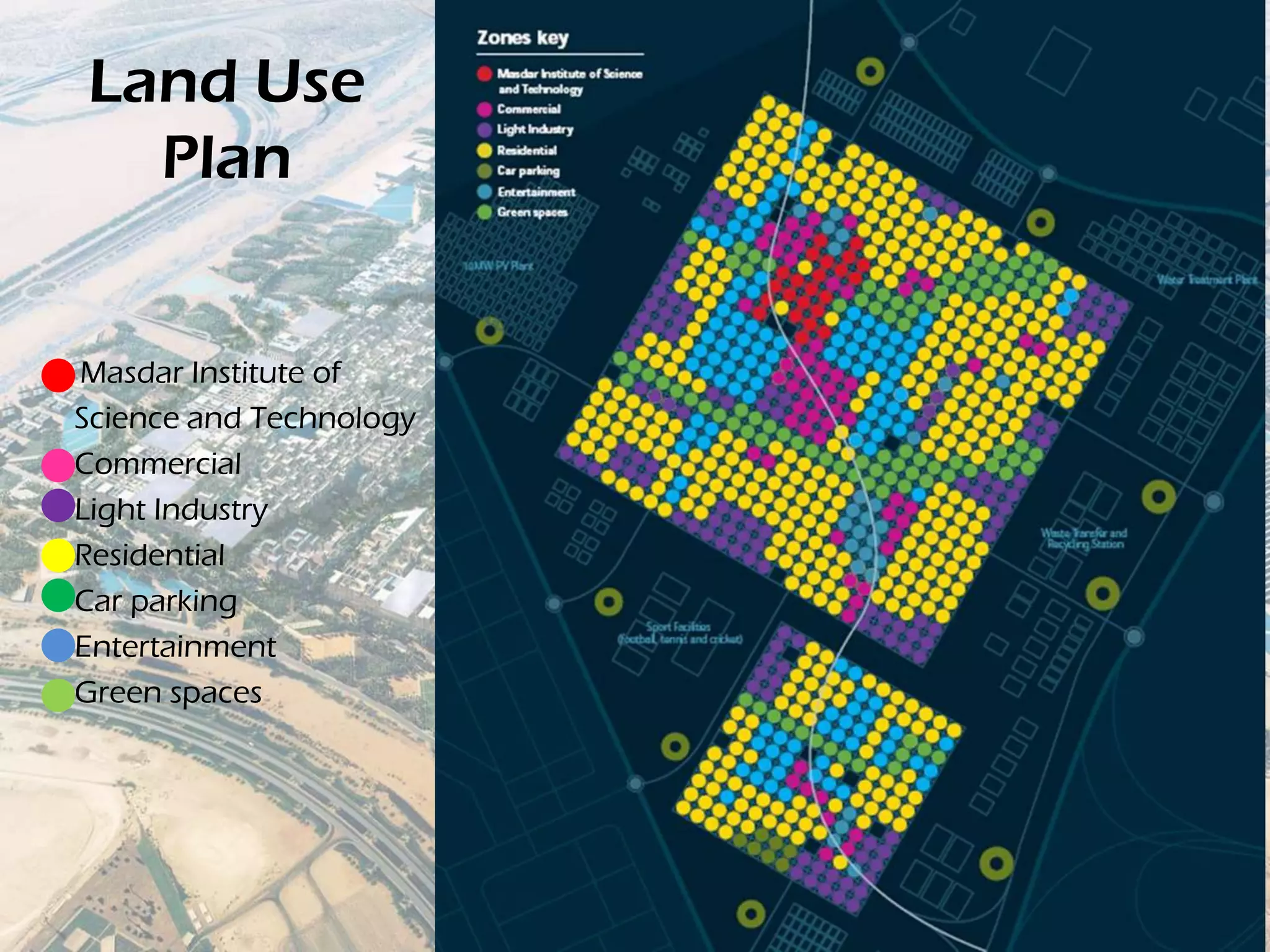
Land Use
Plan
- Masdar Institute of
Science and Technology
- Commercial
- Light Industry
- Residential
- Car parking
- Entertainment
- Green spaces
Design & Plan
• Planners recognised that the biggest environmental gains come from
some of the most passive, and least expensive, tools: the city’s (and
buildings’) orientation (with regards to the sun and prevailing winds)
and its form.
• Next most effective is building performance optimisation, such as an
efficient envelope and systems, and smart building management.
• Active controls, such as renewable energy, are the most expensive,
while offering the lowest relative environment-impact returns. That’s
why designers first concentrated on orientation and performance
optimisation, thereby reducing a large amount of energy demand with
little cost, and only subsequently looked at what active controls could
be implemented.
Masdar City minimises energy consumption by deploying best
commercially available international energy efficient techniques and
setting stringent building efficiency guidelines in areas such as
• insulation,
• low-energy lighting specifications,
• the percentage of glazing (i.e., windows)
• optimizing natural light,
• installing smart appliances, ex: building management systems
• a citywide energy management system that interacts to manage the
electrical load on the grid – all along the system, from the utility to
the consumer.
Energy Management
Savings
• Energy efficient
design
• Energy generation
from renewable
resources
• Waste converted to
energy
• Transportation
• Sequestration
• 100% Powered by
renewable energy
• 170 MW
Photovoltaics
• <30 KW per capita
per day energy use
• (9x less than USA)
Water
Management
• Masdar city’s water needs are less
than half of a city like Abu Dhabi i.e.
145 ltr/person/day as compared to
350 ltr/person/day BAU.
• However, this does not include
water required for district cooling,
which could double the amount of
water required by the city.
• To achieve these lower
consumption figures, the city is
using highly efficient fittings, fixtures
and appliances, smart water metres
that inform consumers of their
consumption, and smart metres to
identify leakage across the system
are already in use.
• Master plan was to desalinate
groundwater with solar energy, but
for now water is piped in from one
of Abu Dhabi's gas-fired, high-
energy, desalination plants.
Water Grid
Water Grid
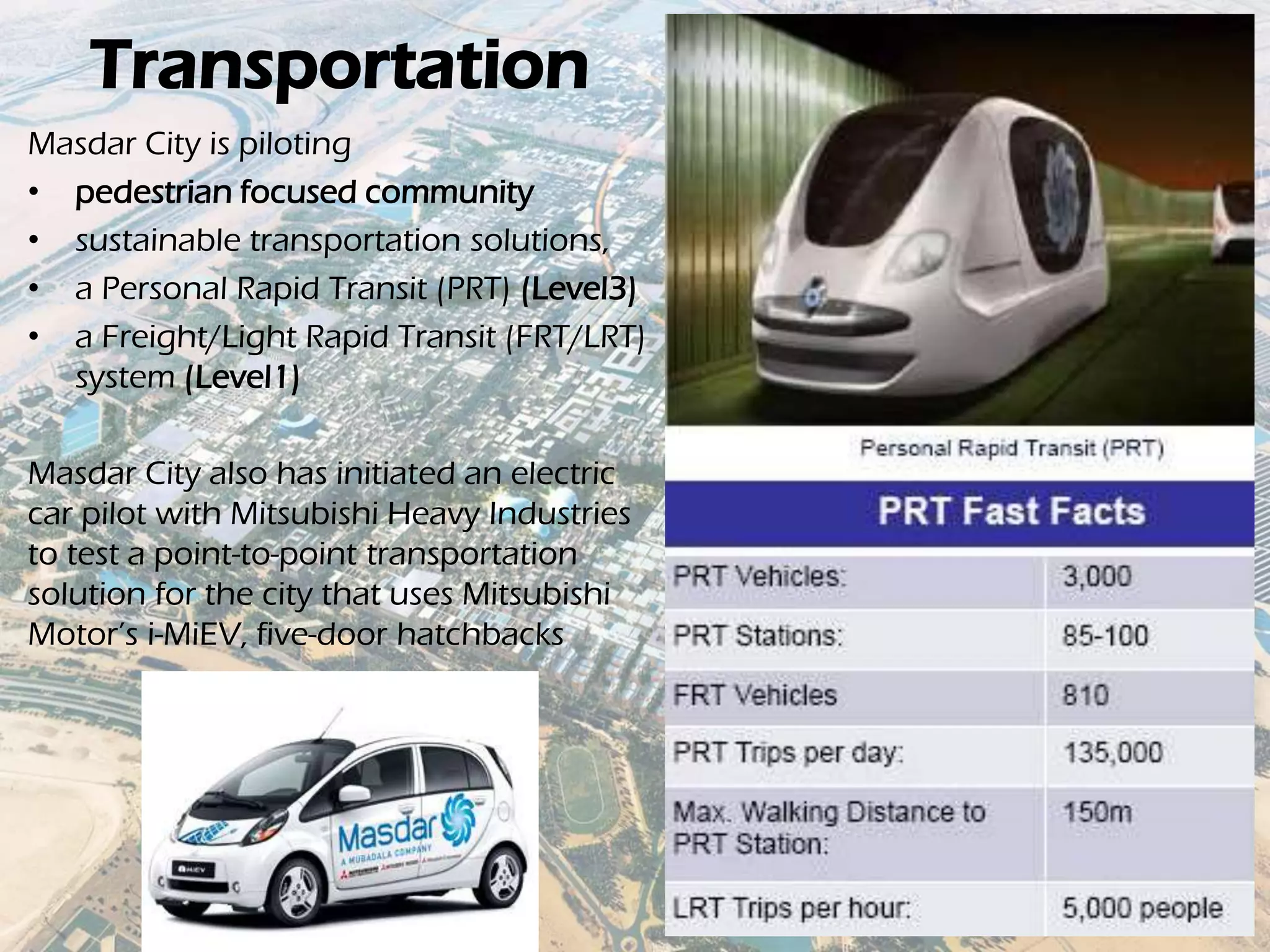
Masdar City is piloting
• pedestrian focused community
• sustainable transportation solutions,
• a Personal Rapid Transit (PRT) (Level3)
• a Freight/Light Rapid Transit (FRT/LRT)
system (Level1)
Masdar City also has initiated an electric
car pilot with Mitsubishi Heavy Industries
to test a point-to-point transportation
solution for the city that uses Mitsubishi
Motor’s i-MiEV, five-door hatchbacks
Transportation
Circulation Map
Construction Material
• Water-based paints that
have no volatile organic
compound, which harm
human health
• Reinforcing bars made of
100% recycled steel
• Green concrete that used ground
granulated blasted slag to replace
cement, resulting in a reduction
of the concrete carbon footprint
by 30-40% of CO2
• The houses and shops
have thick walls made of
dried coral and gypsum
that absorb heat during
the day, releasing it slowly
at night.
• 100% sustainably sourced
timber
• 90% recycled-content
aluminium used for the inner
façade
Landscaping
• Balanced land use with high
density living,
• Vernacular based landscape
strategy using local species for
reduced irrigation demands,
• Consolidated open spaces and
recreational areas
• Vegetation landscapes will create
a habitat for endangered species
and generate air movement to
public areas
• Vertical farming is to
minimize transport and
food chilling emissions –
fresh vegetables fruit and
grains will be grown in
specially designed
greenhouses and
attached farms.
• Entire project has been
constructed on a north -
east axis – which offers
the best options for
naturally utilizing
shading and breezes.
• A diagonal orientation
Narrow streets and
shaded alleyways
minimize solar gain and
glare
Present Construction Scenario
Projected Views
• At the moment, it seems like a
theme park for the rich. In
order to be Sustainable, it
should also justify itself
financially.
• The result feels a bit like
Disneyland. Mr. Foster
acknowledged “Disneyland is
attractive because all the
service is below ground. We
do the same here — it is
literally a walled city.
Traditional cars are stopped at
the edges.”
Conclusion
• The new development, being
built on the outskirts of Abu
Dhabi city, will run almost
entirely on energy from the
sun and will use just 20
percent as much power as a
conventional city of similar size.
• Masdar City will eventually be
a base for international
companies, academics and
researchers and marketers.
• Planners predict that the
development will attract 1,500
clean-tech businesses, ranging
from large international
corporations to startups, and
eventually some 50,000
residents.
thank you…

Masdar City

  • 1.
    Amity School OfArchitecture & Planning Amity University, Uttar Pradesh Sustainability – Masdar City, Abu Dhabi (U.A.E) Jatin Garg B.PLAN (2011-15)
  • 2.
    Overview  Sustainability  Principlesof Sustainability  Introduction to Masdar City  Land Use Plan  Design & Plan  Energy Management  Water Management  Transportation  Construction  Landscaping  Conclusion
  • 3.
    Sustainability… capacity toendure • The term describes how biological systems remain diverse and productive over time. • Sustainable development, basically, refers to the development that takes place without effecting the needs of future generation. • A sustainable city (eco-city) is a city designed with consideration of environmental impact, inhabited by people dedicated to minimization of required inputs of energy, water and food, and waste output of heat, air pollution - CO2, methane, and water pollution.
  • 4.
  • 5.
    Masdar (the source) •Masdar City is an arcology project in Abu Dhabi, in the U.A.E. • It is being built by Masdar (Abu Dhabi Future Energy Company) & planned to be completed by 2030. • Designed by the British architectural firm Foster and Partners and engineering and environmental consultancy Mott MacDonald, the city will rely entirely on solar energy and other renewable energy sources, with a zero waste ecology. • The city is designed to be a hub for cleantech companies.
  • 6.
    Location Masdar City isbeing constructed 17 kilometres (11 mi) south- east of the city of Abu Dhabi, beside Abu Dhabi International Airport.
  • 7.
    Land Use Plan - MasdarInstitute of Science and Technology - Commercial - Light Industry - Residential - Car parking - Entertainment - Green spaces
  • 8.
    Design & Plan •Planners recognised that the biggest environmental gains come from some of the most passive, and least expensive, tools: the city’s (and buildings’) orientation (with regards to the sun and prevailing winds) and its form. • Next most effective is building performance optimisation, such as an efficient envelope and systems, and smart building management. • Active controls, such as renewable energy, are the most expensive, while offering the lowest relative environment-impact returns. That’s why designers first concentrated on orientation and performance optimisation, thereby reducing a large amount of energy demand with little cost, and only subsequently looked at what active controls could be implemented.
  • 10.
    Masdar City minimisesenergy consumption by deploying best commercially available international energy efficient techniques and setting stringent building efficiency guidelines in areas such as • insulation, • low-energy lighting specifications, • the percentage of glazing (i.e., windows) • optimizing natural light, • installing smart appliances, ex: building management systems • a citywide energy management system that interacts to manage the electrical load on the grid – all along the system, from the utility to the consumer. Energy Management
  • 11.
    Savings • Energy efficient design •Energy generation from renewable resources • Waste converted to energy • Transportation • Sequestration • 100% Powered by renewable energy • 170 MW Photovoltaics • <30 KW per capita per day energy use • (9x less than USA)
  • 12.
    Water Management • Masdar city’swater needs are less than half of a city like Abu Dhabi i.e. 145 ltr/person/day as compared to 350 ltr/person/day BAU. • However, this does not include water required for district cooling, which could double the amount of water required by the city. • To achieve these lower consumption figures, the city is using highly efficient fittings, fixtures and appliances, smart water metres that inform consumers of their consumption, and smart metres to identify leakage across the system are already in use. • Master plan was to desalinate groundwater with solar energy, but for now water is piped in from one of Abu Dhabi's gas-fired, high- energy, desalination plants.
  • 13.
  • 14.
  • 15.
    Masdar City ispiloting • pedestrian focused community • sustainable transportation solutions, • a Personal Rapid Transit (PRT) (Level3) • a Freight/Light Rapid Transit (FRT/LRT) system (Level1) Masdar City also has initiated an electric car pilot with Mitsubishi Heavy Industries to test a point-to-point transportation solution for the city that uses Mitsubishi Motor’s i-MiEV, five-door hatchbacks Transportation
  • 16.
  • 17.
    Construction Material • Water-basedpaints that have no volatile organic compound, which harm human health • Reinforcing bars made of 100% recycled steel • Green concrete that used ground granulated blasted slag to replace cement, resulting in a reduction of the concrete carbon footprint by 30-40% of CO2
  • 18.
    • The housesand shops have thick walls made of dried coral and gypsum that absorb heat during the day, releasing it slowly at night. • 100% sustainably sourced timber • 90% recycled-content aluminium used for the inner façade
  • 19.
    Landscaping • Balanced landuse with high density living, • Vernacular based landscape strategy using local species for reduced irrigation demands, • Consolidated open spaces and recreational areas • Vegetation landscapes will create a habitat for endangered species and generate air movement to public areas
  • 20.
    • Vertical farmingis to minimize transport and food chilling emissions – fresh vegetables fruit and grains will be grown in specially designed greenhouses and attached farms. • Entire project has been constructed on a north - east axis – which offers the best options for naturally utilizing shading and breezes. • A diagonal orientation Narrow streets and shaded alleyways minimize solar gain and glare
  • 21.
  • 22.
    • At themoment, it seems like a theme park for the rich. In order to be Sustainable, it should also justify itself financially. • The result feels a bit like Disneyland. Mr. Foster acknowledged “Disneyland is attractive because all the service is below ground. We do the same here — it is literally a walled city. Traditional cars are stopped at the edges.” Conclusion
  • 23.
    • The newdevelopment, being built on the outskirts of Abu Dhabi city, will run almost entirely on energy from the sun and will use just 20 percent as much power as a conventional city of similar size. • Masdar City will eventually be a base for international companies, academics and researchers and marketers. • Planners predict that the development will attract 1,500 clean-tech businesses, ranging from large international corporations to startups, and eventually some 50,000 residents.
  • 24.