CASBEE 
CERTIFICATION 
ENVIRONMENTAL DESIGN 
Ann Mary Athulya Geethika Nazla Pournima Shabareesh
Introduction 
• CASBEE(Comprehensive Assessment System for Building 
Environmental Efficiency) , a system created in 2001 
• Research and development of CASBEE is a joint 
industrial/government/academic project established under the support of 
the Japanese ministry of Land, Infrastructure, Transport and Tourism. 
• The system comprehensively assesses the quality of a building based on its 
environmental awareness in using building materials and equipment that 
have little environmental impact, while also taking into account other 
criteria such as the level of comfort of an interior or the views
The Beginning 
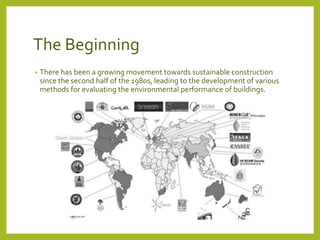
• There has been a growing movement towards sustainable construction 
since the second half of the 1980s, leading to the development of various 
methods for evaluating the environmental performance of buildings.
The Beginning 
CASBEE was developed according to the following policies: 
1) The system should be structured to award high assessments to superior 
buildings, thereby enhancing incentives to designers and others. 
2) The assessment system should be as simple as possible. 
3) The system should be applicable to buildings in a wide range of building 
types. 
4) The system should take into consideration issues and problems peculiar to 
Japan and Asia.
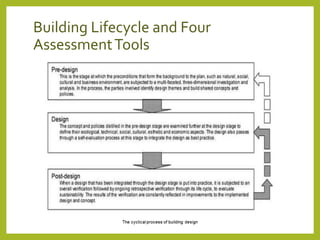
Building Lifecycle and Four 
Assessment Tools
Assessment tools 
Corresponding to the building lifecycle, CASBEE is composed of four 
assessment tools, 
CASBEE for Pre-design, 
CASBEE for New Construction, 
CASBEE for Existing Building 
CASBEE for Renovation, 
and to serve at each stage of the design process. 
CASBEE Family is the collective name for these four basic tools and the 
tools for specific purposes. 
Each tool is intended for the specific purpose and target users, and is 
designed to accommodate a wide range of building types (offices, schools, 
apartments, etc.).
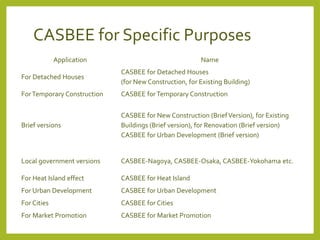
CASBEE for Specific Purposes 
Application Name 
For Detached Houses 
CASBEE for Detached Houses 
(for New Construction, for Existing Building) 
For Temporary Construction CASBEE for Temporary Construction 
Brief versions 
CASBEE for New Construction (Brief Version), for Existing 
Buildings (Brief version), for Renovation (Brief version) 
CASBEE for Urban Development (Brief version) 
Local government versions CASBEE-Nagoya, CASBEE-Osaka, CASBEE-Yokohama etc. 
For Heat Island effect CASBEE for Heat Island 
For Urban Development CASBEE for Urban Development 
For Cities CASBEE for Cities 
For Market Promotion CASBEE for Market Promotion
Assessment system 
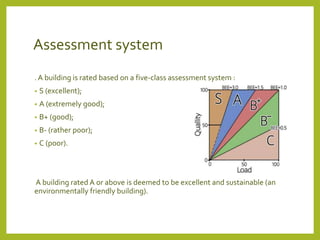
. A building is rated based on a five-class assessment system : 
• S (excellent); 
• A (extremely good); 
• B+ (good); 
• B- (rather poor); 
• C (poor). 
A building rated A or above is deemed to be excellent and sustainable (an 
environmentally friendly building).
Assessment Method 
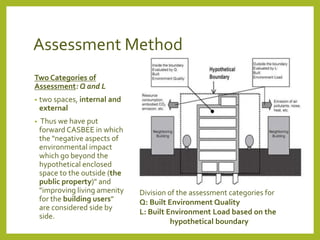
Two Categories of 
Assessment: Q and L 
• two spaces, internal and 
external 
• Thus we have put 
forward CASBEE in which 
the "negative aspects of 
environmental impact 
which go beyond the 
hypothetical enclosed 
space to the outside (the 
public property)" and 
"improving living amenity 
for the building users" 
are considered side by 
side. 
Division of the assessment categories for 
Q: Built Environment Quality 
L: Built Environment Load based on the 
hypothetical boundary
Target Fields and Its Rearrangement 
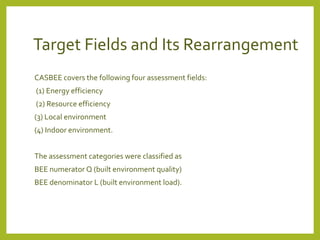
CASBEE covers the following four assessment fields: 
(1) Energy efficiency 
(2) Resource efficiency 
(3) Local environment 
(4) Indoor environment. 
The assessment categories were classified as 
BEE numerator Q (built environment quality) 
BEE denominator L (built environment load).
Target Fields and Its Rearrangement 
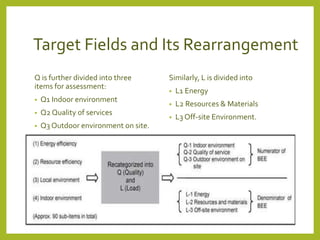
Q is further divided into three 
items for assessment: 
• Q1 Indoor environment 
• Q2 Quality of services 
• Q3 Outdoor environment on site. 
Similarly, L is divided into 
• L1 Energy 
• L2 Resources & Materials 
• L3 Off-site Environment.
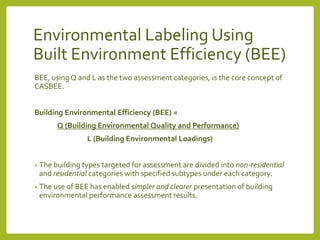
Environmental Labeling Using 
Built Environment Efficiency (BEE) 
BEE, using Q and L as the two assessment categories, is the core concept of 
CASBEE. 
Building Environmental Efficiency (BEE) = 
Q (Building Environmental Quality and Performance) 
L (Building Environmental Loadings) 
• The building types targeted for assessment are divided into non-residential 
and residential categories with specified subtypes under each category. 
• The use of BEE has enabled simpler and clearer presentation of building 
environmental performance assessment results.
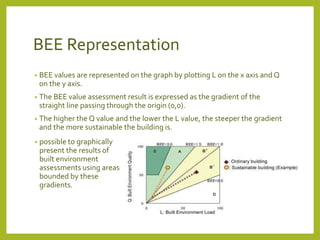
BEE Representation 
• BEE values are represented on the graph by plotting L on the x axis and Q 
on the y axis. 
• The BEE value assessment result is expressed as the gradient of the 
straight line passing through the origin (0,0). 
• The higher the Q value and the lower the L value, the steeper the gradient 
and the more sustainable the building is. 
• possible to graphically 
present the results of 
built environment 
assessments using areas 
bounded by these 
gradients.
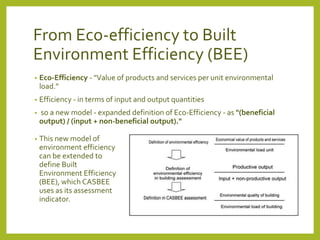
From Eco-efficiency to Built 
Environment Efficiency (BEE) 
• Eco-Efficiency - "Value of products and services per unit environmental 
load.” 
• Efficiency - in terms of input and output quantities 
• so a new model - expanded definition of Eco-Efficiency - as "(beneficial 
output) / (input + non-beneficial output)." 
• This new model of 
environment efficiency 
can be extended to 
define Built 
Environment Efficiency 
(BEE), which CASBEE 
uses as its assessment 
indicator.
CASESTUDY 
Yokohama building
Yokohama Dia Building 
Class S-CASBEE 
• the highest level in an assessment system for evaluating building environmental 
efficiency (CASBEE Yokohama) 
• first Mitsubishi Logistics building to be rated as "Class S.“ 
• In this assessment system, Yokohama City focuses on four main areas: 
global warming measures, 
heat island measures, 
longevity measures 
consideration to the city landscape.
Initiatives To Preserve The 
Environment 
Global warming measures 
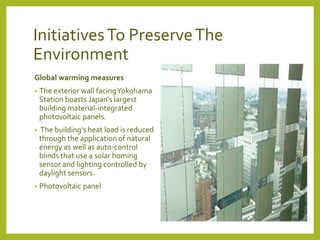
• The exterior wall facing Yokohama 
Station boasts Japan's largest 
building material-integrated 
photovoltaic panels. 
• The building's heat load is reduced 
through the application of natural 
energy as well as auto-control 
blinds that use a solar homing 
sensor and lighting controlled by 
daylight sensors. 
• Photovoltaic panel
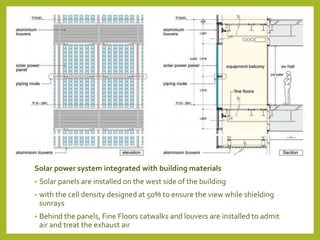
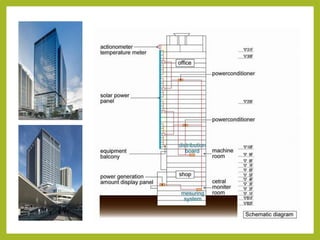
Solar power system integrated with building materials 
• Solar panels are installed on the west side of the building 
• with the cell density designed at 50% to ensure the view while shielding 
sunrays 
• Behind the panels, Fine Floors catwalks and louvers are installed to admit 
air and treat the exhaust air
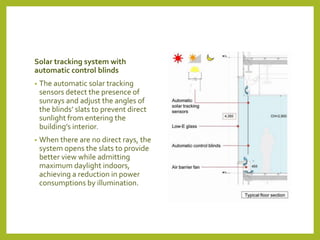
Solar tracking system with 
automatic control blinds 
• The automatic solar tracking 
sensors detect the presence of 
sunrays and adjust the angles of 
the blinds’ slats to prevent direct 
sunlight from entering the 
building’s interior. 
• When there are no direct rays, the 
system opens the slats to provide 
better view while admitting 
maximum daylight indoors, 
achieving a reduction in power 
consumptions by illumination.
Initiatives To Preserve The 
Environment 
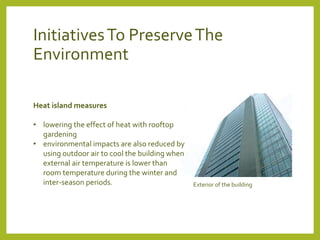
Exterior of the building 
Heat island measures 
• lowering the effect of heat with rooftop 
gardening 
• environmental impacts are also reduced by 
using outdoor air to cool the building when 
external air temperature is lower than 
room temperature during the winter and 
inter-season periods.
Initiatives To Preserve The 
Environment 
Longevity measures 
• Building sway is counterbalanced by vibrating weights with a 
computer-controlled driving mechanism. 
• In addition, a hybrid vibration damping mechanism that combines 
active mass damper (AMD), to reduce vibration caused by wind, 
and vibration damping equipment (vibration damping brace, 
vibration damping wall) is used to increase the building's durability
Initiatives To Preserve The 
Environment 
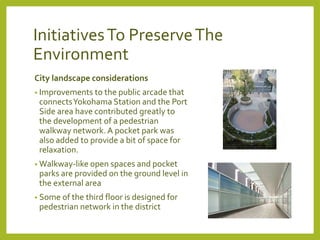
City landscape considerations 
• Improvements to the public arcade that 
connects Yokohama Station and the Port 
Side area have contributed greatly to 
the development of a pedestrian 
walkway network. A pocket park was 
also added to provide a bit of space for 
relaxation. 
• Walkway-like open spaces and pocket 
parks are provided on the ground level in 
the external area 
• Some of the third floor is designed for 
pedestrian network in the district
CASESTUDY 
TEDA MSD H2 Low 
Carbon Building , 
Tianjin, China
TEDA 
Class S-CASBEE 
• First international CASBEE certified building 
• Located at newly developed TEDA Modern Service District (MSD) 
• Densely populated with service industry such as financial and IT companies 
• the TEDA MSD H2 Low Carbon Building is demonstrating environmental 
sustainable urban development. 
features the national top level environmental 
• photovoltaic generation, 
• solar-heat hot water supply system 
• geothermal heat pump system 
• high-performance and low carbon 
technologies; 
• natural lighting, 
• double-skinned facade, .
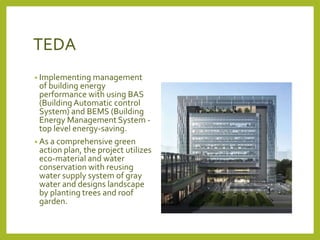
TEDA 
• Implementing management 
of building energy 
performance with using BAS 
(Building Automatic control 
System) and BEMS (Building 
Energy Management System - 
top level energy-saving. 
• As a comprehensive green 
action plan, the project utilizes 
eco-material and water 
conservation with reusing 
water supply system of gray 
water and designs landscape 
by planting trees and roof 
garden.
CASBEE vs. LEED 
CASBEE 
• its practical application has been 
limited in Japan. 
• fundamentally an ‘architectural’ 
design tool,. 
• most commonly utilized as a 
‘checklist for sustainable design, 
and an official CASBEE 
certification is rarely pursued 
• evaluation items in CASBEE are 
subjective 
LEED 
• has been transformed into the 
“world’s biggest green-building 
brand name” due to the 
successful marketing efforts by 
USGBC. 
• comprise or could be dissected 
into various architectural and 
engineering elements 
• LEED certification is customarily 
pursued by project owners for 
marketing and promotional 
purposes and LEED certified 
buildings are growing every day 
• clearly defined terms
• In Japan, a sustainable building is often defined as one that is 
designed “to save energy and resources, recycle materials and 
minimize the emission of toxic substances throughout its life cycle, to 
harmonize with the local climate, traditions, culture and the 
surrounding environment, and to be able to sustain and improve the 
quality of human life while maintaining the capacity of the ecosystem 
at the local and global levels”
Bibliography 
• http://www.ibec.or.jp/CASBEE/documents/CASBEE_news_release( 
E)140415.pdf 
• http://www.ide.titech.ac.jp/~nabe/wp/casbee-vs-leed-how-is-each-embraced- 
by-its-building-community/ 
• http://www.ibec.or.jp/CASBEE/english/backgroundE.htm
THANK YOU

Casbee certification,Japan

  • 1.
    CASBEE CERTIFICATION ENVIRONMENTALDESIGN Ann Mary Athulya Geethika Nazla Pournima Shabareesh
  • 2.
    Introduction • CASBEE(ComprehensiveAssessment System for Building Environmental Efficiency) , a system created in 2001 • Research and development of CASBEE is a joint industrial/government/academic project established under the support of the Japanese ministry of Land, Infrastructure, Transport and Tourism. • The system comprehensively assesses the quality of a building based on its environmental awareness in using building materials and equipment that have little environmental impact, while also taking into account other criteria such as the level of comfort of an interior or the views
  • 3.
    The Beginning •There has been a growing movement towards sustainable construction since the second half of the 1980s, leading to the development of various methods for evaluating the environmental performance of buildings.
  • 4.
    The Beginning CASBEEwas developed according to the following policies: 1) The system should be structured to award high assessments to superior buildings, thereby enhancing incentives to designers and others. 2) The assessment system should be as simple as possible. 3) The system should be applicable to buildings in a wide range of building types. 4) The system should take into consideration issues and problems peculiar to Japan and Asia.
  • 5.
    Building Lifecycle andFour Assessment Tools
  • 6.
    Assessment tools Correspondingto the building lifecycle, CASBEE is composed of four assessment tools, CASBEE for Pre-design, CASBEE for New Construction, CASBEE for Existing Building CASBEE for Renovation, and to serve at each stage of the design process. CASBEE Family is the collective name for these four basic tools and the tools for specific purposes. Each tool is intended for the specific purpose and target users, and is designed to accommodate a wide range of building types (offices, schools, apartments, etc.).
  • 7.
    CASBEE for SpecificPurposes Application Name For Detached Houses CASBEE for Detached Houses (for New Construction, for Existing Building) For Temporary Construction CASBEE for Temporary Construction Brief versions CASBEE for New Construction (Brief Version), for Existing Buildings (Brief version), for Renovation (Brief version) CASBEE for Urban Development (Brief version) Local government versions CASBEE-Nagoya, CASBEE-Osaka, CASBEE-Yokohama etc. For Heat Island effect CASBEE for Heat Island For Urban Development CASBEE for Urban Development For Cities CASBEE for Cities For Market Promotion CASBEE for Market Promotion
  • 8.
    Assessment system .A building is rated based on a five-class assessment system : • S (excellent); • A (extremely good); • B+ (good); • B- (rather poor); • C (poor). A building rated A or above is deemed to be excellent and sustainable (an environmentally friendly building).
  • 9.
    Assessment Method TwoCategories of Assessment: Q and L • two spaces, internal and external • Thus we have put forward CASBEE in which the "negative aspects of environmental impact which go beyond the hypothetical enclosed space to the outside (the public property)" and "improving living amenity for the building users" are considered side by side. Division of the assessment categories for Q: Built Environment Quality L: Built Environment Load based on the hypothetical boundary
  • 10.
    Target Fields andIts Rearrangement CASBEE covers the following four assessment fields: (1) Energy efficiency (2) Resource efficiency (3) Local environment (4) Indoor environment. The assessment categories were classified as BEE numerator Q (built environment quality) BEE denominator L (built environment load).
  • 11.
    Target Fields andIts Rearrangement Q is further divided into three items for assessment: • Q1 Indoor environment • Q2 Quality of services • Q3 Outdoor environment on site. Similarly, L is divided into • L1 Energy • L2 Resources & Materials • L3 Off-site Environment.
  • 12.
    Environmental Labeling Using Built Environment Efficiency (BEE) BEE, using Q and L as the two assessment categories, is the core concept of CASBEE. Building Environmental Efficiency (BEE) = Q (Building Environmental Quality and Performance) L (Building Environmental Loadings) • The building types targeted for assessment are divided into non-residential and residential categories with specified subtypes under each category. • The use of BEE has enabled simpler and clearer presentation of building environmental performance assessment results.
  • 13.
    BEE Representation •BEE values are represented on the graph by plotting L on the x axis and Q on the y axis. • The BEE value assessment result is expressed as the gradient of the straight line passing through the origin (0,0). • The higher the Q value and the lower the L value, the steeper the gradient and the more sustainable the building is. • possible to graphically present the results of built environment assessments using areas bounded by these gradients.
  • 14.
    From Eco-efficiency toBuilt Environment Efficiency (BEE) • Eco-Efficiency - "Value of products and services per unit environmental load.” • Efficiency - in terms of input and output quantities • so a new model - expanded definition of Eco-Efficiency - as "(beneficial output) / (input + non-beneficial output)." • This new model of environment efficiency can be extended to define Built Environment Efficiency (BEE), which CASBEE uses as its assessment indicator.
  • 15.
  • 16.
    Yokohama Dia Building Class S-CASBEE • the highest level in an assessment system for evaluating building environmental efficiency (CASBEE Yokohama) • first Mitsubishi Logistics building to be rated as "Class S.“ • In this assessment system, Yokohama City focuses on four main areas: global warming measures, heat island measures, longevity measures consideration to the city landscape.
  • 17.
    Initiatives To PreserveThe Environment Global warming measures • The exterior wall facing Yokohama Station boasts Japan's largest building material-integrated photovoltaic panels. • The building's heat load is reduced through the application of natural energy as well as auto-control blinds that use a solar homing sensor and lighting controlled by daylight sensors. • Photovoltaic panel
  • 18.
    Solar power systemintegrated with building materials • Solar panels are installed on the west side of the building • with the cell density designed at 50% to ensure the view while shielding sunrays • Behind the panels, Fine Floors catwalks and louvers are installed to admit air and treat the exhaust air
  • 20.
    Solar tracking systemwith automatic control blinds • The automatic solar tracking sensors detect the presence of sunrays and adjust the angles of the blinds’ slats to prevent direct sunlight from entering the building’s interior. • When there are no direct rays, the system opens the slats to provide better view while admitting maximum daylight indoors, achieving a reduction in power consumptions by illumination.
  • 21.
    Initiatives To PreserveThe Environment Exterior of the building Heat island measures • lowering the effect of heat with rooftop gardening • environmental impacts are also reduced by using outdoor air to cool the building when external air temperature is lower than room temperature during the winter and inter-season periods.
  • 22.
    Initiatives To PreserveThe Environment Longevity measures • Building sway is counterbalanced by vibrating weights with a computer-controlled driving mechanism. • In addition, a hybrid vibration damping mechanism that combines active mass damper (AMD), to reduce vibration caused by wind, and vibration damping equipment (vibration damping brace, vibration damping wall) is used to increase the building's durability
  • 23.
    Initiatives To PreserveThe Environment City landscape considerations • Improvements to the public arcade that connects Yokohama Station and the Port Side area have contributed greatly to the development of a pedestrian walkway network. A pocket park was also added to provide a bit of space for relaxation. • Walkway-like open spaces and pocket parks are provided on the ground level in the external area • Some of the third floor is designed for pedestrian network in the district
  • 24.
    CASESTUDY TEDA MSDH2 Low Carbon Building , Tianjin, China
  • 25.
    TEDA Class S-CASBEE • First international CASBEE certified building • Located at newly developed TEDA Modern Service District (MSD) • Densely populated with service industry such as financial and IT companies • the TEDA MSD H2 Low Carbon Building is demonstrating environmental sustainable urban development. features the national top level environmental • photovoltaic generation, • solar-heat hot water supply system • geothermal heat pump system • high-performance and low carbon technologies; • natural lighting, • double-skinned facade, .
  • 26.
    TEDA • Implementingmanagement of building energy performance with using BAS (Building Automatic control System) and BEMS (Building Energy Management System - top level energy-saving. • As a comprehensive green action plan, the project utilizes eco-material and water conservation with reusing water supply system of gray water and designs landscape by planting trees and roof garden.
  • 27.
    CASBEE vs. LEED CASBEE • its practical application has been limited in Japan. • fundamentally an ‘architectural’ design tool,. • most commonly utilized as a ‘checklist for sustainable design, and an official CASBEE certification is rarely pursued • evaluation items in CASBEE are subjective LEED • has been transformed into the “world’s biggest green-building brand name” due to the successful marketing efforts by USGBC. • comprise or could be dissected into various architectural and engineering elements • LEED certification is customarily pursued by project owners for marketing and promotional purposes and LEED certified buildings are growing every day • clearly defined terms
  • 28.
    • In Japan,a sustainable building is often defined as one that is designed “to save energy and resources, recycle materials and minimize the emission of toxic substances throughout its life cycle, to harmonize with the local climate, traditions, culture and the surrounding environment, and to be able to sustain and improve the quality of human life while maintaining the capacity of the ecosystem at the local and global levels”
  • 29.
    Bibliography • http://www.ibec.or.jp/CASBEE/documents/CASBEE_news_release( E)140415.pdf • http://www.ide.titech.ac.jp/~nabe/wp/casbee-vs-leed-how-is-each-embraced- by-its-building-community/ • http://www.ibec.or.jp/CASBEE/english/backgroundE.htm
  • 30.

Editor's Notes

  • #10 Under CASBEE there are two spaces, internal and external, divided by the hypothetical boundary, which is defined by the site boundary and other elements, with two factors related to the two spaces Under CASBEE, these two factors are defined below as Q and L, the main assessment categories, and evaluated separately. Q (Quality): Built Environment Quality Evaluates "improvement in living amenity for the building users, within the hypothetical enclosed space (the private property)." L (Load): Built Environment Load Evaluates "negative aspects of environmental impact which go beyond the hypothetical enclosed space to the outside (the public property)."
  • #11 These four fields are largely the same as the target fields for the existing assessment tools described above in Japan and abroad, but they do not necessarily represent the same concepts, so it is difficult to deal with them on the same basis. Therefore the assessment categories contained within these four fields had to be examined and reorganized.
  • #13 BEE, as used here, is an indicator calculated from Q (built environmental quality ) as the numerator and L (built environment load) as the denominator.
  • #14 Using this approach, it becomes The figure shows how the assessment results for buildings can be ranked on a diagram as class C (poor), class B-, class B+, class A, and class S (excellent), in order of increasing BEE value.
  • #15 The concept of Eco-efficiency has been introduced for CASBEE to enable the integrated assessment of two factors, inside and outside the building site.
  • #19  Air-conditioning loads reduction is thus achieved. . The generated electricity amounts to about 40,000 kWh yearly, which covers part of the demand in the building.
  • #26 The Institute for Building Environment and Energy Conservation (IBEC) (3-5-1, Koji-machi, Chiyoda-ku, Tokyo, Japan, President of IBEC, Dr. Shuzo Murakami) certified TEDA MSD H2 Low Carbon