Carrefour
Agenda
 Background
 History
 Industry
 Competition
 Success Factors
 Challenges
Background
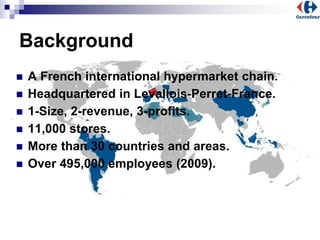
 A French international hypermarket chain.
 Headquartered in Levallois-Perret-France.
 1-Size, 2-revenue, 3-profits.
 11,000 stores.
 More than 30 countries and areas.
 Over 495,000 employees (2009).
History
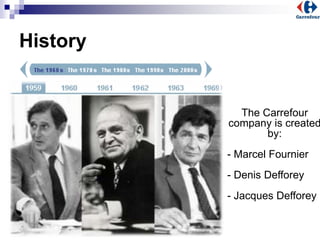
The Carrefour
company is created
by:
- Marcel Fournier
- Denis Defforey
- Jacques Defforey
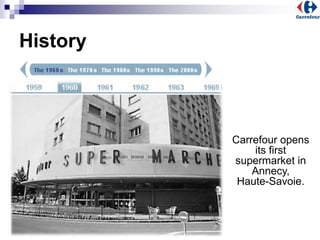
History
Carrefour opens
its first
supermarket in
Annecy,
Haute-Savoie.
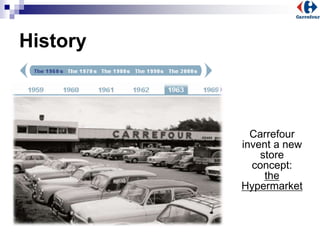
History
Carrefour
invent a new
store
concept:
the
Hypermarket
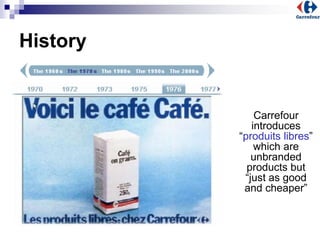
History
Carrefour
introduces
“produits libres”
which are
unbranded
products but
“just as good
and cheaper”
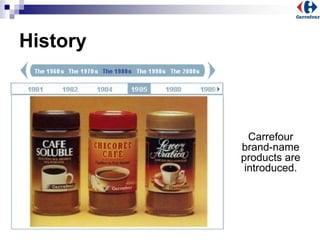
History
Carrefour
brand-name
products are
introduced.
History
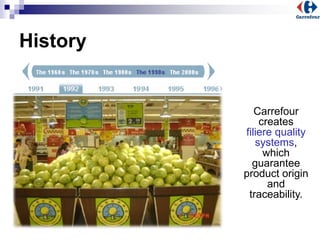
Carrefour
creates
filiere quality
systems,
which
guarantee
product origin
and
traceability.
History
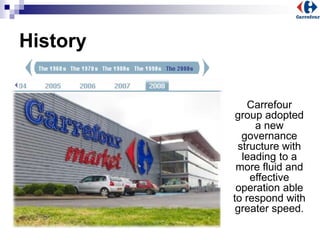
Carrefour
group adopted
a new
governance
structure with
leading to a
more fluid and
effective
operation able
to respond with
greater speed.
History
 1969- the first overseas hypermarket was built in Belgium.
 1973- hypermarket in Spain
 1975- hypermarket in Brazil
 1982- hypermarket in Argentina
 1989- first hypermarket in Asia, in Taiwan
 1990- first hypermarket in Philadelphia,United States
 1991- second hypermarket in New Jersey
 1993- first hypermarkets in Italy and Turkey.
 1994- first hypermarkets in Mexico and Malaysia
 1995- first hypermarket in China mainland
 1996- hypermarkets in Thailand, Korea, and Hong Kong
Industry Analysis
 Oligopoly.
 growing Continually.
 3 essential reasons why hypermarkets
stand out from typical supermarkets and
retail chains:
 Products: Diverse.
 Location: more convenient.
 Prices: lower.
Competition
 Indirect:
 Convenience Stores - general merchandise and
various supermarket items.
 Shopping Canters - variety of items all in one
location.
 Grocery Stores - sell food items.
Direct Competition
 Wal-Mart - world's number one retailer.
 Leclerc - cooperation of over 550 food retail
franchises.
 Auchan - French grocery chain.
 Aldi - European discount chain.
 Ahold - largest grocery retailer in Amsterdam.
 Tesco - Britain’s largest retailer of grocery and
general merchandise.
Success Factors
 Competing low prices.
 Effective promotion system:
 taking full control of its end-to-end promotion
systems.
 in-store and outside promotions.
 loyalty cards…etc.
 Several corporate strategies such as :
 inexpensive construction.
 low-cost land acquisition: cheap lands near high
ways.
 decentralized management.
Challenges
 Existing and potential competitors.
 Global Marketing Challenges.
 New legislations:
 Example: Legal amendments, which came into
effect on January1-2006 under the Dutreil Law,
have updated the French Commerce Code to
redress the balance of power between
manufacturers and distributors, while attempting to
lower retail prices.
THANK YOU
Presented by:
Kenan Al Sayed
Anjad Qusaibaty
Muhannad Akkash
Abdel Rahim Abou Al Shamat

Carrefour 101126150909-phpapp01

Editor's Notes

  • #4 Headquartered in Levallois-Perret, France It is located 6.4 km (4.0 mi) from the center of Paris, Carrefour means "crossroads" in French. Carrefour is the largest hypermarket chain in the world in terms of size, the second largest retail group in the world in terms of revenue and third largest in profit after Wal-Mart and Tesco.
  • #7 In commerce, a hypermarket (from the French hypermarché) is a store which combines a supermarket and a department store. The result is a gigantic retail facility which carries an enormous range of products under one roof, including full lines of fresh groceries and apparel. When they are planned, constructed, and executed correctly, a consumer can ideally satisfy all of their routine weekly shopping needs in one trip to the hypermarket. outlet that combines the features of a supermarket, department store, discount store, and specialty store in one location. Also called hypermart.
  • #15 Even though Wal-Mart is one competitor of Carrefour in the world, the two groups are not on the same geographical markets, so they are not dangerous to one another. The most dangerous competitors for Carrefour are the one that have had activities for many years in a country, and whose customers are used to buy there. For example Leclerc in France is one of the most significant competitors for Carrefour. For a long time, Leclerc had cheaper prices than Carrefour, and this attracted lots of customers. However in the second quarter of 2006 Carrefour decreased its prices and gained market share in France, while Leclerc lost market share… Thus, on a turnover basis, Carrefour was the best again. Faced to a market driven by the objective of minimisation of costs to sell always at a cheapest price, a company like Carrefour has found some solutions to stay above its competitors…
  • #16 They manage their entire promotional process without a third party
  • #17 With 43% of Carrefour's market on domestic soil