Akshat Badaya 
Anshul Gupta 
Ronak Agrawal 
Shuchi Arya 
Vishal Singh
Grove Fresh Ltd. 
• Founded by John Taylor in 1994. 
• GFL became first company to market organic juices in UK in 1996 
• Registered remarkable year-on-year growth of 52% to 3.2 million 
pounds. 
• Operated under the umbrella United Foods International 
• Admired for High Quality Products & Innovative Marketing 
• Acquired German based FSP FRISCHE & French FRAICHEUR in 
1998.
• Acquired Fruity King and achieved sales growth of 185% and saw a profit 
of $ 0.9 million in 2000. 
• In 2001, UFI (A GFL holding) ranked 3rd in Fast Track 100 survey. 
• 2003: GFL registered 52% year on year growth in profit. 
• 2006: Continued to dominate UK organic juice market with market share 
exceeding 60%. 
• But encountered problems like slowing market growth, mounting 
competition, supply shortage
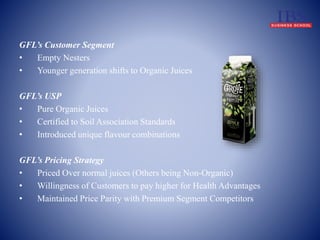
GFL’s Customer Segment 
• Empty Nesters 
• Younger generation shifts to Organic Juices 
GFL’s USP 
• Pure Organic Juices 
• Certified to Soil Association Standards 
• Introduced unique flavour combinations 
GFL’s Pricing Strategy 
• Priced Over normal juices (Others being Non-Organic) 
• Willingness of Customers to pay higher for Health Advantages 
• Maintained Price Parity with Premium Segment Competitors
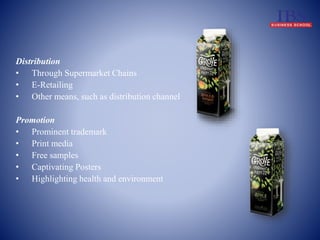
Distribution 
• Through Supermarket Chains 
• E-Retailing 
• Other means, such as distribution channel 
Promotion 
• Prominent trademark 
• Print media 
• Free samples 
• Captivating Posters 
• Highlighting health and environment
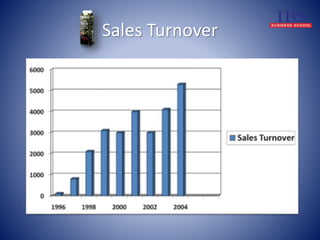
Sales Turnover
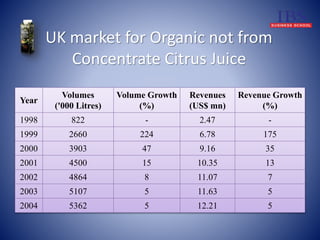
UK market for Organic not from 
Concentrate Citrus Juice 
Year 
Volumes 
('000 Litres) 
Volume Growth 
(%) 
Revenues 
(US$ mn) 
Revenue Growth 
(%) 
1998 822 - 2.47 - 
1999 2660 224 6.78 175 
2000 3903 47 9.16 35 
2001 4500 15 10.35 13 
2002 4864 8 11.07 7 
2003 5107 5 11.63 5 
2004 5362 5 12.21 5
SWOT Analysis 
Strength: 
• High Quality 
• Innovative marketing 
• Diversification (Fruit juice to vegetable juice) 
• Strong customer base 
Weakness: 
• Main source of supply – Florida 
• Too much dependent on 3rd party distribution channels 
• Supply and production shortage of fruits in UK
Opportunities: 
• Market expansion of organic juice. 
• Increase their market shares in UK by acquiring other competing brands 
• Come up with exclusive shops. 
Threats: 
• Claims saying that it is not organic. 
• Low price competitors. 
• Although the volume is increasing the rate of volume growth is 
decreasing. 
• Growth in no. of players operating in organic segments, such as: Everfresh 
juice corporation, Holiday Juice Ltd.
4Ps 
Product: 
• Product Category: FMCG 
• They were having product line with various flavours such as Apple, 
Orange, Apple + Orange, Apple + Cranberry, Grape fruits, Traditional 
lemonade, Breakfast juice. 
• Product diversification – Merger with Dutch company “Fruity King” in 
UK. 
• Branding – Strong brand image helped to dominate the UK market. 
• Brand expansion by starting a sub–brand called “V-juice”. 
Price: 
• They followed a premium price strategy. 
• As organic products were considered environmental friendly and by using 
them customer felt that they were making positive choice to safeguard the 
environment.
Place: 
• Through super market chain they dominated the UK market for organic 
products as they did not use the agent middle men and wholesalers in their 
distribution channel. As they further directly contacted costumer through 
e-retailing. 
Promotion: 
• They used print media like weekend supplements of national news papers 
to target youngster . 
• They did their advertisement through women magazines as it targeted 
females for their product. 
• Promotions by giving free samples as promotion is bit different form 
advertisement.
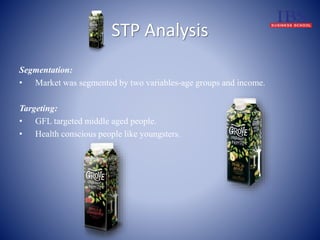
STP Analysis 
Segmentation: 
• Market was segmented by two variables-age groups and income. 
Targeting: 
• GFL targeted middle aged people. 
• Health conscious people like youngsters.
Positioning 
• GFL adopted one of the best strategy to position their product by launching 
an organic product which is purely an extract of fruit and vegetables and 
with no extra added preservatives, colour and additives. 
• Also the unusual combinations of fruits and vegetables juices has been 
other unique factor which helped company to differentiate from other 
competitors in the market.
PEST Analysis 
Political Analysis: 
• Political Analysis Fruits and juices imported from USA and other 
countries were not examined properly (SOIL standards). 
• Controversial advertising campaigns which hampered the company’s 
image badly. 
• It created legal problems and ASA accused company for unethical 
practices and called for quick action PEST Analysis. 
Economical Analysis: 
• In 2006 due to shortage of fruit and vegetable supply they had to import 
the fruits from the USA and other countries which had direct impact on 
country’s economy.
Social Analysis: 
• Due to organic farming since 1994 the fertility of the land is preserved and 
giving higher yields in the future. 
• Organic juices rich in nutrition helped the heart disease patient and others 
with different health concern. 
Technological Analysis: 
• They used latest technology in the organic farming . 
• Used e-retailing for distribution of their product . 
• E-retailing helped product look attractive which added many new 
customers.
Promoting the acceptance & usage of 
organic foods 
• Promotional campaign. 
• Handouts and stalls at leading stores. 
• News paper cut outs. 
• Advertising – Celebrity endorsement. 
• Exclusive shops. 
• Promotional activity through doctors. 
• Certification for product.
What does the future have in store for 
GROVE FRESH Ltd. 
• Slowing market growth. 
• Mounting competition. 
• Supply problems. 
• Analyst’s verdict that organic foods aren’t important.
What can GROVE FRESH Ltd. do to 
address the challenges 
• Online promotion of products. 
• Use UFL’s presence in the market to expand & tackle competition. 
• Experiment with new packaging technologies to cut down on costs. 
• Implement more mergers & acquisitions to increase their existing market 
share.

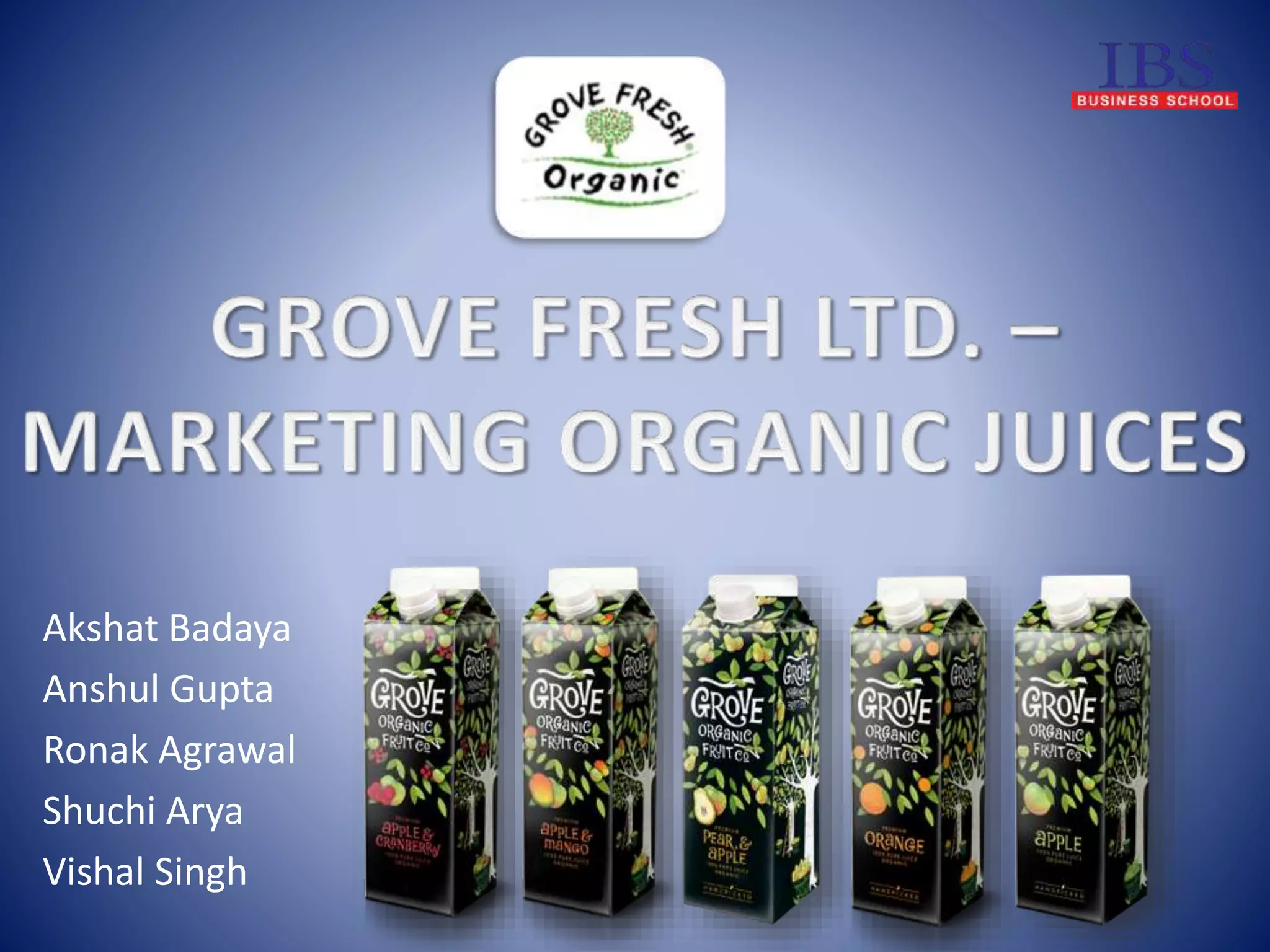
GROVE FRESH LTD. – MARKETING ORGANIC JUICES

  • 1.
    Akshat Badaya AnshulGupta Ronak Agrawal Shuchi Arya Vishal Singh
  • 2.
    Grove Fresh Ltd. • Founded by John Taylor in 1994. • GFL became first company to market organic juices in UK in 1996 • Registered remarkable year-on-year growth of 52% to 3.2 million pounds. • Operated under the umbrella United Foods International • Admired for High Quality Products & Innovative Marketing • Acquired German based FSP FRISCHE & French FRAICHEUR in 1998.
  • 3.
    • Acquired FruityKing and achieved sales growth of 185% and saw a profit of $ 0.9 million in 2000. • In 2001, UFI (A GFL holding) ranked 3rd in Fast Track 100 survey. • 2003: GFL registered 52% year on year growth in profit. • 2006: Continued to dominate UK organic juice market with market share exceeding 60%. • But encountered problems like slowing market growth, mounting competition, supply shortage
  • 4.
    GFL’s Customer Segment • Empty Nesters • Younger generation shifts to Organic Juices GFL’s USP • Pure Organic Juices • Certified to Soil Association Standards • Introduced unique flavour combinations GFL’s Pricing Strategy • Priced Over normal juices (Others being Non-Organic) • Willingness of Customers to pay higher for Health Advantages • Maintained Price Parity with Premium Segment Competitors
  • 5.
    Distribution • ThroughSupermarket Chains • E-Retailing • Other means, such as distribution channel Promotion • Prominent trademark • Print media • Free samples • Captivating Posters • Highlighting health and environment
  • 6.
  • 7.
    UK market forOrganic not from Concentrate Citrus Juice Year Volumes ('000 Litres) Volume Growth (%) Revenues (US$ mn) Revenue Growth (%) 1998 822 - 2.47 - 1999 2660 224 6.78 175 2000 3903 47 9.16 35 2001 4500 15 10.35 13 2002 4864 8 11.07 7 2003 5107 5 11.63 5 2004 5362 5 12.21 5
  • 8.
    SWOT Analysis Strength: • High Quality • Innovative marketing • Diversification (Fruit juice to vegetable juice) • Strong customer base Weakness: • Main source of supply – Florida • Too much dependent on 3rd party distribution channels • Supply and production shortage of fruits in UK
  • 9.
    Opportunities: • Marketexpansion of organic juice. • Increase their market shares in UK by acquiring other competing brands • Come up with exclusive shops. Threats: • Claims saying that it is not organic. • Low price competitors. • Although the volume is increasing the rate of volume growth is decreasing. • Growth in no. of players operating in organic segments, such as: Everfresh juice corporation, Holiday Juice Ltd.
  • 10.
    4Ps Product: •Product Category: FMCG • They were having product line with various flavours such as Apple, Orange, Apple + Orange, Apple + Cranberry, Grape fruits, Traditional lemonade, Breakfast juice. • Product diversification – Merger with Dutch company “Fruity King” in UK. • Branding – Strong brand image helped to dominate the UK market. • Brand expansion by starting a sub–brand called “V-juice”. Price: • They followed a premium price strategy. • As organic products were considered environmental friendly and by using them customer felt that they were making positive choice to safeguard the environment.
  • 11.
    Place: • Throughsuper market chain they dominated the UK market for organic products as they did not use the agent middle men and wholesalers in their distribution channel. As they further directly contacted costumer through e-retailing. Promotion: • They used print media like weekend supplements of national news papers to target youngster . • They did their advertisement through women magazines as it targeted females for their product. • Promotions by giving free samples as promotion is bit different form advertisement.
  • 12.
    STP Analysis Segmentation: • Market was segmented by two variables-age groups and income. Targeting: • GFL targeted middle aged people. • Health conscious people like youngsters.
  • 13.
    Positioning • GFLadopted one of the best strategy to position their product by launching an organic product which is purely an extract of fruit and vegetables and with no extra added preservatives, colour and additives. • Also the unusual combinations of fruits and vegetables juices has been other unique factor which helped company to differentiate from other competitors in the market.
  • 14.
    PEST Analysis PoliticalAnalysis: • Political Analysis Fruits and juices imported from USA and other countries were not examined properly (SOIL standards). • Controversial advertising campaigns which hampered the company’s image badly. • It created legal problems and ASA accused company for unethical practices and called for quick action PEST Analysis. Economical Analysis: • In 2006 due to shortage of fruit and vegetable supply they had to import the fruits from the USA and other countries which had direct impact on country’s economy.
  • 15.
    Social Analysis: •Due to organic farming since 1994 the fertility of the land is preserved and giving higher yields in the future. • Organic juices rich in nutrition helped the heart disease patient and others with different health concern. Technological Analysis: • They used latest technology in the organic farming . • Used e-retailing for distribution of their product . • E-retailing helped product look attractive which added many new customers.
  • 16.
    Promoting the acceptance& usage of organic foods • Promotional campaign. • Handouts and stalls at leading stores. • News paper cut outs. • Advertising – Celebrity endorsement. • Exclusive shops. • Promotional activity through doctors. • Certification for product.
  • 17.
    What does thefuture have in store for GROVE FRESH Ltd. • Slowing market growth. • Mounting competition. • Supply problems. • Analyst’s verdict that organic foods aren’t important.
  • 18.
    What can GROVEFRESH Ltd. do to address the challenges • Online promotion of products. • Use UFL’s presence in the market to expand & tackle competition. • Experiment with new packaging technologies to cut down on costs. • Implement more mergers & acquisitions to increase their existing market share.