Global Expansion: WalMart in Spain
International Trade and Commerce
Agenda
International Trade and Commerce
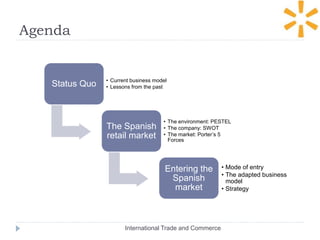
Status Quo • Current business model
• Lessons from the past
The Spanish
retail market
• The environment: PESTEL
• The company: SWOT
• The market: Porter’s 5
Forces
Entering the
Spanish
market
• Mode of entry
• The adapted business
model
• Strategy
Status Quo
International Trade and Commerce
Current Business Model
International Trade and Commerce1
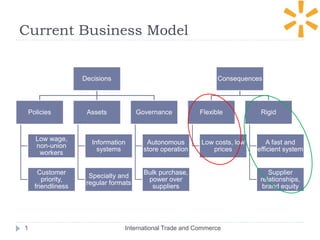
Decisions
Policies
Low wage,
non-union
workers
Customer
priority,
friendliness
Assets
Information
systems
Specialty and
regular formats
Governance
Autonomous
store operation
Bulk purchase,
power over
suppliers
Consequences
Flexible
Low costs, low
prices
Rigid
A fast and
efficient system
Supplier
relationships,
brand equity
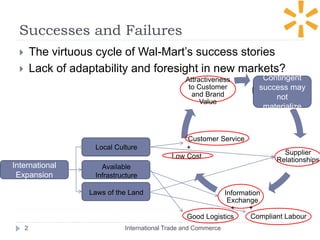
 The virtuous cycle of Wal-Mart’s success stories
 Lack of adaptability and foresight in new markets?
Large Sales
Supplier
Relationships
Information
Exchange
Low Cost
Attractiveness
to Customer
and Brand
Value
Successes and Failures
International Trade and Commerce2
+
Good Logistics
+
Compliant Labour
Customer Service
+Local Culture
Available
Infrastructure
Laws of the Land
International
Expansion
Contingent
success may
not
materialize
Case in Point: Failure in Germany
International Trade and Commerce3
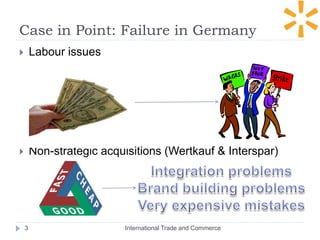
 Labour issues
 Non-strategic acquisitions (Wertkauf & Interspar)
Case in Point: Failure in Germany
International Trade and Commerce4
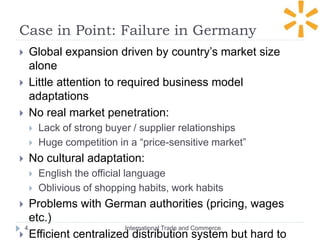
 Global expansion driven by country’s market size
alone
 Little attention to required business model
adaptations
 No real market penetration:
 Lack of strong buyer / supplier relationships
 Huge competition in a “price-sensitive market”
 No cultural adaptation:
 English the official language
 Oblivious of shopping habits, work habits
 Problems with German authorities (pricing, wages
etc.)
 Efficient centralized distribution system but hard to
Spanish retail market
International Trade and Commerce
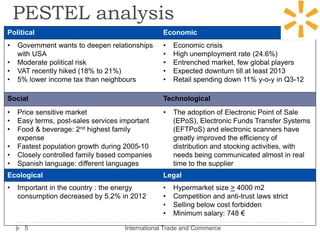
PESTEL analysis
Political Economic
• Government wants to deepen relationships
with USA
• Moderate political risk
• VAT recently hiked (18% to 21%)
• 5% lower income tax than neighbours
• Economic crisis
• High unemployment rate (24.6%)
• Entrenched market, few global players
• Expected downturn till at least 2013
• Retail spending down 11% y-o-y in Q3-12
Social Technological
• Price sensitive market
• Easy terms, post-sales services important
• Food & beverage: 2nd highest family
expense
• Fastest population growth during 2005-10
• Closely controlled family based companies
• Spanish language: different languages
• The adoption of Electronic Point of Sale
(EPoS), Electronic Funds Transfer Systems
(EFTPoS) and electronic scanners have
greatly improved the efficiency of
distribution and stocking activities, with
needs being communicated almost in real
time to the supplier
Ecological Legal
• Important in the country : the energy
consumption decreased by 5.2% in 2012
• Hypermarket size > 4000 m2
• Competition and anti-trust laws strict
• Selling below cost forbidden
• Minimum salary: 748 €
International Trade and Commerce5
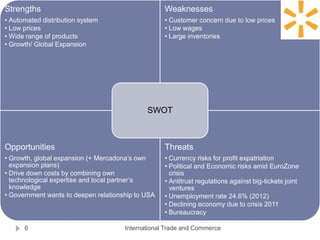
Strengths
• Automated distribution system
• Low prices
• Wide range of products
• Growth/ Global Expansion
Weaknesses
• Customer concern due to low prices
• Low wages
• Large inventories
Opportunities
• Growth, global expansion (+ Mercadona’s own
expansion plans)
• Drive down costs by combining own
technological expertise and local partner’s
knowledge
• Government wants to deepen relationship to USA
Threats
• Currency risks for profit expatriation
• Political and Economic risks amid EuroZone
crisis
• Antitrust regulations against big-tickets joint
ventures
• Unemployment rate 24.6% (2012)
• Declining economy due to crisis 2011
• Bureaucracy
SWOT
International Trade and Commerce6
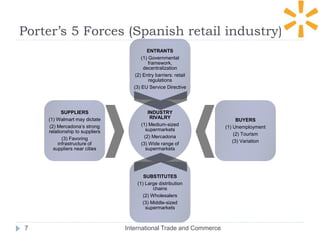
Porter’s 5 Forces (Spanish retail industry)
INDUSTRY
RIVALRY
(1) Medium-sized
supermarkets
(2) Mercadona
(3) Wide range of
supermarkets
ENTRANTS
(1) Governmental
framework,
decentralization
(2) Entry barriers: retail
regulations
(3) EU Service Directive
BUYERS
(1) Unemployment
(2) Tourism
(3) Variation
SUBSTITUTES
(1) Large distribution
chains
(2) Wholesalers
(3) Middle-sized
supermarkets
SUPPLIERS
(1) Walmart may dictate
(2) Mercadona‘s strong
relationship to suppliers
(3) Favoring
infrastructure of
suppliers near cities
International Trade and Commerce7
Entering Spain
International Trade and Commerce
Mode of Entry
International Trade and Commerce8
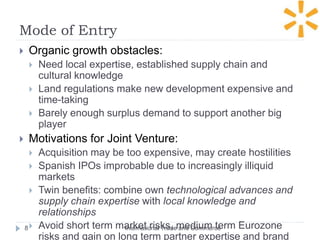
 Organic growth obstacles:
 Need local expertise, established supply chain and
cultural knowledge
 Land regulations make new development expensive and
time-taking
 Barely enough surplus demand to support another big
player
 Motivations for Joint Venture:
 Acquisition may be too expensive, may create hostilities
 Spanish IPOs improbable due to increasingly illiquid
markets
 Twin benefits: combine own technological advances and
supply chain expertise with local knowledge and
relationships
 Avoid short term market risks, medium term Eurozone
risks and gain on long term partner expertise and brand
Mercadona
International Trade and Commerce10
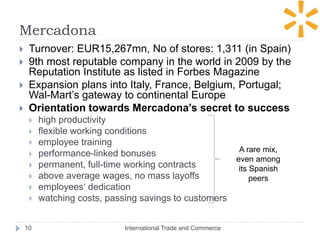
 Turnover: EUR15,267mn, No of stores: 1,311 (in Spain)
 9th most reputable company in the world in 2009 by the
Reputation Institute as listed in Forbes Magazine
 Expansion plans into Italy, France, Belgium, Portugal;
Wal-Mart’s gateway to continental Europe
 Orientation towards Mercadona’s secret to success
 high productivity
 flexible working conditions
 employee training
 performance-linked bonuses
 permanent, full-time working contracts
 above average wages, no mass layoffs
 employees‘ dedication
 watching costs, passing savings to customers
A rare mix,
even among
its Spanish
peers
Recommendations
 Leading European retail format = discounters (low priced
stores with limited assortment but good quality for certain
target groups) [Pfohl and Roth, 2008]
 Market stagnant: aim to grab competitors’ market share
 Capitalize on the downturn sentiment
 Participate in social causes for community benefit and visibility
 Crisis => lower ability to pay => prices a critical factor => EDLP
rules
 Population density rising, improved accessibility more
important than new establishments
 Target new formats (eg. neighbourhood stores) at untapped
areas
 Place supermarkets in areas more accessible to tourists
 Experiment with Marcedona‘s employment practices in other
EU markets
International Trade and Commerce9
The ‘adapted’ Business Model
International Trade and Commerce11
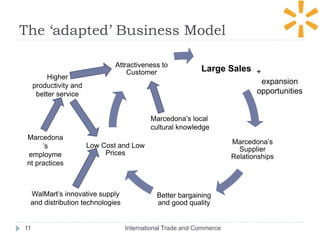
Large Sales
Marcedona’s
Supplier
Relationships
Better bargaining
and good quality
Low Cost and Low
Prices
Attractiveness to
Customer
Marcedona’s local
cultural knowledge
WalMart’s innovative supply
and distribution technologies
Marcedona
’s
employme
nt practices
Higher
productivity and
better service
+
expansion
opportunities
Features of the Model
International Trade and Commerce12
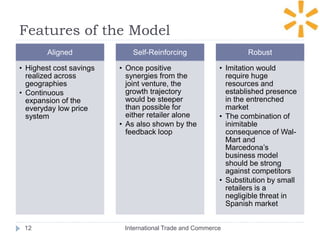
Aligned
• Highest cost savings
realized across
geographies
• Continuous
expansion of the
everyday low price
system
Self-Reinforcing
• Once positive
synergies from the
joint venture, the
growth trajectory
would be steeper
than possible for
either retailer alone
• As also shown by the
feedback loop
Robust
• Imitation would
require huge
resources and
established presence
in the entrenched
market
• The combination of
inimitable
consequence of Wal-
Mart and
Marcedona’s
business model
should be strong
against competitors
• Substitution by small
retailers is a
negligible threat in
Spanish market
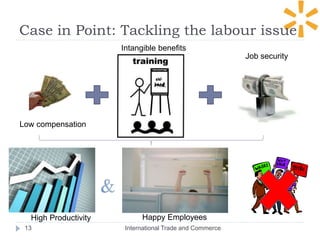
Case in Point: Tackling the labour issue
International Trade and Commerce13
Low compensation
Intangible benefits
Job security
High Productivity Happy Employees
Thank You for your Attention
Elodie Lichtenberger
Harshit Krishna
Lara Aschenbrenner
Louise Roche
Marie Nauméa

Walmart PESTLE

  • 1.
    Global Expansion: WalMartin Spain International Trade and Commerce
  • 2.
    Agenda International Trade andCommerce Status Quo • Current business model • Lessons from the past The Spanish retail market • The environment: PESTEL • The company: SWOT • The market: Porter’s 5 Forces Entering the Spanish market • Mode of entry • The adapted business model • Strategy
  • 3.
  • 4.
    Current Business Model InternationalTrade and Commerce1 Decisions Policies Low wage, non-union workers Customer priority, friendliness Assets Information systems Specialty and regular formats Governance Autonomous store operation Bulk purchase, power over suppliers Consequences Flexible Low costs, low prices Rigid A fast and efficient system Supplier relationships, brand equity
  • 5.
     The virtuouscycle of Wal-Mart’s success stories  Lack of adaptability and foresight in new markets? Large Sales Supplier Relationships Information Exchange Low Cost Attractiveness to Customer and Brand Value Successes and Failures International Trade and Commerce2 + Good Logistics + Compliant Labour Customer Service +Local Culture Available Infrastructure Laws of the Land International Expansion Contingent success may not materialize
  • 6.
    Case in Point:Failure in Germany International Trade and Commerce3  Labour issues  Non-strategic acquisitions (Wertkauf & Interspar)
  • 7.
    Case in Point:Failure in Germany International Trade and Commerce4  Global expansion driven by country’s market size alone  Little attention to required business model adaptations  No real market penetration:  Lack of strong buyer / supplier relationships  Huge competition in a “price-sensitive market”  No cultural adaptation:  English the official language  Oblivious of shopping habits, work habits  Problems with German authorities (pricing, wages etc.)  Efficient centralized distribution system but hard to
  • 8.
  • 9.
    PESTEL analysis Political Economic •Government wants to deepen relationships with USA • Moderate political risk • VAT recently hiked (18% to 21%) • 5% lower income tax than neighbours • Economic crisis • High unemployment rate (24.6%) • Entrenched market, few global players • Expected downturn till at least 2013 • Retail spending down 11% y-o-y in Q3-12 Social Technological • Price sensitive market • Easy terms, post-sales services important • Food & beverage: 2nd highest family expense • Fastest population growth during 2005-10 • Closely controlled family based companies • Spanish language: different languages • The adoption of Electronic Point of Sale (EPoS), Electronic Funds Transfer Systems (EFTPoS) and electronic scanners have greatly improved the efficiency of distribution and stocking activities, with needs being communicated almost in real time to the supplier Ecological Legal • Important in the country : the energy consumption decreased by 5.2% in 2012 • Hypermarket size > 4000 m2 • Competition and anti-trust laws strict • Selling below cost forbidden • Minimum salary: 748 € International Trade and Commerce5
  • 10.
    Strengths • Automated distributionsystem • Low prices • Wide range of products • Growth/ Global Expansion Weaknesses • Customer concern due to low prices • Low wages • Large inventories Opportunities • Growth, global expansion (+ Mercadona’s own expansion plans) • Drive down costs by combining own technological expertise and local partner’s knowledge • Government wants to deepen relationship to USA Threats • Currency risks for profit expatriation • Political and Economic risks amid EuroZone crisis • Antitrust regulations against big-tickets joint ventures • Unemployment rate 24.6% (2012) • Declining economy due to crisis 2011 • Bureaucracy SWOT International Trade and Commerce6
  • 11.
    Porter’s 5 Forces(Spanish retail industry) INDUSTRY RIVALRY (1) Medium-sized supermarkets (2) Mercadona (3) Wide range of supermarkets ENTRANTS (1) Governmental framework, decentralization (2) Entry barriers: retail regulations (3) EU Service Directive BUYERS (1) Unemployment (2) Tourism (3) Variation SUBSTITUTES (1) Large distribution chains (2) Wholesalers (3) Middle-sized supermarkets SUPPLIERS (1) Walmart may dictate (2) Mercadona‘s strong relationship to suppliers (3) Favoring infrastructure of suppliers near cities International Trade and Commerce7
  • 12.
  • 13.
    Mode of Entry InternationalTrade and Commerce8  Organic growth obstacles:  Need local expertise, established supply chain and cultural knowledge  Land regulations make new development expensive and time-taking  Barely enough surplus demand to support another big player  Motivations for Joint Venture:  Acquisition may be too expensive, may create hostilities  Spanish IPOs improbable due to increasingly illiquid markets  Twin benefits: combine own technological advances and supply chain expertise with local knowledge and relationships  Avoid short term market risks, medium term Eurozone risks and gain on long term partner expertise and brand
  • 14.
    Mercadona International Trade andCommerce10  Turnover: EUR15,267mn, No of stores: 1,311 (in Spain)  9th most reputable company in the world in 2009 by the Reputation Institute as listed in Forbes Magazine  Expansion plans into Italy, France, Belgium, Portugal; Wal-Mart’s gateway to continental Europe  Orientation towards Mercadona’s secret to success  high productivity  flexible working conditions  employee training  performance-linked bonuses  permanent, full-time working contracts  above average wages, no mass layoffs  employees‘ dedication  watching costs, passing savings to customers A rare mix, even among its Spanish peers
  • 15.
    Recommendations  Leading Europeanretail format = discounters (low priced stores with limited assortment but good quality for certain target groups) [Pfohl and Roth, 2008]  Market stagnant: aim to grab competitors’ market share  Capitalize on the downturn sentiment  Participate in social causes for community benefit and visibility  Crisis => lower ability to pay => prices a critical factor => EDLP rules  Population density rising, improved accessibility more important than new establishments  Target new formats (eg. neighbourhood stores) at untapped areas  Place supermarkets in areas more accessible to tourists  Experiment with Marcedona‘s employment practices in other EU markets International Trade and Commerce9
  • 16.
    The ‘adapted’ BusinessModel International Trade and Commerce11 Large Sales Marcedona’s Supplier Relationships Better bargaining and good quality Low Cost and Low Prices Attractiveness to Customer Marcedona’s local cultural knowledge WalMart’s innovative supply and distribution technologies Marcedona ’s employme nt practices Higher productivity and better service + expansion opportunities
  • 17.
    Features of theModel International Trade and Commerce12 Aligned • Highest cost savings realized across geographies • Continuous expansion of the everyday low price system Self-Reinforcing • Once positive synergies from the joint venture, the growth trajectory would be steeper than possible for either retailer alone • As also shown by the feedback loop Robust • Imitation would require huge resources and established presence in the entrenched market • The combination of inimitable consequence of Wal- Mart and Marcedona’s business model should be strong against competitors • Substitution by small retailers is a negligible threat in Spanish market
  • 18.
    Case in Point:Tackling the labour issue International Trade and Commerce13 Low compensation Intangible benefits Job security High Productivity Happy Employees
  • 19.
    Thank You foryour Attention Elodie Lichtenberger Harshit Krishna Lara Aschenbrenner Louise Roche Marie Nauméa

Editor's Notes

  • #10 Political The government helps foreign acquisitions The government wants to deepen relationships with USA Medium political risk Economical Economical crisis High unemployment rate : The effects of the global economic crisis of 2008-2009 caused an increase in unemployment from 8.3% in 2007 to 20.1% in 2010, 25% in 2012 Minimum salaries : 748 € Tax burden five points lower than neighboring countries Social Price sensitive market = low income, people are sensitive to price Spanish language : different languages = catalan… Easy terms and after sales services are important Food and beverage = 2nd expenses for families Fastest growing population in UE 2005-2010 : reaching 45.9 million persons by the end of that period Technological The adoption of Electronic Point of Sale (EPoS), Electronic Funds Transfer Systems (EFTPoS) and electronic scanners have greatly improved the efficiency of distribution and stocking activities, with needs being communicated almost in real time to the supplier Ecological Important in the country : the energetic consumption decreased by 5.2% in 2012 Legal Hypermarket size > 4000 m2 Competitive laws Loss sales forbidden
  • #14 Common new retail market entry modes Owned subsidiaries (eg. Aldi) Owned subsidiaries under different name (eg. Tesco) Acquisition of local players (eg. Wal-Mart) Franchising or Joint Venture with local players (eg. Metro)