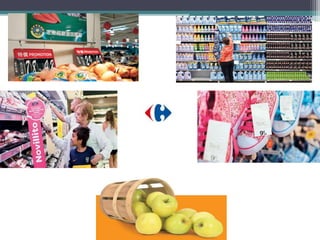
CARREFOUR
positively everyday
Company Profile
Founded - 1ST January, 1958
Founders - Jacques Defforey, Dennis Defforey, Marcel Fouriner
Area Served - Worldwide
Revenue - $ 120.6 BILLION (2015)
CFO - Georges Plassat
VISION
“ doing our job well”
MISSION
“to become the benchmark in modern retailing
each of our markets. Also to offer our customers
the best possible prices and merchandise.
CSR-
, Sustainable and responsible trade
• A partner of COP21, Carrefour is committed
through its daily actions to sustainable and
responsible trade. The Group's Corporate Social
Responsibility approach is built on three pillars:
-fighting against waste in all its forms
-protecting biodiversity
-working alongside the company's partners.
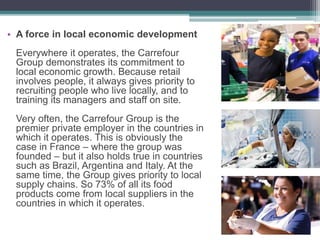
• A force in local economic development
Everywhere it operates, the Carrefour
Group demonstrates its commitment to
local economic growth. Because retail
involves people, it always gives priority to
recruiting people who live locally, and to
training its managers and staff on site.
Very often, the Carrefour Group is the
premier private employer in the countries in
which it operates. This is obviously the
case in France – where the group was
founded – but it also holds true in countries
such as Brazil, Argentina and Italy. At the
same time, the Group gives priority to local
supply chains. So 73% of all its food
products come from local suppliers in the
countries in which it operates.
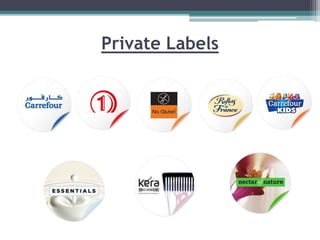
Private Labels
Objectives
(basically for India)
• The top priority of Carrefour is to reach market
share of 2% in Indian retail industry through
B2C channels.
• Expand B2B base in other parts of India, mainly
Bangalore and Pune.
SWOT
• STRENGTHS :
1) Largest hypermarket chain in terms of size
2) Second highest revenue in retail industry
3) Selling a number of private labels
4)Wide market presence and strong brand name
• WEAKNESS:
1)Limited presence in emerging economies
2) Large operating expenses
3) Too much time in opening new stores
4)Has not been able to attract Japanese market
• OPPORTUNITIES:
1)Discount stores development
2)Improve sales performance
3) Reduce operating costs
4) Maintain better labor relations
• Threats:
1) Threats from Wal-mart and Tesco who are
bigger players than Carrefour
2)Recent hardships in Asian sub continent
Strategies So Far…..
• Marketing :
1) Free home delivery on shopping of Rs. 5000
and above
2) Strong online presence
3) Free movie tickets for shopping of Rs. 2000
• Business:
1) Better home delivery services, themed corners,
free credit, child play areas
2) Free shuttle services
3) Low costs and one stop shops for household
needs
4) Produce and purchase products with higher
shelf life and bulk buying.
Global Strategies
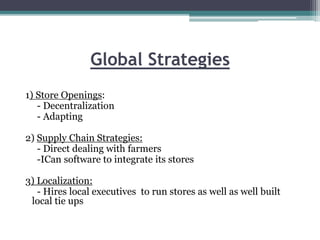
1) Store Openings:
- Decentralization
- Adapting
2) Supply Chain Strategies:
- Direct dealing with farmers
-ICan software to integrate its stores
3) Localization:
- Hires local executives to run stores as well as well built
local tie ups
Though Wal-Mart is the largest retailer globally, it is
being given cut throat competition by French originated
Carrefour
CARREFOUR WALMART
• Number 3 retailer according to
FORBES 500.
• Revenue generated as of FY
2015- $120.66 billion.
• The French-based discounter
that has often gone where
Wal-Mart feared to tread.
• Purchasing locally was one of
the Carrefour’s key strategies,
both in France and
internationally.
• Top retailer in 2015 according to
FORBES 500.
• Revenue generated as of FY
2015- $482 billion.
• No presence at all in China,
world largest consumer hub.
• Wal-Mart offers brand name
products at prices consistently
lower approximately 2–4
percent than those found at
department or specialty store.
Key Learning's
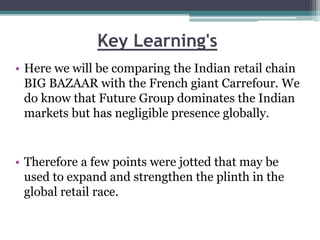
• Here we will be comparing the Indian retail chain
BIG BAZAAR with the French giant Carrefour. We
do know that Future Group dominates the Indian
markets but has negligible presence globally.
• Therefore a few points were jotted that may be
used to expand and strengthen the plinth in the
global retail race.
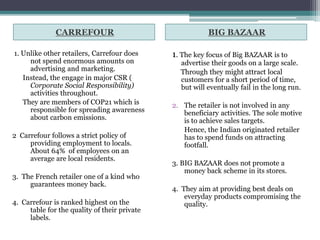
CARREFOUR BIG BAZAAR
1. Unlike other retailers, Carrefour does
not spend enormous amounts on
advertising and marketing.
Instead, the engage in major CSR (
Corporate Social Responsibility)
activities throughout.
They are members of COP21 which is
responsible for spreading awareness
about carbon emissions.
2 Carrefour follows a strict policy of
providing employment to locals.
About 64% of employees on an
average are local residents.
3. The French retailer one of a kind who
guarantees money back.
4. Carrefour is ranked highest on the
table for the quality of their private
labels.
1. The key focus of Big BAZAAR is to
advertise their goods on a large scale.
Through they might attract local
customers for a short period of time,
but will eventually fail in the long run.
2. The retailer is not involved in any
beneficiary activities. The sole motive
is to achieve sales targets.
Hence, the Indian originated retailer
has to spend funds on attracting
footfall.
3. BIG BAZAAR does not promote a
money back scheme in its stores.
4. They aim at providing best deals on
everyday products compromising the
quality.
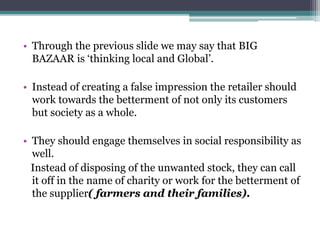
• Through the previous slide we may say that BIG
BAZAAR is ‘thinking local and Global’.
• Instead of creating a false impression the retailer should
work towards the betterment of not only its customers
but society as a whole.
• They should engage themselves in social responsibility as
well.
Instead of disposing of the unwanted stock, they can call
it off in the name of charity or work for the betterment of
the supplier( farmers and their families).
• VEDAANT GUPTA
( vedaantgupta64@gmail.com)

Carrefour- Vedaant GUPTA

  • 1.
  • 2.
    Company Profile Founded -1ST January, 1958 Founders - Jacques Defforey, Dennis Defforey, Marcel Fouriner Area Served - Worldwide Revenue - $ 120.6 BILLION (2015) CFO - Georges Plassat
  • 3.
    VISION “ doing ourjob well” MISSION “to become the benchmark in modern retailing each of our markets. Also to offer our customers the best possible prices and merchandise.
  • 4.
    CSR- , Sustainable andresponsible trade • A partner of COP21, Carrefour is committed through its daily actions to sustainable and responsible trade. The Group's Corporate Social Responsibility approach is built on three pillars: -fighting against waste in all its forms -protecting biodiversity -working alongside the company's partners.
  • 5.
    • A forcein local economic development Everywhere it operates, the Carrefour Group demonstrates its commitment to local economic growth. Because retail involves people, it always gives priority to recruiting people who live locally, and to training its managers and staff on site. Very often, the Carrefour Group is the premier private employer in the countries in which it operates. This is obviously the case in France – where the group was founded – but it also holds true in countries such as Brazil, Argentina and Italy. At the same time, the Group gives priority to local supply chains. So 73% of all its food products come from local suppliers in the countries in which it operates.
  • 6.
  • 7.
    Objectives (basically for India) •The top priority of Carrefour is to reach market share of 2% in Indian retail industry through B2C channels. • Expand B2B base in other parts of India, mainly Bangalore and Pune.
  • 8.
    SWOT • STRENGTHS : 1)Largest hypermarket chain in terms of size 2) Second highest revenue in retail industry 3) Selling a number of private labels 4)Wide market presence and strong brand name
  • 9.
    • WEAKNESS: 1)Limited presencein emerging economies 2) Large operating expenses 3) Too much time in opening new stores 4)Has not been able to attract Japanese market
  • 10.
    • OPPORTUNITIES: 1)Discount storesdevelopment 2)Improve sales performance 3) Reduce operating costs 4) Maintain better labor relations
  • 11.
    • Threats: 1) Threatsfrom Wal-mart and Tesco who are bigger players than Carrefour 2)Recent hardships in Asian sub continent
  • 12.
    Strategies So Far….. •Marketing : 1) Free home delivery on shopping of Rs. 5000 and above 2) Strong online presence 3) Free movie tickets for shopping of Rs. 2000
  • 13.
    • Business: 1) Betterhome delivery services, themed corners, free credit, child play areas 2) Free shuttle services 3) Low costs and one stop shops for household needs 4) Produce and purchase products with higher shelf life and bulk buying.
  • 14.
    Global Strategies 1) StoreOpenings: - Decentralization - Adapting 2) Supply Chain Strategies: - Direct dealing with farmers -ICan software to integrate its stores 3) Localization: - Hires local executives to run stores as well as well built local tie ups
  • 15.
    Though Wal-Mart isthe largest retailer globally, it is being given cut throat competition by French originated Carrefour CARREFOUR WALMART • Number 3 retailer according to FORBES 500. • Revenue generated as of FY 2015- $120.66 billion. • The French-based discounter that has often gone where Wal-Mart feared to tread. • Purchasing locally was one of the Carrefour’s key strategies, both in France and internationally. • Top retailer in 2015 according to FORBES 500. • Revenue generated as of FY 2015- $482 billion. • No presence at all in China, world largest consumer hub. • Wal-Mart offers brand name products at prices consistently lower approximately 2–4 percent than those found at department or specialty store.
  • 16.
    Key Learning's • Herewe will be comparing the Indian retail chain BIG BAZAAR with the French giant Carrefour. We do know that Future Group dominates the Indian markets but has negligible presence globally. • Therefore a few points were jotted that may be used to expand and strengthen the plinth in the global retail race.
  • 17.
    CARREFOUR BIG BAZAAR 1.Unlike other retailers, Carrefour does not spend enormous amounts on advertising and marketing. Instead, the engage in major CSR ( Corporate Social Responsibility) activities throughout. They are members of COP21 which is responsible for spreading awareness about carbon emissions. 2 Carrefour follows a strict policy of providing employment to locals. About 64% of employees on an average are local residents. 3. The French retailer one of a kind who guarantees money back. 4. Carrefour is ranked highest on the table for the quality of their private labels. 1. The key focus of Big BAZAAR is to advertise their goods on a large scale. Through they might attract local customers for a short period of time, but will eventually fail in the long run. 2. The retailer is not involved in any beneficiary activities. The sole motive is to achieve sales targets. Hence, the Indian originated retailer has to spend funds on attracting footfall. 3. BIG BAZAAR does not promote a money back scheme in its stores. 4. They aim at providing best deals on everyday products compromising the quality.
  • 18.
    • Through theprevious slide we may say that BIG BAZAAR is ‘thinking local and Global’. • Instead of creating a false impression the retailer should work towards the betterment of not only its customers but society as a whole. • They should engage themselves in social responsibility as well. Instead of disposing of the unwanted stock, they can call it off in the name of charity or work for the betterment of the supplier( farmers and their families).
  • 20.
    • VEDAANT GUPTA (vedaantgupta64@gmail.com)