Vocabulary Strategies to Improve SAT Scores Leonardtown High School Christine Chadwick, Stefanie Glorioso, Daniel Morris, Marc Pirner
Justification 35 Strategies for developing Content Area Vocabulary by “ Content area achievement depends closely on students’ mastery of specialized  vocabulary”Our Strategy: Semantic Mapping SIP: Improve SAT scores- “Offer the entire school testing skills and vocabulary words”
Content Area Examples English- students write the way they talk (or text), emphasis on vocabulary to help overall academic English  English- explicit academic vocabulary instruction is not being observed in some classes Government- there are many words and concepts that are specific to government that are fundamental to learning / high performance in social studies  Chemistry- there are many vocabulary words that are highly specific to chemistry that are need to be successful in the sciences
Problem and Population Students could improve their verbal SAT scores and content area achievement with more explicit vocabulary instruction. Population: Honors Chemistry English 11 and 12 Standard and CM Government 10 CM
Semantic Map Structured word map write the vocabulary word in the center connect words that are synonyms, antonyms, definitions, examples, parts of speech etc.   Gives students context rather than dictionary definition usage rather than memorization more vocabulary Example of student work
Allows for a visual/spatial representation of vocabulary Students see the relationships between concepts and vocabulary Requires higher order thinking skills Can help activate prior knowledge Benefits of Strategy
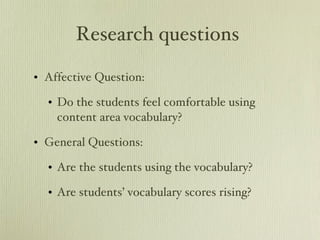
Research questions  Affective Question: Do the students feel comfortable using content area vocabulary? General Questions: Are the students using the vocabulary? Are students’ vocabulary scores rising?
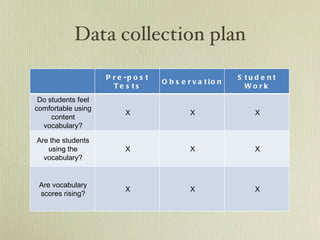
Data collection plan Pre-post Tests Observation Student Work Do students feel comfortable using content vocabulary? X X X Are the students using the vocabulary? X X X Are vocabulary scores rising? X X X
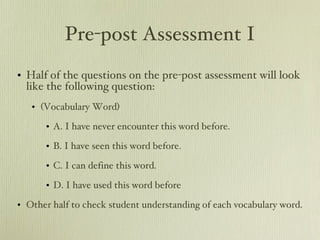
Pre-post Assessment I Half of the questions on the pre-post assessment will look like the following question: (Vocabulary Word)  A. I have never encounter this word before. B. I have seen this word before. C. I can define this word. D. I have used this word before Other half to check student understanding of each vocabulary word.
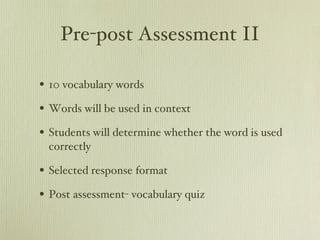
Pre-post Assessment II 10 vocabulary words Words will be used in context Students will determine whether the word is used correctly  Selected response format Post assessment- vocabulary quiz
Observation guidelines Specific items to observe: If the students used vocabulary words When and how often students use vocabulary words in speech and writing Tally of how many times students use vocabulary words  Questions to think about during observation: Do students hesitate when attempting to use vocabulary words?
Timeline Each group member will complete every step on the decided day in their respective classrooms. October 18: pre-test 1 will be given with the vocabulary for the week. October 22: post-test 1 will be given for the same vocabulary. October 25: pre-test 2 given with vocabulary for the week.  Week of October 26: strategy implemented October 29: post-test 2 will be given for the same vocabulary November 8 and 9: analyze data
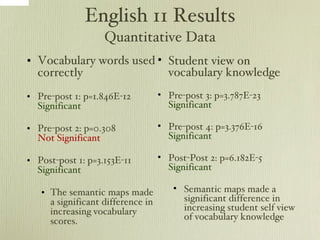
English 11 Results Quantitative Data Vocabulary words used correctly Pre-post 1: p=1.846E-12  Significant Pre-post 2: p=0.308  Not Significant Post-post 1: p=3.153E-11  Significant The semantic maps made a significant difference in increasing vocabulary scores. Student view on vocabulary knowledge Pre-post 3: p=3.787E-23  Significant Pre-post 4: p=3.376E-16  Significant Post-Post 2: p=6.182E-5  Significant Semantic maps made a significant difference in increasing student self view of vocabulary knowledge
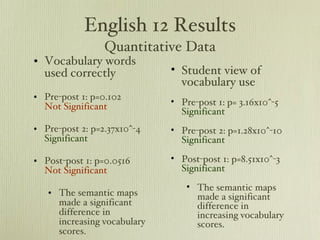
English 12 Results Quantitative Data Vocabulary words used correctly Pre-post 1: p=0.102  Not Significant Pre-post 2: p=2.37x10^-4  Significant Post-post 1: p=0.0516  Not Significant The semantic maps made a significant difference in increasing vocabulary scores. Student view of vocabulary use Pre-post 1: p= 3.16x10^-5  Significant Pre-post 2: p=1.28x10^-10  Significant Post-post 1: p=8.51x10^-3  Significant The semantic maps made a significant difference in increasing vocabulary scores.
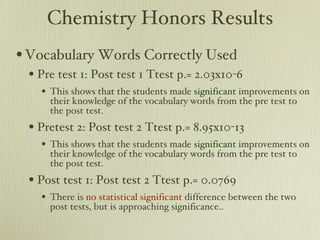
Chemistry Honors Results Vocabulary Words Correctly Used Pre test 1: Post test 1 Ttest p.= 2.03x10⁻⁶ This shows that the students made  significant  improvements on their knowledge of the vocabulary words from the pre test to the post test. Pretest 2: Post test 2 Ttest p.= 8.95x10⁻¹³ This shows that the students made  significant  improvements on their knowledge of the vocabulary words from the pre test to the post test. Post test 1: Post test 2 Ttest p.= 0.0769 There is  no statistical significant  difference between the two post tests, but is approaching significance..
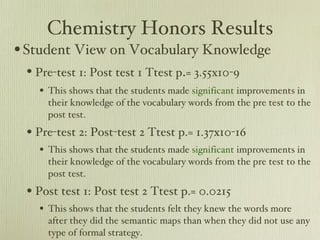
Chemistry Honors Results Student View on Vocabulary Knowledge Pre-test 1: Post test 1 Ttest p . = 3.55x10⁻⁹ This shows that the students made  significant  improvements in their knowledge of the vocabulary words from the pre test to the post test. Pre-test 2: Post-test 2 Ttest p.= 1.37x10⁻¹⁶ This shows that the students made  significant  improvements in their knowledge of the vocabulary words from the pre test to the post test. Post test 1: Post test 2 Ttest p.= 0.0215 This shows that the students felt they knew the words more after they did the semantic maps than when they did not use any type of formal strategy.
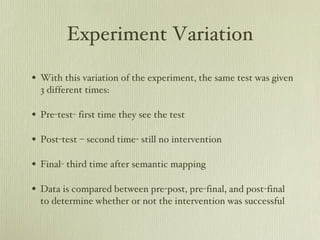
Experiment Variation With this variation of the experiment, the same test was given 3 different times: Pre-test- first time they see the test Post-test – second time- still no intervention Final- third time after semantic mapping  Data is compared between pre-post, pre-final, and post-final to determine whether or not the intervention was successful
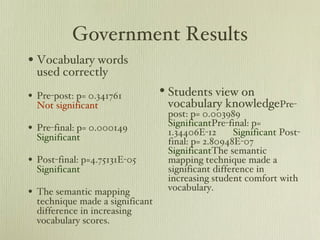
Government Results Vocabulary words used correctly  Pre-post: p= 0.341761  Not significant Pre-final: p= 0.000149  Significant Post-final: p=4.75131E-05  Significant The semantic mapping technique made a significant difference in increasing vocabulary scores. Students view on vocabulary knowledge Pre-post: p= 0.003989  Significant Pre-final: p= 1.34406E-12  Significant  Post-final: p= 2.80948E-07  Significant The semantic mapping technique made a significant difference in increasing student comfort with vocabulary.
Findings from observations Few observations were made: rarely using vocabulary words in English or Government class used more in practice in Chemistry used when explicitly asked to Students recognized words when used by others
Overall Findings Vocabulary scores increased from Post 1 to Post 2 Student view of vocabulary use increased Rare student use of vocabulary words in the classroom setting, more confidence and use in Chemistry Recognition of vocabulary words when used
Answers to research questions Are the students using the vocabulary?  Students use vocabulary rarely Students reported using vocabulary words more often after the implementation of semantic mapping Therefore- semantic mapping increases student use of vocabulary words
Answers to research questions Are students’ vocabulary scores rising? Yes, scores are rising in English and Government, but not in Chemistry could be due to a lack of vocabulary routine in Chemistry.
Discussion This strategy yielded overall positive results although reimplementation would help to provide more reliable results Reasons data could be flawed: Faulty selected response questions Strategies were not implemented identically in all classrooms, nor did they follow a specific procedure difficulty of vocabulary words varied across data sets Timing of the tests Deviation from observation guidelines Too many words in a short amount of time for Chemistry
Next steps? Implications for Future Research: strategy should be implemented identically across all content areas use fewer vocabulary words of relatively equal difficulty  could be broken into two separate studies One study on vocabulary scores specify use as a study tool One study on student view on vocabulary use
Back to the big picture Semantic mapping is one of many study tools Students need to learn about different study tools encouraged to use other visuals as study tools to study for the SAT.

Carp powerpoint

  • 1.
    Vocabulary Strategies toImprove SAT Scores Leonardtown High School Christine Chadwick, Stefanie Glorioso, Daniel Morris, Marc Pirner
  • 2.
    Justification 35 Strategiesfor developing Content Area Vocabulary by “ Content area achievement depends closely on students’ mastery of specialized vocabulary”Our Strategy: Semantic Mapping SIP: Improve SAT scores- “Offer the entire school testing skills and vocabulary words”
  • 3.
    Content Area ExamplesEnglish- students write the way they talk (or text), emphasis on vocabulary to help overall academic English English- explicit academic vocabulary instruction is not being observed in some classes Government- there are many words and concepts that are specific to government that are fundamental to learning / high performance in social studies Chemistry- there are many vocabulary words that are highly specific to chemistry that are need to be successful in the sciences
  • 4.
    Problem and PopulationStudents could improve their verbal SAT scores and content area achievement with more explicit vocabulary instruction. Population: Honors Chemistry English 11 and 12 Standard and CM Government 10 CM
  • 5.
    Semantic Map Structuredword map write the vocabulary word in the center connect words that are synonyms, antonyms, definitions, examples, parts of speech etc.   Gives students context rather than dictionary definition usage rather than memorization more vocabulary Example of student work
  • 6.
    Allows for avisual/spatial representation of vocabulary Students see the relationships between concepts and vocabulary Requires higher order thinking skills Can help activate prior knowledge Benefits of Strategy
  • 7.
    Research questions Affective Question: Do the students feel comfortable using content area vocabulary? General Questions: Are the students using the vocabulary? Are students’ vocabulary scores rising?
  • 8.
    Data collection planPre-post Tests Observation Student Work Do students feel comfortable using content vocabulary? X X X Are the students using the vocabulary? X X X Are vocabulary scores rising? X X X
  • 9.
    Pre-post Assessment IHalf of the questions on the pre-post assessment will look like the following question: (Vocabulary Word) A. I have never encounter this word before. B. I have seen this word before. C. I can define this word. D. I have used this word before Other half to check student understanding of each vocabulary word.
  • 10.
    Pre-post Assessment II10 vocabulary words Words will be used in context Students will determine whether the word is used correctly Selected response format Post assessment- vocabulary quiz
  • 11.
    Observation guidelines Specificitems to observe: If the students used vocabulary words When and how often students use vocabulary words in speech and writing Tally of how many times students use vocabulary words Questions to think about during observation: Do students hesitate when attempting to use vocabulary words?
  • 12.
    Timeline Each groupmember will complete every step on the decided day in their respective classrooms. October 18: pre-test 1 will be given with the vocabulary for the week. October 22: post-test 1 will be given for the same vocabulary. October 25: pre-test 2 given with vocabulary for the week. Week of October 26: strategy implemented October 29: post-test 2 will be given for the same vocabulary November 8 and 9: analyze data
  • 13.
    English 11 ResultsQuantitative Data Vocabulary words used correctly Pre-post 1: p=1.846E-12 Significant Pre-post 2: p=0.308 Not Significant Post-post 1: p=3.153E-11 Significant The semantic maps made a significant difference in increasing vocabulary scores. Student view on vocabulary knowledge Pre-post 3: p=3.787E-23 Significant Pre-post 4: p=3.376E-16 Significant Post-Post 2: p=6.182E-5 Significant Semantic maps made a significant difference in increasing student self view of vocabulary knowledge
  • 14.
    English 12 ResultsQuantitative Data Vocabulary words used correctly Pre-post 1: p=0.102 Not Significant Pre-post 2: p=2.37x10^-4 Significant Post-post 1: p=0.0516 Not Significant The semantic maps made a significant difference in increasing vocabulary scores. Student view of vocabulary use Pre-post 1: p= 3.16x10^-5 Significant Pre-post 2: p=1.28x10^-10 Significant Post-post 1: p=8.51x10^-3 Significant The semantic maps made a significant difference in increasing vocabulary scores.
  • 15.
    Chemistry Honors ResultsVocabulary Words Correctly Used Pre test 1: Post test 1 Ttest p.= 2.03x10⁻⁶ This shows that the students made significant improvements on their knowledge of the vocabulary words from the pre test to the post test. Pretest 2: Post test 2 Ttest p.= 8.95x10⁻¹³ This shows that the students made significant improvements on their knowledge of the vocabulary words from the pre test to the post test. Post test 1: Post test 2 Ttest p.= 0.0769 There is no statistical significant difference between the two post tests, but is approaching significance..
  • 16.
    Chemistry Honors ResultsStudent View on Vocabulary Knowledge Pre-test 1: Post test 1 Ttest p . = 3.55x10⁻⁹ This shows that the students made significant improvements in their knowledge of the vocabulary words from the pre test to the post test. Pre-test 2: Post-test 2 Ttest p.= 1.37x10⁻¹⁶ This shows that the students made significant improvements in their knowledge of the vocabulary words from the pre test to the post test. Post test 1: Post test 2 Ttest p.= 0.0215 This shows that the students felt they knew the words more after they did the semantic maps than when they did not use any type of formal strategy.
  • 17.
    Experiment Variation Withthis variation of the experiment, the same test was given 3 different times: Pre-test- first time they see the test Post-test – second time- still no intervention Final- third time after semantic mapping Data is compared between pre-post, pre-final, and post-final to determine whether or not the intervention was successful
  • 18.
    Government Results Vocabularywords used correctly Pre-post: p= 0.341761 Not significant Pre-final: p= 0.000149 Significant Post-final: p=4.75131E-05 Significant The semantic mapping technique made a significant difference in increasing vocabulary scores. Students view on vocabulary knowledge Pre-post: p= 0.003989 Significant Pre-final: p= 1.34406E-12 Significant Post-final: p= 2.80948E-07 Significant The semantic mapping technique made a significant difference in increasing student comfort with vocabulary.
  • 19.
    Findings from observationsFew observations were made: rarely using vocabulary words in English or Government class used more in practice in Chemistry used when explicitly asked to Students recognized words when used by others
  • 20.
    Overall Findings Vocabularyscores increased from Post 1 to Post 2 Student view of vocabulary use increased Rare student use of vocabulary words in the classroom setting, more confidence and use in Chemistry Recognition of vocabulary words when used
  • 21.
    Answers to researchquestions Are the students using the vocabulary? Students use vocabulary rarely Students reported using vocabulary words more often after the implementation of semantic mapping Therefore- semantic mapping increases student use of vocabulary words
  • 22.
    Answers to researchquestions Are students’ vocabulary scores rising? Yes, scores are rising in English and Government, but not in Chemistry could be due to a lack of vocabulary routine in Chemistry.
  • 23.
    Discussion This strategyyielded overall positive results although reimplementation would help to provide more reliable results Reasons data could be flawed: Faulty selected response questions Strategies were not implemented identically in all classrooms, nor did they follow a specific procedure difficulty of vocabulary words varied across data sets Timing of the tests Deviation from observation guidelines Too many words in a short amount of time for Chemistry
  • 24.
    Next steps? Implicationsfor Future Research: strategy should be implemented identically across all content areas use fewer vocabulary words of relatively equal difficulty could be broken into two separate studies One study on vocabulary scores specify use as a study tool One study on student view on vocabulary use
  • 25.
    Back to thebig picture Semantic mapping is one of many study tools Students need to learn about different study tools encouraged to use other visuals as study tools to study for the SAT.

Editor's Notes

  • #21 Before moving to the next slide, talk about why Chemistry words were used more- possibly because they are more practical and used in a more concrete way than words like oligarchy or imperialism