The 1987 Philippine Constitution
Article 13Social Justice and Human Rights(R.A. 6657-Comprehensive Agrarian Reform Program)
Constitution of the Philippines  the supreme law of the Philippines
 democratic and republican State
 enacted in 1987, during the administration of     President Corazon Aquino, and is popularly known as the "1987 Constitution”.
 The Constitution is divided into 18 parts, excluding the Preamble, which are called Articles.Social Justice and Human Rights refers to the idea of creating a society or institution that is based on the principles of equality and solidarity, that understands and values human rights, and that recognizes the dignity of every human being.
  based on the concepts of human rights and equality and involves a greater degree of economic egalitarianism through progressive taxation, income redistribution, or even property redistribution.Aim  to achieve what developmental economists refer to as moreequality of opportunity than may currently exist in some societies.
  to manufacture equality of outcome in cases where incidental inequalities appear in a procedurally just system. PreambleWe, the sovereign Filipino people, imploring the aid of Almighty God, in order to build a just and humane society and establish a Government that shall embody our ideals and aspirations, promote the common good, conserve and develop our patrimony, and secure to ourselves and our posterity the blessings of independence and democracy under the rule of law and a regime of truth, justice, freedom, love, equality, and peace, do ordain and promulgate this Constitution.
Article XIII – Social Justice and Human Rights Labor
 Agrarian and Natural Resources Reform
 Urban Land Reform and Housing
 Health
 Women
 Role and Rights of People's Organizations
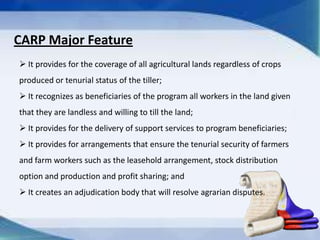
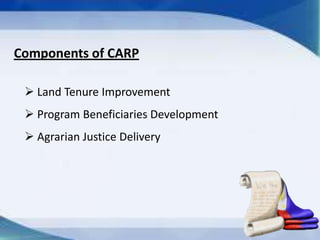
 Human RightsComprehensive Agrarian Reform Program a Philippine state policy that ensures and promotes welfare of landless farmers and farm workers, as well as elevation of social justice and equity among rural areas.
 CARP was established by the Comprehensive Agrarian Reform Law of 1988 (CARL).
  aimed for a nation with equitable land ownership and empowered agrarian reform beneficiaries while, at least, improving social lives.
 enacted by the 8th Congress of the Philippines and signed by Aquino on June 10, 1988.Objective  To successfully devise land reform in Philippines.
 To improve the economic and social status of the beneficiaries of land reform in Philippines.Objectives of Agrarian Reform - Political to put an end to conflicts pertaining to land ownership.
 to bring about harmony between the rural people and the urban residents.
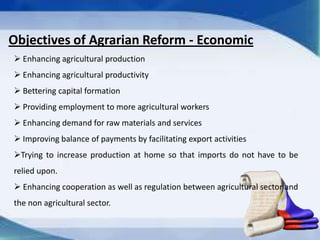
 bringing stability in the political set up of the country.Objective of Agrarian Reform - Social bringing about equality in terms of opportunities, income as well as wealth.Objectives of Agrarian Reform - Economic Enhancing agricultural production
 Enhancing agricultural productivity
 Bettering capital formation
 Providing employment to more agricultural workers

Comprehensive Agrarian Reform

  • 1.
  • 2.
    Article 13Social Justiceand Human Rights(R.A. 6657-Comprehensive Agrarian Reform Program)
  • 3.
    Constitution of thePhilippines  the supreme law of the Philippines
  • 4.
    democratic andrepublican State
  • 5.
    enacted in1987, during the administration of President Corazon Aquino, and is popularly known as the "1987 Constitution”.
  • 6.
    The Constitutionis divided into 18 parts, excluding the Preamble, which are called Articles.Social Justice and Human Rights refers to the idea of creating a society or institution that is based on the principles of equality and solidarity, that understands and values human rights, and that recognizes the dignity of every human being.
  • 7.
     based onthe concepts of human rights and equality and involves a greater degree of economic egalitarianism through progressive taxation, income redistribution, or even property redistribution.Aim  to achieve what developmental economists refer to as moreequality of opportunity than may currently exist in some societies.
  • 8.
     to manufacture equalityof outcome in cases where incidental inequalities appear in a procedurally just system. PreambleWe, the sovereign Filipino people, imploring the aid of Almighty God, in order to build a just and humane society and establish a Government that shall embody our ideals and aspirations, promote the common good, conserve and develop our patrimony, and secure to ourselves and our posterity the blessings of independence and democracy under the rule of law and a regime of truth, justice, freedom, love, equality, and peace, do ordain and promulgate this Constitution.
  • 9.
    Article XIII –Social Justice and Human Rights Labor
  • 10.
    Agrarian andNatural Resources Reform
  • 11.
    Urban LandReform and Housing
  • 12.
  • 13.
  • 14.
    Role andRights of People's Organizations
  • 15.
    Human RightsComprehensiveAgrarian Reform Program a Philippine state policy that ensures and promotes welfare of landless farmers and farm workers, as well as elevation of social justice and equity among rural areas.
  • 16.
    CARP wasestablished by the Comprehensive Agrarian Reform Law of 1988 (CARL).
  • 17.
     aimed fora nation with equitable land ownership and empowered agrarian reform beneficiaries while, at least, improving social lives.
  • 18.
     enacted by the 8thCongress of the Philippines and signed by Aquino on June 10, 1988.Objective To successfully devise land reform in Philippines.
  • 19.
    To improvethe economic and social status of the beneficiaries of land reform in Philippines.Objectives of Agrarian Reform - Political to put an end to conflicts pertaining to land ownership.
  • 20.
    to bringabout harmony between the rural people and the urban residents.
  • 21.
    bringing stabilityin the political set up of the country.Objective of Agrarian Reform - Social bringing about equality in terms of opportunities, income as well as wealth.Objectives of Agrarian Reform - Economic Enhancing agricultural production
  • 22.
  • 23.
  • 24.
    Providing employmentto more agricultural workers