Vocabulary Strategies to Improve SAT Scores By Christine Chadwick, Stefanie Glorioso, and Daniel Morris
Justification 35 Strategies for developing Content Area Vocabulary  by Brenda Spencer and Andrea Guillaume “ Content area achievement depends closely on students’ mastery of specialized  vocabulary” Our Strategy: Semantic Mapping SIP: Improve SAT scores- “Offer the entire school testing skills and vocabulary words” Frayer, Frederick, and Klausmeier (1969) show that concept attainment is more effective through visual organization of definitions and connections to relevance (Frayer Model)
Content Area Examples English - explicit academic vocabulary instruction is not being observed in some classes; students write the way they talk Chemistry - there are many vocabulary words that are highly specific to chemistry that students must be familiar with to be successful in the sciences
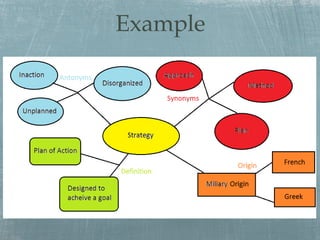
Semantic Map Structured word map write the vocabulary word in the center connect words that are synonyms, antonyms, definitions, examples, parts of speech, etc.   Gives students context rather than dictionary definition usage rather than memorization more vocabulary
Example
Benefits of Strategy Allows for a visual/spatial representation of vocabulary Students see the relationships between concepts and vocabulary Requires higher order thinking skills (Bloom, 1956) Can help activate prior knowledge
Research Questions  Do the students feel comfortable using content area vocabulary? (affective component) Are students’ vocabulary scores rising?
Data Collection Plan Pre-post Tests Student Work Do students feel comfortable using content vocabulary? X X Are vocabulary scores rising? X X
Pre-Post Assessment Half of the questions on the pre-post assessment will look like the following question: odious A. I have never seen this word before. B. I have seen this word before. C. I can define this word. D. I have used this word before
Pre-Post Assessment Post assessment- vocabulary quiz odious There are two odious young men who have been staring at me this half hour. She was odiously joyful. She smelled odious. He jumped odiously.
English 11 Results Vocabulary words used correctly n = 62 Experimental Week: Pre-test average: 5.89 Post-test average: 5.71 p = 0.308   Not Significant The semantic maps made a significant difference in increasing vocabulary scores between the first pre and post-test and the two post-tests.
English 11 Results S tudent view on vocabulary knowledge n = 62 Experimental Week:  Pre-test average: 21.285 Post-test average: 29.08 p < .001   Significant Semantic maps made a significant difference in increasing student self view of vocabulary knowledge
English 12 Results Vocabulary words used correctly n = 117 Experimental Week: Pre-test average: 9.8 Post-test average: 12.5 p < .001   Significant The semantic maps made a significant difference in increasing vocabulary scores.
English 12 Results Student view of vocabulary use n = 117 Experimental Week:  Pre-test average: 13.12 Post-test average: 16.07 p < .001  Significant The semantic maps made a significant difference in increasing vocabulary scores.
Chemistry Results Vocabulary Words Correctly Used n = 33 Experimental Week: Pre-test 2 average: 3.29  Post-test 2 average:6.68 p < .001   Significant This shows that significant change from both pre-tests to post-tests were leading towards significant.
Chemistry Results Student View on Vocabulary Knowledge n=33 Experimental Week: Pre-test average: 19.1 Post-test average: 33.4 p= 1.37x10⁻¹⁶  Significant This shows that significant change across all tests.
Answers to Research Questions Are students’ vocabulary scores rising? Yes, scores are rising in English, but not in Chemistry could be due to a lack of vocabulary routine in Chemistry.
Do the students feel comfortable using content area vocabulary? YES!
Overall Findings Vocabulary scores increased from control week to the experimental week with the use of semantic mapping  Chemistry was approaching significance Student view of vocabulary use increased
Next Steps? Implications for teachers and students: Semantic mapping is one of many study tools that students need to learn. We should encourage students to use other visuals as study tools to study for the SAT.  This strategy can be implemented in different ways to suit different content areas. use fewer vocabulary words of relatively equal difficulty

Full mpds presentation 2011

  • 1.
    Vocabulary Strategies toImprove SAT Scores By Christine Chadwick, Stefanie Glorioso, and Daniel Morris
  • 2.
    Justification 35 Strategiesfor developing Content Area Vocabulary by Brenda Spencer and Andrea Guillaume “ Content area achievement depends closely on students’ mastery of specialized vocabulary” Our Strategy: Semantic Mapping SIP: Improve SAT scores- “Offer the entire school testing skills and vocabulary words” Frayer, Frederick, and Klausmeier (1969) show that concept attainment is more effective through visual organization of definitions and connections to relevance (Frayer Model)
  • 3.
    Content Area ExamplesEnglish - explicit academic vocabulary instruction is not being observed in some classes; students write the way they talk Chemistry - there are many vocabulary words that are highly specific to chemistry that students must be familiar with to be successful in the sciences
  • 4.
    Semantic Map Structuredword map write the vocabulary word in the center connect words that are synonyms, antonyms, definitions, examples, parts of speech, etc.   Gives students context rather than dictionary definition usage rather than memorization more vocabulary
  • 5.
  • 6.
    Benefits of StrategyAllows for a visual/spatial representation of vocabulary Students see the relationships between concepts and vocabulary Requires higher order thinking skills (Bloom, 1956) Can help activate prior knowledge
  • 7.
    Research Questions Do the students feel comfortable using content area vocabulary? (affective component) Are students’ vocabulary scores rising?
  • 8.
    Data Collection PlanPre-post Tests Student Work Do students feel comfortable using content vocabulary? X X Are vocabulary scores rising? X X
  • 9.
    Pre-Post Assessment Halfof the questions on the pre-post assessment will look like the following question: odious A. I have never seen this word before. B. I have seen this word before. C. I can define this word. D. I have used this word before
  • 10.
    Pre-Post Assessment Postassessment- vocabulary quiz odious There are two odious young men who have been staring at me this half hour. She was odiously joyful. She smelled odious. He jumped odiously.
  • 11.
    English 11 ResultsVocabulary words used correctly n = 62 Experimental Week: Pre-test average: 5.89 Post-test average: 5.71 p = 0.308 Not Significant The semantic maps made a significant difference in increasing vocabulary scores between the first pre and post-test and the two post-tests.
  • 12.
    English 11 ResultsS tudent view on vocabulary knowledge n = 62 Experimental Week: Pre-test average: 21.285 Post-test average: 29.08 p < .001 Significant Semantic maps made a significant difference in increasing student self view of vocabulary knowledge
  • 13.
    English 12 ResultsVocabulary words used correctly n = 117 Experimental Week: Pre-test average: 9.8 Post-test average: 12.5 p < .001 Significant The semantic maps made a significant difference in increasing vocabulary scores.
  • 14.
    English 12 ResultsStudent view of vocabulary use n = 117 Experimental Week: Pre-test average: 13.12 Post-test average: 16.07 p < .001 Significant The semantic maps made a significant difference in increasing vocabulary scores.
  • 15.
    Chemistry Results VocabularyWords Correctly Used n = 33 Experimental Week: Pre-test 2 average: 3.29 Post-test 2 average:6.68 p < .001 Significant This shows that significant change from both pre-tests to post-tests were leading towards significant.
  • 16.
    Chemistry Results StudentView on Vocabulary Knowledge n=33 Experimental Week: Pre-test average: 19.1 Post-test average: 33.4 p= 1.37x10⁻¹⁶ Significant This shows that significant change across all tests.
  • 17.
    Answers to ResearchQuestions Are students’ vocabulary scores rising? Yes, scores are rising in English, but not in Chemistry could be due to a lack of vocabulary routine in Chemistry.
  • 18.
    Do the studentsfeel comfortable using content area vocabulary? YES!
  • 19.
    Overall Findings Vocabularyscores increased from control week to the experimental week with the use of semantic mapping Chemistry was approaching significance Student view of vocabulary use increased
  • 20.
    Next Steps? Implicationsfor teachers and students: Semantic mapping is one of many study tools that students need to learn. We should encourage students to use other visuals as study tools to study for the SAT. This strategy can be implemented in different ways to suit different content areas. use fewer vocabulary words of relatively equal difficulty

Editor's Notes

  • #20 Before moving to the next slide, talk about why Chemistry words were used more- possibly because they are more practical and used in a more concrete way than words like oligarchy or imperialism