Reading First
Assessment
Faculty Presentation
Fundamental Discoveries About How
Children Learn to Read
1. Children who enter first grade weak in phonemic awareness have
difficulties learning to “crack the code” of written language.
2. Children who do not acquire good phonemic decoding skills
(phonics) in first grade tend to rely too much on guessing; they
remain inaccurate in their reading and do not read independently.
3. Children must read widely and read accurately in order to acquire
the “sight word vocabulary” that makes them fluent readers.
4. Children who can read the words in grade level text fluently and
accurately can more easily comprehend the meaning of what they
are reading.
The Consequences of Being Left
Behind in Early Reading Growth
1. Children don’t read as much, and miss too many
opportunities for reading practice.
2. Reading is frustrating and this affects attitudes and
motivation to read
3. Opportunities for the development of vocabulary are
missed
Reading First Assessments
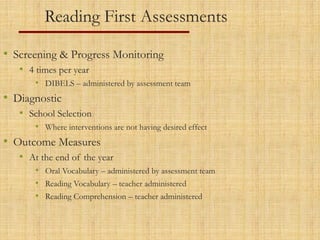
• Screening & Progress Monitoring
• 4 times per year
• DIBELS – administered by assessment team
• Diagnostic
• School Selection
• Where interventions are not having desired effect
• Outcome Measures
• At the end of the year
• Oral Vocabulary – administered by assessment team
• Reading Vocabulary – teacher administered
• Reading Comprehension – teacher administered
Overview of DIBELS Measures
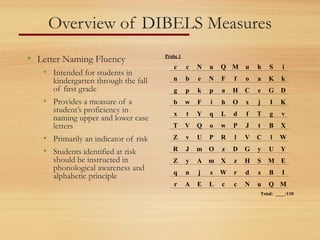
• Letter Naming Fluency
• Intended for students in
kindergarten through the fall
of first grade
• Provides a measure of a
student’s proficiency in
naming upper and lower case
letters
• Primarily an indicator of risk
• Students identified at risk
should be instructed in
phonological awareness and
alphabetic principle
Probe 1
c c N u Q M u h S i
n b e N F f o a K k
g p k p a H C e G D
b w F i h O x j I K
x t Y q L d f T g v
T V Q o w P J t B X
Z v U P R l V C l W
R J m O z D G y U Y
Z y A m X z H S M E
q n j s W r d s B I
r A E L c c N u Q M
Total: ____/110
Overview of DIBELS Measures
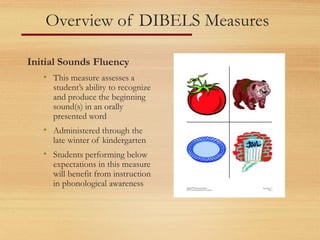
Initial Sounds Fluency
• This measure assesses a
student’s ability to recognize
and produce the beginning
sound(s) in an orally
presented word
• Administered through the
late winter of kindergarten
• Students performing below
expectations in this measure
will benefit from instruction
in phonological awareness
Overview of DIBELS Measures
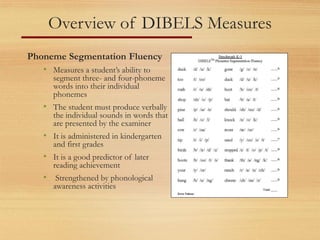
Phoneme Segmentation Fluency
• Measures a student’s ability to
segment three- and four-phoneme
words into their individual
phonemes
• The student must produce verbally
the individual sounds in words that
are presented by the examiner
• It is administered in kindergarten
and first grades
• It is a good predictor of later
reading achievement
• Strengthened by phonological
awareness activities
Overview of DIBELS Measures
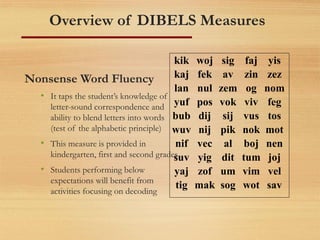
Nonsense Word Fluency
• It taps the student’s knowledge of
letter-sound correspondence and
ability to blend letters into words
(test of the alphabetic principle)
• This measure is provided in
kindergarten, first and second grades
• Students performing below
expectations will benefit from
activities focusing on decoding
kik woj sig faj yis
kaj fek av zin zez
lan nul zem og nom
yuf pos vok viv feg
bub dij sij vus tos
wuv nij pik nok mot
nif vec al boj nen
suv yig dit tum joj
yaj zof um vim vel
tig mak sog wot sav
Overview of DIBELS Measures
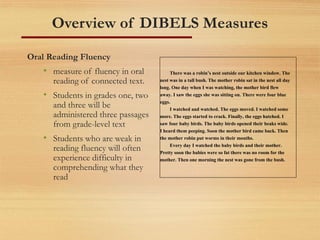
Oral Reading Fluency
• measure of fluency in oral
reading of connected text.
• Students in grades one, two
and three will be
administered three passages
from grade-level text
• Students who are weak in
reading fluency will often
experience difficulty in
comprehending what they
read
There was a robin’s nest outside our kitchen window. The
nest was in a tall bush. The mother robin sat in the nest all day
long. One day when I was watching, the mother bird flew
away. I saw the eggs she was sitting on. There were four blue
eggs.
I watched and watched. The eggs moved. I watched some
more. The eggs started to crack. Finally, the eggs hatched. I
saw four baby birds. The baby birds opened their beaks wide.
I heard them peeping. Soon the mother bird came back. Then
the mother robin put worms in their mouths.
Every day I watched the baby birds and their mother.
Pretty soon the babies were so fat there was no room for the
mother. Then one morning the nest was gone from the bush.
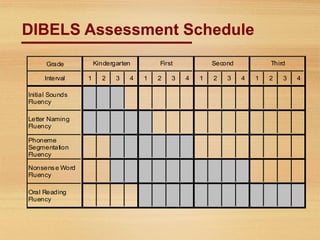
DIBELS Assessment Schedule
Grade
Interval 1 2 3 4 1 2 3 4 1 2 3 4 1 2 3 4
Initial Sounds
Fluency
Letter Naming
Fluency
Phoneme
Segmentation
Fluency
Nonsense Word
Fluency
Oral Reading
Fluency
Kindergarten First Second Third
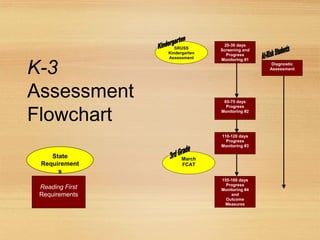
K-3
Assessment
Flowchart
State
Requirement
s
Reading First
Requirements
SRUSS
Kindergarten
Assessment
March
FCAT
20-30 days
Screening and
Progress
Monitoring #1
65-75 days
Progress
Monitoring #2
110-120 days
Progress
Monitoring #3
155-169 days
Progress
Monitoring #4
and
Outcome
Measures
Diagnostic
Assessment
Diagnostic Measures
School selection of diagnostic measures for
• Phonological awareness
• Phonics
• Fluency
• Vocabulary
• Comprehension
Outcome Measures
Oral Vocabulary (K – 3)
• Peabody Picture Vocabulary Test – III form B
• Individually administered
Reading Vocabulary (Grades 2 – 3)
• GMRT
• Group administered
Reading Comprehension (Grades 1 – 3)
• SAT-10
• Group administered
Teachers will be able to
• Identify students “at risk” for reading failure
(screening)
• Determine if students are learning critical
skills at an adequate rate (progress
monitoring)
• Identify specific skills that will be targeted
with intervention (diagnostic)
• Evaluate the effectiveness of the reading
instruction for meeting reading goals for all
children (outcome)
Reading Coach as School-Based Facilitator
of Assessment
• Attends training as part of district-level team
• Assists principal with faculty/staff presentations
• Manages data gathering procedures (class lists, teacher schedules,
master assessment schedule, organizing assessment materials)
• Establishes location for district and school-based teams to work
during assessment times
• Assigns or assesses challenged cases
• Receives and returns all used and unused student record forms to
district facilitator
• Provides feedback to FCRR staff on issues of implementation
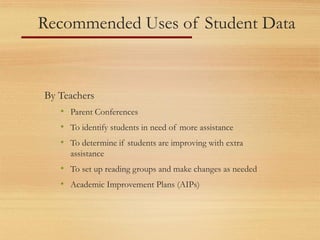
Recommended Uses of Student Data
By Teachers
• Parent Conferences
• To identify students in need of more assistance
• To determine if students are improving with extra
assistance
• To set up reading groups and make changes as needed
• Academic Improvement Plans (AIPs)
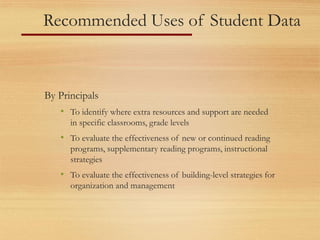
Recommended Uses of Student Data
By Principals
• To identify where extra resources and support are needed
in specific classrooms, grade levels
• To evaluate the effectiveness of new or continued reading
programs, supplementary reading programs, instructional
strategies
• To evaluate the effectiveness of building-level strategies for
organization and management
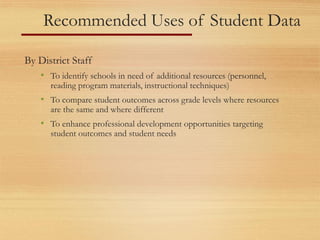
Recommended Uses of Student Data
By District Staff
• To identify schools in need of additional resources (personnel,
reading program materials, instructional techniques)
• To compare student outcomes across grade levels where resources
are the same and where different
• To enhance professional development opportunities targeting
student outcomes and student needs
12Assessment: Specific Assessments For Readers

12Assessment: Specific Assessments For Readers

  • 1.
  • 2.
    Fundamental Discoveries AboutHow Children Learn to Read 1. Children who enter first grade weak in phonemic awareness have difficulties learning to “crack the code” of written language. 2. Children who do not acquire good phonemic decoding skills (phonics) in first grade tend to rely too much on guessing; they remain inaccurate in their reading and do not read independently. 3. Children must read widely and read accurately in order to acquire the “sight word vocabulary” that makes them fluent readers. 4. Children who can read the words in grade level text fluently and accurately can more easily comprehend the meaning of what they are reading.
  • 3.
    The Consequences ofBeing Left Behind in Early Reading Growth 1. Children don’t read as much, and miss too many opportunities for reading practice. 2. Reading is frustrating and this affects attitudes and motivation to read 3. Opportunities for the development of vocabulary are missed
  • 4.
    Reading First Assessments •Screening & Progress Monitoring • 4 times per year • DIBELS – administered by assessment team • Diagnostic • School Selection • Where interventions are not having desired effect • Outcome Measures • At the end of the year • Oral Vocabulary – administered by assessment team • Reading Vocabulary – teacher administered • Reading Comprehension – teacher administered
  • 5.
    Overview of DIBELSMeasures • Letter Naming Fluency • Intended for students in kindergarten through the fall of first grade • Provides a measure of a student’s proficiency in naming upper and lower case letters • Primarily an indicator of risk • Students identified at risk should be instructed in phonological awareness and alphabetic principle Probe 1 c c N u Q M u h S i n b e N F f o a K k g p k p a H C e G D b w F i h O x j I K x t Y q L d f T g v T V Q o w P J t B X Z v U P R l V C l W R J m O z D G y U Y Z y A m X z H S M E q n j s W r d s B I r A E L c c N u Q M Total: ____/110
  • 6.
    Overview of DIBELSMeasures Initial Sounds Fluency • This measure assesses a student’s ability to recognize and produce the beginning sound(s) in an orally presented word • Administered through the late winter of kindergarten • Students performing below expectations in this measure will benefit from instruction in phonological awareness
  • 7.
    Overview of DIBELSMeasures Phoneme Segmentation Fluency • Measures a student’s ability to segment three- and four-phoneme words into their individual phonemes • The student must produce verbally the individual sounds in words that are presented by the examiner • It is administered in kindergarten and first grades • It is a good predictor of later reading achievement • Strengthened by phonological awareness activities
  • 8.
    Overview of DIBELSMeasures Nonsense Word Fluency • It taps the student’s knowledge of letter-sound correspondence and ability to blend letters into words (test of the alphabetic principle) • This measure is provided in kindergarten, first and second grades • Students performing below expectations will benefit from activities focusing on decoding kik woj sig faj yis kaj fek av zin zez lan nul zem og nom yuf pos vok viv feg bub dij sij vus tos wuv nij pik nok mot nif vec al boj nen suv yig dit tum joj yaj zof um vim vel tig mak sog wot sav
  • 9.
    Overview of DIBELSMeasures Oral Reading Fluency • measure of fluency in oral reading of connected text. • Students in grades one, two and three will be administered three passages from grade-level text • Students who are weak in reading fluency will often experience difficulty in comprehending what they read There was a robin’s nest outside our kitchen window. The nest was in a tall bush. The mother robin sat in the nest all day long. One day when I was watching, the mother bird flew away. I saw the eggs she was sitting on. There were four blue eggs. I watched and watched. The eggs moved. I watched some more. The eggs started to crack. Finally, the eggs hatched. I saw four baby birds. The baby birds opened their beaks wide. I heard them peeping. Soon the mother bird came back. Then the mother robin put worms in their mouths. Every day I watched the baby birds and their mother. Pretty soon the babies were so fat there was no room for the mother. Then one morning the nest was gone from the bush.
  • 10.
    DIBELS Assessment Schedule Grade Interval1 2 3 4 1 2 3 4 1 2 3 4 1 2 3 4 Initial Sounds Fluency Letter Naming Fluency Phoneme Segmentation Fluency Nonsense Word Fluency Oral Reading Fluency Kindergarten First Second Third
  • 11.
    K-3 Assessment Flowchart State Requirement s Reading First Requirements SRUSS Kindergarten Assessment March FCAT 20-30 days Screeningand Progress Monitoring #1 65-75 days Progress Monitoring #2 110-120 days Progress Monitoring #3 155-169 days Progress Monitoring #4 and Outcome Measures Diagnostic Assessment
  • 12.
    Diagnostic Measures School selectionof diagnostic measures for • Phonological awareness • Phonics • Fluency • Vocabulary • Comprehension
  • 13.
    Outcome Measures Oral Vocabulary(K – 3) • Peabody Picture Vocabulary Test – III form B • Individually administered Reading Vocabulary (Grades 2 – 3) • GMRT • Group administered Reading Comprehension (Grades 1 – 3) • SAT-10 • Group administered
  • 14.
    Teachers will beable to • Identify students “at risk” for reading failure (screening) • Determine if students are learning critical skills at an adequate rate (progress monitoring) • Identify specific skills that will be targeted with intervention (diagnostic) • Evaluate the effectiveness of the reading instruction for meeting reading goals for all children (outcome)
  • 15.
    Reading Coach asSchool-Based Facilitator of Assessment • Attends training as part of district-level team • Assists principal with faculty/staff presentations • Manages data gathering procedures (class lists, teacher schedules, master assessment schedule, organizing assessment materials) • Establishes location for district and school-based teams to work during assessment times • Assigns or assesses challenged cases • Receives and returns all used and unused student record forms to district facilitator • Provides feedback to FCRR staff on issues of implementation
  • 16.
    Recommended Uses ofStudent Data By Teachers • Parent Conferences • To identify students in need of more assistance • To determine if students are improving with extra assistance • To set up reading groups and make changes as needed • Academic Improvement Plans (AIPs)
  • 17.
    Recommended Uses ofStudent Data By Principals • To identify where extra resources and support are needed in specific classrooms, grade levels • To evaluate the effectiveness of new or continued reading programs, supplementary reading programs, instructional strategies • To evaluate the effectiveness of building-level strategies for organization and management
  • 18.
    Recommended Uses ofStudent Data By District Staff • To identify schools in need of additional resources (personnel, reading program materials, instructional techniques) • To compare student outcomes across grade levels where resources are the same and where different • To enhance professional development opportunities targeting student outcomes and student needs