
Rosa Martinez
April 19, 2012


CAREER RESILIENCE & CAREER SELF-
RELIANCE
WORKSHOP OUTCOMES

 To become aware of one’s career resilience
  skills
 To identify career self-reliance areas to work
  on
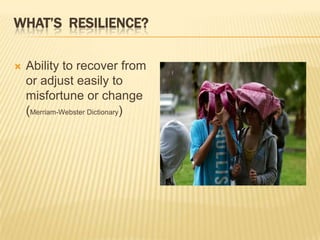
WHAT’S RESILIENCE?

   Ability to recover from
    or adjust easily to
    misfortune or change
    (Merriam-Webster Dictionary)
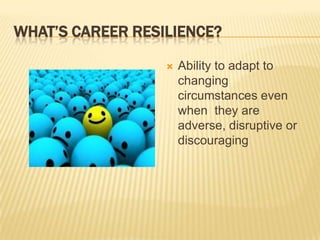
WHAT’S CAREER RESILIENCE?

                     Ability to adapt to
                      changing
                      circumstances even
                      when they are
                      adverse, disruptive or
                      discouraging
TASK 1.

 Self-assess your career resilience skills
  (Worksheet 1)
 Discuss your findings and how you can build
  your resilience skills
DEALING WITH CAREER CHANGES
1) Describe the change. What will you lose as a
   result of this change?

   Example: Job loss
   Losses: Stable job; income; job status; contact
   with co-workers; sense of belonging;
   professional purpose.
2) Find out everything about the change and how it
  affects you. Look for the positives

  Example: The job loss was a result of relocation.
  My profession is a regulated one here so I first
  need to pass a series of regulatory bodies exams
  before working as a doctor again.
 Positives: I 
.
3) Allow yourself time to process what your
  learned about the change and about yourself

 Example: Focus on your leisure activities or
 hobbies; do sports; read a book; meet new
 people
4) Explore the positives that result from this change and make
  some decisions about how you’ll respond to change

Example:
Options: Change career; get a transitional job; get accredited
  as a doctor
Decision: I’ll look for my professional accreditation
Benefit: Greater job satisfaction
Challenge: It takes time and persistence
Next step: Start your accreditation & figure out budget
CAREER RESILIENCE SKILLS
   Acknowledge change as part of your life
   Give yourself time to process it
   Look for opportunities change creates
   Know your skills and keep them updated
   Reframe career development around learning
   Be able to compromise and adapt to changes
TRAITS OF CAREER RESILIENT PEOPLE

   Team players               Focus on continuous
   Effective                   learning
    communicators              Self-confident
   Adaptable to change        Willing to take risks
   Positive and flexible      Committed to personal
    attitudes                   excellence
TASK 2.

   Explore your beliefs and attitudes towards
    work search in your field (Worksheet 2)
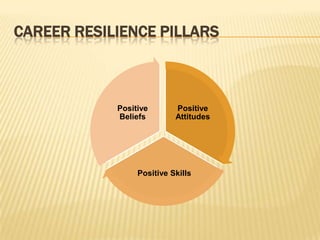
CAREER RESILIENCE PILLARS


            Positive       Positive
            Beliefs        Attitudes


                 Positive Skills
CAREER SELF-RELIANCE
WHAT’S CAREER SELF-RELIANCE?

To depend or rely upon yourself; to be in
charge of your own career
IF YOU ARE CAREER SELF-RELIANT

Growth & development mean:
 Moving sideways, downwards our upwards in
  your current position
 Changing employers

 Changing occupations

 Specializing or generalizing

 Choosing self-employment
CASE STUDY
Jose, an electronic engineer, used to work as a
production manager, in a textile company in his
home country. When he arrived here, he first worked
as a technician for a small embroidery company and
after a year he changed jobs. Now, he works for a
nation-wide company and he plans to take his
professional accreditation exam by October.
In the long-term he would like to start his own
business so he is saving to take some businees
courses first.
TASK 3.

 Complete the Self-Reliance Test (Worksheet
  3)
 Think about the ways you could growth in
  each of the career self-reliance areas
CAREER SELF-RELIANCE SKILLS

   Self-awareness            Matching & decision
   Self-promotion             making
   Exploring & creating      Political awareness
    opportunities             Coping with uncertainty
   Action planning           Development focus
   Networking                Transfer skills
   Negotiation               Self-confidence
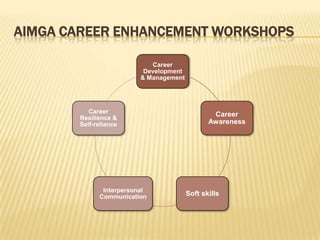
AIMGA CAREER ENHANCEMENT WORKSHOPS

                             Career
                           Development
                          & Management


           Career                                Career
        Resilience &
        Self-reliance                           Awareness


               Interpersonal
              Communication              Soft skills
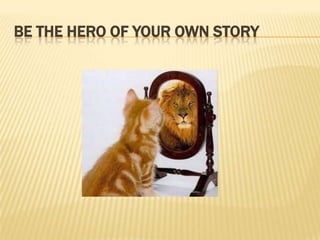
BE THE HERO OF YOUR OWN STORY
REFERENCES
   Brown, B. L. (n.d.). Career Resilience. ERIC Digest. In ERIC
    Digests. Retrieved April 18, 2012, from
    http://www.ericdigests.org/1997-3/career2.html
   Careers: Self-reliance Skills (2010). In Moreton Bay College.
    Retrieved April 18, 2012, from
    http://www.mbc.qld.edu.au/mymbc/careers/careers-self-
    reliance-skills
   Positive Works II (pp. 22-36). (2004). Edmonton, Canada:
    Government of Alberta, Human Resources & Employment.

Career enhancement workshop 5

  • 1.
    Rosa Martinez April 19,2012 CAREER RESILIENCE & CAREER SELF- RELIANCE
  • 3.
    WORKSHOP OUTCOMES  Tobecome aware of one’s career resilience skills  To identify career self-reliance areas to work on
  • 4.
    WHAT’S RESILIENCE?  Ability to recover from or adjust easily to misfortune or change (Merriam-Webster Dictionary)
  • 5.
    WHAT’S CAREER RESILIENCE?  Ability to adapt to changing circumstances even when they are adverse, disruptive or discouraging
  • 6.
    TASK 1.  Self-assessyour career resilience skills (Worksheet 1)  Discuss your findings and how you can build your resilience skills
  • 7.
    DEALING WITH CAREERCHANGES 1) Describe the change. What will you lose as a result of this change? Example: Job loss Losses: Stable job; income; job status; contact with co-workers; sense of belonging; professional purpose.
  • 8.
    2) Find outeverything about the change and how it affects you. Look for the positives Example: The job loss was a result of relocation. My profession is a regulated one here so I first need to pass a series of regulatory bodies exams before working as a doctor again. Positives: I 
.
  • 9.
    3) Allow yourselftime to process what your learned about the change and about yourself Example: Focus on your leisure activities or hobbies; do sports; read a book; meet new people
  • 10.
    4) Explore thepositives that result from this change and make some decisions about how you’ll respond to change Example: Options: Change career; get a transitional job; get accredited as a doctor Decision: I’ll look for my professional accreditation Benefit: Greater job satisfaction Challenge: It takes time and persistence Next step: Start your accreditation & figure out budget
  • 11.
    CAREER RESILIENCE SKILLS  Acknowledge change as part of your life  Give yourself time to process it  Look for opportunities change creates  Know your skills and keep them updated  Reframe career development around learning  Be able to compromise and adapt to changes
  • 12.
    TRAITS OF CAREERRESILIENT PEOPLE  Team players  Focus on continuous  Effective learning communicators  Self-confident  Adaptable to change  Willing to take risks  Positive and flexible  Committed to personal attitudes excellence
  • 13.
    TASK 2.  Explore your beliefs and attitudes towards work search in your field (Worksheet 2)
  • 14.
    CAREER RESILIENCE PILLARS Positive Positive Beliefs Attitudes Positive Skills
  • 15.
  • 16.
    WHAT’S CAREER SELF-RELIANCE? Todepend or rely upon yourself; to be in charge of your own career
  • 17.
    IF YOU ARECAREER SELF-RELIANT Growth & development mean:  Moving sideways, downwards our upwards in your current position  Changing employers  Changing occupations  Specializing or generalizing  Choosing self-employment
  • 18.
    CASE STUDY Jose, anelectronic engineer, used to work as a production manager, in a textile company in his home country. When he arrived here, he first worked as a technician for a small embroidery company and after a year he changed jobs. Now, he works for a nation-wide company and he plans to take his professional accreditation exam by October. In the long-term he would like to start his own business so he is saving to take some businees courses first.
  • 19.
    TASK 3.  Completethe Self-Reliance Test (Worksheet 3)  Think about the ways you could growth in each of the career self-reliance areas
  • 20.
    CAREER SELF-RELIANCE SKILLS  Self-awareness  Matching & decision  Self-promotion making  Exploring & creating  Political awareness opportunities  Coping with uncertainty  Action planning  Development focus  Networking  Transfer skills  Negotiation  Self-confidence
  • 21.
    AIMGA CAREER ENHANCEMENTWORKSHOPS Career Development & Management Career Career Resilience & Self-reliance Awareness Interpersonal Communication Soft skills
  • 22.
    BE THE HEROOF YOUR OWN STORY
  • 23.
    REFERENCES  Brown, B. L. (n.d.). Career Resilience. ERIC Digest. In ERIC Digests. Retrieved April 18, 2012, from http://www.ericdigests.org/1997-3/career2.html  Careers: Self-reliance Skills (2010). In Moreton Bay College. Retrieved April 18, 2012, from http://www.mbc.qld.edu.au/mymbc/careers/careers-self- reliance-skills  Positive Works II (pp. 22-36). (2004). Edmonton, Canada: Government of Alberta, Human Resources & Employment.