Career Planning
and Assessment
William Tan
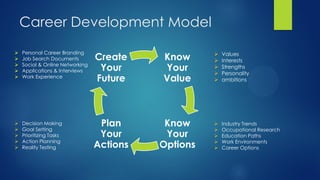
Career Development Model






Personal Career Branding
Job Search Documents
Social & Online Networking
Applications & Interviews
Work Experience

Create
Your
Future







Decision Making
Goal Setting
Prioritizing Tasks
Action Planning
Reality Testing

Plan
Your
Actions

Know
Your
Value







Values
Interests
Strengths
Personality
ambitions

Know
Your
Options







Industry Trends
Occupational Research
Education Paths
Work Environments
Career Options
Top 10 Considerations in Career
Planning
1.

Education

2.

Work environment

3.

Future outlook

4.

Personality

5.

Aptitudes/skills

6.

Earning

7.

Interests

8.

Values

9.

Working conditions

10.

Career paths
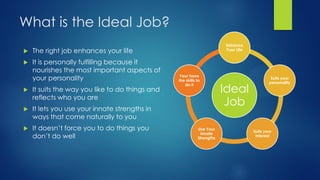
What is the Ideal Job?


The right job enhances your life



It is personally fulfilling because it
nourishes the most important aspects of
your personality

Enhance
Your Life



It suits the way you like to do things and
reflects who you are



It lets you use your innate strengths in
ways that come naturally to you



It doesn’t force you to do things you
don’t do well

Your have
the skills to
do it

Use Your
Innate
Strengths

Ideal
Job

Suits your
personality

Suits your
interest
How Do You Know If You’re In the
Right Job


Look forward to going to work



Feel energized most of the time by what you
do



Feel your contribution is respected and
appreciated



Feel proud when describing your work to
others



Enjoy and respect the people you work with



Feel optimistic about your future
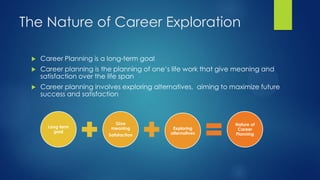
The Nature of Career Exploration


Career Planning is a long-term goal



Career planning is the planning of one’s life work that give meaning and
satisfaction over the life span



Career planning involves exploring alternatives, aiming to maximize future
success and satisfaction

Long term
goal

Give
meaning
Satisfaction

Exploring
alternatives

Nature of
Career
Planning
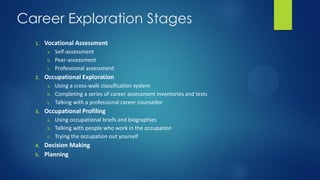
Career Exploration Stages
1.

Vocational Assessment
Self-assessment
b. Peer-assessment
c. Professional assessment
a.

2.

Occupational Exploration
a.
b.
c.

3.

Occupational Profiling
a.
b.
c.

4.

5.

Using a cross-walk classification system
Completing a series of career assessment inventories and tests
Talking with a professional career counsellor
Using occupational briefs and biographies
Talking with people who work in the occupation
Trying the occupation out yourself

Decision Making
Planning
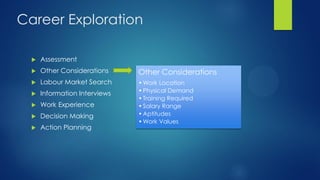
Career Exploration


Assessment



Other Considerations

Other Considerations



Labour Market Search



Information Interviews



Work Experience



Decision Making



Action Planning

• Work Location
• Physical Demand
• Training Required
• Salary Range
• Aptitudes
• Work Values
Role of Assessment in Career
Planning


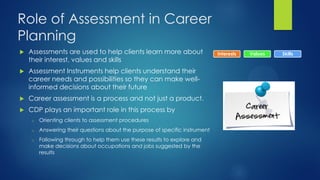
Assessments are used to help clients learn more about
their interest, values and skills



Assessment Instruments help clients understand their
career needs and possibilities so they can make wellinformed decisions about their future



Career assessment is a process and not just a product.



CDP plays an important role in this process by
o

Orienting clients to assessment procedures

o

Answering their questions about the purpose of specific instrument

o

Following through to help them use these results to explore and
make decisions about occupations and jobs suggested by the
results

Interests

Values

Skills
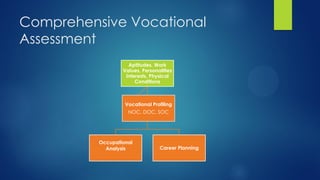
Comprehensive Vocational
Assessment
Aptitudes, Work
Values, Personalities
Interests, Physical
Conditions

Vocational Profiling
NOC, DOC, SOC

Occupational
Analysis

Career Planning
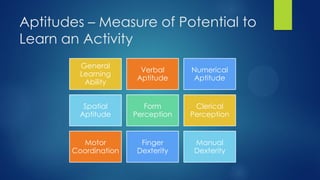
Aptitudes – Measure of Potential to
Learn an Activity
General
Learning
Ability

Verbal
Aptitude

Numerical
Aptitude

Spatial
Aptitude

Form
Perception

Clerical
Perception

Motor
Coordination

Finger
Dexterity

Manual
Dexterity
Terms


Assessment – covers the administration of many types of instruments



Instruments – general terms that includes both tests and inventories



Test – generally applied to a scientifically developed instrument that
measures ability (the potential to learn something) or achievement
(tests have answers that are right or wrong)



Inventory –used to describe a less formal questionnaire that is
designed to help individual learn more about themselves. (No right
or wrong answers for inventory). The assessments used in most
career development settings fall into this category
Relationship between Theory and
Assessment


Theory – an attempt to explain the factors involved in the career planning
process. Theories can help CDP know how to assist clients in identifying
what is important to them and what to consider when making a career
decision



Assessment are one of the “bridges” ta brings conceptual theories into
practice; they represent a way of putting into operation the theory’s
constructs
Holland’s Theory


Most people and work environments can be categorized by of
the six types



Goal of the instrument such as Interest profiler, and Self-Directed
Search, is seeking to define an individual’s Holland Code



The theory is the underlying foundation for the assessment and
the interpretation guidelines



Examples of assessment based on Holland’s Theory
o

Interest Profiler

o

Campbell Interest and Skill Survey

o

Career Liftoff

o

Interest Determination, Exploration and Assessment system
Super’s Theory


An individual’s career development is divided into a number of
development stages



Each stage has a list of specific tasks that should be accomplished
during that stage



When the tasks of a given stage are accomplished, an individual is
developmentally on schedule or mature and, therefore, is more
likely to accomplish the tasks of the next life stage



However, the individual is developmentally off schedule or
immature and may have difficulty in life stages that follow



Examples of Assessment based on Super’s Theory
o

Adult Career Concerns Inventory

o

Life-career Rainbow
Guidelines for Selecting and Using
Assessments


An assessment can be a potential harm to a clients
o
o



Assessments that do not fit their needs
Assessments that administered or interpreted improperly

CDP’s Responsibility about assessment
o

Understand and work within the ethical standards that apply to the use
of assessments

o

To practice only within the scope of the CDP’s role

o

To work only with those assessments you have been trained to use
What Instruments will be Most
Appropriate for your Clients
1.

What does the instrument cost?

2.

Who is your target audience?

3.

How will the results be used?

4.

What are the psychometric properties of the instruments, meaning the construction and
validation of the items?

5.

What format is best?

6.

How much time does the instrument take to administer and interpret

7.

How will the results be formatted and given to the student or client?

8.

Who will interpret the results and what are their qualifications?

9.

Is appropriate documentation provided?

10.

What do your colleagues think of this instrument and its publishers?
What Ethical Issues Need to be
Considered?


A career practitioner is limited to working with Level A assessments



Working with Level B or C instruments is not ethical without
completing additional training



Ethical Considerations
o

Ensure that assessment you are using has validity

o

Do not use material outside the copyright law

o

Do not share client’s information

o

Do no reproduce material without proper consent from publisher

o

Ensure your client is properly prepared for the assessment
Common Pitfalls of Career Planning


Overdependence on assessment instruments



Inadequate interpretation



Inappropriate use



Inadequate client preparation
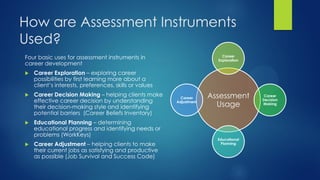
How are Assessment Instruments
Used?
Four basic uses for assessment instruments in
career development


Career Exploration – exploring career
possibilities by first learning more about a
client’s interests, preferences, skills or values



Career Decision Making – helping clients make
effective career decision by understanding
their decision-making style and identifying
potential barriers (Career Beliefs Inventory)



Educational Planning – determining
educational progress and identifying needs or
problems (WorkKeys)

Career
Exploration



Career Adjustment – helping clients to make
their current jobs as satisfying and productive
as possible (Job Survival and Success Code)

Career
Adjustment

Assessment
Usage

Educational
Planning

Career
Decision
Making
What are Formal Assessments?


Formal assessments are inventories or tests that have been
developed by experts according to scientific principles of test
construction, also called standardization. It involves specific steps
that must be followed in developing, administering, and interpreting
them. They typically produce scores or score profiles as part of their
results
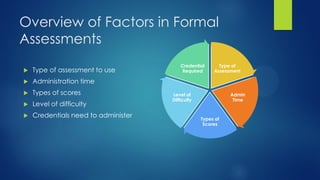
Overview of Factors in Formal
Assessments


Type of assessment to use



Types of scores



Level of difficulty



Credentials need to administer

Type of
Assessment

Administration time



Credential
Required

Level of
Difficulty

Admin
Time

Types of
Scores
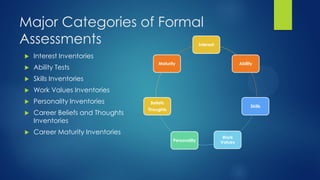
Major Categories of Formal
Assessments

Interest



Interest Inventories



Ability Tests



Work Values Inventories



Personality Inventories

Ability

Skills Inventories



Maturity



Career Beliefs and Thoughts
Inventories



Beliefs

Skills

Thoughts

Career Maturity Inventories
Personality

Work
Values
Informal Assessments













Force-choice Activities
Card Sorts
Checklists or Structured Worksheets
Guided Imagery
Transferrable Skills Activities
Checklists of Interests, Values, Abilities
Interviews
Group Discussions
Writing Samples
Observation of Skills Being Demonstrated
Job Shadowing
Informal Assessments


Informal assessments are subjective



Informal assessments sometimes require more time to administer



Informal assessments demand thoughtful interpretation



The validity of most informal assessments may be questionable
Comparison of Formal and Informal
Assessments


Formal assessments
o

Standardized and structured

o

Validity, reliability, and bias

o

Additional training usually
required



Informal Assessments
o Easier to use
o Less specialized training
o Subjective/Open to
greater interpretation
7 Steps in Working with Assessments
1.

Determine whether assessment would be helpful to the client

2.

Select the instrument or instruments best suited to the client’s needs

3.

Prepare the client for assessments

4.

Administer the assessment

5.

Interpret and use the results

6.

Maintain records

7.

Practice only within your boundaries/competencies level (A,B,C)

Career planning and assessment

  • 1.
  • 2.
    Career Development Model      PersonalCareer Branding Job Search Documents Social & Online Networking Applications & Interviews Work Experience Create Your Future      Decision Making Goal Setting Prioritizing Tasks Action Planning Reality Testing Plan Your Actions Know Your Value      Values Interests Strengths Personality ambitions Know Your Options      Industry Trends Occupational Research Education Paths Work Environments Career Options
  • 3.
    Top 10 Considerationsin Career Planning 1. Education 2. Work environment 3. Future outlook 4. Personality 5. Aptitudes/skills 6. Earning 7. Interests 8. Values 9. Working conditions 10. Career paths
  • 4.
    What is theIdeal Job?  The right job enhances your life  It is personally fulfilling because it nourishes the most important aspects of your personality Enhance Your Life  It suits the way you like to do things and reflects who you are  It lets you use your innate strengths in ways that come naturally to you  It doesn’t force you to do things you don’t do well Your have the skills to do it Use Your Innate Strengths Ideal Job Suits your personality Suits your interest
  • 5.
    How Do YouKnow If You’re In the Right Job  Look forward to going to work  Feel energized most of the time by what you do  Feel your contribution is respected and appreciated  Feel proud when describing your work to others  Enjoy and respect the people you work with  Feel optimistic about your future
  • 6.
    The Nature ofCareer Exploration  Career Planning is a long-term goal  Career planning is the planning of one’s life work that give meaning and satisfaction over the life span  Career planning involves exploring alternatives, aiming to maximize future success and satisfaction Long term goal Give meaning Satisfaction Exploring alternatives Nature of Career Planning
  • 7.
    Career Exploration Stages 1. VocationalAssessment Self-assessment b. Peer-assessment c. Professional assessment a. 2. Occupational Exploration a. b. c. 3. Occupational Profiling a. b. c. 4. 5. Using a cross-walk classification system Completing a series of career assessment inventories and tests Talking with a professional career counsellor Using occupational briefs and biographies Talking with people who work in the occupation Trying the occupation out yourself Decision Making Planning
  • 8.
    Career Exploration  Assessment  Other Considerations OtherConsiderations  Labour Market Search  Information Interviews  Work Experience  Decision Making  Action Planning • Work Location • Physical Demand • Training Required • Salary Range • Aptitudes • Work Values
  • 9.
    Role of Assessmentin Career Planning  Assessments are used to help clients learn more about their interest, values and skills  Assessment Instruments help clients understand their career needs and possibilities so they can make wellinformed decisions about their future  Career assessment is a process and not just a product.  CDP plays an important role in this process by o Orienting clients to assessment procedures o Answering their questions about the purpose of specific instrument o Following through to help them use these results to explore and make decisions about occupations and jobs suggested by the results Interests Values Skills
  • 10.
    Comprehensive Vocational Assessment Aptitudes, Work Values,Personalities Interests, Physical Conditions Vocational Profiling NOC, DOC, SOC Occupational Analysis Career Planning
  • 11.
    Aptitudes – Measureof Potential to Learn an Activity General Learning Ability Verbal Aptitude Numerical Aptitude Spatial Aptitude Form Perception Clerical Perception Motor Coordination Finger Dexterity Manual Dexterity
  • 12.
    Terms  Assessment – coversthe administration of many types of instruments  Instruments – general terms that includes both tests and inventories  Test – generally applied to a scientifically developed instrument that measures ability (the potential to learn something) or achievement (tests have answers that are right or wrong)  Inventory –used to describe a less formal questionnaire that is designed to help individual learn more about themselves. (No right or wrong answers for inventory). The assessments used in most career development settings fall into this category
  • 13.
    Relationship between Theoryand Assessment  Theory – an attempt to explain the factors involved in the career planning process. Theories can help CDP know how to assist clients in identifying what is important to them and what to consider when making a career decision  Assessment are one of the “bridges” ta brings conceptual theories into practice; they represent a way of putting into operation the theory’s constructs
  • 14.
    Holland’s Theory  Most peopleand work environments can be categorized by of the six types  Goal of the instrument such as Interest profiler, and Self-Directed Search, is seeking to define an individual’s Holland Code  The theory is the underlying foundation for the assessment and the interpretation guidelines  Examples of assessment based on Holland’s Theory o Interest Profiler o Campbell Interest and Skill Survey o Career Liftoff o Interest Determination, Exploration and Assessment system
  • 15.
    Super’s Theory  An individual’scareer development is divided into a number of development stages  Each stage has a list of specific tasks that should be accomplished during that stage  When the tasks of a given stage are accomplished, an individual is developmentally on schedule or mature and, therefore, is more likely to accomplish the tasks of the next life stage  However, the individual is developmentally off schedule or immature and may have difficulty in life stages that follow  Examples of Assessment based on Super’s Theory o Adult Career Concerns Inventory o Life-career Rainbow
  • 16.
    Guidelines for Selectingand Using Assessments  An assessment can be a potential harm to a clients o o  Assessments that do not fit their needs Assessments that administered or interpreted improperly CDP’s Responsibility about assessment o Understand and work within the ethical standards that apply to the use of assessments o To practice only within the scope of the CDP’s role o To work only with those assessments you have been trained to use
  • 17.
    What Instruments willbe Most Appropriate for your Clients 1. What does the instrument cost? 2. Who is your target audience? 3. How will the results be used? 4. What are the psychometric properties of the instruments, meaning the construction and validation of the items? 5. What format is best? 6. How much time does the instrument take to administer and interpret 7. How will the results be formatted and given to the student or client? 8. Who will interpret the results and what are their qualifications? 9. Is appropriate documentation provided? 10. What do your colleagues think of this instrument and its publishers?
  • 18.
    What Ethical IssuesNeed to be Considered?  A career practitioner is limited to working with Level A assessments  Working with Level B or C instruments is not ethical without completing additional training  Ethical Considerations o Ensure that assessment you are using has validity o Do not use material outside the copyright law o Do not share client’s information o Do no reproduce material without proper consent from publisher o Ensure your client is properly prepared for the assessment
  • 19.
    Common Pitfalls ofCareer Planning  Overdependence on assessment instruments  Inadequate interpretation  Inappropriate use  Inadequate client preparation
  • 20.
    How are AssessmentInstruments Used? Four basic uses for assessment instruments in career development  Career Exploration – exploring career possibilities by first learning more about a client’s interests, preferences, skills or values  Career Decision Making – helping clients make effective career decision by understanding their decision-making style and identifying potential barriers (Career Beliefs Inventory)  Educational Planning – determining educational progress and identifying needs or problems (WorkKeys) Career Exploration  Career Adjustment – helping clients to make their current jobs as satisfying and productive as possible (Job Survival and Success Code) Career Adjustment Assessment Usage Educational Planning Career Decision Making
  • 21.
    What are FormalAssessments?  Formal assessments are inventories or tests that have been developed by experts according to scientific principles of test construction, also called standardization. It involves specific steps that must be followed in developing, administering, and interpreting them. They typically produce scores or score profiles as part of their results
  • 22.
    Overview of Factorsin Formal Assessments  Type of assessment to use  Types of scores  Level of difficulty  Credentials need to administer Type of Assessment Administration time  Credential Required Level of Difficulty Admin Time Types of Scores
  • 23.
    Major Categories ofFormal Assessments Interest  Interest Inventories  Ability Tests  Work Values Inventories  Personality Inventories Ability Skills Inventories  Maturity  Career Beliefs and Thoughts Inventories  Beliefs Skills Thoughts Career Maturity Inventories Personality Work Values
  • 24.
    Informal Assessments            Force-choice Activities CardSorts Checklists or Structured Worksheets Guided Imagery Transferrable Skills Activities Checklists of Interests, Values, Abilities Interviews Group Discussions Writing Samples Observation of Skills Being Demonstrated Job Shadowing
  • 25.
    Informal Assessments  Informal assessmentsare subjective  Informal assessments sometimes require more time to administer  Informal assessments demand thoughtful interpretation  The validity of most informal assessments may be questionable
  • 26.
    Comparison of Formaland Informal Assessments  Formal assessments o Standardized and structured o Validity, reliability, and bias o Additional training usually required  Informal Assessments o Easier to use o Less specialized training o Subjective/Open to greater interpretation
  • 27.
    7 Steps inWorking with Assessments 1. Determine whether assessment would be helpful to the client 2. Select the instrument or instruments best suited to the client’s needs 3. Prepare the client for assessments 4. Administer the assessment 5. Interpret and use the results 6. Maintain records 7. Practice only within your boundaries/competencies level (A,B,C)