Career Research Lesson 3.2 Page 50
Bell Ringer Write 10 questions on paper that you would like to ask someone who holds a job. You can ask about anything you want to know, including working environment, education requirements, skills required, and career outlook (number of jobs expected in the future).
Objectives: After completing this lesson, the students will have learned: Key questions to ask about careers that interest them Where to get information about careers
Raise your hand if you have had a paid job such as baby-sitting, housecleaning, raking leaves, or mowing lawns.
Research Investigating a subject and gathering information about it
What to Research 1. What skills and aptitudes should I have?
What to Research 2. What education and training would I need?
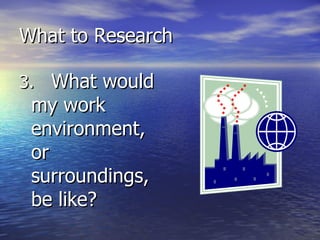
What to Research 3. What would my work environment, or surroundings, be like?
What to Research 4. What hours would I spend on the job?
What to Research 5. What kinds of work would I do?
What to Research 6. What responsibilities would I have?
What to Research 7. Would I be able to move ahead?
What to Research 8. What will this career be like when I’m ready to work?
What to Research 9. What does this career pay?
What to Research 10. What other rewards would this career provide?
Why ask these 10 questions about careers?
Where Do You Find It? Library Dictionary of Occupational Titles (DOT) [detailed information] Collection of job profiles Occupational Outlook Handbook (OOH) [general information] Explains what workers do, education needed, and makes predictions about career future
Library Guide for Occupational Exploration Explores careers based on 12 interest areas Occupational Outlook Quarterly Provides current information about employment trends and outlooks Reader’s Guide to Periodical Literature Detailed index of magazine articles
Where Do You Find It? Search the Internet Make sure the information is true and current Reliable source
Where Do You Find It? Talk to People Exploratory Interview A short, informal talk with someone who works in a career that interests you.
Conduct Exploratory Interview Talk to People Ask Questions How did you start in your career? What education and training did it require? What do you like about your job? What do you do on a typical day at your job? Take Notes
I have an interest in the area of ____________, and to research this area I will ________________.

Career Research Power Point

  • 1.
  • 2.
    Bell Ringer Write10 questions on paper that you would like to ask someone who holds a job. You can ask about anything you want to know, including working environment, education requirements, skills required, and career outlook (number of jobs expected in the future).
  • 3.
    Objectives: After completingthis lesson, the students will have learned: Key questions to ask about careers that interest them Where to get information about careers
  • 4.
    Raise your handif you have had a paid job such as baby-sitting, housecleaning, raking leaves, or mowing lawns.
  • 5.
    Research Investigating asubject and gathering information about it
  • 6.
    What to Research1. What skills and aptitudes should I have?
  • 7.
    What to Research2. What education and training would I need?
  • 8.
    What to Research3. What would my work environment, or surroundings, be like?
  • 9.
    What to Research4. What hours would I spend on the job?
  • 10.
    What to Research5. What kinds of work would I do?
  • 11.
    What to Research6. What responsibilities would I have?
  • 12.
    What to Research7. Would I be able to move ahead?
  • 13.
    What to Research8. What will this career be like when I’m ready to work?
  • 14.
    What to Research9. What does this career pay?
  • 15.
    What to Research10. What other rewards would this career provide?
  • 16.
    Why ask these10 questions about careers?
  • 17.
    Where Do YouFind It? Library Dictionary of Occupational Titles (DOT) [detailed information] Collection of job profiles Occupational Outlook Handbook (OOH) [general information] Explains what workers do, education needed, and makes predictions about career future
  • 18.
    Library Guide forOccupational Exploration Explores careers based on 12 interest areas Occupational Outlook Quarterly Provides current information about employment trends and outlooks Reader’s Guide to Periodical Literature Detailed index of magazine articles
  • 19.
    Where Do YouFind It? Search the Internet Make sure the information is true and current Reliable source
  • 20.
    Where Do YouFind It? Talk to People Exploratory Interview A short, informal talk with someone who works in a career that interests you.
  • 21.
    Conduct Exploratory InterviewTalk to People Ask Questions How did you start in your career? What education and training did it require? What do you like about your job? What do you do on a typical day at your job? Take Notes
  • 22.
    I have aninterest in the area of ____________, and to research this area I will ________________.

Editor's Notes

  • #3 Let’s discuss the questions you wrote in the Bell Ringer activity. Go around the room asking various students to share one of their questions with the class.
  • #4 In this lesson you will learn about what questions to ask and where to find the answers about careers that interest you.
  • #5 On a piece of paper, describe the job and the skills used in the job. These job experiences will be helpful when researching careers.
  • #6 We’ve discussed different careers that might interest us and now it’s time to research those careers. Research is investigating a subject and gathering information about it.
  • #7 First, you need to know what kind of information you’re looking for. Ten questions will help you gather basic information about careers.
  • #17 You ask these questions so that you can compare different careers.
  • #18 What is the most important difference between the OOH and the DOT? OOH provides general information; DOT provides detailed information.
  • #20 The Internet offers a wide range of career research Web sites. You can also find career opportunities and information on a specific company. If you are unsure about a source, compare information with other sources. Check to see how up-to-date the information is.
  • #21 Talk to family, friends and neighbors about careers. Build a list of people who have interesting careers and arrange an exploratory interview.
  • #23 Have students complete this statement.