
Mar 18, 2013

LEARNING APPROACHES & STUDY
SKILLS
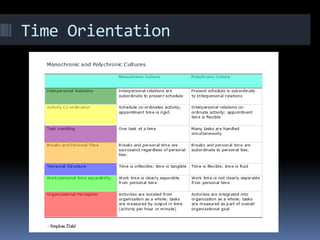
Time Orientation
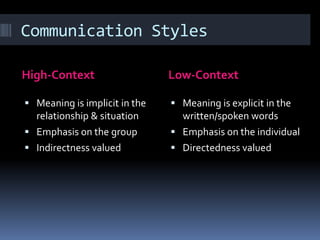
Communication Styles

High-Context                   Low-Context

ď‚§ Meaning is implicit in the   ď‚§ Meaning is explicit in the
  relationship & situation       written/spoken words
ď‚§ Emphasis on the group        ď‚§ Emphasis on the individual
ď‚§ Indirectness valued          ď‚§ Directedness valued
Learning Approaches
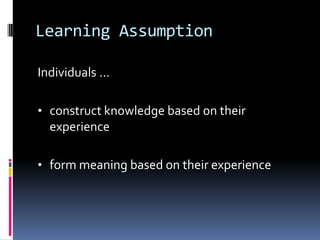
Learning Assumption

Individuals ...

• construct knowledge based on their
  experience

• form meaning based on their experience
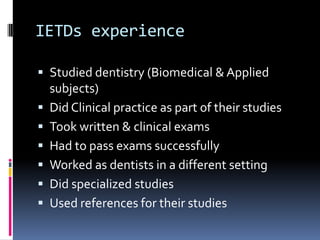
IETDs experience

ď‚§ Studied dentistry (Biomedical & Applied
    subjects)
ď‚§   Did Clinical practice as part of their studies
ď‚§   Took written & clinical exams
ď‚§   Had to pass exams successfully
ď‚§   Worked as dentists in a different setting
ď‚§   Did specialized studies
ď‚§   Used references for their studies
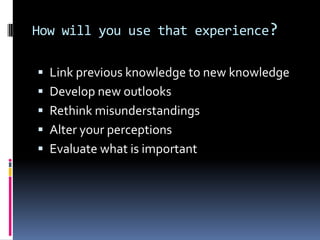
How will you use that experience?

ď‚§ Link previous knowledge to new knowledge
ď‚§ Develop new outlooks
ď‚§ Rethink misunderstandings
ď‚§ Alter your perceptions
ď‚§ Evaluate what is important
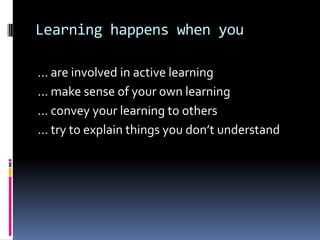
Learning happens when you

... are involved in active learning
... make sense of your own learning
... convey your learning to others
... try to explain things you don’t understand
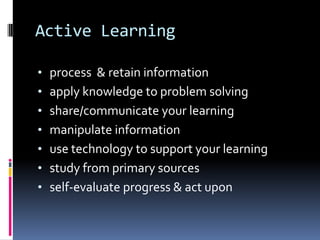
Active Learning

• process & retain information
• apply knowledge to problem solving
• share/communicate your learning
• manipulate information
• use technology to support your learning
• study from primary sources
• self-evaluate progress & act upon
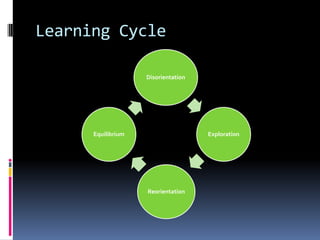
Learning Cycle

                    Disorientation


      Equilibrium                    Exploration


                    Reorientation
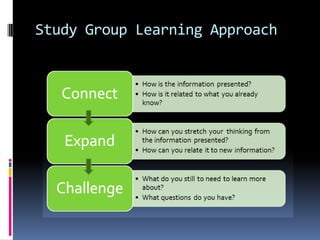
Study Group Learning Approach
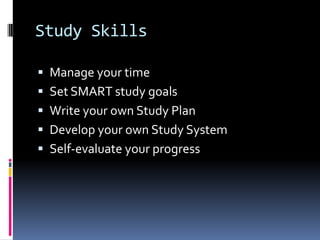
Study Skills

ď‚§ Manage your time
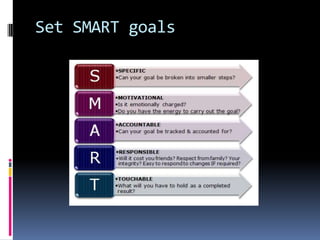
ď‚§ Set SMART study goals
ď‚§ Write your own Study Plan
ď‚§ Develop your own Study System
ď‚§ Self-evaluate your progress
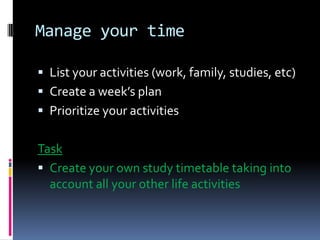
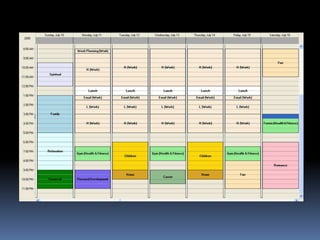
Manage your time

ď‚§ List your activities (work, family, studies, etc)
 Create a week’s plan
ď‚§ Prioritize your activities


Task
ď‚§ Create your own study timetable taking into
  account all your other life activities
Set SMART goals
Write your Study Plan
•   Set up SMART goals for your plan
•   Define content areas
•   Determine strengths & weaknesses
•   Identify resources available
•   Develop a realistic schedule
•   Study with others
•   Plan for self-review sessions

Task
ď‚§ Write your own study plan for the revision of
  Biomedical Sciences
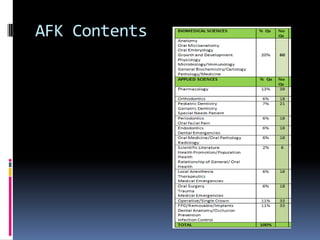
AFK Contents
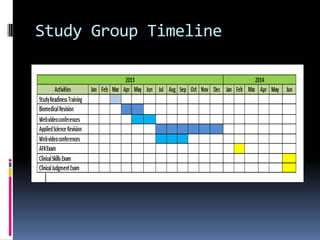
Study Group Timeline
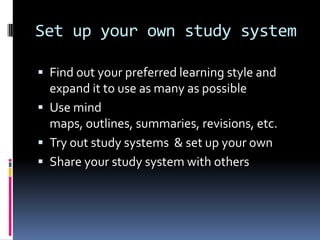
Set up your own study system

ď‚§ Find out your preferred learning style and
  expand it to use as many as possible
ď‚§ Use mind
  maps, outlines, summaries, revisions, etc.
ď‚§ Try out study systems & set up your own
ď‚§ Share your study system with others
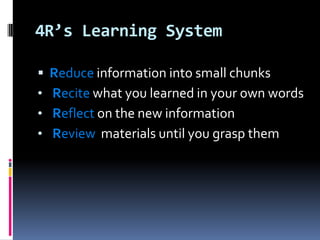
4R’s Learning System

ď‚§   Reduce information into small chunks
•   Recite what you learned in your own words
•   Reflect on the new information
•   Review materials until you grasp them
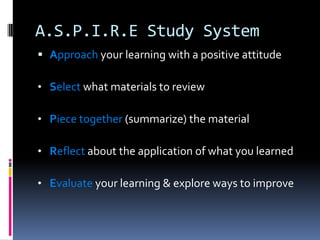
A.S.P.I.R.E Study System
ď‚§ Approach your learning with a positive attitude

• Select what materials to review

• Piece together (summarize) the material

• Reflect about the application of what you learned

• Evaluate your learning & explore ways to improve
Self-evaluate your progress

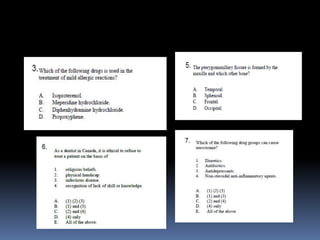
 Do quizzes & chapter’s questions
ď‚§ Identify areas you need to review
ď‚§ Set up a plan to go over sections
ď‚§ Implement the plan
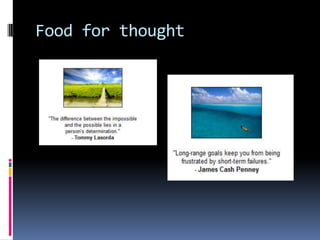
Food for thought

Study Group Readiness: Learning Approaches & Study Skills

  • 2.
    Mar 18, 2013 LEARNINGAPPROACHES & STUDY SKILLS
  • 3.
  • 4.
    Communication Styles High-Context Low-Context ď‚§ Meaning is implicit in the ď‚§ Meaning is explicit in the relationship & situation written/spoken words ď‚§ Emphasis on the group ď‚§ Emphasis on the individual ď‚§ Indirectness valued ď‚§ Directedness valued
  • 5.
  • 6.
    Learning Assumption Individuals ... •construct knowledge based on their experience • form meaning based on their experience
  • 7.
    IETDs experience ď‚§ Studieddentistry (Biomedical & Applied subjects) ď‚§ Did Clinical practice as part of their studies ď‚§ Took written & clinical exams ď‚§ Had to pass exams successfully ď‚§ Worked as dentists in a different setting ď‚§ Did specialized studies ď‚§ Used references for their studies
  • 8.
    How will youuse that experience? ď‚§ Link previous knowledge to new knowledge ď‚§ Develop new outlooks ď‚§ Rethink misunderstandings ď‚§ Alter your perceptions ď‚§ Evaluate what is important
  • 10.
    Learning happens whenyou ... are involved in active learning ... make sense of your own learning ... convey your learning to others ... try to explain things you don’t understand
  • 11.
    Active Learning • process& retain information • apply knowledge to problem solving • share/communicate your learning • manipulate information • use technology to support your learning • study from primary sources • self-evaluate progress & act upon
  • 12.
    Learning Cycle Disorientation Equilibrium Exploration Reorientation
  • 13.
  • 16.
    Study Skills ď‚§ Manageyour time ď‚§ Set SMART study goals ď‚§ Write your own Study Plan ď‚§ Develop your own Study System ď‚§ Self-evaluate your progress
  • 17.
    Manage your time List your activities (work, family, studies, etc)  Create a week’s plan  Prioritize your activities Task  Create your own study timetable taking into account all your other life activities
  • 19.
  • 20.
    Write your StudyPlan • Set up SMART goals for your plan • Define content areas • Determine strengths & weaknesses • Identify resources available • Develop a realistic schedule • Study with others • Plan for self-review sessions Task  Write your own study plan for the revision of Biomedical Sciences
  • 21.
  • 22.
  • 23.
    Set up yourown study system ď‚§ Find out your preferred learning style and expand it to use as many as possible ď‚§ Use mind maps, outlines, summaries, revisions, etc. ď‚§ Try out study systems & set up your own ď‚§ Share your study system with others
  • 24.
    4R’s Learning System  Reduce information into small chunks • Recite what you learned in your own words • Reflect on the new information • Review materials until you grasp them
  • 25.
    A.S.P.I.R.E Study System Approach your learning with a positive attitude • Select what materials to review • Piece together (summarize) the material • Reflect about the application of what you learned • Evaluate your learning & explore ways to improve
  • 26.
    Self-evaluate your progress Do quizzes & chapter’s questions  Identify areas you need to review  Set up a plan to go over sections  Implement the plan
  • 27.