CSO3001: CAREER LAB
INTERACTIVE WORKBOOK
Name:
CC/AM:
Section:
Major:
Aqsa ashraf
shahida.irshad@ucp.edu.pk
A4M
Mathematics
Welcome to Career Lab - CS3001
About the Course
Apply effective professional interpersonal communication skills in business contexts.
Enhance technical writing skills through the development of effective resumes, cover letters, statement of
purpose, and e-etiquette.
Learn how to make appropriate occupational/educational choices and set realistic
occupational/educational goals.
Develop life-long skills associated with career decision-making and career management.
Recognize the qualities, skills, and abilities that employers are seeking in job candidates.
Comprehend the importance of networking and identify employment leads often overlooked by many job
seekers.
The goal of this course is to introduce a blended learning model to prepare students for the job market by
helping them internalize professional and business skills. Based on the frameworks of experiential learning
and facilitation techniques, the course aims to build the requisite skills for becoming seasoned professionals,
capable of independent thought and action, who work well with others and are influential in their
organizations.
You have embarked on a journey to transform your life.
Learning Outcomes
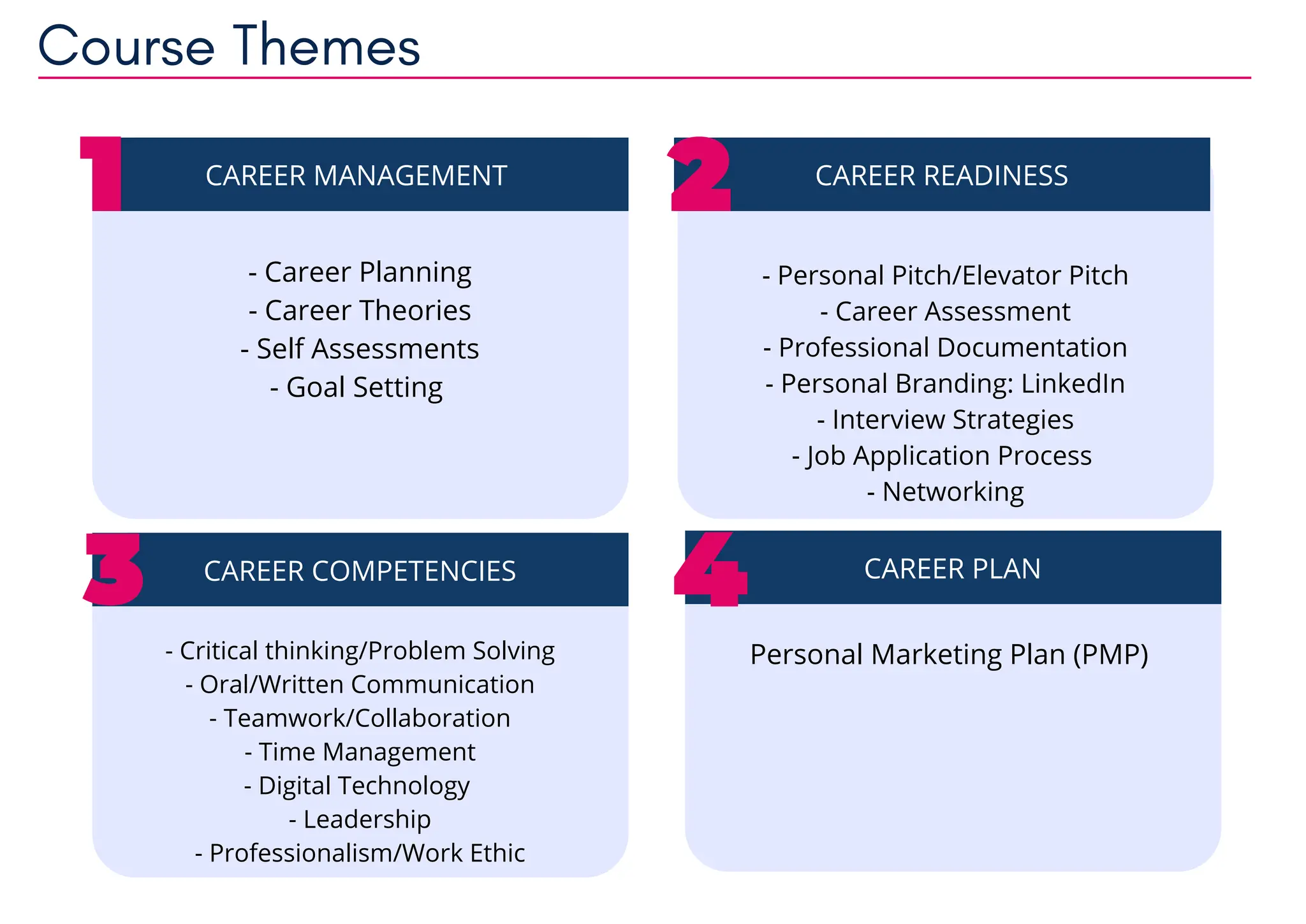
- Career Planning
- Career Theories
- Self Assessments
- Goal Setting
Career Readiness
- Personal Pitch/Elevator Pitch
- Career Assessment
- Professional Documentation
- Personal Branding: LinkedIn
- Interview Strategies
- Job Application Process
- Networking
Career Competencies
- Critical thinking/Problem Solving
- Oral/Written Communication
- Teamwork/Collaboration
- Time Management
- Digital Technology
- Leadership
- Professionalism/Work Ethic
Career Plan
Personal Marketing Plan (PMP)
jsjfskfks
jfsjjfsj
jfjsfjjs
fjsjjfsj
mfkf
CAREER READINESS
CAREER COMPETENCIES CAREER PLAN
CAREER MANAGEMENT
Course Themes
Week 1 Course Introduction & Career Planning
Week 2 Knowing Yourself & Time Management
Week 3 Business Communication & Presentation Skills
Week 4 Verbal Communication & Resume Writing
Week 5 Cover Letters, Job Research and Problem-Solving
Week 6 Job Application Process & Interviews
Week 7 Interviewing Skills
Roadmap to Success
Course Timeline
Week 8 Interview Practice
Week 9 Mock Interviews
Week 10 Exploring Possibilities: Entrepreneurship & Further Education
Week 11 The Power Of Mindset
Week 12 Final Presentations - Personal Marketing Plan
Week 13 Final Presentations - Personal Marketing Plan
Week 14 Assessment Center & Wrap Up
Roadmap to Success
Course Timeline
Session 1
Introduction to Career Planning &
Knowing Yourself
Krumboltz theory
Several factors have been highlighted as being helpful in career management, including:
the commitment to ongoing learning and skill development
ongoing self-assessment
assessment and feedback from others
effective networking
achieving work-life balance
financial planning to incorporate periods of unemployment
These attributes and tasks enable you to turn chance encounters and occurrences into career
opportunities.
Career Theories Key Takeaways
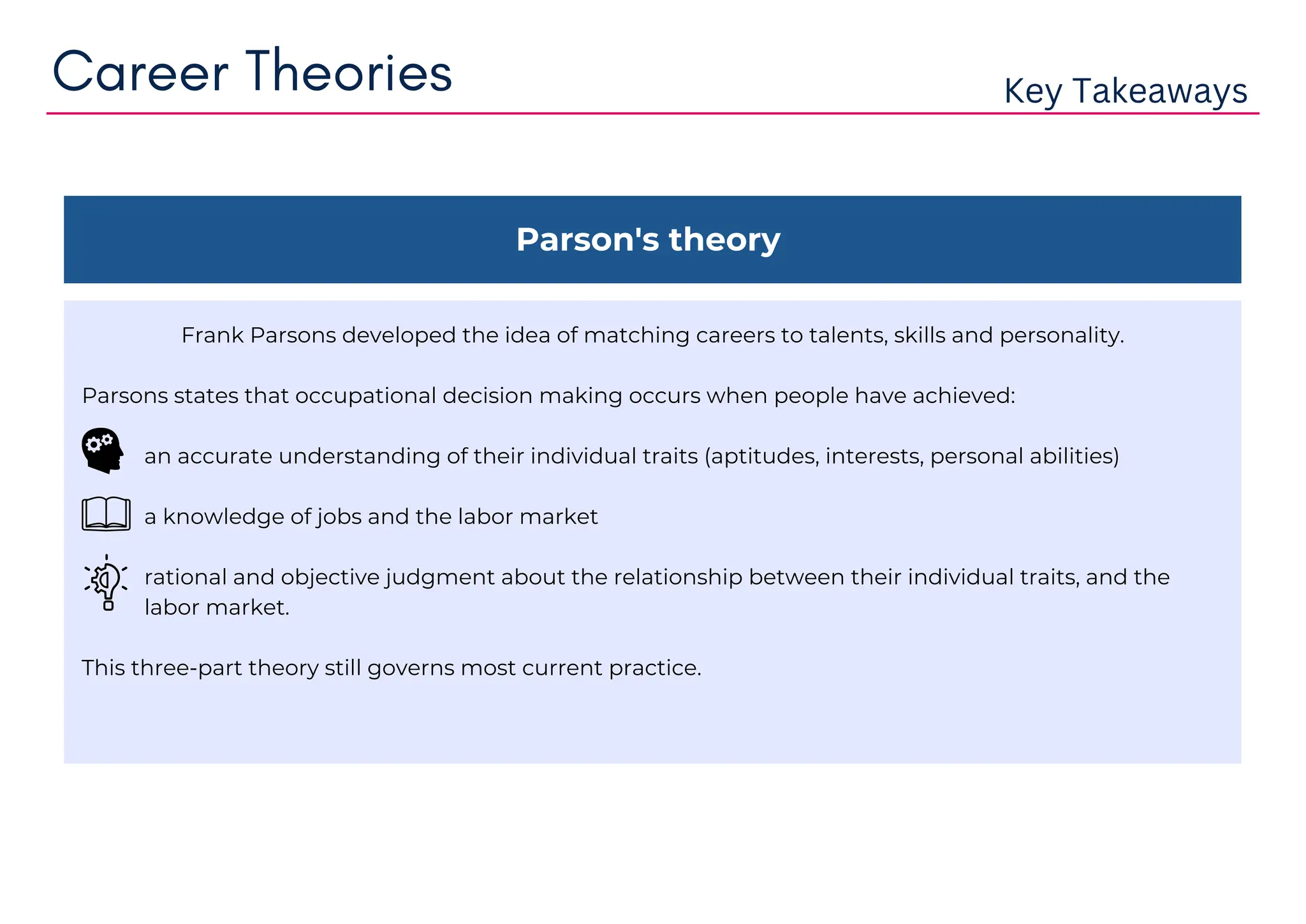
Parson's theory
Frank Parsons developed the idea of matching careers to talents, skills and personality.
Parsons states that occupational decision making occurs when people have achieved:
an accurate understanding of their individual traits (aptitudes, interests, personal abilities)
a knowledge of jobs and the labor market
rational and objective judgment about the relationship between their individual traits, and the
labor market.
This three-part theory still governs most current practice.
Career Theories Key Takeaways
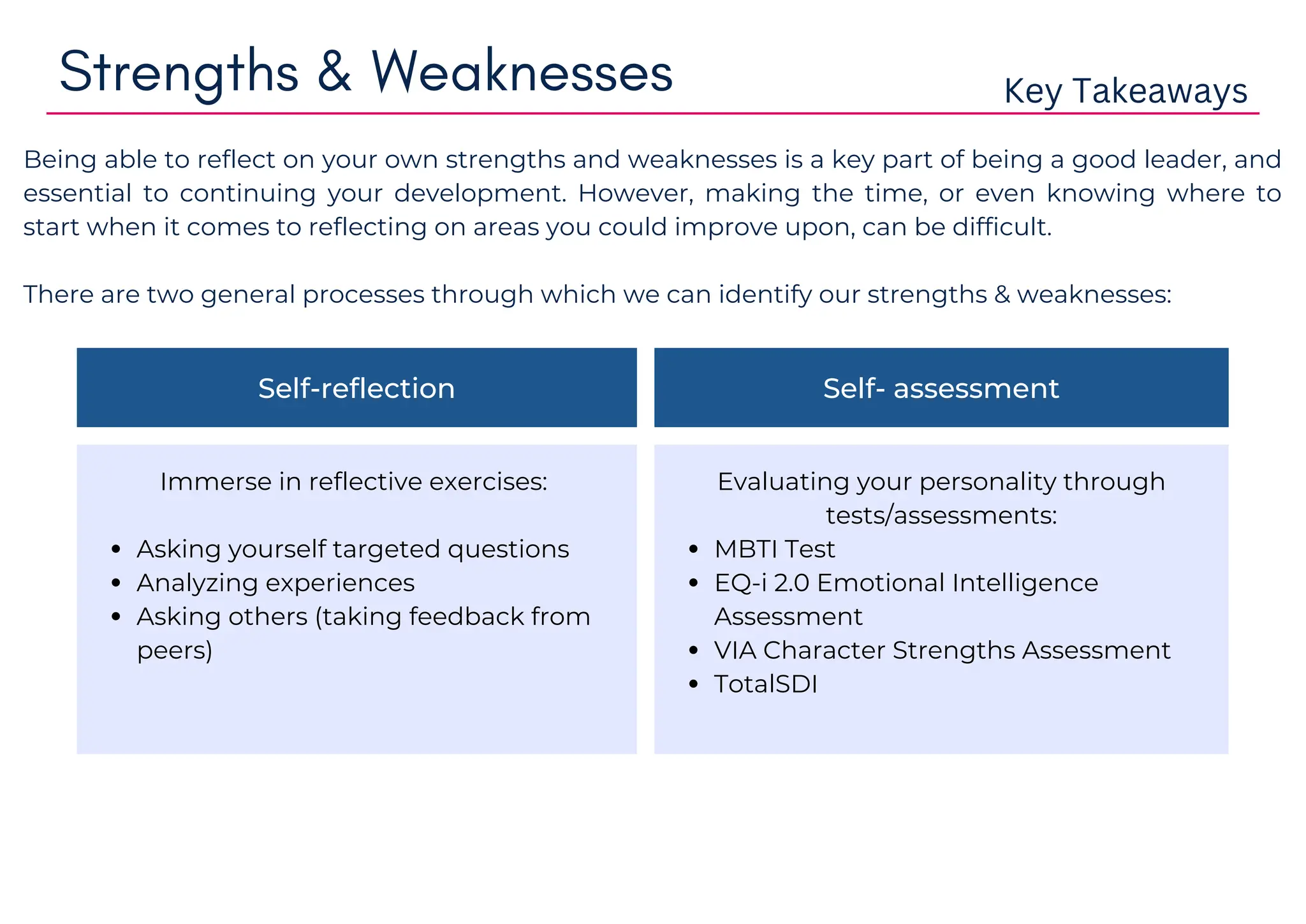
Being able to reflect on your own strengths and weaknesses is a key part of being a good leader, and
essential to continuing your development. However, making the time, or even knowing where to
start when it comes to reflecting on areas you could improve upon, can be difficult.
There are two general processes through which we can identify our strengths & weaknesses:
Self-reflection Self- assessment
Asking yourself targeted questions
Analyzing experiences
Asking others (taking feedback from
peers)
Immerse in reflective exercises:
hhh
h
MBTI Test
EQ-i 2.0 Emotional Intelligence
Assessment
VIA Character Strengths Assessment
TotalSDI
Evaluating your personality through
tests/assessments:
Strengths & Weaknesses Key Takeaways
Strengths Weaknesses
Strengths & Weaknesses Worksheet
From the BINGO activity conducted during the session, you were able to identify your strengths
and weaknesses. In the space below, list down your strengths and weaknesses.
1.Attentive,
2collaborative,
3honest,
4creative,
5 empathetic,
6innovative,
7patient,
8respectful
1competitive
2 disorganized
3 not skilled at delegating task
4not skilled at public speaking
5 self critical
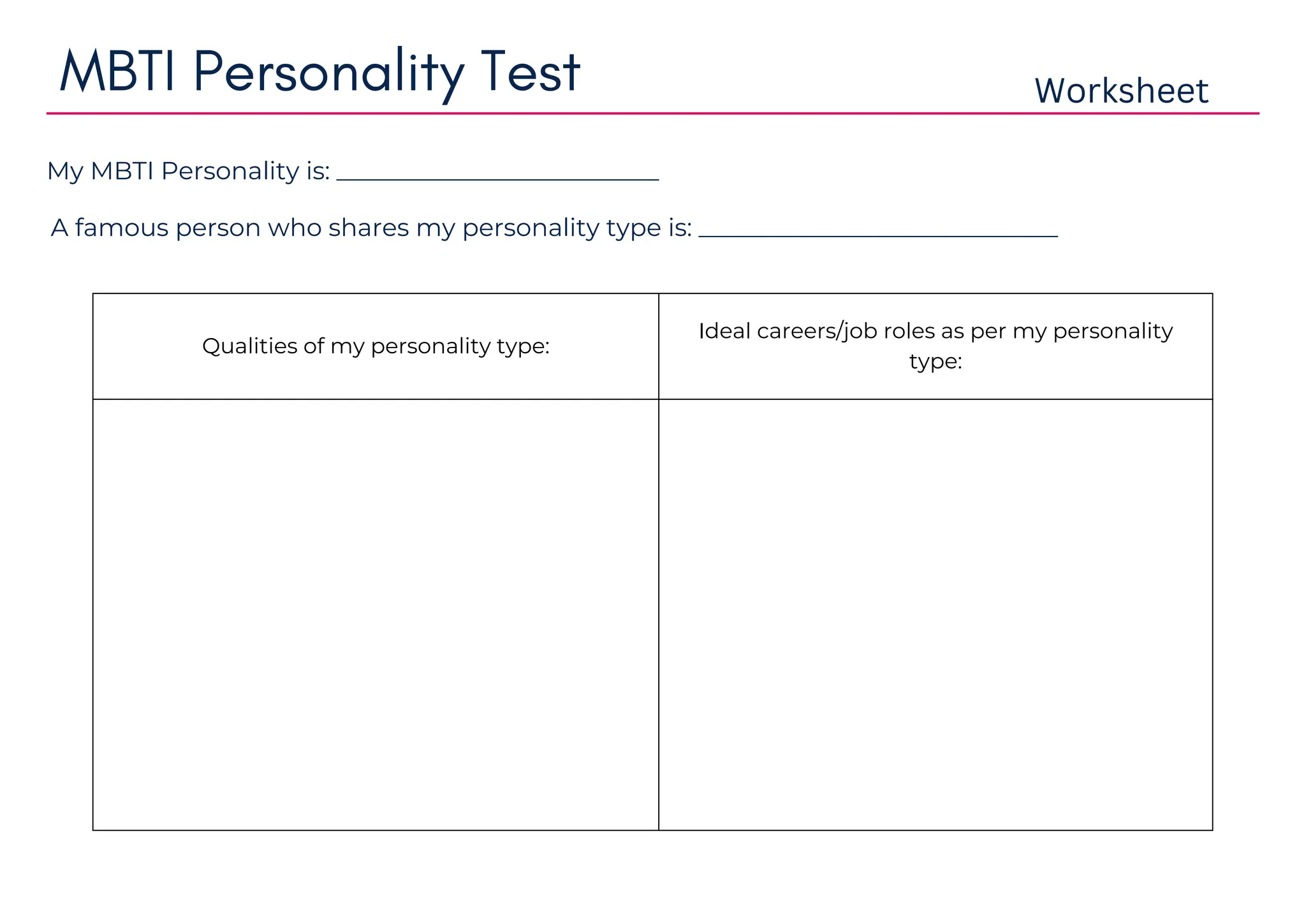
Qualities of my personality type:
Ideal careers/job roles as per my personality
type:
MBTI Personality Test Worksheet
My MBTI Personality is: __________________________
A famous person who shares my personality type is: _____________________________
ISFJ-A
noone
defender
observant
feeling
assertive
teaching
creative activities
agent
A Letter to My Future Self Worksheet
Write a letter to your future self, to be opened and read by you at the completion of this course. You may
answer questions related to how prepared are you for the future, what have you planned after you graduate,
how do you feel about your future planning, what do you expect from the course, or if you have any tip/advice
for your current self. When you finally open and read the letter, you will look back to see how much you have
grown throughout the course.
To my future self , I hope that time has been kind to you. I know your plans in life were to go far, and reach for stars and I have no doubt that you
have not done that. I hope that where you are right now is where you want to be, and if it is not dont give up keep pushing. Remember you are
the only person who can control your happiness. Depending on what age you are reading this you have special incidents in life . From childhood
dreams and goals to dreams you had while growing up changed rather drastically. Best wishes from paat self to future self.
Session 2
Knowing Yourself & Time Management
Knowing our strengths and weaknesses is important for our career progression in several ways:
Career Progression
It is important to know both your strengths and weaknesses in order to self-evaluate.
Having this knowledge about yourself will also help you narrow down your job search to
specific jobs based on what you’re good at, and it will make employers’ decision to hire
you easier.
Leveraging Your Strengths
Your strengths are the skills you can leverage and use to push yourself further to achieve
your goals. Knowing what you excel in can help you grow and aim higher.
Developing Skills
Having a strong self-awareness and ability to highlight your areas of weakness enables
you to proactively work on these, such as taking courses, seeking additional exposure to a
task you are less comfortable with, or working with a mentor to address a weakness. This
process of self-assessment will ultimately strengthen your skill set so that you can
overcome any limitations.
Corresponding Strengths
Every weakness has a hidden strength - all students have to do is accept them for what
they are. They should leverage these associated strengths and ask other people for advice
to improve themselves and fix any gaps they might have.
Knowing What Skills to
Hire
It is important to understand (if you are in a leadership role/or an entrepreneur) your
weaknesses as it means you know what skill set you need to hire the right skills and build
a diverse team that can help you, and your organization, to achieve your goals.
Recalling Strengths & Weaknesses Key Takeaways
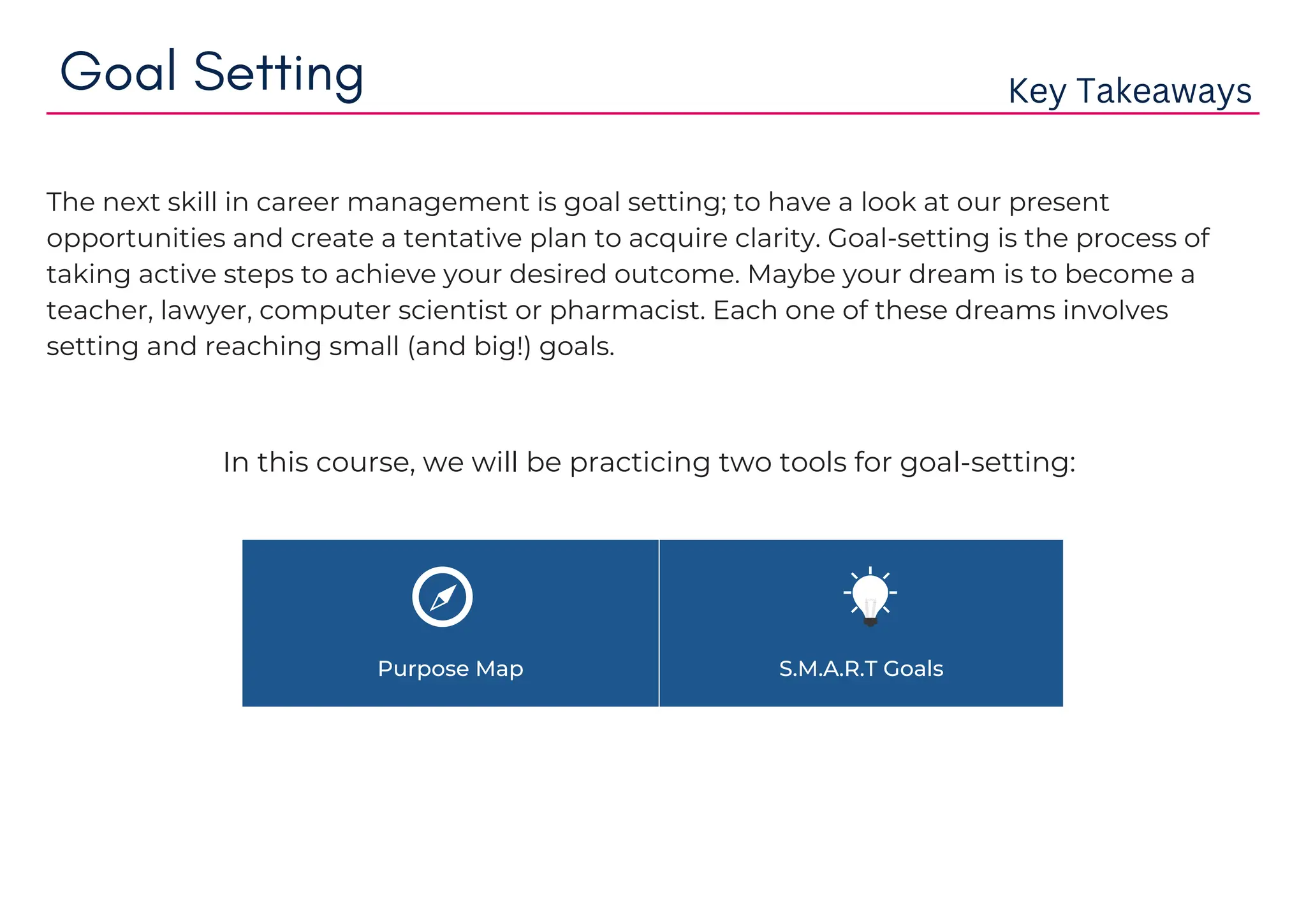
Purpose Map S.M.A.R.T Goals
Goal Setting Key Takeaways
The next skill in career management is goal setting; to have a look at our present
opportunities and create a tentative plan to acquire clarity. Goal-setting is the process of
taking active steps to achieve your desired outcome. Maybe your dream is to become a
teacher, lawyer, computer scientist or pharmacist. Each one of these dreams involves
setting and reaching small (and big!) goals.
In this course, we will be practicing two tools for goal-setting:
Purpose Map
A simple but powerful tool helps you identify the opportunities you have right now to live more purposefully and
become the person you want to be. It helps us identify our Purpose and map out possibilities to narrow down our
career path.
Purpose Map begins by answering three questions:
What Do I Really Want?
Designed to help identify a lifestyle
that incorporates what is most
important to them.
Reflection Questions: What kind of
lifestyle is important to me? How do
I want to spend my time? Who are
the people I want to surround
myself with? What activities bring
me joy?
How Can I Best Serve Others?
Caters to the natural human need
to connect with others. This is true
whether they are at work, at home,
volunteering, or doing any other
activity that’s important to them.
Reflection Questions: What does
service mean to me? How can I use
the talents and resources I have to
be of service to others? When do I
feel like I’m at my most useful? How
do I define meaningful work?
How Can I Meet My Financial
Needs?
Designed to think about the role
that money plays in their life right
now and in the future.
Reflection Questions: How much
stability do I want and need? What
have I done so far that people have
been willing to pay me for? What
am I better at than most people?
What kind of environment do I
require in order to do my best
work?
Purpose Map Key Takeaways
What Do I Really Want? How Can I Best Serve Others?
How Can I Meet My Financial
Needs?
Creating Your Purpose Map Worksheet
As attempted during the session, please fill in the template below:
encourging people to work, work , work
without wasting precious time
by helping them
volunteering as a family children watch everythinv we do. we can ahow
them how it feels good to help others
its a valuable way to get to know to
organizations in community
to make a combined orphanage and old
home
by taking care of them by doing part time job with study
S M A R T
S.M.A.R.T Goals Key Takeaways
Set goals intelligently with the S.M.A.R.T approach
SPECIFIC
You need to
be clear on
what you
want to
accomplish
MEASURABLE
The goals
should be
quantifiable
e.g., generate
one lead per
month.
ATTAINABLE
The goals
should not be
too easy or too
hard. Set
ambitious, but
realistic
targets.
RELEVANT
The target
should align
with your
personal/
professional
goals.
TIME-BOUND
Set a
timeframe
and/or a clear
deadline for
achieving your
goal.
What do I want to
accomplish?
How will I know when
it's accomplished?
How can the goal be
accomplished?
Does this seem
worthwhile?
When can I
accomplish this goal?
GOAL:
SPECIFIC
MEASURABLE
ATTAINABLE
RELEVANT
TIME-BOUND
S.M.A.R.T Goal Setting Worksheet
SMART GOAL:
I wanted to start a business
I will sell handmade cards through websites( online)
I will be ready to take my first order within four weeks
I will get setup on website first then i build an inventory of 30 hadmade cards to sell
selling handmade cards will allow me to benefit financially
my website will be running up within four weeks
within a month i am goong to get setup to sell handmade cards on websire it help me buildiing my customers
Strengths Weaknesses
Strength 1: ________________________________
Explanation:
___________________________________________________
___________________________________________________
___________________________________________________
___________________________________________________
Weakness 1: __________________________
Explanation:
____________________________________________________
____________________________________________________
____________________________________________________
____________________________________________________
Strength 2: ______________________________
Explanation:
___________________________________________________
___________________________________________________
___________________________________________________
___________________________________________________
Weakness 2: _________________________
Explanation:
____________________________________________________
____________________________________________________
____________________________________________________
____________________________________________________
Strategizing Strengths & Weaknesses Worksheet
List any two of the strengths and weaknesses you have identified in the previous activity. For strengths,
mention how they could help in your career progression. For your weaknesses, state how they could be a
hurdle and the steps you would take to overcome them.
honest not skilled at public speaking
by staying honest helped me alot in my all fields of life either on
work lif, bussiness life , professional life
it created problems in my work life i cant easily asked or answered
questions . It can be overcomed by speaking to yourself in front of
mirror.
patient taking on to much responsibility
by taking to much responsibility created problems for my own work
which is get ignored. it can be overcomed by taking burden which
is bearable for me not more than that.
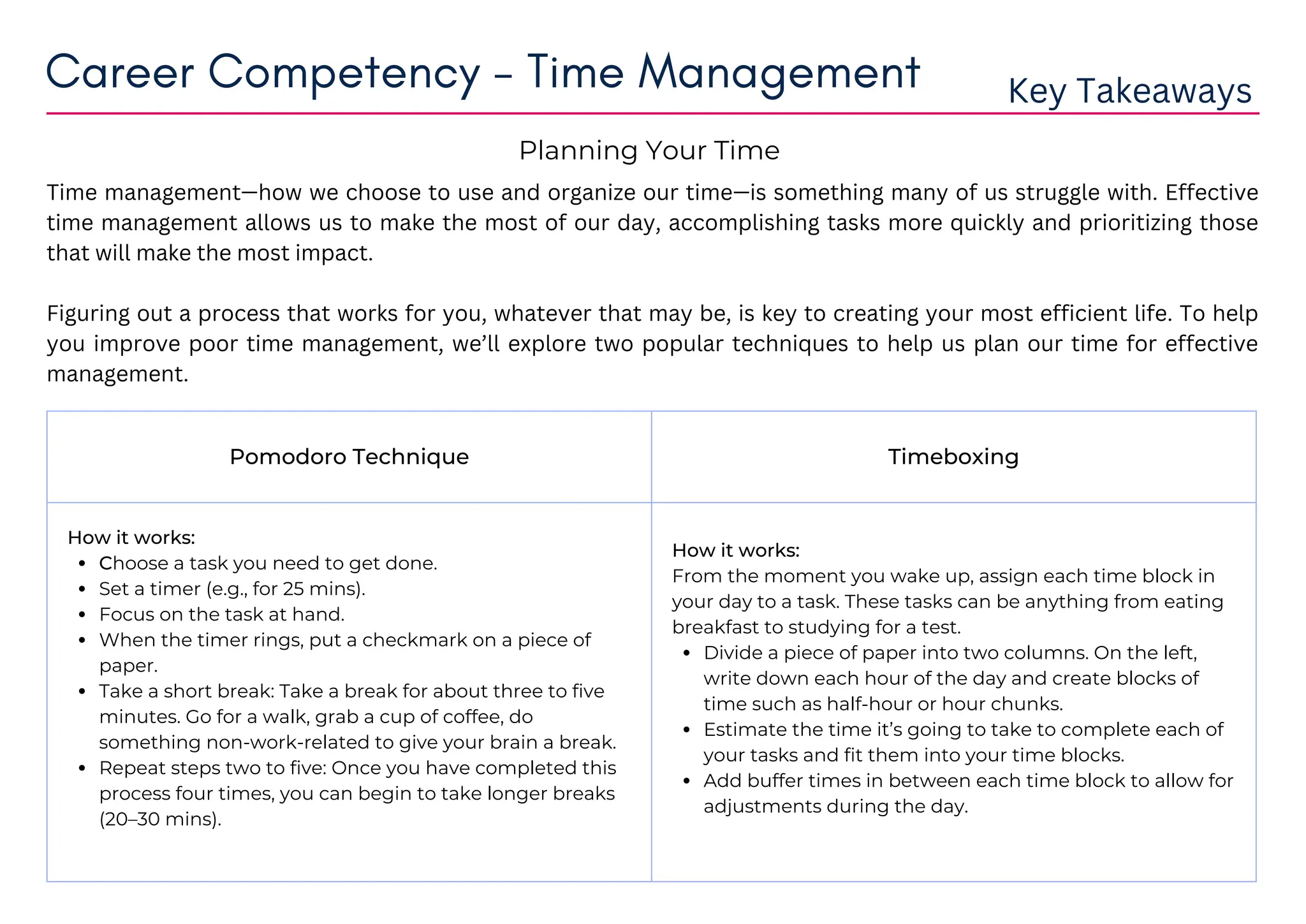
Career Competency - Time Management Key Takeaways
Pomodoro Technique Timeboxing
Choose a task you need to get done.
Set a timer (e.g., for 25 mins).
Focus on the task at hand.
When the timer rings, put a checkmark on a piece of
paper.
Take a short break: Take a break for about three to five
minutes. Go for a walk, grab a cup of coffee, do
something non-work-related to give your brain a break.
Repeat steps two to five: Once you have completed this
process four times, you can begin to take longer breaks
(20–30 mins).
How it works:
Divide a piece of paper into two columns. On the left,
write down each hour of the day and create blocks of
time such as half-hour or hour chunks.
Estimate the time it’s going to take to complete each of
your tasks and fit them into your time blocks.
Add buffer times in between each time block to allow for
adjustments during the day.
How it works:
From the moment you wake up, assign each time block in
your day to a task. These tasks can be anything from eating
breakfast to studying for a test.
Planning Your Time
Time management—how we choose to use and organize our time—is something many of us struggle with. Effective
time management allows us to make the most of our day, accomplishing tasks more quickly and prioritizing those
that will make the most impact.
Figuring out a process that works for you, whatever that may be, is key to creating your most efficient life. To help
you improve poor time management, we’ll explore two popular techniques to help us plan our time for effective
management.
Session 3
Business Communication & Presentation Skills
Career Competency - Time Management Key Takeaways
Prioritizing Your Tasks
Time boxing and pomodoro helps us organize our time better, whereas Glass jar and Eisenhower help us prioritize
our tasks. Once we have prioritized our tasks using Glass jar/Eisenhower, we may use timeboxing/pomodoro for the
completion of each task.
Glass Jar Technique Eisenhower Matrix
Rocks: Your most important strategic projects
Pebbles: Projects and tasks that are important but not
the most critical
Sand: Smaller, more insignificant tasks
How it works:
Categorize your work in this way:
Tackle the rocks first. If you keep tackling the small things
(the sand and pebbles), and not the important strategic
items, the rocks, then your jar will quickly fill up with no
room for more rocks.
Organize your task list into four separate quadrants,
sorting them by important vs. unimportant and urgent
vs. not urgent.
Urgent tasks are those we feel need to get done
immediately. Important tasks are those that contribute
to your long-term goals or values. Ideally, you should
only work on tasks in the top two quadrants—the other
tasks, you should delegate or delete.
How it works:
Career Competency - Time Management Visual Aid
Eisenhower Matrix
Not
Important
Important
Urgent Not Urgent
Do.
Tasks with
deadlines or
consequences
Schedule.
Tasks with unclear
deadlines that
contribute to long-term
success
Delegate.
Tasks that must get
done but don't
require your skill-set
Delete.
Distractions and
unnecessary tasks
Worksheet 1
Using the list of tasks created during discussion, arrange the tasks based on the Glass Jar technique.
Time Management
Glass Jar Technique
Rocks
Pebbles
Sand
List of Tasks
mid term exam preparation
assignments
watching podcasts
mid term exam preparation
assignments
watching podcasts
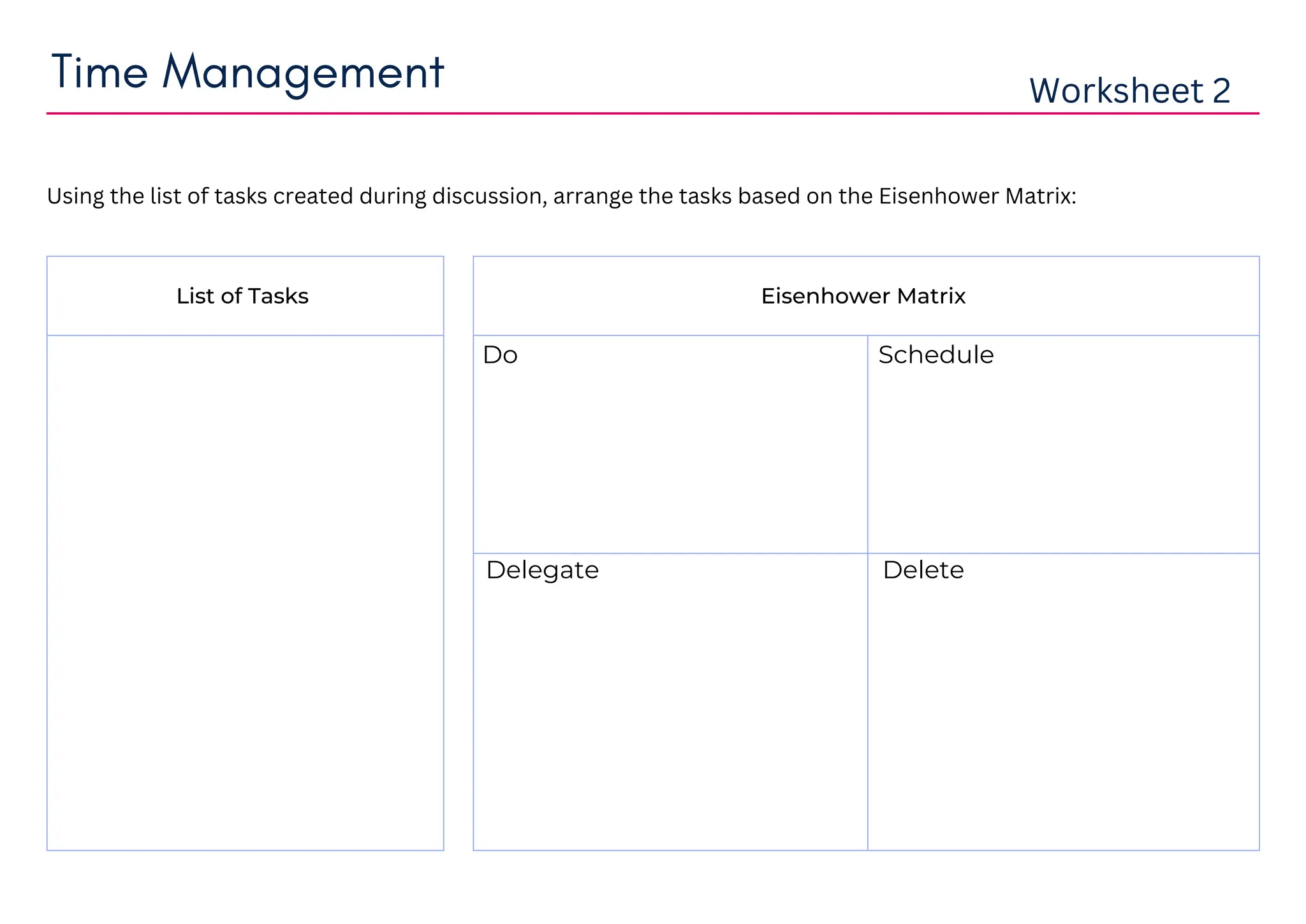
Worksheet 2
Using the list of tasks created during discussion, arrange the tasks based on the Eisenhower Matrix:
Time Management
Eisenhower Matrix
List of Tasks
Do Schedule
Delegate Delete
mid term exams preparation
exercising
watching podcasts
cleaning study table
mid term exams preparation exercising
watching podcasts cleaning study table
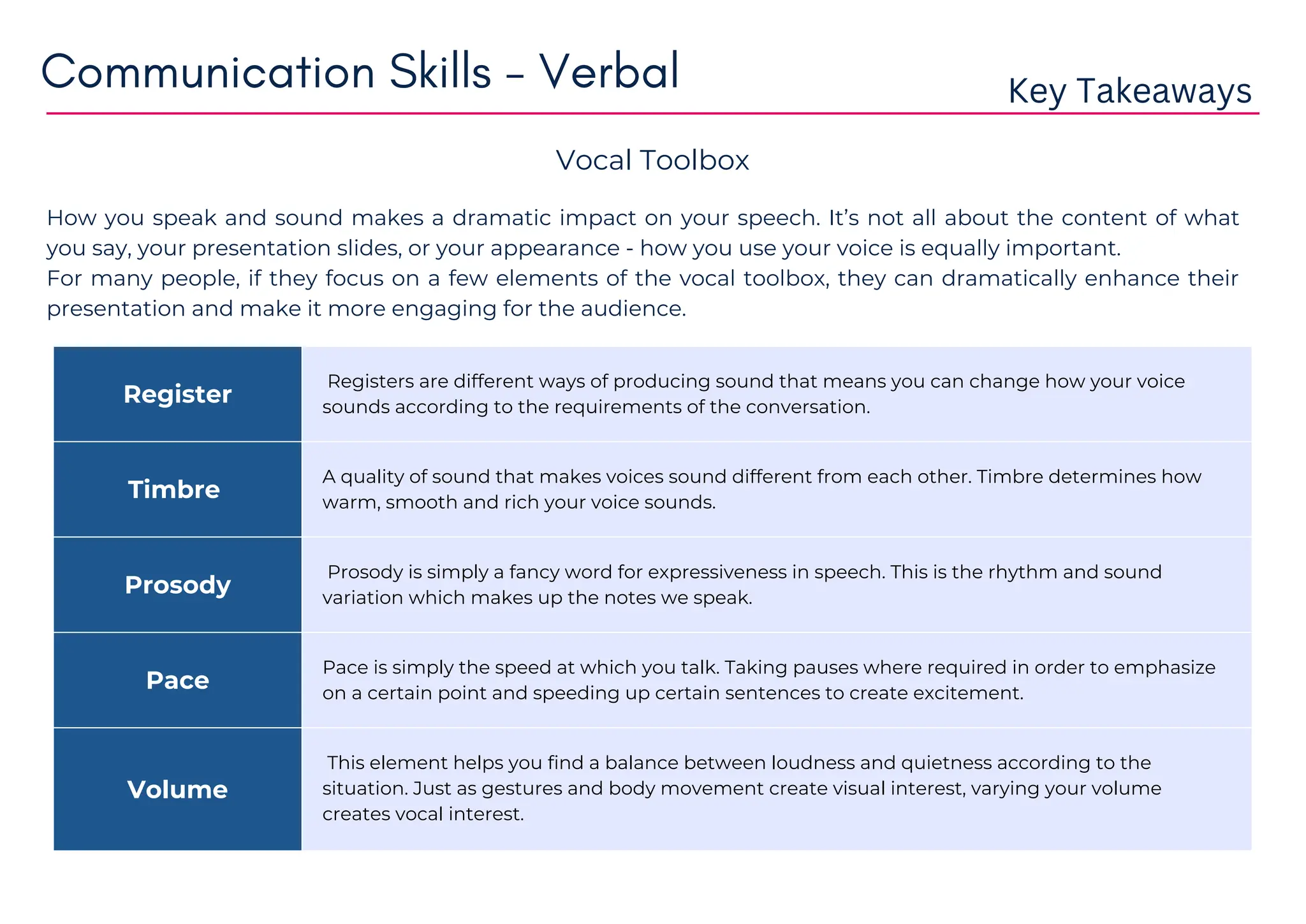
How you speak and sound makes a dramatic impact on your speech. It’s not all about the content of what
you say, your presentation slides, or your appearance - how you use your voice is equally important.
For many people, if they focus on a few elements of the vocal toolbox, they can dramatically enhance their
presentation and make it more engaging for the audience.
Register
Registers are different ways of producing sound that means you can change how your voice
sounds according to the requirements of the conversation.
Timbre
A quality of sound that makes voices sound different from each other. Timbre determines how
warm, smooth and rich your voice sounds.
Prosody
Prosody is simply a fancy word for expressiveness in speech. This is the rhythm and sound
variation which makes up the notes we speak.
Pace
Pace is simply the speed at which you talk. Taking pauses where required in order to emphasize
on a certain point and speeding up certain sentences to create excitement.
Volume
This element helps you find a balance between loudness and quietness according to the
situation. Just as gestures and body movement create visual interest, varying your volume
creates vocal interest.
Communication Skills - Verbal Key Takeaways
Vocal Toolbox
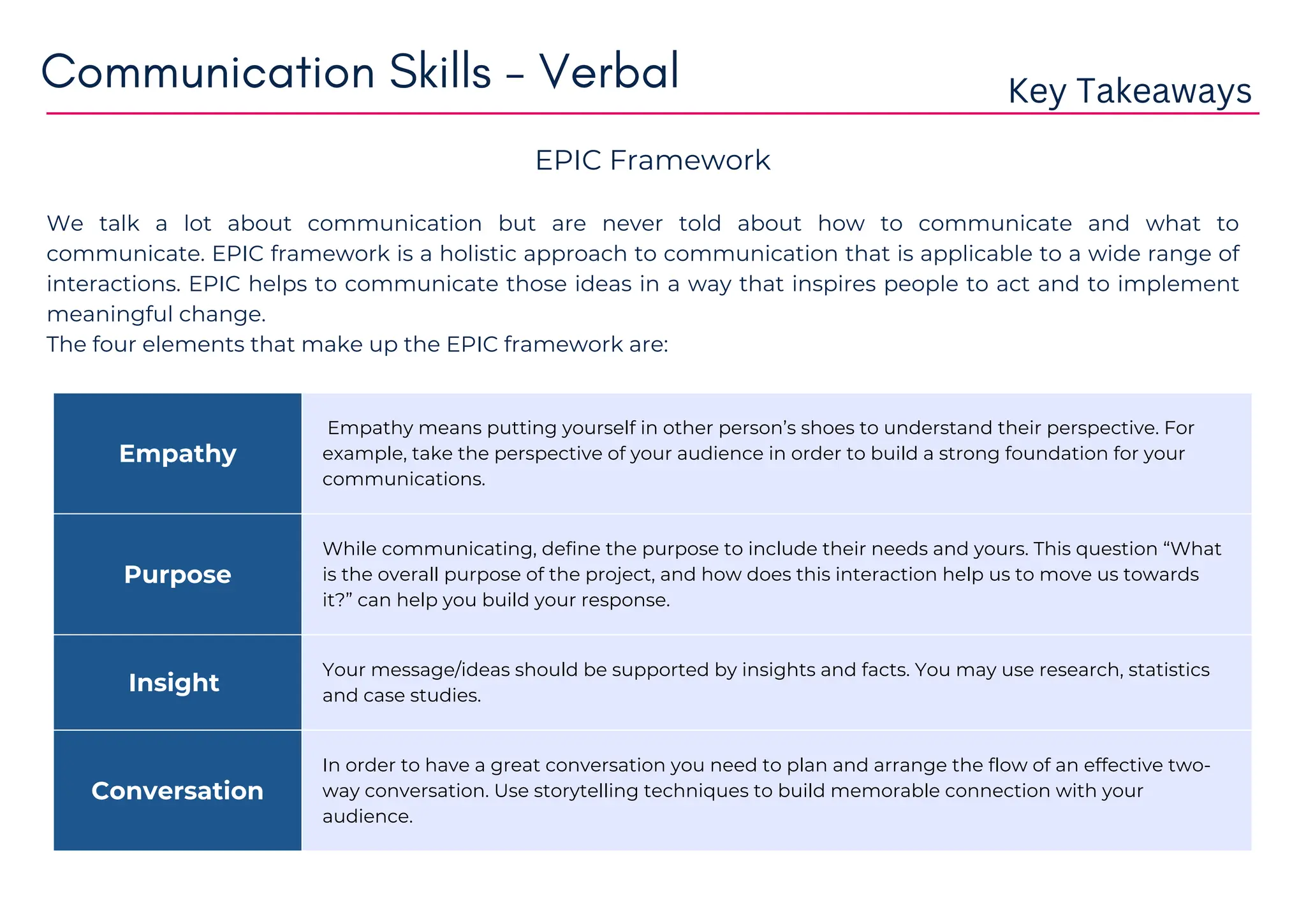
We talk a lot about communication but are never told about how to communicate and what to
communicate. EPIC framework is a holistic approach to communication that is applicable to a wide range of
interactions. EPIC helps to communicate those ideas in a way that inspires people to act and to implement
meaningful change.
The four elements that make up the EPIC framework are:
Empathy
Empathy means putting yourself in other person’s shoes to understand their perspective. For
example, take the perspective of your audience in order to build a strong foundation for your
communications.
Purpose
While communicating, define the purpose to include their needs and yours. This question “What
is the overall purpose of the project, and how does this interaction help us to move us towards
it?” can help you build your response.
Insight
Your message/ideas should be supported by insights and facts. You may use research, statistics
and case studies.
Conversation
In order to have a great conversation you need to plan and arrange the flow of an effective two-
way conversation. Use storytelling techniques to build memorable connection with your
audience.
Communication Skills - Verbal Key Takeaways
EPIC Framework
Communication Skills - Non-Verbal Key Takeaways
Non-verbal communication is as important as verbal communication to make an impact. Below
are a few elements of non-verbal communication:
Eye contact Sitting posture Facial expressions
Gestures Dressing style Body Language
Communication Skills - Non-Verbal Worksheet
In the picture below, identify areas where non-verbal communication is not up to par.
1. body language
2.facial expressions
3.eye contact
4. siiting posture
5. dressing style
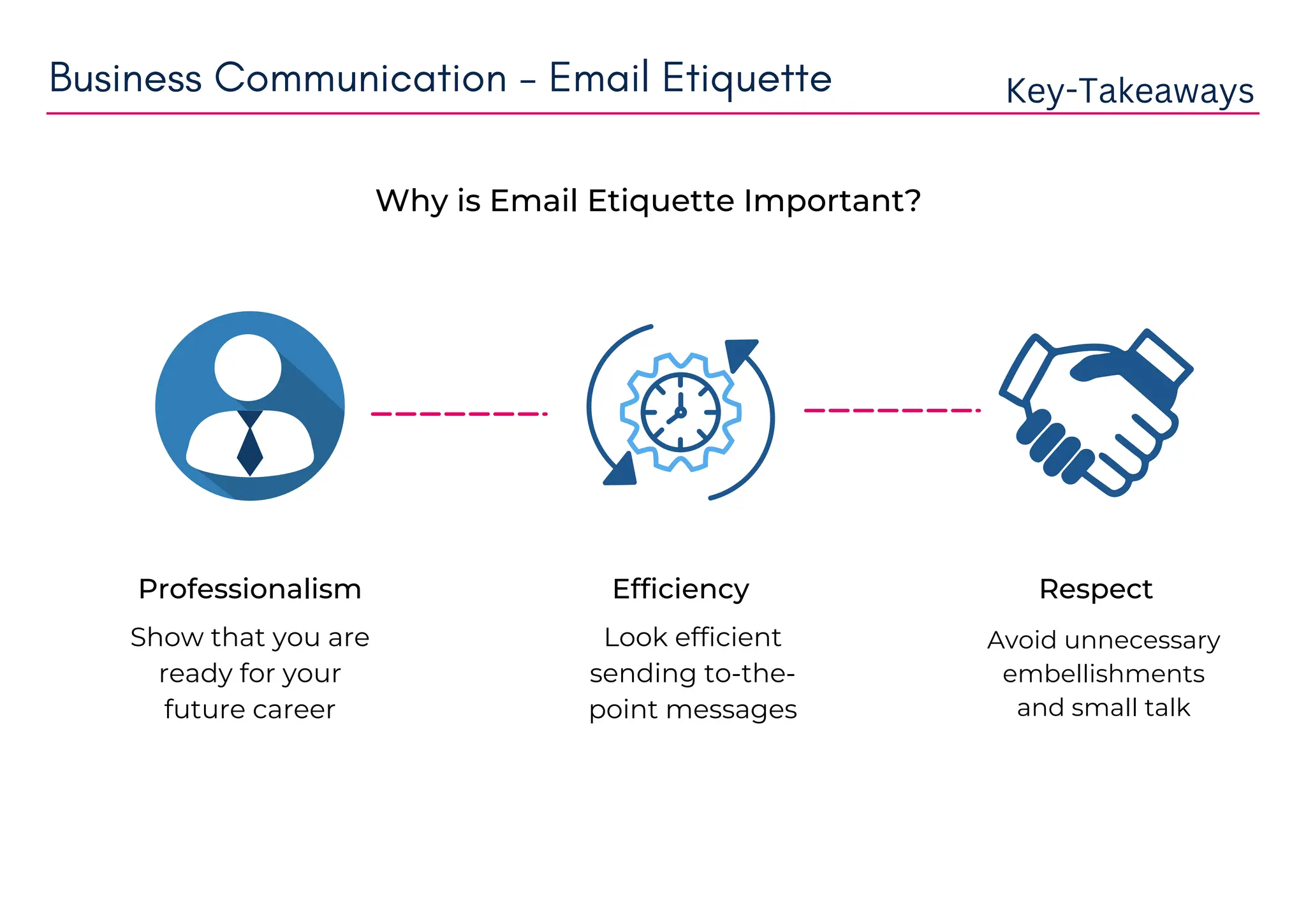
Business Communication - Email Etiquette Key-Takeaways
Why is Email Etiquette Important?
Professionalism Efficiency Respect
Show that you are
ready for your
future career
Look efficient
sending to-the-
point messages
Avoid unnecessary
embellishments
and small talk
Use a professional email
address
Using an unprofessional email address tends to be a common mistake among students.
Make sure to make a professional email ID before sending important emails.
A professional email would ideally only include your name or some number if need be.
Use a direct subject line
The email's subject line informs the recipient of what they can expect to find in the email's
body. It may help them sort their emails or begin finding information for a response before
reading the full message. Make email subject lines clear and straightforward.
Use professional greetings Easy rule of thumb is to stick to modifying them according to the time of the day, such as:
Good morning, Good afternoon or Good evening.
Avoid using unprofessional
language
Do not write (Roman Urdu) Urdu using English alphabets in your email. Stick to using
English and avoid slang words.
Closing of Email
Conclude your email with a short closing, such as “Thank you,” “Best regards” or
“Sincerely.” Include your full name at the bottom along with your title and essential
contact information, such as your phone number. This closing gives your recipient all the
details they need to respond.
Review
It is always a good idea to take another look before pressing send. Spellcheck can catch
many errors but be sure to check for typos on your own, too.
Business Communication - Email Etiquette Key-Takeaways
Tips to Write a Professional Email
Session 4
Verbal Communication & Resume Writing
Career Readiness - Elevator Pitch Key-Takeaways
"An elevator pitch is a short yet impressive introduction of yourself designed to market your experiences and skill
sets. You can also use it to create interest in a project, idea or product – or in yourself. A good elevator pitch should
last no longer than a short elevator ride of 20 to 30 seconds, hence the name."
Knowing how to write a good elevator pitch will be useful. Refer to the elements below for a good elevator pitch:
Identify Your Goal
Start by thinking about the objective of your pitch.
For instance, are you a current student looking to get an internship over the summers? A fresh
graduate applying for jobs or an entrepreneur looking for investors?
Explain What You Do
It is important for the listener to have an idea of the person/product/idea they are being informed
about. If you are a student, your pitch will include your semester and major. If you are a fresh graduate,
you will talk about your major and field of interest. In case you are pitching a business idea, you will
talk about your product.
USP
Unique Selling Proposition to what makes a product unique, you should also know that people also
have USPs. A Unique Selling Proposition is any skill, idea or characteristic that makes you or your
product stand out from the rest.
Engage With a Question
After you communicate your USP, you need to engage your audience. To do this, ask questions to
involve them in the conversation.
Put It All Together
When you've completed each section of your pitch, put it all together.
Then, read it aloud and time how long it takes. It should be no longer than 20-30 seconds. Otherwise,
you risk losing the person's interest, or monopolizing the conversation.
Try to cut out anything that doesn't absolutely need to be there. Remember, your pitch needs to be
snappy and compelling, so the shorter it is, the better!
Elevator Pitch - Sell a Product Worksheet
Draft an Elevator Pitch for your product in the 'Sell a product' activity using the template below:
Identify Your Goal
Explain What You Do
USP
Engage With a Question
Put It All Together
Hi, my name is laiba. I am sure you heard about bonanza brand. I am selling their perfume original copies.
I am selling their perfume original copies. Iam doing this from 5 years and nothing experienced any kind of
complain from the customers.
Regardless, I am selling copied perfumes but i granteed you that it works much similar to the original ones.
There smell, shape and style is much similar to original. The only difference is in its lasting fragrance.
have you ever used the copied things? If yes, then I want to know your experience.
In conclusion, I want you to experience this at once. I hoped that you really liked it.
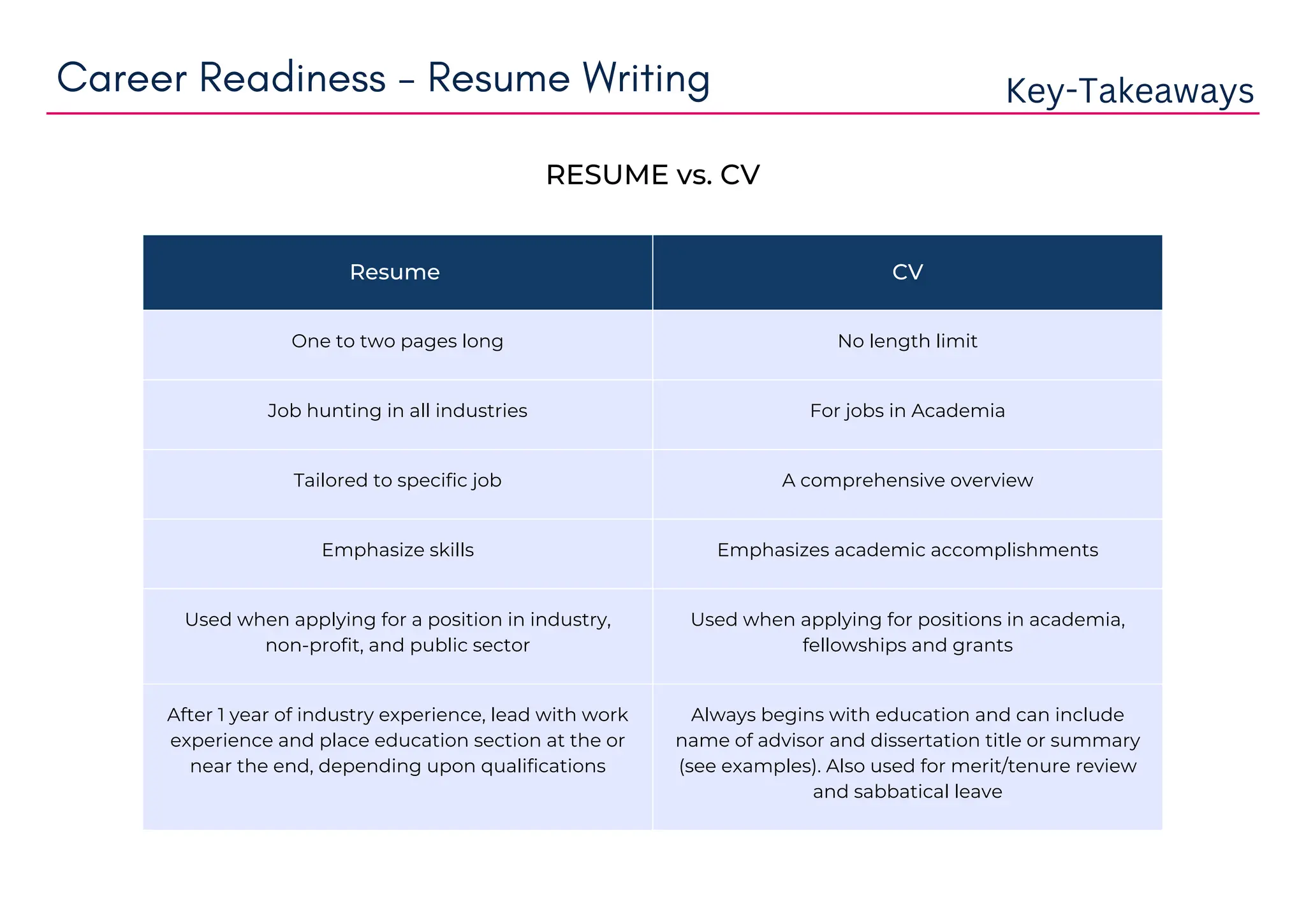
Resume CV
One to two pages long No length limit
Job hunting in all industries For jobs in Academia
Tailored to specific job A comprehensive overview
Emphasize skills Emphasizes academic accomplishments
Used when applying for a position in industry,
non-profit, and public sector
Used when applying for positions in academia,
fellowships and grants
After 1 year of industry experience, lead with work
experience and place education section at the or
near the end, depending upon qualifications
Always begins with education and can include
name of advisor and dissertation title or summary
(see examples). Also used for merit/tenure review
and sabbatical leave
Career Readiness - Resume Writing Key-Takeaways
RESUME vs. CV
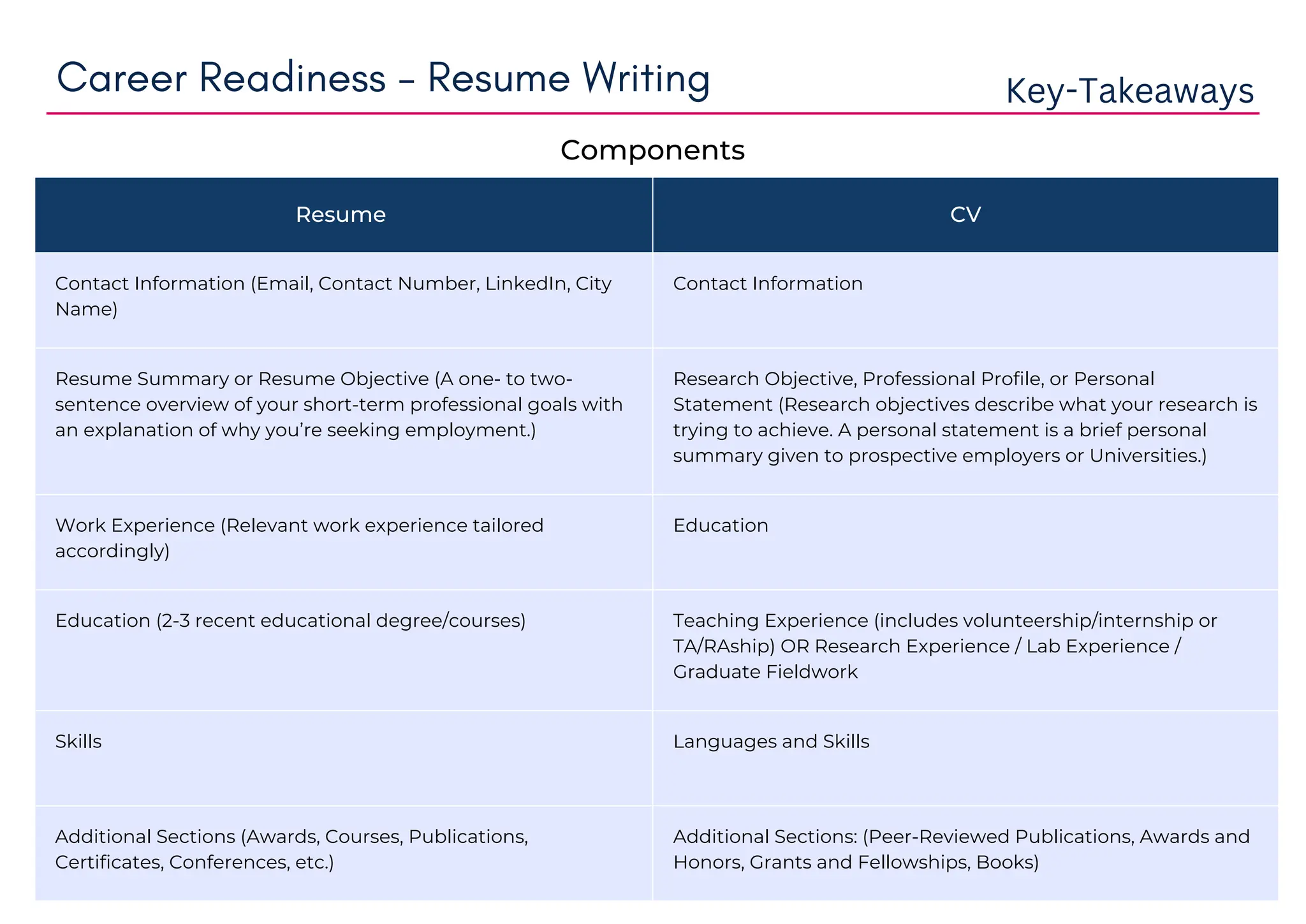
Resume CV
Contact Information (Email, Contact Number, LinkedIn, City
Name)
Contact Information
Resume Summary or Resume Objective (A one- to two-
sentence overview of your short-term professional goals with
an explanation of why you’re seeking employment.)
Research Objective, Professional Profile, or Personal
Statement (Research objectives describe what your research is
trying to achieve. A personal statement is a brief personal
summary given to prospective employers or Universities.)
Work Experience (Relevant work experience tailored
accordingly)
Education
Education (2-3 recent educational degree/courses) Teaching Experience (includes volunteership/internship or
TA/RAship) OR Research Experience / Lab Experience /
Graduate Fieldwork
Skills Languages and Skills
Additional Sections (Awards, Courses, Publications,
Certificates, Conferences, etc.)
Additional Sections: (Peer-Reviewed Publications, Awards and
Honors, Grants and Fellowships, Books)
Career Readiness - Resume Writing Key-Takeaways
Components
Chronological order
In all the sections, focus on the latest thing first. For example, in Education, mention the
degree you are currently pursuing.
Action Verbs
Action Verbs describe the impact of your work and make your resume more professional.
Trained my department vs. Created new training material and supervised a team of 30
employees.
Quantification
Quantification makes an impact on the job role statements in the resume. For example:
writing, 'mentored a class of 40 students on leadership and growth mindset skills' shows
the scale of your teaching practice and leaves an impact on the recruiter who might
consider you for the position as he/she will be aware that you are equipped to deal with a
large audience.
By quantifying, we can make our work seem more credible and impactful. So, always add
numbers in your resume.
Career Readiness - Resume Writing Key-Takeaways
How to Organize and Write a Resume
Trained my department
Created new training material and supervised a team of 30 employees.
Did a fellowship on professional
development
Did an internship at a digital
agency and made social media
content for them
President of debating society and
organized many competitions
Action Verbs & Quantification Worksheet
Using action verbs and quantification, revise the statements given below:
Did a companionship on 10 years professional development
Did a 5 years work experience at a digital agency and made a social media content for them
Premier of debating society organized 100+ competitions
Career Competency - Critical Thinking Key Takeaways
Keep the goal in mind
Know your biases and try to look past them
Ask questions and gather information
Evaluate the facts of the situation and all available data
Collaborate and get feedback from others—especially people with different backgrounds than your
own
Generate possible solutions, particularly out-of-the-box ideas
Consider the short- and long-term consequences of implementing each solution
Make a decision or come to a conclusion
Present and communicate the decision or conclusion
Are you looking to land the perfect job? Or an employee aiming to climb the next rung on the career
ladder? Developing your critical problem-solving skills will make you a better candidate for that new job
or promotion.
The words “critical thinking” frequently pops up in job descriptions and on adjective lists for resume-
writing, so it’s clearly a desirable characteristic. It’s such an important skill that some employers even
require candidates to pass a critical thinking test for employment with the company.
Here are some ways to improve and utilize your critical thinking skills:
Session 5
Cover Letters, Job Research and Problem-Solving
Role Match
Your "target job title" should match the title that is being advertised and go toward the top of your resume to catch the eye of
the hiring manager and any applicant tracking system (ATS) that's searching for a match.
Job Description Key Takeaways
A job description contains the following components: job title, job purpose, job duties and responsibilities,
required qualifications, preferred qualifications, and working conditions.
When you find a job posting you like, look for these factors while you revise your professional documentation:
Value Match
Find overlap between your previous responsibilities and qualifications to show what value you can bring to this organization.
Look beyond tangible skills and highlight your work ethic or personality traits that make you a great candidate.
Skill Match
Identify the hard and soft skills from the job ad and mirror the same language in your resume. Include your educational
background, work experiences and transferable skills that show you are equipped to perform the job with the skills you have
acquired through your career.
Career Readiness: Cover Letter Key Takeaways
A cover letter is a one-page document that you submit as part of your job application (alongside
your CV or Resume). Its purpose is to introduce you and briefly summarize your professional
background. A good cover letter can spark the HR manager’s interest and get them to read your
resume.
Tips to write an effective cover-letter:
Step 1: Make it Personal
Step 2: Tell Them Why You Picked Them
Step 3: Tell Them Why They Should Pick You
Step 4: Show Passion
Step 5: Show Kindness
Career Readiness: Cover Letter Key Takeaways
The cover letter can be divided into 4 paragraphs:
Paragraph 1
[Make it personal]
Start by your introduction and write about the job you are applying
for. You can mention your qualifications here.
Paragraph 2
[Why you picked
them]
Talk about the company here, do your research, find out which
specific projects the company is doing and what strikes your interest.
Paragraph 3
[Why they should pick
you + Show passion]
Now, talk about yourself. Talk about all your relevant job experiences
or anything you have done to learn the skills the JD has mentioned.
Paragraph 4
[Show kindness]
End on a good note - talk about how you are looking forward to
meeting them and how thankful you are to them for taking out the
time.
Websites Portals Additional Sources
Career Readiness: Job Database Worksheet
From the job database create during the session with your facilitators, mention the
relevant sources that you plan to consult in the template below:
Global job hunting
pakistani job hunting
Joby.pk
rozee.pk
olx
packaging company in usa
glassdoor
technical recruiter
ajwa tuitor
nescafe
upwork
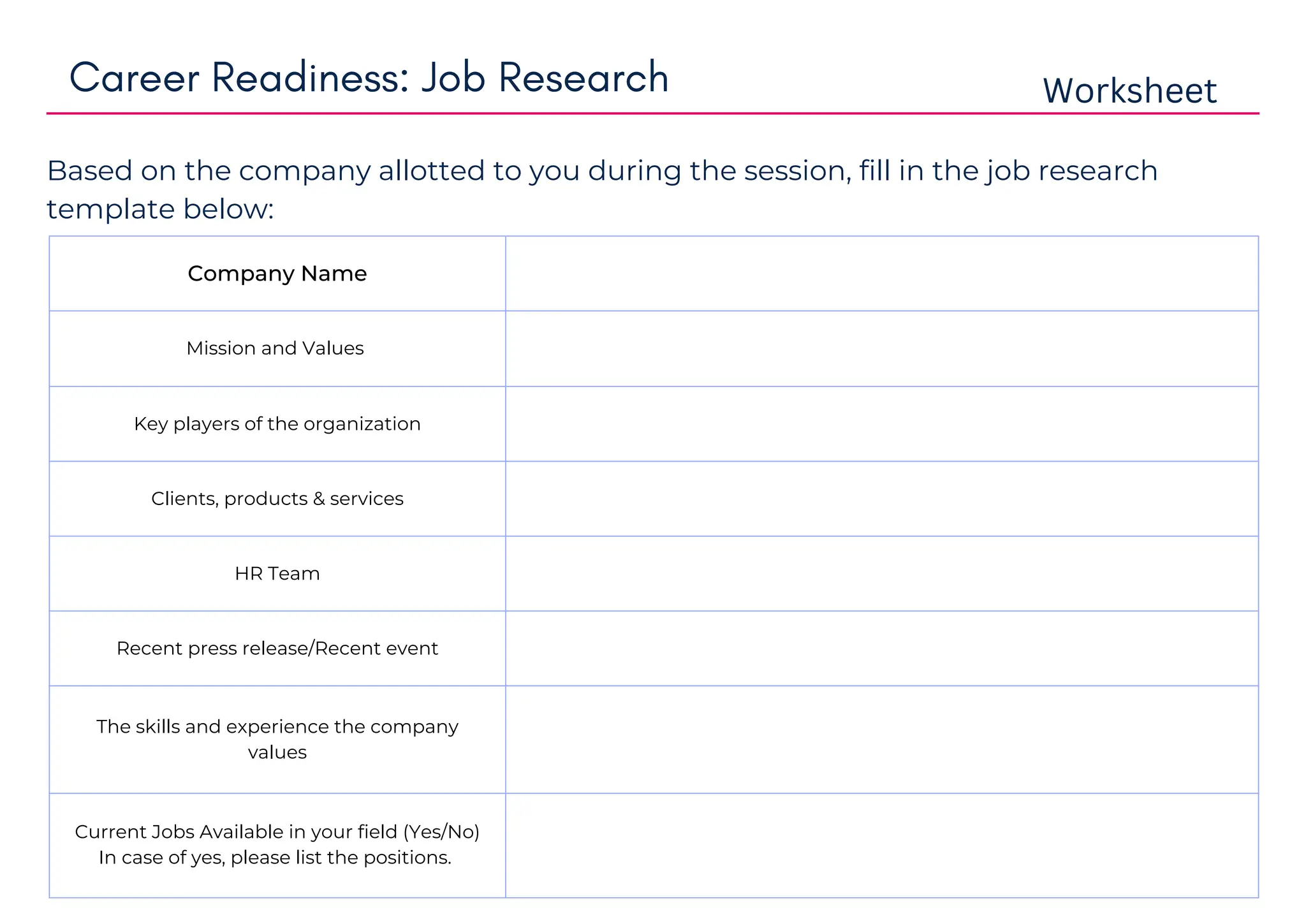
Company Name
Mission and Values
Key players of the organization
Clients, products & services
HR Team
Recent press release/Recent event
The skills and experience the company
values
Current Jobs Available in your field (Yes/No)
In case of yes, please list the positions.
Career Readiness: Job Research Worksheet
Based on the company allotted to you during the session, fill in the job research
template below:
Career Competency - Problem Solving & Team Building Key Takeaways
The Desert Survival Problem provides a unique opportunity to quickly and objectively
measure whether your groups are achieving synergy—as well as demonstrate this
otherwise elusive concept. Synergy occurs when the interactive efforts of two or more
people produce a solution that is superior to their independent solutions.
By measuring the quality of both individual and team performance on a single task,
this simulation allows groups to quickly calculate the extent to which they are fully
utilizing their resources—and doing so in a way that achieves synergy.
Session 6
Job Application Process & Interviews
Recruitment
Drive
Online
Application
Form
Gaming
Test
HR
Interview
Panel
Interview/
Technical
Interview
Assessment
Center
Job Offer
In order to increase the chances of being successful at any task, it is crucial to know
the steps involved in that task. A thorough understanding of the hiring process will set
you on the right track and equip you to prepare for the job that they want.
Career Readiness: Job Application Process Key Takeaways
General Process for Private Jobs
General Process for Government Jobs
Online Application
[PPSC, FPSC, NTS,
National Job
Portal]
Test
[English/Analytical,
Quantitative/
Technical]
Interview
Medical
Examination
Job Offer
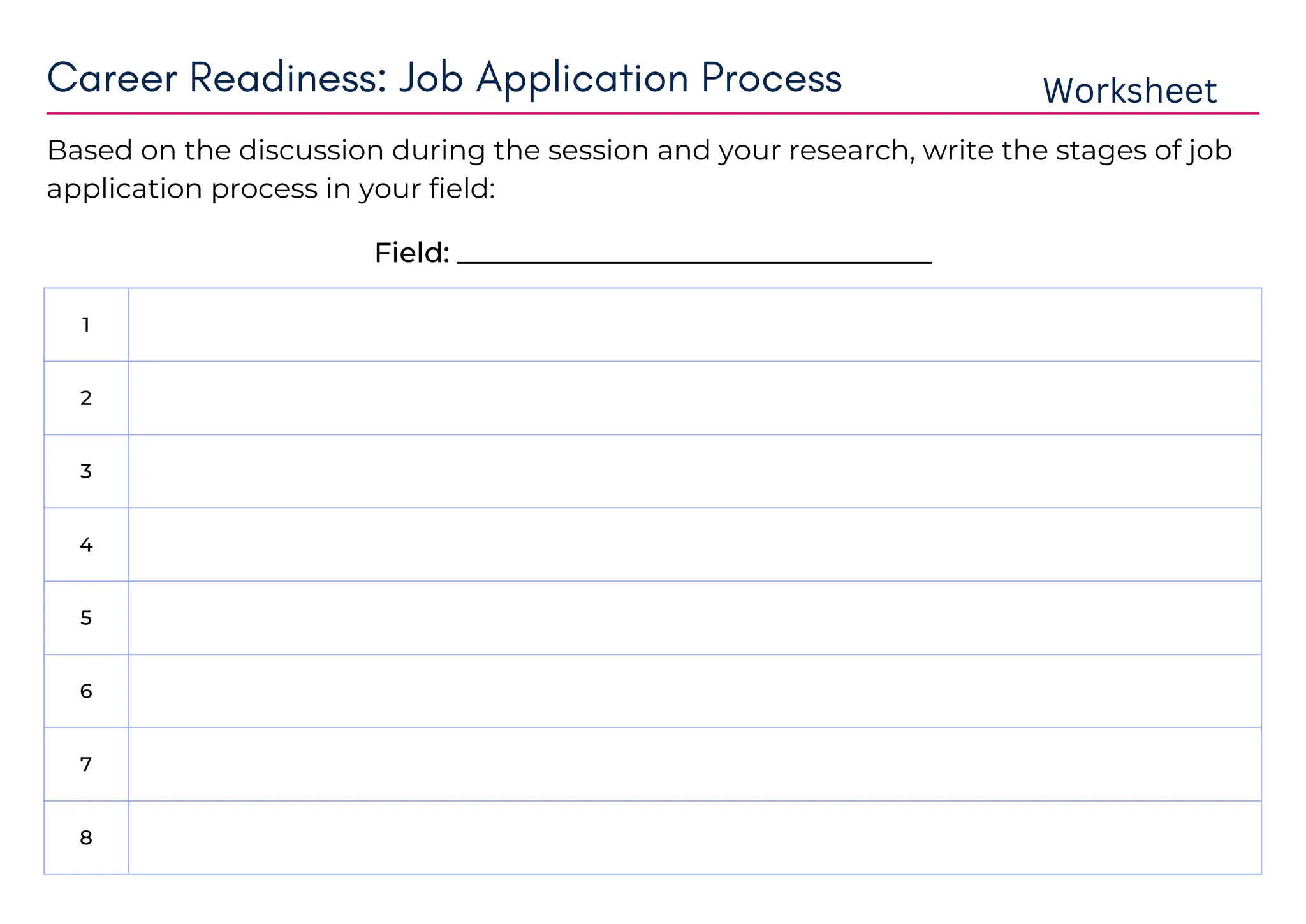
1
2
3
4
5
6
7
8
Based on the discussion during the session and your research, write the stages of job
application process in your field:
Career Readiness: Job Application Process Worksheet
Field: __________________________________
bs maths
recruitment drives
online form fill
test
assessment centres
interview with HR
panal interview
interview with director of concerned department
Professional Photo
Headline (Student + Degree)
Profile Summary
Work and Experience: Short & Sweet
Recommendations
(From teachers and any managers you have worked with)
Contact Details
Customize your public profile URL
Skills & Endorsements
LinkedIn will help you find a job faster because most hiring managers and recruiters are already using it. A
whopping 87% of recruiters find LinkedIn to be the most effective when vetting candidates during the hiring
process. Having an active and well put together LinkedIn profile will, thus, significantly increase the chances of
your discovery by various companies looking to hire people based on your skills and experience.
Here is checklist that you can refer to while updating your LinkedIn profiles:
Career Readiness: LinkedIn Profile Key Takeaways
Pre-Interview During interview Post-interview
Understanding the hiring
process and job
requirements
Doing company research
Tailoring documents -
resume and cover letter
Applying and appearing for
the interview on time -
punctuality can make or
break the deal
Professional Dressing
Verbal communication - how
they answer the interview
questions
Non-verbal communication -
how confident and
comfortable do they appear
Thank-you email
Reflection on interview
performance
Follow-up in 1 week
By now, you have prepared your professional documentation, understood the job
description and conducted company research. What comes next? The interview
process!
Career Readiness: Interview Preparation Key Takeaways
Breakdown of an Interview:
The interview process can be divided into 3 stages. These 3 stages are:
What do I wear to an Interview? At a corporate
firm? At a start-up firm?
What should I bring to an interview?
What should I NOT bring to an interview?
When should I arrive for my interview? What if I
am running late?
Should I ask how much I’d be getting paid? If so,
how/when should I ask?
Should I ask other questions (not related to pay)?
What could those be?
Is following up necessary? If so, how/when do I
follow up?
Unwritten Rules of Interviewing
Career Readiness: Interview Preparation Worksheet
dress pants with dress shirts and blazers
1. folder
2. copies of resume
3. questions
1. snacks
2. chewing gums
3. shopping bag
around 10 mints before interview. if you are running late then letting your iunterview know
that you are late because of serious issue
it is not rude to ask how much i paid . ask this at the end of interview
yes we can. example can you me more about the day to day responsibilities of the role?
follow up the same day or one day later
leadership
problem-solving
communication
Critical thinking is one of the most highly sought-after skills in the workplace. Critical thinking skills allow a person to
analyze information, arrive at conclusions and make sound decisions. Applying critical thinking in the workplace is an
essential skill everyone should be trying to improve. It can set you apart as a leader, improve the quality of your work,
and the perception those higher up the chain have of you.
Critical thinking in the workplace is a deeper level of thinking where we question, analyze and draw conclusions about
information and evidence.
Critical thinking skills are valuable in all roles in an organization. These skills enhance communication, creativity and
problem-solving. Thinking critically in the workplace allows you to connect ideas, evaluate arguments, find errors and
solve complex issues. The workplace is packed with situations that require teams and individuals to approach complex
problems and solve them using new and innovative approaches. Employees who can communicate and relate with
coworkers, develop strategies and overcome issues are more likely to succeed.
Critical thinking is especially important in three areas of business:
Career Competency: Critical Thinking Key Takeaways
Session 7
Interviewing Skills
Skills
includes the right qualification and
prowess essential to perform a job. The
qualifications, necessary technical
skills, soft skills and practical expertise
all come under the umbrella of skills.
Passion
seeks to explore if a candidate is
actually ambitious about the role and
the work that comes with it.
Fit
indicates how well a person will
integrate within a company. A
company seeks to have a team
that empowers others and creates
a strong support system.
Degree
Courses/Certifications
Internships
Communication
Extracurricular and leadership
activities
An interviewer will assess a candidate’s
skills in the following ways:
Manner in which a person talks about
the role and the work
Deeper knowledge and
understanding of the job, that which
surpassed surface-level knowledge
Knowledge of recent developments in
related fields
Volunteer/internship experience
Ideas and visions to contribute to the
discipline
An interviewer will assess a candidate’s
passion in the following ways:
General behavior and
demeanor before, during, and
even after the interview
Companies can also look up a
person’s social media handles
to
Questions related to social
issues can be asked to assess if
a person possesses extreme or
moderate ideas
Questions related to past
conflicts indicate how a person
reacts in face of an unfavorable
situation
Compatibility can be assessed in a
number of ways:
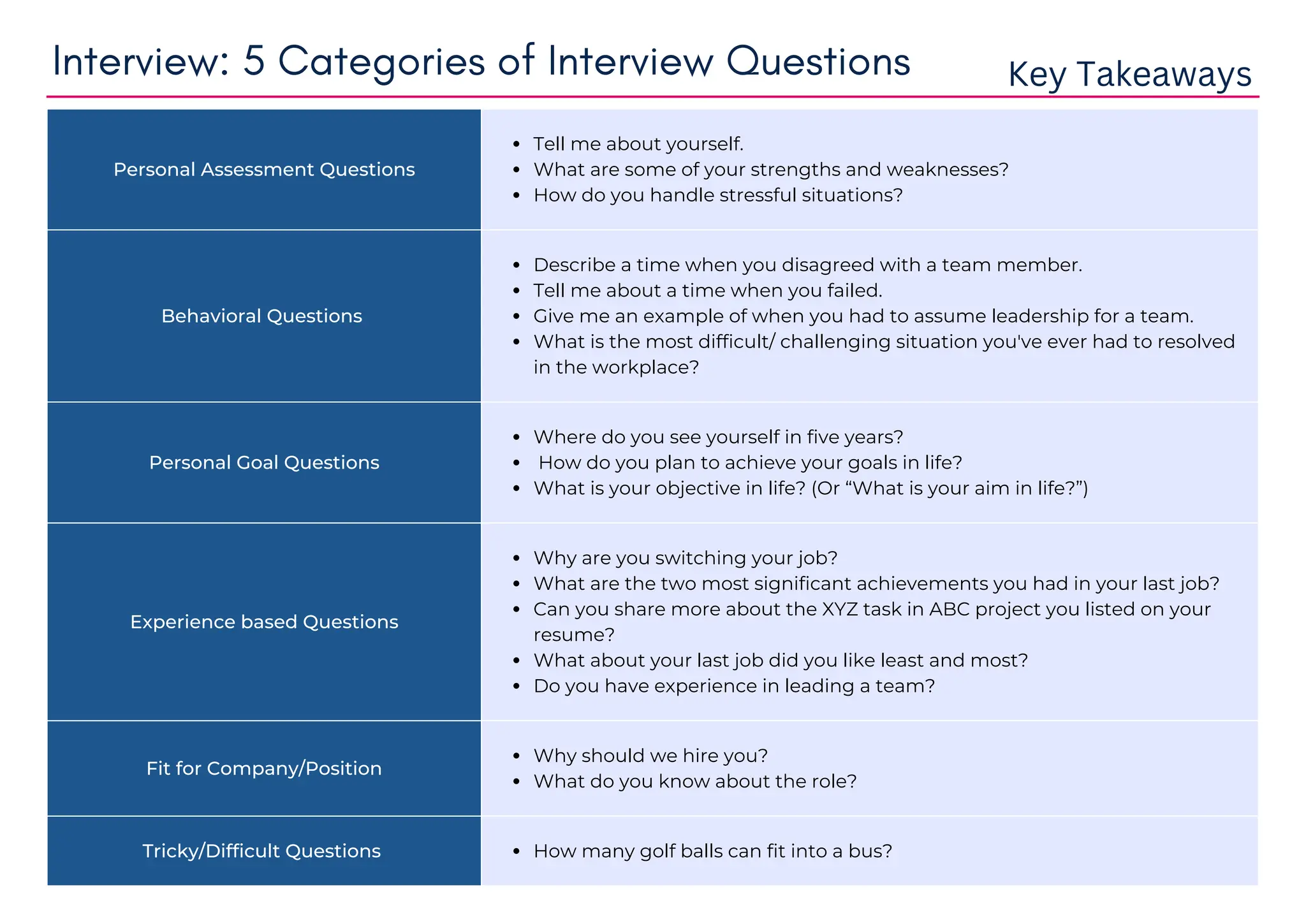
Interview: Question Behind Questions Key Takeaways
Three Core Themes:
Personal Assessment Questions
Tell me about yourself.
What are some of your strengths and weaknesses?
How do you handle stressful situations?
Behavioral Questions
Describe a time when you disagreed with a team member.
Tell me about a time when you failed.
Give me an example of when you had to assume leadership for a team.
What is the most difficult/ challenging situation you've ever had to resolved
in the workplace?
Personal Goal Questions
Where do you see yourself in five years?
How do you plan to achieve your goals in life?
What is your objective in life? (Or “What is your aim in life?”)
Experience based Questions
Why are you switching your job?
What are the two most significant achievements you had in your last job?
Can you share more about the XYZ task in ABC project you listed on your
resume?
What about your last job did you like least and most?
Do you have experience in leading a team?
Fit for Company/Position
Why should we hire you?
What do you know about the role?
Tricky/Difficult Questions How many golf balls can fit into a bus?
Interview: 5 Categories of Interview Questions Key Takeaways
Session 10
Exploring Possibilities:
Entrepreneurship & Further Education
Herd Mentality Key Takeaways
"Following actions of a bigger group, without any critical thinking or self-awareness."
When it comes to planning our future, we tend to have the herd mentality; doing what the
majority of the people are doing. For example, we generally believe that only medical and
engineering fields are most rewarding ones.
Social factors lead us towards herding and making career and educational choices regardless of
knowing our personal interests and faculties.
Find your own career path that’s right for you. Think of what you’re good at, where your skills
best lie and what exactly you enjoy doing. Then, go for it!
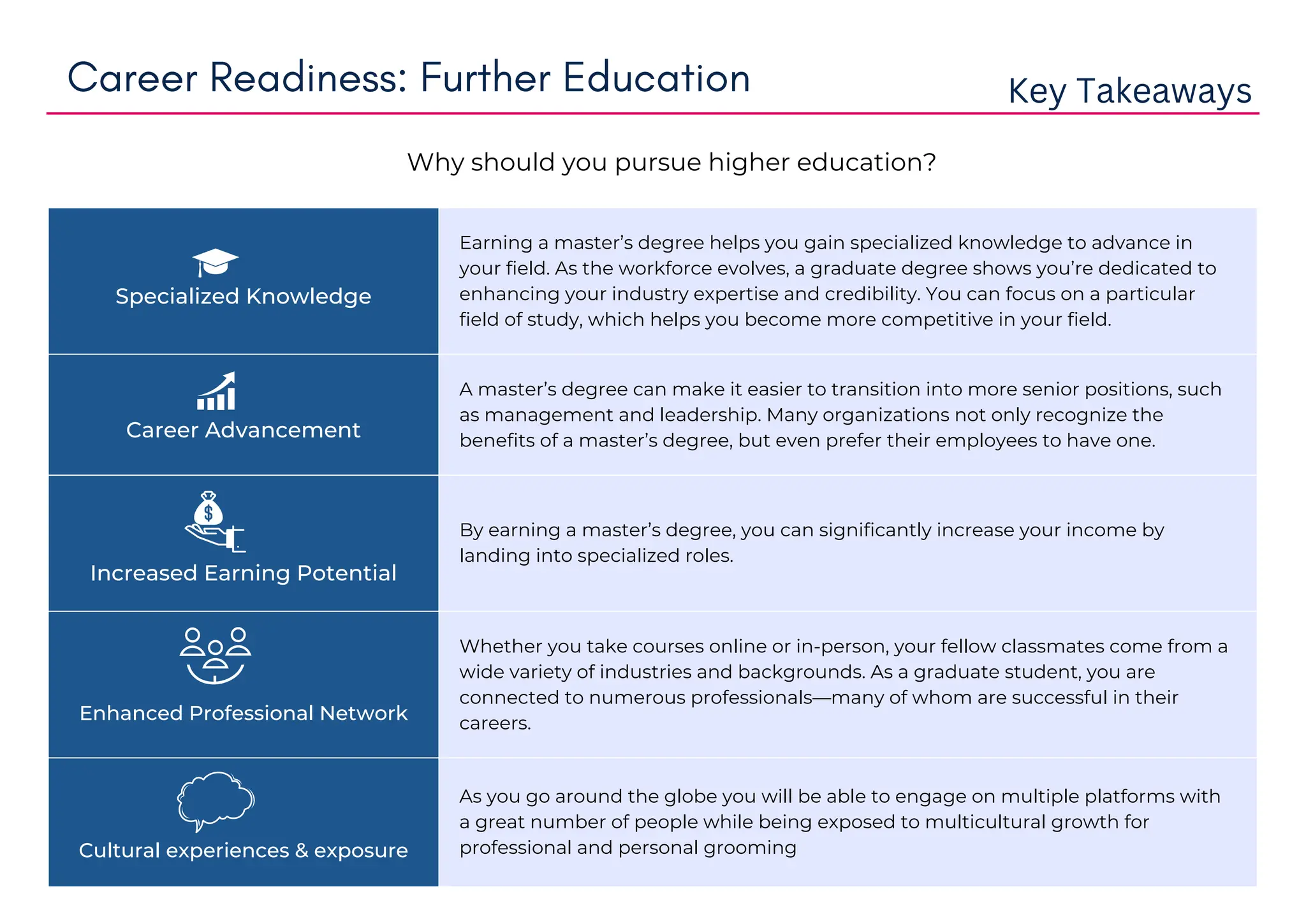
Specialized Knowledge
Earning a master’s degree helps you gain specialized knowledge to advance in
your field. As the workforce evolves, a graduate degree shows you’re dedicated to
enhancing your industry expertise and credibility. You can focus on a particular
field of study, which helps you become more competitive in your field.
Career Advancement
A master’s degree can make it easier to transition into more senior positions, such
as management and leadership. Many organizations not only recognize the
benefits of a master’s degree, but even prefer their employees to have one.
Increased Earning Potential
By earning a master’s degree, you can significantly increase your income by
landing into specialized roles.
Enhanced Professional Network
Whether you take courses online or in-person, your fellow classmates come from a
wide variety of industries and backgrounds. As a graduate student, you are
connected to numerous professionals—many of whom are successful in their
careers.
Cultural experiences & exposure
As you go around the globe you will be able to engage on multiple platforms with
a great number of people while being exposed to multicultural growth for
professional and personal grooming
Career Readiness: Further Education Key Takeaways
Why should you pursue higher education?
Career Readiness: Further Education Key Takeaways
The steps involved in applying for a Higher Education degree are mentioned below:
Finding the Right
Country
Finding the Right
University
Choosing the
Relevant Program
The Application
Process
Step 1 Step 2
Step 3 Step 4
Undergraduate Major
Preferable Country/Countries
Preferable University/Universities
Preferable Program(s)
(For each program, mention the
duration of degree.)
Criteria
(Please list down the general
application process)
Design Your Graduate Plan Worksheet
Math's
canada
Univerisity of Ottava
MS maths (linear algebra),2years programme
0fficial Transcript
standarized test score (IELTS (6.5),PTE ACADEMIC)
Letter of Recommendations.
copy of your valid passport
Candidate must have an average of 70%,or a b grade (calculated using your last 20 subjects)
Career Readiness: Entrepreneurship Key Takeaways
"Entrepreneurship is starting and developing a company, delivering something new
to the market, or organizing the means of production superiorly."
"Entrepreneurship is the pursuit of opportunity beyond the resources you currently
control” - (Stevenson, Business School- Harvard)
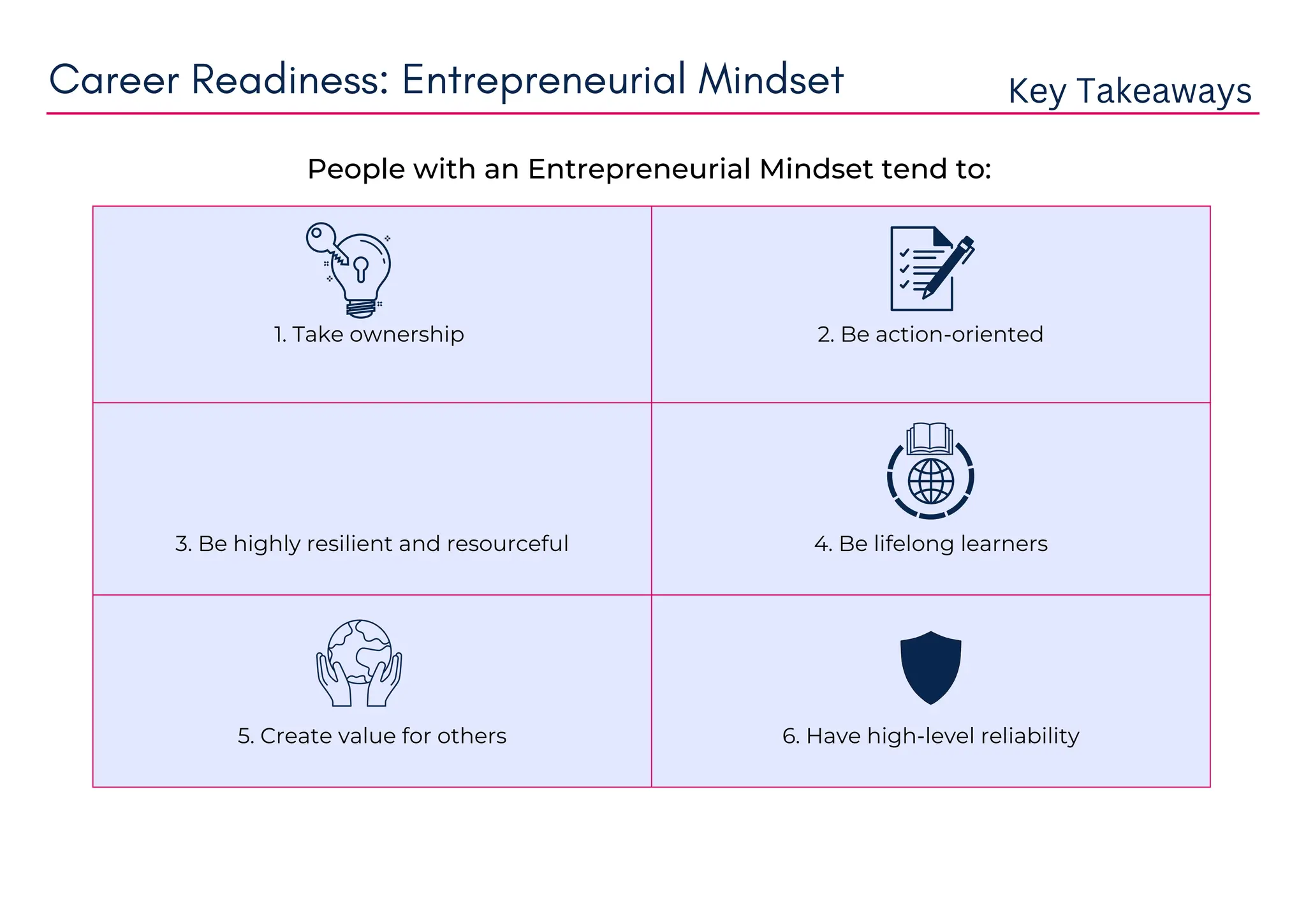
1. Take ownership 2. Be action-oriented
3. Be highly resilient and resourceful 4. Be lifelong learners
5. Create value for others 6. Have high-level reliability
Career Readiness: Entrepreneurial Mindset Key Takeaways
People with an Entrepreneurial Mindset tend to:
"A tool for visionaries, game changers, and challengers. A pre-structured canvas of 9 building
blocks to help you map, discuss, design the new business model/idea."
The 9 building blocks of the business model canvas are mentioned below:
Customer Segments Who are the customers? What do they think? See? Feel? Do?
Value Propositions What’s compelling about the proposition? Why do customers buy, use?
Channels How are these propositions promoted, sold and delivered? Why? Is it working?
Customer Relationships How do you interact with the customer through their journey?
Revenue Streams How does the business earn revenue from the value propositions?
Key Activities What uniquely strategic things does the business do to deliver its proposition?
Key Resources What unique strategic assets must the business have to compete?
Key Partnerships What can the company not do so it can focus on its Key Activities?
Cost Structure What are the business major cost drivers? How are they linked to revenue?
Entrepreneurship: Business Model Canvas Key Takeaways
Entrepreneurship: Business Model Canvas Worksheet
Key Partners Key Activities Value Propositions Customer Relationships Customer Segments
Key Resources Channels
Revenue Streams
Cost Structure
Ice cream machine
manufacturers
Marketing
Production
Logistics
Distribution Channels
Patient on system
Brand
Production area
High end icecream place
EXpressing qulality,rather
than nearby places
Membership club
Websites.com
different channels as aid
like Geo,HUM tv
Professionals working
from home
Boomers at home
Marketing
MManufacturing
Distribution Channels
Machine and acccessories
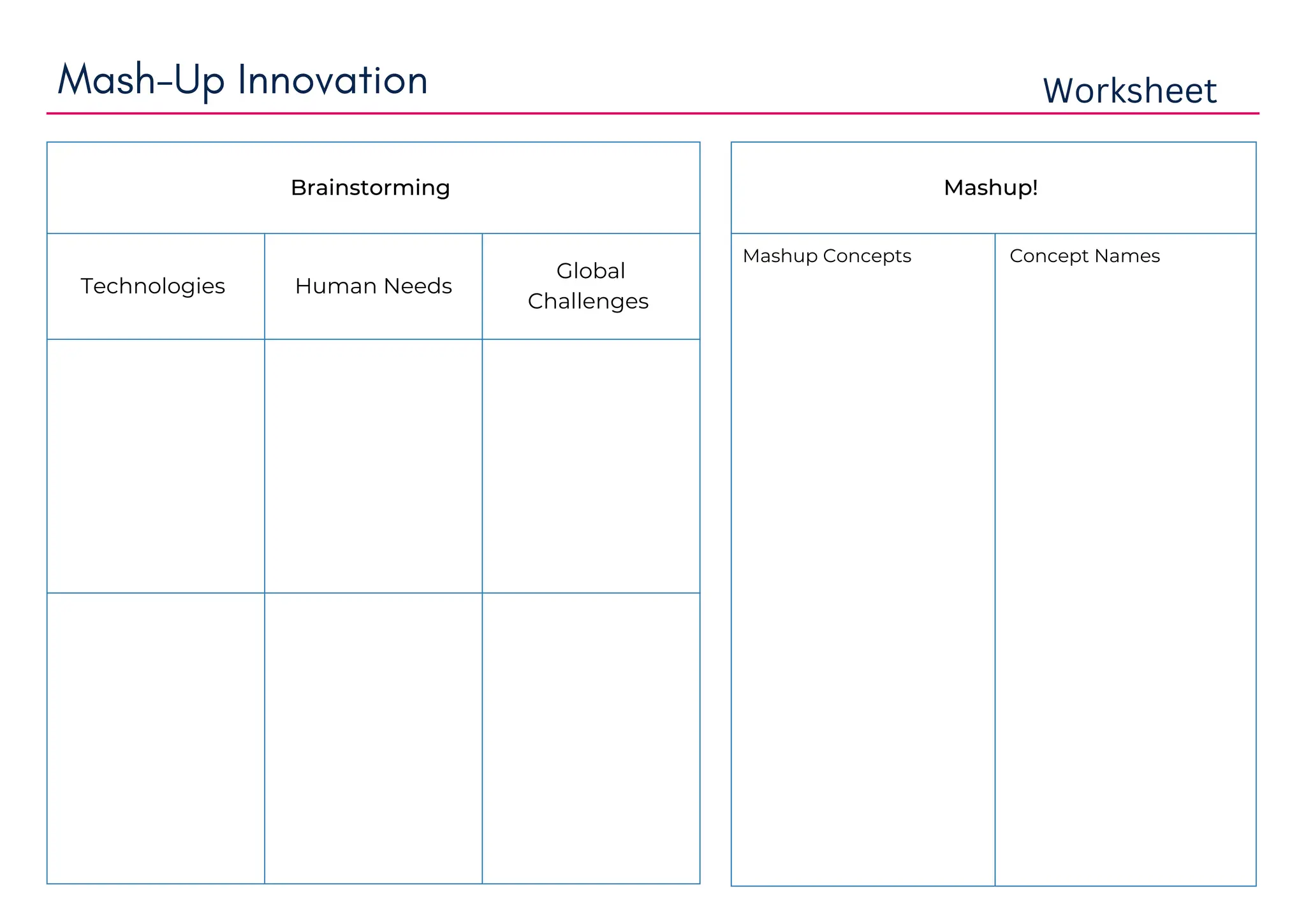
Brainstorming
Technologies Human Needs
Global
Challenges
Mash-Up Innovation Worksheet
Mashup!
Mashup Concepts Concept Names
3D
Ipads+ doing laundry +
PayPal
Laundry
Love Google translate
Telephone Transportation income inequality
Session 11
The Power Of Mindset
Mindset Overview Key Takeaways
How we react in the face of adversity or in a challenging situation has a lot to do with
our mindset. Our mindset can reinforce our beliefs related to ourselves and our
surroundings. Having the right mindset can increase our likelihood of realizing our
potential and achieving long-term success.
“A set of attitudes or beliefs that you hold which shapes how you make sense of the
world and yourself. It affects how you think, feel and react in a specific situation"
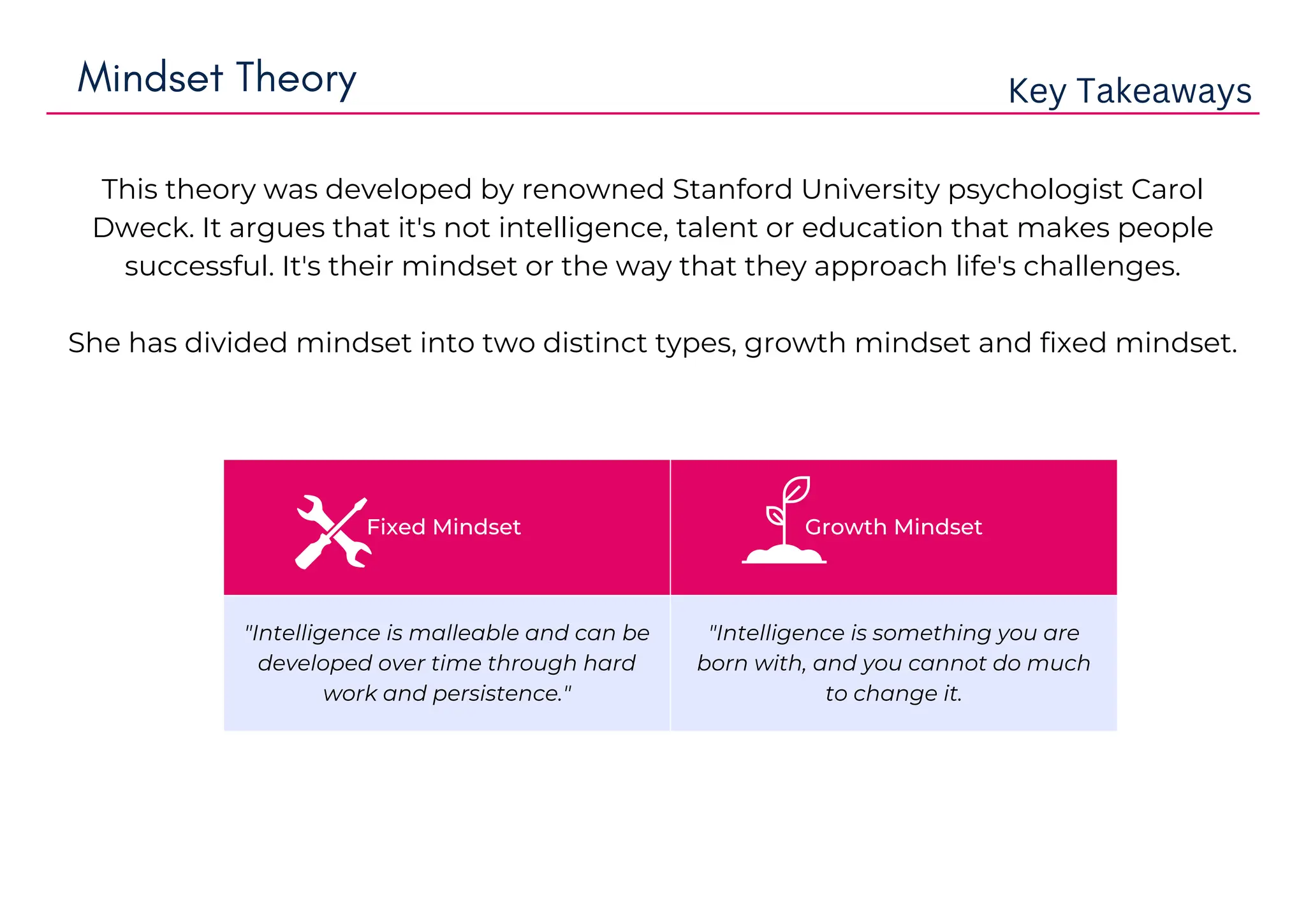
Fixed Mindset Growth Mindset
"Intelligence is malleable and can be
developed over time through hard
work and persistence."
"Intelligence is something you are
born with, and you cannot do much
to change it.
Mindset Theory Key Takeaways
This theory was developed by renowned Stanford University psychologist Carol
Dweck. It argues that it's not intelligence, talent or education that makes people
successful. It's their mindset or the way that they approach life's challenges.
She has divided mindset into two distinct types, growth mindset and fixed mindset.
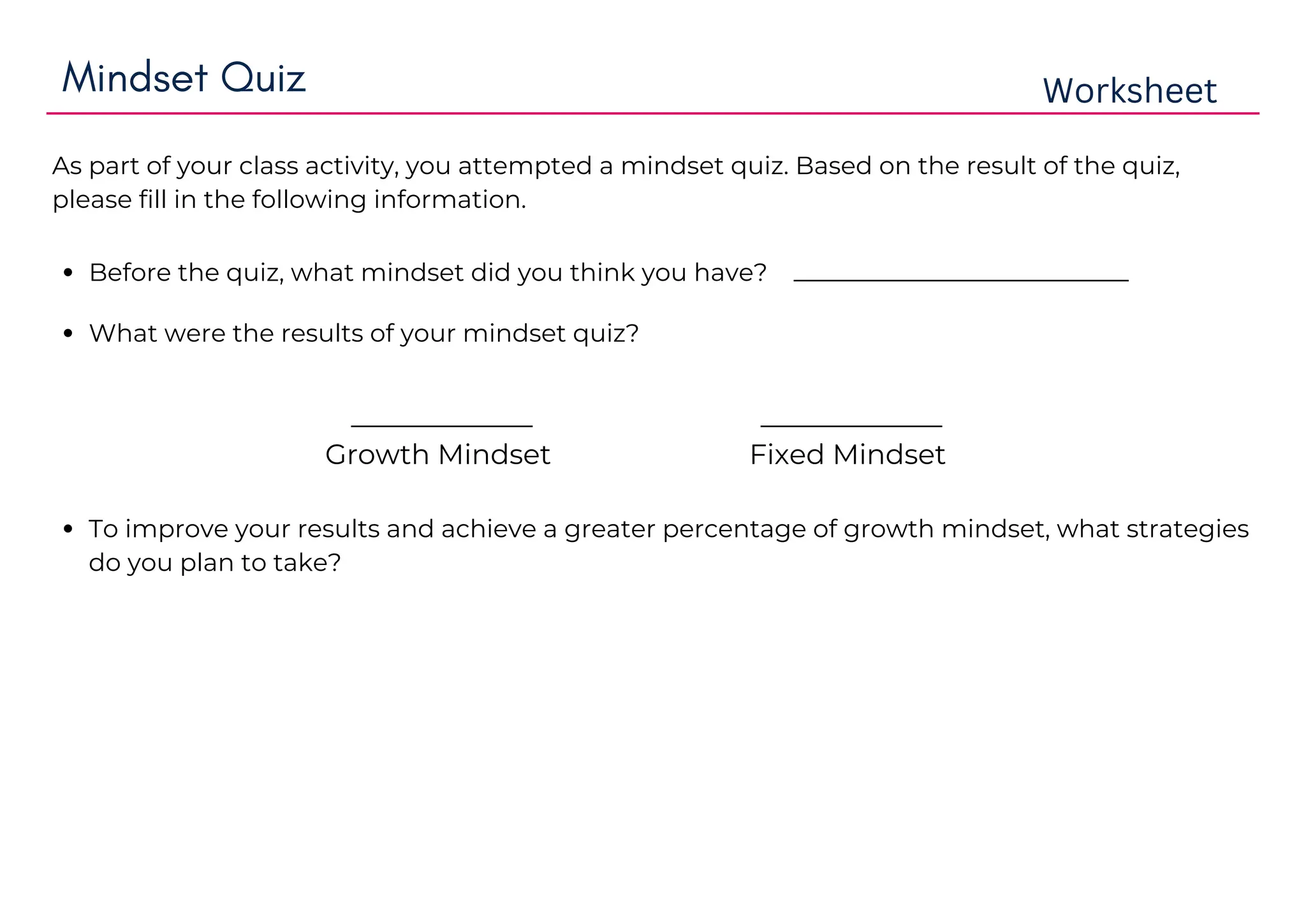
Mindset Quiz Worksheet
As part of your class activity, you attempted a mindset quiz. Based on the result of the quiz,
please fill in the following information.
Before the quiz, what mindset did you think you have? ________________________
What were the results of your mindset quiz?
_____________
Growth Mindset
_____________
Fixed Mindset
To improve your results and achieve a greater percentage of growth mindset, what strategies
do you plan to take?
Growth mindset.
growth mindset with some fixed
mindset.Learning can be
improve with time and effort.
I will change my fixed mindset to growth mindsrt. By struggling my learning with growing mindset peoples i can change my mindset and also
by watching the videosinterviews of growing mindset personailties.
learn with mind
learn with hardwork.
learn with positive peoples
learn with open minded peoples because they dont have as much negativityjealousy as other peoples have.Narrow minded peoples dont
want to see other peoples success or their growing results.
A Million & One Uses Worksheet
As part of your group activity, you came up with as many distinct uses of a paper clip as possible.
List down the uses you brainstormed for this object.
use as a button of shirt if shirts button has broken
use as a belt of pent.
use for fix the zip.
for repairing eye glasses
keep food fresh
for letter opener.
emergency key chain.
smart phone mount
open your stuck CD drive
use as a hair barrette
diy fish hooks
lottery ticket scratcher
cable catcher
use as a money clip
recipe card holder
Fixed Mindset Reflection Question Growth Mindset
Example:
“I tried; I failed. It’s just beyond me."
Example:
Could I try a different strategy or
approach?
Example:
Failure is a part of the process and in fact
a learning point. I should try a new
technique and hopefully it will work
“I didn’t achieve what I set out to do; I
failed.”
“I just wasn’t born smart:"
“I can’t do it; I’ll never be able to do it.”
“I don’t know how or if I’ll get there…
ever.”
“This course is way too challenging for
me”
Mindset Statements Worksheet
As part of your group activity, you converted statements representing a fixed mindset into
growth mindset. Re-write the statements below:
if my student visa of higher studies got rejected
from foreign country.
I'll do my Ms from Pkistani University(like Gc,uol)
I'll do work hard to be smart as much as i should
be.
If i fail in my hardwoking procedure.I'll do more
hardwork to bs smart.As we all know hard work
makes a man perfect. If i fail for being smart i'll be
able to do hardwork.
hardwork makes a person perfect. who said u can't do it. Buddy u can do it. believe
in your self and be hardworking person.
To be sustain in your work will get u there where u
want to go,where you want to be.Yes i can try
different strategy like sustainbility.
If i couldnt to be there ,where i want to be it means i can
change my mindset .like if i want to do buisness but i do not
have much more money ,ill do a job and earn the money nd
then ill start my buisness with this money.
To be more attentive in class i can change this
challenging subject to easy subject.
If i failed to understand this subject,ill connect with
teachers ,Might be possible they have many more
ways to understand this subject.
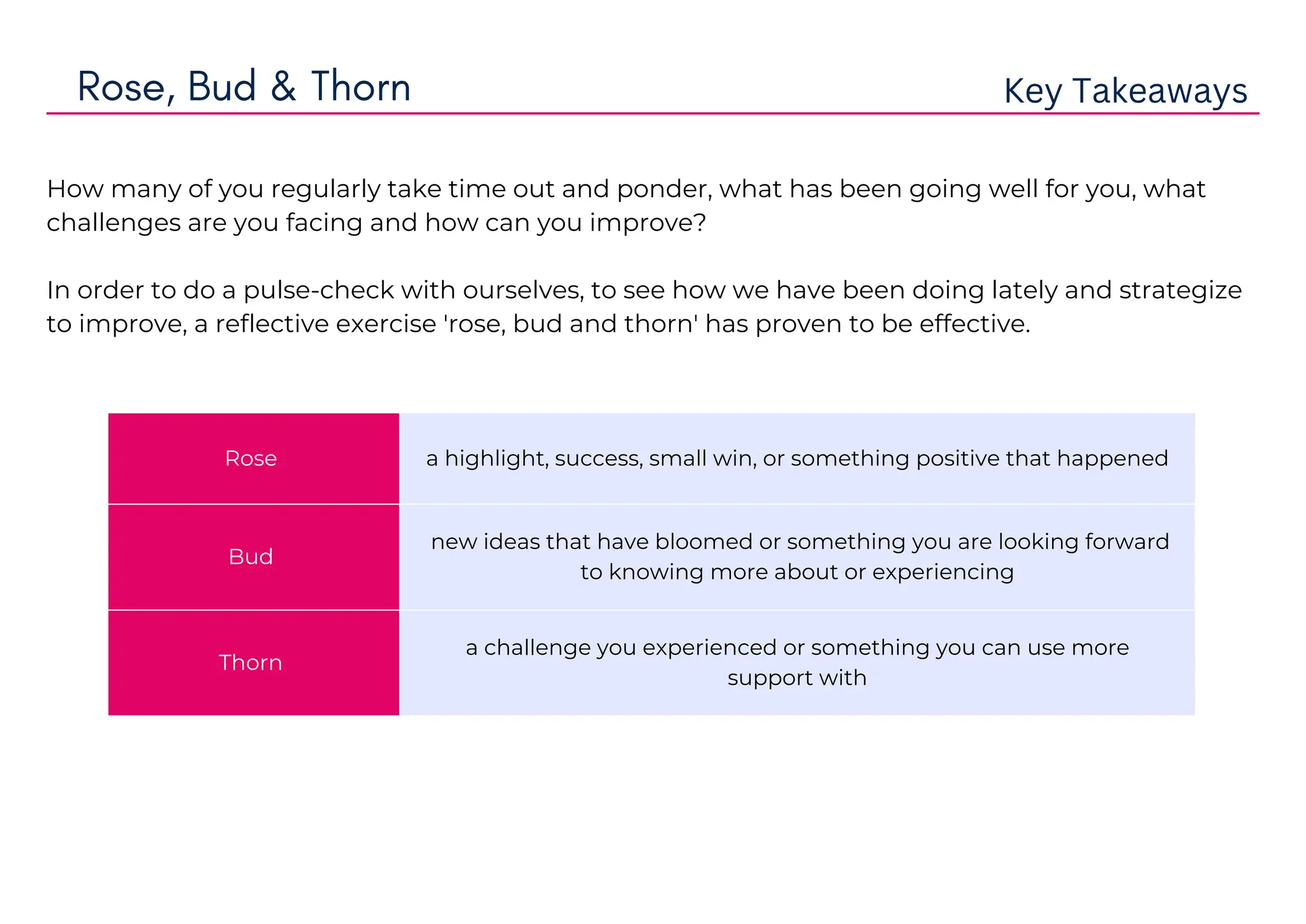
Rose a highlight, success, small win, or something positive that happened
Bud
new ideas that have bloomed or something you are looking forward
to knowing more about or experiencing
Thorn
a challenge you experienced or something you can use more
support with
Rose, Bud & Thorn Key Takeaways
How many of you regularly take time out and ponder, what has been going well for you, what
challenges are you facing and how can you improve?
In order to do a pulse-check with ourselves, to see how we have been doing lately and strategize
to improve, a reflective exercise 'rose, bud and thorn' has proven to be effective.
Situation:
Rose
Bud
Thorn
List down the strategies through which you can change your thorns into roses OR for the thorn(s) mentioned,
identify the buds that could be a result of it helping you grow.
Rose, Bud & Thorn Worksheet
Reflect on any situation in your life, and identify the rose, bud & thorn in the situation.
This week i received pocket money.
I am a teacher thats why i want to do something good for my students.
Next week i have presentations,put some efforts to get good marks in presentations.
I have presentations(Thorns),put some efforts(Strategy) to get good marks(Rose) in presentations.
To do something good for my students(Bud) ,I want to experience how much good they feelI. I'll get positive vibes asa human being(growing
result).

AQSA WORKBOOK PDF SESSION about career lab (7-12).pdf

  • 1.
    CSO3001: CAREER LAB INTERACTIVEWORKBOOK Name: CC/AM: Section: Major: Aqsa ashraf shahida.irshad@ucp.edu.pk A4M Mathematics
  • 2.
    Welcome to CareerLab - CS3001 About the Course Apply effective professional interpersonal communication skills in business contexts. Enhance technical writing skills through the development of effective resumes, cover letters, statement of purpose, and e-etiquette. Learn how to make appropriate occupational/educational choices and set realistic occupational/educational goals. Develop life-long skills associated with career decision-making and career management. Recognize the qualities, skills, and abilities that employers are seeking in job candidates. Comprehend the importance of networking and identify employment leads often overlooked by many job seekers. The goal of this course is to introduce a blended learning model to prepare students for the job market by helping them internalize professional and business skills. Based on the frameworks of experiential learning and facilitation techniques, the course aims to build the requisite skills for becoming seasoned professionals, capable of independent thought and action, who work well with others and are influential in their organizations. You have embarked on a journey to transform your life. Learning Outcomes
  • 3.
    - Career Planning -Career Theories - Self Assessments - Goal Setting Career Readiness - Personal Pitch/Elevator Pitch - Career Assessment - Professional Documentation - Personal Branding: LinkedIn - Interview Strategies - Job Application Process - Networking Career Competencies - Critical thinking/Problem Solving - Oral/Written Communication - Teamwork/Collaboration - Time Management - Digital Technology - Leadership - Professionalism/Work Ethic Career Plan Personal Marketing Plan (PMP) jsjfskfks jfsjjfsj jfjsfjjs fjsjjfsj mfkf CAREER READINESS CAREER COMPETENCIES CAREER PLAN CAREER MANAGEMENT Course Themes
  • 4.
    Week 1 CourseIntroduction & Career Planning Week 2 Knowing Yourself & Time Management Week 3 Business Communication & Presentation Skills Week 4 Verbal Communication & Resume Writing Week 5 Cover Letters, Job Research and Problem-Solving Week 6 Job Application Process & Interviews Week 7 Interviewing Skills Roadmap to Success Course Timeline
  • 5.
    Week 8 InterviewPractice Week 9 Mock Interviews Week 10 Exploring Possibilities: Entrepreneurship & Further Education Week 11 The Power Of Mindset Week 12 Final Presentations - Personal Marketing Plan Week 13 Final Presentations - Personal Marketing Plan Week 14 Assessment Center & Wrap Up Roadmap to Success Course Timeline
  • 6.
    Session 1 Introduction toCareer Planning & Knowing Yourself
  • 7.
    Krumboltz theory Several factorshave been highlighted as being helpful in career management, including: the commitment to ongoing learning and skill development ongoing self-assessment assessment and feedback from others effective networking achieving work-life balance financial planning to incorporate periods of unemployment These attributes and tasks enable you to turn chance encounters and occurrences into career opportunities. Career Theories Key Takeaways
  • 8.
    Parson's theory Frank Parsonsdeveloped the idea of matching careers to talents, skills and personality. Parsons states that occupational decision making occurs when people have achieved: an accurate understanding of their individual traits (aptitudes, interests, personal abilities) a knowledge of jobs and the labor market rational and objective judgment about the relationship between their individual traits, and the labor market. This three-part theory still governs most current practice. Career Theories Key Takeaways
  • 9.
    Being able toreflect on your own strengths and weaknesses is a key part of being a good leader, and essential to continuing your development. However, making the time, or even knowing where to start when it comes to reflecting on areas you could improve upon, can be difficult. There are two general processes through which we can identify our strengths & weaknesses: Self-reflection Self- assessment Asking yourself targeted questions Analyzing experiences Asking others (taking feedback from peers) Immerse in reflective exercises: hhh h MBTI Test EQ-i 2.0 Emotional Intelligence Assessment VIA Character Strengths Assessment TotalSDI Evaluating your personality through tests/assessments: Strengths & Weaknesses Key Takeaways
  • 10.
    Strengths Weaknesses Strengths &Weaknesses Worksheet From the BINGO activity conducted during the session, you were able to identify your strengths and weaknesses. In the space below, list down your strengths and weaknesses. 1.Attentive, 2collaborative, 3honest, 4creative, 5 empathetic, 6innovative, 7patient, 8respectful 1competitive 2 disorganized 3 not skilled at delegating task 4not skilled at public speaking 5 self critical
  • 11.
    Qualities of mypersonality type: Ideal careers/job roles as per my personality type: MBTI Personality Test Worksheet My MBTI Personality is: __________________________ A famous person who shares my personality type is: _____________________________ ISFJ-A noone defender observant feeling assertive teaching creative activities agent
  • 12.
    A Letter toMy Future Self Worksheet Write a letter to your future self, to be opened and read by you at the completion of this course. You may answer questions related to how prepared are you for the future, what have you planned after you graduate, how do you feel about your future planning, what do you expect from the course, or if you have any tip/advice for your current self. When you finally open and read the letter, you will look back to see how much you have grown throughout the course. To my future self , I hope that time has been kind to you. I know your plans in life were to go far, and reach for stars and I have no doubt that you have not done that. I hope that where you are right now is where you want to be, and if it is not dont give up keep pushing. Remember you are the only person who can control your happiness. Depending on what age you are reading this you have special incidents in life . From childhood dreams and goals to dreams you had while growing up changed rather drastically. Best wishes from paat self to future self.
  • 13.
    Session 2 Knowing Yourself& Time Management
  • 14.
    Knowing our strengthsand weaknesses is important for our career progression in several ways: Career Progression It is important to know both your strengths and weaknesses in order to self-evaluate. Having this knowledge about yourself will also help you narrow down your job search to specific jobs based on what you’re good at, and it will make employers’ decision to hire you easier. Leveraging Your Strengths Your strengths are the skills you can leverage and use to push yourself further to achieve your goals. Knowing what you excel in can help you grow and aim higher. Developing Skills Having a strong self-awareness and ability to highlight your areas of weakness enables you to proactively work on these, such as taking courses, seeking additional exposure to a task you are less comfortable with, or working with a mentor to address a weakness. This process of self-assessment will ultimately strengthen your skill set so that you can overcome any limitations. Corresponding Strengths Every weakness has a hidden strength - all students have to do is accept them for what they are. They should leverage these associated strengths and ask other people for advice to improve themselves and fix any gaps they might have. Knowing What Skills to Hire It is important to understand (if you are in a leadership role/or an entrepreneur) your weaknesses as it means you know what skill set you need to hire the right skills and build a diverse team that can help you, and your organization, to achieve your goals. Recalling Strengths & Weaknesses Key Takeaways
  • 15.
    Purpose Map S.M.A.R.TGoals Goal Setting Key Takeaways The next skill in career management is goal setting; to have a look at our present opportunities and create a tentative plan to acquire clarity. Goal-setting is the process of taking active steps to achieve your desired outcome. Maybe your dream is to become a teacher, lawyer, computer scientist or pharmacist. Each one of these dreams involves setting and reaching small (and big!) goals. In this course, we will be practicing two tools for goal-setting:
  • 16.
    Purpose Map A simplebut powerful tool helps you identify the opportunities you have right now to live more purposefully and become the person you want to be. It helps us identify our Purpose and map out possibilities to narrow down our career path. Purpose Map begins by answering three questions: What Do I Really Want? Designed to help identify a lifestyle that incorporates what is most important to them. Reflection Questions: What kind of lifestyle is important to me? How do I want to spend my time? Who are the people I want to surround myself with? What activities bring me joy? How Can I Best Serve Others? Caters to the natural human need to connect with others. This is true whether they are at work, at home, volunteering, or doing any other activity that’s important to them. Reflection Questions: What does service mean to me? How can I use the talents and resources I have to be of service to others? When do I feel like I’m at my most useful? How do I define meaningful work? How Can I Meet My Financial Needs? Designed to think about the role that money plays in their life right now and in the future. Reflection Questions: How much stability do I want and need? What have I done so far that people have been willing to pay me for? What am I better at than most people? What kind of environment do I require in order to do my best work? Purpose Map Key Takeaways
  • 17.
    What Do IReally Want? How Can I Best Serve Others? How Can I Meet My Financial Needs? Creating Your Purpose Map Worksheet As attempted during the session, please fill in the template below: encourging people to work, work , work without wasting precious time by helping them volunteering as a family children watch everythinv we do. we can ahow them how it feels good to help others its a valuable way to get to know to organizations in community to make a combined orphanage and old home by taking care of them by doing part time job with study
  • 18.
    S M AR T S.M.A.R.T Goals Key Takeaways Set goals intelligently with the S.M.A.R.T approach SPECIFIC You need to be clear on what you want to accomplish MEASURABLE The goals should be quantifiable e.g., generate one lead per month. ATTAINABLE The goals should not be too easy or too hard. Set ambitious, but realistic targets. RELEVANT The target should align with your personal/ professional goals. TIME-BOUND Set a timeframe and/or a clear deadline for achieving your goal. What do I want to accomplish? How will I know when it's accomplished? How can the goal be accomplished? Does this seem worthwhile? When can I accomplish this goal?
  • 19.
    GOAL: SPECIFIC MEASURABLE ATTAINABLE RELEVANT TIME-BOUND S.M.A.R.T Goal SettingWorksheet SMART GOAL: I wanted to start a business I will sell handmade cards through websites( online) I will be ready to take my first order within four weeks I will get setup on website first then i build an inventory of 30 hadmade cards to sell selling handmade cards will allow me to benefit financially my website will be running up within four weeks within a month i am goong to get setup to sell handmade cards on websire it help me buildiing my customers
  • 20.
    Strengths Weaknesses Strength 1:________________________________ Explanation: ___________________________________________________ ___________________________________________________ ___________________________________________________ ___________________________________________________ Weakness 1: __________________________ Explanation: ____________________________________________________ ____________________________________________________ ____________________________________________________ ____________________________________________________ Strength 2: ______________________________ Explanation: ___________________________________________________ ___________________________________________________ ___________________________________________________ ___________________________________________________ Weakness 2: _________________________ Explanation: ____________________________________________________ ____________________________________________________ ____________________________________________________ ____________________________________________________ Strategizing Strengths & Weaknesses Worksheet List any two of the strengths and weaknesses you have identified in the previous activity. For strengths, mention how they could help in your career progression. For your weaknesses, state how they could be a hurdle and the steps you would take to overcome them. honest not skilled at public speaking by staying honest helped me alot in my all fields of life either on work lif, bussiness life , professional life it created problems in my work life i cant easily asked or answered questions . It can be overcomed by speaking to yourself in front of mirror. patient taking on to much responsibility by taking to much responsibility created problems for my own work which is get ignored. it can be overcomed by taking burden which is bearable for me not more than that.
  • 21.
    Career Competency -Time Management Key Takeaways Pomodoro Technique Timeboxing Choose a task you need to get done. Set a timer (e.g., for 25 mins). Focus on the task at hand. When the timer rings, put a checkmark on a piece of paper. Take a short break: Take a break for about three to five minutes. Go for a walk, grab a cup of coffee, do something non-work-related to give your brain a break. Repeat steps two to five: Once you have completed this process four times, you can begin to take longer breaks (20–30 mins). How it works: Divide a piece of paper into two columns. On the left, write down each hour of the day and create blocks of time such as half-hour or hour chunks. Estimate the time it’s going to take to complete each of your tasks and fit them into your time blocks. Add buffer times in between each time block to allow for adjustments during the day. How it works: From the moment you wake up, assign each time block in your day to a task. These tasks can be anything from eating breakfast to studying for a test. Planning Your Time Time management—how we choose to use and organize our time—is something many of us struggle with. Effective time management allows us to make the most of our day, accomplishing tasks more quickly and prioritizing those that will make the most impact. Figuring out a process that works for you, whatever that may be, is key to creating your most efficient life. To help you improve poor time management, we’ll explore two popular techniques to help us plan our time for effective management.
  • 22.
    Session 3 Business Communication& Presentation Skills
  • 23.
    Career Competency -Time Management Key Takeaways Prioritizing Your Tasks Time boxing and pomodoro helps us organize our time better, whereas Glass jar and Eisenhower help us prioritize our tasks. Once we have prioritized our tasks using Glass jar/Eisenhower, we may use timeboxing/pomodoro for the completion of each task. Glass Jar Technique Eisenhower Matrix Rocks: Your most important strategic projects Pebbles: Projects and tasks that are important but not the most critical Sand: Smaller, more insignificant tasks How it works: Categorize your work in this way: Tackle the rocks first. If you keep tackling the small things (the sand and pebbles), and not the important strategic items, the rocks, then your jar will quickly fill up with no room for more rocks. Organize your task list into four separate quadrants, sorting them by important vs. unimportant and urgent vs. not urgent. Urgent tasks are those we feel need to get done immediately. Important tasks are those that contribute to your long-term goals or values. Ideally, you should only work on tasks in the top two quadrants—the other tasks, you should delegate or delete. How it works:
  • 24.
    Career Competency -Time Management Visual Aid Eisenhower Matrix Not Important Important Urgent Not Urgent Do. Tasks with deadlines or consequences Schedule. Tasks with unclear deadlines that contribute to long-term success Delegate. Tasks that must get done but don't require your skill-set Delete. Distractions and unnecessary tasks
  • 25.
    Worksheet 1 Using thelist of tasks created during discussion, arrange the tasks based on the Glass Jar technique. Time Management Glass Jar Technique Rocks Pebbles Sand List of Tasks mid term exam preparation assignments watching podcasts mid term exam preparation assignments watching podcasts
  • 26.
    Worksheet 2 Using thelist of tasks created during discussion, arrange the tasks based on the Eisenhower Matrix: Time Management Eisenhower Matrix List of Tasks Do Schedule Delegate Delete mid term exams preparation exercising watching podcasts cleaning study table mid term exams preparation exercising watching podcasts cleaning study table
  • 27.
    How you speakand sound makes a dramatic impact on your speech. It’s not all about the content of what you say, your presentation slides, or your appearance - how you use your voice is equally important. For many people, if they focus on a few elements of the vocal toolbox, they can dramatically enhance their presentation and make it more engaging for the audience. Register Registers are different ways of producing sound that means you can change how your voice sounds according to the requirements of the conversation. Timbre A quality of sound that makes voices sound different from each other. Timbre determines how warm, smooth and rich your voice sounds. Prosody Prosody is simply a fancy word for expressiveness in speech. This is the rhythm and sound variation which makes up the notes we speak. Pace Pace is simply the speed at which you talk. Taking pauses where required in order to emphasize on a certain point and speeding up certain sentences to create excitement. Volume This element helps you find a balance between loudness and quietness according to the situation. Just as gestures and body movement create visual interest, varying your volume creates vocal interest. Communication Skills - Verbal Key Takeaways Vocal Toolbox
  • 28.
    We talk alot about communication but are never told about how to communicate and what to communicate. EPIC framework is a holistic approach to communication that is applicable to a wide range of interactions. EPIC helps to communicate those ideas in a way that inspires people to act and to implement meaningful change. The four elements that make up the EPIC framework are: Empathy Empathy means putting yourself in other person’s shoes to understand their perspective. For example, take the perspective of your audience in order to build a strong foundation for your communications. Purpose While communicating, define the purpose to include their needs and yours. This question “What is the overall purpose of the project, and how does this interaction help us to move us towards it?” can help you build your response. Insight Your message/ideas should be supported by insights and facts. You may use research, statistics and case studies. Conversation In order to have a great conversation you need to plan and arrange the flow of an effective two- way conversation. Use storytelling techniques to build memorable connection with your audience. Communication Skills - Verbal Key Takeaways EPIC Framework
  • 29.
    Communication Skills -Non-Verbal Key Takeaways Non-verbal communication is as important as verbal communication to make an impact. Below are a few elements of non-verbal communication: Eye contact Sitting posture Facial expressions Gestures Dressing style Body Language
  • 30.
    Communication Skills -Non-Verbal Worksheet In the picture below, identify areas where non-verbal communication is not up to par. 1. body language 2.facial expressions 3.eye contact 4. siiting posture 5. dressing style
  • 31.
    Business Communication -Email Etiquette Key-Takeaways Why is Email Etiquette Important? Professionalism Efficiency Respect Show that you are ready for your future career Look efficient sending to-the- point messages Avoid unnecessary embellishments and small talk
  • 32.
    Use a professionalemail address Using an unprofessional email address tends to be a common mistake among students. Make sure to make a professional email ID before sending important emails. A professional email would ideally only include your name or some number if need be. Use a direct subject line The email's subject line informs the recipient of what they can expect to find in the email's body. It may help them sort their emails or begin finding information for a response before reading the full message. Make email subject lines clear and straightforward. Use professional greetings Easy rule of thumb is to stick to modifying them according to the time of the day, such as: Good morning, Good afternoon or Good evening. Avoid using unprofessional language Do not write (Roman Urdu) Urdu using English alphabets in your email. Stick to using English and avoid slang words. Closing of Email Conclude your email with a short closing, such as “Thank you,” “Best regards” or “Sincerely.” Include your full name at the bottom along with your title and essential contact information, such as your phone number. This closing gives your recipient all the details they need to respond. Review It is always a good idea to take another look before pressing send. Spellcheck can catch many errors but be sure to check for typos on your own, too. Business Communication - Email Etiquette Key-Takeaways Tips to Write a Professional Email
  • 33.
  • 34.
    Career Readiness -Elevator Pitch Key-Takeaways "An elevator pitch is a short yet impressive introduction of yourself designed to market your experiences and skill sets. You can also use it to create interest in a project, idea or product – or in yourself. A good elevator pitch should last no longer than a short elevator ride of 20 to 30 seconds, hence the name." Knowing how to write a good elevator pitch will be useful. Refer to the elements below for a good elevator pitch: Identify Your Goal Start by thinking about the objective of your pitch. For instance, are you a current student looking to get an internship over the summers? A fresh graduate applying for jobs or an entrepreneur looking for investors? Explain What You Do It is important for the listener to have an idea of the person/product/idea they are being informed about. If you are a student, your pitch will include your semester and major. If you are a fresh graduate, you will talk about your major and field of interest. In case you are pitching a business idea, you will talk about your product. USP Unique Selling Proposition to what makes a product unique, you should also know that people also have USPs. A Unique Selling Proposition is any skill, idea or characteristic that makes you or your product stand out from the rest. Engage With a Question After you communicate your USP, you need to engage your audience. To do this, ask questions to involve them in the conversation. Put It All Together When you've completed each section of your pitch, put it all together. Then, read it aloud and time how long it takes. It should be no longer than 20-30 seconds. Otherwise, you risk losing the person's interest, or monopolizing the conversation. Try to cut out anything that doesn't absolutely need to be there. Remember, your pitch needs to be snappy and compelling, so the shorter it is, the better!
  • 35.
    Elevator Pitch -Sell a Product Worksheet Draft an Elevator Pitch for your product in the 'Sell a product' activity using the template below: Identify Your Goal Explain What You Do USP Engage With a Question Put It All Together Hi, my name is laiba. I am sure you heard about bonanza brand. I am selling their perfume original copies. I am selling their perfume original copies. Iam doing this from 5 years and nothing experienced any kind of complain from the customers. Regardless, I am selling copied perfumes but i granteed you that it works much similar to the original ones. There smell, shape and style is much similar to original. The only difference is in its lasting fragrance. have you ever used the copied things? If yes, then I want to know your experience. In conclusion, I want you to experience this at once. I hoped that you really liked it.
  • 36.
    Resume CV One totwo pages long No length limit Job hunting in all industries For jobs in Academia Tailored to specific job A comprehensive overview Emphasize skills Emphasizes academic accomplishments Used when applying for a position in industry, non-profit, and public sector Used when applying for positions in academia, fellowships and grants After 1 year of industry experience, lead with work experience and place education section at the or near the end, depending upon qualifications Always begins with education and can include name of advisor and dissertation title or summary (see examples). Also used for merit/tenure review and sabbatical leave Career Readiness - Resume Writing Key-Takeaways RESUME vs. CV
  • 37.
    Resume CV Contact Information(Email, Contact Number, LinkedIn, City Name) Contact Information Resume Summary or Resume Objective (A one- to two- sentence overview of your short-term professional goals with an explanation of why you’re seeking employment.) Research Objective, Professional Profile, or Personal Statement (Research objectives describe what your research is trying to achieve. A personal statement is a brief personal summary given to prospective employers or Universities.) Work Experience (Relevant work experience tailored accordingly) Education Education (2-3 recent educational degree/courses) Teaching Experience (includes volunteership/internship or TA/RAship) OR Research Experience / Lab Experience / Graduate Fieldwork Skills Languages and Skills Additional Sections (Awards, Courses, Publications, Certificates, Conferences, etc.) Additional Sections: (Peer-Reviewed Publications, Awards and Honors, Grants and Fellowships, Books) Career Readiness - Resume Writing Key-Takeaways Components
  • 38.
    Chronological order In allthe sections, focus on the latest thing first. For example, in Education, mention the degree you are currently pursuing. Action Verbs Action Verbs describe the impact of your work and make your resume more professional. Trained my department vs. Created new training material and supervised a team of 30 employees. Quantification Quantification makes an impact on the job role statements in the resume. For example: writing, 'mentored a class of 40 students on leadership and growth mindset skills' shows the scale of your teaching practice and leaves an impact on the recruiter who might consider you for the position as he/she will be aware that you are equipped to deal with a large audience. By quantifying, we can make our work seem more credible and impactful. So, always add numbers in your resume. Career Readiness - Resume Writing Key-Takeaways How to Organize and Write a Resume
  • 39.
    Trained my department Creatednew training material and supervised a team of 30 employees. Did a fellowship on professional development Did an internship at a digital agency and made social media content for them President of debating society and organized many competitions Action Verbs & Quantification Worksheet Using action verbs and quantification, revise the statements given below: Did a companionship on 10 years professional development Did a 5 years work experience at a digital agency and made a social media content for them Premier of debating society organized 100+ competitions
  • 40.
    Career Competency -Critical Thinking Key Takeaways Keep the goal in mind Know your biases and try to look past them Ask questions and gather information Evaluate the facts of the situation and all available data Collaborate and get feedback from others—especially people with different backgrounds than your own Generate possible solutions, particularly out-of-the-box ideas Consider the short- and long-term consequences of implementing each solution Make a decision or come to a conclusion Present and communicate the decision or conclusion Are you looking to land the perfect job? Or an employee aiming to climb the next rung on the career ladder? Developing your critical problem-solving skills will make you a better candidate for that new job or promotion. The words “critical thinking” frequently pops up in job descriptions and on adjective lists for resume- writing, so it’s clearly a desirable characteristic. It’s such an important skill that some employers even require candidates to pass a critical thinking test for employment with the company. Here are some ways to improve and utilize your critical thinking skills:
  • 41.
    Session 5 Cover Letters,Job Research and Problem-Solving
  • 42.
    Role Match Your "targetjob title" should match the title that is being advertised and go toward the top of your resume to catch the eye of the hiring manager and any applicant tracking system (ATS) that's searching for a match. Job Description Key Takeaways A job description contains the following components: job title, job purpose, job duties and responsibilities, required qualifications, preferred qualifications, and working conditions. When you find a job posting you like, look for these factors while you revise your professional documentation: Value Match Find overlap between your previous responsibilities and qualifications to show what value you can bring to this organization. Look beyond tangible skills and highlight your work ethic or personality traits that make you a great candidate. Skill Match Identify the hard and soft skills from the job ad and mirror the same language in your resume. Include your educational background, work experiences and transferable skills that show you are equipped to perform the job with the skills you have acquired through your career.
  • 43.
    Career Readiness: CoverLetter Key Takeaways A cover letter is a one-page document that you submit as part of your job application (alongside your CV or Resume). Its purpose is to introduce you and briefly summarize your professional background. A good cover letter can spark the HR manager’s interest and get them to read your resume. Tips to write an effective cover-letter: Step 1: Make it Personal Step 2: Tell Them Why You Picked Them Step 3: Tell Them Why They Should Pick You Step 4: Show Passion Step 5: Show Kindness
  • 44.
    Career Readiness: CoverLetter Key Takeaways The cover letter can be divided into 4 paragraphs: Paragraph 1 [Make it personal] Start by your introduction and write about the job you are applying for. You can mention your qualifications here. Paragraph 2 [Why you picked them] Talk about the company here, do your research, find out which specific projects the company is doing and what strikes your interest. Paragraph 3 [Why they should pick you + Show passion] Now, talk about yourself. Talk about all your relevant job experiences or anything you have done to learn the skills the JD has mentioned. Paragraph 4 [Show kindness] End on a good note - talk about how you are looking forward to meeting them and how thankful you are to them for taking out the time.
  • 45.
    Websites Portals AdditionalSources Career Readiness: Job Database Worksheet From the job database create during the session with your facilitators, mention the relevant sources that you plan to consult in the template below: Global job hunting pakistani job hunting Joby.pk rozee.pk olx packaging company in usa glassdoor technical recruiter ajwa tuitor nescafe upwork
  • 46.
    Company Name Mission andValues Key players of the organization Clients, products & services HR Team Recent press release/Recent event The skills and experience the company values Current Jobs Available in your field (Yes/No) In case of yes, please list the positions. Career Readiness: Job Research Worksheet Based on the company allotted to you during the session, fill in the job research template below:
  • 47.
    Career Competency -Problem Solving & Team Building Key Takeaways The Desert Survival Problem provides a unique opportunity to quickly and objectively measure whether your groups are achieving synergy—as well as demonstrate this otherwise elusive concept. Synergy occurs when the interactive efforts of two or more people produce a solution that is superior to their independent solutions. By measuring the quality of both individual and team performance on a single task, this simulation allows groups to quickly calculate the extent to which they are fully utilizing their resources—and doing so in a way that achieves synergy.
  • 48.
    Session 6 Job ApplicationProcess & Interviews
  • 49.
    Recruitment Drive Online Application Form Gaming Test HR Interview Panel Interview/ Technical Interview Assessment Center Job Offer In orderto increase the chances of being successful at any task, it is crucial to know the steps involved in that task. A thorough understanding of the hiring process will set you on the right track and equip you to prepare for the job that they want. Career Readiness: Job Application Process Key Takeaways General Process for Private Jobs General Process for Government Jobs Online Application [PPSC, FPSC, NTS, National Job Portal] Test [English/Analytical, Quantitative/ Technical] Interview Medical Examination Job Offer
  • 50.
    1 2 3 4 5 6 7 8 Based on thediscussion during the session and your research, write the stages of job application process in your field: Career Readiness: Job Application Process Worksheet Field: __________________________________ bs maths recruitment drives online form fill test assessment centres interview with HR panal interview interview with director of concerned department
  • 51.
    Professional Photo Headline (Student+ Degree) Profile Summary Work and Experience: Short & Sweet Recommendations (From teachers and any managers you have worked with) Contact Details Customize your public profile URL Skills & Endorsements LinkedIn will help you find a job faster because most hiring managers and recruiters are already using it. A whopping 87% of recruiters find LinkedIn to be the most effective when vetting candidates during the hiring process. Having an active and well put together LinkedIn profile will, thus, significantly increase the chances of your discovery by various companies looking to hire people based on your skills and experience. Here is checklist that you can refer to while updating your LinkedIn profiles: Career Readiness: LinkedIn Profile Key Takeaways
  • 52.
    Pre-Interview During interviewPost-interview Understanding the hiring process and job requirements Doing company research Tailoring documents - resume and cover letter Applying and appearing for the interview on time - punctuality can make or break the deal Professional Dressing Verbal communication - how they answer the interview questions Non-verbal communication - how confident and comfortable do they appear Thank-you email Reflection on interview performance Follow-up in 1 week By now, you have prepared your professional documentation, understood the job description and conducted company research. What comes next? The interview process! Career Readiness: Interview Preparation Key Takeaways Breakdown of an Interview: The interview process can be divided into 3 stages. These 3 stages are:
  • 53.
    What do Iwear to an Interview? At a corporate firm? At a start-up firm? What should I bring to an interview? What should I NOT bring to an interview? When should I arrive for my interview? What if I am running late? Should I ask how much I’d be getting paid? If so, how/when should I ask? Should I ask other questions (not related to pay)? What could those be? Is following up necessary? If so, how/when do I follow up? Unwritten Rules of Interviewing Career Readiness: Interview Preparation Worksheet dress pants with dress shirts and blazers 1. folder 2. copies of resume 3. questions 1. snacks 2. chewing gums 3. shopping bag around 10 mints before interview. if you are running late then letting your iunterview know that you are late because of serious issue it is not rude to ask how much i paid . ask this at the end of interview yes we can. example can you me more about the day to day responsibilities of the role? follow up the same day or one day later
  • 54.
    leadership problem-solving communication Critical thinking isone of the most highly sought-after skills in the workplace. Critical thinking skills allow a person to analyze information, arrive at conclusions and make sound decisions. Applying critical thinking in the workplace is an essential skill everyone should be trying to improve. It can set you apart as a leader, improve the quality of your work, and the perception those higher up the chain have of you. Critical thinking in the workplace is a deeper level of thinking where we question, analyze and draw conclusions about information and evidence. Critical thinking skills are valuable in all roles in an organization. These skills enhance communication, creativity and problem-solving. Thinking critically in the workplace allows you to connect ideas, evaluate arguments, find errors and solve complex issues. The workplace is packed with situations that require teams and individuals to approach complex problems and solve them using new and innovative approaches. Employees who can communicate and relate with coworkers, develop strategies and overcome issues are more likely to succeed. Critical thinking is especially important in three areas of business: Career Competency: Critical Thinking Key Takeaways
  • 55.
  • 56.
    Skills includes the rightqualification and prowess essential to perform a job. The qualifications, necessary technical skills, soft skills and practical expertise all come under the umbrella of skills. Passion seeks to explore if a candidate is actually ambitious about the role and the work that comes with it. Fit indicates how well a person will integrate within a company. A company seeks to have a team that empowers others and creates a strong support system. Degree Courses/Certifications Internships Communication Extracurricular and leadership activities An interviewer will assess a candidate’s skills in the following ways: Manner in which a person talks about the role and the work Deeper knowledge and understanding of the job, that which surpassed surface-level knowledge Knowledge of recent developments in related fields Volunteer/internship experience Ideas and visions to contribute to the discipline An interviewer will assess a candidate’s passion in the following ways: General behavior and demeanor before, during, and even after the interview Companies can also look up a person’s social media handles to Questions related to social issues can be asked to assess if a person possesses extreme or moderate ideas Questions related to past conflicts indicate how a person reacts in face of an unfavorable situation Compatibility can be assessed in a number of ways: Interview: Question Behind Questions Key Takeaways Three Core Themes:
  • 57.
    Personal Assessment Questions Tellme about yourself. What are some of your strengths and weaknesses? How do you handle stressful situations? Behavioral Questions Describe a time when you disagreed with a team member. Tell me about a time when you failed. Give me an example of when you had to assume leadership for a team. What is the most difficult/ challenging situation you've ever had to resolved in the workplace? Personal Goal Questions Where do you see yourself in five years? How do you plan to achieve your goals in life? What is your objective in life? (Or “What is your aim in life?”) Experience based Questions Why are you switching your job? What are the two most significant achievements you had in your last job? Can you share more about the XYZ task in ABC project you listed on your resume? What about your last job did you like least and most? Do you have experience in leading a team? Fit for Company/Position Why should we hire you? What do you know about the role? Tricky/Difficult Questions How many golf balls can fit into a bus? Interview: 5 Categories of Interview Questions Key Takeaways
  • 58.
  • 59.
    Herd Mentality KeyTakeaways "Following actions of a bigger group, without any critical thinking or self-awareness." When it comes to planning our future, we tend to have the herd mentality; doing what the majority of the people are doing. For example, we generally believe that only medical and engineering fields are most rewarding ones. Social factors lead us towards herding and making career and educational choices regardless of knowing our personal interests and faculties. Find your own career path that’s right for you. Think of what you’re good at, where your skills best lie and what exactly you enjoy doing. Then, go for it!
  • 60.
    Specialized Knowledge Earning amaster’s degree helps you gain specialized knowledge to advance in your field. As the workforce evolves, a graduate degree shows you’re dedicated to enhancing your industry expertise and credibility. You can focus on a particular field of study, which helps you become more competitive in your field. Career Advancement A master’s degree can make it easier to transition into more senior positions, such as management and leadership. Many organizations not only recognize the benefits of a master’s degree, but even prefer their employees to have one. Increased Earning Potential By earning a master’s degree, you can significantly increase your income by landing into specialized roles. Enhanced Professional Network Whether you take courses online or in-person, your fellow classmates come from a wide variety of industries and backgrounds. As a graduate student, you are connected to numerous professionals—many of whom are successful in their careers. Cultural experiences & exposure As you go around the globe you will be able to engage on multiple platforms with a great number of people while being exposed to multicultural growth for professional and personal grooming Career Readiness: Further Education Key Takeaways Why should you pursue higher education?
  • 61.
    Career Readiness: FurtherEducation Key Takeaways The steps involved in applying for a Higher Education degree are mentioned below: Finding the Right Country Finding the Right University Choosing the Relevant Program The Application Process Step 1 Step 2 Step 3 Step 4
  • 62.
    Undergraduate Major Preferable Country/Countries PreferableUniversity/Universities Preferable Program(s) (For each program, mention the duration of degree.) Criteria (Please list down the general application process) Design Your Graduate Plan Worksheet Math's canada Univerisity of Ottava MS maths (linear algebra),2years programme 0fficial Transcript standarized test score (IELTS (6.5),PTE ACADEMIC) Letter of Recommendations. copy of your valid passport Candidate must have an average of 70%,or a b grade (calculated using your last 20 subjects)
  • 63.
    Career Readiness: EntrepreneurshipKey Takeaways "Entrepreneurship is starting and developing a company, delivering something new to the market, or organizing the means of production superiorly." "Entrepreneurship is the pursuit of opportunity beyond the resources you currently control” - (Stevenson, Business School- Harvard)
  • 64.
    1. Take ownership2. Be action-oriented 3. Be highly resilient and resourceful 4. Be lifelong learners 5. Create value for others 6. Have high-level reliability Career Readiness: Entrepreneurial Mindset Key Takeaways People with an Entrepreneurial Mindset tend to:
  • 65.
    "A tool forvisionaries, game changers, and challengers. A pre-structured canvas of 9 building blocks to help you map, discuss, design the new business model/idea." The 9 building blocks of the business model canvas are mentioned below: Customer Segments Who are the customers? What do they think? See? Feel? Do? Value Propositions What’s compelling about the proposition? Why do customers buy, use? Channels How are these propositions promoted, sold and delivered? Why? Is it working? Customer Relationships How do you interact with the customer through their journey? Revenue Streams How does the business earn revenue from the value propositions? Key Activities What uniquely strategic things does the business do to deliver its proposition? Key Resources What unique strategic assets must the business have to compete? Key Partnerships What can the company not do so it can focus on its Key Activities? Cost Structure What are the business major cost drivers? How are they linked to revenue? Entrepreneurship: Business Model Canvas Key Takeaways
  • 66.
    Entrepreneurship: Business ModelCanvas Worksheet Key Partners Key Activities Value Propositions Customer Relationships Customer Segments Key Resources Channels Revenue Streams Cost Structure Ice cream machine manufacturers Marketing Production Logistics Distribution Channels Patient on system Brand Production area High end icecream place EXpressing qulality,rather than nearby places Membership club Websites.com different channels as aid like Geo,HUM tv Professionals working from home Boomers at home Marketing MManufacturing Distribution Channels Machine and acccessories
  • 67.
    Brainstorming Technologies Human Needs Global Challenges Mash-UpInnovation Worksheet Mashup! Mashup Concepts Concept Names 3D Ipads+ doing laundry + PayPal Laundry Love Google translate Telephone Transportation income inequality
  • 68.
  • 69.
    Mindset Overview KeyTakeaways How we react in the face of adversity or in a challenging situation has a lot to do with our mindset. Our mindset can reinforce our beliefs related to ourselves and our surroundings. Having the right mindset can increase our likelihood of realizing our potential and achieving long-term success. “A set of attitudes or beliefs that you hold which shapes how you make sense of the world and yourself. It affects how you think, feel and react in a specific situation"
  • 70.
    Fixed Mindset GrowthMindset "Intelligence is malleable and can be developed over time through hard work and persistence." "Intelligence is something you are born with, and you cannot do much to change it. Mindset Theory Key Takeaways This theory was developed by renowned Stanford University psychologist Carol Dweck. It argues that it's not intelligence, talent or education that makes people successful. It's their mindset or the way that they approach life's challenges. She has divided mindset into two distinct types, growth mindset and fixed mindset.
  • 71.
    Mindset Quiz Worksheet Aspart of your class activity, you attempted a mindset quiz. Based on the result of the quiz, please fill in the following information. Before the quiz, what mindset did you think you have? ________________________ What were the results of your mindset quiz? _____________ Growth Mindset _____________ Fixed Mindset To improve your results and achieve a greater percentage of growth mindset, what strategies do you plan to take? Growth mindset. growth mindset with some fixed mindset.Learning can be improve with time and effort. I will change my fixed mindset to growth mindsrt. By struggling my learning with growing mindset peoples i can change my mindset and also by watching the videosinterviews of growing mindset personailties. learn with mind learn with hardwork. learn with positive peoples learn with open minded peoples because they dont have as much negativityjealousy as other peoples have.Narrow minded peoples dont want to see other peoples success or their growing results.
  • 72.
    A Million &One Uses Worksheet As part of your group activity, you came up with as many distinct uses of a paper clip as possible. List down the uses you brainstormed for this object. use as a button of shirt if shirts button has broken use as a belt of pent. use for fix the zip. for repairing eye glasses keep food fresh for letter opener. emergency key chain. smart phone mount open your stuck CD drive use as a hair barrette diy fish hooks lottery ticket scratcher cable catcher use as a money clip recipe card holder
  • 73.
    Fixed Mindset ReflectionQuestion Growth Mindset Example: “I tried; I failed. It’s just beyond me." Example: Could I try a different strategy or approach? Example: Failure is a part of the process and in fact a learning point. I should try a new technique and hopefully it will work “I didn’t achieve what I set out to do; I failed.” “I just wasn’t born smart:" “I can’t do it; I’ll never be able to do it.” “I don’t know how or if I’ll get there… ever.” “This course is way too challenging for me” Mindset Statements Worksheet As part of your group activity, you converted statements representing a fixed mindset into growth mindset. Re-write the statements below: if my student visa of higher studies got rejected from foreign country. I'll do my Ms from Pkistani University(like Gc,uol) I'll do work hard to be smart as much as i should be. If i fail in my hardwoking procedure.I'll do more hardwork to bs smart.As we all know hard work makes a man perfect. If i fail for being smart i'll be able to do hardwork. hardwork makes a person perfect. who said u can't do it. Buddy u can do it. believe in your self and be hardworking person. To be sustain in your work will get u there where u want to go,where you want to be.Yes i can try different strategy like sustainbility. If i couldnt to be there ,where i want to be it means i can change my mindset .like if i want to do buisness but i do not have much more money ,ill do a job and earn the money nd then ill start my buisness with this money. To be more attentive in class i can change this challenging subject to easy subject. If i failed to understand this subject,ill connect with teachers ,Might be possible they have many more ways to understand this subject.
  • 74.
    Rose a highlight,success, small win, or something positive that happened Bud new ideas that have bloomed or something you are looking forward to knowing more about or experiencing Thorn a challenge you experienced or something you can use more support with Rose, Bud & Thorn Key Takeaways How many of you regularly take time out and ponder, what has been going well for you, what challenges are you facing and how can you improve? In order to do a pulse-check with ourselves, to see how we have been doing lately and strategize to improve, a reflective exercise 'rose, bud and thorn' has proven to be effective.
  • 75.
    Situation: Rose Bud Thorn List down thestrategies through which you can change your thorns into roses OR for the thorn(s) mentioned, identify the buds that could be a result of it helping you grow. Rose, Bud & Thorn Worksheet Reflect on any situation in your life, and identify the rose, bud & thorn in the situation. This week i received pocket money. I am a teacher thats why i want to do something good for my students. Next week i have presentations,put some efforts to get good marks in presentations. I have presentations(Thorns),put some efforts(Strategy) to get good marks(Rose) in presentations. To do something good for my students(Bud) ,I want to experience how much good they feelI. I'll get positive vibes asa human being(growing result).