
Feeding Sows for Maximum 
Lifetime Production
What are we trying to measure? 
• Chronological age 
• There is no greater harm than that of time wasted - 
Michelangelo 
• Other options 
• Parity at removal 
• Pigs / day of productive life 
• Lifetime pigs / gilt entered
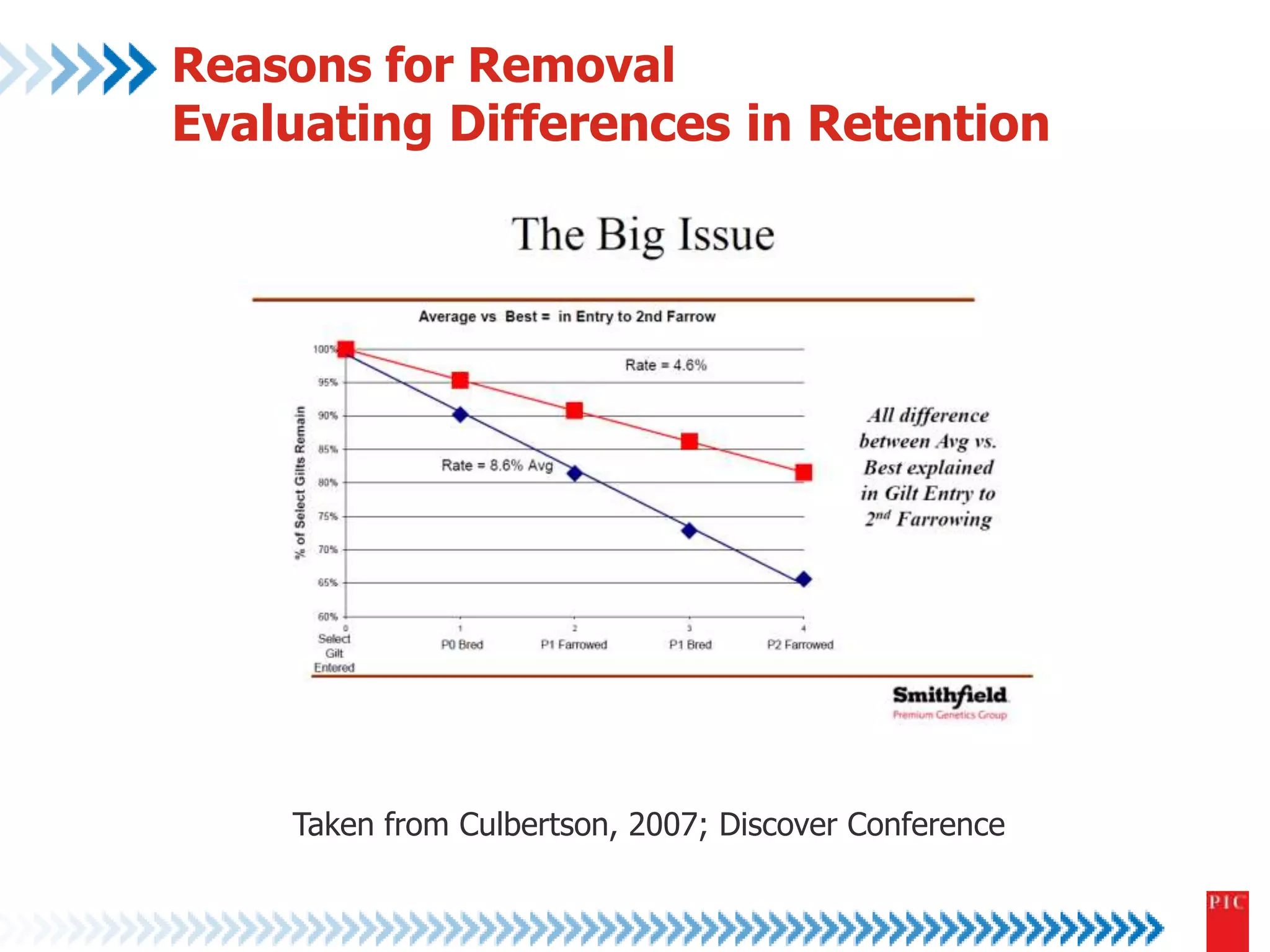
Reasons for Removal 
Evaluating Differences in Retention 
Taken from Culbertson, 2007; Discover Conference
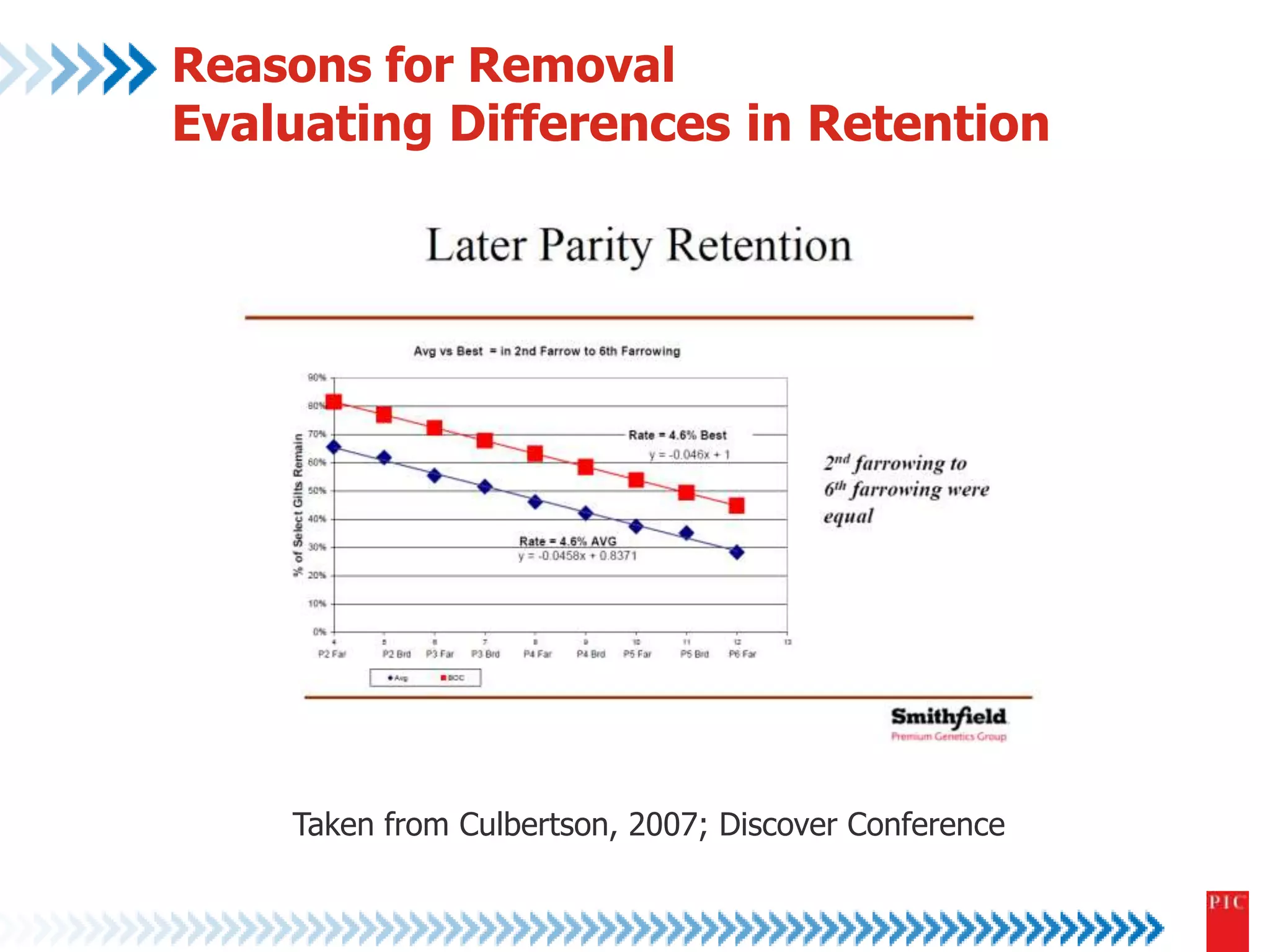
Reasons for Removal 
Evaluating Differences in Retention 
Taken from Culbertson, 2007; Discover Conference
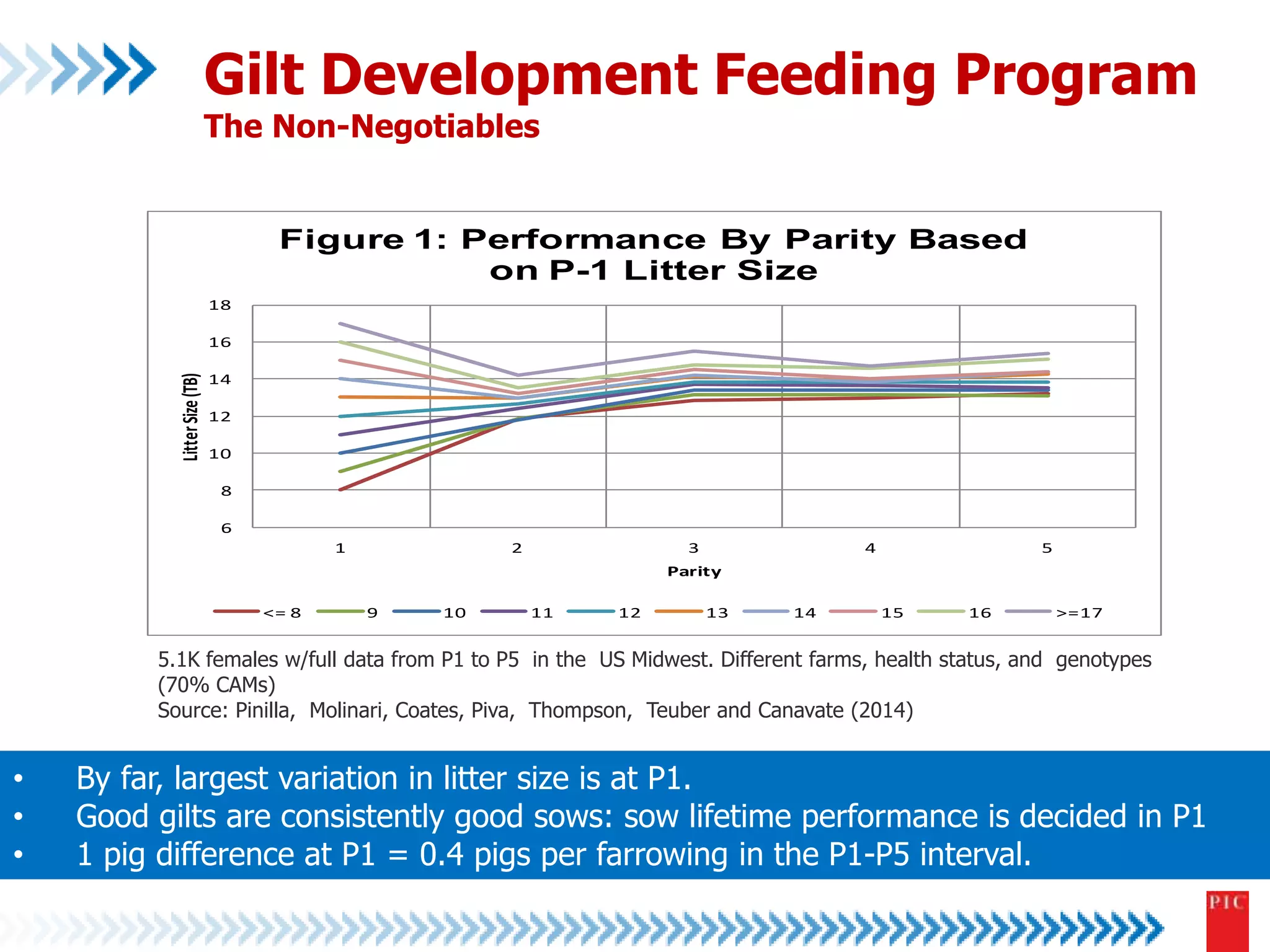
Gilt Development Feeding Program 
The Non-Negotiables 
18 
16 
14 
12 
10 
8 
6 
Figure 1: Performance By Parity Based 
on P-1 Litter Size 
1 2 3 4 5 
Litter Size (TB) 
Parity 
<= 8 9 10 11 12 13 14 15 16 >=17 
5.1K females w/full data from P1 to P5 in the US Midwest. Different farms, health status, and genotypes 
(70% CAMs) 
Source: Pinilla, Molinari, Coates, Piva, Thompson, Teuber and Canavate (2014) 
• By far, largest variation in litter size is at P1. 
• Good gilts are consistently good sows: sow lifetime performance is decided in P1 
• 1 pig difference at P1 = 0.4 pigs per farrowing in the P1-P5 interval.
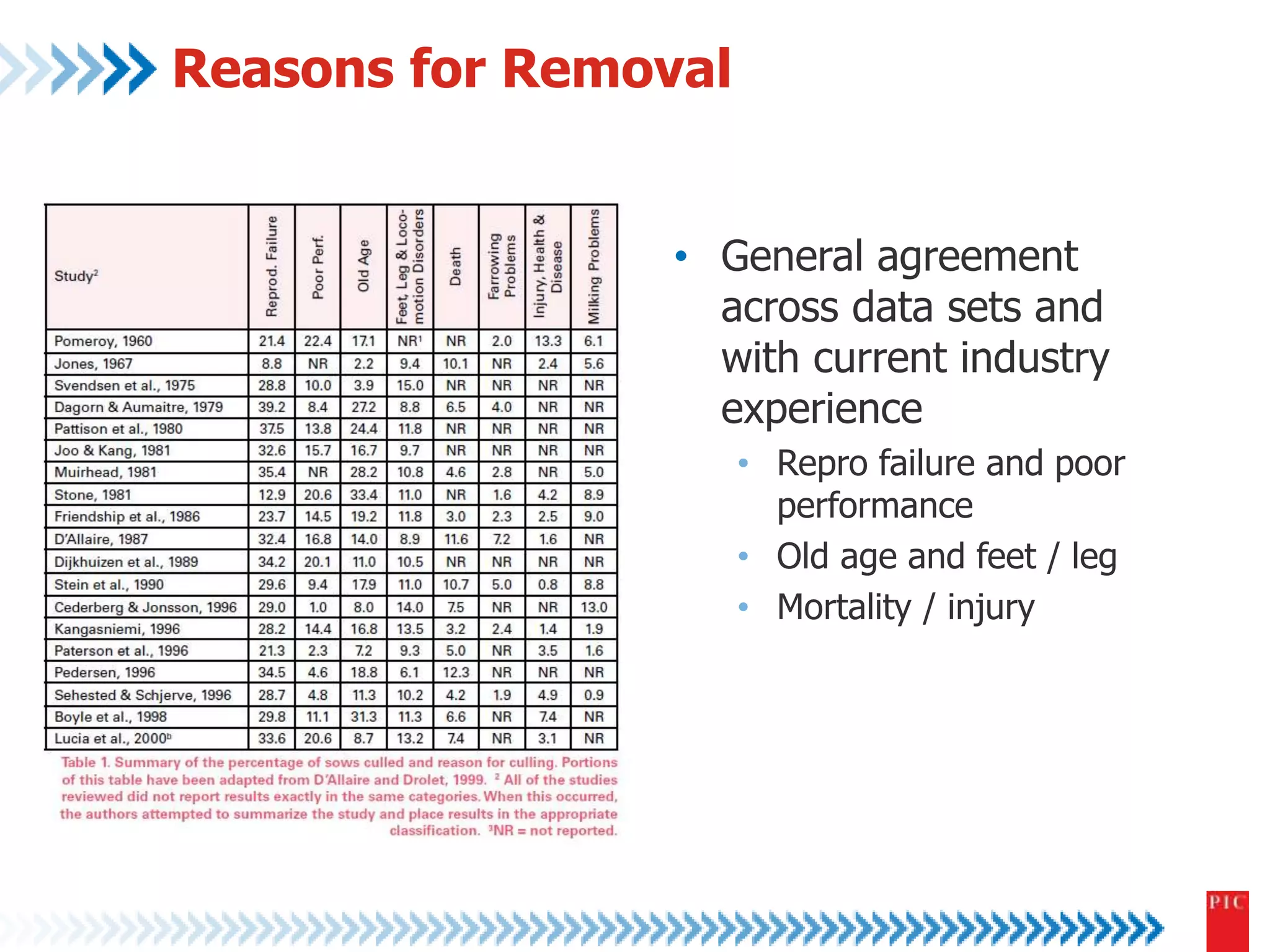
Reasons for Removal 
• General agreement 
across data sets and 
with current industry 
experience 
• Repro failure and poor 
performance 
• Old age and feet / leg 
• Mortality / injury
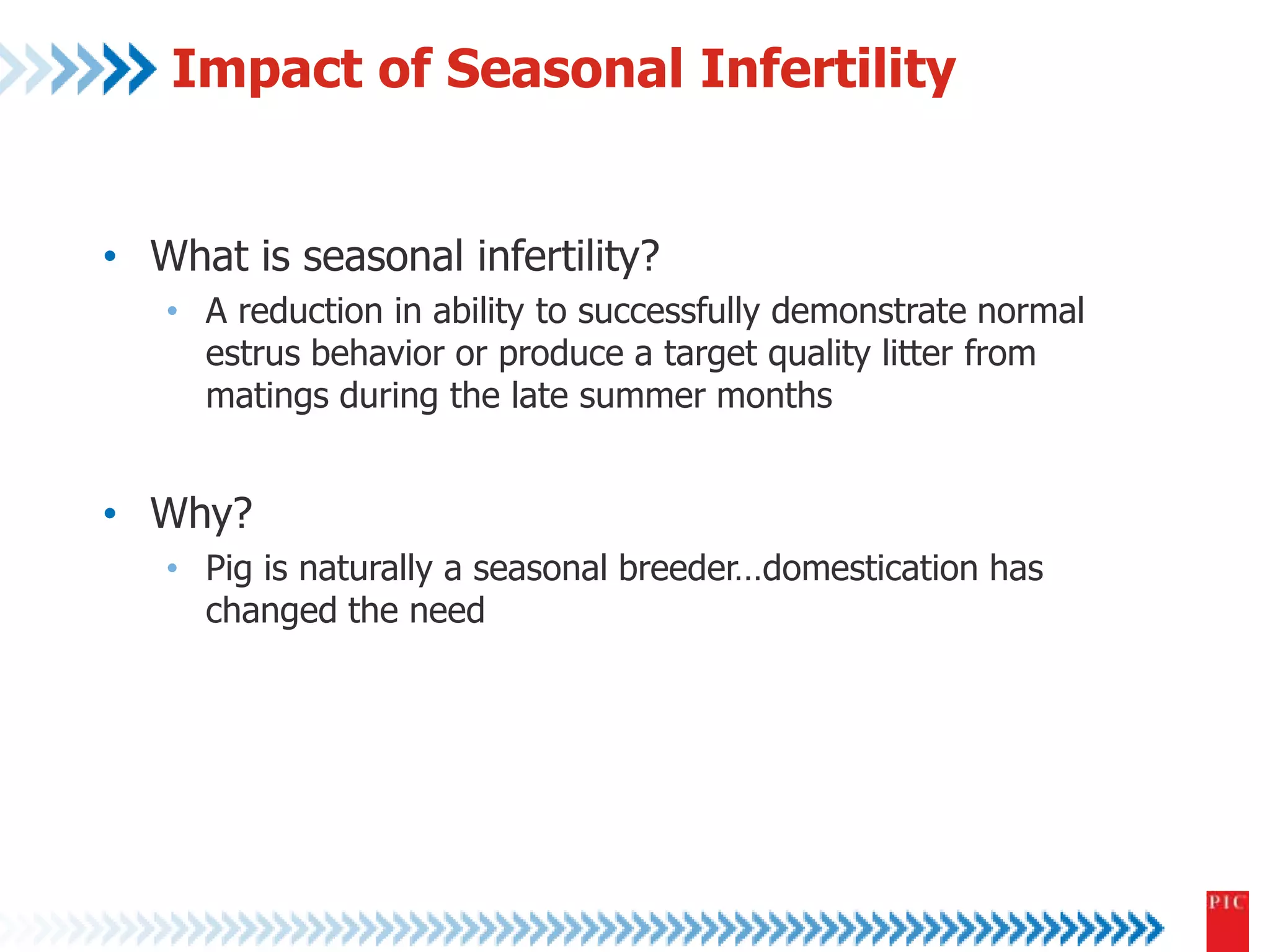
Impact of Seasonal Infertility 
• What is seasonal infertility? 
• A reduction in ability to successfully demonstrate normal 
estrus behavior or produce a target quality litter from 
matings during the late summer months 
• Why? 
• Pig is naturally a seasonal breeder…domestication has 
changed the need
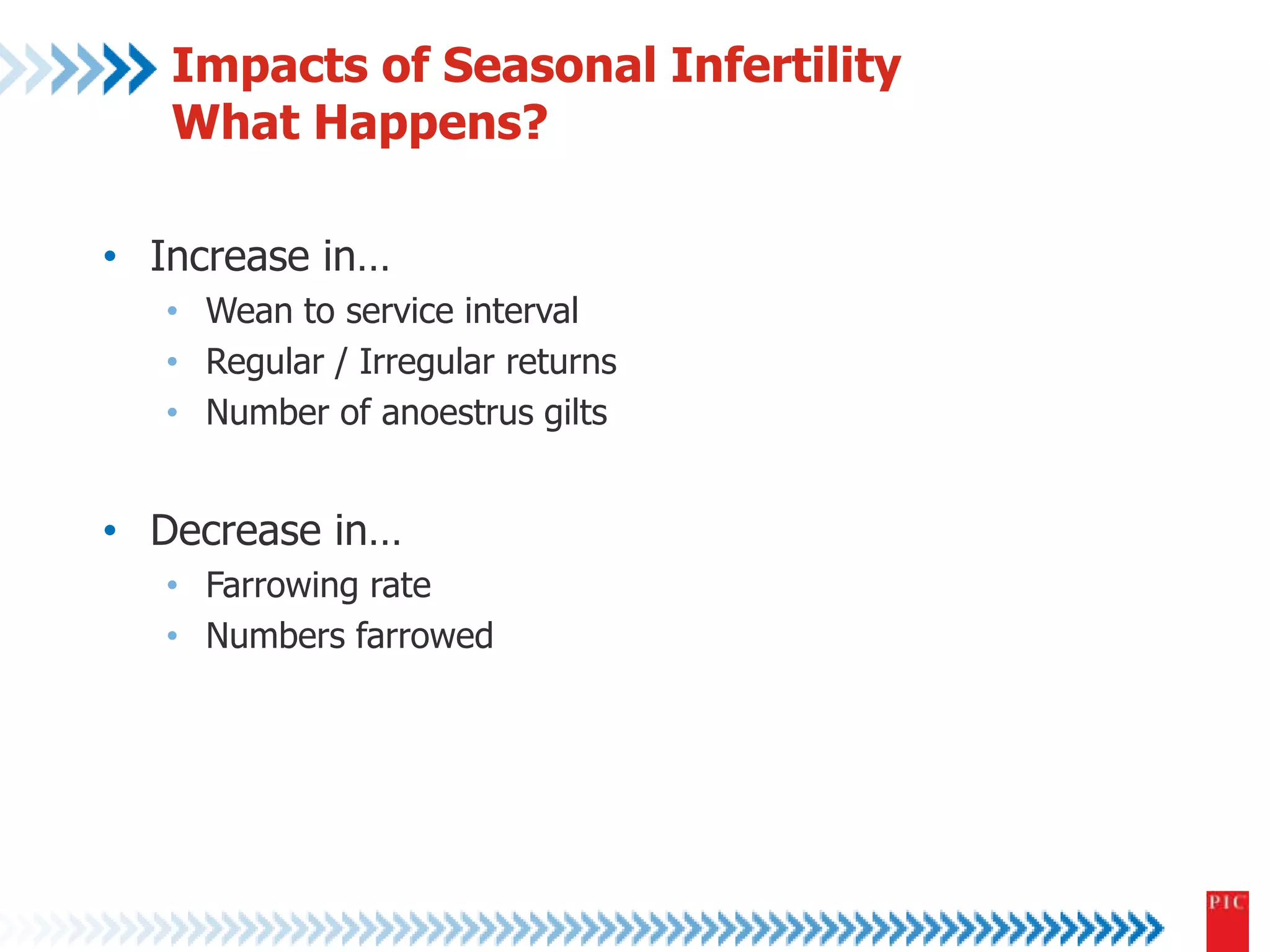
Impacts of Seasonal Infertility 
What Happens? 
• Increase in… 
• Wean to service interval 
• Regular / Irregular returns 
• Number of anoestrus gilts 
• Decrease in… 
• Farrowing rate 
• Numbers farrowed
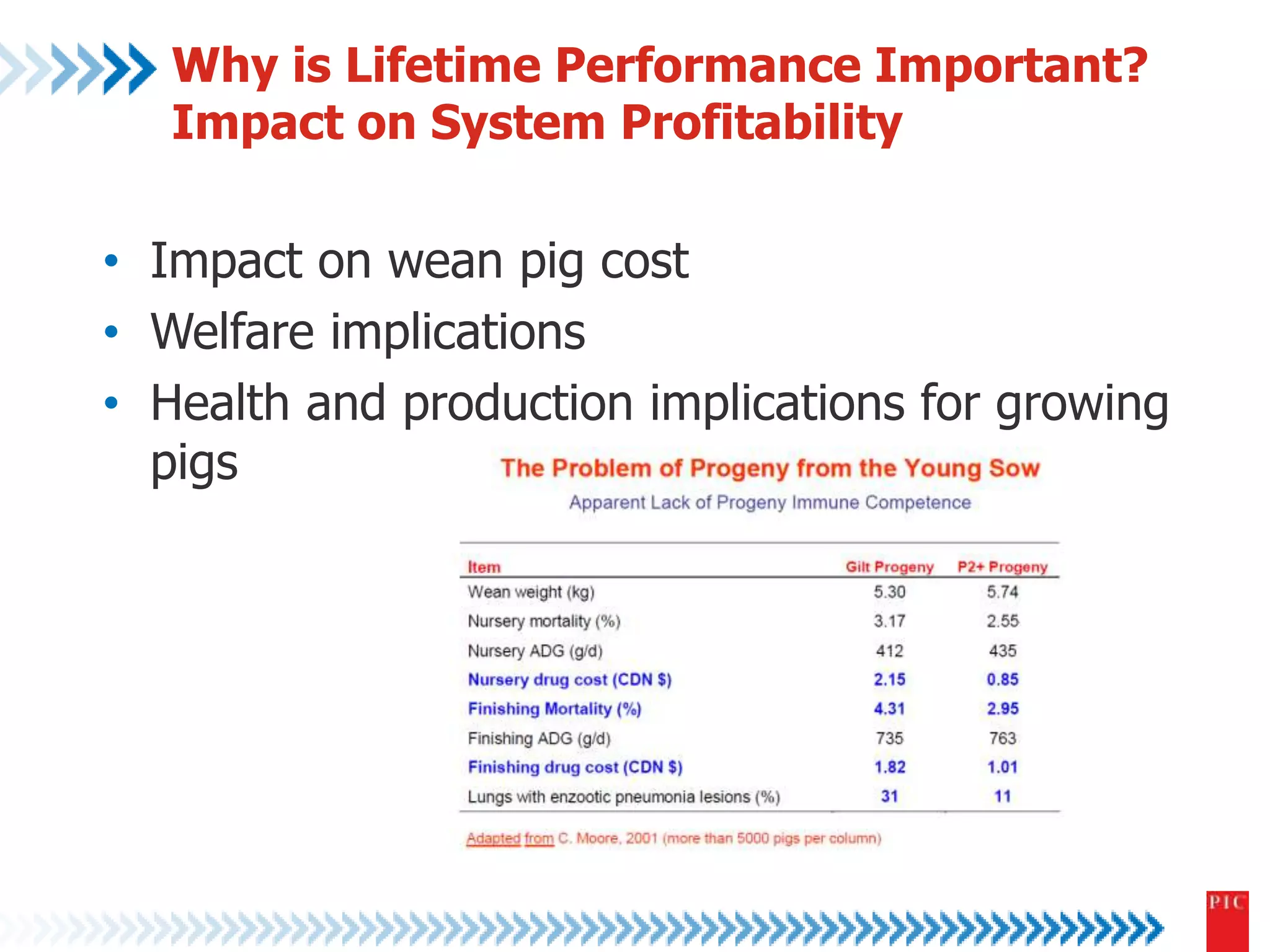
Why is Lifetime Performance Important? 
Impact on System Profitability 
• Impact on wean pig cost 
• Welfare implications 
• Health and production implications for growing 
pigs
Feeding Females for Maximum 
Lifetime Production
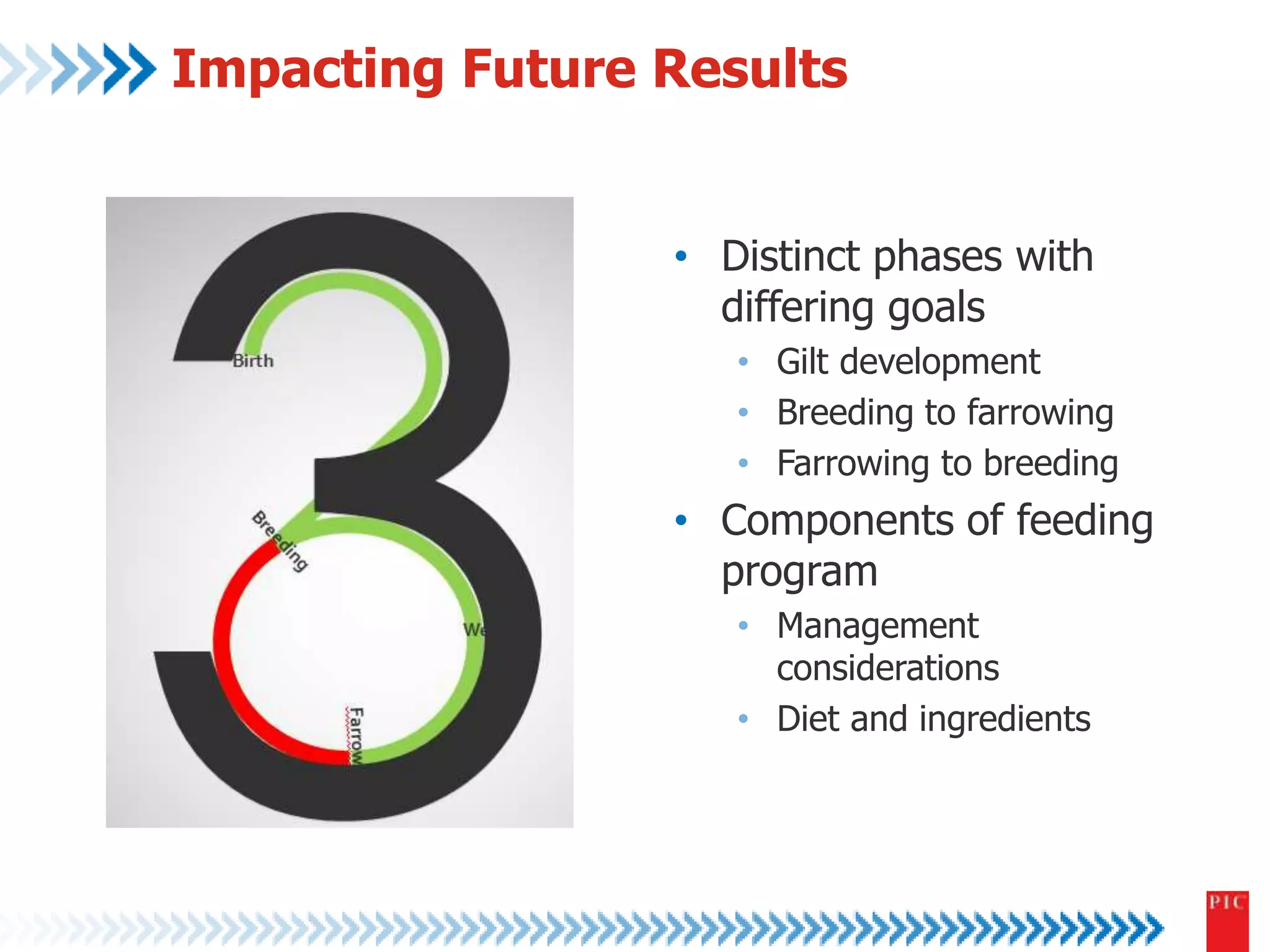
So…where should we focus… 
Weaning 
Birth
Impacting Future Results 
• Distinct phases with 
differing goals 
• Gilt development 
• Breeding to farrowing 
• Farrowing to breeding 
• Components of feeding 
program 
• Management 
considerations 
• Diet and ingredients
Gilt Development Program 
The Non-Negotiables 
• Always remember the impact of P1 performance on 
lifetime production 
• Increasing chances to get better P1 performance by 
– Ad lib feed until first breeding and ensure an optimum 
ADG range allow higher litter size in P1 
– HNS program that make the system to breed 95%+ of 
the gilts with at least 1 HNS
Gilt Development Program 
The Non-Negotiables 
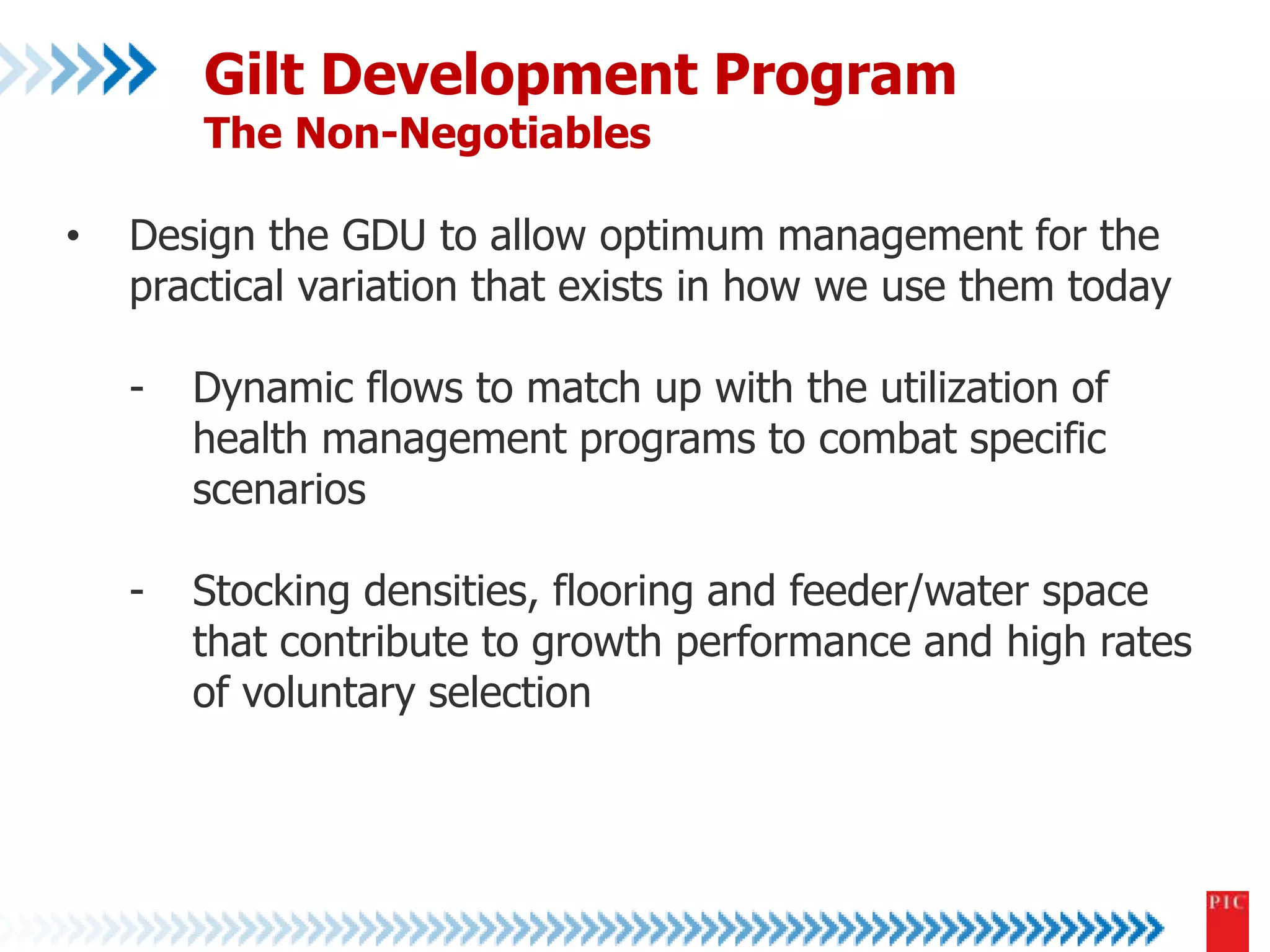
• Design the GDU to allow optimum management for the 
practical variation that exists in how we use them today 
- Dynamic flows to match up with the utilization of 
health management programs to combat specific 
scenarios 
- Stocking densities, flooring and feeder/water space 
that contribute to growth performance and high rates 
of voluntary selection
Gilt Development 
Nutrition Considerations 
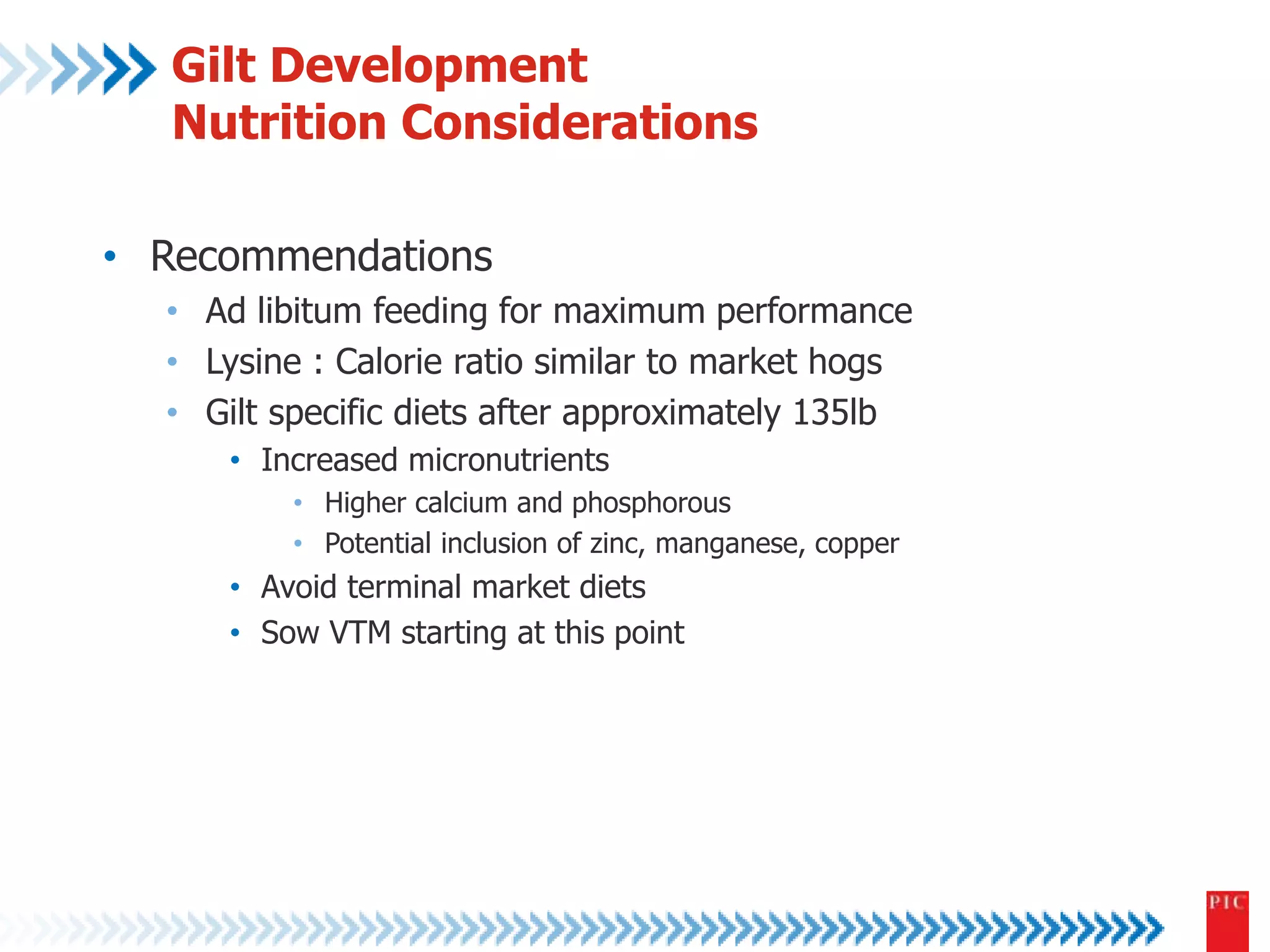
• Recommendations 
• Ad libitum feeding for maximum performance 
• Lysine : Calorie ratio similar to market hogs 
• Gilt specific diets after approximately 135lb 
• Increased micronutrients 
• Higher calcium and phosphorous 
• Potential inclusion of zinc, manganese, copper 
• Avoid terminal market diets 
• Sow VTM starting at this point
Gilt Development Program 
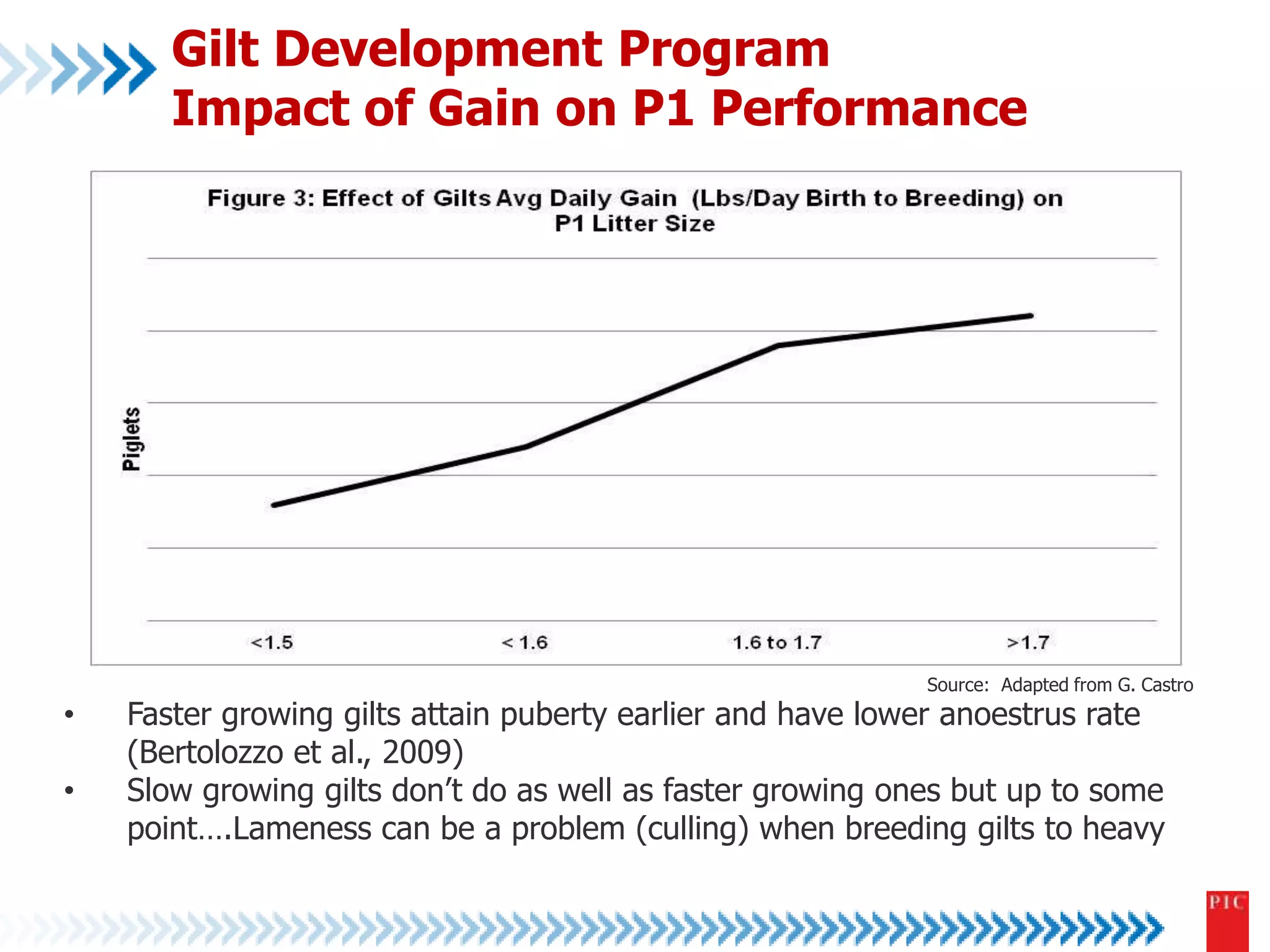
Impact of Gain on P1 Performance 
Source: Adapted from G. Castro 
• Faster growing gilts attain puberty earlier and have lower anoestrus rate 
(Bertolozzo et al., 2009) 
• Slow growing gilts don’t do as well as faster growing ones but up to some 
point….Lameness can be a problem (culling) when breeding gilts to heavy
Gilt Development Program 
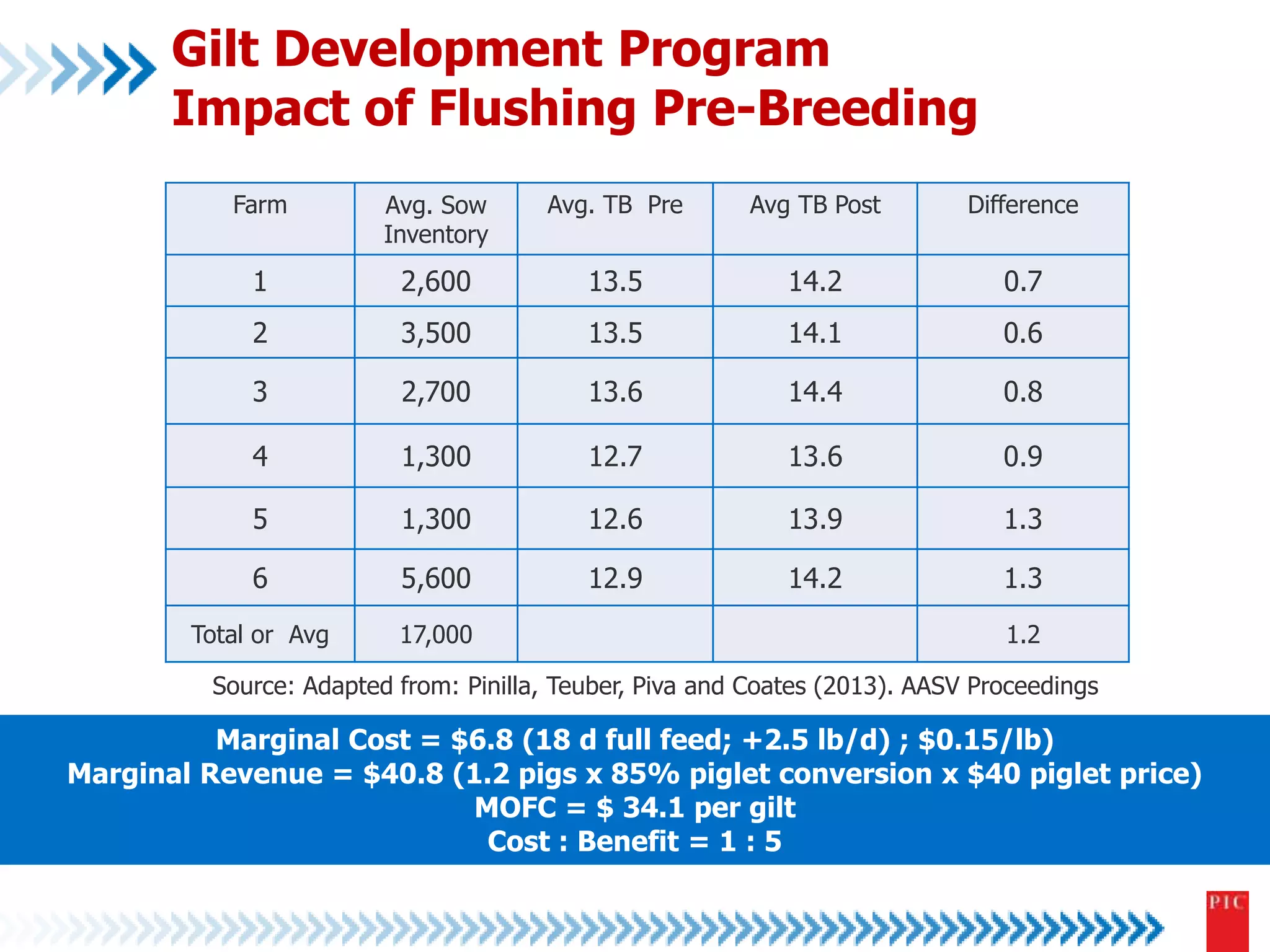
Impact of Flushing Pre-Breeding 
Farm Avg. Sow 
Inventory 
Avg. TB Pre Avg TB Post Difference 
1 2,600 13.5 14.2 0.7 
2 3,500 13.5 14.1 0.6 
3 2,700 13.6 14.4 0.8 
4 1,300 12.7 13.6 0.9 
5 1,300 12.6 13.9 1.3 
6 5,600 12.9 14.2 1.3 
Total or Avg 17,000 1.2 
Source: Adapted from: Pinilla, Teuber, Piva and Coates (2013). AASV Proceedings 
Marginal Cost = $6.8 (18 d full feed; +2.5 lb/d) ; $0.15/lb) 
Marginal Revenue = $40.8 (1.2 pigs x 85% piglet conversion x $40 piglet price) 
MOFC = $ 34.1 per gilt 
Cost : Benefit = 1 : 5
Gilt Development Program 
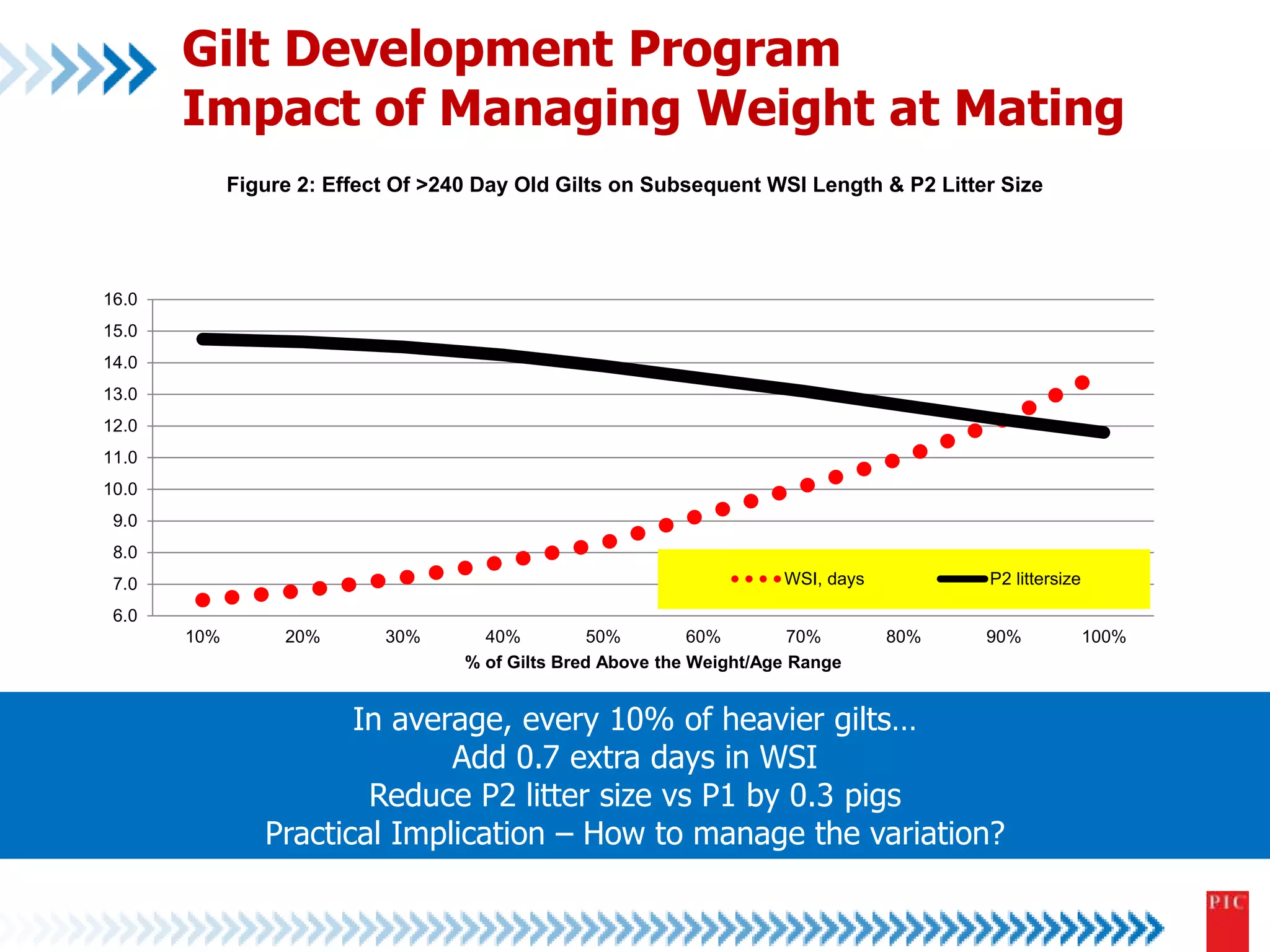
Impact of Managing Weight at Mating 
Figure 2: Effect Of >240 Day Old Gilts on Subsequent WSI Length & P2 Litter Size 
WSI, days P2 littersize 
In average, every 10% of heavier gilts… 
Add 0.7 extra days in WSI 
Reduce P2 litter size vs P1 by 0.3 pigs 
Practical Implication – How to manage the variation? 
16.0 
15.0 
14.0 
13.0 
12.0 
11.0 
10.0 
9.0 
8.0 
7.0 
6.0 
10% 20% 30% 40% 50% 60% 70% 80% 90% 100% 
% of Gilts Bred Above the Weight/Age Range
Gilt Development Program 
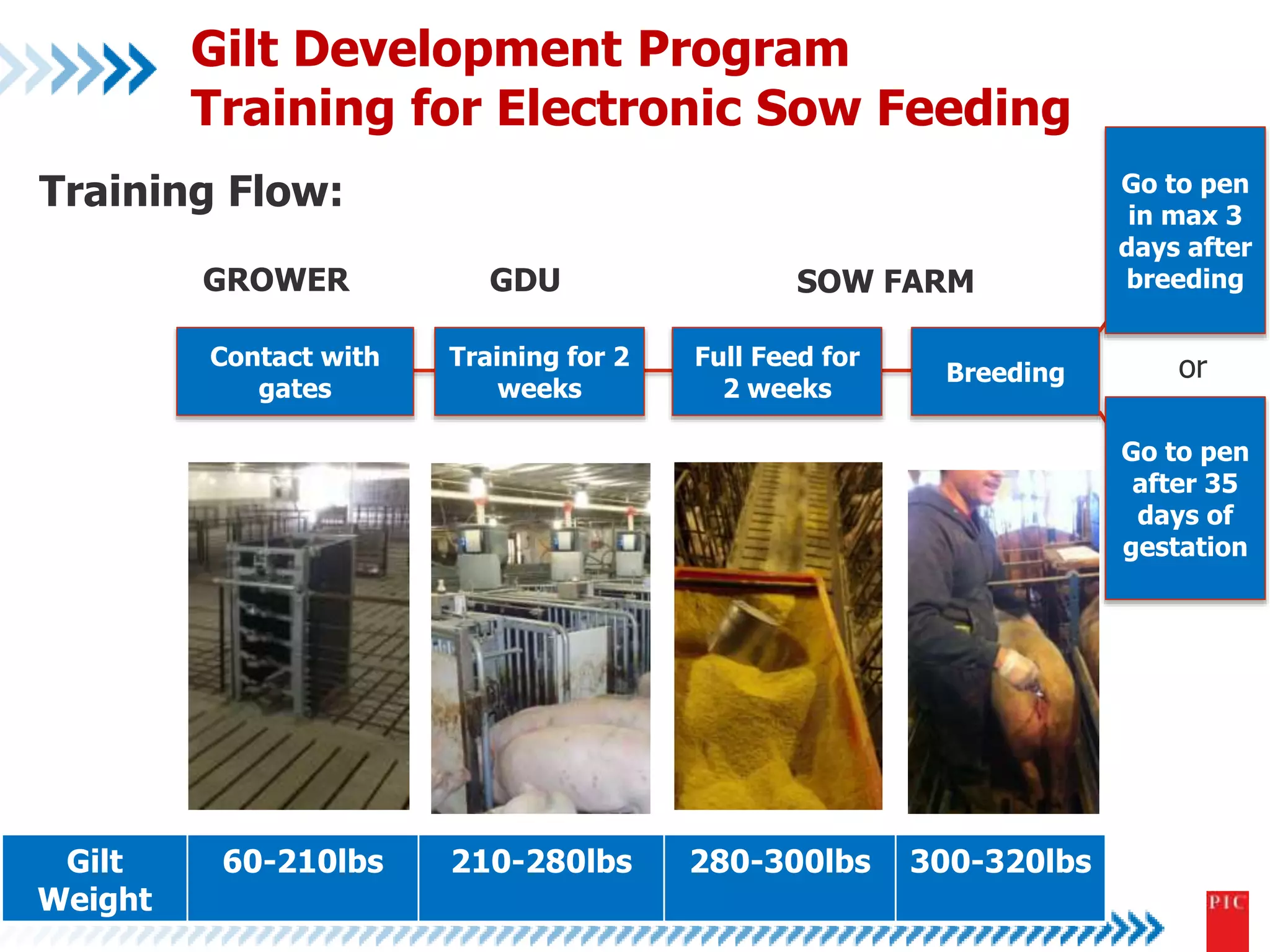
Training for Electronic Sow Feeding 
Training Flow: 
GROWER GDU SOW FARM 
Full Feed for or 
Breeding 
Go to pen 
in max 3 
days after 
breeding 
Go to pen 
after 35 
days of 
gestation 
2 weeks 
Training for 2 
weeks 
Contact with 
gates 
Gilt 
Weight 
60-210lbs 210-280lbs 280-300lbs 300-320lbs
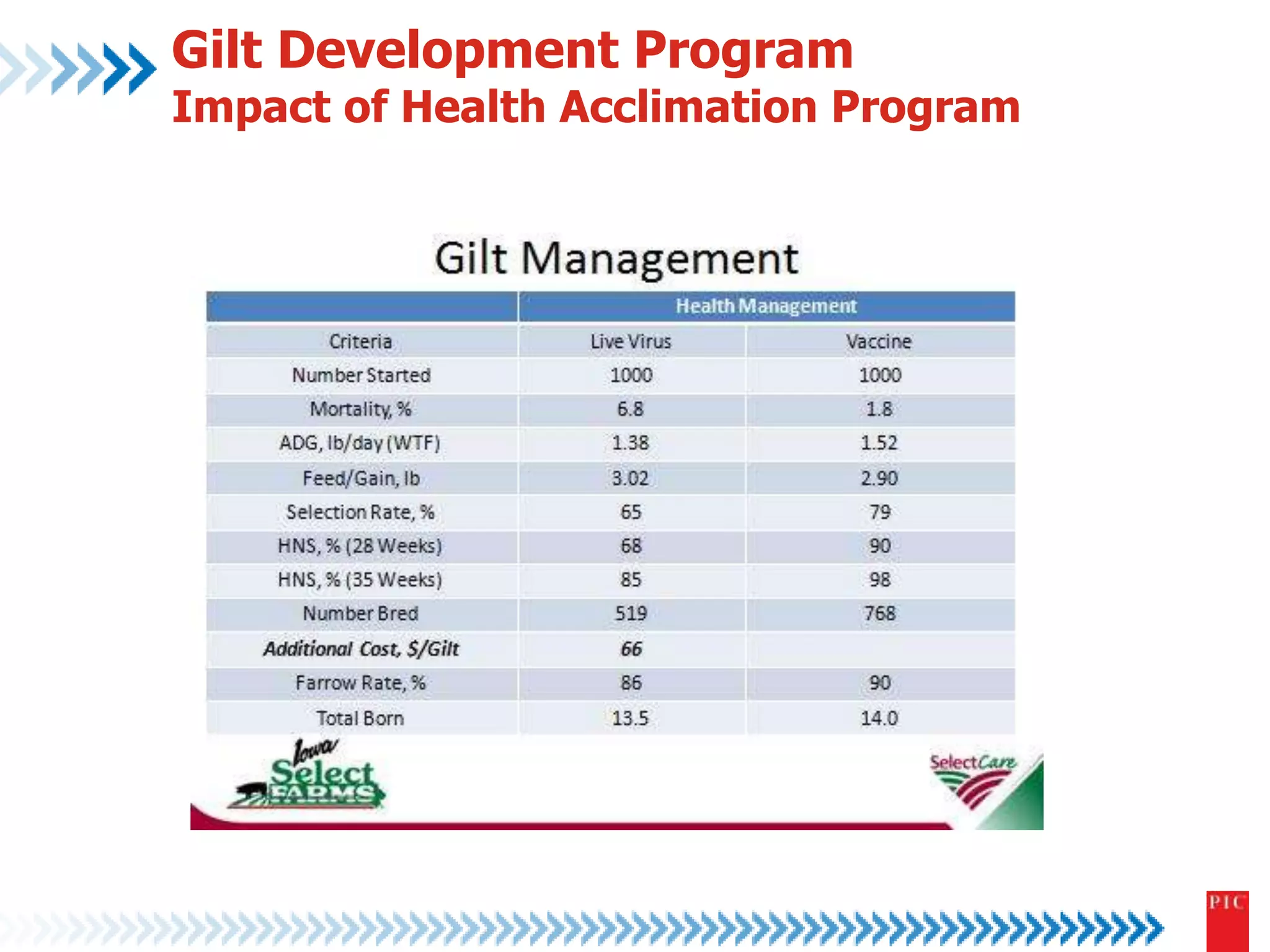
Gilt Development Program 
Impact of Health Acclimation Program
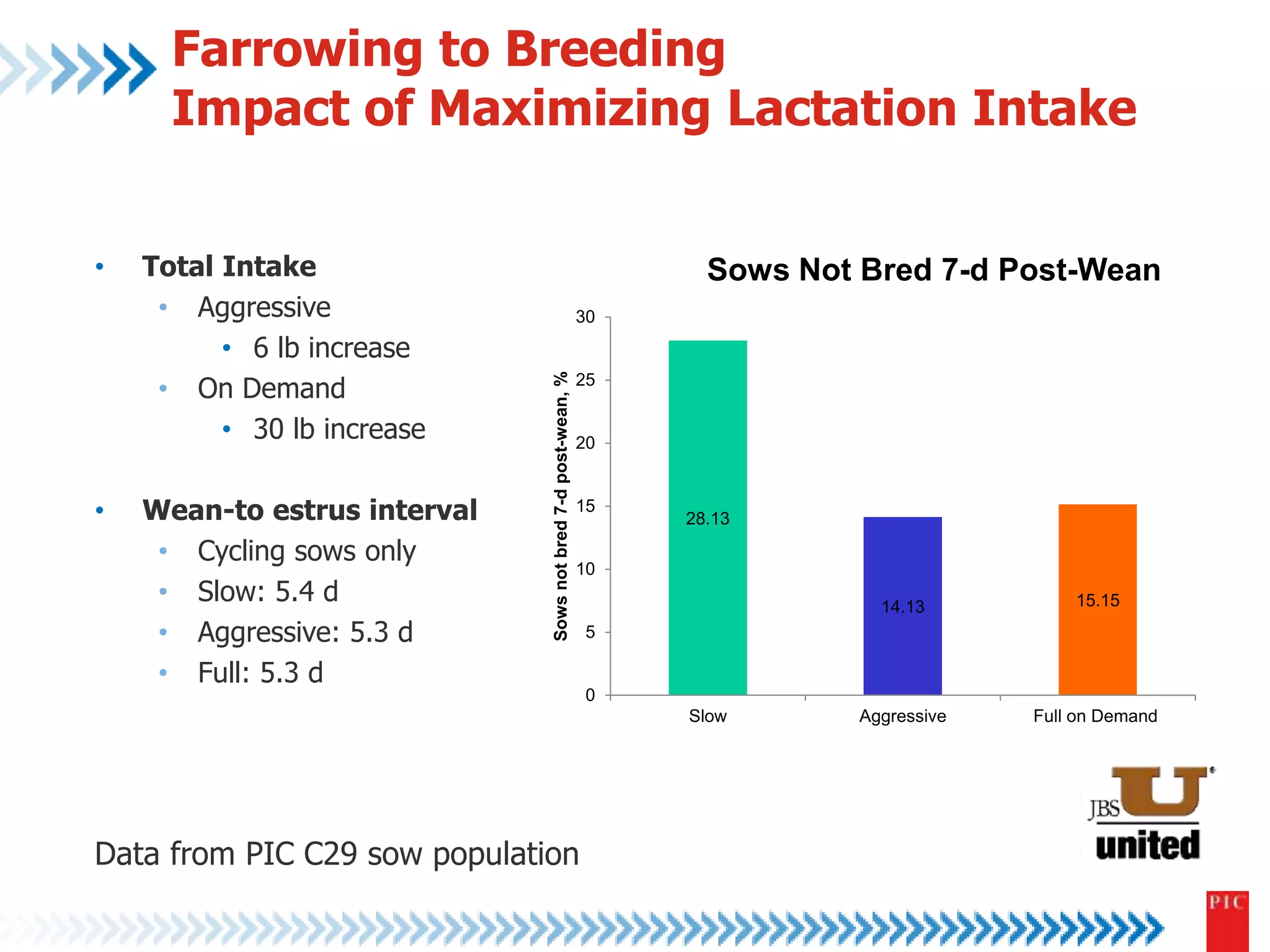
Farrowing to Breeding 
Impact of Maximizing Lactation Intake 
• Total Intake 
• Aggressive 
• 6 lb increase 
• On Demand 
• 30 lb increase 
• Wean-to estrus interval 
• Cycling sows only 
• Slow: 5.4 d 
• Aggressive: 5.3 d 
• Full: 5.3 d 
28.13 
14.13 15.15 
30 
25 
20 
15 
10 
5 
0 
Slow Aggressive Full on Demand 
Sows not bred 7-d post-wean, % 
Sows Not Bred 7-d Post-Wean 
Data from PIC C29 sow population
Farrowing to Breeding 
Impact of Maximizing Lactation Intake 
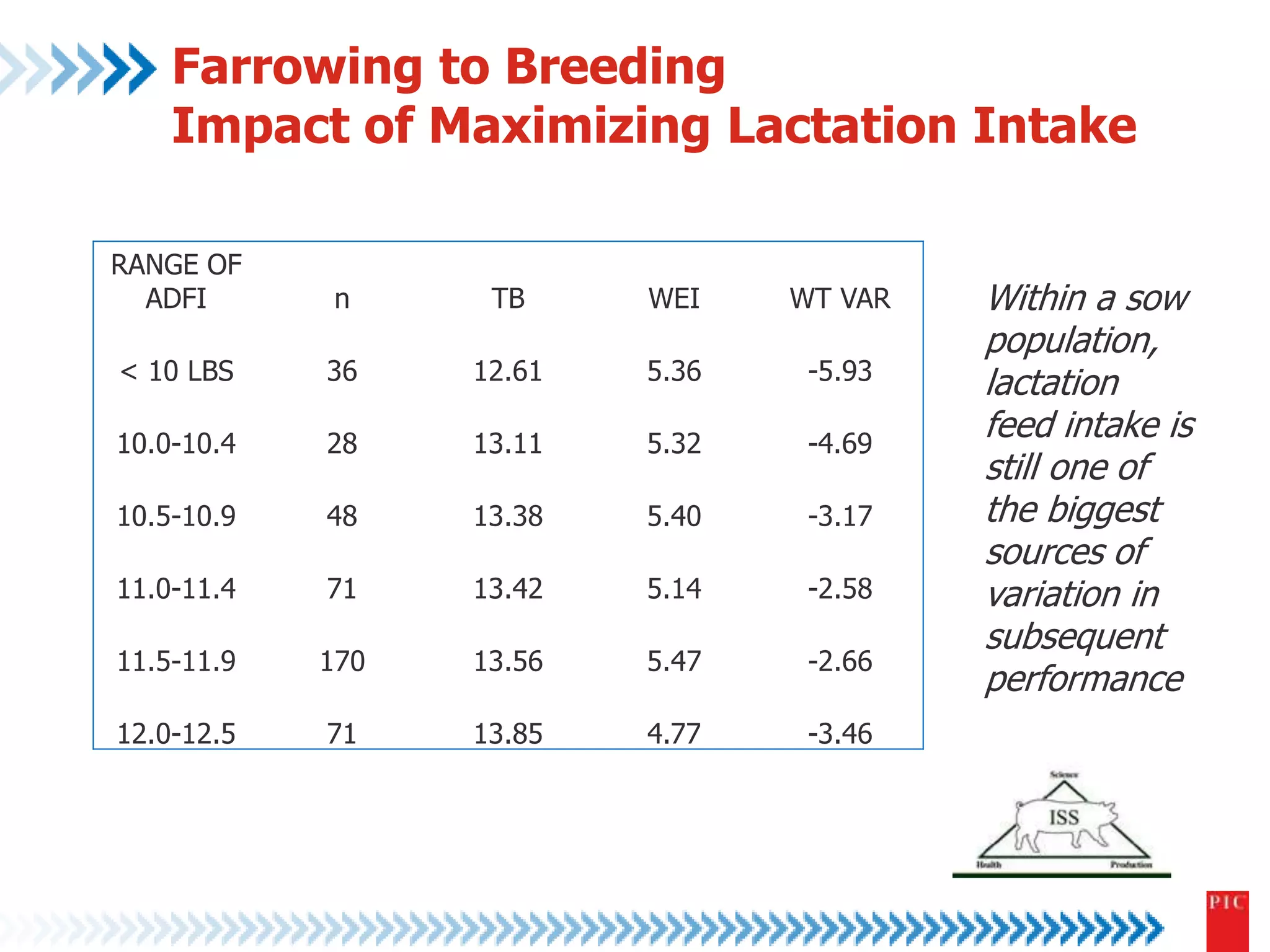
RANGE OF 
ADFI n TB WEI WT VAR 
< 10 LBS 36 12.61 5.36 -5.93 
10.0-10.4 28 13.11 5.32 -4.69 
10.5-10.9 48 13.38 5.40 -3.17 
11.0-11.4 71 13.42 5.14 -2.58 
11.5-11.9 170 13.56 5.47 -2.66 
12.0-12.5 71 13.85 4.77 -3.46 
Within a sow 
population, 
lactation 
feed intake is 
still one of 
the biggest 
sources of 
variation in 
subsequent 
performance
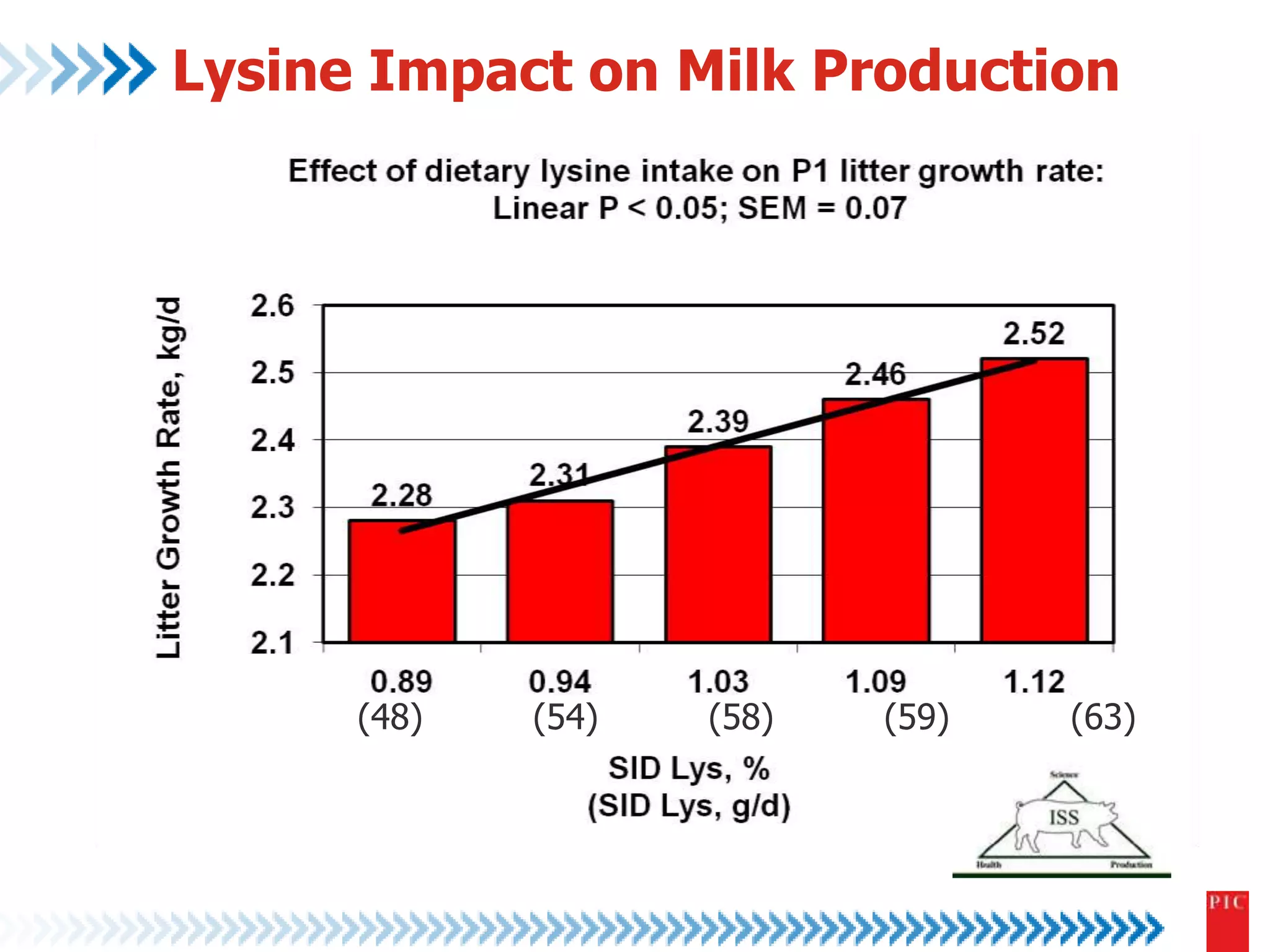
Lysine Impact on Milk Production 
(48) (54) (58) (59) (63)
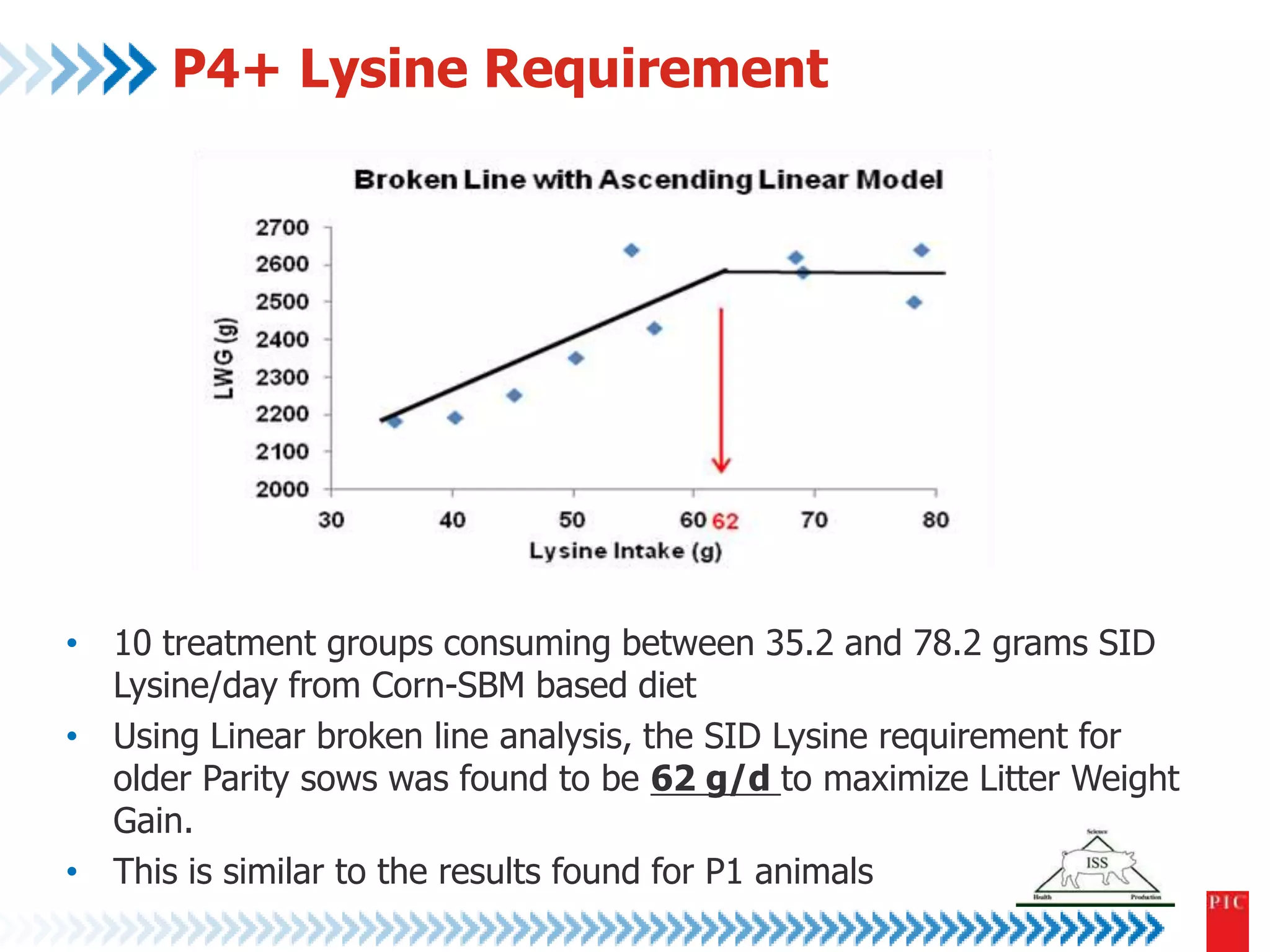
P4+ Lysine Requirement 
• 10 treatment groups consuming between 35.2 and 78.2 grams SID 
Lysine/day from Corn-SBM based diet 
• Using Linear broken line analysis, the SID Lysine requirement for 
older Parity sows was found to be 62 g/d to maximize Litter Weight 
Gain. 
• This is similar to the results found for P1 animals
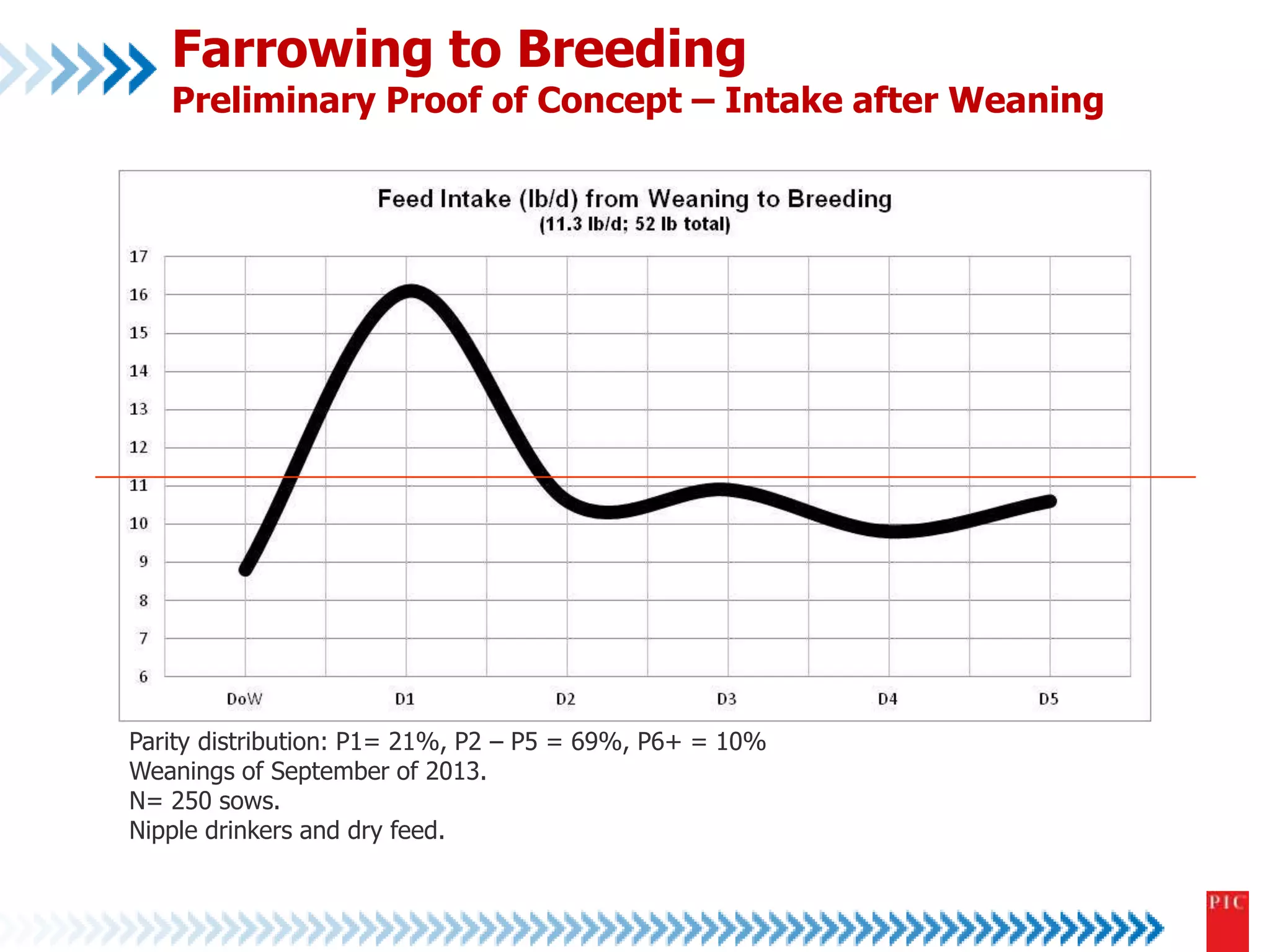
Farrowing to Breeding 
Preliminary Proof of Concept – Intake after Weaning 
Parity distribution: P1= 21%, P2 – P5 = 69%, P6+ = 10% 
Weanings of September of 2013. 
N= 250 sows. 
Nipple drinkers and dry feed.
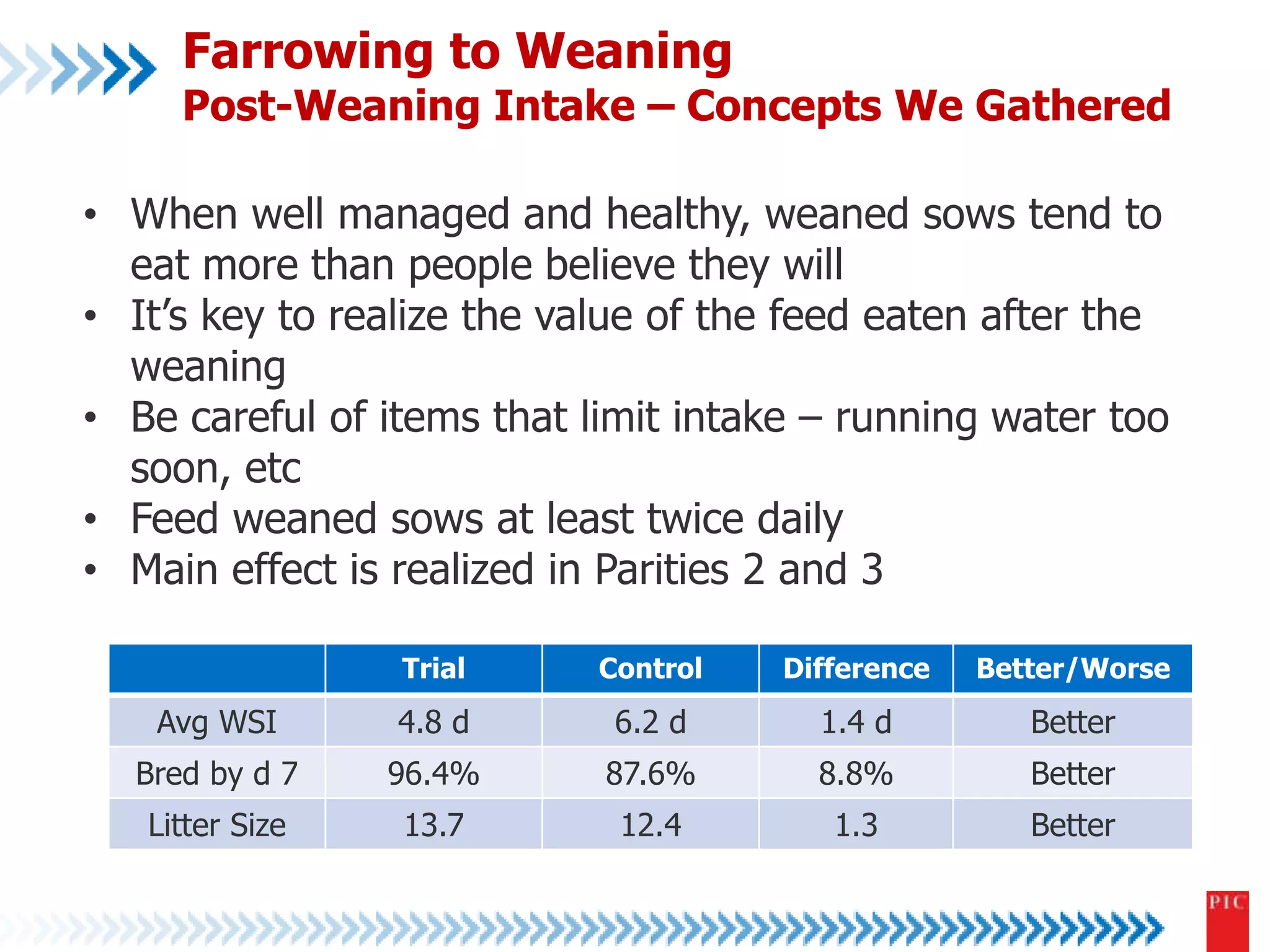
Farrowing to Weaning 
Post-Weaning Intake – Concepts We Gathered 
• When well managed and healthy, weaned sows tend to 
eat more than people believe they will 
• It’s key to realize the value of the feed eaten after the 
weaning 
• Be careful of items that limit intake – running water too 
soon, etc 
• Feed weaned sows at least twice daily 
• Main effect is realized in Parities 2 and 3 
Trial Control Difference Better/Worse 
Avg WSI 4.8 d 6.2 d 1.4 d Better 
Bred by d 7 96.4% 87.6% 8.8% Better 
Litter Size 13.7 12.4 1.3 Better
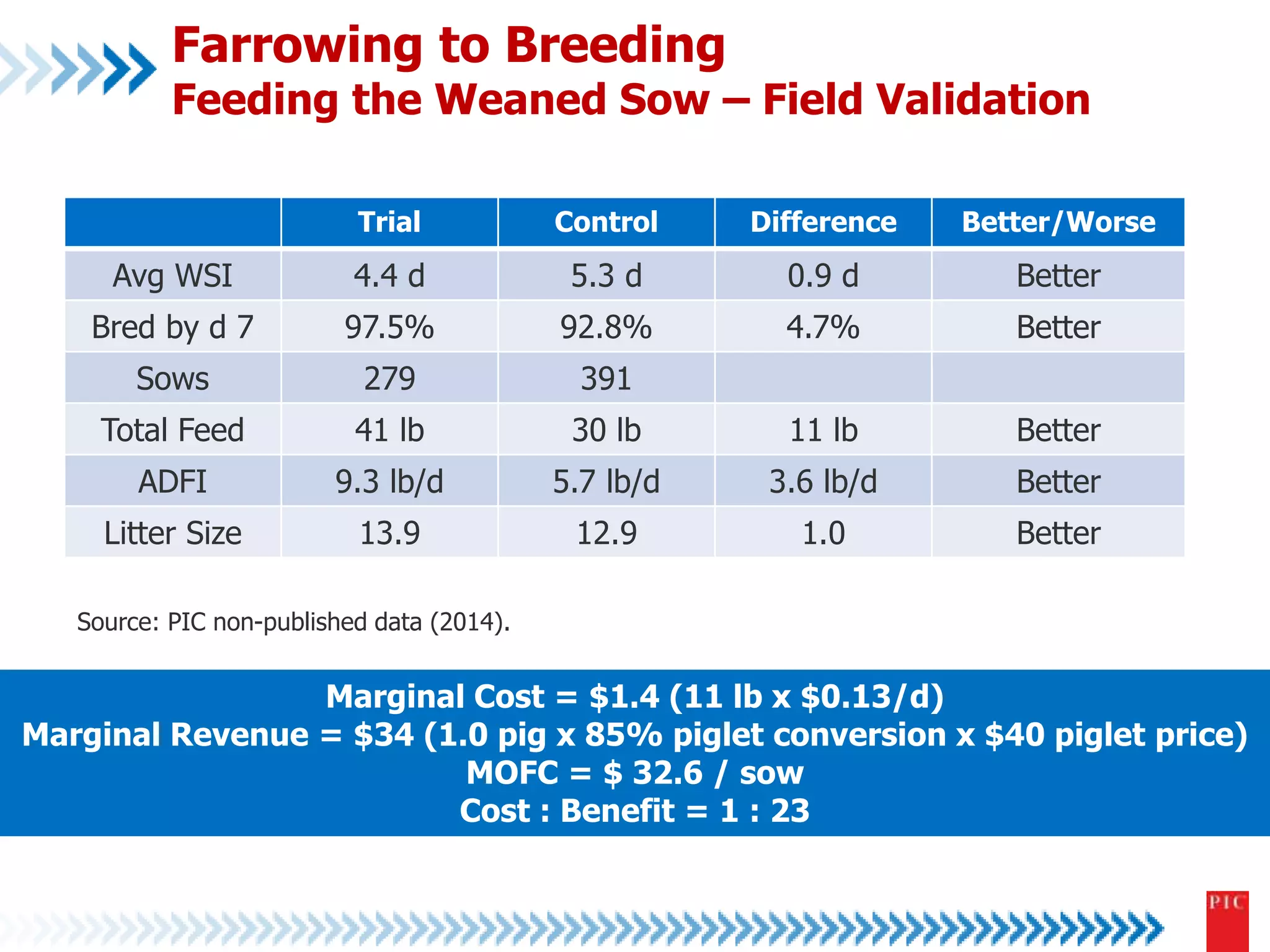
Farrowing to Breeding 
Feeding the Weaned Sow – Field Validation 
Trial Control Difference Better/Worse 
Avg WSI 4.4 d 5.3 d 0.9 d Better 
Bred by d 7 97.5% 92.8% 4.7% Better 
Sows 279 391 
Total Feed 41 lb 30 lb 11 lb Better 
ADFI 9.3 lb/d 5.7 lb/d 3.6 lb/d Better 
Litter Size 13.9 12.9 1.0 Better 
Source: PIC non-published data (2014). 
Marginal Cost = $1.4 (11 lb x $0.13/d) 
Marginal Revenue = $34 (1.0 pig x 85% piglet conversion x $40 piglet price) 
MOFC = $ 32.6 / sow 
Cost : Benefit = 1 : 23
Novel Focus Areas 
Seasonal Infertility 
• New research is being done that highlights potential 
opportunities to modulate response of some at-risk 
females 
• Increases sow herd performance 
• Improves breeding female retention 
• Special thanks to David Rosero for his recent 
dissertation on work conducted in the Hanor system
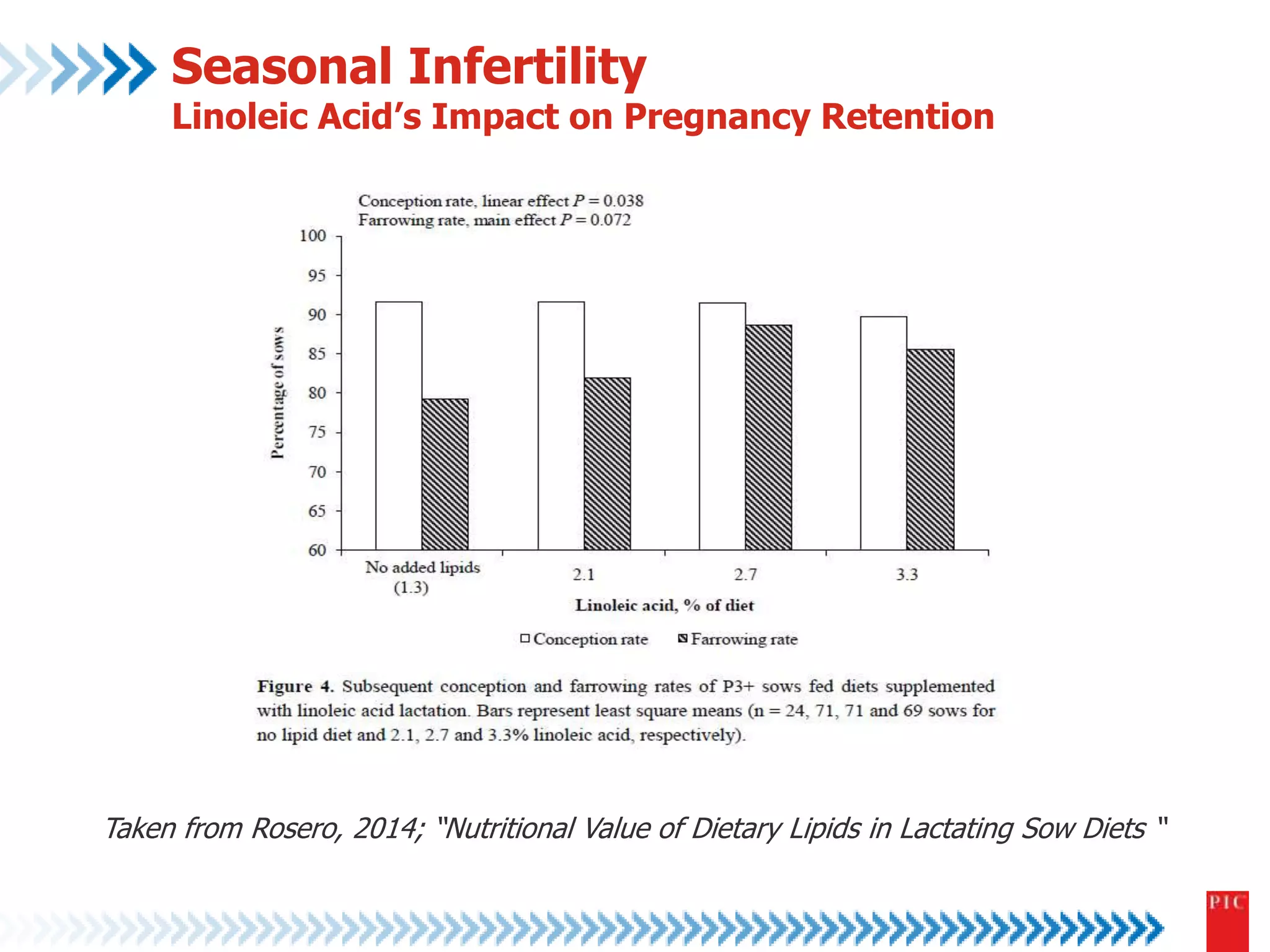
Seasonal Infertility 
Linoleic Acid’s Impact on Pregnancy Retention 
Taken from Rosero, 2014; “Nutritional Value of Dietary Lipids in Lactating Sow Diets “
Seasonal Infertility 
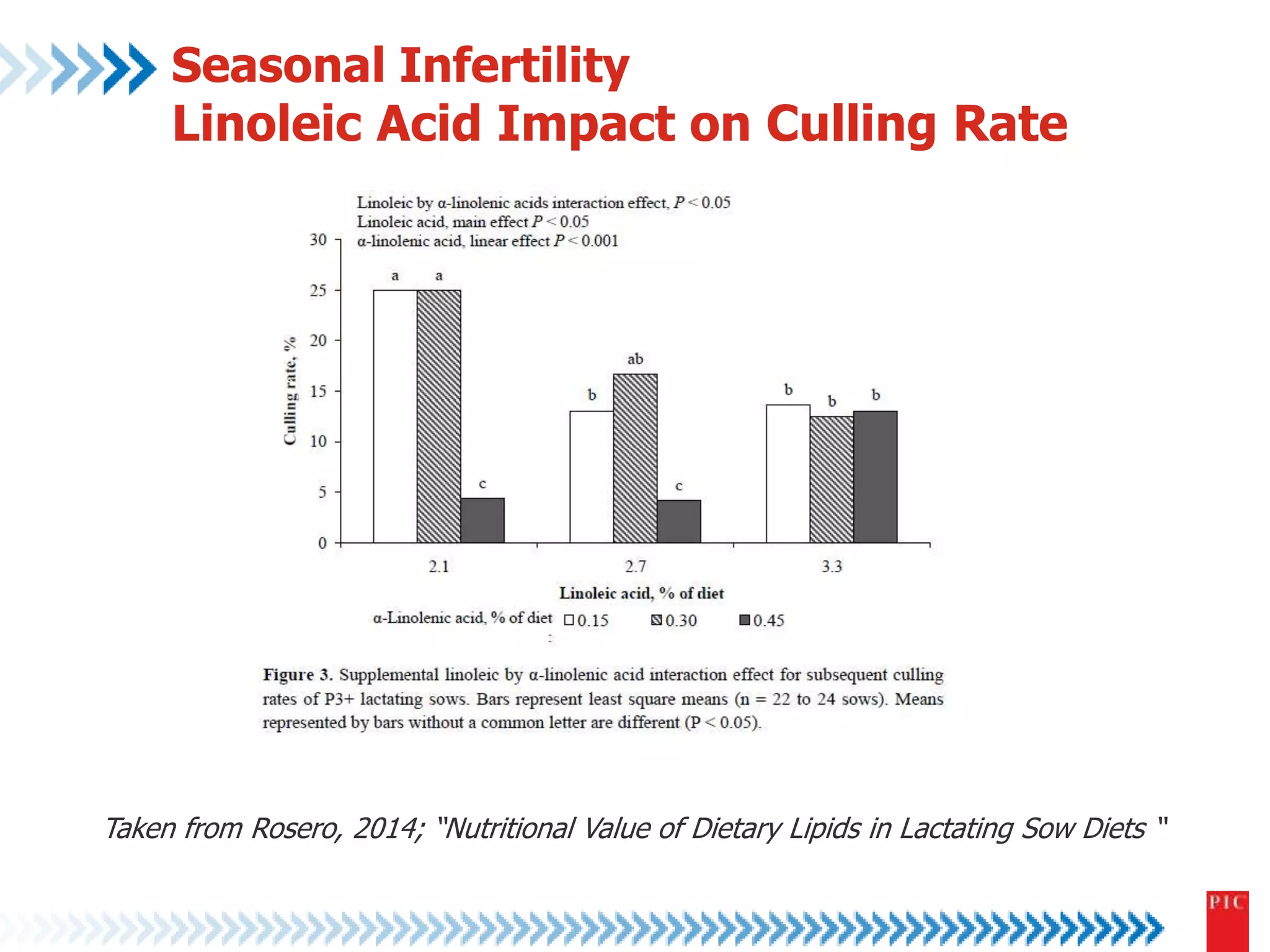
Linoleic Acid Impact on Culling Rate 
Taken from Rosero, 2014; “Nutritional Value of Dietary Lipids in Lactating Sow Diets “
Diet Considerations 
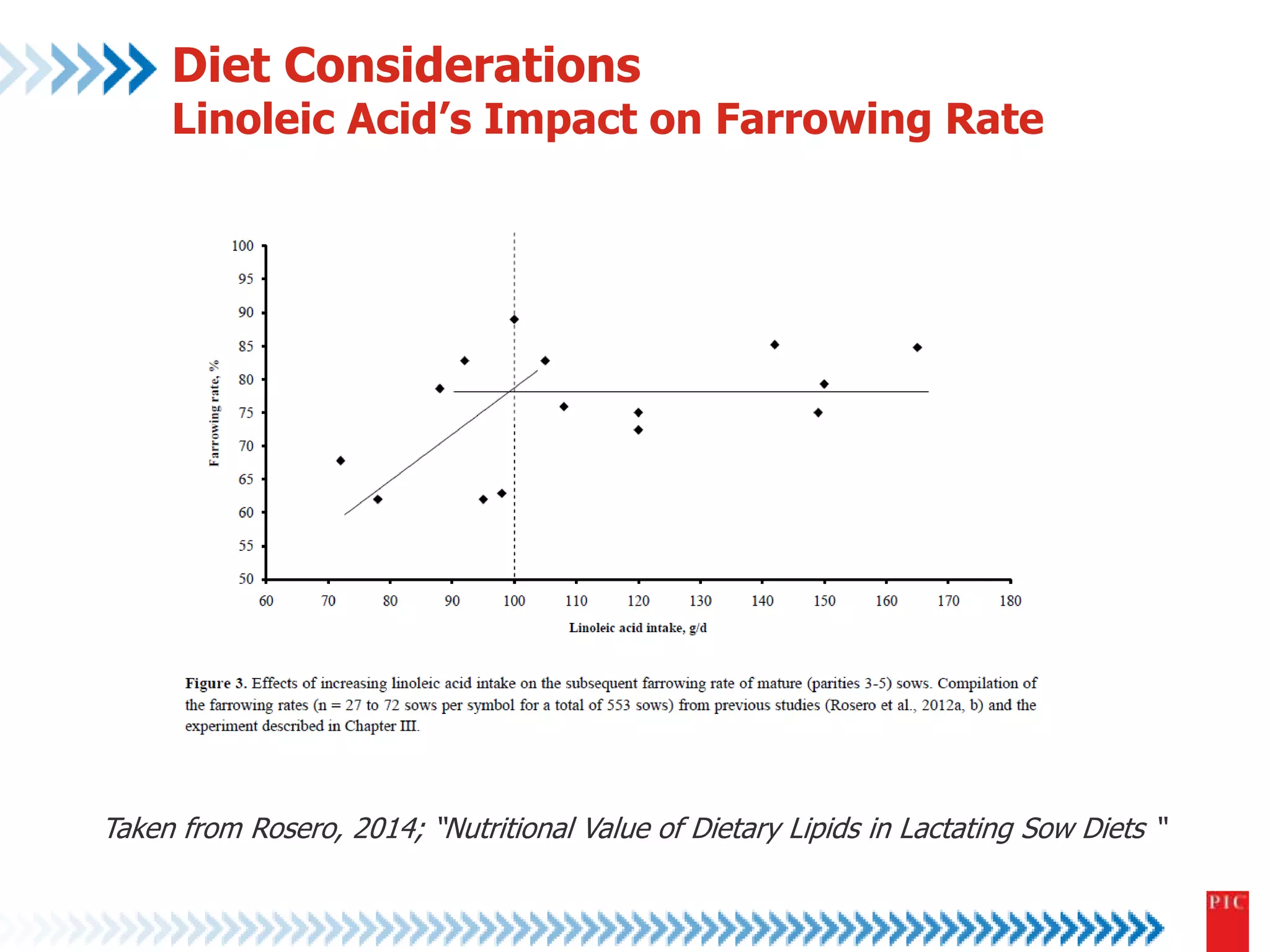
Linoleic Acid’s Impact on Farrowing Rate 
Taken from Rosero, 2014; “Nutritional Value of Dietary Lipids in Lactating Sow Diets “
Diet Considerations 
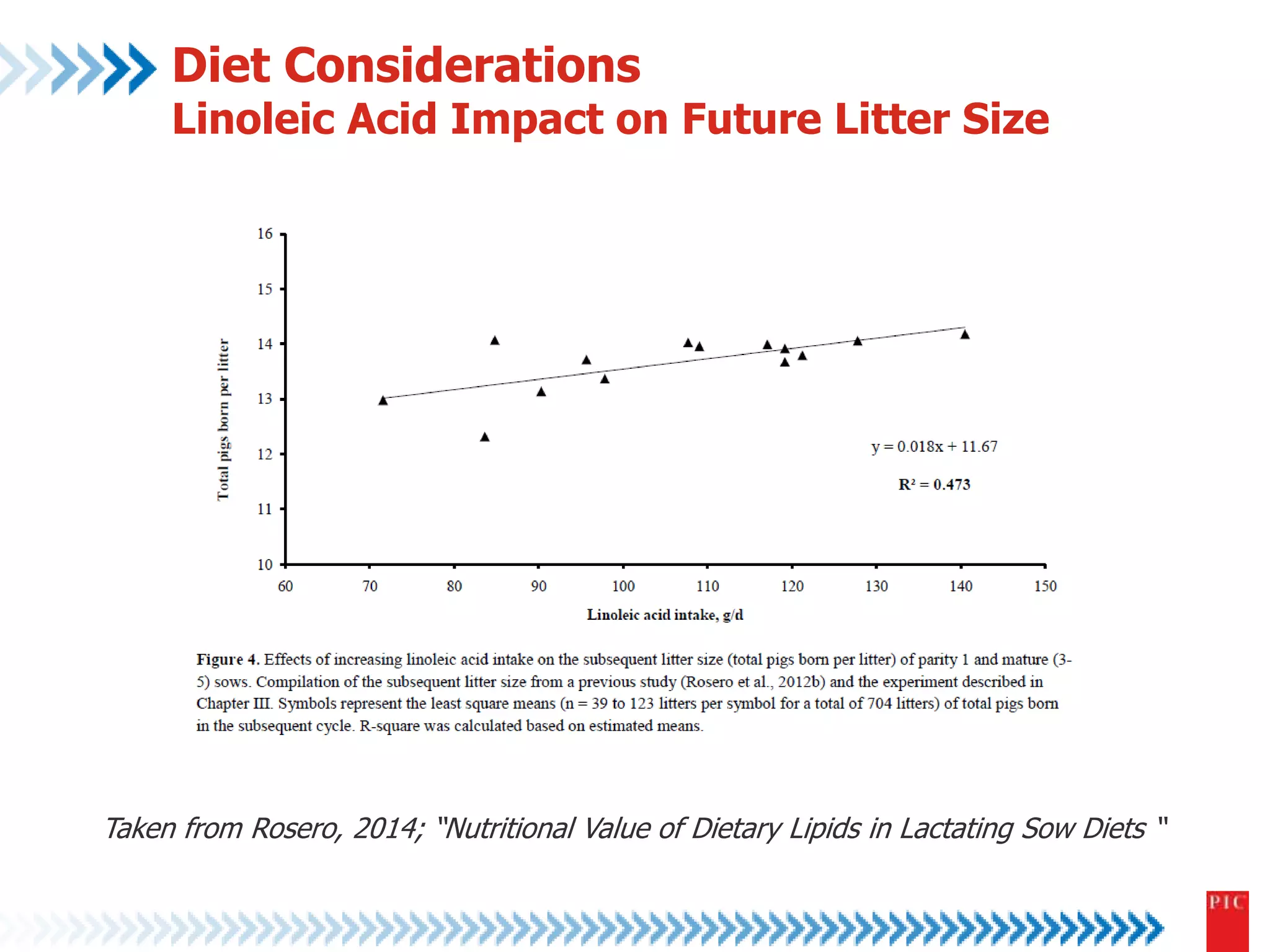
Linoleic Acid Impact on Future Litter Size 
Taken from Rosero, 2014; “Nutritional Value of Dietary Lipids in Lactating Sow Diets “
Dietary Considerations 
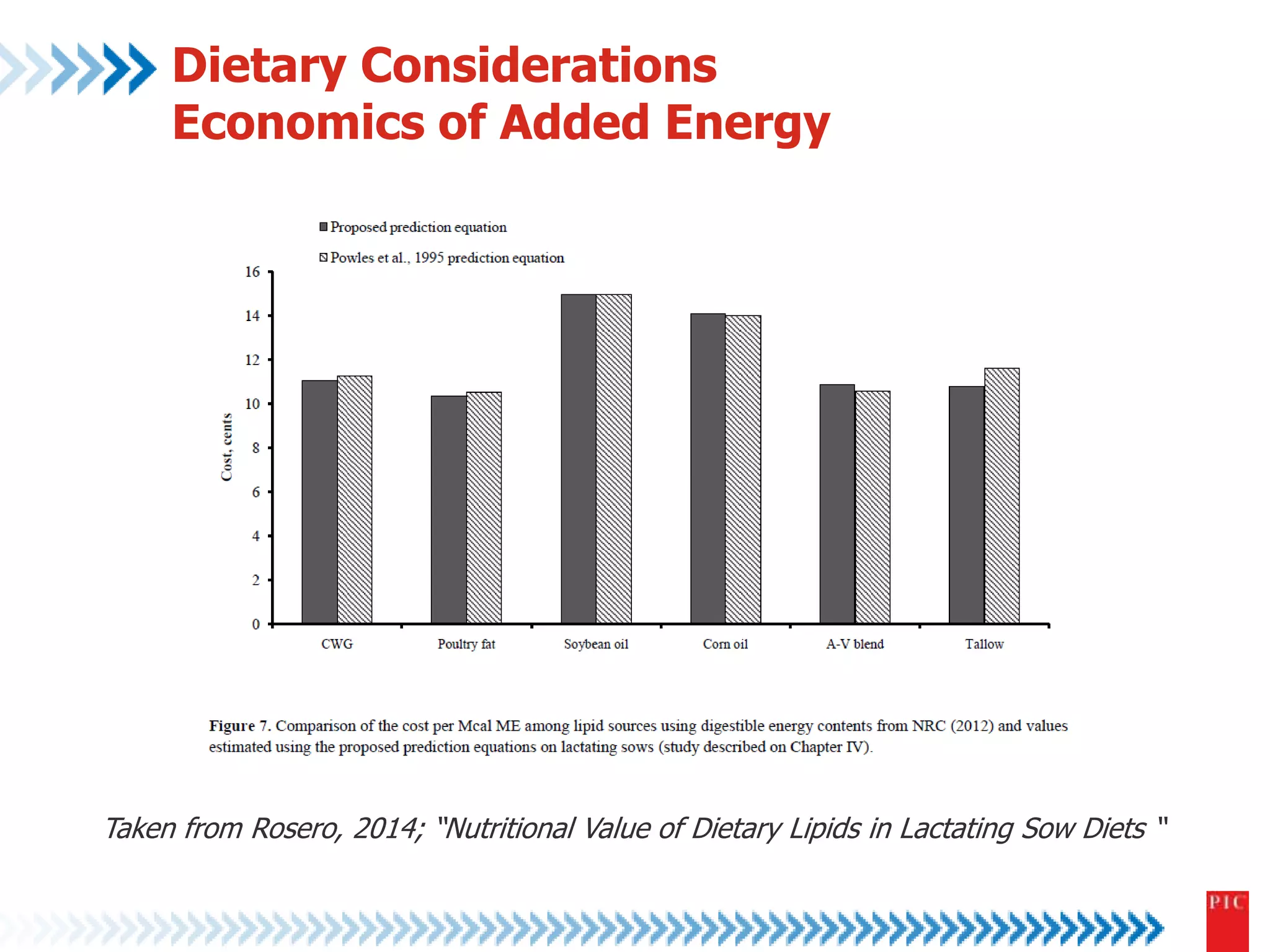
Economics of Added Energy 
Taken from Rosero, 2014; “Nutritional Value of Dietary Lipids in Lactating Sow Diets “
Dietary Considerations 
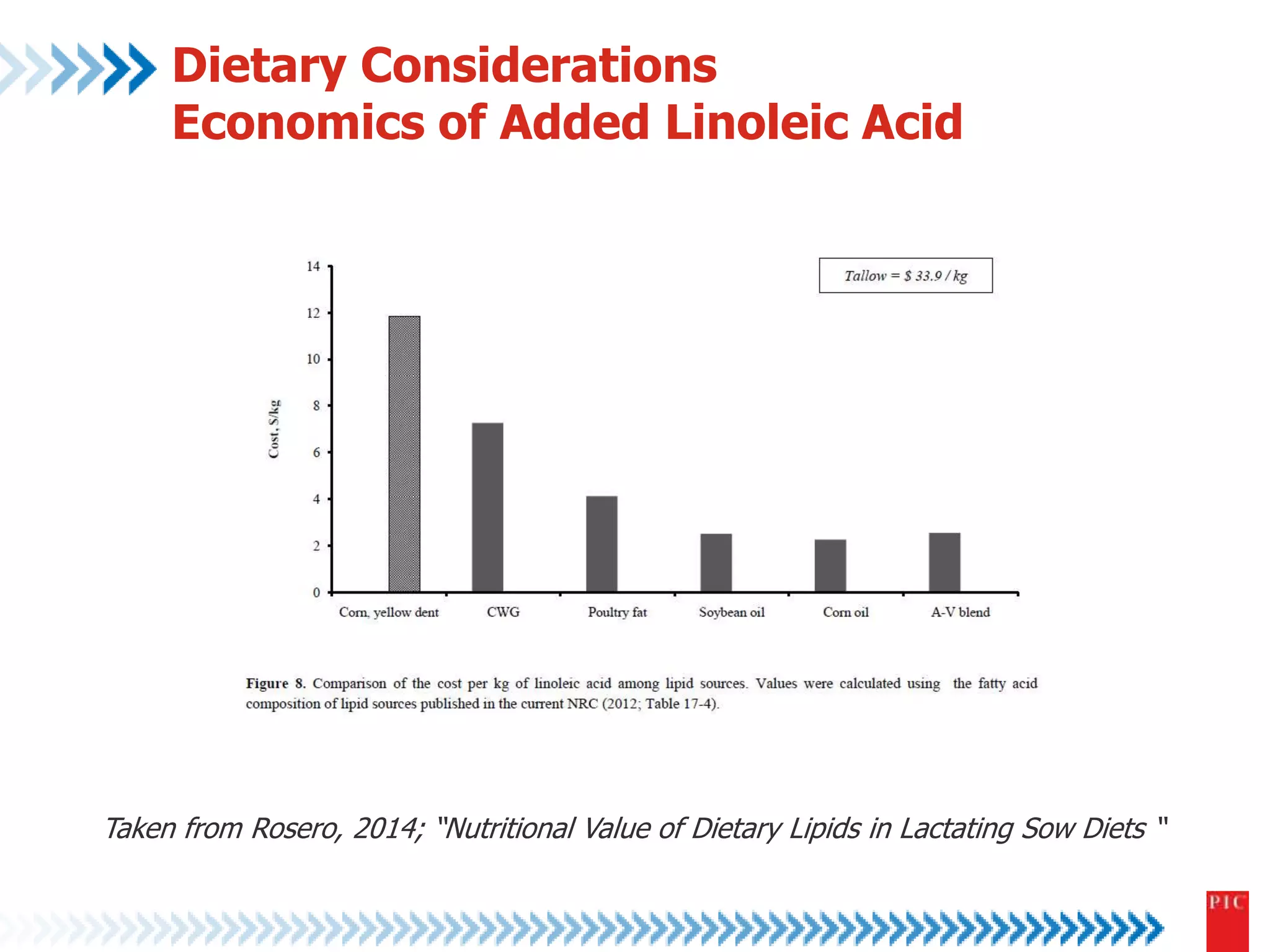
Economics of Added Linoleic Acid 
Taken from Rosero, 2014; “Nutritional Value of Dietary Lipids in Lactating Sow Diets “
So…what does this mean? 
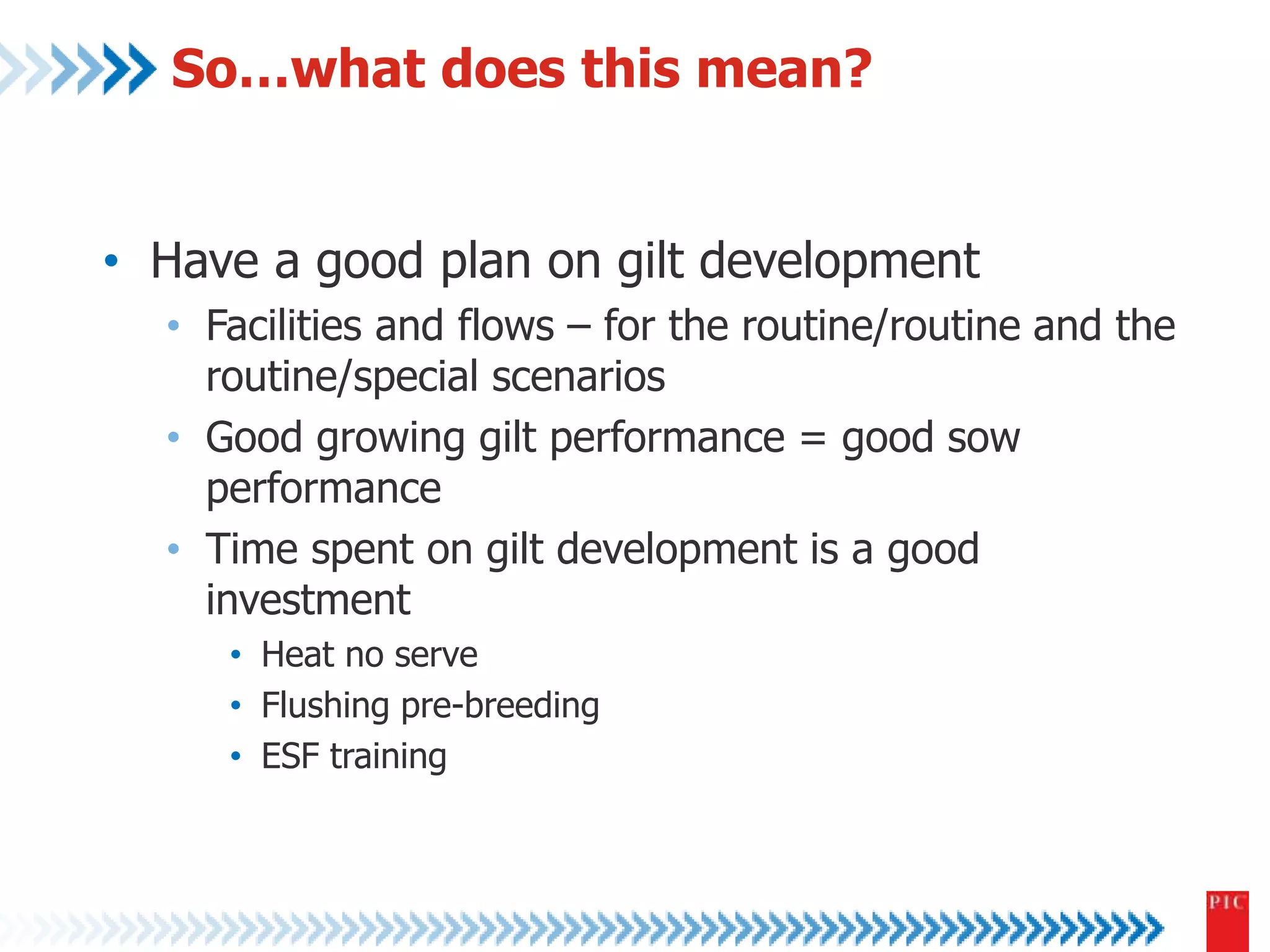
• Have a good plan on gilt development 
• Facilities and flows – for the routine/routine and the 
routine/special scenarios 
• Good growing gilt performance = good sow 
performance 
• Time spent on gilt development is a good 
investment 
• Heat no serve 
• Flushing pre-breeding 
• ESF training
So…what does this mean? 
• Managing the sow herd has two distinct phases 
• Breeding to farrowing 
• Managing body condition 
• Less critical than historically thought 
• Farrowing to breeding 
• Not farrowing to weaning 
• All about maximizing good intake
So…what does this mean? 
• Changing realities should cause us to continue to 
challenge our perspectives 
• Higher total production output 
• Greater efficiency of the biological process 
• Changing production environments – facilities, health, etc 
• Continually search for and revisit opportunities 
• Novel nutritional strategies 
• Acclimation / health programs 
• Expectations for the pigs and people

Dr. Matt Culbertson - Feeding Sows for Maximum Lifetime Production

  • 1.
    Feeding Sows forMaximum Lifetime Production
  • 2.
    What are wetrying to measure? • Chronological age • There is no greater harm than that of time wasted - Michelangelo • Other options • Parity at removal • Pigs / day of productive life • Lifetime pigs / gilt entered
  • 3.
    Reasons for Removal Evaluating Differences in Retention Taken from Culbertson, 2007; Discover Conference
  • 4.
    Reasons for Removal Evaluating Differences in Retention Taken from Culbertson, 2007; Discover Conference
  • 5.
    Gilt Development FeedingProgram The Non-Negotiables 18 16 14 12 10 8 6 Figure 1: Performance By Parity Based on P-1 Litter Size 1 2 3 4 5 Litter Size (TB) Parity <= 8 9 10 11 12 13 14 15 16 >=17 5.1K females w/full data from P1 to P5 in the US Midwest. Different farms, health status, and genotypes (70% CAMs) Source: Pinilla, Molinari, Coates, Piva, Thompson, Teuber and Canavate (2014) • By far, largest variation in litter size is at P1. • Good gilts are consistently good sows: sow lifetime performance is decided in P1 • 1 pig difference at P1 = 0.4 pigs per farrowing in the P1-P5 interval.
  • 6.
    Reasons for Removal • General agreement across data sets and with current industry experience • Repro failure and poor performance • Old age and feet / leg • Mortality / injury
  • 7.
    Impact of SeasonalInfertility • What is seasonal infertility? • A reduction in ability to successfully demonstrate normal estrus behavior or produce a target quality litter from matings during the late summer months • Why? • Pig is naturally a seasonal breeder…domestication has changed the need
  • 8.
    Impacts of SeasonalInfertility What Happens? • Increase in… • Wean to service interval • Regular / Irregular returns • Number of anoestrus gilts • Decrease in… • Farrowing rate • Numbers farrowed
  • 9.
    Why is LifetimePerformance Important? Impact on System Profitability • Impact on wean pig cost • Welfare implications • Health and production implications for growing pigs
  • 10.
    Feeding Females forMaximum Lifetime Production
  • 11.
    So…where should wefocus… Weaning Birth
  • 12.
    Impacting Future Results • Distinct phases with differing goals • Gilt development • Breeding to farrowing • Farrowing to breeding • Components of feeding program • Management considerations • Diet and ingredients
  • 13.
    Gilt Development Program The Non-Negotiables • Always remember the impact of P1 performance on lifetime production • Increasing chances to get better P1 performance by – Ad lib feed until first breeding and ensure an optimum ADG range allow higher litter size in P1 – HNS program that make the system to breed 95%+ of the gilts with at least 1 HNS
  • 14.
    Gilt Development Program The Non-Negotiables • Design the GDU to allow optimum management for the practical variation that exists in how we use them today - Dynamic flows to match up with the utilization of health management programs to combat specific scenarios - Stocking densities, flooring and feeder/water space that contribute to growth performance and high rates of voluntary selection
  • 15.
    Gilt Development NutritionConsiderations • Recommendations • Ad libitum feeding for maximum performance • Lysine : Calorie ratio similar to market hogs • Gilt specific diets after approximately 135lb • Increased micronutrients • Higher calcium and phosphorous • Potential inclusion of zinc, manganese, copper • Avoid terminal market diets • Sow VTM starting at this point
  • 16.
    Gilt Development Program Impact of Gain on P1 Performance Source: Adapted from G. Castro • Faster growing gilts attain puberty earlier and have lower anoestrus rate (Bertolozzo et al., 2009) • Slow growing gilts don’t do as well as faster growing ones but up to some point….Lameness can be a problem (culling) when breeding gilts to heavy
  • 17.
    Gilt Development Program Impact of Flushing Pre-Breeding Farm Avg. Sow Inventory Avg. TB Pre Avg TB Post Difference 1 2,600 13.5 14.2 0.7 2 3,500 13.5 14.1 0.6 3 2,700 13.6 14.4 0.8 4 1,300 12.7 13.6 0.9 5 1,300 12.6 13.9 1.3 6 5,600 12.9 14.2 1.3 Total or Avg 17,000 1.2 Source: Adapted from: Pinilla, Teuber, Piva and Coates (2013). AASV Proceedings Marginal Cost = $6.8 (18 d full feed; +2.5 lb/d) ; $0.15/lb) Marginal Revenue = $40.8 (1.2 pigs x 85% piglet conversion x $40 piglet price) MOFC = $ 34.1 per gilt Cost : Benefit = 1 : 5
  • 18.
    Gilt Development Program Impact of Managing Weight at Mating Figure 2: Effect Of >240 Day Old Gilts on Subsequent WSI Length & P2 Litter Size WSI, days P2 littersize In average, every 10% of heavier gilts… Add 0.7 extra days in WSI Reduce P2 litter size vs P1 by 0.3 pigs Practical Implication – How to manage the variation? 16.0 15.0 14.0 13.0 12.0 11.0 10.0 9.0 8.0 7.0 6.0 10% 20% 30% 40% 50% 60% 70% 80% 90% 100% % of Gilts Bred Above the Weight/Age Range
  • 19.
    Gilt Development Program Training for Electronic Sow Feeding Training Flow: GROWER GDU SOW FARM Full Feed for or Breeding Go to pen in max 3 days after breeding Go to pen after 35 days of gestation 2 weeks Training for 2 weeks Contact with gates Gilt Weight 60-210lbs 210-280lbs 280-300lbs 300-320lbs
  • 20.
    Gilt Development Program Impact of Health Acclimation Program
  • 21.
    Farrowing to Breeding Impact of Maximizing Lactation Intake • Total Intake • Aggressive • 6 lb increase • On Demand • 30 lb increase • Wean-to estrus interval • Cycling sows only • Slow: 5.4 d • Aggressive: 5.3 d • Full: 5.3 d 28.13 14.13 15.15 30 25 20 15 10 5 0 Slow Aggressive Full on Demand Sows not bred 7-d post-wean, % Sows Not Bred 7-d Post-Wean Data from PIC C29 sow population
  • 22.
    Farrowing to Breeding Impact of Maximizing Lactation Intake RANGE OF ADFI n TB WEI WT VAR < 10 LBS 36 12.61 5.36 -5.93 10.0-10.4 28 13.11 5.32 -4.69 10.5-10.9 48 13.38 5.40 -3.17 11.0-11.4 71 13.42 5.14 -2.58 11.5-11.9 170 13.56 5.47 -2.66 12.0-12.5 71 13.85 4.77 -3.46 Within a sow population, lactation feed intake is still one of the biggest sources of variation in subsequent performance
  • 23.
    Lysine Impact onMilk Production (48) (54) (58) (59) (63)
  • 24.
    P4+ Lysine Requirement • 10 treatment groups consuming between 35.2 and 78.2 grams SID Lysine/day from Corn-SBM based diet • Using Linear broken line analysis, the SID Lysine requirement for older Parity sows was found to be 62 g/d to maximize Litter Weight Gain. • This is similar to the results found for P1 animals
  • 25.
    Farrowing to Breeding Preliminary Proof of Concept – Intake after Weaning Parity distribution: P1= 21%, P2 – P5 = 69%, P6+ = 10% Weanings of September of 2013. N= 250 sows. Nipple drinkers and dry feed.
  • 26.
    Farrowing to Weaning Post-Weaning Intake – Concepts We Gathered • When well managed and healthy, weaned sows tend to eat more than people believe they will • It’s key to realize the value of the feed eaten after the weaning • Be careful of items that limit intake – running water too soon, etc • Feed weaned sows at least twice daily • Main effect is realized in Parities 2 and 3 Trial Control Difference Better/Worse Avg WSI 4.8 d 6.2 d 1.4 d Better Bred by d 7 96.4% 87.6% 8.8% Better Litter Size 13.7 12.4 1.3 Better
  • 27.
    Farrowing to Breeding Feeding the Weaned Sow – Field Validation Trial Control Difference Better/Worse Avg WSI 4.4 d 5.3 d 0.9 d Better Bred by d 7 97.5% 92.8% 4.7% Better Sows 279 391 Total Feed 41 lb 30 lb 11 lb Better ADFI 9.3 lb/d 5.7 lb/d 3.6 lb/d Better Litter Size 13.9 12.9 1.0 Better Source: PIC non-published data (2014). Marginal Cost = $1.4 (11 lb x $0.13/d) Marginal Revenue = $34 (1.0 pig x 85% piglet conversion x $40 piglet price) MOFC = $ 32.6 / sow Cost : Benefit = 1 : 23
  • 28.
    Novel Focus Areas Seasonal Infertility • New research is being done that highlights potential opportunities to modulate response of some at-risk females • Increases sow herd performance • Improves breeding female retention • Special thanks to David Rosero for his recent dissertation on work conducted in the Hanor system
  • 29.
    Seasonal Infertility LinoleicAcid’s Impact on Pregnancy Retention Taken from Rosero, 2014; “Nutritional Value of Dietary Lipids in Lactating Sow Diets “
  • 30.
    Seasonal Infertility LinoleicAcid Impact on Culling Rate Taken from Rosero, 2014; “Nutritional Value of Dietary Lipids in Lactating Sow Diets “
  • 31.
    Diet Considerations LinoleicAcid’s Impact on Farrowing Rate Taken from Rosero, 2014; “Nutritional Value of Dietary Lipids in Lactating Sow Diets “
  • 32.
    Diet Considerations LinoleicAcid Impact on Future Litter Size Taken from Rosero, 2014; “Nutritional Value of Dietary Lipids in Lactating Sow Diets “
  • 33.
    Dietary Considerations Economicsof Added Energy Taken from Rosero, 2014; “Nutritional Value of Dietary Lipids in Lactating Sow Diets “
  • 34.
    Dietary Considerations Economicsof Added Linoleic Acid Taken from Rosero, 2014; “Nutritional Value of Dietary Lipids in Lactating Sow Diets “
  • 35.
    So…what does thismean? • Have a good plan on gilt development • Facilities and flows – for the routine/routine and the routine/special scenarios • Good growing gilt performance = good sow performance • Time spent on gilt development is a good investment • Heat no serve • Flushing pre-breeding • ESF training
  • 36.
    So…what does thismean? • Managing the sow herd has two distinct phases • Breeding to farrowing • Managing body condition • Less critical than historically thought • Farrowing to breeding • Not farrowing to weaning • All about maximizing good intake
  • 37.
    So…what does thismean? • Changing realities should cause us to continue to challenge our perspectives • Higher total production output • Greater efficiency of the biological process • Changing production environments – facilities, health, etc • Continually search for and revisit opportunities • Novel nutritional strategies • Acclimation / health programs • Expectations for the pigs and people

Editor's Notes

  • #22 Limit feeding resulted in a greater % of sows not bred by 7 d post wean. Allow the sows to have feed early on (aggressive or full) may be enough to keep the sows from going into a very negative E balance ultimately leading to delayed WTE
  • #24 Linear respone to litter growth rate – 2nd study with higher levels demonstrated a plateau