Cardiac PV Loop Data
Analysis: Tips & Tricks
DeWayne Townsend, DVM, PhD
Associate Professor, Department of
Integrative Biology and Physiology
University of Minnesota Medical School
Adam Goodwill, PhD
Assistant Research Professor,
Anatomy Cell Biology & Physiology
Indiana University School of Medicine
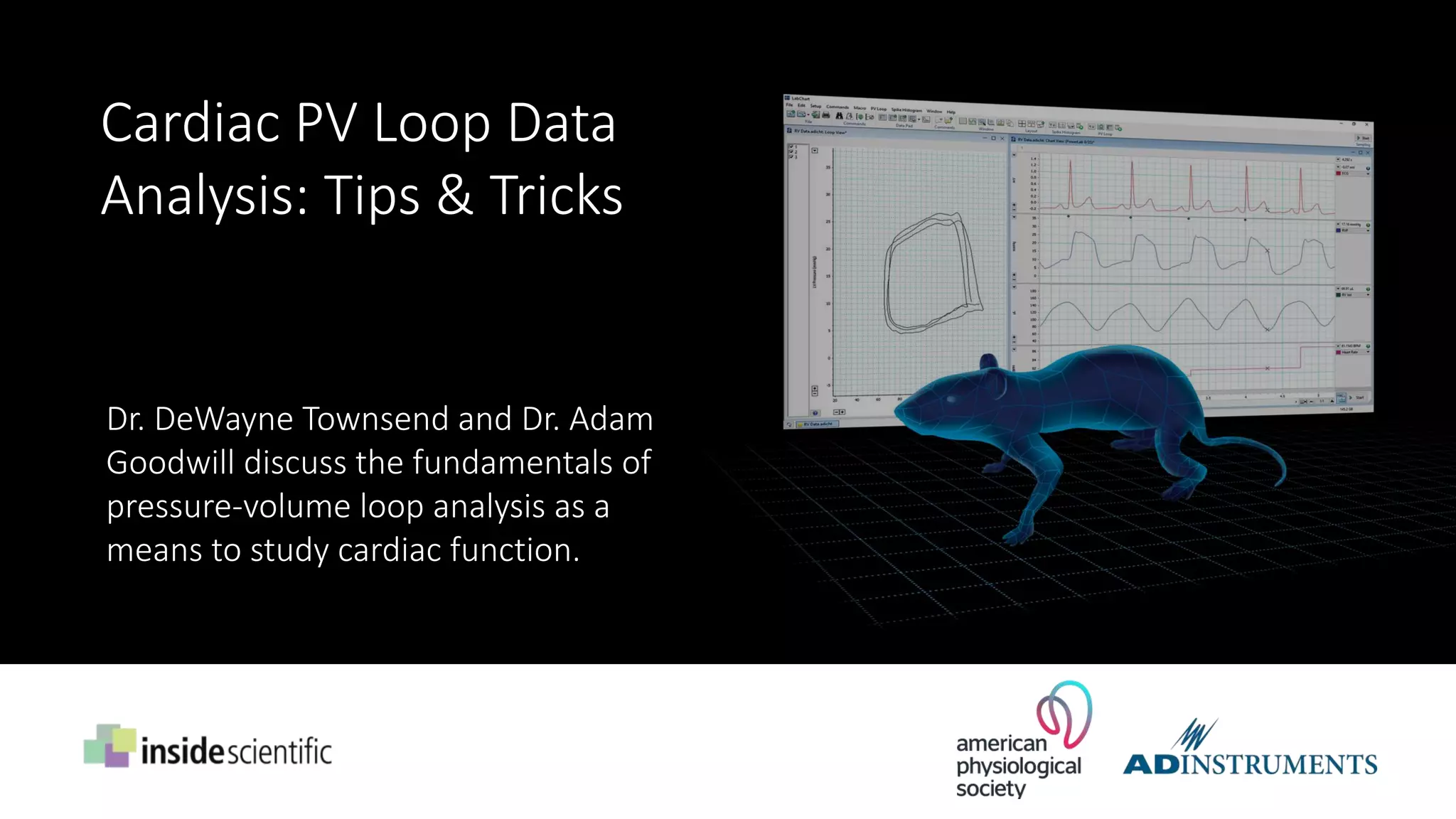
Cardiac PV Loop Data
Analysis: Tips & Tricks
Dr. DeWayne Townsend and Dr. Adam
Goodwill discuss the fundamentals of
pressure-volume loop analysis as a
means to study cardiac function.
InsideScientific is an online educational
environment designed for life science
researchers. Our goal is to aid in the
sharing and distribution of scientific
information regarding innovative
technologies, protocols, research tools
and laboratory services
To access webinar content,
Q&A reports, FAQ documents,
and information on lab
workshops,
subscribe to our mail list
Cardiac PV Loop Data
Analysis: Tips & Tricks
Copyright 2020 A. Goodwill and InsideScientific. All Rights Reserved.
Adam Goodwill, PhD
Assistant Research Professor,
Anatomy, Cell Biology & Physiology
Indiana University School of Medicine
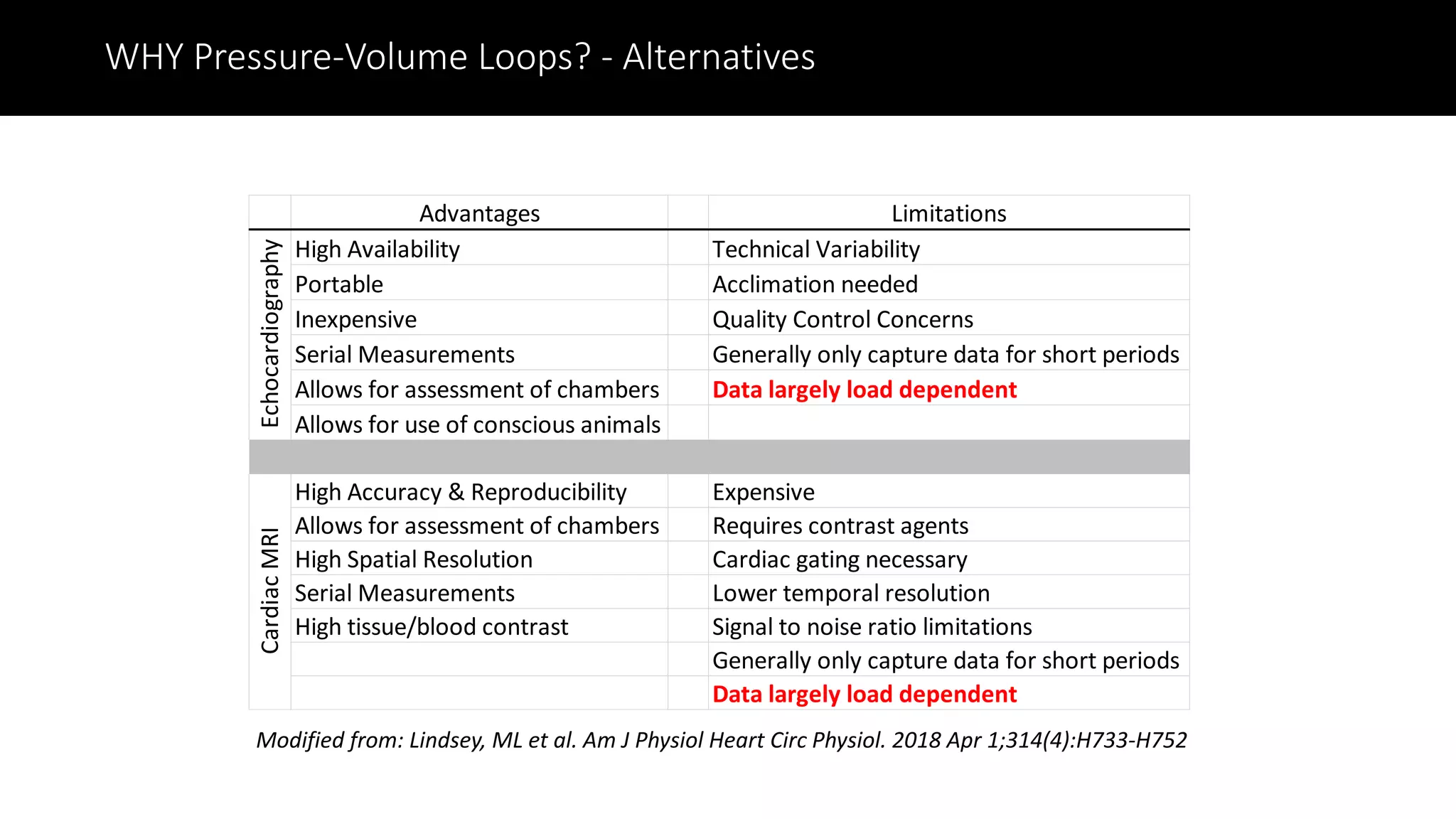
WHY Pressure-Volume Loops? - Alternatives
Advantages Limitations
High Availability Technical Variability
Portable Acclimation needed
Inexpensive Quality Control Concerns
Serial Measurements Generally only capture data for short periods
Allows for assessment of chambers Data largely load dependent
Allows for use of conscious animals
High Accuracy & Reproducibility Expensive
Allows for assessment of chambers Requires contrast agents
High Spatial Resolution Cardiac gating necessary
Serial Measurements Lower temporal resolution
High tissue/blood contrast Signal to noise ratio limitations
Generally only capture data for short periods
Data largely load dependent
EchocardiographyCardiacMRI
Modified from: Lindsey, ML et al. Am J Physiol Heart Circ Physiol. 2018 Apr 1;314(4):H733-H752
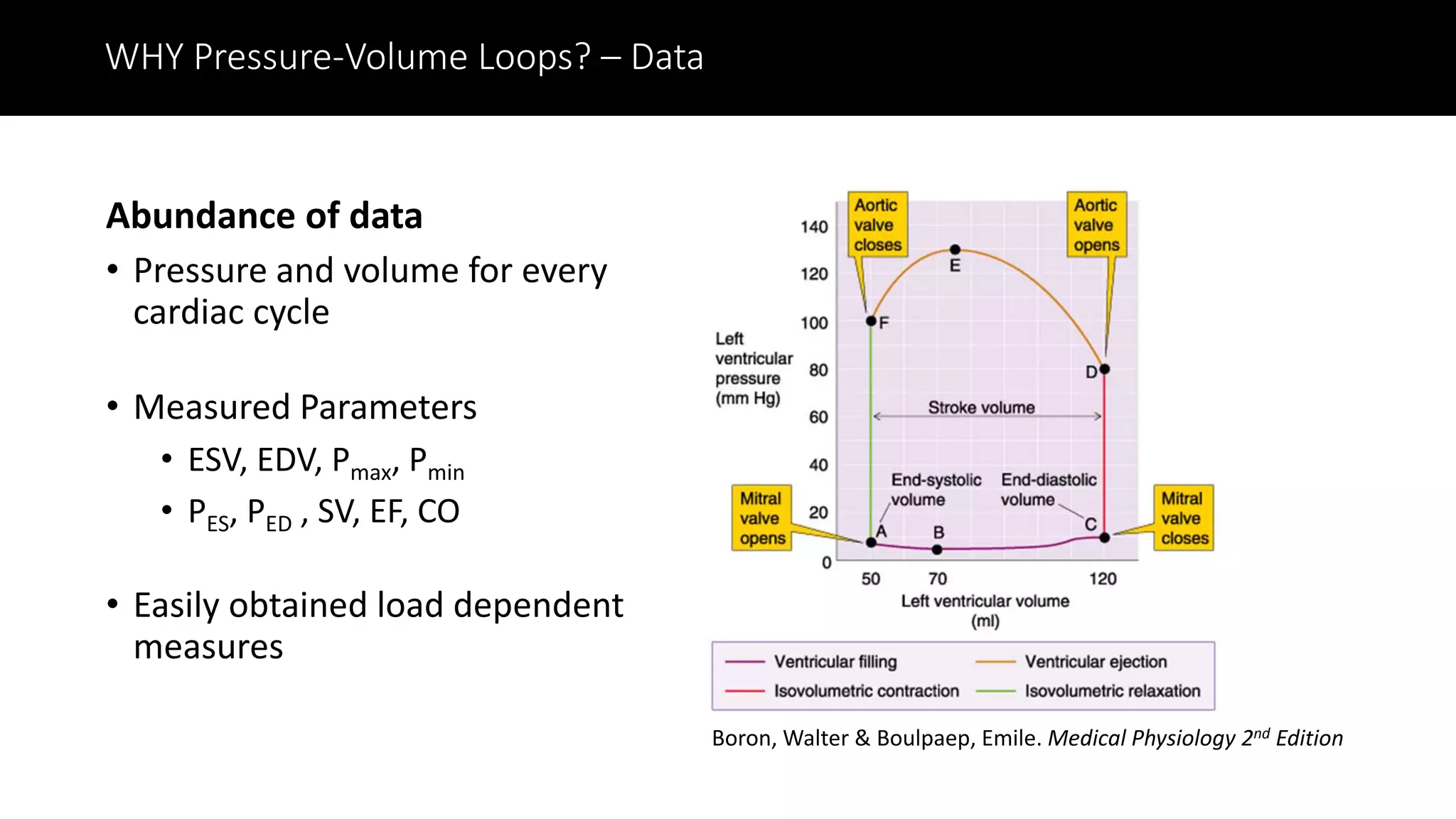
WHY Pressure-Volume Loops? – Data
Boron, Walter & Boulpaep, Emile. Medical Physiology 2nd Edition
Abundance of data
• Pressure and volume for every
cardiac cycle
• Measured Parameters
• ESV, EDV, Pmax, Pmin
• PES, PED , SV, EF, CO
• Easily obtained load dependent
measures
WHY Pressure-Volume Loops? – Data
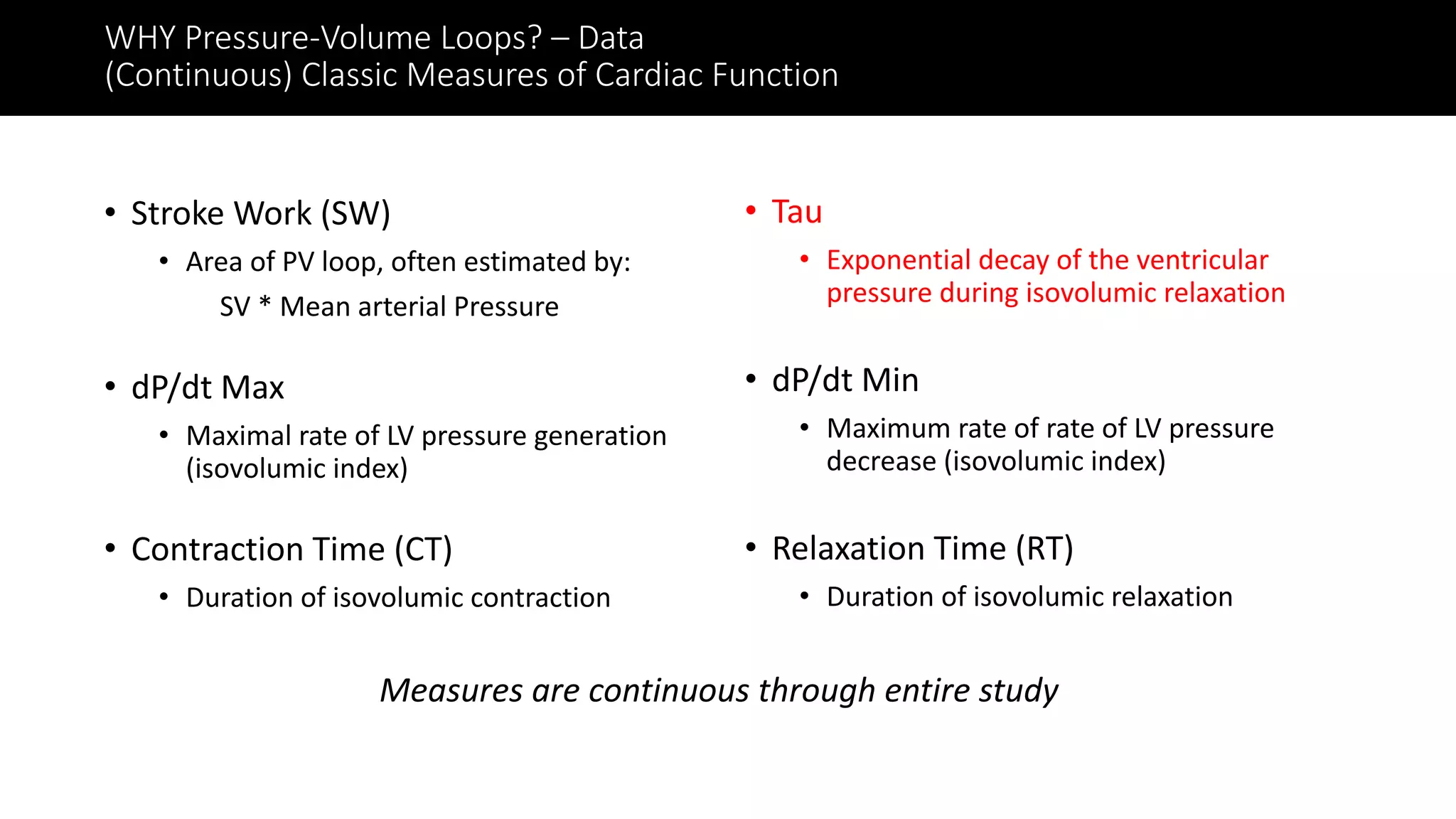
(Continuous) Classic Measures of Cardiac Function
• Tau
• Exponential decay of the ventricular
pressure during isovolumic relaxation
• dP/dt Min
• Maximum rate of rate of LV pressure
decrease (isovolumic index)
• Relaxation Time (RT)
• Duration of isovolumic relaxation
• Stroke Work (SW)
• Area of PV loop, often estimated by:
SV * Mean arterial Pressure
• dP/dt Max
• Maximal rate of LV pressure generation
(isovolumic index)
• Contraction Time (CT)
• Duration of isovolumic contraction
Measures are continuous through entire study
WHAT are Starling Effects and WHY are they Important?
What is a Starling Effect:
The greater the preload (stretch) on cardiac muscle fibers prior to contraction,
the greater their force of contraction. (NOT change in contractility)
Boron, Walter & Boulpaep, Emile. Medical Physiology 2nd Edition
What is Contractility?
The innate ability of the heart
muscle (cardiac muscle or
myocardium) to contract
(independent of preload)
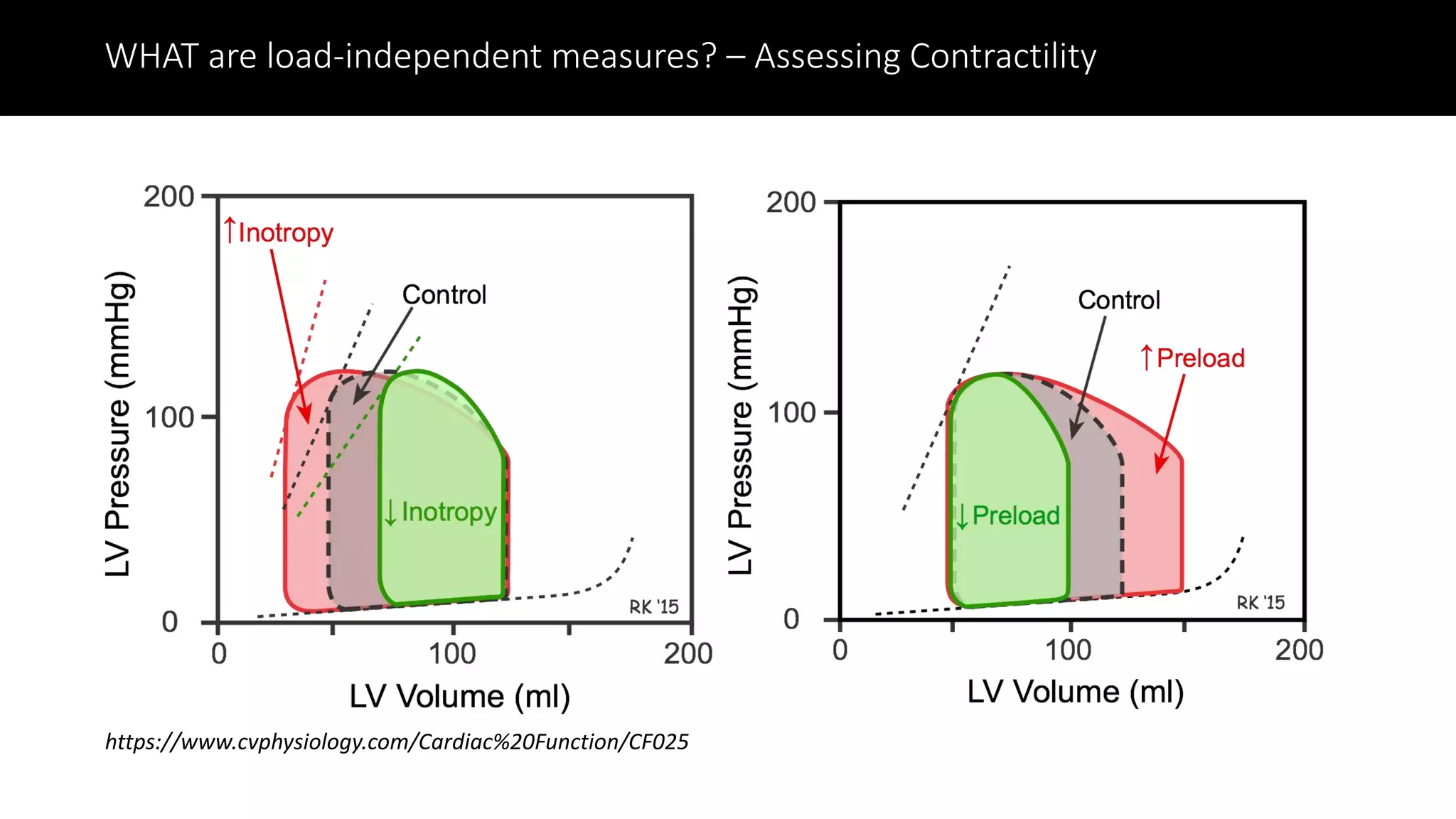
WHAT are load-independent measures? – Assessing Contractility
WHAT are load-independent measures? – Assessing Contractility and Compliance
ESPVR Obtaining ESPVR and EDPVR
Relationships
• End Systolic Pressure Volume
Relationship (ESPVR); Contractility
• Linear Relationship
• Slope = End Systolic Elastance (Ees)
• X intercept = Volume Axis Intercept (V0)
• End Diastolic Pressure Volume
Relationship (EDPVR); Compliance
• Curvilinear Relationship
Modified from: Knaapen et al. Circulation 2007 Feb 20;115(7):918-27
https://www.cvphysiology.com/Cardiac%20Function/CF025
WHAT are load-independent measures? – Assessing Contractility
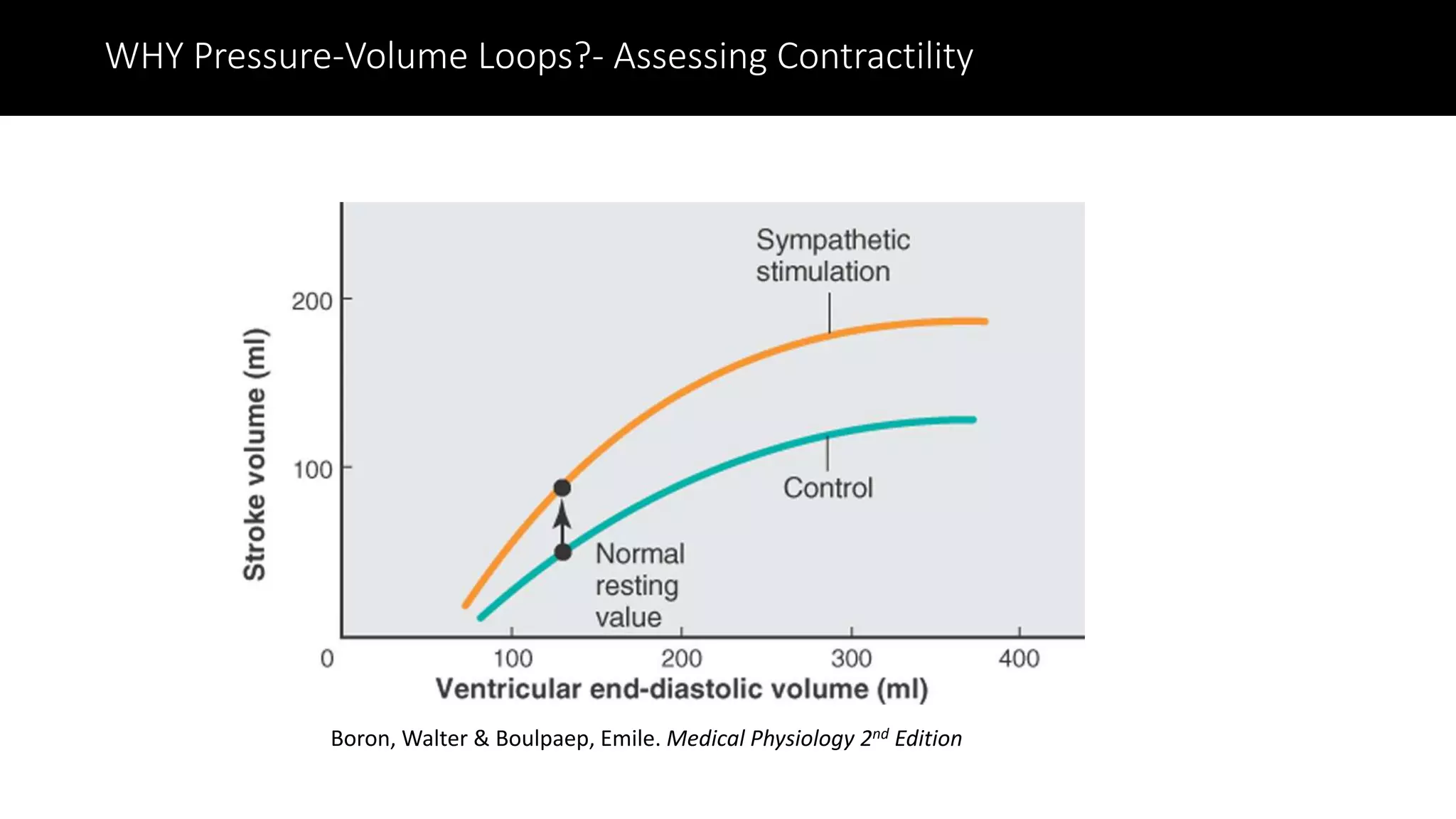
WHY Pressure-Volume Loops?- Assessing Contractility
Boron, Walter & Boulpaep, Emile. Medical Physiology 2nd Edition
WHAT are load-independent measures? – Assessing Ventricular Compliance
• Diastolic volume is influenced by the loading conditions and elastic properties of the heart
• Decreases in diastolic function shift the end-diastolic pressure-volume relationship upward
• LV Compliance is a reciprocal of the slope of EDPVR
https://www.cvphysiology.com/Cardiac%20Function/CF014
WHY Pressure-Volume Loops? – Cardiac Energetics
External work (EW) – energy that propels blood from the
ventricles into the aorta or pulmonary artery
- stroke work = pressure x stroke volume
Potential work (PW/PE) – energy generated with
contraction that is NOT converted to external work
i.e. energy to stretch and lengthen viscous elements
in the ventricles.
Pressure Volume Area (PVA) – Sum of total work and
potential work. Directly proportionate to myocardial
oxygen consumption
Cardiac Power – external (stroke) work x HR
- work per unit time
Cardiac Efficiency – external work per unit energy
consumedKnaapen et al. Circulation 2007 Feb 20;115(7):918-27
Cardiac PV Loop Data
Analysis: Tips & Tricks
DeWayne Townsend,
DVM, PhD
Associate Professor, Department of
Integrative Biology and Physiology
University of Minnesota Medical School
Copyright 2020 D. Townsend and InsideScientific. All Rights Reserved.
Surgical and Anesthesia
• Blood loss is a big deal in mice
• Total blood volume is 77-88 ml/kg
• 1.54 – 1.76 mL in a 20 g mouse
• 2.31 – 2.64 mL in a 25 g mouse
• Thus losses of 0.1-0.2 mL are hemodynamically significant
• Insensible fluid loss
• Water lost through evaporation
• Respiratory loss (≈4ml/kg/hr)
• Exposed Tissue (≈2-3 ml/kg/hr)
• Recommend ≈5ml/kg IV 10% Albumin in 0.9% NaCl
• More if blood loss- 1 Q-tip ≈ 0.1 ml
• Must replace lost blood
Sources of Variability in PV Loops in Rodents
Catheter Placement – Carotid Approach
Advantages
• Closed-Chest Approach
• Ventilation not required
• Although often used to
allow respiratory control
Disadvantages
• Catheter placement
defined by aortic
anatomy
• Laparotomy required to
occlude the vena cava
• Potential for outflow
track obstruction in
smaller hearts
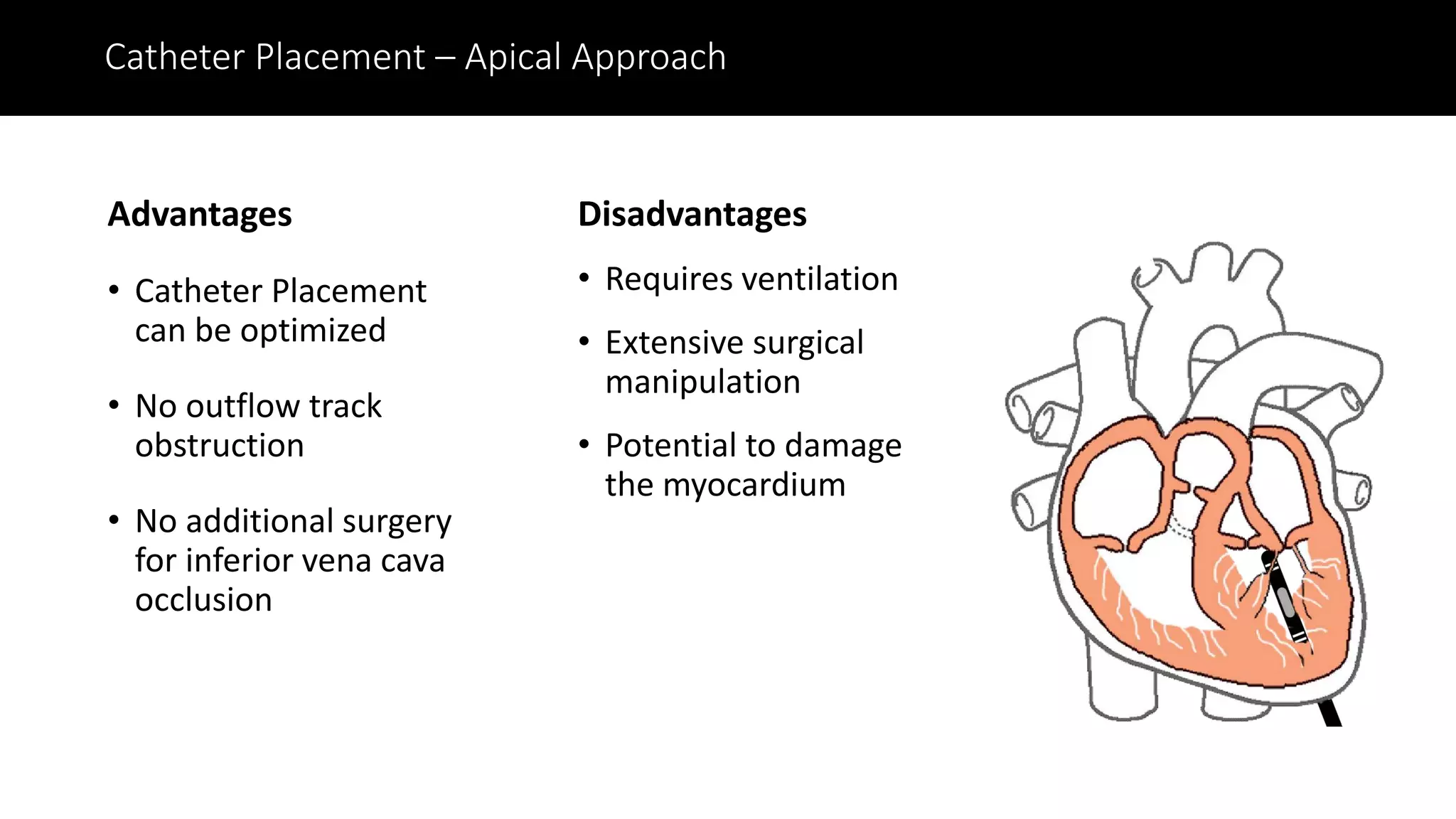
Catheter Placement – Apical Approach
Advantages
• Catheter Placement
can be optimized
• No outflow track
obstruction
• No additional surgery
for inferior vena cava
occlusion
Disadvantages
• Requires ventilation
• Extensive surgical
manipulation
• Potential to damage
the myocardium
Catheter Placement – Papillary Entrapment
• A ventricular pressure artifact
resulting from the direct
interaction of cardiac structures
with the pressure transducer.
• Positive pressure ventilation creates
changes in left ventricular pre-load
• This creates respiratory dependent
oscillation in left ventricular
pressure
• Collecting data during brief periods
of apnea results in more stable
measures of cardiac function
Respiratory Artifacts
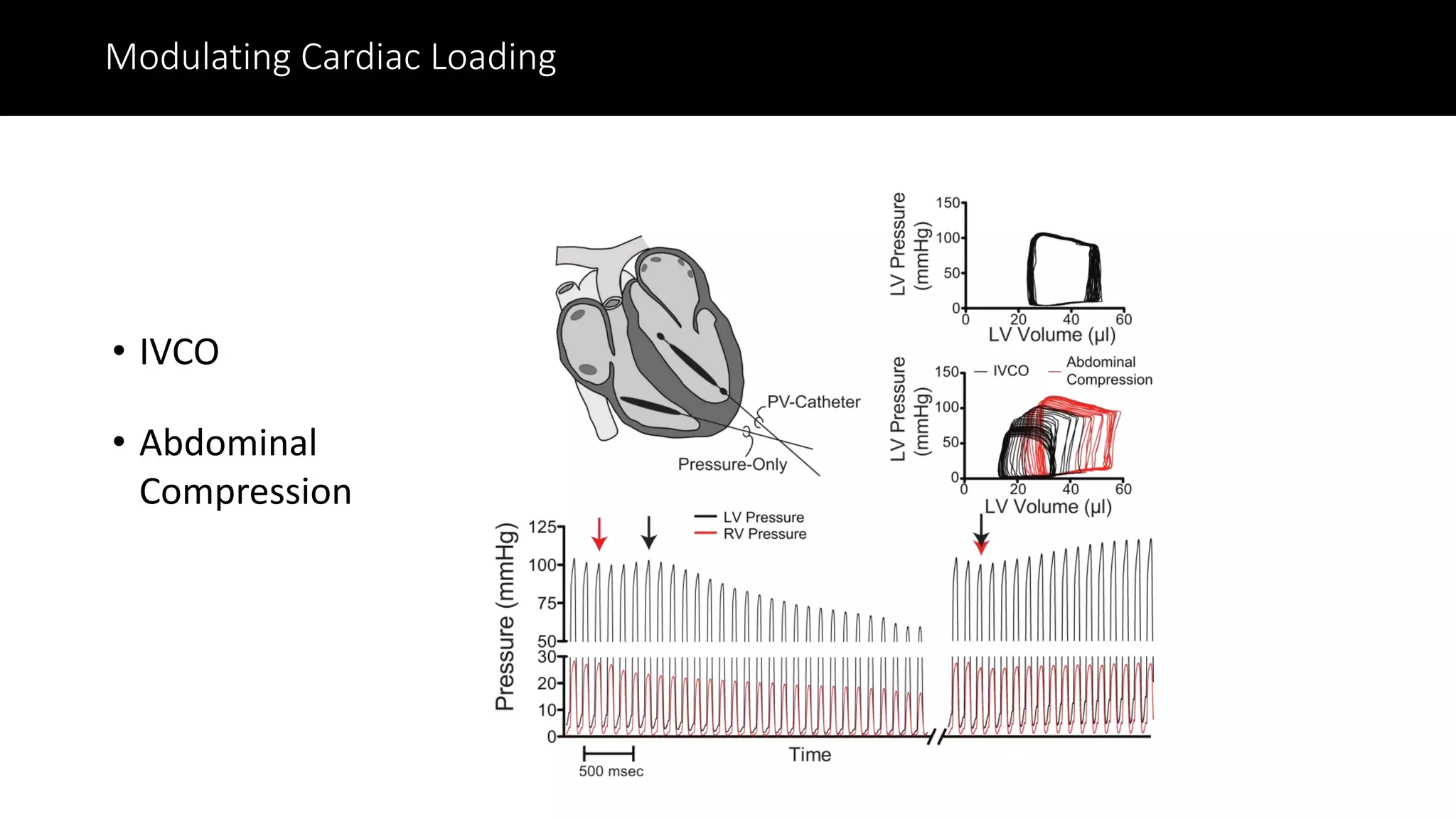
• IVCO
• Abdominal
Compression
Modulating Cardiac Loading
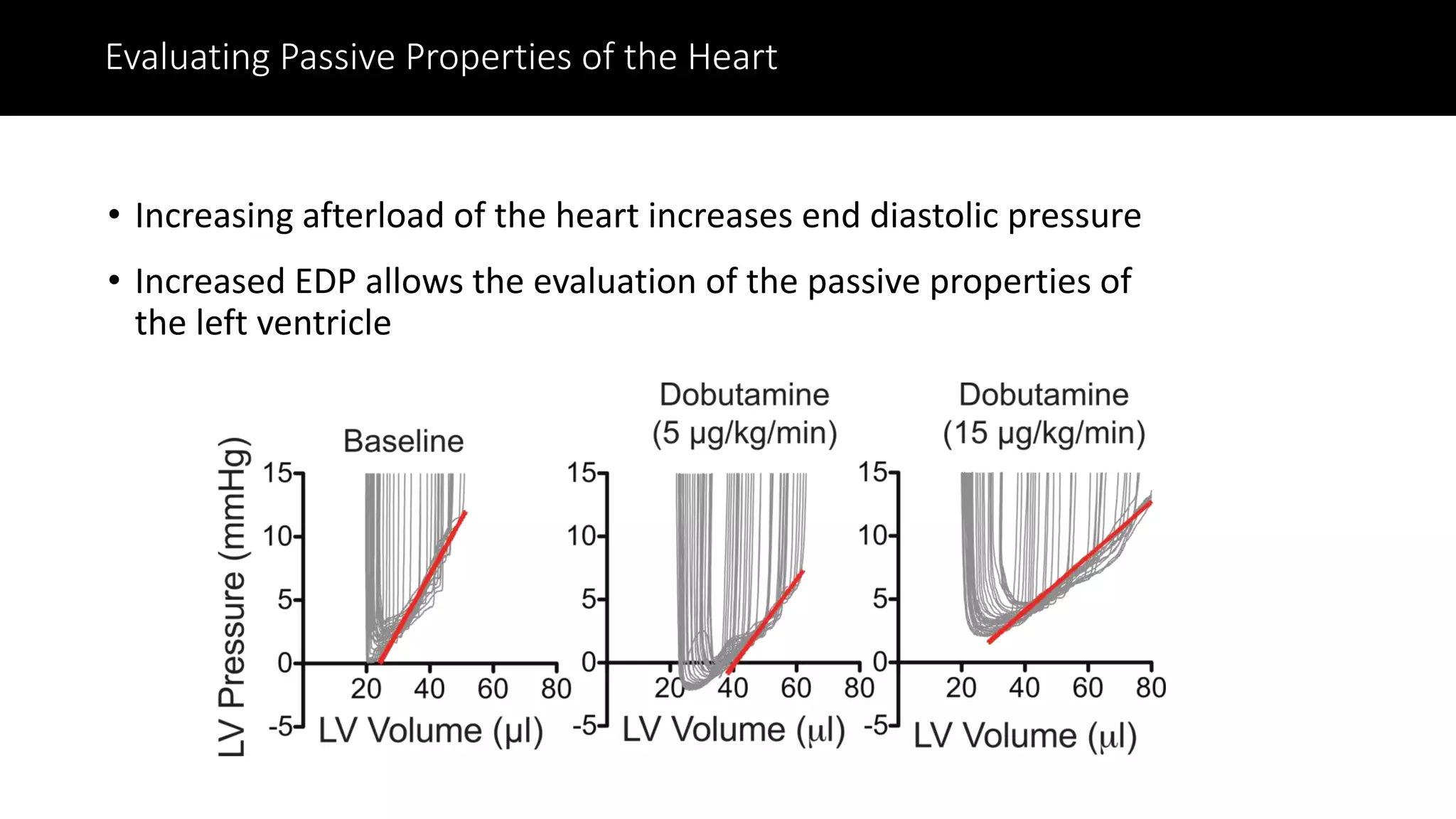
Evaluating Passive Properties of the Heart
• Increasing afterload of the heart increases end diastolic pressure
• Increased EDP allows the evaluation of the passive properties of
the left ventricle
Analysis Issues
• Pause for 10–15 seconds after inferior vena caval occlusion
• The drop in blood pressure resulting from this maneuver activates the baroreceptor reflex.
• This increases the sympathetic nervous system output to the heart
• Any measures taken immediately after an occlusion will have increased contractility because
of this nervous input.
• Similar, but reversed, for abdominal compression
• Loop rejection
• Occasionally there will be an arrhythmic beat during a period of measurement.
• The data from these loops will be outliers and should be removed
• Removed loops should be recorded and original data maintained to preserve the integrity of
the data workflow
DeWayne Townsend, DVM, PhD
Associate Professor, Department of
Integrative Biology and Physiology
University of Minnesota Medical School
Adam Goodwill, PhD
Assistant Research Professor,
Anatomy Cell Biology & Physiology
Indiana University School of Medicine
Thank You!
To learn more about PV loop analysis solutions from
ADInstruments, please visit:
www.adinstruments.com/products/pv-loop

Cardiac PV Loop Data Analysis: Tips & Tricks

  • 1.
    Cardiac PV LoopData Analysis: Tips & Tricks DeWayne Townsend, DVM, PhD Associate Professor, Department of Integrative Biology and Physiology University of Minnesota Medical School Adam Goodwill, PhD Assistant Research Professor, Anatomy Cell Biology & Physiology Indiana University School of Medicine
  • 2.
    Cardiac PV LoopData Analysis: Tips & Tricks Dr. DeWayne Townsend and Dr. Adam Goodwill discuss the fundamentals of pressure-volume loop analysis as a means to study cardiac function.
  • 3.
    InsideScientific is anonline educational environment designed for life science researchers. Our goal is to aid in the sharing and distribution of scientific information regarding innovative technologies, protocols, research tools and laboratory services
  • 4.
    To access webinarcontent, Q&A reports, FAQ documents, and information on lab workshops, subscribe to our mail list
  • 5.
    Cardiac PV LoopData Analysis: Tips & Tricks Copyright 2020 A. Goodwill and InsideScientific. All Rights Reserved. Adam Goodwill, PhD Assistant Research Professor, Anatomy, Cell Biology & Physiology Indiana University School of Medicine
  • 6.
    WHY Pressure-Volume Loops?- Alternatives Advantages Limitations High Availability Technical Variability Portable Acclimation needed Inexpensive Quality Control Concerns Serial Measurements Generally only capture data for short periods Allows for assessment of chambers Data largely load dependent Allows for use of conscious animals High Accuracy & Reproducibility Expensive Allows for assessment of chambers Requires contrast agents High Spatial Resolution Cardiac gating necessary Serial Measurements Lower temporal resolution High tissue/blood contrast Signal to noise ratio limitations Generally only capture data for short periods Data largely load dependent EchocardiographyCardiacMRI Modified from: Lindsey, ML et al. Am J Physiol Heart Circ Physiol. 2018 Apr 1;314(4):H733-H752
  • 7.
    WHY Pressure-Volume Loops?– Data Boron, Walter & Boulpaep, Emile. Medical Physiology 2nd Edition Abundance of data • Pressure and volume for every cardiac cycle • Measured Parameters • ESV, EDV, Pmax, Pmin • PES, PED , SV, EF, CO • Easily obtained load dependent measures
  • 8.
    WHY Pressure-Volume Loops?– Data (Continuous) Classic Measures of Cardiac Function • Tau • Exponential decay of the ventricular pressure during isovolumic relaxation • dP/dt Min • Maximum rate of rate of LV pressure decrease (isovolumic index) • Relaxation Time (RT) • Duration of isovolumic relaxation • Stroke Work (SW) • Area of PV loop, often estimated by: SV * Mean arterial Pressure • dP/dt Max • Maximal rate of LV pressure generation (isovolumic index) • Contraction Time (CT) • Duration of isovolumic contraction Measures are continuous through entire study
  • 9.
    WHAT are StarlingEffects and WHY are they Important? What is a Starling Effect: The greater the preload (stretch) on cardiac muscle fibers prior to contraction, the greater their force of contraction. (NOT change in contractility) Boron, Walter & Boulpaep, Emile. Medical Physiology 2nd Edition What is Contractility? The innate ability of the heart muscle (cardiac muscle or myocardium) to contract (independent of preload)
  • 10.
    WHAT are load-independentmeasures? – Assessing Contractility
  • 11.
    WHAT are load-independentmeasures? – Assessing Contractility and Compliance ESPVR Obtaining ESPVR and EDPVR Relationships • End Systolic Pressure Volume Relationship (ESPVR); Contractility • Linear Relationship • Slope = End Systolic Elastance (Ees) • X intercept = Volume Axis Intercept (V0) • End Diastolic Pressure Volume Relationship (EDPVR); Compliance • Curvilinear Relationship Modified from: Knaapen et al. Circulation 2007 Feb 20;115(7):918-27
  • 12.
  • 13.
    WHY Pressure-Volume Loops?-Assessing Contractility Boron, Walter & Boulpaep, Emile. Medical Physiology 2nd Edition
  • 14.
    WHAT are load-independentmeasures? – Assessing Ventricular Compliance • Diastolic volume is influenced by the loading conditions and elastic properties of the heart • Decreases in diastolic function shift the end-diastolic pressure-volume relationship upward • LV Compliance is a reciprocal of the slope of EDPVR https://www.cvphysiology.com/Cardiac%20Function/CF014
  • 15.
    WHY Pressure-Volume Loops?– Cardiac Energetics External work (EW) – energy that propels blood from the ventricles into the aorta or pulmonary artery - stroke work = pressure x stroke volume Potential work (PW/PE) – energy generated with contraction that is NOT converted to external work i.e. energy to stretch and lengthen viscous elements in the ventricles. Pressure Volume Area (PVA) – Sum of total work and potential work. Directly proportionate to myocardial oxygen consumption Cardiac Power – external (stroke) work x HR - work per unit time Cardiac Efficiency – external work per unit energy consumedKnaapen et al. Circulation 2007 Feb 20;115(7):918-27
  • 16.
    Cardiac PV LoopData Analysis: Tips & Tricks DeWayne Townsend, DVM, PhD Associate Professor, Department of Integrative Biology and Physiology University of Minnesota Medical School Copyright 2020 D. Townsend and InsideScientific. All Rights Reserved.
  • 17.
    Surgical and Anesthesia •Blood loss is a big deal in mice • Total blood volume is 77-88 ml/kg • 1.54 – 1.76 mL in a 20 g mouse • 2.31 – 2.64 mL in a 25 g mouse • Thus losses of 0.1-0.2 mL are hemodynamically significant • Insensible fluid loss • Water lost through evaporation • Respiratory loss (≈4ml/kg/hr) • Exposed Tissue (≈2-3 ml/kg/hr) • Recommend ≈5ml/kg IV 10% Albumin in 0.9% NaCl • More if blood loss- 1 Q-tip ≈ 0.1 ml • Must replace lost blood Sources of Variability in PV Loops in Rodents
  • 18.
    Catheter Placement –Carotid Approach Advantages • Closed-Chest Approach • Ventilation not required • Although often used to allow respiratory control Disadvantages • Catheter placement defined by aortic anatomy • Laparotomy required to occlude the vena cava • Potential for outflow track obstruction in smaller hearts
  • 19.
    Catheter Placement –Apical Approach Advantages • Catheter Placement can be optimized • No outflow track obstruction • No additional surgery for inferior vena cava occlusion Disadvantages • Requires ventilation • Extensive surgical manipulation • Potential to damage the myocardium
  • 20.
    Catheter Placement –Papillary Entrapment • A ventricular pressure artifact resulting from the direct interaction of cardiac structures with the pressure transducer.
  • 21.
    • Positive pressureventilation creates changes in left ventricular pre-load • This creates respiratory dependent oscillation in left ventricular pressure • Collecting data during brief periods of apnea results in more stable measures of cardiac function Respiratory Artifacts
  • 22.
  • 23.
    Evaluating Passive Propertiesof the Heart • Increasing afterload of the heart increases end diastolic pressure • Increased EDP allows the evaluation of the passive properties of the left ventricle
  • 24.
    Analysis Issues • Pausefor 10–15 seconds after inferior vena caval occlusion • The drop in blood pressure resulting from this maneuver activates the baroreceptor reflex. • This increases the sympathetic nervous system output to the heart • Any measures taken immediately after an occlusion will have increased contractility because of this nervous input. • Similar, but reversed, for abdominal compression • Loop rejection • Occasionally there will be an arrhythmic beat during a period of measurement. • The data from these loops will be outliers and should be removed • Removed loops should be recorded and original data maintained to preserve the integrity of the data workflow
  • 25.
    DeWayne Townsend, DVM,PhD Associate Professor, Department of Integrative Biology and Physiology University of Minnesota Medical School Adam Goodwill, PhD Assistant Research Professor, Anatomy Cell Biology & Physiology Indiana University School of Medicine Thank You! To learn more about PV loop analysis solutions from ADInstruments, please visit: www.adinstruments.com/products/pv-loop