ECG INTERPRETATION
AND
ARRYTHMIAS
By Dr Victor Ngo Jia Tong
Supervised by Dr Michelle
TheMoreY
ouSee,The
MoreY
ouKnow
N
o
r
m
a
lI
m
p
u
l
s
eC
o
n
d
u
c
t
i
o
n
Sinoatrial node
A
Vnode
Bundle of His
Bundle Branches
Purkinje fibers
P
a
c
e
m
a
k
e
r
softheH
eart
● SA Node - Dominant pacemaker with an intrinsic rate of 60 - 100
beats/minute.
● A
VNode - Back-up pacemaker with an intrinsic rate of 40 - 60 beats/minute.
● Ventricular cells - Back-up pacemaker with an intrinsic rate of 20 - 45 bpm.
The P-wave indicates the electricalactivity
associatedwith contraction of the cardiac atria, the
heart's upperchambers.
● The P-R interval is the delay
between the beginning of
activity in the atria and the
ventricles (atrio-ventricular
conduction time)
● The QRS complex indicates the
onset of contraction of the
ventricles.
ST-T wave:ventricular
repolarization
The T-wave indicates when the
electrical activity associated with the
cells in the cardiac ventricle returns to
the resting state after electrical
activation -ventricular repolarization
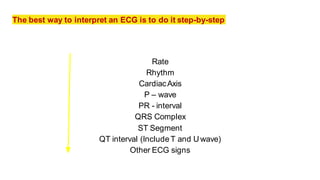
The best way to interpret an ECG is to do it step-by-step
Rate
Rhythm
CardiacAxis
P – wave
PR - interval
QRS Complex
ST Segment
QT interval (Include T and U wave)
Other ECG signs
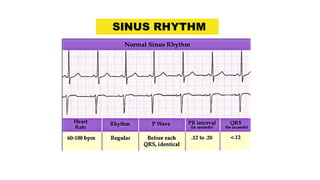
SINUS RHYTHM
ARRHYTHMIAS
Arrhythmia Formation
Arrhythmias can arise from problems in the:
• Sinus node
• Atrial cells
• A
Vjunction
• Ventricular cells
SANode Problems
The SANode can:
● fire too slow
● fire too fast
Sinus Bradycardia
Sinus Tachycardia
Sinus Tachycardia may be an appropriate
response to stress.
SINUS BRADYCARDIA
● A sinus rate of less than 60 bpm
Normal in atheletes and elderly
● Causes: hypothermia,
hypothyroidism, raised ICP, drugs
( B blocker, Digitalis),acute
ischemia and infarction , chronic
degenerative changes eg:
fibrosis of atrium or sinus nodes
● Rx: asx; no treatment
● Rx: sx ; atropine /pacemaker
SINUS ARRYTHMIA
● changing sinus node rate
with the respiratory cycle,
on inspiration and
expiration.
● Thus , during inspiration,
parasympathetic tone
falls and the heart rate
quickens and
● On expiration, the heart
rate falls.
● Normal- particularly in
children and young adult.
SINUS TACHYCARDIA
● Sinus rate acceleration to
more than 100bpm
● Causes: fever, pain, anemia,
thyrotoxicosis, pregnancy,
emotion, exercise etc
● Rx: correction of condition
causing the tachycardia.
● B blocker may be used to
slow the rate
HEART BLOCK
1
s
t Degree Heartblock
● Prolongation of PR interval > 0.2s ( > 5 small boxes)
● No drop beats
● Every atrial depolarization is followed by conduction to the ventricle but
with delay somewhere along the conduction pathway
● Depend on the cause, does not cause haemodynamic disturbance
● No specific treatment is required
● Causes ; Increased
vagal tone, Athletic
training, Inferior MI,
Mitral valve surgery,
Myocarditis (e.g. Lyme
disease),Electrolyte
disturbances (e.g.
Hyperkalaemia),AV
nodal blocking drugs
(beta-blockers,
calcium channel
blockers, digoxin,
amiodarone), May be
a normal variant
2nd Degree Heartblock MOBITZ I (WENCKENBACH)
●
● Constant atrial rate
● Ventricularrate :irregular,
● Progressive lengthening of PR interval, then failure of conductionof an atrial beat followed by a
conducted beatwith a short PR interval then repetitionof this cycle
● Veryrarely progressto complete heartblock
● Does not require pacing unless hemodynamically compromised
Causes of Wenckebachphenomenon
● Drugs: beta-blockers,calcium
channel blockers,digoxin,
amiodarone
● Increasedvagal tone (e.g.
athletes)
● InferiorMI
● Myocarditis
● Following cardiac surgery(mitral
valve repair,Tetralogyof Fallot
repair)
2ND DEGREE HEART BLOCK MOBITZ II
● Atrial rate : regular and unaffected
● Ventricular rate : less than atrial rate
● PR interval is constant.
● P wave is normal , each will be followed by QRS except the blocked P
wave.
● Common site of block: His-Purkinjee system
● May progress to complete heart block
● Causes : degenerative disease of the conducting systems,Anteroseptal MI
● Rx: permanent pacemaker
Causes of Mobitz II
● Anterior MI (due to septal infarction with
necrosis of the bundle branches).
● Idiopathic fibrosis of the conducting system
(Lenegre’s or Lev’s disease).
● Cardiac surgery (especially surgery occurring
close to the septum, e.g. mitral valve repair)
● Inflammatory conditions (rheumatic fever,
myocarditis, Lyme disease).
● Autoimmune (SLE, systemic sclerosis).
● Infiltrative myocardial disease(amyloidosis,
haemochromatosis, sarcoidosis).
● Hyperkalaemia.
● Drugs: beta-blockers, calcium channel
blockers, digoxin, amiodarone
3RD DEGREE HEART BLOCK
● Occurs when atrial contraction is normal but no beats are conducted to ventricles.
● Atrial rate :unaffected
● Ventricular rate: slower
● Atrial + ventricular rhythm are regular.
● Causes : MI ( usually transient), fibrosis around bundle of His
● Rx: Atropine 0.5 mg IV max 2 mg or transcutaneous pacing
● Persistent symptomatic ; permanent pacemaker
Causes ofcomplete heart block
The causes are the same as forMobitz I and
Mobitz II second degreeheart block.The most
important causes;
● Inferiormyocardial infarction
● AV-nodalblocking drugs (e.g.
calcium-channel blockers,
beta-blockers,digoxin)
● Idiopathic degenerationof the
conducting system (Lenegre’sorLev’s
disease)
Bradycardia(HR
< 60 bpm)
P waves
absent
P waves
present
P>QRS
P=QRS
Escape rhythms
(junctional and
ventricular)
Slow atrial
fibrillation
Irregular QRS Regular QRS
PR fixed
3rd Degree
Heart Block
Mobitz II
Progressive
lengthening of PR
Mobitz I
Sinus bradycardia
Sinus arrhythmia
2nd degree
Heart Block
ATRIALFIBRILLATION
ECG FEATURES
Irregularly irregular rhythm.
No P waves.
Absence of an isoelectric baseline.
Variable ventricular rate.
QRS complexes usually < 120 ms unless pre-existing bundle branch block, accessory pathway, or rate
related aberrant conduction.
Fibrillatory waves may be present and can be either fine (amplitude < 0.5mm) or coarse (amplitude
>0.5mm).
Fibrillatory waves may mimic P waves leading to misdiagnosis.
Commonly AF is associated with a ventricular rate ~ 110 – 160.
AF is often described as having ‘rapid ventricular response’ once the ventricular rate is > 100 bpm.
‘Slow’AFis a term often used to describe AFwith a ventricular rate < 60 bpm.
Causes of ‘slow’AFinclude hypothermia, digoxin toxicity, medications, and sinus node dysfunction.
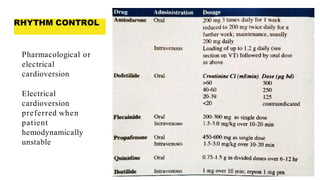
RHYTHM CONTROL
Pharmacological or
electrical
cardioversion
Electrical
cardioversion
preferred when
patient
hemodynamically
unstable
R
A
T
E
C
O
N
T
R
O
L
ATRIALFLUTTER
ECG FEATURES
Narrow complex tachycardia
Regular atrial activity at ~300 bpm
Flutter waves (“saw-tooth” pattern) best seen in leads II, III, aVF —may be more
easily spotted by turning the ECG upside down!
Flutter waves in V1 may resemble P waves
Loss of the isoelectric baseline
SUPRAVENTRICULAR
TACHYCARDIA
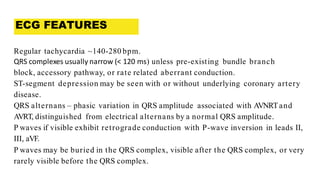
ECG FEATURES
Regular tachycardia ~140-280 bpm.
QRS complexes usually narrow (< 120 ms) unless pre-existing bundle branch
block, accessory pathway, or rate related aberrant conduction.
ST-segment depression may be seen with or without underlying coronary artery
disease.
QRS alternans – phasic variation in QRS amplitude associated with AVNRTand
AVRT, distinguished from electrical alternans by a normal QRS amplitude.
P waves if visible exhibit retrograde conduction with P-wave inversion in leads II,
III, aVF.
P waves may be buried in the QRS complex, visible after the QRS complex, or very
rarely visible before the QRS complex.
VENTRICULAR
TACHYCARDIA
ECG FEATURES
• broad QRS complexes (>0.14s)
• Ventricular rate 100-200/min.
• Fusion Beats
• AV dissociation
• Sustained – lasted more than 30 sec or associated with immediate hemodynamic
collapse
VENTRICULAR
FIBRILLA
TION
ECG FEATURES
Chaotic irregular deflections of varying amplitude
No identifiable P waves, QRS complexes, or T waves
Rate 150 to 500 per minute
Amplitude decreases with duration (coarse VF →fine VF)
THANKYOU

Ecg presentation

  • 1.
    ECG INTERPRETATION AND ARRYTHMIAS By DrVictor Ngo Jia Tong Supervised by Dr Michelle TheMoreY ouSee,The MoreY ouKnow
  • 3.
  • 4.
    P a c e m a k e r softheH eart ● SA Node- Dominant pacemaker with an intrinsic rate of 60 - 100 beats/minute. ● A VNode - Back-up pacemaker with an intrinsic rate of 40 - 60 beats/minute. ● Ventricular cells - Back-up pacemaker with an intrinsic rate of 20 - 45 bpm.
  • 5.
    The P-wave indicatesthe electricalactivity associatedwith contraction of the cardiac atria, the heart's upperchambers.
  • 6.
    ● The P-Rinterval is the delay between the beginning of activity in the atria and the ventricles (atrio-ventricular conduction time)
  • 7.
    ● The QRScomplex indicates the onset of contraction of the ventricles.
  • 8.
  • 9.
    The T-wave indicateswhen the electrical activity associated with the cells in the cardiac ventricle returns to the resting state after electrical activation -ventricular repolarization
  • 10.
    The best wayto interpret an ECG is to do it step-by-step Rate Rhythm CardiacAxis P – wave PR - interval QRS Complex ST Segment QT interval (Include T and U wave) Other ECG signs
  • 12.
  • 14.
  • 15.
    Arrhythmia Formation Arrhythmias canarise from problems in the: • Sinus node • Atrial cells • A Vjunction • Ventricular cells
  • 17.
    SANode Problems The SANodecan: ● fire too slow ● fire too fast Sinus Bradycardia Sinus Tachycardia Sinus Tachycardia may be an appropriate response to stress.
  • 18.
  • 19.
    ● A sinusrate of less than 60 bpm Normal in atheletes and elderly ● Causes: hypothermia, hypothyroidism, raised ICP, drugs ( B blocker, Digitalis),acute ischemia and infarction , chronic degenerative changes eg: fibrosis of atrium or sinus nodes ● Rx: asx; no treatment ● Rx: sx ; atropine /pacemaker
  • 20.
  • 21.
    ● changing sinusnode rate with the respiratory cycle, on inspiration and expiration. ● Thus , during inspiration, parasympathetic tone falls and the heart rate quickens and ● On expiration, the heart rate falls. ● Normal- particularly in children and young adult.
  • 22.
  • 23.
    ● Sinus rateacceleration to more than 100bpm ● Causes: fever, pain, anemia, thyrotoxicosis, pregnancy, emotion, exercise etc ● Rx: correction of condition causing the tachycardia. ● B blocker may be used to slow the rate
  • 24.
  • 25.
    1 s t Degree Heartblock ●Prolongation of PR interval > 0.2s ( > 5 small boxes) ● No drop beats ● Every atrial depolarization is followed by conduction to the ventricle but with delay somewhere along the conduction pathway ● Depend on the cause, does not cause haemodynamic disturbance ● No specific treatment is required
  • 26.
    ● Causes ;Increased vagal tone, Athletic training, Inferior MI, Mitral valve surgery, Myocarditis (e.g. Lyme disease),Electrolyte disturbances (e.g. Hyperkalaemia),AV nodal blocking drugs (beta-blockers, calcium channel blockers, digoxin, amiodarone), May be a normal variant
  • 27.
    2nd Degree HeartblockMOBITZ I (WENCKENBACH) ● ● Constant atrial rate ● Ventricularrate :irregular, ● Progressive lengthening of PR interval, then failure of conductionof an atrial beat followed by a conducted beatwith a short PR interval then repetitionof this cycle ● Veryrarely progressto complete heartblock ● Does not require pacing unless hemodynamically compromised
  • 28.
    Causes of Wenckebachphenomenon ●Drugs: beta-blockers,calcium channel blockers,digoxin, amiodarone ● Increasedvagal tone (e.g. athletes) ● InferiorMI ● Myocarditis ● Following cardiac surgery(mitral valve repair,Tetralogyof Fallot repair)
  • 29.
    2ND DEGREE HEARTBLOCK MOBITZ II ● Atrial rate : regular and unaffected ● Ventricular rate : less than atrial rate ● PR interval is constant. ● P wave is normal , each will be followed by QRS except the blocked P wave. ● Common site of block: His-Purkinjee system ● May progress to complete heart block ● Causes : degenerative disease of the conducting systems,Anteroseptal MI ● Rx: permanent pacemaker
  • 30.
    Causes of MobitzII ● Anterior MI (due to septal infarction with necrosis of the bundle branches). ● Idiopathic fibrosis of the conducting system (Lenegre’s or Lev’s disease). ● Cardiac surgery (especially surgery occurring close to the septum, e.g. mitral valve repair) ● Inflammatory conditions (rheumatic fever, myocarditis, Lyme disease). ● Autoimmune (SLE, systemic sclerosis). ● Infiltrative myocardial disease(amyloidosis, haemochromatosis, sarcoidosis). ● Hyperkalaemia. ● Drugs: beta-blockers, calcium channel blockers, digoxin, amiodarone
  • 31.
    3RD DEGREE HEARTBLOCK ● Occurs when atrial contraction is normal but no beats are conducted to ventricles. ● Atrial rate :unaffected ● Ventricular rate: slower ● Atrial + ventricular rhythm are regular. ● Causes : MI ( usually transient), fibrosis around bundle of His ● Rx: Atropine 0.5 mg IV max 2 mg or transcutaneous pacing ● Persistent symptomatic ; permanent pacemaker
  • 32.
    Causes ofcomplete heartblock The causes are the same as forMobitz I and Mobitz II second degreeheart block.The most important causes; ● Inferiormyocardial infarction ● AV-nodalblocking drugs (e.g. calcium-channel blockers, beta-blockers,digoxin) ● Idiopathic degenerationof the conducting system (Lenegre’sorLev’s disease)
  • 33.
    Bradycardia(HR < 60 bpm) Pwaves absent P waves present P>QRS P=QRS Escape rhythms (junctional and ventricular) Slow atrial fibrillation Irregular QRS Regular QRS PR fixed 3rd Degree Heart Block Mobitz II Progressive lengthening of PR Mobitz I Sinus bradycardia Sinus arrhythmia 2nd degree Heart Block
  • 35.
  • 36.
    ECG FEATURES Irregularly irregularrhythm. No P waves. Absence of an isoelectric baseline. Variable ventricular rate. QRS complexes usually < 120 ms unless pre-existing bundle branch block, accessory pathway, or rate related aberrant conduction. Fibrillatory waves may be present and can be either fine (amplitude < 0.5mm) or coarse (amplitude >0.5mm). Fibrillatory waves may mimic P waves leading to misdiagnosis. Commonly AF is associated with a ventricular rate ~ 110 – 160. AF is often described as having ‘rapid ventricular response’ once the ventricular rate is > 100 bpm. ‘Slow’AFis a term often used to describe AFwith a ventricular rate < 60 bpm. Causes of ‘slow’AFinclude hypothermia, digoxin toxicity, medications, and sinus node dysfunction.
  • 38.
  • 41.
  • 44.
  • 45.
    ECG FEATURES Narrow complextachycardia Regular atrial activity at ~300 bpm Flutter waves (“saw-tooth” pattern) best seen in leads II, III, aVF —may be more easily spotted by turning the ECG upside down! Flutter waves in V1 may resemble P waves Loss of the isoelectric baseline
  • 49.
  • 50.
    ECG FEATURES Regular tachycardia~140-280 bpm. QRS complexes usually narrow (< 120 ms) unless pre-existing bundle branch block, accessory pathway, or rate related aberrant conduction. ST-segment depression may be seen with or without underlying coronary artery disease. QRS alternans – phasic variation in QRS amplitude associated with AVNRTand AVRT, distinguished from electrical alternans by a normal QRS amplitude. P waves if visible exhibit retrograde conduction with P-wave inversion in leads II, III, aVF. P waves may be buried in the QRS complex, visible after the QRS complex, or very rarely visible before the QRS complex.
  • 53.
  • 54.
    ECG FEATURES • broadQRS complexes (>0.14s) • Ventricular rate 100-200/min. • Fusion Beats • AV dissociation • Sustained – lasted more than 30 sec or associated with immediate hemodynamic collapse
  • 58.
  • 59.
    ECG FEATURES Chaotic irregulardeflections of varying amplitude No identifiable P waves, QRS complexes, or T waves Rate 150 to 500 per minute Amplitude decreases with duration (coarse VF →fine VF)
  • 62.