476
CarboxylicAcids
17
Contents
17.1 Carboxylic Acids
17.2 Names of Carboxylic Acids
17.3 Physical Properties of
Carboxylic Acids
17.4 Soaps and Detergents
17.5 Characteristic Reactions of
Carboxylic Acids
17.1 Carboxylic Acids
In this chapter, we study carboxylic acids, another class of organic com-
pounds containing the carbonyl group. The carboxylic acid functional group
can be represented in any one of three ways:
9C9OH 9COOH 9CO2H
O
17.2 Names of Carboxylic Acids
A. IUPAC Names
The longest carbon chain that contains the carboxylic acid functional group
is used to obtain the IUPAC name of an acyclic carboxylic acid. Drop the
final -e from the name of the parent alkane and replace it with -oic acid.
Number the chain beginning with the carbonyl carbon of the carboxylic
acid. Because this carbonyl carbon is understood to be carbon 1, there is no
©
Ruslan
Mitin/Shutterstock.com
These foods can contain low levels of harmful trans fats.
Copyright 2020 Cengage Learning. All Rights Reserved. May not be copied, scanned, or duplicated, in whole or in part. Due to electronic rights, some third party content may be suppressed from the eBook and/or eChapter(s).
Editorial review has deemed that any suppressed content does not materially affect the overall learning experience. Cengage Learning reserves the right to remove additional content at any time if subsequent rights restrictions require it.
Copyright 2020 Cengage Learning. All Rights Reserved. May not be copied, scanned, or duplicated, in whole or in part. WCN 02-200-202
need to give it a number in the final IUPAC name. In the following exam-
ples, the common name is given in parentheses.
3-Methylbutanoic acid
(Isovaleric acid)
OH
O
1
3
Hexanoic acid
(Caproic acid)
OH
O
1
6 4
When a carboxylic acid also contains an iOH (hydroxyl) group, we indi-
cate its presence by adding the prefix hydroxy-. When it contains a primary
(1°) amine, we indicate the presence of the iNH2 group with amino-. When
a carboxylic acid also contains a ketone or aldehyde group, we indicate the
presence of that group by the prefix -oxo.
4-Aminobenzoic acid
(p-Aminobenzoic acid)
COOH
H2N
5
5-Hydroxyhexanoic acid
OH
OH O
1
3-Oxobutanoic acid
(-Ketobutyric acid,
Acetoacetic acid)
2-Oxopropanoic acid
(Pyruvic acid)
CH3CCH2CO2H CH3CCO2H
O
O
To name dicarboxylic acids, we add the suffix -dioic acid to the name of
the parent alkane that contains both carboxylic acids. The numbers of the
carbonyl carbon of the carboxylic acids carbons are not indicated because
they can be only at the ends of the parent chain.
Ethanedioic acid
(Oxalic acid)
OH
HO
O
O
1
2
Propanedioic acid
(Malonic acid)
OH
HO
O
3
O
1
The name oxalic acid is derived from one of its sources in the biological
world—plants of the genus Oxalis, one of which is rhubarb. Oxalic acid also
occurs in human and animal urine, and calcium oxalate is a major com-
ponent of kidney stones. Succinic acid is an intermediate in the citric acid
cycle (Section 26.4). Adipic acid is one of the two monomers required for the
synthesis of the polymer nylon-66 (Section 17.6B).
B. Common Names
Common names for aliphatic carboxylic acids, many of which were known
long before the development of IUPAC nomenclature, are often derived from
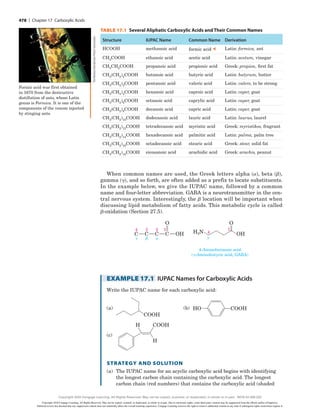
the name of a natural source from which the acid could be isolated. Table 17.1
lists several of the unbranched aliphatic carboxylic acids found in the biological
world along with the common name of each. Those with 16, 18, and 20 carbon
atoms are particularly abundant in animal fats and vegetable oils (Section 20.2)
and the phospholipid components of biological membranes (Section 20.5).
Butanedioic acid
(Succinic acid)
OH
HO
O
O O
1
4
Pentanedioic acid
(Glutaric acid)
OH
HO
O
5
O
1
Hexanedioic acid
(Adipic acid)
OH
HO 6
O
1
17.2 Names of Carboxylic Acids | 477
Copyright 2020 Cengage Learning. All Rights Reserved. May not be copied, scanned, or duplicated, in whole or in part. Due to electronic rights, some third party content may be suppressed from the eBook and/or eChapter(s).
Editorial review has deemed that any suppressed content does not materially affect the overall learning experience. Cengage Learning reserves the right to remove additional content at any time if subsequent rights restrictions require it.
Copyright 2020 Cengage Learning. All Rights Reserved. May not be copied, scanned, or duplicated, in whole or in part. WCN 02-200-202
When common names are used, the Greek letters alpha sad, beta sbd,
gamma sgd, and so forth, are often added as a prefix to locate substituents.
In the example below, we give the IUPAC name, followed by a common
name and four-letter abbreviation. GABA is a neurotransmitter in the cen-
tral nervous system. Interestingly, the b location will be important when
discussing lipid metabolism of fatty acids. This metabolic cycle is called
b-oxidation (Section 27.5).
4-Aminobutanoic acid
(-Aminobutyric acid; GABA)
OH
C9C9C9C9OH H2N
O
O
1
1
2
3
4


4

Example 17.1 IUPAC Names for Carboxylic Acids
Write the IUPAC name for each carboxylic acid:
(a)
COOH
HO
COOH
H
H
COOH     
(b) COOH
HO
COOH
H
H
COOH
(c)
COOH
HO
COOH
H
H
COOH
Strategy and Solution
(a) The IUPAC name for an acyclic carboxylic acid begins with identifying
the longest carbon chain containing the carboxylic acid. The longest
carbon chain (red numbers) that contains the carboxylic acid (shaded
Table 17.1 Several Aliphatic Carboxylic Acids and Their Common Names
Structure IUPAC Name Common Name Derivation
HCOOH methanoic acid formic acid
▲
Latin: formica, ant
CH3COOH ethanoic acid acetic acid Latin: acetum, vinegar
CH3CH2COOH propanoic acid propionic acid Greek: propion, first fat
CH3sCH2d2COOH butanoic acid butyric acid Latin: butyrum, butter
CH3sCH2d3COOH pentanoic acid valeric acid Latin: valere, to be strong
CH3sCH2d4COOH hexanoic acid caproic acid Latin: caper, goat
CH3sCH2d6COOH octanoic acid caprylic acid Latin: caper, goat
CH3sCH2d8COOH decanoic acid capric acid Latin: caper, goat
CH3sCH2d10COOH dodecanoic acid lauric acid Latin: laurus, laurel
CH3sCH2d12COOH tetradecanoic acid myristic acid Greek: myristikos, fragrant
CH3sCH2d14COOH hexadecanoic acid palmitic acid Latin: palma, palm tree
CH3sCH2d16COOH octadecanoic acid stearic acid Greek: stear, solid fat
CH3sCH2d18COOH eicosanoic acid arachidic acid Greek: arachis, peanut
Ted
Nelson/Dembinsky
Photo
Associates
Formic acid was first obtained
in 1670 from the destructive
distillation of ants, whose Latin
genus is Formica. It is one of the
components of the venom injected
by stinging ants.
478 | Chapter 17 Carboxylic Acids
Copyright 2020 Cengage Learning. All Rights Reserved. May not be copied, scanned, or duplicated, in whole or in part. Due to electronic rights, some third party content may be suppressed from the eBook and/or eChapter(s).
Editorial review has deemed that any suppressed content does not materially affect the overall learning experience. Cengage Learning reserves the right to remove additional content at any time if subsequent rights restrictions require it.
Copyright 2020 Cengage Learning. All Rights Reserved. May not be copied, scanned, or duplicated, in whole or in part. WCN 02-200-202
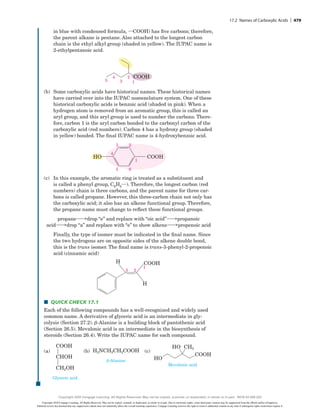
in blue with condensed formula, iCOOH) has five carbons; therefore,
the parent alkane is pentane. Also attached to the longest carbon
chain is the ethyl alkyl group (shaded in yellow). The IUPAC name is
2-ethylpentanoic acid.
5
4
3
2
1
COOH
(b) Some carboxylic acids have historical names. These historical names
have carried over into the IUPAC nomenclature system. One of these
historical carboxylic acids is benzoic acid (shaded in pink). When a
hydrogen atom is removed from an aromatic group, this is called an
aryl group, and this aryl group is used to number the carbons. There-
fore, carbon 1 is the aryl carbon bonded to the carbonyl carbon of the
carboxylic acid (red numbers). Carbon 4 has a hydroxy group (shaded
in yellow) bonded. The final IUPAC name is 4-hydroxybenzoic acid.
3 2
5
4
6
1
COOH
HO
(c) In this example, the aromatic ring is treated as a substituent and
is called a phenyl group, C6H5i). Therefore, the longest carbon (red
numbers) chain is three carbons, and the parent name for three car-
bons is called propane. However, this three-carbon chain not only has
the carboxylic acid; it also has an alkene functional group. Therefore,
the propane name must change to reflect these functional groups.
propanehdrop “e” and replace with “oic acid”hpropanoic
acidhdrop “a” and replace with “e” to show alkenehpropenoic acid
Finally, the type of isomer must be indicated in the final name. Since
the two hydrogens are on opposite sides of the alkene double bond,
this is the trans isomer. The final name is trans-3-phenyl-2-propenoic
acid (cinnamic acid)
2
1
3
H
H COOH
■
■ Quick Check 17.1
Each of the following compounds has a well-recognized and widely used
common name. A derivative of glyceric acid is an intermediate in gly-
colysis (Section 27.2). b-Alanine is a building block of pantothenic acid
(Section 26.5). Mevalonic acid is an intermediate in the biosynthesis of
steroids (Section 26.4). Write the IUPAC name for each compound.
(a)
COOH
CHOH
CH2OH
Glyceric acid
(a) (b) H2NCH2CH2COOH
b-Alanine
(c)
HO
HO
CH3
COOH
Mevalonic acid
  
(b)
COOH
CHOH
CH2OH
Glyceric acid
(a) (b) H2NCH2CH2COOH
b-Alanine
(c)
HO
HO
CH3
COOH
Mevalonic acid
  
(c)
COOH
CHOH
CH2OH
Glyceric acid
(a) (b) H2NCH2CH2COOH
b-Alanine
(c)
HO
HO
CH3
COOH
Mevalonic acid
17.2 Names of Carboxylic Acids | 479
Copyright 2020 Cengage Learning. All Rights Reserved. May not be copied, scanned, or duplicated, in whole or in part. Due to electronic rights, some third party content may be suppressed from the eBook and/or eChapter(s).
Editorial review has deemed that any suppressed content does not materially affect the overall learning experience. Cengage Learning reserves the right to remove additional content at any time if subsequent rights restrictions require it.
Copyright 2020 Cengage Learning. All Rights Reserved. May not be copied, scanned, or duplicated, in whole or in part. WCN 02-200-202
17.3 Physical Properties of Carboxylic Acids
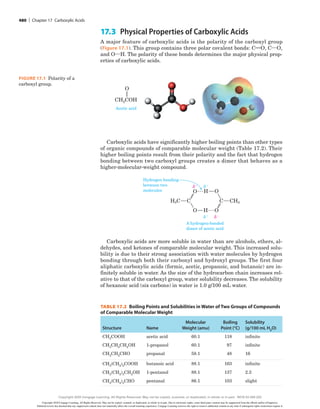
A major feature of carboxylic acids is the polarity of the carboxyl group
­(Figure 17.1). This group contains three polar covalent bonds: CwO, CiO,
and OiH. The polarity of these bonds determines the major physical prop-
erties of carboxylic acids.
CH3COH
O
Acetic acid
FIGURE 17.1 Polarity of a
carboxyl group.
Carboxylic acids have significantly higher boiling points than other types
of organic compounds of comparable molecular weight (Table 17.2). Their
higher boiling points result from their polarity and the fact that hydrogen
bonding between two carboxyl groups creates a dimer that behaves as a
higher-molecular-weight compound.
Hydrogen bonding
between two
molecules
A hydrogen-bonded
dimer of acetic acid
H3C9C C9CH3
O9H
O
O
H9O
1
2
2
1
Carboxylic acids are more soluble in water than are alcohols, ethers, al-
dehydes, and ketones of comparable molecular weight. This increased solu-
bility is due to their strong association with water molecules by hydrogen
bonding through both their carbonyl and hydroxyl groups. The first four
aliphatic carboxylic acids (formic, acetic, propanoic, and butanoic) are in-
finitely soluble in water. As the size of the hydrocarbon chain increases rel-
ative to that of the carboxyl group, water solubility decreases. The solubility
of hexanoic acid (six carbons) in water is 1.0 g/100 mL water.
Table 17.2 Boiling Points and Solubilities in Water of Two Groups of Compounds
of Comparable Molecular Weight
Structure Name
Molecular
Weight (amu)
Boiling
Point (°C)
Solubility
(g/100 mL H2O)
CH3COOH acetic acid 60.1 118 infinite
CH3CH2CH2OH 1-propanol 60.1 97 infinite
CH3CH2CHO propanal 58.1 48 16
CH3sCH2d2COOH butanoic acid 88.1 163 infinite
CH3sCH2d3CH2OH 1-pentanol 88.1 137 2.3
CH3sCH2d3CHO pentanal 86.1 103 slight
480 | Chapter 17 Carboxylic Acids
Copyright 2020 Cengage Learning. All Rights Reserved. May not be copied, scanned, or duplicated, in whole or in part. Due to electronic rights, some third party content may be suppressed from the eBook and/or eChapter(s).
Editorial review has deemed that any suppressed content does not materially affect the overall learning experience. Cengage Learning reserves the right to remove additional content at any time if subsequent rights restrictions require it.
Copyright 2020 Cengage Learning. All Rights Reserved. May not be copied, scanned, or duplicated, in whole or in part. WCN 02-200-202
We must mention two other properties of carboxylic acids. First, the liq-
uid carboxylic acids from propanoic acid to decanoic acid have sharp, often
disagreeable odors. Butanoic acid is found in stale perspiration and is a ma-
jor component of “locker room odor.” Pentanoic acid smells even worse, and
goats, which secrete C6, C8, and C10 carboxylic acids (Table 17.1), are not fa-
mous for their pleasant odors. Second, carboxylic acids have a characteristic
sour taste. The sour taste of pickles and sauerkraut, for example, is due to
the presence of lactic acid. The sour tastes of limes (pH 1.9), lemons (pH 2.3),
and grapefruit (pH 3.2) are due to the presence of citric and other acids.
17.4 Soaps and Detergents
A. Fatty Acids
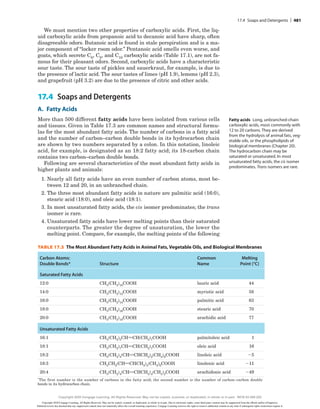
More than 500 different fatty acids have been isolated from various cells
and tissues. Given in Table 17.3 are common names and structural formu-
las for the most abundant fatty acids. The number of carbons in a fatty acid
and the number of carbon–carbon double bonds in its hydrocarbon chain
are shown by two numbers separated by a colon. In this notation, linoleic
acid, for example, is designated as an 18:2 fatty acid; its 18-carbon chain
contains two carbon–carbon double bonds.
Following are several characteristics of the most abundant fatty acids in
higher plants and animals:
1. Nearly all fatty acids have an even number of carbon atoms, most be-
tween 12 and 20, in an unbranched chain.
2. The three most abundant fatty acids in nature are palmitic acid (16:0),
stearic acid (18:0), and oleic acid (18:1).
3. In most unsaturated fatty acids, the cis isomer predominates; the trans
isomer is rare.
4. Unsaturated fatty acids have lower melting points than their saturated
counterparts. The greater the degree of unsaturation, the lower the
melting point. Compare, for example, the melting points of the following
Fatty acids ​Long, unbranched-chain
carboxylic acids, most commonly with
12 to 20 carbons. They are derived
from the ­
hydrolysis of animal fats, veg-
etable oils, or the phospholipids of
biological ­
membranes (Chapter 20).
The hydrocarbon chain may be
saturated or unsaturated. In most
unsaturated fatty acids, the cis isomer
predominates. Trans isomers are rare.
Table 17.3 The Most Abundant Fatty Acids in Animal Fats, Vegetable Oils, and Biological Membranes
Carbon Atoms:
Double Bonds* Structure
Common
Name
Melting
Point (°C)
Saturated Fatty Acids
12:0 CH3sCH2d10COOH lauric acid 44
14:0 CH3sCH2d12COOH myristic acid 58
16:0 CH3sCH2d14COOH palmitic acid 63
18:0 CH3sCH2d16COOH stearic acid 70
20:0 CH3sCH2d18COOH arachidic acid 77
Unsaturated Fatty Acids
16:1 CH3sCH2d5CHwCHsCH2d7COOH palmitoleic acid   1
18:1 CH3sCH2d7CHwCHsCH2d7COOH oleic acid 16
18:2 CH3sCH2d4sCHwCHCH2d2sCH2d6COOH linoleic acid 25
18:3 CH3CH2sCHwCHCH2d3sCH2d6COOH linolenic acid 211
20:4 CH3sCH2d4sCHwCHCH2d4sCH2d2COOH arachidonic acid 249
*The first number is the number of carbons in the fatty acid; the second number is the number of carbon–carbon double
bonds in its hydrocarbon chain.
17.4 Soaps and Detergents | 481
Copyright 2020 Cengage Learning. All Rights Reserved. May not be copied, scanned, or duplicated, in whole or in part. Due to electronic rights, some third party content may be suppressed from the eBook and/or eChapter(s).
Editorial review has deemed that any suppressed content does not materially affect the overall learning experience. Cengage Learning reserves the right to remove additional content at any time if subsequent rights restrictions require it.
Copyright 2020 Cengage Learning. All Rights Reserved. May not be copied, scanned, or duplicated, in whole or in part. WCN 02-200-202
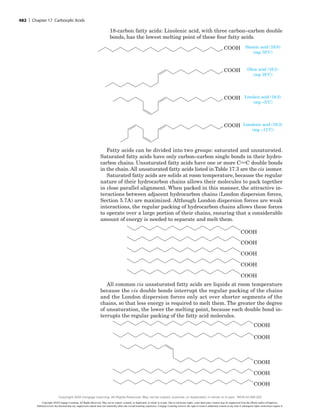
18-carbon fatty acids: Linolenic acid, with three carbon–carbon double
bonds, has the lowest melting point of these four fatty acids.
COOH Stearic acid (18:0)
(mp 708C)
COOH Oleic acid (18:1)
(mp 168C)
COOH Linoleic acid (18:2)
(mp –58C)
COOH Linolenic acid (18:3)
(mp –118C)
Fatty acids can be divided into two groups: saturated and unsaturated.
Saturated fatty acids have only carbon–carbon single bonds in their hydro-
carbon chains. Unsaturated fatty acids have one or more CwC double bonds
in the chain.All unsaturated fatty acids listed in Table 17.3 are the cis isomer.
Saturated fatty acids are solids at room temperature, because the regular
nature of their hydrocarbon chains allows their molecules to pack together
in close parallel alignment. When packed in this manner, the attractive in-
teractions between adjacent hydrocarbon chains (London dispersion forces,
Section 5.7A) are maximized. Although London dispersion forces are weak
interactions, the regular packing of hydrocarbon chains allows these forces
to operate over a large portion of their chains, ensuring that a considerable
amount of energy is needed to separate and melt them.
COOH
COOH
COOH
COOH
COOH
All common cis unsaturated fatty acids are liquids at room temperature
because the cis double bonds interrupt the regular packing of the chains
and the London dispersion forces only act over shorter segments of the
chains, so that less energy is required to melt them. The greater the degree
of unsaturation, the lower the melting point, because each double bond in-
terrupts the regular packing of the fatty acid molecules.
COOH
COOH
COOH
COOH
COOH
482 | Chapter 17 Carboxylic Acids
Copyright 2020 Cengage Learning. All Rights Reserved. May not be copied, scanned, or duplicated, in whole or in part. Due to electronic rights, some third party content may be suppressed from the eBook and/or eChapter(s).
Editorial review has deemed that any suppressed content does not materially affect the overall learning experience. Cengage Learning reserves the right to remove additional content at any time if subsequent rights restrictions require it.
Copyright 2020 Cengage Learning. All Rights Reserved. May not be copied, scanned, or duplicated, in whole or in part. WCN 02-200-202
CHEMICAL CONNECTIONS 17A 
Trans Fatty Acids: What Are They and How
Do You Avoid Them?
Animal fats are rich in saturated fatty acids, whereas
plant oils (for example, corn, soybean, canola, olive, and
palm oils) are rich in unsaturated fatty acids. Fats are
added to processed foods to provide a desirable firm-
ness along with a moist texture and pleasant taste. To
supply the demand for dietary fats of the appropriate
consistency, the cis double bonds of vegetable oils are
partially hydrogenated. The greater the extent of hy-
drogenation, the higher the melting point of the fatty
acid. The ­
extent of hydrogenation is carefully con-
trolled, usually by employing a Ni catalyst and a calcu-
lated amount of H2 as a limiting reagent. Under these
conditions, the H2 is used up before all double bonds
are reduced, so that only partial hydrogenation and
the desired overall consistency is achieved. For exam-
ple, by controlling the degree of ­
hydrogenation, an oil
with a melting point below room temperature can be
converted to a semisolid or even a solid product.
The mechanism of catalytic hydrogenation of alkenes
was discussed in Section 12.6D. Recall that a key step
in this mechanism involves interaction of the carbon–­
carbon double bond of the alkene with the metal catalyst
to form a carbon–metal bond. Because the interaction
of a carbon–carbon double bond with the Ni catalyst is
reversible, many of the double bonds remaining in the
oil may be isomerized from the less stable cis configu-
ration to the more stable trans configuration. Thus, the
equilibration between the cis and trans configurations
may occur when H2 is the limiting reagent. For example,
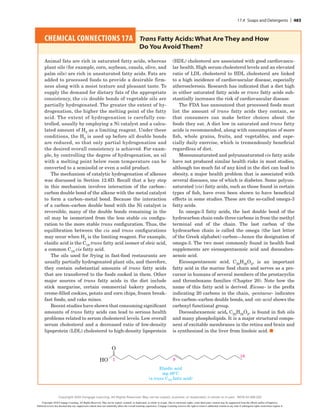
elaidic acid is the C18 trans fatty acid isomer of oleic acid,
a common C18 cis fatty acid.
The oils used for frying in fast-food restaurants are
usually partially hydrogenated plant oils, and therefore,
they contain substantial amounts of trans fatty acids
that are transferred to the foods cooked in them. Other
major sources of trans fatty acids in the diet include
stick margarine, certain commercial bakery products,
creme-filled cookies, potato and corn chips, frozen break-
fast foods, and cake mixes.
Recent studies have shown that consuming significant
amounts of trans fatty acids can lead to serious health
problems related to serum cholesterol levels. Low overall
serum cholesterol and a decreased ratio of low-density
lipoprotein (LDL) cholesterol to high-density lipoprotein
(HDL) cholesterol are associated with good cardiovascu-
lar health. High serum cholesterol levels and an elevated
ratio of LDL cholesterol to HDL cholesterol are linked
to a high incidence of cardiovascular disease, especially
atherosclerosis. Research has indicated that a diet high
in either saturated fatty acids or trans fatty acids sub-
stantially increases the risk of cardiovascular disease.
The FDA has announced that processed foods must
list the amount of trans fatty acids they contain, so
that consumers can make better choices about the
foods they eat. A diet low in saturated and trans fatty
acids is recommended, along with consumption of more
fish, whole grains, fruits, and vegetables, and espe-
cially daily exercise, which is tremendously beneficial
regardless of diet.
Monounsaturated and polyunsaturated cis fatty acids
have not produced similar health risks in most studies,
although too much fat of any kind in the diet can lead to
obesity, a major health problem that is associated with
several diseases, one of which is diabetes. Some polyun-
saturated (cis) fatty acids, such as those found in certain
types of fish, have even been shown to have beneficial
effects in some studies. These are the so-called omega-3
fatty acids.
In omega-3 fatty acids, the last double bond of the
hydrocarbon chain ends three carbons in from the methyl
terminal end of the chain. The last carbon of the
hydrocarbon chain is called the omega (the last letter
of the Greek alphabet) carbon—hence the designation of
omega-3. The two most commonly found in health food
supplements are eicosapentaenoic acid and docosahex-
aenoic acid.
Eicosapentaenoic acid, C20H30O2, is an important
fatty acid in the marine food chain and serves as a pre-
cursor in humans of several members of the prostacyclin
and thromboxane families (Chapter 20). Note how the
name of this fatty acid is derived. Eicosa- is the prefix
indicating 20 carbons in the chain, -pentaene- indicates
five carbon–­
carbon double bonds, and -oic acid shows the
carboxyl functional group.
Docosahexaenoic acid, C22H32O2, is found in fish oils
and many phospholipids. It is a major structural compo-
nent of excitable membranes in the retina and brain and
is synthesized in the liver from linoleic acid. ■
Elaidic acid
mp 46°C
(a trans C18 fatty acid)
18
9
1
HO
O
17.4 Soaps and Detergents | 483
Copyright 2020 Cengage Learning. All Rights Reserved. May not be copied, scanned, or duplicated, in whole or in part. Due to electronic rights, some third party content may be suppressed from the eBook and/or eChapter(s).
Editorial review has deemed that any suppressed content does not materially affect the overall learning experience. Cengage Learning reserves the right to remove additional content at any time if subsequent rights restrictions require it.
Copyright 2020 Cengage Learning. All Rights Reserved. May not be copied, scanned, or duplicated, in whole or in part. WCN 02-200-202
B. Structure and Preparation of Soaps
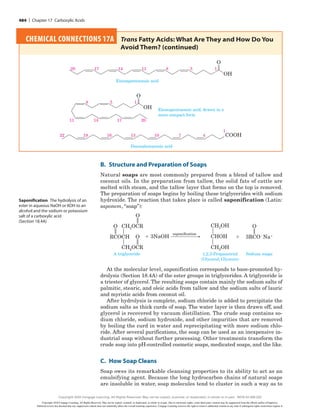
Natural soaps are most commonly prepared from a blend of tallow and
coconut oils. In the preparation from tallow, the solid fats of cattle are
melted with steam, and the tallow layer that forms on the top is removed.
The preparation of soaps begins by boiling these triglycerides with sodium
hydroxide. The reaction that takes place is called saponification (Latin:
saponem, “soap”):
A triglyceride
CH2OCR
O
O
CH2OCR
O
RCOCH
Sodium soaps
O
3RCO2Na1
1
saponification
CH2OH
CHOH
1 3NaOH
CH2OH
1,2,3-Propanetriol
(Glycerol; Glycerin)
At the molecular level, saponification corresponds to base-promoted hy-
drolysis (Section 18.4A) of the ester groups in triglycerides. A triglyceride is
a triester of glycerol. The resulting soaps contain mainly the sodium salts of
palmitic, stearic, and oleic acids from tallow and the sodium salts of lauric
and myristic acids from coconut oil.
After hydrolysis is complete, sodium chloride is added to precipitate the
sodium salts as thick curds of soap. The water layer is then drawn off, and
glycerol is recovered by vacuum distillation. The crude soap contains so-
dium chloride, sodium hydroxide, and other impurities that are removed
by boiling the curd in water and reprecipitating with more sodium chlo-
ride. After several purifications, the soap can be used as an inexpensive in-
dustrial soap without further processing. Other treatments transform the
crude soap into pH-controlled cosmetic soaps, medicated soaps, and the like.
C. How Soap Cleans
Soap owes its remarkable cleansing properties to its ability to act as an
emulsifying agent. Because the long hydrocarbon chains of natural soaps
are insoluble in water, soap molecules tend to cluster in such a way as to
Saponification ​
The hydrolysis of an
ester in aqueous NaOH or KOH to an
alcohol and the sodium or potassium
salt of a carboxylic acid
(Section 18.4A)
CHEMICAL CONNECTIONS 17A 
Trans Fatty Acids: What Are They and How Do You
Avoid Them? (continued)
OH
O
1
5
8
11
14
17
20
Eicosapentaenoic acid
OH
O
1
5
8
17 20
14
11
Eicosapentaenoic acid, drawn in a
more compact form
COOH
1
4
7
10
13
16
19
22
Docosahexaenoic acid
484 | Chapter 17 Carboxylic Acids
Copyright 2020 Cengage Learning. All Rights Reserved. May not be copied, scanned, or duplicated, in whole or in part. Due to electronic rights, some third party content may be suppressed from the eBook and/or eChapter(s).
Editorial review has deemed that any suppressed content does not materially affect the overall learning experience. Cengage Learning reserves the right to remove additional content at any time if subsequent rights restrictions require it.
Copyright 2020 Cengage Learning. All Rights Reserved. May not be copied, scanned, or duplicated, in whole or in part. WCN 02-200-202
minimize contact of their hydrocarbon chains with surrounding water mol-
ecules. The polar carboxylate groups, by contrast, tend to remain in contact
with the surrounding water molecules. Thus, in water, soap molecules spon-
taneously cluster into micelles (Figure 17.2).
Many of the things we commonly think of as dirt (such as grease, oil, and
fat stains) are nonpolar and insoluble in water. When soap and this type
of dirt are mixed together, as in a washing machine, the nonpolar hydro-
carbon inner parts of the soap micelles “dissolve” the nonpolar substances.
In effect, new soap micelles form, with the nonpolar dirt molecules in the
center (Figure 17.3). In this way, nonpolar organic grease, oil, and fat are
“dissolved” and washed away in the polar wash water.
Soaps, however, have their disadvantages, foremost among which is the
fact that they form water-insoluble salts when used in water containing
Ca(II), Mg(II), or Fe(III) ions (hard water):
A sodium soap
(soluble in water as micelles)
2CH3(CH2)14COO2
Na1
Ca21
1
Calcium salt of a fatty acid
(insoluble in water)
[CH3(CH2)14COO2
]2Ca21
2Na1
1
These water-insoluble calcium, magnesium, and iron salts of fatty acids cre-
ate problems, including rings around the bathtub, films that spoil the luster
of hair, and grayness and roughness that build up on textiles after repeated
washings.
D. ​Synthetic Detergents
After the cleansing action of soaps was understood, chemists were in a po-
sition to design a synthetic detergent. Molecules of a good detergent, they
reasoned, must have a long hydrocarbon chain—preferably 12 to 20 carbon
atoms long—and a polar group at one end of the molecule that does not
form insoluble salts with the Ca(II), Mg(II), or Fe(III) ions that are present
in hard water. These essential characteristics of a soap, they recognized,
could be produced in a molecule containing a sulfonate siSO3
2d group in-
stead of a carboxylate siCOO2d group. Calcium, magnesium, and iron salts
of alkylsulfonic acids sRiSO3Hd are much more soluble in water than com-
parable salts of fatty acids.
The most widely used synthetic detergents today are the linear alkyl-
benzenesulfonates (LAS). One of the most common of these is sodium
4-dodecylbenzenesulfonate. To prepare this type of detergent, a linear alkyl-
benzene is treated with sulfuric acid to form an alkylbenzenesulfonic acid
Micelles ​
Spherical arrangements of
molecules in aqueous solution such
that their hydrophobic (water-hating)
parts are shielded from the aqueous
environment and their hydrophilic
(water-loving) parts are on the surface
of the sphere and in contact with the
aqueous environment
Nonpolar
“tail”
Na1
ions
(a) A soap (b) Cross section of a soap
micelle in water
—
1
1
1
1
1
1
1
1
1
1
1
1
1
1
1
—
—
—
—
—
— — —
—
—
—
—
—
—
—
—
—
—
Na1
Polar “head”
O2
O
C
Figure 17.2 Soap micelles.
Nonpolar (hydrophobic)
hydrocarbon chains cluster in
the interior of the micelle, and
polar (hydrophilic) carboxylate
groups are on the surface of the
micelle. Soap micelles repel each
other because of their negative
surface charges.
Grease
Soap
Soap micelle with
“dissolved” grease
FIGURE 17.3 A soap micelle
with a “dissolved” oil or grease
droplet.
17.4 Soaps and Detergents | 485
Copyright 2020 Cengage Learning. All Rights Reserved. May not be copied, scanned, or duplicated, in whole or in part. Due to electronic rights, some third party content may be suppressed from the eBook and/or eChapter(s).
Editorial review has deemed that any suppressed content does not materially affect the overall learning experience. Cengage Learning reserves the right to remove additional content at any time if subsequent rights restrictions require it.
Copyright 2020 Cengage Learning. All Rights Reserved. May not be copied, scanned, or duplicated, in whole or in part. WCN 02-200-202
(Section 12.3C), followed by neutralization of the sulfonic acid with sodium
hydroxide:
SO3
2
Dodecylbenzene
CH3(CH2)10CH2 Na1
H2SO4
NaOH
1.
2.
Sodium 4-dodecylbenzenesulfonate
(an anionic detergent)
CH3(CH2)10CH2
The product is mixed with builders and then spray-dried to give a
smooth-flowing powder. The most common builder is sodium silicate. Alkyl-
benzenesulfonate detergents were introduced in the late 1950s, and today
they account for close to 90% of the market that was once held by natural
soaps.
Among the most common additives to detergent preparations are foam
stabilizers, bleaches, and optical brighteners. A common foam stabilizer
added to liquid soaps, but not to laundry detergents (for obvious reasons:
think of a top-loading washing machine with foam spewing out of the lid!), is
the amide prepared from dodecanoic acid (lauric acid) and 2-aminoethanol
(ethanolamine). The most common bleach is sodium perborate tetrahydrate,
which decomposes at temperatures higher than 50°C to give hydrogen per-
oxide, the actual bleaching agent.
N-(2-Hydroxyethyl)dodecanamide
(a foam stabilizer)
Sodium perborate tetrahydrate
(a bleach)
CH3(CH2)10CNHCH2CH2OH 4H2O
NaBO3
O
Also added to laundry detergents are optical brighteners (optical
bleaches). These substances are absorbed onto fabrics and, after absorbing
ambient light, fluoresce with a blue color, offsetting the yellow color that
develops in fabric as it ages. Optical brighteners produce a “whiter-than-
white” appearance. You most certainly have observed their effects if you
have seen the glow of white T-shirts or blouses when they are exposed to
black light (UV radiation).
17.5 Characteristic Reactions of Carboxylic Acids
A. Acidity
Carboxylic acids are weak acids. Values of Ka for most unsubstituted
­
aliphatic and aromatic carboxylic acids fall within the range of 1024
to 1025 (pKa 5 4.0–5.0). The value of Ka for acetic acid, for example, is
1.74 3 1025; its pKa is 4.75 (Section 8.5).
CH3COH 1 H2O
O
CH3CO2 1 H3O1 Ka 5 5 1.74 3 1025
pKa 5 4.75
O
[CH3COO2][H3O1]
[CH3COOH]
acetic acid
carboxylic acid
acetate
conjugate base
Substituents with high electronegativity (especially iOH, iCl, and
iNH3
1) near the carboxyl group increase the acidity of carboxylic acids,
often by several orders of magnitude. Compare, for example, the acidities
of acetic acid and the chlorine-substituted acetic acids. Both dichloroacetic
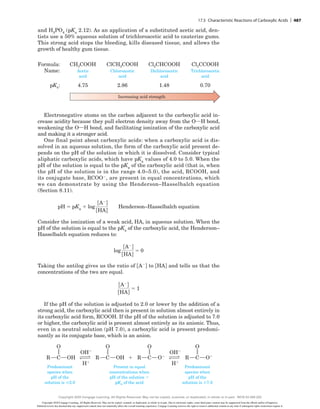
acid and trichloroacetic acid are stronger acids than acetic acid (pKa 4.75)
486 | Chapter 17 Carboxylic Acids
Copyright 2020 Cengage Learning. All Rights Reserved. May not be copied, scanned, or duplicated, in whole or in part. Due to electronic rights, some third party content may be suppressed from the eBook and/or eChapter(s).
Editorial review has deemed that any suppressed content does not materially affect the overall learning experience. Cengage Learning reserves the right to remove additional content at any time if subsequent rights restrictions require it.
Copyright 2020 Cengage Learning. All Rights Reserved. May not be copied, scanned, or duplicated, in whole or in part. WCN 02-200-202
and H3PO4 (pKa 2.12). As an application of a substituted acetic acid, den-
tists use a 50% aqueous solution of trichloroacetic acid to cauterize gums.
This strong acid stops the bleeding, kills diseased tissue, and allows the
growth of healthy gum tissue.
Increasing acid strength
4.75
Acetic
acid
CH3COOH
2.86
Chloroacetic
acid
ClCH2COOH
1.48
Dichloroacetic
acid
Cl2CHCOOH
0.70
Trichloroacetic
acid
Cl3CCOOH
Formula:
Name:
pKa:
Electronegative atoms on the carbon adjacent to the carboxylic acid in-
crease acidity because they pull electron density away from the OiH bond,
weakening the OiH bond, and facilitating ionization of the carboxylic acid
and making it a stronger acid.
One final point about carboxylic acids: when a carboxylic acid is dis-
solved in an aqueous solution, the form of the carboxylic acid present de-
pends on the pH of the solution in which it is dissolved. Consider typical
aliphatic carboxylic acids, which have pKa values of 4.0 to 5.0. When the
pH of the solution is equal to the pKa of the carboxylic acid (that is, when
the pH of the solution is in the range 4.0–5.0), the acid, RCOOH, and
its conjugate base, RCOO2, are present in equal concentrations, which
we can demonstrate by using the Henderson–Hasselbalch equation
(Section 8.11).
pH 5 pKa 1 log
fA2g
fHAg
  Henderson–Hasselbalch equation
Consider the ionization of a weak acid, HA, in aqueous solution. When the
pH of the solution is equal to the pKa of the carboxylic acid, the Henderson–
Hasselbalch equation reduces to:
log
fA2g
fHAg
5 0
Taking the antilog gives us the ratio of fA2g to fHAg and tells us that the
concentrations of the two are equal.
fA2g
fHAg
5 1
If the pH of the solution is adjusted to 2.0 or lower by the addition of a
strong acid, the carboxylic acid then is present in solution almost entirely in
its carboxylic acid form, RCOOH. If the pH of the solution is adjusted to 7.0
or higher, the carboxylic acid is present almost entirely as its anionic. Thus,
even in a neutral solution (pH 7.0), a carboxylic acid is present predomi-
nantly as its conjugate base, which is an anion.
Predominant
species when
pH of the
solution is 2.0
Predominant
species when
pH of the
solution is 7.0
Present in equal
concentrations when
pH of the solution
pKa of the acid
O O O
R9C9OH EF R9C9O EF
O
R9C9O
R9C9OH 1
OH
H
OH
H
17.5 Characteristic Reactions of Carboxylic Acids | 487
Copyright 2020 Cengage Learning. All Rights Reserved. May not be copied, scanned, or duplicated, in whole or in part. Due to electronic rights, some third party content may be suppressed from the eBook and/or eChapter(s).
Editorial review has deemed that any suppressed content does not materially affect the overall learning experience. Cengage Learning reserves the right to remove additional content at any time if subsequent rights restrictions require it.
Copyright 2020 Cengage Learning. All Rights Reserved. May not be copied, scanned, or duplicated, in whole or in part. WCN 02-200-202
B. Reaction with Bases
All carboxylic acids, whether soluble or insoluble in water, react with NaOH,
KOH, and other strong bases to form water-soluble salts.
Benzoic acid
(slightly soluble in water)
NaOH
COOH
Sodium benzoate
(60 g/100 mL water)
COO2Na1
1 H2O
1
H2O
Sodium benzoate, a fungal growth inhibitor, is often added to baked goods
“to retard spoilage.”
▲
Calcium propanoate is used for the same purpose.
Carboxylic acids also form water-soluble salts with ammonia and amines.
Benzoic acid
(slightly soluble in water)
NH3
COOH
Ammonium benzoate
(20 g/100 mL water)
COO2NH4
1
1
H2O
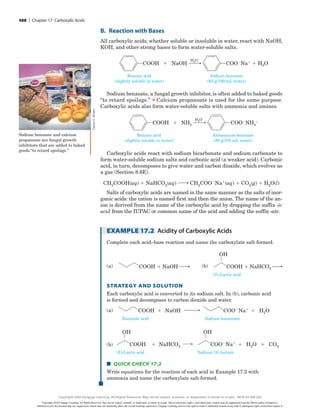
Carboxylic acids react with sodium bicarbonate and sodium carbonate to
form water-soluble sodium salts and carbonic acid (a weaker acid). Carbonic
acid, in turn, decomposes to give water and carbon dioxide, which evolves as
a gas (Section 8.6E).
CH3COOHsaqd 1 NaHCO3saqd ¡ CH3COO2Na1saqd 1 CO2sgd 1 H2Osld
Salts of carboxylic acids are named in the same manner as the salts of inor-
ganic acids: the cation is named first and then the anion. The name of the an-
ion is derived from the name of the carboxylic acid by dropping the suffix -ic
acid from the IUPAC or common name of the acid and adding the suffix -ate.
EXAMPLE 17.2 Acidity of Carboxylic Acids
Complete each acid–base reaction and name the carboxylate salt formed.
(a)
(S)-Lactic acid
COOH 1 NaOH !: COOH 1 NaHCO3 !:
(a) (b)
OH
  
(b)
(S)-Lactic acid
COOH 1 NaOH !: COOH 1 NaHCO3 !:
(a) (b)
OH
Strategy and Solution
Each carboxylic acid is converted to its sodium salt. In (b), carbonic acid
is formed and decomposes to carbon dioxide and water.
(a)
Sodium butanoate
Butanoic acid
COOH NaOH
1
(a) COO Na 1 H2O
(b) COO Na 1 H2O 1 CO2
(S)-Lactic acid Sodium (S)-lactate
COOH NaHCO3
1
OH OH
(b)
Sodium butanoate
Butanoic acid
COOH NaOH
1
(a) COO Na 1 H2O
(b) COO Na 1 H2O 1 CO2
(S)-Lactic acid Sodium (S)-lactate
COOH NaHCO3
1
OH OH
■
■ Quick Check 17.2
Write equations for the reaction of each acid in Example 17.2 with
ammonia and name the carboxylate salt formed.
Charles
D.
Winters
Sodium benzoate and calcium
propanoate are fungal growth
inhibitors that are added to baked
goods “to retard spoilage.”
488 | Chapter 17 Carboxylic Acids
Copyright 2020 Cengage Learning. All Rights Reserved. May not be copied, scanned, or duplicated, in whole or in part. Due to electronic rights, some third party content may be suppressed from the eBook and/or eChapter(s).
Editorial review has deemed that any suppressed content does not materially affect the overall learning experience. Cengage Learning reserves the right to remove additional content at any time if subsequent rights restrictions require it.
Copyright 2020 Cengage Learning. All Rights Reserved. May not be copied, scanned, or duplicated, in whole or in part. WCN 02-200-202
A consequence of the water solubility of carboxylic acid salts is that wa-
ter-insoluble carboxylic acids can be converted to water-soluble ammonium
or alkali metal salts and extracted into aqueous solution. The salt, in turn,
can be transformed back to the free carboxylic acid by treatment with HCl,
H2SO4, or another strong acid. These reactions allow an easy separation of
water-insoluble carboxylic acids from water-insoluble nonacidic compounds.
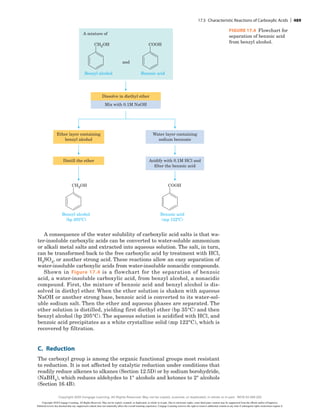
Shown in Figure 17.4 is a flowchart for the separation of benzoic
acid, a water-insoluble carboxylic acid, from benzyl alcohol, a nonacidic
­
compound. First, the mixture of benzoic acid and benzyl alcohol is dis-
solved in diethyl ether. When the ether solution is shaken with aqueous
NaOH or another strong base, benzoic acid is converted to its water-sol-
uble sodium salt. Then the ether and aqueous phases are separated. The
ether solution is distilled, yielding first diethyl ether (bp 35°C) and then
benzyl alcohol (bp 205°C). The aqueous solution is acidified with HCl, and
benzoic acid precipitates as a white crystalline solid (mp 122°C), which is
recovered by filtration.
C. ​Reduction
The carboxyl group is among the organic functional groups most resistant
to reduction. It is not affected by catalytic reduction under conditions that
readily reduce alkenes to alkanes (Section 12.5D) or by sodium borohydride,
(NaBH4), which reduces aldehydes to 1° alcohols and ketones to 2° alcohols
(Section 16.4B).
Mix with 0.1M NaOH
Dissolve in diethyl ether
Benzyl alcohol
CH2OH
and
Benzyl alcohol
(bp 205ºC)
CH2OH
Benzoic acid
COOH
A mixture of
Benzoic acid
(mp 122ºC)
COOH
Distill the ether
Water layer containing
sodium benzoate
Ether layer containing
benzyl alcohol
Acidify with 0.1M HCl and
filter the benzoic acid
FIGURE 17.4 Flowchart for
separation of benzoic acid
from benzyl alcohol.
17.5 Characteristic Reactions of Carboxylic Acids | 489
Copyright 2020 Cengage Learning. All Rights Reserved. May not be copied, scanned, or duplicated, in whole or in part. Due to electronic rights, some third party content may be suppressed from the eBook and/or eChapter(s).
Editorial review has deemed that any suppressed content does not materially affect the overall learning experience. Cengage Learning reserves the right to remove additional content at any time if subsequent rights restrictions require it.
Copyright 2020 Cengage Learning. All Rights Reserved. May not be copied, scanned, or duplicated, in whole or in part. WCN 02-200-202
The most common reagent for the reduction of a carboxylic acid to a 1° al-
cohol is the very powerful reducing agent lithium aluminum hydride, LiAlH4.
Reduction of a carboxyl group with this reagent is commonly carried out in
diethyl ether. The initial product is an aluminum alkoxide, which is then
treated with water to give the primary alcohol and lithium and aluminum hy-
droxides.These two hydroxides are insoluble in diethyl ether and are removed
by filtration. Evaporation of the ether solvent yields the primary alcohol.
3-Cyclopentene-
carboxylic acid
COH
LiAlH4, ether
H2O
4
3
2
1 1.
2.
4-Hydroxymethyl-
cyclopentene
O
CH2OH LiOH Al(OH)3
1 1
1
2
3
4
D. Fischer Esterification
Treatment of a carboxylic acid with an alcohol in the presence of an acid
catalyst—most commonly, concentrated sulfuric acid—gives an ester. This
method of forming an ester is given the special name Fischer ­esterification,
after the German chemist Emil Fischer (1852–1919). As an example of
Fischer esterification, treating acetic acid with ethanol in the presence of
concentrated sulfuric acid gives ethyl acetate and water:
H2SO4
CH3C9OH
O
O
1 1
CH3COCH2CH3 H2O
Ethanoic acid
(Acetic acid)
Removal of OH and
H gives the ester
Ethanol
(Ethyl alcohol)
Ethyl ethanoate
(Ethyl acetate)
H9OCH2CH3
We study the structure, nomenclature, and reactions of esters in detail in
Chapter 18. In this chapter, we discuss only their preparation from carboxy-
lic acids.
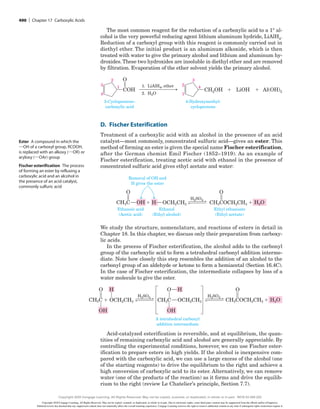
In the process of Fischer esterification, the alcohol adds to the carbonyl
group of the carboxylic acid to form a tetrahedral carbonyl addition interme-
diate. Note how closely this step resembles the addition of an alcohol to the
carbonyl group of an aldehyde or ketone to form a hemiacetal ­
(Section 16.4C).
In the case of Fischer esterification, the intermediate collapses by loss of a
water molecule to give the ester.
Acid-catalyzed esterification is reversible, and at equilibrium, the quan-
tities of remaining carboxylic acid and alcohol are generally appreciable. By
controlling the experimental conditions, however, we can use Fischer ester-
ification to prepare esters in high yields. If the alcohol is inexpensive com-
pared with the carboxylic acid, we can use a large excess of the alcohol (one
of the starting reagents) to drive the equilibrium to the right and achieve a
high conversion of carboxylic acid to its ester. Alternatively, we can remove
water (one of the products of the reaction) as it forms and drive the equilib-
rium to the right (review Le Chatelier’s principle, Section 7.7).
Ester A compound in which the
iOH of a carboxyl group, RCOOH,
is replaced with an alkoxy siORd or
aryloxy siOArd group
Fischer esterification ​The process
of forming an ester by refluxing a
carboxylic acid and an alcohol in
the presence of an acid catalyst,
commonly sulfuric acid
H2SO4 H2SO4
CH3C
O
OH
H
1 1
CH3C9OCH2CH3 H2O
A tetrahedral carbonyl
addition intermediate
OCH2CH3 CH3COCH2CH3
O
OH
O9H
490 | Chapter 17 Carboxylic Acids
Copyright 2020 Cengage Learning. All Rights Reserved. May not be copied, scanned, or duplicated, in whole or in part. Due to electronic rights, some third party content may be suppressed from the eBook and/or eChapter(s).
Editorial review has deemed that any suppressed content does not materially affect the overall learning experience. Cengage Learning reserves the right to remove additional content at any time if subsequent rights restrictions require it.
Copyright 2020 Cengage Learning. All Rights Reserved. May not be copied, scanned, or duplicated, in whole or in part. WCN 02-200-202
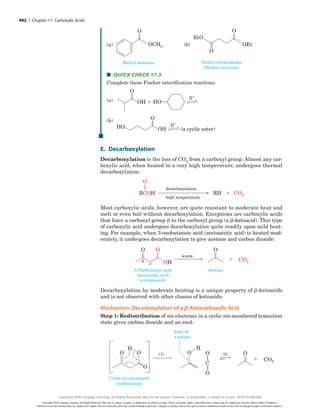
EXAMPLE 17.3 Fischer Esterification
Complete these Fischer esterification reactions (assume an excess of the
alcohol). The stoichiometry of each reaction is indicated in the problem.
(a)
H1
H1
COH 1 CH3OH
(a)
O
Benzoic acid
1
(b)
Butanedioic acid
(Succinic acid)
(excess)
OH 2 EtOH
HO
O
O
(b)
H1
H1
CH3OH 1
(b)
Butanedioic acid
(Succinic acid)
(excess)
OH 2 EtOH
HO
O
O
Strategy and Solution
Substitution of the iOR group of the alcohol for the iOH group of the
carboxyl group gives an ester. Here are the structural formulas and
names for the ester produced in each reaction.
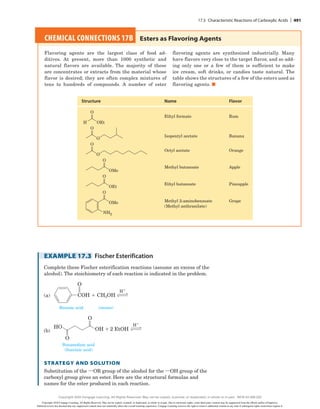
CHEMICAL CONNECTIONS 17B 
Esters as Flavoring Agents
Flavoring agents are the largest class of food ad-
ditives. At present, more than 1000 synthetic and
natural flavors are available. The majority of these
are concentrates or extracts from the material whose
flavor is desired; they are often complex mixtures of
tens to hundreds of compounds. A number of ester
flavoring agents are ­
synthesized ­
industrially. Many
have flavors very close to the target flavor, and so add-
ing only one or a few of them is sufficient to make
ice cream, soft drinks, or candies taste natural. The
table shows the structures of a few of the esters used as
flavoring agents. ■
Isopentyl acetate
Octyl acetate
Methyl butanoate
Ethyl butanoate
Methyl 2-aminobenzoate
(Methyl anthranilate)
Banana
Structure Name Flavor
Orange
Apple
Pineapple
Grape
Ethyl formate Rum
O
H OEt
O
O
O
O
O
OMe
O
OEt
O
OMe
NH2
17.5 Characteristic Reactions of Carboxylic Acids | 491
Copyright 2020 Cengage Learning. All Rights Reserved. May not be copied, scanned, or duplicated, in whole or in part. Due to electronic rights, some third party content may be suppressed from the eBook and/or eChapter(s).
Editorial review has deemed that any suppressed content does not materially affect the overall learning experience. Cengage Learning reserves the right to remove additional content at any time if subsequent rights restrictions require it.
Copyright 2020 Cengage Learning. All Rights Reserved. May not be copied, scanned, or duplicated, in whole or in part. WCN 02-200-202
(a)
(a)
O
OCH3
Methyl benzoate
(b)
(b)
O
O
OEt
EtO
Diethyl butanedioate
(Diethyl succinate)
■
■ Quick Check 17.3
Complete these Fischer esterification reactions:
(a) H1
H1
(a)
OH 1 HO9
O
(b)
OH (a cyclic ester)
HO
O
(b)
H1
H1
(a)
OH 1 HO9
O
(b)
OH (a cyclic ester)
HO
O
E. Decarboxylation
Decarboxylation is the loss of CO2 from a carboxyl group. Almost any car-
boxylic acid, when heated to a very high temperature, undergoes thermal
decarboxylation:
RH
decarboxylation
high temperature
RCOH CO2
1
O
Most carboxylic acids, however, are quite resistant to moderate heat and
melt or even boil without decarboxylation. Exceptions are carboxylic acids
that have a carbonyl group b to the carboxyl group (a b-ketoacid). This type
of carboxylic acid undergoes decarboxylation quite readily upon mild heat-
ing. For example, when 3-oxobutanoic acid (acetoacetic acid) is heated mod-
erately, it undergoes decarboxylation to give acetone and carbon dioxide:
O

 OH
O
warm
3-Oxobutanoic acid
(Acetoacetic acid)
(a -ketoacid)
Acetone
1
O
CO2
Decarboxylation by moderate heating is a unique property of b-ketoacids
and is not observed with other classes of ketoacids.
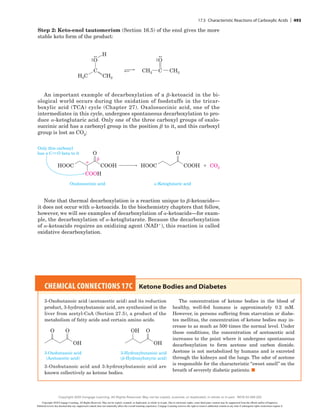
Mechanism: Decarboxylation of a b-Ketocarboxylic Acid
Step 1: Redistribution of six electrons in a cyclic six-membered transition
state gives carbon dioxide and an enol:
1
(1) (2)
Cyclic six-membered
conformation
C
O
O
H
O
O
O
Enol of
a ketone
H
O O
CO2
E1
492 | Chapter 17 Carboxylic Acids
Copyright 2020 Cengage Learning. All Rights Reserved. May not be copied, scanned, or duplicated, in whole or in part. Due to electronic rights, some third party content may be suppressed from the eBook and/or eChapter(s).
Editorial review has deemed that any suppressed content does not materially affect the overall learning experience. Cengage Learning reserves the right to remove additional content at any time if subsequent rights restrictions require it.
Copyright 2020 Cengage Learning. All Rights Reserved. May not be copied, scanned, or duplicated, in whole or in part. WCN 02-200-202
Step 2: Keto-enol tautomerism (Section 16.5) of the enol gives the more
stable keto form of the product:
CH2
H
C C
H3C
CH3
CH3
O O
An important example of decarboxylation of a b-ketoacid in the bi-
ological world occurs during the oxidation of foodstuffs in the tricar-
boxylic acid (TCA) cycle (Chapter 27). Oxalosuccinic acid, one of the
intermediates in this cycle, undergoes spontaneous decarboxylation to pro-
duce a-­
ketoglutaric acid. Only one of the three carboxyl groups of oxalo-
succinic acid has a carbonyl group in the position b to it, and this carboxyl
group is lost as CO2:
COOH
HOOC 1
-Ketoglutaric acid
Oxalosuccinic acid


Only this carboxyl
has a CRO beta to it O
CO2
COOH
COOH
HOOC
O
Note that thermal decarboxylation is a reaction unique to b-ketoacids—
it does not occur with a-ketoacids. In the biochemistry chapters that follow,
however, we will see examples of decarboxylation of a-ketoacids—for exam-
ple, the decarboxylation of a-ketoglutarate. Because the decarboxylation
of a-ketoacids requires an oxidizing agent (NAD1), this reaction is called
oxidative decarboxylation.
CHEMICAL CONNECTIONS 17C 
Ketone Bodies and Diabetes
3-Oxobutanoic acid (acetoacetic acid) and its reduction
product, 3-hydroxybutanoic acid, are synthesized in the
liver from acetyl-CoA (Section 27.5), a product of the
metabolism of fatty acids and certain amino acids.
OH
3-Hydroxybutanoic acid
(-Hydroxybutyric acid)
3-Oxobutanoic acid
(Acetoacetic acid)
O
OH
OH
O
O
3-Oxobutanoic acid and 3-hydroxybutanoic acid are
known collectively as ketone bodies.
The concentration of ketone bodies in the blood of
healthy, well-fed humans is approximately 0.2 mM.
However, in persons suffering from starvation or diabe-
tes mellitus, the concentration of ketone bodies may in-
crease to as much as 500 times the normal level. Under
these conditions, the concentration of acetoacetic acid
increases to the point where it undergoes spontaneous
decarboxylation to form acetone and carbon dioxide.
Acetone is not metabolized by humans and is excreted
through the kidneys and the lungs. The odor of acetone
is responsible for the characteristic “sweet smell” on the
breath of severely diabetic patients. ■
17.5 Characteristic Reactions of Carboxylic Acids | 493
Copyright 2020 Cengage Learning. All Rights Reserved. May not be copied, scanned, or duplicated, in whole or in part. Due to electronic rights, some third party content may be suppressed from the eBook and/or eChapter(s).
Editorial review has deemed that any suppressed content does not materially affect the overall learning experience. Cengage Learning reserves the right to remove additional content at any time if subsequent rights restrictions require it.
Copyright 2020 Cengage Learning. All Rights Reserved. May not be copied, scanned, or duplicated, in whole or in part. WCN 02-200-202
17.1 Carboxylic Acids
●
● The functional group of a carboxylic acid is the
carboxyl group, iCOOH.
17.2 Names of Carboxylic Acids
●
● IUPAC names of carboxylic acids are derived from the
name of the parent alkane by dropping the suffix -e and
adding -oic acid. Because the carboxyl group can only
occur at the end of a carbon chain, there is no need to
give it a number because it is automatically carbon 1.
●
● Dicarboxylic acids are named as -dioic acids.
●
● Common names for many carboxylic and dicarboxylic
acids are still widely used.
17.3 Physical Properties of Carboxylic Acids
●
● Carboxylic acids are polar compounds and can particip-
ate in hydrogen bonding as both a hydrogen-bond donor
and a hydrogen-bond acceptor. Consequently, they have
higher boiling points and are more soluble in water
than alcohols, aldehydes, ketones, and ethers of compar-
able molecular weight.
17.4 Soaps and Detergents
●
● Fatty acids are long, unbranched-chain carboxylic acids.
They can be saturated or unsaturated.
●
● A triglyceride is a triester of glycerol.
●
● A micelle is a spherical arrangement of molecules in
an aqueous environment in which the hydrocarbon
parts are on the inside and the hydrophilic parts are
on the surface.
17.5 Characteristic Reactions of Carboxylic Acids
●
● Carboxylic acids are weak acids that react with strong
bases to form water-soluble salts.
●
● Treatment of a carboxylic acid with an alcohol in the
presence of an acid catalyst gives an ester.
●
● When exposed to a very high temperature, carboxylic
acids can undergo decarboxylation.
chapter Summary
1. Acidity of Carboxylic Acids (Section 17.5A) ­Values
of pKa for most unsubstituted carboxylic acids are
within the range of 4 to 5.
[CH3COO2
][H3O1
]
[CH3COOH]
O
CH3COH 1 H2O EF Ka 1.74 3 10–5
O
CH3CO2
1 5
pKa 4.75
5
5
H3O1
[CH3COO2
][H3O1
]
[CH3COOH]
Ka 1.74 3 10–5
5
pKa 4.75
5
5
H3O1
2. Reaction of Carboxylic Acids with Bases
(Section 17.5B) Carboxylic acids, whether water-
soluble or insoluble, react with alkali metal hydroxides,
carbonates and bicarbonates, and ammonia and amines
to form water-soluble salts.
Na1
NaHCO3
H2O
CH3COOH 1
CO2
CH3COO2
1 1
Benzoic acid
(slightly soluble in water)
Na1
H2O
Sodium benzoate
(60 g/100 mL water)
NaOH
H2O
COOH
COO2
1
NaHCO3
CH3COOH 1
2
Benzoic acid
(slightly soluble in water)
Na1
H2O
Sodium benzoate
(60 g/100 mL water)
NaOH
H2O
COOH
COO2
Na1
NaHCO3
H2O
CH3COOH 1
CO2
CH3COO2
1 1
Benzoic acid
(slightly soluble in water)
Na1
H2O
Sodium benzoate
(60 g/100 mL water)
NaOH
H2O
COOH
COO2
Na1
NaHCO3
H2O
CH3COOH 1
CO2
CH3COO2
1 1
Benzoic acid
(slightly soluble in water)
Na1
H2O
Sodium benzoate
(60 g/100 mL water)
NaOH
H2O
COOH
COO2
3. Reduction by Lithium Aluminum Hydride
(Section 17.5C) Lithium aluminum hydride reduces a
carboxyl group to a primary alcohol. This reagent does
not normally reduce carbon–carbon double bonds, but
it does reduce aldehydes to 1° alcohols and ketones to
2° alcohols.
3-Cyclopentene-
carboxylic acid
COH
LiAlH4, ether
H2O
1.
2.
4-Hydroxymethyl-
cyclopentene
O
CH2OH LiOH Al(OH)3
1 1
4
3
2
1
1
2
3
4
3-Cyclopentene-
carboxylic acid
COH
LiAlH4, ether
H2O
1.
2.
4-Hydroxymethyl-
cyclopentene
O
CH2OH LiOH Al(OH)3
1 1
4
3
2
1
1
2
3
4
4. Fischer Esterification (Section 17.5D) Fischer
esterification is reversible.
In Fischer esterification, a carboxylic acid and an
alcohol are heated in the presence of a strong acid, most
commonly sulfuric acid, to produce an ester.
Summary of Key Reactions
494 | Chapter 17 Carboxylic Acids
Copyright 2020 Cengage Learning. All Rights Reserved. May not be copied, scanned, or duplicated, in whole or in part. Due to electronic rights, some third party content may be suppressed from the eBook and/or eChapter(s).
Editorial review has deemed that any suppressed content does not materially affect the overall learning experience. Cengage Learning reserves the right to remove additional content at any time if subsequent rights restrictions require it.
Copyright 2020 Cengage Learning. All Rights Reserved. May not be copied, scanned, or duplicated, in whole or in part. WCN 02-200-202
water can be removed from the reaction mixture as
it is formed.
5. Decarboxylation (Section 17.5E) Thermal decar-
boxylation is a unique property of b-ketoacids. The
immediate products of thermal decarboxylation of a b-
ketoacid are carbon dioxide and an enol. Loss of CO2 is
followed immediately by keto-enol tautomerism.
Acetone
3-Oxobutanoic acid
(Acetoacetic acid)
(a b-ketoacid)
O

 OH
O
O
warm
CO2
1
O
CH3COH CH3CH2OH
O
CH3COCH2CH3 H2O
H2SO4
Ethanoic acid
(Acetic acid)
Ethyl ethanoate
(Ethyl acetate)
Ethanol
(Ethyl alcohol)
O
CH3COH CH3CH2OH
O
CH3COCH2CH3 H2O
H2SO4
Ethanoic acid
(Acetic acid)
Ethyl ethanoate
(Ethyl acetate)
Ethanol
(Ethyl alcohol)
One way to force the equilibrium to the right
is to use an excess of the alcohol. Alternatively,
Problems
Problems marked with a green caret are applied.
17.1 Carboxylic Acids
1 Answer true or false.
(a) The functional groups of a carboxylic acid are a
carbonyl group bonded to a hydroxyl group.
(b) The VSEPR model predicts bond angles of 180°
about the carbonyl carbon of a carboxyl group.
(c) The VSEPR model predicts bond angles of 109.5° about
the oxygen of the OH group of a carboxyl group.
(d) The carbonyl carbon of a carboxyl group can be a
stereocenter, depending on its location within a
molecule.
(e) Carboxylic acids can be prepared by chromic acid
oxidation of primary alcohols and of aldehydes.
(f) The product of chromic acid oxidation of hexanoic
acid is 1-hexanol.
17.2 Names of Carboxylic Acids
2 Answer true or false.
(a) The general name of an aliphatic carboxylic acid
is alkanoic acid.
(b) A molecule containing two COOH groups is called
a dicarboxylic acid.
(c) Ethanedioic acid (oxalic acid) is the simplest
­dicarboxylic acid.
(d) 3-Methylbutanoic acid is chiral.
(e) The simplest carboxylic acid is methanoic acid
(common name: formic acid), HCO2H.
(f) Benzoic acid is an aromatic carboxylic acid.
(g) Formic acid, which is the common name for
HCO2H, is derived from the word formica, which
is the Latin name for ants.
(h) (S)-Lactic acid, CH3iCHOHiCOOH, contains
two functional groups: a 2° alcohol and a carboxyl
group.
3 Name and draw structural formulas for the four car-
boxylic acids with the molecular formula C5H10O2.
Which of these carboxylic acids are chiral?
4 Write the IUPAC name for each carboxylic acid.
(a)
O
(a)
O
(b)
OH
OH
(c)
COOH
NH2
  (b)
O
(a)
O
(b)
OH
OH
(c)
COOH
NH2
(c)
O
(a)
O
(b)
OH
OH
(c)
COOH
NH2
5 Write the IUPAC name for each carboxylic acid.
(a) (b)
(a)
COOH
OH
OH
COOH
HOOC
(c) CCl3COOH
  (b)
(b)
(a)
COOH
OH
OH
COOH
HOOC
(c) CCl3COOH
(c)
(b)
(a)
COOH
OH
OH
COOH
HOOC
(c) CCl3COOH
6 Draw a structural formula for each carboxylic acid.
(a) 4-Nitrophenylacetic acid
(b) 4-Aminobutanoic acid
(c) 4-Phenylbutanoic acid
(d) cis-3-Hexenedioic acid
7 Draw a structural formula for each carboxylic acid.
(a) 2-Aminopropanoic acid
(b) 3,5-Dinitrobenzoic acid
(c) Dichloroacetic acid
(d) o-Aminobenzoic acid
8 Draw a structural formula for each carboxylate salt.
(a) Sodium benzoate (b) Lithium acetate
(c) Ammonium acetate (d) Disodium adipate
(e) Sodium salicylate (f) Calcium butanoate
9 Calcium oxalate is a major component of ­
kidney
stones. Draw a structural formula for this compound.
10 The monopotassium salt of oxalic acid is present in
certain leafy vegetables, including rhubarb. Both oxalic
acid and its salts are poisonous in high concentrations.
Draw a structural formula for monopotassium oxalate.
▲
▲
Problems | 495
Copyright 2020 Cengage Learning. All Rights Reserved. May not be copied, scanned, or duplicated, in whole or in part. Due to electronic rights, some third party content may be suppressed from the eBook and/or eChapter(s).
Editorial review has deemed that any suppressed content does not materially affect the overall learning experience. Cengage Learning reserves the right to remove additional content at any time if subsequent rights restrictions require it.
Copyright 2020 Cengage Learning. All Rights Reserved. May not be copied, scanned, or duplicated, in whole or in part. WCN 02-200-202
17.3 Physical Properties of Carboxylic Acids
11 Answer true or false.
(a) Carboxylic acids are polar compounds.
(b) The most polar bond of a carboxyl group is the
CiO single bond.
(c) Carboxylic acids have significantly higher boiling
points than aldehydes, ketones, and alcohols of
comparable molecular weight.
(d) The low-molecular-weight carboxylic acids
(formic, acetic, propanoic, and butanoic acids)
are infinitely soluble in water.
(e) The following compounds are arranged in order of
increasing boiling point:
O O O
HOCCH2CH2COH  HOCCH2CH2CH3 
I II
O O O
HOCCH2CH2CH2CH2CH3  HOCCH2CH2CH2CH2COH
III IV
O O O
HOCCH2CH2COH  HOCCH2CH2CH3 
I II
O O O
HOCCH2CH2CH2CH2CH3  HOCCH2CH2CH2CH2COH
III IV
12 Draw a structural formula for the dimer formed when
two molecules of formic acid interact by hydrogen
bonding.
13 Propanedioic (malonic) acid forms an intramolecular hy-
drogen bond in which the H of one COOH group forms
a hydrogen bond with an O of the other COOH group.
Draw a structural formula to show this internal hydro-
gen bonding. (There are two ­
possible answers.)
14 Hexanoic (caproic) acid has a solubility in water of
about 1 g/100 mL water. Which part of the molecule
contributes to water solubility, and which part
prevents solubility?
15 Propanoic acid and methyl acetate are constitutional
isomers, and both are liquids at room temperature.
One of these compounds has a boiling point of 141ºC;
the other has a boiling point of 57ºC. Which compound
has which boiling point? Explain.
Propanoic acid
O
CH39CH29C9OH
Methyl acetate
O
CH39C9OCH3
16 The following compounds have approximately the
same molecular weight: hexanoic acid, heptanal, and
1-heptanol. Arrange them in order of increasing
boiling point.
17 The following compounds have approximately the same
molecular weight: propanoic acid, 1-butanol, and diethyl
ether. Arrange them in order of increasing boiling point.
18 Arrange these compounds in order of increasing solubility
in water: acetic acid, pentanoic acid, decanoic acid.
17.4 Soaps and Detergents
19 Answer true or false.
(a) Fatty acids are long-chain carboxylic acids, with
most consisting of between 12 to 20 carbons in an
unbranched chain.
(b) An unsaturated fatty acid contains one or more
carbon–carbon double bonds in its hydrocarbon
chain.
(c) In most unsaturated fatty acids found in animal
fats, vegetable oils, and biological membranes, the
cis isomer predominates.
(d) In general, unsaturated fatty acids have lower
melting points than saturated fatty acids with the
same number of carbon atoms.
(e) Natural soaps are sodium or potassium salts of
fatty acids.
(f) Soaps remove grease, oil, and fat stains by incor-
porating these substances into the nonpolar inte-
rior of soap micelles.
(g) “Hard water,” by definition, is water that contains
Ca21, Mg21, or Fe31 ions, all of which react with
soap molecules to form water-insoluble salts.
(h) The structure of synthetic detergents is patterned
after that of natural soaps.
(i) The most widely used synthetic detergents are the
linear alkylbenzenesulfonates (LAS).
(j) Present-day synthetic detergents do not form
water-insoluble salts with hard water.
(k) Most detergent preparations contain foam stabi-
lizers, a bleach, and optical brighteners (optical
bleaches).
20 Characterize the structural features necessary to
make a good synthetic detergent.
21 The detergents illustrated in this chapter are classified
as anionic detergents. Following are structural formu-
las for two other classifications of synthetic detergents:
cationic detergents and neutral detergents.
Benzyldimethyloctylammonium chloride
(a cationic detergent)
CH2
CH3(CH2)6CH2NCH3 Cl2
CH3
1
Pentaerythrityl palmitate
(a neutral detergent)
HOCH2
HOCH2CCH2OC(CH2)14CH3
HOCH2 O
Benzyldimethyloctylammonium chloride
(a cationic detergent)
CH2
CH3(CH2)6CH2NCH3 Cl2
CH3
1
Pentaerythrityl palmitate
(a neutral detergent)
HOCH2
HOCH2CCH2OC(CH2)14CH3
HOCH2 O
Explain how each compound is able to function as a
detergent.
22 Following are structural formulas for two more cat-
ionic detergents. Each is a mild surface-acting deter-
gent and fungicide and is used as a topical antiseptic
and disinfectant. They are examples of quaternary
ammonium detergents, commonly called “quats.”
Account for the detergent properties of each.
496 | Chapter 17 Carboxylic Acids
Copyright 2020 Cengage Learning. All Rights Reserved. May not be copied, scanned, or duplicated, in whole or in part. Due to electronic rights, some third party content may be suppressed from the eBook and/or eChapter(s).
Editorial review has deemed that any suppressed content does not materially affect the overall learning experience. Cengage Learning reserves the right to remove additional content at any time if subsequent rights restrictions require it.
Copyright 2020 Cengage Learning. All Rights Reserved. May not be copied, scanned, or duplicated, in whole or in part. WCN 02-200-202
(h) Conversion of compound I to compound II is best
accomplished by reduction with NaBH4.
COH CH2OH
HO
O
O
I II
(i) The following ester can be prepared by treating
benzoic acid with 1-butanol in the presence of a
catalytic amount of H2SO4:
O
OCH2CH2CH2CH3
OH
(j) Thermal decarboxylation of this b-ketoacid gives
benzoic acid and carbon dioxide:
OH
O O
(k) Thermal decarboxylation of this b-ketoacid gives
2-pentanone and carbon dioxide.
O O
CH3CH2CH2CCH2COH
24 Alcohols, phenols, and carboxylic acids all contain an
iOH group. Which are the strongest acids? Which are
the weakest acids?
25 Arrange these compounds in order of increasing acid-
ity: benzoic acid, benzyl alcohol, phenol.
26 Complete the equations for these acid–base reactions.
(a)
(a) CH2COOH 1 NaOH
(b)
(b) COOH 1 NaHCO3
(c) 1 NaHCO3
(c)
COOH
OCH3
(d) CH3CHCOOH 1 H2NCH2CH2OH
(d)
OH
(e)
(e) COO2Na1 1 HCl
27 Complete the equations for these acid–base reactions.
(a) 1 NaOH
(a)
OH
CH3
Cetylpyridinium chloride
CH3
CH3
CH2NCH2(CH2)14CH3
Cl2
1
Benzylcetyldimethylammonium chloride
Cl2
CH2(CH2)14CH3
1N
Cetylpyridinium chloride
CH3
CH3
CH2NCH2(CH2)14CH3
Cl2
1
Benzylcetyldimethylammonium chloride
Cl2
CH2(CH2)14CH3
1N
17.5 Characteristic Reactions of Carboxylic Acids
23 Answer true or false.
(a) Carboxylic acids are weak acids compared to min-
eral acids such as HCl, H2SO4, and HNO3.
(b) Phenols, alcohols, and carboxylic acids have in
common the presence of an iOH group.
(c) Carboxylic acids are stronger acids than alcohols
but weaker acids than phenols.
(d) The order of acidity of the following carboxylic
acids is:
OH
O
Cl
Cl
OH
A
C
B
D
. .
.
O
OH
O
OH
O
Cl
OH
O
Cl
Cl
OH
A
C
B
D
. .
.
O
OH
O
OH
O
Cl
(e) The order of acidity of the following carboxylic
acids is:
Cl
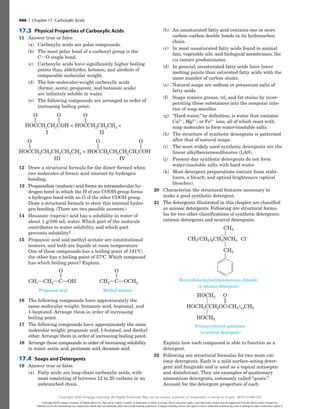
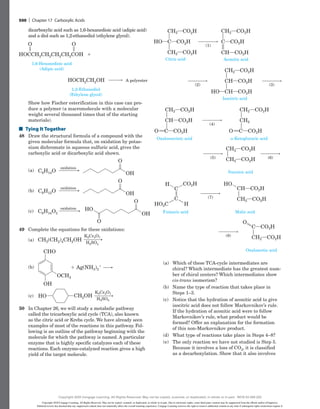
Cl
Cl
OH
O
Cl
Cl
OH
O
Cl
OH
. .
.
O
OH
O
A
C
B
D
Cl
Cl
Cl
OH
O
Cl
Cl
OH
O
Cl
OH
. .
.
O
OH
O
A
C
B
D
(f) The reaction of benzoic acid with aqueous
sodium hydroxide gives sodium benzoate.
(g) A mixture of the following compounds is extracted
in order with (1) 1 M HCl, (2) 1 M NaOH, and
(3) diethyl ether. Only compound II is extracted
into the basic layer.
I II III
O
O
NH2 C OH
Problems | 497
Copyright 2020 Cengage Learning. All Rights Reserved. May not be copied, scanned, or duplicated, in whole or in part. Due to electronic rights, some third party content may be suppressed from the eBook and/or eChapter(s).
Editorial review has deemed that any suppressed content does not materially affect the overall learning experience. Cengage Learning reserves the right to remove additional content at any time if subsequent rights restrictions require it.
Copyright 2020 Cengage Learning. All Rights Reserved. May not be copied, scanned, or duplicated, in whole or in part. WCN 02-200-202
(b)
CH3CHCOOH NaOH
(a)
NH3
CH3CHCOO Na NaOH
(b)
NH3
H2O
H2O
35 Which is the stronger base: CH3CH2NH2 or
CH3CH2COO2? Explain.
36 Complete the equations for the following acid–base
reactions. Assume one mole of HCl per mole of
amino acid.
(a) CH3CHCOO Na HCl
(a)
NH2
H2O
CH3CHCOO Na HCl
(b)
NH3
H2O
(b)
CH3CHCOO Na HCl
(a)
NH2
H2O
CH3CHCOO Na HCl
(b)
NH3
H2O
17.5D Fischer Esterification
37 Define and give an example of Fischer esterification.
38 Complete these examples of Fischer esterification. In
each case, assume an excess of the alcohol.
(a)
H
H
H
CH3CH2OH
(c)
COOH
COOH
CH3COOH HO
(b)
CH3COOH
(a) HO
(b)
H
H
H
CH3CH2OH
(c)
COOH
COOH
CH3COOH HO
(b)
CH3COOH
(a) HO
(c)
H
H
H
CH3CH2OH
(c)
COOH
COOH
CH3COOH HO
(b)
CH3COOH
(a) HO
39 From what carboxylic acid and alcohol is each ester
derived?
(a) OCCH3
CH3CO
(a)
CH3OCCH2CH2COCH3
(c)
(d)
O O
COCH3
(b)
O
O O
O
O
(b)
OCCH3
CH3CO
(a)
CH3OCCH2CH2COCH3
(c)
(d)
O O
COCH3
(b)
O
O O
O
O
(c)
OCCH3
CH3CO
(a)
CH3OCCH2CH2COCH3
(c)
(d)
O O
COCH3
(b)
O
O O
O
O
(d)
OCCH3
CH3CO
(a)
CH3OCCH2CH2COCH3
(c)
(d)
O O
COCH3
(b)
O
O O
O
O
40 Methyl 2-hydroxybenzoate (methyl salicylate) has
the odor of oil of wintergreen. This compound is pre-
pared by Fischer esterification of 2-hydroxybenzoic
acid (salicylic acid) with methanol. Draw a struc-
tural formula for methyl 2-hydroxybenzoate.
▲
(b) 1 HCl
(b)
COO2Na1
OH
(c) 1 H2NCH2CH2OH
(c)
COOH
OCH3
(d) 1 NaHCO3
(d) COOH
28 Formic acid is one of the components responsible for
the sting of biting ants. The pain can be relieved by
rubbing the area of the sting with a paste of baking
soda (NaHCO3) and water, which neutralizes the acid.
Write an equation for this reaction.
29 Starting with the definition of Ka of a weak acid,
HA, as
HA 1 H2O m A2 1 H3O1  Ka 5
fA2gfH3O1g
fHAg
show that:
fA2g
fHAg
5
Ka
fH3O1g
30 Using the equation from Problem 29 that shows the
relationship between Ka, fH3O1g, fA2g, and fHAg, cal-
culate the ratio of fA2g to fHAg in a solution whose
pH is:
(a) 2.0 (b) 5.0
(c) 7.0 (d) 9.0
(e) 11.0
Assume that the pKa of the weak acid is 5.0.
31 The pKa of acetic acid is 4.75. What form(s) of acetic
acid are present at pH 2.0 or lower? At pH 4.75? At pH
8.0 or higher?
32 The normal pH range for blood plasma is 7.35 to 7.45.
Under these conditions, would you expect the carboxyl
group of lactic acid (pKa 4.07) to exist ­
primarily as a
carboxyl group or as a carboxylate anion? Explain.
33 The pKa of ascorbic acid (Vitamin C, see Chemical
­
Connections 19B) is 4.10. Would you expect ascorbic
acid dissolved in blood plasma, pH 7.35–7.45, to ­
exist
primarily as ascorbic acid or as ascorbate ­
anion?
Explain.
34 Complete the equations for the following acid–base re-
actions. Assume one mole of NaOH per mole of amino
acid. (Hint: Review Section 8.4.)
(a) CH3CHCOOH NaOH
(a)
NH3
CH3CHCOO Na NaOH
(b)
NH3
H2O
H2O
▲
▲
▲
498 | Chapter 17 Carboxylic Acids
Copyright 2020 Cengage Learning. All Rights Reserved. May not be copied, scanned, or duplicated, in whole or in part. Due to electronic rights, some third party content may be suppressed from the eBook and/or eChapter(s).
Editorial review has deemed that any suppressed content does not materially affect the overall learning experience. Cengage Learning reserves the right to remove additional content at any time if subsequent rights restrictions require it.
Copyright 2020 Cengage Learning. All Rights Reserved. May not be copied, scanned, or duplicated, in whole or in part. WCN 02-200-202
44 Methylparaben and propylparaben are used as
preservatives in foods, beverages, and cosmetics.
OH
O
OCH3
O
O
H2N
H2N
H2N
O
4-Aminobenzoic acid
(p-Aminobenzoic acid)
Methyl 4-aminobenzoate
(Methylparaben)
Propyl 4-aminobenzoate
(Propylparaben)
Show how each of these preservatives can be prepared
from 4-aminobenzoic acid.
45 4-Aminobenzoic acid is prepared from benzoic acid by
the following two steps.
OH (1)
O
Benzoic acid
OH
O
O2N
4-Nitrobenzoic acid
(2) OH
O
H2N
4-Aminobenzoic acid
OH (1)
O
Benzoic acid
OH
O
O2N
4-Nitrobenzoic acid
(2) OH
O
H2N
4-Aminobenzoic acid
Show reagents and experimental conditions to bring
about each step.
■
■ Looking Ahead
46 When 5-hydroxypentanoic acid is treated with an acid
catalyst, it forms a lactone (a cyclic ester). Draw a
structural formula for this lactone.
47 We have seen that esters can be prepared by treatment
of a carboxylic acid with an alcohol in the presence of
an acid catalyst. Suppose you start instead with a
▲
41 Show how you could convert cinnamic acid to each
compound.
OH
O
OH
OH
O
OCH2CH3
O
trans-3-Phenyl-2-propenoic acid
(Cinnamic acid)
■
■ Additional Problems
42 Give the expected organic product formed when phe-
nylacetic acid, C6H5CH2COOH, is treated with each
of the following reagents:
(a) NaHCO3, H2O		 (b) NaOH, H2O
(c) NH3, H2O			 (d) LiAlH4 then H2O
(e) NaBH4 then H2O (f)	
CH3OH 1 H2SO4
     (catalyst)
(g) H2 y Ni
43 Procaine (its hydrochloride salt is marketed as No-
vocaine) was one of the first local anesthetics devel-
oped for infiltration and regional ­
anesthesia. It is
synthesized by the following Fischer esterification:
OH
O
H2N
4-Aminobenzoic acid 2-Diethylaminoethanol
HO
N
Fischer
esterification
Procaine
1
OH
O
H2N
4-Aminobenzoic acid 2-Diethylaminoethanol
HO
N
Fischer
esterification
Procaine
1
(a) Draw the structural formula of Procaine.
(b) Which of the two nitrogen atoms in Procaine is
the stronger base?
(c) Draw the structural formula of Novocaine (the hy-
drochloride salt of Procaine).
(d) Would you predict Procaine or Novocaine to be
more soluble in blood?
Problems | 499
Copyright 2020 Cengage Learning. All Rights Reserved. May not be copied, scanned, or duplicated, in whole or in part. Due to electronic rights, some third party content may be suppressed from the eBook and/or eChapter(s).
Editorial review has deemed that any suppressed content does not materially affect the overall learning experience. Cengage Learning reserves the right to remove additional content at any time if subsequent rights restrictions require it.
Copyright 2020 Cengage Learning. All Rights Reserved. May not be copied, scanned, or duplicated, in whole or in part. WCN 02-200-202
Citric acid Aconitic acid
Isocitric acid
CH2iCO2H
HOiCiCO2H
CH2iCO2H
HOiCHiCO2H
CH2iCO2H
CHiCO2H
CiCO2H
CH2iCO2H
CHiCO2H
(1)
(2) (3)
Oxalosuccinic acid
CH2iCO2H
OwCiCO2H
CHiCO2H
(4)
a-Ketoglutaric acid
OwCiCO2H
CH2iCO2H
CH2
(5)
Succinic acid
CH2iCO2H
CH2iCO2H (6)
(7)
Malic acid
Fumaric acid
Oxaloacetic acid
(8)
H CO2H
HO2C
C
C
H
CH2iCO2H
HO
CHiCO2H
CH2iCO2H
O
CiCO2H
Citric acid Aconitic acid
Isocitric acid
CH2iCO2H
HOiCiCO2H
CH2iCO2H
HOiCHiCO2H
CH2iCO2H
CHiCO2H
CiCO2H
CH2iCO2H
CHiCO2H
(1)
(2) (3)
Oxalosuccinic acid
CH2iCO2H
OwCiCO2H
CHiCO2H
(4)
a-Ketoglutaric acid
OwCiCO2H
CH2iCO2H
CH2
(5)
Succinic acid
CH2iCO2H
CH2iCO2H (6)
(7)
Malic acid
Fumaric acid
Oxaloacetic acid
(8)
H CO2H
HO2C
C
C
H
CH2iCO2H
HO
CHiCO2H
CH2iCO2H
O
CiCO2H
Citric acid Aconitic acid
Isocitric acid
CH2iCO2H
HOiCiCO2H
CH2iCO2H
HOiCHiCO2H
CH2iCO2H
CHiCO2H
CiCO2H
CH2iCO2H
CHiCO2H
(1)
(2) (3)
Oxalosuccinic acid
CH2iCO2H
OwCiCO2H
CHiCO2H
(4)
a-Ketoglutaric acid
OwCiCO2H
CH2iCO2H
CH2
(5)
Succinic acid
CH2iCO2H
CH2iCO2H (6)
(7)
Malic acid
Fumaric acid
Oxaloacetic acid
(8)
H CO2H
HO2C
C
C
H
CH2iCO2H
HO
CHiCO2H
CH2iCO2H
O
CiCO2H
Citric acid Aconitic acid
Isocitric acid
CH2iCO2H
HOiCiCO2H
CH2iCO2H
HOiCHiCO2H
CH2iCO2H
CHiCO2H
CiCO2H
CH2iCO2H
CHiCO2H
(1)
(2) (3)
Oxalosuccinic acid
CH2iCO2H
OwCiCO2H
CHiCO2H
(4)
a-Ketoglutaric acid
OwCiCO2H
CH2iCO2H
CH2
(5)
Succinic acid
CH2iCO2H
CH2iCO2H (6)
(7)
Malic acid
Fumaric acid
Oxaloacetic acid
(8)
H CO2H
HO2C
C
C
H
CH2iCO2H
HO
CHiCO2H
CH2iCO2H
O
CiCO2H
Citric acid Aconitic acid
Isocitric acid
CH2iCO2H
HOiCiCO2H
CH2iCO2H
HOiCHiCO2H
CH2iCO2H
CHiCO2H
CiCO2H
CH2iCO2H
CHiCO2H
(1)
(2) (3)
Oxalosuccinic acid
CH2iCO2H
OwCiCO2H
CHiCO2H
(4)
a-Ketoglutaric acid
OwCiCO2H
CH2iCO2H
CH2
(5)
Succinic acid
CH2iCO2H
CH2iCO2H (6)
(7)
Malic acid
Fumaric acid
Oxaloacetic acid
(8)
H CO2H
HO2C
C
C
H
CH2iCO2H
HO
CHiCO2H
CH2iCO2H
O
CiCO2H
Citric acid Aconitic acid
Isocitric acid
CH2iCO2H
HOiCiCO2H
CH2iCO2H
HOiCHiCO2H
CH2iCO2H
CHiCO2H
CiCO2H
CH2iCO2H
CHiCO2H
(1)
(2) (3)
Oxalosuccinic acid
CH2iCO2H
OwCiCO2H
CHiCO2H
(4)
a-Ketoglutaric acid
OwCiCO2H
CH2iCO2H
CH2
(5)
Succinic acid
CH2iCO2H
CH2iCO2H (6)
(7)
Malic acid
Fumaric acid
Oxaloacetic acid
(8)
H CO2H
HO2C
C
C
H
CH2iCO2H
HO
CHiCO2H
CH2iCO2H
O
CiCO2H
(a) Which of these TCA-cycle intermediates are
chiral? Which intermediate has the greatest num-
ber of chiral centers? Which intermediates show
cis-trans isomerism?
(b) Name the type of reaction that takes place in
Steps 1–3.
(c) Notice that the hydration of aconitic acid to give
isocitric acid does not follow Markovnikov’s rule.
If the hydration of aconitic acid were to follow
Markovnikov’s rule, what product would be
formed? Offer an explanation for the formation
of this non-Markovnikov product.
(d) What type of reactions take place in Steps 4–8?
(e) The only reaction we have not studied is Step 5.
Because it involves a loss of CO2, it is classified
as a decarboxylation. Show that it also involves
dicarboxylic acid such as 1,6-hexanedioic acid (adipic acid)
and a diol such as 1,2-ethanediol (ethylene glycol).
1,6-Hexanedioic acid
(Adipic acid)
O O
HOCCH2CH2CH2CH2COH
1,2-Ethanediol
(Ethylene glycol)
HOCH2CH2OH A polyester
1
1,6-Hexanedioic acid
(Adipic acid)
O O
HOCCH2CH2CH2CH2COH
1,2-Ethanediol
(Ethylene glycol)
HOCH2CH2OH A polyester
1
Show how Fischer esterification in this case can pro-
duce a polymer (a macromolecule with a molecular
weight several thousand times that of the starting
materials).
■
■ Tying It Together
48 Draw the structural formula of a compound with the
given molecular formula that, on oxidation by potas-
sium dichromate in aqueous sulfuric acid, gives the
carboxylic acid or dicarboxylic acid shown.
(a)
O
OH
(a) C6H14O
oxidation
O
OH
oxidation
O
OH
HO
O
oxidation
(b) C6H12O
(c) C6H14O2
(b)
O
OH
(a) C6H14O
oxidation
O
OH
oxidation
O
OH
HO
O
oxidation
(b) C6H12O
(c) C6H14O2
(c)
O
OH
(a) C6H14O
oxidation
O
OH
oxidation
O
OH
HO
O
oxidation
(b) C6H12O
(c) C6H14O2
49 Complete the equations for these oxidations:
(a)
(a) CH3(CH2)4CH2OH
K2Cr2O7
H2SO4
(b)
(b)
OCH3
CHO
OH
1 Ag(NH3)2
1
(c)
(c)
K2Cr2O7
H2SO4
CH2OH
HO
50 In Chapter 26, we will study a metabolic pathway
called the tricarboxylic acid cycle (TCA), also known
as the citric acid or Krebs cycle. We have already seen
examples of most of the reactions in this pathway. Fol-
lowing is an outline of the pathway beginning with the
molecule for which the pathway is named. A particular
enzyme that is highly specific catalyzes each of these
reactions. Each enzyme-catalyzed reaction gives a high
yield of the target molecule.
500 | Chapter 17 Carboxylic Acids
Copyright 2020 Cengage Learning. All Rights Reserved. May not be copied, scanned, or duplicated, in whole or in part. Due to electronic rights, some third party content may be suppressed from the eBook and/or eChapter(s).
Editorial review has deemed that any suppressed content does not materially affect the overall learning experience. Cengage Learning reserves the right to remove additional content at any time if subsequent rights restrictions require it.
Copyright 2020 Cengage Learning. All Rights Reserved. May not be copied, scanned, or duplicated, in whole or in part. WCN 02-200-202
(c) Is azithromycin chiral? If so, how many stereoiso-
mers are possible for this structural formula?
(d) Azithromycin contains a very large ring and two
smaller six-membered rings. The larger ring is
closed by an intramolecular ester bond. Show that
each smaller ring is attached to the larger ring by
one arm of an acetal group. If each acetal were to be
cleaved by hydrolysis to an alcohol and a carbonyl-
containing compound, draw the structural for-
mula of the two carbonyl-containing compounds
that would be formed. (Hint: It may be difficult to
identify the acetal group but remember that the
characteristic structural feature of an acetal is a
carbon bonded to two —OR groups.
52 Below is the structural formula of a compound known
as the queen substance, which is secreted in the man-
dibular gland of queen honey bees (Apis mellifera).
The queen substance inhibits the development of
ovaries in worker bees, prevents queen cell formation,
and attracts male bees (drones) to virgin queens for
the purpose of mating. Write the IUPAC name of this
compound. Note that in the IUPAC system, when the
carboxylic acid also contains an aldehyde or ketone
group in the molecule, the presence of the aldehyde
or ketone group is indicated by the prefix -oxo.
Queen substance
H
H COOH
O
oxidation. Because it involves both oxidation and
decarboxylation, it is classified as an oxidative
decarboxylation.
(f) Reaction 4 is also classified as a decarboxyla­
tion. Does this decarboxylation also involve an
oxidation?
51 Azithromycin is a broad-spectrum antibiotic derived
from erythromycin. It is one of a large number of what
are called macrocyclic antibiotics, so named because
they contain a large ring as part of their structure.
Like many of the macrocyclic antibiotics, azithromy-
cin has an incredibly complex structure, and it was
an enormous challenge for chemists to determine its
structural formula.
Azithromycin
C38H72N2O12
O
O
O
O
CH3
N
N
O
O
O
HO
HO
HO
OH
OH
CH3
CH3
CH3
CH3
CH3
CH3
CH3
H3C
H3C
H3C
H3C
CH3
CH3
(a) What is the size of the large ring in this antibiotic?
(b) Name the functional groups present in
azithromycin.
Problems | 501
Copyright 2020 Cengage Learning. All Rights Reserved. May not be copied, scanned, or duplicated, in whole or in part. Due to electronic rights, some third party content may be suppressed from the eBook and/or eChapter(s).
Editorial review has deemed that any suppressed content does not materially affect the overall learning experience. Cengage Learning reserves the right to remove additional content at any time if subsequent rights restrictions require it.
Copyright 2020 Cengage Learning. All Rights Reserved. May not be copied, scanned, or duplicated, in whole or in part. WCN 02-200-202

Chap17 Carboxylic Acids (1).pdf

  • 1.
    476 CarboxylicAcids 17 Contents 17.1 Carboxylic Acids 17.2Names of Carboxylic Acids 17.3 Physical Properties of Carboxylic Acids 17.4 Soaps and Detergents 17.5 Characteristic Reactions of Carboxylic Acids 17.1 Carboxylic Acids In this chapter, we study carboxylic acids, another class of organic com- pounds containing the carbonyl group. The carboxylic acid functional group can be represented in any one of three ways: 9C9OH 9COOH 9CO2H O 17.2 Names of Carboxylic Acids A. IUPAC Names The longest carbon chain that contains the carboxylic acid functional group is used to obtain the IUPAC name of an acyclic carboxylic acid. Drop the final -e from the name of the parent alkane and replace it with -oic acid. Number the chain beginning with the carbonyl carbon of the carboxylic acid. Because this carbonyl carbon is understood to be carbon 1, there is no © Ruslan Mitin/Shutterstock.com These foods can contain low levels of harmful trans fats. Copyright 2020 Cengage Learning. All Rights Reserved. May not be copied, scanned, or duplicated, in whole or in part. Due to electronic rights, some third party content may be suppressed from the eBook and/or eChapter(s). Editorial review has deemed that any suppressed content does not materially affect the overall learning experience. Cengage Learning reserves the right to remove additional content at any time if subsequent rights restrictions require it. Copyright 2020 Cengage Learning. All Rights Reserved. May not be copied, scanned, or duplicated, in whole or in part. WCN 02-200-202
  • 2.
    need to giveit a number in the final IUPAC name. In the following exam- ples, the common name is given in parentheses. 3-Methylbutanoic acid (Isovaleric acid) OH O 1 3 Hexanoic acid (Caproic acid) OH O 1 6 4 When a carboxylic acid also contains an iOH (hydroxyl) group, we indi- cate its presence by adding the prefix hydroxy-. When it contains a primary (1°) amine, we indicate the presence of the iNH2 group with amino-. When a carboxylic acid also contains a ketone or aldehyde group, we indicate the presence of that group by the prefix -oxo. 4-Aminobenzoic acid (p-Aminobenzoic acid) COOH H2N 5 5-Hydroxyhexanoic acid OH OH O 1 3-Oxobutanoic acid (-Ketobutyric acid, Acetoacetic acid) 2-Oxopropanoic acid (Pyruvic acid) CH3CCH2CO2H CH3CCO2H O O To name dicarboxylic acids, we add the suffix -dioic acid to the name of the parent alkane that contains both carboxylic acids. The numbers of the carbonyl carbon of the carboxylic acids carbons are not indicated because they can be only at the ends of the parent chain. Ethanedioic acid (Oxalic acid) OH HO O O 1 2 Propanedioic acid (Malonic acid) OH HO O 3 O 1 The name oxalic acid is derived from one of its sources in the biological world—plants of the genus Oxalis, one of which is rhubarb. Oxalic acid also occurs in human and animal urine, and calcium oxalate is a major com- ponent of kidney stones. Succinic acid is an intermediate in the citric acid cycle (Section 26.4). Adipic acid is one of the two monomers required for the synthesis of the polymer nylon-66 (Section 17.6B). B. Common Names Common names for aliphatic carboxylic acids, many of which were known long before the development of IUPAC nomenclature, are often derived from the name of a natural source from which the acid could be isolated. Table 17.1 lists several of the unbranched aliphatic carboxylic acids found in the biological world along with the common name of each. Those with 16, 18, and 20 carbon atoms are particularly abundant in animal fats and vegetable oils (Section 20.2) and the phospholipid components of biological membranes (Section 20.5). Butanedioic acid (Succinic acid) OH HO O O O 1 4 Pentanedioic acid (Glutaric acid) OH HO O 5 O 1 Hexanedioic acid (Adipic acid) OH HO 6 O 1 17.2 Names of Carboxylic Acids | 477 Copyright 2020 Cengage Learning. All Rights Reserved. May not be copied, scanned, or duplicated, in whole or in part. Due to electronic rights, some third party content may be suppressed from the eBook and/or eChapter(s). Editorial review has deemed that any suppressed content does not materially affect the overall learning experience. Cengage Learning reserves the right to remove additional content at any time if subsequent rights restrictions require it. Copyright 2020 Cengage Learning. All Rights Reserved. May not be copied, scanned, or duplicated, in whole or in part. WCN 02-200-202
  • 3.
    When common namesare used, the Greek letters alpha sad, beta sbd, gamma sgd, and so forth, are often added as a prefix to locate substituents. In the example below, we give the IUPAC name, followed by a common name and four-letter abbreviation. GABA is a neurotransmitter in the cen- tral nervous system. Interestingly, the b location will be important when discussing lipid metabolism of fatty acids. This metabolic cycle is called b-oxidation (Section 27.5). 4-Aminobutanoic acid (-Aminobutyric acid; GABA) OH C9C9C9C9OH H2N O O 1 1 2 3 4 4 Example 17.1 IUPAC Names for Carboxylic Acids Write the IUPAC name for each carboxylic acid: (a) COOH HO COOH H H COOH      (b) COOH HO COOH H H COOH (c) COOH HO COOH H H COOH Strategy and Solution (a) The IUPAC name for an acyclic carboxylic acid begins with identifying the longest carbon chain containing the carboxylic acid. The longest carbon chain (red numbers) that contains the carboxylic acid (shaded Table 17.1 Several Aliphatic Carboxylic Acids and Their Common Names Structure IUPAC Name Common Name Derivation HCOOH methanoic acid formic acid ▲ Latin: formica, ant CH3COOH ethanoic acid acetic acid Latin: acetum, vinegar CH3CH2COOH propanoic acid propionic acid Greek: propion, first fat CH3sCH2d2COOH butanoic acid butyric acid Latin: butyrum, butter CH3sCH2d3COOH pentanoic acid valeric acid Latin: valere, to be strong CH3sCH2d4COOH hexanoic acid caproic acid Latin: caper, goat CH3sCH2d6COOH octanoic acid caprylic acid Latin: caper, goat CH3sCH2d8COOH decanoic acid capric acid Latin: caper, goat CH3sCH2d10COOH dodecanoic acid lauric acid Latin: laurus, laurel CH3sCH2d12COOH tetradecanoic acid myristic acid Greek: myristikos, fragrant CH3sCH2d14COOH hexadecanoic acid palmitic acid Latin: palma, palm tree CH3sCH2d16COOH octadecanoic acid stearic acid Greek: stear, solid fat CH3sCH2d18COOH eicosanoic acid arachidic acid Greek: arachis, peanut Ted Nelson/Dembinsky Photo Associates Formic acid was first obtained in 1670 from the destructive distillation of ants, whose Latin genus is Formica. It is one of the components of the venom injected by stinging ants. 478 | Chapter 17 Carboxylic Acids Copyright 2020 Cengage Learning. All Rights Reserved. May not be copied, scanned, or duplicated, in whole or in part. Due to electronic rights, some third party content may be suppressed from the eBook and/or eChapter(s). Editorial review has deemed that any suppressed content does not materially affect the overall learning experience. Cengage Learning reserves the right to remove additional content at any time if subsequent rights restrictions require it. Copyright 2020 Cengage Learning. All Rights Reserved. May not be copied, scanned, or duplicated, in whole or in part. WCN 02-200-202
  • 4.
    in blue withcondensed formula, iCOOH) has five carbons; therefore, the parent alkane is pentane. Also attached to the longest carbon chain is the ethyl alkyl group (shaded in yellow). The IUPAC name is 2-ethylpentanoic acid. 5 4 3 2 1 COOH (b) Some carboxylic acids have historical names. These historical names have carried over into the IUPAC nomenclature system. One of these historical carboxylic acids is benzoic acid (shaded in pink). When a hydrogen atom is removed from an aromatic group, this is called an aryl group, and this aryl group is used to number the carbons. There- fore, carbon 1 is the aryl carbon bonded to the carbonyl carbon of the carboxylic acid (red numbers). Carbon 4 has a hydroxy group (shaded in yellow) bonded. The final IUPAC name is 4-hydroxybenzoic acid. 3 2 5 4 6 1 COOH HO (c) In this example, the aromatic ring is treated as a substituent and is called a phenyl group, C6H5i). Therefore, the longest carbon (red numbers) chain is three carbons, and the parent name for three car- bons is called propane. However, this three-carbon chain not only has the carboxylic acid; it also has an alkene functional group. Therefore, the propane name must change to reflect these functional groups. propanehdrop “e” and replace with “oic acid”hpropanoic acidhdrop “a” and replace with “e” to show alkenehpropenoic acid Finally, the type of isomer must be indicated in the final name. Since the two hydrogens are on opposite sides of the alkene double bond, this is the trans isomer. The final name is trans-3-phenyl-2-propenoic acid (cinnamic acid) 2 1 3 H H COOH ■ ■ Quick Check 17.1 Each of the following compounds has a well-recognized and widely used common name. A derivative of glyceric acid is an intermediate in gly- colysis (Section 27.2). b-Alanine is a building block of pantothenic acid (Section 26.5). Mevalonic acid is an intermediate in the biosynthesis of steroids (Section 26.4). Write the IUPAC name for each compound. (a) COOH CHOH CH2OH Glyceric acid (a) (b) H2NCH2CH2COOH b-Alanine (c) HO HO CH3 COOH Mevalonic acid    (b) COOH CHOH CH2OH Glyceric acid (a) (b) H2NCH2CH2COOH b-Alanine (c) HO HO CH3 COOH Mevalonic acid    (c) COOH CHOH CH2OH Glyceric acid (a) (b) H2NCH2CH2COOH b-Alanine (c) HO HO CH3 COOH Mevalonic acid 17.2 Names of Carboxylic Acids | 479 Copyright 2020 Cengage Learning. All Rights Reserved. May not be copied, scanned, or duplicated, in whole or in part. Due to electronic rights, some third party content may be suppressed from the eBook and/or eChapter(s). Editorial review has deemed that any suppressed content does not materially affect the overall learning experience. Cengage Learning reserves the right to remove additional content at any time if subsequent rights restrictions require it. Copyright 2020 Cengage Learning. All Rights Reserved. May not be copied, scanned, or duplicated, in whole or in part. WCN 02-200-202
  • 5.
    17.3 Physical Propertiesof Carboxylic Acids A major feature of carboxylic acids is the polarity of the carboxyl group ­(Figure 17.1). This group contains three polar covalent bonds: CwO, CiO, and OiH. The polarity of these bonds determines the major physical prop- erties of carboxylic acids. CH3COH O Acetic acid FIGURE 17.1 Polarity of a carboxyl group. Carboxylic acids have significantly higher boiling points than other types of organic compounds of comparable molecular weight (Table 17.2). Their higher boiling points result from their polarity and the fact that hydrogen bonding between two carboxyl groups creates a dimer that behaves as a higher-molecular-weight compound. Hydrogen bonding between two molecules A hydrogen-bonded dimer of acetic acid H3C9C C9CH3 O9H O O H9O 1 2 2 1 Carboxylic acids are more soluble in water than are alcohols, ethers, al- dehydes, and ketones of comparable molecular weight. This increased solu- bility is due to their strong association with water molecules by hydrogen bonding through both their carbonyl and hydroxyl groups. The first four aliphatic carboxylic acids (formic, acetic, propanoic, and butanoic) are in- finitely soluble in water. As the size of the hydrocarbon chain increases rel- ative to that of the carboxyl group, water solubility decreases. The solubility of hexanoic acid (six carbons) in water is 1.0 g/100 mL water. Table 17.2 Boiling Points and Solubilities in Water of Two Groups of Compounds of Comparable Molecular Weight Structure Name Molecular Weight (amu) Boiling Point (°C) Solubility (g/100 mL H2O) CH3COOH acetic acid 60.1 118 infinite CH3CH2CH2OH 1-propanol 60.1 97 infinite CH3CH2CHO propanal 58.1 48 16 CH3sCH2d2COOH butanoic acid 88.1 163 infinite CH3sCH2d3CH2OH 1-pentanol 88.1 137 2.3 CH3sCH2d3CHO pentanal 86.1 103 slight 480 | Chapter 17 Carboxylic Acids Copyright 2020 Cengage Learning. All Rights Reserved. May not be copied, scanned, or duplicated, in whole or in part. Due to electronic rights, some third party content may be suppressed from the eBook and/or eChapter(s). Editorial review has deemed that any suppressed content does not materially affect the overall learning experience. Cengage Learning reserves the right to remove additional content at any time if subsequent rights restrictions require it. Copyright 2020 Cengage Learning. All Rights Reserved. May not be copied, scanned, or duplicated, in whole or in part. WCN 02-200-202
  • 6.
    We must mentiontwo other properties of carboxylic acids. First, the liq- uid carboxylic acids from propanoic acid to decanoic acid have sharp, often disagreeable odors. Butanoic acid is found in stale perspiration and is a ma- jor component of “locker room odor.” Pentanoic acid smells even worse, and goats, which secrete C6, C8, and C10 carboxylic acids (Table 17.1), are not fa- mous for their pleasant odors. Second, carboxylic acids have a characteristic sour taste. The sour taste of pickles and sauerkraut, for example, is due to the presence of lactic acid. The sour tastes of limes (pH 1.9), lemons (pH 2.3), and grapefruit (pH 3.2) are due to the presence of citric and other acids. 17.4 Soaps and Detergents A. Fatty Acids More than 500 different fatty acids have been isolated from various cells and tissues. Given in Table 17.3 are common names and structural formu- las for the most abundant fatty acids. The number of carbons in a fatty acid and the number of carbon–carbon double bonds in its hydrocarbon chain are shown by two numbers separated by a colon. In this notation, linoleic acid, for example, is designated as an 18:2 fatty acid; its 18-carbon chain contains two carbon–carbon double bonds. Following are several characteristics of the most abundant fatty acids in higher plants and animals: 1. Nearly all fatty acids have an even number of carbon atoms, most be- tween 12 and 20, in an unbranched chain. 2. The three most abundant fatty acids in nature are palmitic acid (16:0), stearic acid (18:0), and oleic acid (18:1). 3. In most unsaturated fatty acids, the cis isomer predominates; the trans isomer is rare. 4. Unsaturated fatty acids have lower melting points than their saturated counterparts. The greater the degree of unsaturation, the lower the melting point. Compare, for example, the melting points of the following Fatty acids ​Long, unbranched-chain carboxylic acids, most commonly with 12 to 20 carbons. They are derived from the ­ hydrolysis of animal fats, veg- etable oils, or the phospholipids of biological ­ membranes (Chapter 20). The hydrocarbon chain may be saturated or unsaturated. In most unsaturated fatty acids, the cis isomer predominates. Trans isomers are rare. Table 17.3 The Most Abundant Fatty Acids in Animal Fats, Vegetable Oils, and Biological Membranes Carbon Atoms: Double Bonds* Structure Common Name Melting Point (°C) Saturated Fatty Acids 12:0 CH3sCH2d10COOH lauric acid 44 14:0 CH3sCH2d12COOH myristic acid 58 16:0 CH3sCH2d14COOH palmitic acid 63 18:0 CH3sCH2d16COOH stearic acid 70 20:0 CH3sCH2d18COOH arachidic acid 77 Unsaturated Fatty Acids 16:1 CH3sCH2d5CHwCHsCH2d7COOH palmitoleic acid   1 18:1 CH3sCH2d7CHwCHsCH2d7COOH oleic acid 16 18:2 CH3sCH2d4sCHwCHCH2d2sCH2d6COOH linoleic acid 25 18:3 CH3CH2sCHwCHCH2d3sCH2d6COOH linolenic acid 211 20:4 CH3sCH2d4sCHwCHCH2d4sCH2d2COOH arachidonic acid 249 *The first number is the number of carbons in the fatty acid; the second number is the number of carbon–carbon double bonds in its hydrocarbon chain. 17.4 Soaps and Detergents | 481 Copyright 2020 Cengage Learning. All Rights Reserved. May not be copied, scanned, or duplicated, in whole or in part. Due to electronic rights, some third party content may be suppressed from the eBook and/or eChapter(s). Editorial review has deemed that any suppressed content does not materially affect the overall learning experience. Cengage Learning reserves the right to remove additional content at any time if subsequent rights restrictions require it. Copyright 2020 Cengage Learning. All Rights Reserved. May not be copied, scanned, or duplicated, in whole or in part. WCN 02-200-202
  • 7.
    18-carbon fatty acids:Linolenic acid, with three carbon–carbon double bonds, has the lowest melting point of these four fatty acids. COOH Stearic acid (18:0) (mp 708C) COOH Oleic acid (18:1) (mp 168C) COOH Linoleic acid (18:2) (mp –58C) COOH Linolenic acid (18:3) (mp –118C) Fatty acids can be divided into two groups: saturated and unsaturated. Saturated fatty acids have only carbon–carbon single bonds in their hydro- carbon chains. Unsaturated fatty acids have one or more CwC double bonds in the chain.All unsaturated fatty acids listed in Table 17.3 are the cis isomer. Saturated fatty acids are solids at room temperature, because the regular nature of their hydrocarbon chains allows their molecules to pack together in close parallel alignment. When packed in this manner, the attractive in- teractions between adjacent hydrocarbon chains (London dispersion forces, Section 5.7A) are maximized. Although London dispersion forces are weak interactions, the regular packing of hydrocarbon chains allows these forces to operate over a large portion of their chains, ensuring that a considerable amount of energy is needed to separate and melt them. COOH COOH COOH COOH COOH All common cis unsaturated fatty acids are liquids at room temperature because the cis double bonds interrupt the regular packing of the chains and the London dispersion forces only act over shorter segments of the chains, so that less energy is required to melt them. The greater the degree of unsaturation, the lower the melting point, because each double bond in- terrupts the regular packing of the fatty acid molecules. COOH COOH COOH COOH COOH 482 | Chapter 17 Carboxylic Acids Copyright 2020 Cengage Learning. All Rights Reserved. May not be copied, scanned, or duplicated, in whole or in part. Due to electronic rights, some third party content may be suppressed from the eBook and/or eChapter(s). Editorial review has deemed that any suppressed content does not materially affect the overall learning experience. Cengage Learning reserves the right to remove additional content at any time if subsequent rights restrictions require it. Copyright 2020 Cengage Learning. All Rights Reserved. May not be copied, scanned, or duplicated, in whole or in part. WCN 02-200-202
  • 8.
    CHEMICAL CONNECTIONS 17A  TransFatty Acids: What Are They and How Do You Avoid Them? Animal fats are rich in saturated fatty acids, whereas plant oils (for example, corn, soybean, canola, olive, and palm oils) are rich in unsaturated fatty acids. Fats are added to processed foods to provide a desirable firm- ness along with a moist texture and pleasant taste. To supply the demand for dietary fats of the appropriate consistency, the cis double bonds of vegetable oils are partially hydrogenated. The greater the extent of hy- drogenation, the higher the melting point of the fatty acid. The ­ extent of hydrogenation is carefully con- trolled, usually by employing a Ni catalyst and a calcu- lated amount of H2 as a limiting reagent. Under these conditions, the H2 is used up before all double bonds are reduced, so that only partial hydrogenation and the desired overall consistency is achieved. For exam- ple, by controlling the degree of ­ hydrogenation, an oil with a melting point below room temperature can be converted to a semisolid or even a solid product. The mechanism of catalytic hydrogenation of alkenes was discussed in Section 12.6D. Recall that a key step in this mechanism involves interaction of the carbon–­ carbon double bond of the alkene with the metal catalyst to form a carbon–metal bond. Because the interaction of a carbon–carbon double bond with the Ni catalyst is reversible, many of the double bonds remaining in the oil may be isomerized from the less stable cis configu- ration to the more stable trans configuration. Thus, the equilibration between the cis and trans configurations may occur when H2 is the limiting reagent. For example, elaidic acid is the C18 trans fatty acid isomer of oleic acid, a common C18 cis fatty acid. The oils used for frying in fast-food restaurants are usually partially hydrogenated plant oils, and therefore, they contain substantial amounts of trans fatty acids that are transferred to the foods cooked in them. Other major sources of trans fatty acids in the diet include stick margarine, certain commercial bakery products, creme-filled cookies, potato and corn chips, frozen break- fast foods, and cake mixes. Recent studies have shown that consuming significant amounts of trans fatty acids can lead to serious health problems related to serum cholesterol levels. Low overall serum cholesterol and a decreased ratio of low-density lipoprotein (LDL) cholesterol to high-density lipoprotein (HDL) cholesterol are associated with good cardiovascu- lar health. High serum cholesterol levels and an elevated ratio of LDL cholesterol to HDL cholesterol are linked to a high incidence of cardiovascular disease, especially atherosclerosis. Research has indicated that a diet high in either saturated fatty acids or trans fatty acids sub- stantially increases the risk of cardiovascular disease. The FDA has announced that processed foods must list the amount of trans fatty acids they contain, so that consumers can make better choices about the foods they eat. A diet low in saturated and trans fatty acids is recommended, along with consumption of more fish, whole grains, fruits, and vegetables, and espe- cially daily exercise, which is tremendously beneficial regardless of diet. Monounsaturated and polyunsaturated cis fatty acids have not produced similar health risks in most studies, although too much fat of any kind in the diet can lead to obesity, a major health problem that is associated with several diseases, one of which is diabetes. Some polyun- saturated (cis) fatty acids, such as those found in certain types of fish, have even been shown to have beneficial effects in some studies. These are the so-called omega-3 fatty acids. In omega-3 fatty acids, the last double bond of the hydrocarbon chain ends three carbons in from the methyl terminal end of the chain. The last carbon of the hydrocarbon chain is called the omega (the last letter of the Greek alphabet) carbon—hence the designation of omega-3. The two most commonly found in health food supplements are eicosapentaenoic acid and docosahex- aenoic acid. Eicosapentaenoic acid, C20H30O2, is an important fatty acid in the marine food chain and serves as a pre- cursor in humans of several members of the prostacyclin and thromboxane families (Chapter 20). Note how the name of this fatty acid is derived. Eicosa- is the prefix indicating 20 carbons in the chain, -pentaene- indicates five carbon–­ carbon double bonds, and -oic acid shows the carboxyl functional group. Docosahexaenoic acid, C22H32O2, is found in fish oils and many phospholipids. It is a major structural compo- nent of excitable membranes in the retina and brain and is synthesized in the liver from linoleic acid. ■ Elaidic acid mp 46°C (a trans C18 fatty acid) 18 9 1 HO O 17.4 Soaps and Detergents | 483 Copyright 2020 Cengage Learning. All Rights Reserved. May not be copied, scanned, or duplicated, in whole or in part. Due to electronic rights, some third party content may be suppressed from the eBook and/or eChapter(s). Editorial review has deemed that any suppressed content does not materially affect the overall learning experience. Cengage Learning reserves the right to remove additional content at any time if subsequent rights restrictions require it. Copyright 2020 Cengage Learning. All Rights Reserved. May not be copied, scanned, or duplicated, in whole or in part. WCN 02-200-202
  • 9.
    B. Structure andPreparation of Soaps Natural soaps are most commonly prepared from a blend of tallow and coconut oils. In the preparation from tallow, the solid fats of cattle are melted with steam, and the tallow layer that forms on the top is removed. The preparation of soaps begins by boiling these triglycerides with sodium hydroxide. The reaction that takes place is called saponification (Latin: saponem, “soap”): A triglyceride CH2OCR O O CH2OCR O RCOCH Sodium soaps O 3RCO2Na1 1 saponification CH2OH CHOH 1 3NaOH CH2OH 1,2,3-Propanetriol (Glycerol; Glycerin) At the molecular level, saponification corresponds to base-promoted hy- drolysis (Section 18.4A) of the ester groups in triglycerides. A triglyceride is a triester of glycerol. The resulting soaps contain mainly the sodium salts of palmitic, stearic, and oleic acids from tallow and the sodium salts of lauric and myristic acids from coconut oil. After hydrolysis is complete, sodium chloride is added to precipitate the sodium salts as thick curds of soap. The water layer is then drawn off, and glycerol is recovered by vacuum distillation. The crude soap contains so- dium chloride, sodium hydroxide, and other impurities that are removed by boiling the curd in water and reprecipitating with more sodium chlo- ride. After several purifications, the soap can be used as an inexpensive in- dustrial soap without further processing. Other treatments transform the crude soap into pH-controlled cosmetic soaps, medicated soaps, and the like. C. How Soap Cleans Soap owes its remarkable cleansing properties to its ability to act as an emulsifying agent. Because the long hydrocarbon chains of natural soaps are insoluble in water, soap molecules tend to cluster in such a way as to Saponification ​ The hydrolysis of an ester in aqueous NaOH or KOH to an alcohol and the sodium or potassium salt of a carboxylic acid (Section 18.4A) CHEMICAL CONNECTIONS 17A  Trans Fatty Acids: What Are They and How Do You Avoid Them? (continued) OH O 1 5 8 11 14 17 20 Eicosapentaenoic acid OH O 1 5 8 17 20 14 11 Eicosapentaenoic acid, drawn in a more compact form COOH 1 4 7 10 13 16 19 22 Docosahexaenoic acid 484 | Chapter 17 Carboxylic Acids Copyright 2020 Cengage Learning. All Rights Reserved. May not be copied, scanned, or duplicated, in whole or in part. Due to electronic rights, some third party content may be suppressed from the eBook and/or eChapter(s). Editorial review has deemed that any suppressed content does not materially affect the overall learning experience. Cengage Learning reserves the right to remove additional content at any time if subsequent rights restrictions require it. Copyright 2020 Cengage Learning. All Rights Reserved. May not be copied, scanned, or duplicated, in whole or in part. WCN 02-200-202
  • 10.
    minimize contact oftheir hydrocarbon chains with surrounding water mol- ecules. The polar carboxylate groups, by contrast, tend to remain in contact with the surrounding water molecules. Thus, in water, soap molecules spon- taneously cluster into micelles (Figure 17.2). Many of the things we commonly think of as dirt (such as grease, oil, and fat stains) are nonpolar and insoluble in water. When soap and this type of dirt are mixed together, as in a washing machine, the nonpolar hydro- carbon inner parts of the soap micelles “dissolve” the nonpolar substances. In effect, new soap micelles form, with the nonpolar dirt molecules in the center (Figure 17.3). In this way, nonpolar organic grease, oil, and fat are “dissolved” and washed away in the polar wash water. Soaps, however, have their disadvantages, foremost among which is the fact that they form water-insoluble salts when used in water containing Ca(II), Mg(II), or Fe(III) ions (hard water): A sodium soap (soluble in water as micelles) 2CH3(CH2)14COO2 Na1 Ca21 1 Calcium salt of a fatty acid (insoluble in water) [CH3(CH2)14COO2 ]2Ca21 2Na1 1 These water-insoluble calcium, magnesium, and iron salts of fatty acids cre- ate problems, including rings around the bathtub, films that spoil the luster of hair, and grayness and roughness that build up on textiles after repeated washings. D. ​Synthetic Detergents After the cleansing action of soaps was understood, chemists were in a po- sition to design a synthetic detergent. Molecules of a good detergent, they reasoned, must have a long hydrocarbon chain—preferably 12 to 20 carbon atoms long—and a polar group at one end of the molecule that does not form insoluble salts with the Ca(II), Mg(II), or Fe(III) ions that are present in hard water. These essential characteristics of a soap, they recognized, could be produced in a molecule containing a sulfonate siSO3 2d group in- stead of a carboxylate siCOO2d group. Calcium, magnesium, and iron salts of alkylsulfonic acids sRiSO3Hd are much more soluble in water than com- parable salts of fatty acids. The most widely used synthetic detergents today are the linear alkyl- benzenesulfonates (LAS). One of the most common of these is sodium 4-dodecylbenzenesulfonate. To prepare this type of detergent, a linear alkyl- benzene is treated with sulfuric acid to form an alkylbenzenesulfonic acid Micelles ​ Spherical arrangements of molecules in aqueous solution such that their hydrophobic (water-hating) parts are shielded from the aqueous environment and their hydrophilic (water-loving) parts are on the surface of the sphere and in contact with the aqueous environment Nonpolar “tail” Na1 ions (a) A soap (b) Cross section of a soap micelle in water — 1 1 1 1 1 1 1 1 1 1 1 1 1 1 1 — — — — — — — — — — — — — — — — — — Na1 Polar “head” O2 O C Figure 17.2 Soap micelles. Nonpolar (hydrophobic) hydrocarbon chains cluster in the interior of the micelle, and polar (hydrophilic) carboxylate groups are on the surface of the micelle. Soap micelles repel each other because of their negative surface charges. Grease Soap Soap micelle with “dissolved” grease FIGURE 17.3 A soap micelle with a “dissolved” oil or grease droplet. 17.4 Soaps and Detergents | 485 Copyright 2020 Cengage Learning. All Rights Reserved. May not be copied, scanned, or duplicated, in whole or in part. Due to electronic rights, some third party content may be suppressed from the eBook and/or eChapter(s). Editorial review has deemed that any suppressed content does not materially affect the overall learning experience. Cengage Learning reserves the right to remove additional content at any time if subsequent rights restrictions require it. Copyright 2020 Cengage Learning. All Rights Reserved. May not be copied, scanned, or duplicated, in whole or in part. WCN 02-200-202
  • 11.
    (Section 12.3C), followedby neutralization of the sulfonic acid with sodium hydroxide: SO3 2 Dodecylbenzene CH3(CH2)10CH2 Na1 H2SO4 NaOH 1. 2. Sodium 4-dodecylbenzenesulfonate (an anionic detergent) CH3(CH2)10CH2 The product is mixed with builders and then spray-dried to give a smooth-flowing powder. The most common builder is sodium silicate. Alkyl- benzenesulfonate detergents were introduced in the late 1950s, and today they account for close to 90% of the market that was once held by natural soaps. Among the most common additives to detergent preparations are foam stabilizers, bleaches, and optical brighteners. A common foam stabilizer added to liquid soaps, but not to laundry detergents (for obvious reasons: think of a top-loading washing machine with foam spewing out of the lid!), is the amide prepared from dodecanoic acid (lauric acid) and 2-aminoethanol (ethanolamine). The most common bleach is sodium perborate tetrahydrate, which decomposes at temperatures higher than 50°C to give hydrogen per- oxide, the actual bleaching agent. N-(2-Hydroxyethyl)dodecanamide (a foam stabilizer) Sodium perborate tetrahydrate (a bleach) CH3(CH2)10CNHCH2CH2OH 4H2O NaBO3 O Also added to laundry detergents are optical brighteners (optical bleaches). These substances are absorbed onto fabrics and, after absorbing ambient light, fluoresce with a blue color, offsetting the yellow color that develops in fabric as it ages. Optical brighteners produce a “whiter-than- white” appearance. You most certainly have observed their effects if you have seen the glow of white T-shirts or blouses when they are exposed to black light (UV radiation). 17.5 Characteristic Reactions of Carboxylic Acids A. Acidity Carboxylic acids are weak acids. Values of Ka for most unsubstituted ­ aliphatic and aromatic carboxylic acids fall within the range of 1024 to 1025 (pKa 5 4.0–5.0). The value of Ka for acetic acid, for example, is 1.74 3 1025; its pKa is 4.75 (Section 8.5). CH3COH 1 H2O O CH3CO2 1 H3O1 Ka 5 5 1.74 3 1025 pKa 5 4.75 O [CH3COO2][H3O1] [CH3COOH] acetic acid carboxylic acid acetate conjugate base Substituents with high electronegativity (especially iOH, iCl, and iNH3 1) near the carboxyl group increase the acidity of carboxylic acids, often by several orders of magnitude. Compare, for example, the acidities of acetic acid and the chlorine-substituted acetic acids. Both dichloroacetic acid and trichloroacetic acid are stronger acids than acetic acid (pKa 4.75) 486 | Chapter 17 Carboxylic Acids Copyright 2020 Cengage Learning. All Rights Reserved. May not be copied, scanned, or duplicated, in whole or in part. Due to electronic rights, some third party content may be suppressed from the eBook and/or eChapter(s). Editorial review has deemed that any suppressed content does not materially affect the overall learning experience. Cengage Learning reserves the right to remove additional content at any time if subsequent rights restrictions require it. Copyright 2020 Cengage Learning. All Rights Reserved. May not be copied, scanned, or duplicated, in whole or in part. WCN 02-200-202
  • 12.
    and H3PO4 (pKa2.12). As an application of a substituted acetic acid, den- tists use a 50% aqueous solution of trichloroacetic acid to cauterize gums. This strong acid stops the bleeding, kills diseased tissue, and allows the growth of healthy gum tissue. Increasing acid strength 4.75 Acetic acid CH3COOH 2.86 Chloroacetic acid ClCH2COOH 1.48 Dichloroacetic acid Cl2CHCOOH 0.70 Trichloroacetic acid Cl3CCOOH Formula: Name: pKa: Electronegative atoms on the carbon adjacent to the carboxylic acid in- crease acidity because they pull electron density away from the OiH bond, weakening the OiH bond, and facilitating ionization of the carboxylic acid and making it a stronger acid. One final point about carboxylic acids: when a carboxylic acid is dis- solved in an aqueous solution, the form of the carboxylic acid present de- pends on the pH of the solution in which it is dissolved. Consider typical aliphatic carboxylic acids, which have pKa values of 4.0 to 5.0. When the pH of the solution is equal to the pKa of the carboxylic acid (that is, when the pH of the solution is in the range 4.0–5.0), the acid, RCOOH, and its conjugate base, RCOO2, are present in equal concentrations, which we can demonstrate by using the Henderson–Hasselbalch equation (Section 8.11). pH 5 pKa 1 log fA2g fHAg   Henderson–Hasselbalch equation Consider the ionization of a weak acid, HA, in aqueous solution. When the pH of the solution is equal to the pKa of the carboxylic acid, the Henderson– Hasselbalch equation reduces to: log fA2g fHAg 5 0 Taking the antilog gives us the ratio of fA2g to fHAg and tells us that the concentrations of the two are equal. fA2g fHAg 5 1 If the pH of the solution is adjusted to 2.0 or lower by the addition of a strong acid, the carboxylic acid then is present in solution almost entirely in its carboxylic acid form, RCOOH. If the pH of the solution is adjusted to 7.0 or higher, the carboxylic acid is present almost entirely as its anionic. Thus, even in a neutral solution (pH 7.0), a carboxylic acid is present predomi- nantly as its conjugate base, which is an anion. Predominant species when pH of the solution is 2.0 Predominant species when pH of the solution is 7.0 Present in equal concentrations when pH of the solution pKa of the acid O O O R9C9OH EF R9C9O EF O R9C9O R9C9OH 1 OH H OH H 17.5 Characteristic Reactions of Carboxylic Acids | 487 Copyright 2020 Cengage Learning. All Rights Reserved. May not be copied, scanned, or duplicated, in whole or in part. Due to electronic rights, some third party content may be suppressed from the eBook and/or eChapter(s). Editorial review has deemed that any suppressed content does not materially affect the overall learning experience. Cengage Learning reserves the right to remove additional content at any time if subsequent rights restrictions require it. Copyright 2020 Cengage Learning. All Rights Reserved. May not be copied, scanned, or duplicated, in whole or in part. WCN 02-200-202
  • 13.
    B. Reaction withBases All carboxylic acids, whether soluble or insoluble in water, react with NaOH, KOH, and other strong bases to form water-soluble salts. Benzoic acid (slightly soluble in water) NaOH COOH Sodium benzoate (60 g/100 mL water) COO2Na1 1 H2O 1 H2O Sodium benzoate, a fungal growth inhibitor, is often added to baked goods “to retard spoilage.” ▲ Calcium propanoate is used for the same purpose. Carboxylic acids also form water-soluble salts with ammonia and amines. Benzoic acid (slightly soluble in water) NH3 COOH Ammonium benzoate (20 g/100 mL water) COO2NH4 1 1 H2O Carboxylic acids react with sodium bicarbonate and sodium carbonate to form water-soluble sodium salts and carbonic acid (a weaker acid). Carbonic acid, in turn, decomposes to give water and carbon dioxide, which evolves as a gas (Section 8.6E). CH3COOHsaqd 1 NaHCO3saqd ¡ CH3COO2Na1saqd 1 CO2sgd 1 H2Osld Salts of carboxylic acids are named in the same manner as the salts of inor- ganic acids: the cation is named first and then the anion. The name of the an- ion is derived from the name of the carboxylic acid by dropping the suffix -ic acid from the IUPAC or common name of the acid and adding the suffix -ate. EXAMPLE 17.2 Acidity of Carboxylic Acids Complete each acid–base reaction and name the carboxylate salt formed. (a) (S)-Lactic acid COOH 1 NaOH !: COOH 1 NaHCO3 !: (a) (b) OH    (b) (S)-Lactic acid COOH 1 NaOH !: COOH 1 NaHCO3 !: (a) (b) OH Strategy and Solution Each carboxylic acid is converted to its sodium salt. In (b), carbonic acid is formed and decomposes to carbon dioxide and water. (a) Sodium butanoate Butanoic acid COOH NaOH 1 (a) COO Na 1 H2O (b) COO Na 1 H2O 1 CO2 (S)-Lactic acid Sodium (S)-lactate COOH NaHCO3 1 OH OH (b) Sodium butanoate Butanoic acid COOH NaOH 1 (a) COO Na 1 H2O (b) COO Na 1 H2O 1 CO2 (S)-Lactic acid Sodium (S)-lactate COOH NaHCO3 1 OH OH ■ ■ Quick Check 17.2 Write equations for the reaction of each acid in Example 17.2 with ammonia and name the carboxylate salt formed. Charles D. Winters Sodium benzoate and calcium propanoate are fungal growth inhibitors that are added to baked goods “to retard spoilage.” 488 | Chapter 17 Carboxylic Acids Copyright 2020 Cengage Learning. All Rights Reserved. May not be copied, scanned, or duplicated, in whole or in part. Due to electronic rights, some third party content may be suppressed from the eBook and/or eChapter(s). Editorial review has deemed that any suppressed content does not materially affect the overall learning experience. Cengage Learning reserves the right to remove additional content at any time if subsequent rights restrictions require it. Copyright 2020 Cengage Learning. All Rights Reserved. May not be copied, scanned, or duplicated, in whole or in part. WCN 02-200-202
  • 14.
    A consequence ofthe water solubility of carboxylic acid salts is that wa- ter-insoluble carboxylic acids can be converted to water-soluble ammonium or alkali metal salts and extracted into aqueous solution. The salt, in turn, can be transformed back to the free carboxylic acid by treatment with HCl, H2SO4, or another strong acid. These reactions allow an easy separation of water-insoluble carboxylic acids from water-insoluble nonacidic compounds. Shown in Figure 17.4 is a flowchart for the separation of benzoic acid, a water-insoluble carboxylic acid, from benzyl alcohol, a nonacidic ­ compound. First, the mixture of benzoic acid and benzyl alcohol is dis- solved in diethyl ether. When the ether solution is shaken with aqueous NaOH or another strong base, benzoic acid is converted to its water-sol- uble sodium salt. Then the ether and aqueous phases are separated. The ether solution is distilled, yielding first diethyl ether (bp 35°C) and then benzyl alcohol (bp 205°C). The aqueous solution is acidified with HCl, and benzoic acid precipitates as a white crystalline solid (mp 122°C), which is recovered by filtration. C. ​Reduction The carboxyl group is among the organic functional groups most resistant to reduction. It is not affected by catalytic reduction under conditions that readily reduce alkenes to alkanes (Section 12.5D) or by sodium borohydride, (NaBH4), which reduces aldehydes to 1° alcohols and ketones to 2° alcohols (Section 16.4B). Mix with 0.1M NaOH Dissolve in diethyl ether Benzyl alcohol CH2OH and Benzyl alcohol (bp 205ºC) CH2OH Benzoic acid COOH A mixture of Benzoic acid (mp 122ºC) COOH Distill the ether Water layer containing sodium benzoate Ether layer containing benzyl alcohol Acidify with 0.1M HCl and filter the benzoic acid FIGURE 17.4 Flowchart for separation of benzoic acid from benzyl alcohol. 17.5 Characteristic Reactions of Carboxylic Acids | 489 Copyright 2020 Cengage Learning. All Rights Reserved. May not be copied, scanned, or duplicated, in whole or in part. Due to electronic rights, some third party content may be suppressed from the eBook and/or eChapter(s). Editorial review has deemed that any suppressed content does not materially affect the overall learning experience. Cengage Learning reserves the right to remove additional content at any time if subsequent rights restrictions require it. Copyright 2020 Cengage Learning. All Rights Reserved. May not be copied, scanned, or duplicated, in whole or in part. WCN 02-200-202
  • 15.
    The most commonreagent for the reduction of a carboxylic acid to a 1° al- cohol is the very powerful reducing agent lithium aluminum hydride, LiAlH4. Reduction of a carboxyl group with this reagent is commonly carried out in diethyl ether. The initial product is an aluminum alkoxide, which is then treated with water to give the primary alcohol and lithium and aluminum hy- droxides.These two hydroxides are insoluble in diethyl ether and are removed by filtration. Evaporation of the ether solvent yields the primary alcohol. 3-Cyclopentene- carboxylic acid COH LiAlH4, ether H2O 4 3 2 1 1. 2. 4-Hydroxymethyl- cyclopentene O CH2OH LiOH Al(OH)3 1 1 1 2 3 4 D. Fischer Esterification Treatment of a carboxylic acid with an alcohol in the presence of an acid catalyst—most commonly, concentrated sulfuric acid—gives an ester. This method of forming an ester is given the special name Fischer ­esterification, after the German chemist Emil Fischer (1852–1919). As an example of Fischer esterification, treating acetic acid with ethanol in the presence of concentrated sulfuric acid gives ethyl acetate and water: H2SO4 CH3C9OH O O 1 1 CH3COCH2CH3 H2O Ethanoic acid (Acetic acid) Removal of OH and H gives the ester Ethanol (Ethyl alcohol) Ethyl ethanoate (Ethyl acetate) H9OCH2CH3 We study the structure, nomenclature, and reactions of esters in detail in Chapter 18. In this chapter, we discuss only their preparation from carboxy- lic acids. In the process of Fischer esterification, the alcohol adds to the carbonyl group of the carboxylic acid to form a tetrahedral carbonyl addition interme- diate. Note how closely this step resembles the addition of an alcohol to the carbonyl group of an aldehyde or ketone to form a hemiacetal ­ (Section 16.4C). In the case of Fischer esterification, the intermediate collapses by loss of a water molecule to give the ester. Acid-catalyzed esterification is reversible, and at equilibrium, the quan- tities of remaining carboxylic acid and alcohol are generally appreciable. By controlling the experimental conditions, however, we can use Fischer ester- ification to prepare esters in high yields. If the alcohol is inexpensive com- pared with the carboxylic acid, we can use a large excess of the alcohol (one of the starting reagents) to drive the equilibrium to the right and achieve a high conversion of carboxylic acid to its ester. Alternatively, we can remove water (one of the products of the reaction) as it forms and drive the equilib- rium to the right (review Le Chatelier’s principle, Section 7.7). Ester A compound in which the iOH of a carboxyl group, RCOOH, is replaced with an alkoxy siORd or aryloxy siOArd group Fischer esterification ​The process of forming an ester by refluxing a carboxylic acid and an alcohol in the presence of an acid catalyst, commonly sulfuric acid H2SO4 H2SO4 CH3C O OH H 1 1 CH3C9OCH2CH3 H2O A tetrahedral carbonyl addition intermediate OCH2CH3 CH3COCH2CH3 O OH O9H 490 | Chapter 17 Carboxylic Acids Copyright 2020 Cengage Learning. All Rights Reserved. May not be copied, scanned, or duplicated, in whole or in part. Due to electronic rights, some third party content may be suppressed from the eBook and/or eChapter(s). Editorial review has deemed that any suppressed content does not materially affect the overall learning experience. Cengage Learning reserves the right to remove additional content at any time if subsequent rights restrictions require it. Copyright 2020 Cengage Learning. All Rights Reserved. May not be copied, scanned, or duplicated, in whole or in part. WCN 02-200-202
  • 16.
    EXAMPLE 17.3 FischerEsterification Complete these Fischer esterification reactions (assume an excess of the alcohol). The stoichiometry of each reaction is indicated in the problem. (a) H1 H1 COH 1 CH3OH (a) O Benzoic acid 1 (b) Butanedioic acid (Succinic acid) (excess) OH 2 EtOH HO O O (b) H1 H1 CH3OH 1 (b) Butanedioic acid (Succinic acid) (excess) OH 2 EtOH HO O O Strategy and Solution Substitution of the iOR group of the alcohol for the iOH group of the carboxyl group gives an ester. Here are the structural formulas and names for the ester produced in each reaction. CHEMICAL CONNECTIONS 17B  Esters as Flavoring Agents Flavoring agents are the largest class of food ad- ditives. At present, more than 1000 synthetic and natural flavors are available. The majority of these are concentrates or extracts from the material whose flavor is desired; they are often complex mixtures of tens to hundreds of compounds. A number of ester flavoring agents are ­ synthesized ­ industrially. Many have flavors very close to the target flavor, and so add- ing only one or a few of them is sufficient to make ice cream, soft drinks, or candies taste natural. The table shows the structures of a few of the esters used as flavoring agents. ■ Isopentyl acetate Octyl acetate Methyl butanoate Ethyl butanoate Methyl 2-aminobenzoate (Methyl anthranilate) Banana Structure Name Flavor Orange Apple Pineapple Grape Ethyl formate Rum O H OEt O O O O O OMe O OEt O OMe NH2 17.5 Characteristic Reactions of Carboxylic Acids | 491 Copyright 2020 Cengage Learning. All Rights Reserved. May not be copied, scanned, or duplicated, in whole or in part. Due to electronic rights, some third party content may be suppressed from the eBook and/or eChapter(s). Editorial review has deemed that any suppressed content does not materially affect the overall learning experience. Cengage Learning reserves the right to remove additional content at any time if subsequent rights restrictions require it. Copyright 2020 Cengage Learning. All Rights Reserved. May not be copied, scanned, or duplicated, in whole or in part. WCN 02-200-202
  • 17.
    (a) (a) O OCH3 Methyl benzoate (b) (b) O O OEt EtO Diethyl butanedioate (Diethylsuccinate) ■ ■ Quick Check 17.3 Complete these Fischer esterification reactions: (a) H1 H1 (a) OH 1 HO9 O (b) OH (a cyclic ester) HO O (b) H1 H1 (a) OH 1 HO9 O (b) OH (a cyclic ester) HO O E. Decarboxylation Decarboxylation is the loss of CO2 from a carboxyl group. Almost any car- boxylic acid, when heated to a very high temperature, undergoes thermal decarboxylation: RH decarboxylation high temperature RCOH CO2 1 O Most carboxylic acids, however, are quite resistant to moderate heat and melt or even boil without decarboxylation. Exceptions are carboxylic acids that have a carbonyl group b to the carboxyl group (a b-ketoacid). This type of carboxylic acid undergoes decarboxylation quite readily upon mild heat- ing. For example, when 3-oxobutanoic acid (acetoacetic acid) is heated mod- erately, it undergoes decarboxylation to give acetone and carbon dioxide: O OH O warm 3-Oxobutanoic acid (Acetoacetic acid) (a -ketoacid) Acetone 1 O CO2 Decarboxylation by moderate heating is a unique property of b-ketoacids and is not observed with other classes of ketoacids. Mechanism: Decarboxylation of a b-Ketocarboxylic Acid Step 1: Redistribution of six electrons in a cyclic six-membered transition state gives carbon dioxide and an enol: 1 (1) (2) Cyclic six-membered conformation C O O H O O O Enol of a ketone H O O CO2 E1 492 | Chapter 17 Carboxylic Acids Copyright 2020 Cengage Learning. All Rights Reserved. May not be copied, scanned, or duplicated, in whole or in part. Due to electronic rights, some third party content may be suppressed from the eBook and/or eChapter(s). Editorial review has deemed that any suppressed content does not materially affect the overall learning experience. Cengage Learning reserves the right to remove additional content at any time if subsequent rights restrictions require it. Copyright 2020 Cengage Learning. All Rights Reserved. May not be copied, scanned, or duplicated, in whole or in part. WCN 02-200-202
  • 18.
    Step 2: Keto-enoltautomerism (Section 16.5) of the enol gives the more stable keto form of the product: CH2 H C C H3C CH3 CH3 O O An important example of decarboxylation of a b-ketoacid in the bi- ological world occurs during the oxidation of foodstuffs in the tricar- boxylic acid (TCA) cycle (Chapter 27). Oxalosuccinic acid, one of the intermediates in this cycle, undergoes spontaneous decarboxylation to pro- duce a-­ ketoglutaric acid. Only one of the three carboxyl groups of oxalo- succinic acid has a carbonyl group in the position b to it, and this carboxyl group is lost as CO2: COOH HOOC 1 -Ketoglutaric acid Oxalosuccinic acid Only this carboxyl has a CRO beta to it O CO2 COOH COOH HOOC O Note that thermal decarboxylation is a reaction unique to b-ketoacids— it does not occur with a-ketoacids. In the biochemistry chapters that follow, however, we will see examples of decarboxylation of a-ketoacids—for exam- ple, the decarboxylation of a-ketoglutarate. Because the decarboxylation of a-ketoacids requires an oxidizing agent (NAD1), this reaction is called oxidative decarboxylation. CHEMICAL CONNECTIONS 17C  Ketone Bodies and Diabetes 3-Oxobutanoic acid (acetoacetic acid) and its reduction product, 3-hydroxybutanoic acid, are synthesized in the liver from acetyl-CoA (Section 27.5), a product of the metabolism of fatty acids and certain amino acids. OH 3-Hydroxybutanoic acid (-Hydroxybutyric acid) 3-Oxobutanoic acid (Acetoacetic acid) O OH OH O O 3-Oxobutanoic acid and 3-hydroxybutanoic acid are known collectively as ketone bodies. The concentration of ketone bodies in the blood of healthy, well-fed humans is approximately 0.2 mM. However, in persons suffering from starvation or diabe- tes mellitus, the concentration of ketone bodies may in- crease to as much as 500 times the normal level. Under these conditions, the concentration of acetoacetic acid increases to the point where it undergoes spontaneous decarboxylation to form acetone and carbon dioxide. Acetone is not metabolized by humans and is excreted through the kidneys and the lungs. The odor of acetone is responsible for the characteristic “sweet smell” on the breath of severely diabetic patients. ■ 17.5 Characteristic Reactions of Carboxylic Acids | 493 Copyright 2020 Cengage Learning. All Rights Reserved. May not be copied, scanned, or duplicated, in whole or in part. Due to electronic rights, some third party content may be suppressed from the eBook and/or eChapter(s). Editorial review has deemed that any suppressed content does not materially affect the overall learning experience. Cengage Learning reserves the right to remove additional content at any time if subsequent rights restrictions require it. Copyright 2020 Cengage Learning. All Rights Reserved. May not be copied, scanned, or duplicated, in whole or in part. WCN 02-200-202
  • 19.
    17.1 Carboxylic Acids ● ●The functional group of a carboxylic acid is the carboxyl group, iCOOH. 17.2 Names of Carboxylic Acids ● ● IUPAC names of carboxylic acids are derived from the name of the parent alkane by dropping the suffix -e and adding -oic acid. Because the carboxyl group can only occur at the end of a carbon chain, there is no need to give it a number because it is automatically carbon 1. ● ● Dicarboxylic acids are named as -dioic acids. ● ● Common names for many carboxylic and dicarboxylic acids are still widely used. 17.3 Physical Properties of Carboxylic Acids ● ● Carboxylic acids are polar compounds and can particip- ate in hydrogen bonding as both a hydrogen-bond donor and a hydrogen-bond acceptor. Consequently, they have higher boiling points and are more soluble in water than alcohols, aldehydes, ketones, and ethers of compar- able molecular weight. 17.4 Soaps and Detergents ● ● Fatty acids are long, unbranched-chain carboxylic acids. They can be saturated or unsaturated. ● ● A triglyceride is a triester of glycerol. ● ● A micelle is a spherical arrangement of molecules in an aqueous environment in which the hydrocarbon parts are on the inside and the hydrophilic parts are on the surface. 17.5 Characteristic Reactions of Carboxylic Acids ● ● Carboxylic acids are weak acids that react with strong bases to form water-soluble salts. ● ● Treatment of a carboxylic acid with an alcohol in the presence of an acid catalyst gives an ester. ● ● When exposed to a very high temperature, carboxylic acids can undergo decarboxylation. chapter Summary 1. Acidity of Carboxylic Acids (Section 17.5A) ­Values of pKa for most unsubstituted carboxylic acids are within the range of 4 to 5. [CH3COO2 ][H3O1 ] [CH3COOH] O CH3COH 1 H2O EF Ka 1.74 3 10–5 O CH3CO2 1 5 pKa 4.75 5 5 H3O1 [CH3COO2 ][H3O1 ] [CH3COOH] Ka 1.74 3 10–5 5 pKa 4.75 5 5 H3O1 2. Reaction of Carboxylic Acids with Bases (Section 17.5B) Carboxylic acids, whether water- soluble or insoluble, react with alkali metal hydroxides, carbonates and bicarbonates, and ammonia and amines to form water-soluble salts. Na1 NaHCO3 H2O CH3COOH 1 CO2 CH3COO2 1 1 Benzoic acid (slightly soluble in water) Na1 H2O Sodium benzoate (60 g/100 mL water) NaOH H2O COOH COO2 1 NaHCO3 CH3COOH 1 2 Benzoic acid (slightly soluble in water) Na1 H2O Sodium benzoate (60 g/100 mL water) NaOH H2O COOH COO2 Na1 NaHCO3 H2O CH3COOH 1 CO2 CH3COO2 1 1 Benzoic acid (slightly soluble in water) Na1 H2O Sodium benzoate (60 g/100 mL water) NaOH H2O COOH COO2 Na1 NaHCO3 H2O CH3COOH 1 CO2 CH3COO2 1 1 Benzoic acid (slightly soluble in water) Na1 H2O Sodium benzoate (60 g/100 mL water) NaOH H2O COOH COO2 3. Reduction by Lithium Aluminum Hydride (Section 17.5C) Lithium aluminum hydride reduces a carboxyl group to a primary alcohol. This reagent does not normally reduce carbon–carbon double bonds, but it does reduce aldehydes to 1° alcohols and ketones to 2° alcohols. 3-Cyclopentene- carboxylic acid COH LiAlH4, ether H2O 1. 2. 4-Hydroxymethyl- cyclopentene O CH2OH LiOH Al(OH)3 1 1 4 3 2 1 1 2 3 4 3-Cyclopentene- carboxylic acid COH LiAlH4, ether H2O 1. 2. 4-Hydroxymethyl- cyclopentene O CH2OH LiOH Al(OH)3 1 1 4 3 2 1 1 2 3 4 4. Fischer Esterification (Section 17.5D) Fischer esterification is reversible. In Fischer esterification, a carboxylic acid and an alcohol are heated in the presence of a strong acid, most commonly sulfuric acid, to produce an ester. Summary of Key Reactions 494 | Chapter 17 Carboxylic Acids Copyright 2020 Cengage Learning. All Rights Reserved. May not be copied, scanned, or duplicated, in whole or in part. Due to electronic rights, some third party content may be suppressed from the eBook and/or eChapter(s). Editorial review has deemed that any suppressed content does not materially affect the overall learning experience. Cengage Learning reserves the right to remove additional content at any time if subsequent rights restrictions require it. Copyright 2020 Cengage Learning. All Rights Reserved. May not be copied, scanned, or duplicated, in whole or in part. WCN 02-200-202
  • 20.
    water can beremoved from the reaction mixture as it is formed. 5. Decarboxylation (Section 17.5E) Thermal decar- boxylation is a unique property of b-ketoacids. The immediate products of thermal decarboxylation of a b- ketoacid are carbon dioxide and an enol. Loss of CO2 is followed immediately by keto-enol tautomerism. Acetone 3-Oxobutanoic acid (Acetoacetic acid) (a b-ketoacid) O OH O O warm CO2 1 O CH3COH CH3CH2OH O CH3COCH2CH3 H2O H2SO4 Ethanoic acid (Acetic acid) Ethyl ethanoate (Ethyl acetate) Ethanol (Ethyl alcohol) O CH3COH CH3CH2OH O CH3COCH2CH3 H2O H2SO4 Ethanoic acid (Acetic acid) Ethyl ethanoate (Ethyl acetate) Ethanol (Ethyl alcohol) One way to force the equilibrium to the right is to use an excess of the alcohol. Alternatively, Problems Problems marked with a green caret are applied. 17.1 Carboxylic Acids 1 Answer true or false. (a) The functional groups of a carboxylic acid are a carbonyl group bonded to a hydroxyl group. (b) The VSEPR model predicts bond angles of 180° about the carbonyl carbon of a carboxyl group. (c) The VSEPR model predicts bond angles of 109.5° about the oxygen of the OH group of a carboxyl group. (d) The carbonyl carbon of a carboxyl group can be a stereocenter, depending on its location within a molecule. (e) Carboxylic acids can be prepared by chromic acid oxidation of primary alcohols and of aldehydes. (f) The product of chromic acid oxidation of hexanoic acid is 1-hexanol. 17.2 Names of Carboxylic Acids 2 Answer true or false. (a) The general name of an aliphatic carboxylic acid is alkanoic acid. (b) A molecule containing two COOH groups is called a dicarboxylic acid. (c) Ethanedioic acid (oxalic acid) is the simplest ­dicarboxylic acid. (d) 3-Methylbutanoic acid is chiral. (e) The simplest carboxylic acid is methanoic acid (common name: formic acid), HCO2H. (f) Benzoic acid is an aromatic carboxylic acid. (g) Formic acid, which is the common name for HCO2H, is derived from the word formica, which is the Latin name for ants. (h) (S)-Lactic acid, CH3iCHOHiCOOH, contains two functional groups: a 2° alcohol and a carboxyl group. 3 Name and draw structural formulas for the four car- boxylic acids with the molecular formula C5H10O2. Which of these carboxylic acids are chiral? 4 Write the IUPAC name for each carboxylic acid. (a) O (a) O (b) OH OH (c) COOH NH2   (b) O (a) O (b) OH OH (c) COOH NH2 (c) O (a) O (b) OH OH (c) COOH NH2 5 Write the IUPAC name for each carboxylic acid. (a) (b) (a) COOH OH OH COOH HOOC (c) CCl3COOH   (b) (b) (a) COOH OH OH COOH HOOC (c) CCl3COOH (c) (b) (a) COOH OH OH COOH HOOC (c) CCl3COOH 6 Draw a structural formula for each carboxylic acid. (a) 4-Nitrophenylacetic acid (b) 4-Aminobutanoic acid (c) 4-Phenylbutanoic acid (d) cis-3-Hexenedioic acid 7 Draw a structural formula for each carboxylic acid. (a) 2-Aminopropanoic acid (b) 3,5-Dinitrobenzoic acid (c) Dichloroacetic acid (d) o-Aminobenzoic acid 8 Draw a structural formula for each carboxylate salt. (a) Sodium benzoate (b) Lithium acetate (c) Ammonium acetate (d) Disodium adipate (e) Sodium salicylate (f) Calcium butanoate 9 Calcium oxalate is a major component of ­ kidney stones. Draw a structural formula for this compound. 10 The monopotassium salt of oxalic acid is present in certain leafy vegetables, including rhubarb. Both oxalic acid and its salts are poisonous in high concentrations. Draw a structural formula for monopotassium oxalate. ▲ ▲ Problems | 495 Copyright 2020 Cengage Learning. All Rights Reserved. May not be copied, scanned, or duplicated, in whole or in part. Due to electronic rights, some third party content may be suppressed from the eBook and/or eChapter(s). Editorial review has deemed that any suppressed content does not materially affect the overall learning experience. Cengage Learning reserves the right to remove additional content at any time if subsequent rights restrictions require it. Copyright 2020 Cengage Learning. All Rights Reserved. May not be copied, scanned, or duplicated, in whole or in part. WCN 02-200-202
  • 21.
    17.3 Physical Propertiesof Carboxylic Acids 11 Answer true or false. (a) Carboxylic acids are polar compounds. (b) The most polar bond of a carboxyl group is the CiO single bond. (c) Carboxylic acids have significantly higher boiling points than aldehydes, ketones, and alcohols of comparable molecular weight. (d) The low-molecular-weight carboxylic acids (formic, acetic, propanoic, and butanoic acids) are infinitely soluble in water. (e) The following compounds are arranged in order of increasing boiling point: O O O HOCCH2CH2COH HOCCH2CH2CH3 I II O O O HOCCH2CH2CH2CH2CH3 HOCCH2CH2CH2CH2COH III IV O O O HOCCH2CH2COH HOCCH2CH2CH3 I II O O O HOCCH2CH2CH2CH2CH3 HOCCH2CH2CH2CH2COH III IV 12 Draw a structural formula for the dimer formed when two molecules of formic acid interact by hydrogen bonding. 13 Propanedioic (malonic) acid forms an intramolecular hy- drogen bond in which the H of one COOH group forms a hydrogen bond with an O of the other COOH group. Draw a structural formula to show this internal hydro- gen bonding. (There are two ­ possible answers.) 14 Hexanoic (caproic) acid has a solubility in water of about 1 g/100 mL water. Which part of the molecule contributes to water solubility, and which part prevents solubility? 15 Propanoic acid and methyl acetate are constitutional isomers, and both are liquids at room temperature. One of these compounds has a boiling point of 141ºC; the other has a boiling point of 57ºC. Which compound has which boiling point? Explain. Propanoic acid O CH39CH29C9OH Methyl acetate O CH39C9OCH3 16 The following compounds have approximately the same molecular weight: hexanoic acid, heptanal, and 1-heptanol. Arrange them in order of increasing boiling point. 17 The following compounds have approximately the same molecular weight: propanoic acid, 1-butanol, and diethyl ether. Arrange them in order of increasing boiling point. 18 Arrange these compounds in order of increasing solubility in water: acetic acid, pentanoic acid, decanoic acid. 17.4 Soaps and Detergents 19 Answer true or false. (a) Fatty acids are long-chain carboxylic acids, with most consisting of between 12 to 20 carbons in an unbranched chain. (b) An unsaturated fatty acid contains one or more carbon–carbon double bonds in its hydrocarbon chain. (c) In most unsaturated fatty acids found in animal fats, vegetable oils, and biological membranes, the cis isomer predominates. (d) In general, unsaturated fatty acids have lower melting points than saturated fatty acids with the same number of carbon atoms. (e) Natural soaps are sodium or potassium salts of fatty acids. (f) Soaps remove grease, oil, and fat stains by incor- porating these substances into the nonpolar inte- rior of soap micelles. (g) “Hard water,” by definition, is water that contains Ca21, Mg21, or Fe31 ions, all of which react with soap molecules to form water-insoluble salts. (h) The structure of synthetic detergents is patterned after that of natural soaps. (i) The most widely used synthetic detergents are the linear alkylbenzenesulfonates (LAS). (j) Present-day synthetic detergents do not form water-insoluble salts with hard water. (k) Most detergent preparations contain foam stabi- lizers, a bleach, and optical brighteners (optical bleaches). 20 Characterize the structural features necessary to make a good synthetic detergent. 21 The detergents illustrated in this chapter are classified as anionic detergents. Following are structural formu- las for two other classifications of synthetic detergents: cationic detergents and neutral detergents. Benzyldimethyloctylammonium chloride (a cationic detergent) CH2 CH3(CH2)6CH2NCH3 Cl2 CH3 1 Pentaerythrityl palmitate (a neutral detergent) HOCH2 HOCH2CCH2OC(CH2)14CH3 HOCH2 O Benzyldimethyloctylammonium chloride (a cationic detergent) CH2 CH3(CH2)6CH2NCH3 Cl2 CH3 1 Pentaerythrityl palmitate (a neutral detergent) HOCH2 HOCH2CCH2OC(CH2)14CH3 HOCH2 O Explain how each compound is able to function as a detergent. 22 Following are structural formulas for two more cat- ionic detergents. Each is a mild surface-acting deter- gent and fungicide and is used as a topical antiseptic and disinfectant. They are examples of quaternary ammonium detergents, commonly called “quats.” Account for the detergent properties of each. 496 | Chapter 17 Carboxylic Acids Copyright 2020 Cengage Learning. All Rights Reserved. May not be copied, scanned, or duplicated, in whole or in part. Due to electronic rights, some third party content may be suppressed from the eBook and/or eChapter(s). Editorial review has deemed that any suppressed content does not materially affect the overall learning experience. Cengage Learning reserves the right to remove additional content at any time if subsequent rights restrictions require it. Copyright 2020 Cengage Learning. All Rights Reserved. May not be copied, scanned, or duplicated, in whole or in part. WCN 02-200-202
  • 22.
    (h) Conversion ofcompound I to compound II is best accomplished by reduction with NaBH4. COH CH2OH HO O O I II (i) The following ester can be prepared by treating benzoic acid with 1-butanol in the presence of a catalytic amount of H2SO4: O OCH2CH2CH2CH3 OH (j) Thermal decarboxylation of this b-ketoacid gives benzoic acid and carbon dioxide: OH O O (k) Thermal decarboxylation of this b-ketoacid gives 2-pentanone and carbon dioxide. O O CH3CH2CH2CCH2COH 24 Alcohols, phenols, and carboxylic acids all contain an iOH group. Which are the strongest acids? Which are the weakest acids? 25 Arrange these compounds in order of increasing acid- ity: benzoic acid, benzyl alcohol, phenol. 26 Complete the equations for these acid–base reactions. (a) (a) CH2COOH 1 NaOH (b) (b) COOH 1 NaHCO3 (c) 1 NaHCO3 (c) COOH OCH3 (d) CH3CHCOOH 1 H2NCH2CH2OH (d) OH (e) (e) COO2Na1 1 HCl 27 Complete the equations for these acid–base reactions. (a) 1 NaOH (a) OH CH3 Cetylpyridinium chloride CH3 CH3 CH2NCH2(CH2)14CH3 Cl2 1 Benzylcetyldimethylammonium chloride Cl2 CH2(CH2)14CH3 1N Cetylpyridinium chloride CH3 CH3 CH2NCH2(CH2)14CH3 Cl2 1 Benzylcetyldimethylammonium chloride Cl2 CH2(CH2)14CH3 1N 17.5 Characteristic Reactions of Carboxylic Acids 23 Answer true or false. (a) Carboxylic acids are weak acids compared to min- eral acids such as HCl, H2SO4, and HNO3. (b) Phenols, alcohols, and carboxylic acids have in common the presence of an iOH group. (c) Carboxylic acids are stronger acids than alcohols but weaker acids than phenols. (d) The order of acidity of the following carboxylic acids is: OH O Cl Cl OH A C B D . . . O OH O OH O Cl OH O Cl Cl OH A C B D . . . O OH O OH O Cl (e) The order of acidity of the following carboxylic acids is: Cl Cl Cl OH O Cl Cl OH O Cl OH . . . O OH O A C B D Cl Cl Cl OH O Cl Cl OH O Cl OH . . . O OH O A C B D (f) The reaction of benzoic acid with aqueous sodium hydroxide gives sodium benzoate. (g) A mixture of the following compounds is extracted in order with (1) 1 M HCl, (2) 1 M NaOH, and (3) diethyl ether. Only compound II is extracted into the basic layer. I II III O O NH2 C OH Problems | 497 Copyright 2020 Cengage Learning. All Rights Reserved. May not be copied, scanned, or duplicated, in whole or in part. Due to electronic rights, some third party content may be suppressed from the eBook and/or eChapter(s). Editorial review has deemed that any suppressed content does not materially affect the overall learning experience. Cengage Learning reserves the right to remove additional content at any time if subsequent rights restrictions require it. Copyright 2020 Cengage Learning. All Rights Reserved. May not be copied, scanned, or duplicated, in whole or in part. WCN 02-200-202
  • 23.
    (b) CH3CHCOOH NaOH (a) NH3 CH3CHCOO NaNaOH (b) NH3 H2O H2O 35 Which is the stronger base: CH3CH2NH2 or CH3CH2COO2? Explain. 36 Complete the equations for the following acid–base reactions. Assume one mole of HCl per mole of amino acid. (a) CH3CHCOO Na HCl (a) NH2 H2O CH3CHCOO Na HCl (b) NH3 H2O (b) CH3CHCOO Na HCl (a) NH2 H2O CH3CHCOO Na HCl (b) NH3 H2O 17.5D Fischer Esterification 37 Define and give an example of Fischer esterification. 38 Complete these examples of Fischer esterification. In each case, assume an excess of the alcohol. (a) H H H CH3CH2OH (c) COOH COOH CH3COOH HO (b) CH3COOH (a) HO (b) H H H CH3CH2OH (c) COOH COOH CH3COOH HO (b) CH3COOH (a) HO (c) H H H CH3CH2OH (c) COOH COOH CH3COOH HO (b) CH3COOH (a) HO 39 From what carboxylic acid and alcohol is each ester derived? (a) OCCH3 CH3CO (a) CH3OCCH2CH2COCH3 (c) (d) O O COCH3 (b) O O O O O (b) OCCH3 CH3CO (a) CH3OCCH2CH2COCH3 (c) (d) O O COCH3 (b) O O O O O (c) OCCH3 CH3CO (a) CH3OCCH2CH2COCH3 (c) (d) O O COCH3 (b) O O O O O (d) OCCH3 CH3CO (a) CH3OCCH2CH2COCH3 (c) (d) O O COCH3 (b) O O O O O 40 Methyl 2-hydroxybenzoate (methyl salicylate) has the odor of oil of wintergreen. This compound is pre- pared by Fischer esterification of 2-hydroxybenzoic acid (salicylic acid) with methanol. Draw a struc- tural formula for methyl 2-hydroxybenzoate. ▲ (b) 1 HCl (b) COO2Na1 OH (c) 1 H2NCH2CH2OH (c) COOH OCH3 (d) 1 NaHCO3 (d) COOH 28 Formic acid is one of the components responsible for the sting of biting ants. The pain can be relieved by rubbing the area of the sting with a paste of baking soda (NaHCO3) and water, which neutralizes the acid. Write an equation for this reaction. 29 Starting with the definition of Ka of a weak acid, HA, as HA 1 H2O m A2 1 H3O1  Ka 5 fA2gfH3O1g fHAg show that: fA2g fHAg 5 Ka fH3O1g 30 Using the equation from Problem 29 that shows the relationship between Ka, fH3O1g, fA2g, and fHAg, cal- culate the ratio of fA2g to fHAg in a solution whose pH is: (a) 2.0 (b) 5.0 (c) 7.0 (d) 9.0 (e) 11.0 Assume that the pKa of the weak acid is 5.0. 31 The pKa of acetic acid is 4.75. What form(s) of acetic acid are present at pH 2.0 or lower? At pH 4.75? At pH 8.0 or higher? 32 The normal pH range for blood plasma is 7.35 to 7.45. Under these conditions, would you expect the carboxyl group of lactic acid (pKa 4.07) to exist ­ primarily as a carboxyl group or as a carboxylate anion? Explain. 33 The pKa of ascorbic acid (Vitamin C, see Chemical ­ Connections 19B) is 4.10. Would you expect ascorbic acid dissolved in blood plasma, pH 7.35–7.45, to ­ exist primarily as ascorbic acid or as ascorbate ­ anion? Explain. 34 Complete the equations for the following acid–base re- actions. Assume one mole of NaOH per mole of amino acid. (Hint: Review Section 8.4.) (a) CH3CHCOOH NaOH (a) NH3 CH3CHCOO Na NaOH (b) NH3 H2O H2O ▲ ▲ ▲ 498 | Chapter 17 Carboxylic Acids Copyright 2020 Cengage Learning. All Rights Reserved. May not be copied, scanned, or duplicated, in whole or in part. Due to electronic rights, some third party content may be suppressed from the eBook and/or eChapter(s). Editorial review has deemed that any suppressed content does not materially affect the overall learning experience. Cengage Learning reserves the right to remove additional content at any time if subsequent rights restrictions require it. Copyright 2020 Cengage Learning. All Rights Reserved. May not be copied, scanned, or duplicated, in whole or in part. WCN 02-200-202
  • 24.
    44 Methylparaben andpropylparaben are used as preservatives in foods, beverages, and cosmetics. OH O OCH3 O O H2N H2N H2N O 4-Aminobenzoic acid (p-Aminobenzoic acid) Methyl 4-aminobenzoate (Methylparaben) Propyl 4-aminobenzoate (Propylparaben) Show how each of these preservatives can be prepared from 4-aminobenzoic acid. 45 4-Aminobenzoic acid is prepared from benzoic acid by the following two steps. OH (1) O Benzoic acid OH O O2N 4-Nitrobenzoic acid (2) OH O H2N 4-Aminobenzoic acid OH (1) O Benzoic acid OH O O2N 4-Nitrobenzoic acid (2) OH O H2N 4-Aminobenzoic acid Show reagents and experimental conditions to bring about each step. ■ ■ Looking Ahead 46 When 5-hydroxypentanoic acid is treated with an acid catalyst, it forms a lactone (a cyclic ester). Draw a structural formula for this lactone. 47 We have seen that esters can be prepared by treatment of a carboxylic acid with an alcohol in the presence of an acid catalyst. Suppose you start instead with a ▲ 41 Show how you could convert cinnamic acid to each compound. OH O OH OH O OCH2CH3 O trans-3-Phenyl-2-propenoic acid (Cinnamic acid) ■ ■ Additional Problems 42 Give the expected organic product formed when phe- nylacetic acid, C6H5CH2COOH, is treated with each of the following reagents: (a) NaHCO3, H2O (b) NaOH, H2O (c) NH3, H2O (d) LiAlH4 then H2O (e) NaBH4 then H2O (f) CH3OH 1 H2SO4      (catalyst) (g) H2 y Ni 43 Procaine (its hydrochloride salt is marketed as No- vocaine) was one of the first local anesthetics devel- oped for infiltration and regional ­ anesthesia. It is synthesized by the following Fischer esterification: OH O H2N 4-Aminobenzoic acid 2-Diethylaminoethanol HO N Fischer esterification Procaine 1 OH O H2N 4-Aminobenzoic acid 2-Diethylaminoethanol HO N Fischer esterification Procaine 1 (a) Draw the structural formula of Procaine. (b) Which of the two nitrogen atoms in Procaine is the stronger base? (c) Draw the structural formula of Novocaine (the hy- drochloride salt of Procaine). (d) Would you predict Procaine or Novocaine to be more soluble in blood? Problems | 499 Copyright 2020 Cengage Learning. All Rights Reserved. May not be copied, scanned, or duplicated, in whole or in part. Due to electronic rights, some third party content may be suppressed from the eBook and/or eChapter(s). Editorial review has deemed that any suppressed content does not materially affect the overall learning experience. Cengage Learning reserves the right to remove additional content at any time if subsequent rights restrictions require it. Copyright 2020 Cengage Learning. All Rights Reserved. May not be copied, scanned, or duplicated, in whole or in part. WCN 02-200-202
  • 25.
    Citric acid Aconiticacid Isocitric acid CH2iCO2H HOiCiCO2H CH2iCO2H HOiCHiCO2H CH2iCO2H CHiCO2H CiCO2H CH2iCO2H CHiCO2H (1) (2) (3) Oxalosuccinic acid CH2iCO2H OwCiCO2H CHiCO2H (4) a-Ketoglutaric acid OwCiCO2H CH2iCO2H CH2 (5) Succinic acid CH2iCO2H CH2iCO2H (6) (7) Malic acid Fumaric acid Oxaloacetic acid (8) H CO2H HO2C C C H CH2iCO2H HO CHiCO2H CH2iCO2H O CiCO2H Citric acid Aconitic acid Isocitric acid CH2iCO2H HOiCiCO2H CH2iCO2H HOiCHiCO2H CH2iCO2H CHiCO2H CiCO2H CH2iCO2H CHiCO2H (1) (2) (3) Oxalosuccinic acid CH2iCO2H OwCiCO2H CHiCO2H (4) a-Ketoglutaric acid OwCiCO2H CH2iCO2H CH2 (5) Succinic acid CH2iCO2H CH2iCO2H (6) (7) Malic acid Fumaric acid Oxaloacetic acid (8) H CO2H HO2C C C H CH2iCO2H HO CHiCO2H CH2iCO2H O CiCO2H Citric acid Aconitic acid Isocitric acid CH2iCO2H HOiCiCO2H CH2iCO2H HOiCHiCO2H CH2iCO2H CHiCO2H CiCO2H CH2iCO2H CHiCO2H (1) (2) (3) Oxalosuccinic acid CH2iCO2H OwCiCO2H CHiCO2H (4) a-Ketoglutaric acid OwCiCO2H CH2iCO2H CH2 (5) Succinic acid CH2iCO2H CH2iCO2H (6) (7) Malic acid Fumaric acid Oxaloacetic acid (8) H CO2H HO2C C C H CH2iCO2H HO CHiCO2H CH2iCO2H O CiCO2H Citric acid Aconitic acid Isocitric acid CH2iCO2H HOiCiCO2H CH2iCO2H HOiCHiCO2H CH2iCO2H CHiCO2H CiCO2H CH2iCO2H CHiCO2H (1) (2) (3) Oxalosuccinic acid CH2iCO2H OwCiCO2H CHiCO2H (4) a-Ketoglutaric acid OwCiCO2H CH2iCO2H CH2 (5) Succinic acid CH2iCO2H CH2iCO2H (6) (7) Malic acid Fumaric acid Oxaloacetic acid (8) H CO2H HO2C C C H CH2iCO2H HO CHiCO2H CH2iCO2H O CiCO2H Citric acid Aconitic acid Isocitric acid CH2iCO2H HOiCiCO2H CH2iCO2H HOiCHiCO2H CH2iCO2H CHiCO2H CiCO2H CH2iCO2H CHiCO2H (1) (2) (3) Oxalosuccinic acid CH2iCO2H OwCiCO2H CHiCO2H (4) a-Ketoglutaric acid OwCiCO2H CH2iCO2H CH2 (5) Succinic acid CH2iCO2H CH2iCO2H (6) (7) Malic acid Fumaric acid Oxaloacetic acid (8) H CO2H HO2C C C H CH2iCO2H HO CHiCO2H CH2iCO2H O CiCO2H Citric acid Aconitic acid Isocitric acid CH2iCO2H HOiCiCO2H CH2iCO2H HOiCHiCO2H CH2iCO2H CHiCO2H CiCO2H CH2iCO2H CHiCO2H (1) (2) (3) Oxalosuccinic acid CH2iCO2H OwCiCO2H CHiCO2H (4) a-Ketoglutaric acid OwCiCO2H CH2iCO2H CH2 (5) Succinic acid CH2iCO2H CH2iCO2H (6) (7) Malic acid Fumaric acid Oxaloacetic acid (8) H CO2H HO2C C C H CH2iCO2H HO CHiCO2H CH2iCO2H O CiCO2H (a) Which of these TCA-cycle intermediates are chiral? Which intermediate has the greatest num- ber of chiral centers? Which intermediates show cis-trans isomerism? (b) Name the type of reaction that takes place in Steps 1–3. (c) Notice that the hydration of aconitic acid to give isocitric acid does not follow Markovnikov’s rule. If the hydration of aconitic acid were to follow Markovnikov’s rule, what product would be formed? Offer an explanation for the formation of this non-Markovnikov product. (d) What type of reactions take place in Steps 4–8? (e) The only reaction we have not studied is Step 5. Because it involves a loss of CO2, it is classified as a decarboxylation. Show that it also involves dicarboxylic acid such as 1,6-hexanedioic acid (adipic acid) and a diol such as 1,2-ethanediol (ethylene glycol). 1,6-Hexanedioic acid (Adipic acid) O O HOCCH2CH2CH2CH2COH 1,2-Ethanediol (Ethylene glycol) HOCH2CH2OH A polyester 1 1,6-Hexanedioic acid (Adipic acid) O O HOCCH2CH2CH2CH2COH 1,2-Ethanediol (Ethylene glycol) HOCH2CH2OH A polyester 1 Show how Fischer esterification in this case can pro- duce a polymer (a macromolecule with a molecular weight several thousand times that of the starting materials). ■ ■ Tying It Together 48 Draw the structural formula of a compound with the given molecular formula that, on oxidation by potas- sium dichromate in aqueous sulfuric acid, gives the carboxylic acid or dicarboxylic acid shown. (a) O OH (a) C6H14O oxidation O OH oxidation O OH HO O oxidation (b) C6H12O (c) C6H14O2 (b) O OH (a) C6H14O oxidation O OH oxidation O OH HO O oxidation (b) C6H12O (c) C6H14O2 (c) O OH (a) C6H14O oxidation O OH oxidation O OH HO O oxidation (b) C6H12O (c) C6H14O2 49 Complete the equations for these oxidations: (a) (a) CH3(CH2)4CH2OH K2Cr2O7 H2SO4 (b) (b) OCH3 CHO OH 1 Ag(NH3)2 1 (c) (c) K2Cr2O7 H2SO4 CH2OH HO 50 In Chapter 26, we will study a metabolic pathway called the tricarboxylic acid cycle (TCA), also known as the citric acid or Krebs cycle. We have already seen examples of most of the reactions in this pathway. Fol- lowing is an outline of the pathway beginning with the molecule for which the pathway is named. A particular enzyme that is highly specific catalyzes each of these reactions. Each enzyme-catalyzed reaction gives a high yield of the target molecule. 500 | Chapter 17 Carboxylic Acids Copyright 2020 Cengage Learning. All Rights Reserved. May not be copied, scanned, or duplicated, in whole or in part. Due to electronic rights, some third party content may be suppressed from the eBook and/or eChapter(s). Editorial review has deemed that any suppressed content does not materially affect the overall learning experience. Cengage Learning reserves the right to remove additional content at any time if subsequent rights restrictions require it. Copyright 2020 Cengage Learning. All Rights Reserved. May not be copied, scanned, or duplicated, in whole or in part. WCN 02-200-202
  • 26.
    (c) Is azithromycinchiral? If so, how many stereoiso- mers are possible for this structural formula? (d) Azithromycin contains a very large ring and two smaller six-membered rings. The larger ring is closed by an intramolecular ester bond. Show that each smaller ring is attached to the larger ring by one arm of an acetal group. If each acetal were to be cleaved by hydrolysis to an alcohol and a carbonyl- containing compound, draw the structural for- mula of the two carbonyl-containing compounds that would be formed. (Hint: It may be difficult to identify the acetal group but remember that the characteristic structural feature of an acetal is a carbon bonded to two —OR groups. 52 Below is the structural formula of a compound known as the queen substance, which is secreted in the man- dibular gland of queen honey bees (Apis mellifera). The queen substance inhibits the development of ovaries in worker bees, prevents queen cell formation, and attracts male bees (drones) to virgin queens for the purpose of mating. Write the IUPAC name of this compound. Note that in the IUPAC system, when the carboxylic acid also contains an aldehyde or ketone group in the molecule, the presence of the aldehyde or ketone group is indicated by the prefix -oxo. Queen substance H H COOH O oxidation. Because it involves both oxidation and decarboxylation, it is classified as an oxidative decarboxylation. (f) Reaction 4 is also classified as a decarboxyla­ tion. Does this decarboxylation also involve an oxidation? 51 Azithromycin is a broad-spectrum antibiotic derived from erythromycin. It is one of a large number of what are called macrocyclic antibiotics, so named because they contain a large ring as part of their structure. Like many of the macrocyclic antibiotics, azithromy- cin has an incredibly complex structure, and it was an enormous challenge for chemists to determine its structural formula. Azithromycin C38H72N2O12 O O O O CH3 N N O O O HO HO HO OH OH CH3 CH3 CH3 CH3 CH3 CH3 CH3 H3C H3C H3C H3C CH3 CH3 (a) What is the size of the large ring in this antibiotic? (b) Name the functional groups present in azithromycin. Problems | 501 Copyright 2020 Cengage Learning. All Rights Reserved. May not be copied, scanned, or duplicated, in whole or in part. Due to electronic rights, some third party content may be suppressed from the eBook and/or eChapter(s). Editorial review has deemed that any suppressed content does not materially affect the overall learning experience. Cengage Learning reserves the right to remove additional content at any time if subsequent rights restrictions require it. Copyright 2020 Cengage Learning. All Rights Reserved. May not be copied, scanned, or duplicated, in whole or in part. WCN 02-200-202