สารประกอบคาร์บอกซิลิก
และอนุพันธ์
Carboxylic Compounds
and Derivatives
ST2091101 เคมีสำหรับสุขภำพ เครื่องสำอำงและกำรชะลอวัย
ผศ.ดร.วรวิทย์ จันทร์สุวรรณ
Asst.Prof.Woravith Chansuvarn, Ph.D. http://web.rmutp.ac.th/woravith
woravith
woravith.c@rmutp.ac.th
Chemographics
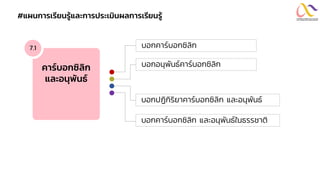
#แผนการเรียนรู้และการประเมินผลการเรียนรู้
คาร์บอกซิลิก
และอนุพันธ์
7.1 บอกคาร์บอกซิลิก
บอกอนุพันธ์คาร์บอกซิลิก
บอกปฏิกิริยาคาร์บอกซิลิก และอนุพันธ์
บอกคาร์บอกซิลิก และอนุพันธ์ในธรรชาติ
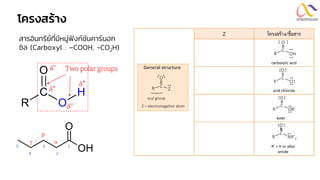
โครงสร้าง
สารอินทรีย์ที่มีหมู่ฟังก์ชันคาร์บอก
ซิล (Carboxyl : –COOH, -CO2H)
-
-
+ +
4 2
OH
O
5 3 1


g
R O
C H
O Two polar groups
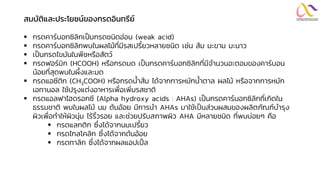
สมบัติและประโยชน์ของกรดอินทรีย์
▪ กรดคาร์บอกซิลิกเป็นกรดชนิดอ่อน (weak acid)
▪ กรดคาร์บอกซิลิกพบในผลไม้ที่มีรสเปรี้ยวหลายชนิด เช่น ส้ม มะขาม มะนาว
▪ เป็นกรดไขมันในพืชหรือสัตว์
▪ กรดฟอร์มิก (HCOOH) หรือกรดมด เป็นกรดคาร์บอกซิลิกที่มีจานวนอะตอมของคาร์บอน
น้อยที่สุดพบในผึ้งและมด
▪ กรดแอซีติก (CH3COOH) หรือกรดน้าส้ม ได้จากการหมักน้าตาล ผลไม้ หรือจากการหมัก
เอทานอล ใช้ปรุงแต่งอาหารเพื่อเพิ่มรสชาติ
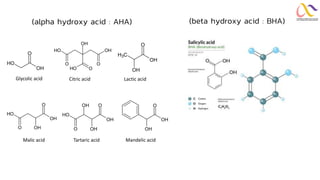
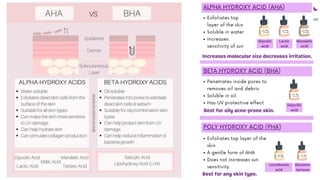
▪ กรดแอลฟาไฮดรอกซี (Alpha hydroxy acids : AHAs) เป็นกรดคาร์บอกซิลิกที่เกิดใน
ธรรมชาติ พบในผลไม้ นม ต้นอ้อย มีการนา AHAs มาใช้เป็นส่วนผสมของผลิตภัณฑ์บารุง
ผิวเพื่อทาให้ผิวนุ่ม ไร้ริ้วรอย และช่วยปรับสภาพผิว AHA มีหลายชนิด ที่พบบ่อยๆ คือ
▪ กรดแลกติก ซึ่งได้จากนมเปรี้ยว
▪ กรดไกลโคลิก ซึ่งได้จากต้นอ้อย
▪ กรดทาลิก ซึ่งได้จากผลแอปเปิ้ ล
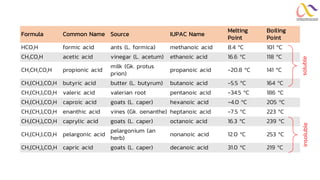
Formula Common Name Source IUPAC Name
Melting
Point
Boiling
Point
HCO2H formic acid ants (L. formica) methanoic acid 8.4 ºC 101 ºC
CH3CO2H acetic acid vinegar (L. acetum) ethanoic acid 16.6 ºC 118 ºC
CH3CH2CO2H propionic acid
milk (Gk. protus
prion)
propanoic acid -20.8 ºC 141 ºC
CH3(CH2)2CO2H butyric acid butter (L. butyrum) butanoic acid -5.5 ºC 164 ºC
CH3(CH2)3CO2H valeric acid valerian root pentanoic acid -34.5 ºC 186 ºC
CH3(CH2)4CO2H caproic acid goats (L. caper) hexanoic acid -4.0 ºC 205 ºC
CH3(CH2)5CO2H enanthic acid vines (Gk. oenanthe) heptanoic acid -7.5 ºC 223 ºC
CH3(CH2)6CO2H caprylic acid goats (L. caper) octanoic acid 16.3 ºC 239 ºC
CH3(CH2)7CO2H pelargonic acid
pelargonium (an
herb)
nonanoic acid 12.0 ºC 253 ºC
CH3(CH2)8CO2H capric acid goats (L. caper) decanoic acid 31.0 ºC 219 ºC
soluble
insoluble
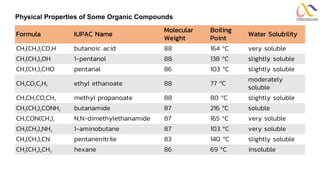
Formula IUPAC Name
Molecular
Weight
Boiling
Point
Water Solubility
CH3(CH2)2CO2H butanoic acid 88 164 ºC very soluble
CH3(CH2)4OH 1-pentanol 88 138 ºC slightly soluble
CH3(CH2)3CHO pentanal 86 103 ºC slightly soluble
CH3CO2C2H5 ethyl ethanoate 88 77 ºC
moderately
soluble
CH3CH2CO2CH3 methyl propanoate 88 80 ºC slightly soluble
CH3(CH2)2CONH2 butanamide 87 216 ºC soluble
CH3CON(CH3)2 N,N-dimethylethanamide 87 165 ºC very soluble
CH3(CH2)4NH2 1-aminobutane 87 103 ºC very soluble
CH3(CH2)3CN pentanenitrile 83 140 ºC slightly soluble
CH3(CH2)4CH3 hexane 86 69 ºC insoluble
Physical Properties of Some Organic Compounds
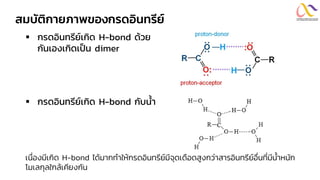
สมบัติกายภาพของกรดอินทรีย์
▪ กรดอินทรีย์เกิด H-bond ด้วย
กันเองเกิดเป็น dimer
▪ กรดอินทรีย์เกิด H-bond กับน้ำ
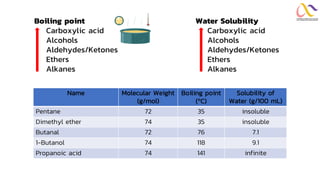
เนื่องมีเกิด H-bond ได้มากทาให้กรดอินทรีย์มีจุดเดือดสูงกว่าสารอินทรีย์อื่นที่มีน้าหนัก
โมเลกุลใกล้เคียงกัน
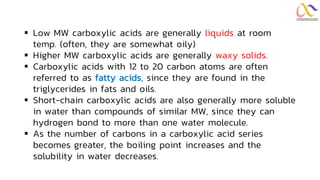
▪ Low MW carboxylic acids are generally liquids at room
temp. (often, they are somewhat oily)
▪ Higher MW carboxylic acids are generally waxy solids.
▪ Carboxylic acids with 12 to 20 carbon atoms are often
referred to as fatty acids, since they are found in the
triglycerides in fats and oils.
▪ Short-chain carboxylic acids are also generally more soluble
in water than compounds of similar MW, since they can
hydrogen bond to more than one water molecule.
▪ As the number of carbons in a carboxylic acid series
becomes greater, the boiling point increases and the
solubility in water decreases.
Boiling point
Carboxylic acid
Alcohols
Aldehydes/Ketones
Ethers
Alkanes
Water Solubility
Carboxylic acid
Alcohols
Aldehydes/Ketones
Ethers
Alkanes
Name Molecular Weight
(g/mol)
Boiling point
(C)
Solubility of
Water (g/100 mL)
Pentane 72 35 insoluble
Dimethyl ether 74 35 insoluble
Butanal 72 76 7.1
1-Butanol 74 118 9.1
Propanoic acid 74 141 infinite
(alpha hydroxy acid : AHA) (beta hydroxy acid : BHA)
O
O
H
O
O
OH
O
H
OH
OH
O
H
O
OH
OH
O
O
H
O
OH
OH
O
C
H3
O
OH
OH
O
H
O
OH
O
OH
OH
Glycolic acid Citric acid Lactic acid
Malic acid Tartaric acid Mandelic acid
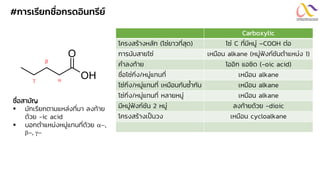
#การเรียกชื่อกรดอินทรีย์
Carboxylic
โครงสร้างหลัก (โซ่ยาวที่สุด) โซ่ C ที่มีหมู่ –COOH ต่อ
การนับสายโซ่ เหมือน alkane (หมู่ฟังก์ชันตาแหน่ง 1)
คาลงท้าย โออิก แอซิด (-oic acid)
ชื่อโซ่กิ่ง/หมู่แทนที่ เหมือน alkane
โซ่กิ่ง/หมู่แทนที่ เหมือนกันซ้ากัน เหมือน alkane
โซ่กิ่ง/หมู่แทนที่ หลายหมู่ เหมือน alkane
มีหมู่ฟังก์ชัน 2 หมู่ ลงท้ายด้วย -dioic
โครงสร้างเป็นวง เหมือน cycloalkane
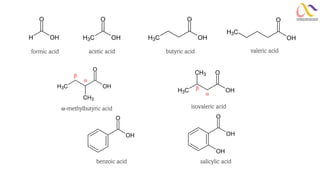
ชื่อสามัญ
▪ มักเรียกตามแหล่งที่มา ลงท้าย
ด้วย -ic acid
▪ บอกตาแหน่งหมู่แทนที่ด้วย -,
-, g-
OH
O


g
OH
OH
O
OH
O
salicylic acid
benzoic acid
H OH
O
C
H3 OH
O
OH
O
C
H3 OH
O
C
H3
formic acid acetic acid butyric acid valeric acid
OH
O
C
H3
CH3
-methylbutyric acid
OH
O
C
H3
CH3
isovaleric acid




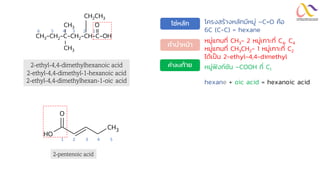
โครงสร้างหลักมีหมู่ –C=O คือ
6C (C-C) = hexane
หมู่แทนที่ CH3- 2 หมู่เกาะที่ C4, C4
หมู่แทนที่ CH3CH2- 1 หมู่เกาะที่ C2
ได้เป็น 2-ethyl-4,4-dimethyl
หมู่ฟังก์ชัน –COOH ที่ C1
2-ethyl-4,4-dimethylhexanoic acid
2-ethyl-4,4-dimethyl-1-hexanoic acid
2-ethyl-4,4-dimethylhexan-1-oic acid
CH2CH3
CH3 O
CH3-CH2-C-CH2-CH-C-OH
CH3
6 5 4 3 2 1
2-pentenoic acid
1 2 3 4 5
O
H
CH3
O
โซ่หลัก
คำลงท้ำย
คำนำหน้ำ
hexane + oic acid = hexanoic acid
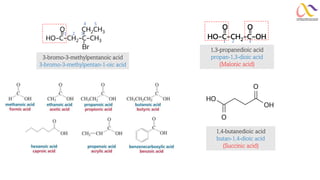
3-bromo-3-methylpentanoic acid
3-bromo-3-methylpentan-1-oic acid
1,4-butanedioic acid
butan-1,4-dioic acid
(Succinic acid)
O O
HO-C-CH2-C-OH
1 2 3
O CH2CH3
HO-C-CH2-C-CH3
Br
1 2 3
4 5
OH
O
O
O
H
1,3-propanedioic acid
propan-1,3-dioic acid
(Malonic acid)
OH
O
Br
Br
OH
O
OH
O
OH
O
O
H OH
O
O
O
H
O
OH
O
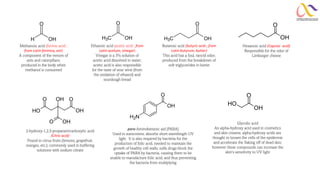
para-Aminobenzoic aid (PABA)
Used in sunscreens; absorbs short-wavelength UV
light. It is also required by bacteria for the
production of folic acid, needed to maintain the
growth of healthy cell walls; sulfa drugs block the
uptake of PABA by bacteria, causing them to be
unable to manufacture folic acid, and thus preventing
the bacteria from multiplying
2-hydroxy-1,2,3-propanetricarboxylic acid
(Citric acid)
Found in citrus fruits (lemons, grapefruit,
oranges, etc.); commonly used in buffering
solutions with sodium citrate
H OH
O
C
H3 OH
O
OH
O
C
H3
Methanoic acid (formic acid ;
from Latin formica, ant)
A component of the venom of
ants and caterpillars;
produced in the body when
methanol is consumed
Ethanoic acid (acetic acid ; from
Latin acetum, vinegar)
Vinegar is a 5% solution of
acetic acid dissolved in water;
acetic acid is also responsible
for the taste of sour wine (from
the oxidation of ethanol) and
sourdough bread
Butanoic acid (butyric acid ; from
Latin butyrum, butter)
This acid has a foul, rancid odor;
produced from the breakdown of
soft triglycerides in butter
Glycolic acid
An alpha-hydroxy acid used in cosmetics
and skin creams; alpha-hydroxy acids are
thought to loosen the cells of the epidermis
and accelerate the flaking off of dead skin;
however these compounds can increase the
skin's sensitivity to UV light
OH
O
Hexanoic acid (Caproic acid)
Responsible for the odor of
Limburger cheese
OH
O
O
H
O OH
OH
O
OH
O
N
H2
O
H
OH
O
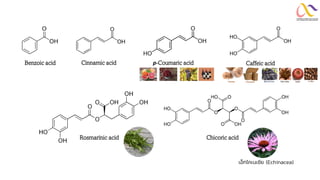
เอ็กไคเนเซีย (Echinacea)
Rosmarinic acid Chicoric acid
Caffeic acid
p-Coumaric acid
Cinnamic acid
Benzoic acid
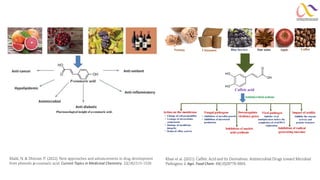
Malik, N. & Dhiman, P. (2022). New approaches and advancements in drug development
from phenolic p-coumaric acid. Current Topics in Medicinal Chemistry. 22(18)1515-1529.
Khan et al. (2021). Caffeic Acid and Its Derivatives: Antimicrobial Drugs toward Microbial
Pathogens. J. Agri. Food Chem. 69(10)29779-3004.
การเตรี
ย
มกรดคาร์
บ
อกซิ
ล
ิ
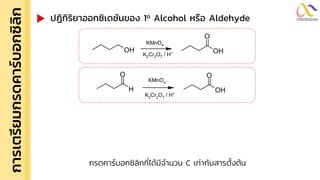
ก ปฏิกิริยำออกซิเดชันของ 1o Alcohol หรือ Aldehyde
กรดคาร์บอกซิลิกที่ได้มีจานวน C เท่ากับสารตั้งต้น
OH
O
H
O
KMnO4
K2
Cr2
O7
/ H+
OH
O
OH
KMnO4
K2Cr2O7 / H+
การเตรี
ย
มกรดคาร์
บ
อกซิ
ล
ิ
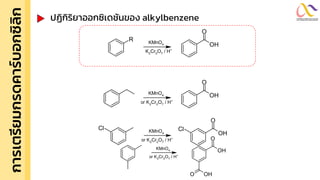
ก ปฏิกิริยำออกซิเดชันของ alkylbenzene
OH
O
R KMnO4
K2Cr2O7 / H+
OH
O
KMnO4
or K2Cr2O7 / H+
OH
O
Cl
Cl KMnO4
or K2Cr2O7 / H+
KMnO4
or K2
Cr2
O7
/ H+
OH
O
OH
O
การเตรี
ย
มกรดคาร์
บ
อกซิ
ล
ิ
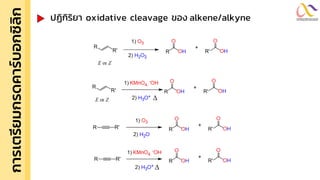
ก ปฏิกิริยำ oxidative cleavage ของ alkene/alkyne
การเตรี
ย
มกรดคาร์
บ
อกซิ
ล
ิ
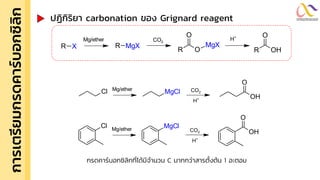
ก ปฏิกิริยำ carbonation ของ Grignard reagent
กรดคาร์บอกซิลิกที่ได้มีจานวน C มากกว่าสารตั้งต้น 1 อะตอม
R X
Mg/ether
R MgX
CO2
O
R
MgX
O
H+
OH
R
O
Mg/ether CO2
H+
Cl MgCl
OH
O
Mg/ether CO2
H+
MgCl
OH
O
Cl
การเตรี
ย
มกรดคาร์
บ
อกซิ
ล
ิ
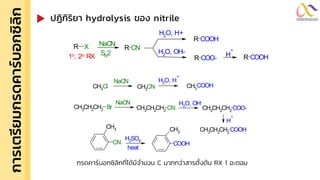
ก ปฏิกิริยำ hydrolysis ของ nitrile
กรดคาร์บอกซิลิกที่ได้มีจานวน C มากกว่าสารตั้งต้น RX 1 อะตอม
R X NaCN
SN2
R CN
H2O, H+
R COOH
H2O, OH-
R COO- R COOH
H
+
1o, 2o RX
CH3Cl CH3
COOH
CH3
CN COOH
CH3
NaCN H
+
H2SO4
heat
CH3CN
H2O,
CH3CH2CH2 Br CH3CH2CH2 COO-
NaCN
H
+
CH3CH2CH2 CN
H2O, OH-
CH3CH2CH2 COOH
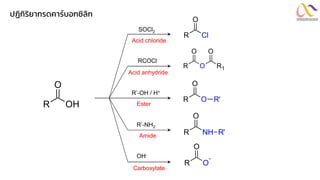
ปฏิกิริยำกรดคำร์บอกซิลิก
OH
R
O
Cl
R
O
O
R
O
R1
O
O
R
O
R'
NH
R
O
R'
O
-
R
O
SOCl2
Acid chloride
Acid anhydride
Ester
Amide
Carboxylate
RCOCl
R’-OH / H+
R’-NH2
OH-
ปฏิกิริยาคาร์บอกซิลิก :
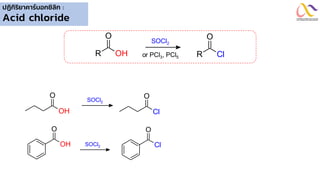
Acid chloride
OH
R
O
Cl
R
O
SOCl2
or PCl3, PCl5
Cl
O
SOCl2
OH
O
Cl
O
SOCl2
OH
O
ปฏิกิริยาคาร์บอกซิลิก :
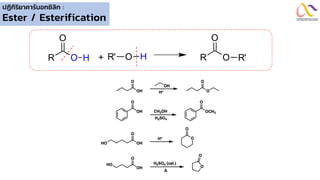
Ester / Esterification
R O
O
H R' O H
+ R O
O
R'
C OH
O
C NH2
O
C
Cl
(CH3)3C
O
SOCl2
C
OH
(CH3)3C
O
NH3
C
NH2
(CH3)3C
O
1. SOCl2
2. NH3
C
Cl
C
H3
O
SOCl2
C
OH
C
H3
O
NH3
C
NH2
C
H3
O
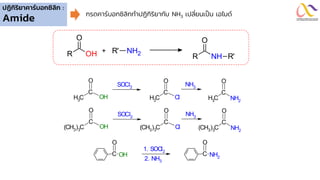
ปฏิกิริยาคาร์บอกซิลิก :
Amide
OH
R
O
NH
R
O
R'
R' NH2
+
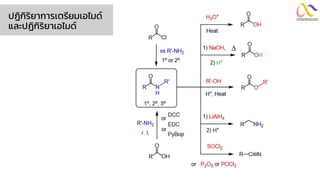
กรดคาร์บอกซิลิกทาปฏิกิริยากับ NH3 เปลี่ยนเป็น เอไมด์
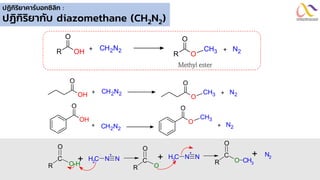
ปฏิกิริยาคาร์บอกซิลิก :
ปฏิกิริยากับ diazomethane (CH2N2)
C
O-H
R
O
+ C
H2 N
+
N
C
O
R
O
CH3
+ N2
C
O
R
O
+ C
H3 N
+
N
OH
R
O
O
R
O
CH3
+ CH2N2 + N2
Methyl ester
OH
O
O
O
CH3
+ CH2N2 + N2
OH
O
O
O
CH3
+ CH2N2
+ N2
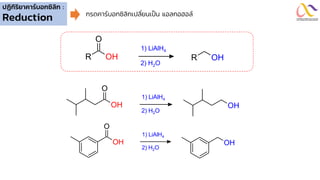
ปฏิกิริยาคาร์บอกซิลิก :
Reduction
OH
R
1) LiAlH4
OH
R
O
2) H2O
OH
1) LiAlH4
OH
O
2) H2O
OH
1) LiAlH4
OH
O
2) H2O
กรดคาร์บอกซิลิกเปลี่ยนเป็น แอลกอฮอล์
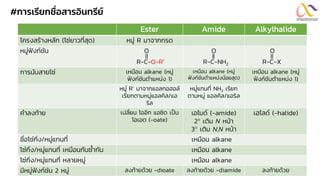
#การเรียกชื่อสารอินทรีย์
Ester Amide Alkylhalide
โครงสร้างหลัก (โซ่ยาวที่สุด) หมู่ R มาจากกรด
หมู่ฟังก์ชัน O
R-C-O-R’
O
R-C-NH2
O
R-C-X
การนับสายโซ่ เหมือน alkane (หมู่
ฟังก์ชันตาแหน่ง 1)
เหมือน alkane (หมู่
ฟังก์ชันตาแหน่งน้อยสุด)
เหมือน alkane (หมู่
ฟังก์ชันตาแหน่ง 1)
หมู่ R’ มาจากแอลกอฮอล์
เรียกตามหมู่แอลคิล/แอ
ริล
หมู่แทนที่ NH2 เรียก
ตามหมู่ แอลคิล/แอริล
คาลงท้าย เปลี่ยน โออิก แอซิด เป็น
โอเอต (-oate)
เอไมด์ (-amide)
2 เติม N หน้า
3 เติม N,N หน้า
เฮไลด์ (-halide)
ชื่อโซ่กิ่ง/หมู่แทนที่ เหมือน alkane
โซ่กิ่ง/หมู่แทนที่ เหมือนกันซ้ากัน เหมือน alkane
โซ่กิ่ง/หมู่แทนที่ หลายหมู่ เหมือน alkane
มีหมู่ฟังก์ชัน 2 หมู่ ลงท้ายด้วย -dioate ลงท้ายด้วย -diamide ลงท้ายด้วย
O
R-C-O-R’
=
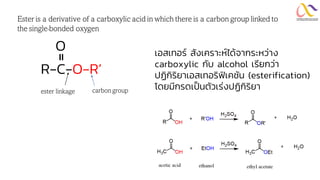
Ester is a derivative of a carboxylic acid in which there is a carbon group linked to
the single-bonded oxygen
carbon group
ester linkage
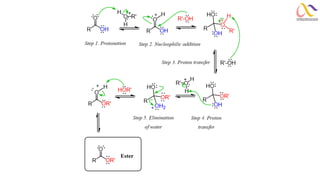
เอสเทอร์ สังเคราะห์ได้จากระหว่าง
carboxylic กับ alcohol เรียกว่า
ปฏิกิริยาเอสเทอริฟิเคชัน (esterification)
โดยมีกรดเป็นตัวเร่งปฏิกิริยา
O
C CH3
H3C O
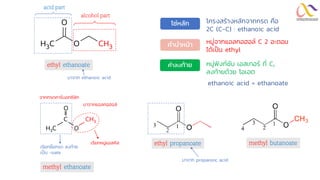
มาจากแอลกอฮอล์
จากกรดคาร์บอกซิลิก
เรียกหมู่แอลคิล
เรียกชื่อกรด ลงท้าย
เป็น -oate
methyl ethanoate
ethyl ethanoate
C
H3 O
O
CH3
โครงสร้างหลักจากกรด คือ
2C (C-C) : ethanoic acid
หมู่จากแอลกอฮอล์ C 2 อะตอม
ได้เป็น ethyl
หมู่ฟังก์ชัน เอสเทอร์ ที่ C1
ลงท้ายด้วย โอเอต
โซ่หลัก
คำลงท้ำย
คำนำหน้ำ
ethanoic acid = ethanoate
ethyl propanoate
มาจาก propanoic acid
methyl butanoate
มาจาก ethanoic acid
alcohol part
acid part
CH3
O
CH3
O
CH3
O
O
CH3
CH3
CH3
C
H3
O
O
C
H3
O
O
C
H3
CH3
CH3
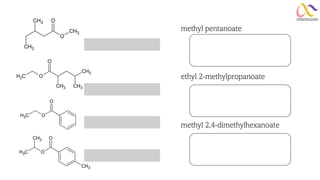
methyl pentanoate
ethyl 2-methylpropanoate
methyl 2,4-dimethylhexanoate
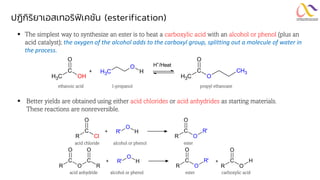
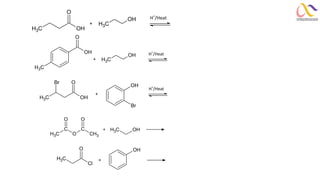
ปฏิกิริยาเอสเทอริฟิเคชัน (esterification)
▪ The simplest way to synthesize an ester is to heat a carboxylic acid with an alcohol or phenol (plus an
acid catalyst); the oxygen of the alcohol adds to the carboxyl group, splitting out a molecule of water in
the process.
▪ Better yields are obtained using either acid chlorides or acid anhydrides as starting materials.
These reactions are nonreversible.
R Cl
C
O
O
R' H
+
R O
C
O
R'
acid chloride alcohol or phenol ester
acid anhydride alcohol or phenol ester carboxylic acid
C
H3 OH
C
O
O
H
C
H3
+
C
H3 O
C
O
CH3
H+
/Heat
ethanoic acid 1-propanol propyl ethanoate
R O
C
O
R
C
O
O
R' H
+
R O
C
O
R' +
R O
C
O
H
C
H3 OH
O
OH
C
H3
+
H+
/Heat
OH
O
C
H3
OH
C
H3
+
H+
/Heat
C
H3 OH
O
Br
+
H+
/Heat
OH
Br
C
H3
Cl
O
+
OH
C
H3 O
C
O
CH3
C
O
+ C
H3 OH
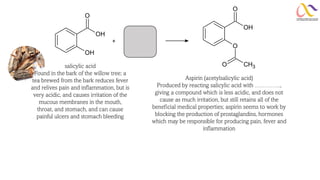
salicylic acid
Found in the bark of the willow tree; a
tea brewed from the bark reduces fever
and relives pain and inflammation, but is
very acidic, and causes irritation of the
mucous membranes in the mouth,
throat, and stomach, and can cause
painful ulcers and stomach bleeding
Aspirin (acetylsalicylic acid)
Produced by reacting salicylic acid with ………….,
giving a compound which is less acidic, and does not
cause as much irritation, but still retains all of the
beneficial medical properties; aspirin seems to work by
blocking the production of prostaglandins, hormones
which may be responsible for producing pain, fever and
inflammation
OH
OH
O
+
OH
O
O
CH3
O
สมบัติเอสเทอร์
▪ เอสเทอร์ไม่เกิดพันธะไฮโดรเจน ดังนั้น จุดเดือด จุดหลอมเหลว
ของเอสเทอร์จึงต่ากว่า แอลกอฮอล์และกรดคาร์บอกซิลิก
▪ เอสเทอร์เป็นโมเลกุลที่มีขั้ว แต่สภาพขั้วจะลดลงเมื่อโมเลกุลใหญ่
ขึ้น ดังนั้นโมเลกุลเล็กๆ จะละลายน้าได้ดี และเมื่อโมเลกุลใหญ่ขึ้น
การละลายน้าจะลดลง
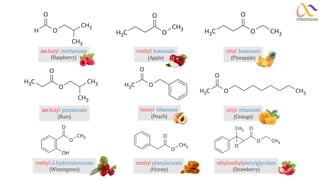
▪ เอสเทอร์ส่วนใหญ่เป็นของเหลวที่ระเหยง่ายและมีกลิ่นหอม
methyl butanoate
(Apple)
ethyl butanoate
(Pineapple)
iso-butyl methanoate
(Raspberry)
iso-butyl propanoate
(Rum)
octyl ethanoate
(Orange)
benzyl ethanoate
(Peach)
methyl-2-hydroxybenzoate
(Wintergreen)
O
H
CH3
CH3
O
O
CH3
O
C
H3
O
O
C
H3 CH3
O
O
C
H3 CH3
CH3
O
C
H3
O
O
C
H3
O
CH3
O
CH3
O
OH
O
CH3
O
methyl phenylacetate
(Honey)
O
O
CH3
O
CH3
ethylmethylphenylglycidate
(Strawberry)
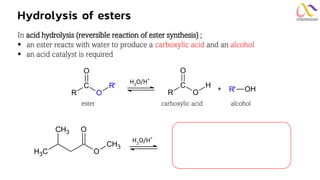
Hydrolysis of esters
In acid hydrolysis (reversible reaction of ester synthesis) ;
▪ an ester reacts with water to produce a carboxylic acid and an alcohol
▪ an acid catalyst is required
ester carboxylic acid alcohol
R O
C H
O
+
R O
C R'
O
R' OH
H2
O/H+
O
CH3
O
C
H3
CH3
H2
O/H+
Hydrolysis of esters
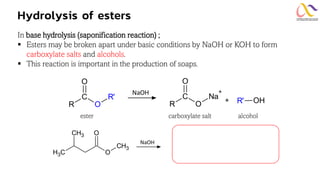
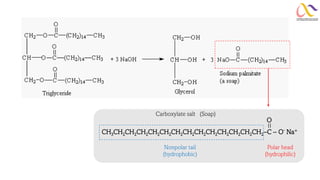
In base hydrolysis (saponification reaction) ;
▪ Esters may be broken apart under basic conditions by NaOH or KOH to form
carboxylate salts and alcohols.
▪ This reaction is important in the production of soaps.
ester carboxylate salt alcohol
R O
C Na
+
O
+
R O
C R'
O
R' OH
NaOH
NaOH
O
CH3
O
C
H3
CH3
Fatty acid
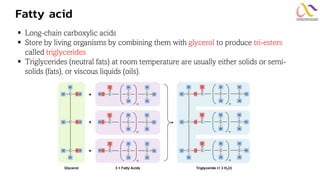
▪ Long-chain carboxylic acids
▪ Store by living organisms by combining them with glycerol to produce tri-esters
called triglycerides
▪ Triglycerides (neutral fats) at room temperature are usually either solids or semi-
solids (fats), or viscous liquids (oils).
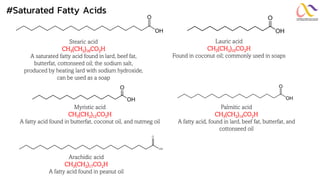
Stearic acid
CH3(CH2)16CO2H
A saturated fatty acid found in lard, beef fat,
butterfat, cottonseed oil; the sodium salt,
produced by heating lard with sodium hydroxide,
can be used as a soap
Lauric acid
CH3(CH2)10CO2H
Found in coconut oil; commonly used in soaps
Myristic acid
CH3(CH2)12CO2H
A fatty acid found in butterfat, coconut oil, and nutmeg oil
Arachidic acid
CH3(CH2)17CO2H
A fatty acid found in peanut oil
Palmitic acid
CH3(CH2)14CO2H
A fatty acid, found in lard, beef fat, butterfat, and
cottonseed oil
#Saturated Fatty Acids
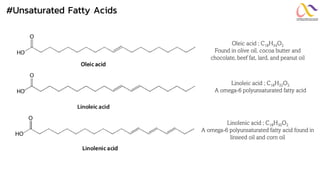
#Unsaturated Fatty Acids
Oleic acid ; C18H34O2
Found in olive oil, cocoa butter and
chocolate, beef fat, lard, and peanut oil
Linolenic acid ; C18H30O2
A omega-6 polyunsaturated fatty acid found in
linseed oil and corn oil
Linoleic acid ; C18H32O2
A omega-6 polyunsaturated fatty acid
O
CH3CH2CH2CH2CH2CH2CH2CH2CH2CH2CH2CH2CH2CH2-C - O-
Na+
=
Polar head
(hydrophilic)
Nonpolar tail
(hydrophobic)
Carboxylate salt (Soap)
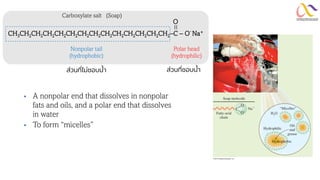
▪ A nonpolar end that dissolves in nonpolar
fats and oils, and a polar end that dissolves
in water
▪ To form “micelles”
ส่วนที่ชอบน้า
ส่วนที่ไม่ชอบน้า
O
CH3CH2CH2CH2CH2CH2CH2CH2CH2CH2CH2CH2CH2CH2-C - O-
Na+
=
Polar head
(hydrophilic)
Nonpolar tail
(hydrophobic)
Carboxylate salt (Soap)
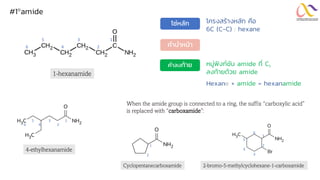
โครงสร้างหลัก คือ
6C (C-C) : hexane
หมู่ฟังก์ชัน amide ที่ C1
ลงท้ายด้วย amide
โซ่หลัก
คำลงท้ำย
คำนำหน้ำ
Hexane + amide = hexanamide
5 3 1
6 4 2
1-hexanamide
NH2
C
H3
O
Br
NH2
O
Cyclopentanecarboxamide 2-bromo-5-methylcyclohexane-1-carboxamide
1
2
6
3
5
4
1
2
C
H3
C
H3 NH2
O
4-ethylhexanamide
6 4 2
5 3 1
#1amide
When the amide group is connected to a ring, the suffix “carboxylic acid”
is replaced with “carboxamide”:
หมู่แทนที่ NH2
เรียกหมู่แอลคิล
4 2
3 1
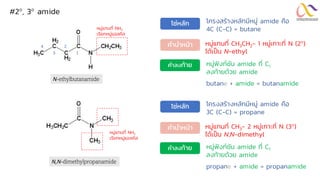
N-ethylbutanamide
หมู่แทนที่ CH3CH2- 1 หมู่เกาะที่ N (2)
ได้เป็น N-ethyl
หมู่แทนที่ NH2
เรียกหมู่แอลคิล
N,N-dimethylpropanamide
โครงสร้างหลักมีหมู่ amide คือ
4C (C-C) = butane
หมู่ฟังก์ชัน amide ที่ C1
ลงท้ายด้วย amide
โซ่หลัก
คำลงท้ำย
คำนำหน้ำ
butane + amide = butanamide
#2, 3 amide
หมู่แทนที่ CH3- 2 หมู่เกาะที่ N (3)
ได้เป็น N,N-dimethyl
โครงสร้างหลักมีหมู่ amide คือ
3C (C-C) = propane
หมู่ฟังก์ชัน amide ที่ C1
ลงท้ายด้วย amide
โซ่หลัก
คำลงท้ำย
คำนำหน้ำ
propane + amide = propanamide
ปฏิกิริยำกำรเตรียมเอไมด์
และปฏิกิริยำเอไมด์
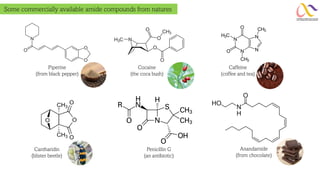
Piperine
(from black pepper)
Cocaine
(the coca bush)
Caffeine
(coffee and tea)
Cantharidin
(blister beetle)
Penicillin G
(an antibiotic)
Anandamide
(from chocolate)
Some commercially available amide compounds from natures
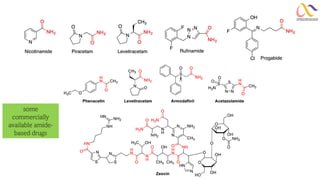
some
commercially
available amide-
based drugs
#กิจกรรม work@class
แบ่งกลุ่มทากิจกรรม 7.1
มอบหมายโจทย์ให้แต่ละกลุ่ม
ระดมสมองแก้ไขโดยวิธีการ
ร่วมแสดงความคิดเห็น
ให้แต่ละกลุ่มนาเสนอ วิธีการแก้ไขโจทย์ปัญหา
1) หลักการสาคัญหรือหลักพื้นฐานที่ถูกต้อง
2) วิธีการคานวณค่าที่ถูกต้อง
3) วิธีอธิบายเชิงพฤติกรรม (วิธีปฏิบัติ) ที่ถูกต้อง
โดยให้กลุ่มอื่น ๆ รับฟัง และซักถามในข้อที่สงสัย

กรดคาร์บอกซิลิกและอนุพันธ์ (Carboxylic acid & Derivatives)