Microchannel Heat
Exchanger Flow Loop
Team 16 Final Technical Report
April 29, 2015
MECE: Capstone 2014-2015
Jeremy Evans, Olivia Pacheco,
John-Roland Espinosa, Michael Russo
Outline
 Project Background
 Statement of Work
 Deliverables and Validation
 Methodology
 Results and Accomplishments
 Conclusion
 Recommendations
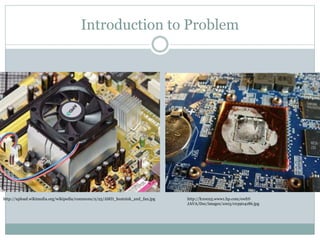
Introduction to Problem
http://upload.wikimedia.org/wikipedia/commons/2/25/AMD_heatsink_and_fan.jpg http://h10025.www1.hp.com/ewfrf-
JAVA/Doc/images/1003/c03904186.jpg
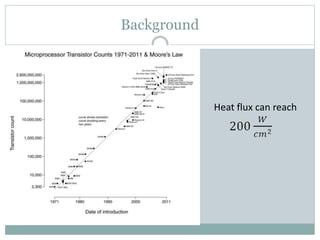
Background
Heat flux can reach
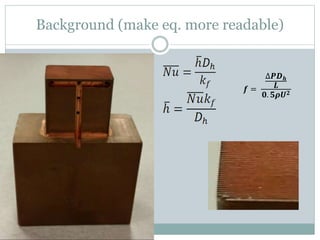
Background (make eq. more readable)
𝒇 =
∆𝑷𝑫 𝒉
𝑳
𝟎. 𝟓𝝆𝑼 𝟐
Statement of Work
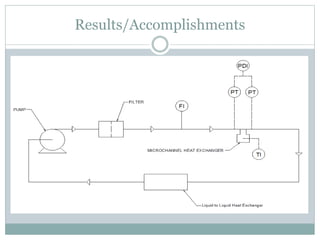
1. Create a coolant flow loop incorporating a
microchannel heat exchanger to be used in MECE
4371
2. Compose a flow loop manual
3. Write two lab experiments for students to
conduct in MECE 4371 dealing with fluid and
thermal theories
Deliverables and Validation
 A completed flow loop containing a microchannel heat
exchanger
 Two lab manuals incorporating the completed flow loop to
be used for experiments in MECE 4371
 Experimental temperature and pressure data with
theoretical correlations
 Coolant loop performs as specified by Dr. Liu
Methodology & Process
• Research
• Internet
• MECE coursework
• Dr. Liu’s thesis
• Analysis to determine required
components and specifications
• Determine theoretical predictions,
required formulas and relations
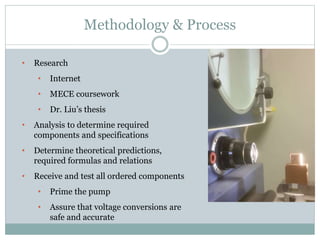
• Receive and test all ordered components
• Prime the pump
• Assure that voltage conversions are
safe and accurate
Methodology & Process
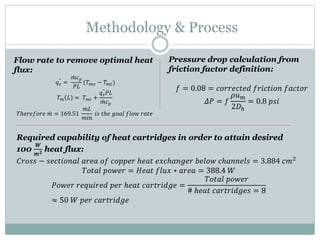
Flow rate to remove optimal heat
flux:
𝑞 𝑠
"
=
𝑚𝑐 𝑝
𝑃𝐿
(𝑇 𝑚𝑜 − 𝑇 𝑚𝑖)
𝑇 𝑚 𝐿 = 𝑇 𝑚𝑖 +
𝑞 𝑠
"
𝑃𝐿
𝑚𝑐 𝑝
𝑇ℎ𝑒𝑟𝑒𝑓𝑜𝑟𝑒 𝑚 = 169.51
𝑚𝐿
𝑚𝑖𝑛
𝑖𝑠 𝑡ℎ𝑒 𝑔𝑜𝑎𝑙 𝑓𝑙𝑜𝑤 𝑟𝑎𝑡𝑒
Pressure drop calculation from
friction factor definition:
𝑓 = 0.08 = 𝑐𝑜𝑟𝑟𝑒𝑐𝑡𝑒𝑑 𝑓𝑟𝑖𝑐𝑡𝑖𝑜𝑛 𝑓𝑎𝑐𝑡𝑜𝑟
𝛥𝑃 = 𝑓
𝜌𝑢 𝑚
2𝐷ℎ
= 0.8 𝑝𝑠𝑖
Required capability of heat cartridges in order to attain desired
100
𝑾
𝒎 𝟐 heat flux:
𝐶𝑟𝑜𝑠𝑠 − 𝑠𝑒𝑐𝑡𝑖𝑜𝑛𝑎𝑙 𝑎𝑟𝑒𝑎 𝑜𝑓 𝑐𝑜𝑝𝑝𝑒𝑟 ℎ𝑒𝑎𝑡 𝑒𝑥𝑐ℎ𝑎𝑛𝑔𝑒𝑟 𝑏𝑒𝑙𝑜𝑤 𝑐ℎ𝑎𝑛𝑛𝑒𝑙𝑠 = 3.884 𝑐𝑚2
𝑇𝑜𝑡𝑎𝑙 𝑝𝑜𝑤𝑒𝑟 = 𝐻𝑒𝑎𝑡 𝑓𝑙𝑢𝑥 ∗ 𝑎𝑟𝑒𝑎 = 388.4 𝑊
𝑃𝑜𝑤𝑒𝑟 𝑟𝑒𝑞𝑢𝑖𝑟𝑒𝑑 𝑝𝑒𝑟 ℎ𝑒𝑎𝑡 𝑐𝑎𝑟𝑡𝑟𝑖𝑑𝑔𝑒 =
𝑇𝑜𝑡𝑎𝑙 𝑝𝑜𝑤𝑒𝑟
# ℎ𝑒𝑎𝑡 𝑐𝑎𝑟𝑡𝑟𝑖𝑑𝑔𝑒𝑠 = 8
≈ 50 𝑊 𝑝𝑒𝑟 𝑐𝑎𝑟𝑡𝑟𝑖𝑑𝑔𝑒
Methodology & Process
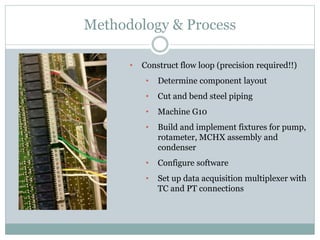
• Construct flow loop (precision required!!)
• Determine component layout
• Cut and bend steel piping
• Machine G10
• Build and implement fixtures for pump,
rotameter, MCHX assembly and
condenser
• Configure software
• Set up data acquisition multiplexer with
TC and PT connections
Methodology & Process
• Run Nusselt’s Number and Friction Factor experiments and document
processes
• Compare measured data for experiments with theoretical predictions and
provide to client
• Document flow loop operation instructions
Results/Accomplishments
1. Milestone 1 – Component
Fabrication and Procurement
Completed
2. Milestone 2 – Flow Loop Assembled
3. Milestone 3 – Flow Loop and
Experiment Documentation
4. Milestone 4 – Final Design Validated
for Client
COMPLETED
COMPLETED
COMPLETED
COMPLETED
Results/Accomplishments
1. Flow Loop Constructed and Validated
 Show temperature and pressure data vs. flow rate, explain the
trends that were sought, etc.
 Show pictures of completed flow loop
2. Friction Factor Experiment and Validation
 Show f*Re plot with theoretical curve
 Show theoretical relation
3. Nusselt’s Number Experiment and Validation
 Show f*Re(???) plot with theoretical curve
 Show theoretical relation
Results/Accomplishments
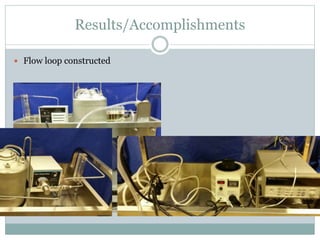
 Flow loop constructed
Results/Accomplishments
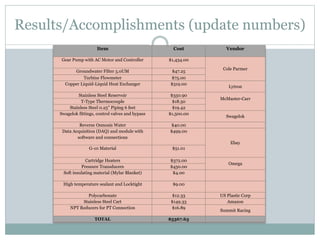
Item Cost Vendor
Gear Pump with AC Motor and Controller $1,434.00
Cole Parmer
Groundwater Filter 5.0UM $47.25
Turbine Flowmeter $75.00
Copper Liquid-Liquid Heat Exchanger $319.00
Lytron
Stainless Steel Reservoir $350.90
McMaster-Carr
T-Type Thermocouple $18.50
Stainless Steel 0.25” Piping 6 feet $19.42
Swagelok fittings, control valves and bypass $1,500.00
Swagelok
Reverse Osmosis Water $40.00
Data Acquisition (DAQ) and module with
software and connections
$499.00
Ebay
G-10 Material $51.01
Cartridge Heaters $372.00
Omega
Pressure Transducers $450.00
Soft insulating material (Mylar Blanket) $4.00
High temperature sealant and Locktight $9.00
Polycarbonate $12.33 US Plastic Corp
Stainless Steel Cart $149.33 Amazon
NPT Reducers for PT Connection $16.89
Summit Racing
TOTAL $5367.63
Results/Accomplishments (update numbers)
Conclusion
 Thermal management is gaining priority as the
number of transistors per IC increases in modern
computers.
 The flow loop, its manual, and both experiment
manuals have been completed and delivered to the
client on time and were approved
Recommendations
 Extensions to experiments:
 2 – phase flow experiments
 Slug flow experiments
 Improvements to flow loop:
 Pressure transducers with increased voltage range
 More accurate rotameter
 Different housing design – improved fit between copper block
and housing, easier manipulation of o-rings

capstone_final_technical_report

  • 1.
    Microchannel Heat Exchanger FlowLoop Team 16 Final Technical Report April 29, 2015 MECE: Capstone 2014-2015 Jeremy Evans, Olivia Pacheco, John-Roland Espinosa, Michael Russo
  • 2.
    Outline  Project Background Statement of Work  Deliverables and Validation  Methodology  Results and Accomplishments  Conclusion  Recommendations
  • 3.
    Introduction to Problem http://upload.wikimedia.org/wikipedia/commons/2/25/AMD_heatsink_and_fan.jpghttp://h10025.www1.hp.com/ewfrf- JAVA/Doc/images/1003/c03904186.jpg
  • 4.
  • 5.
    Background (make eq.more readable) 𝒇 = ∆𝑷𝑫 𝒉 𝑳 𝟎. 𝟓𝝆𝑼 𝟐
  • 6.
    Statement of Work 1.Create a coolant flow loop incorporating a microchannel heat exchanger to be used in MECE 4371 2. Compose a flow loop manual 3. Write two lab experiments for students to conduct in MECE 4371 dealing with fluid and thermal theories
  • 7.
    Deliverables and Validation A completed flow loop containing a microchannel heat exchanger  Two lab manuals incorporating the completed flow loop to be used for experiments in MECE 4371  Experimental temperature and pressure data with theoretical correlations  Coolant loop performs as specified by Dr. Liu
  • 8.
    Methodology & Process •Research • Internet • MECE coursework • Dr. Liu’s thesis • Analysis to determine required components and specifications • Determine theoretical predictions, required formulas and relations • Receive and test all ordered components • Prime the pump • Assure that voltage conversions are safe and accurate
  • 9.
    Methodology & Process Flowrate to remove optimal heat flux: 𝑞 𝑠 " = 𝑚𝑐 𝑝 𝑃𝐿 (𝑇 𝑚𝑜 − 𝑇 𝑚𝑖) 𝑇 𝑚 𝐿 = 𝑇 𝑚𝑖 + 𝑞 𝑠 " 𝑃𝐿 𝑚𝑐 𝑝 𝑇ℎ𝑒𝑟𝑒𝑓𝑜𝑟𝑒 𝑚 = 169.51 𝑚𝐿 𝑚𝑖𝑛 𝑖𝑠 𝑡ℎ𝑒 𝑔𝑜𝑎𝑙 𝑓𝑙𝑜𝑤 𝑟𝑎𝑡𝑒 Pressure drop calculation from friction factor definition: 𝑓 = 0.08 = 𝑐𝑜𝑟𝑟𝑒𝑐𝑡𝑒𝑑 𝑓𝑟𝑖𝑐𝑡𝑖𝑜𝑛 𝑓𝑎𝑐𝑡𝑜𝑟 𝛥𝑃 = 𝑓 𝜌𝑢 𝑚 2𝐷ℎ = 0.8 𝑝𝑠𝑖 Required capability of heat cartridges in order to attain desired 100 𝑾 𝒎 𝟐 heat flux: 𝐶𝑟𝑜𝑠𝑠 − 𝑠𝑒𝑐𝑡𝑖𝑜𝑛𝑎𝑙 𝑎𝑟𝑒𝑎 𝑜𝑓 𝑐𝑜𝑝𝑝𝑒𝑟 ℎ𝑒𝑎𝑡 𝑒𝑥𝑐ℎ𝑎𝑛𝑔𝑒𝑟 𝑏𝑒𝑙𝑜𝑤 𝑐ℎ𝑎𝑛𝑛𝑒𝑙𝑠 = 3.884 𝑐𝑚2 𝑇𝑜𝑡𝑎𝑙 𝑝𝑜𝑤𝑒𝑟 = 𝐻𝑒𝑎𝑡 𝑓𝑙𝑢𝑥 ∗ 𝑎𝑟𝑒𝑎 = 388.4 𝑊 𝑃𝑜𝑤𝑒𝑟 𝑟𝑒𝑞𝑢𝑖𝑟𝑒𝑑 𝑝𝑒𝑟 ℎ𝑒𝑎𝑡 𝑐𝑎𝑟𝑡𝑟𝑖𝑑𝑔𝑒 = 𝑇𝑜𝑡𝑎𝑙 𝑝𝑜𝑤𝑒𝑟 # ℎ𝑒𝑎𝑡 𝑐𝑎𝑟𝑡𝑟𝑖𝑑𝑔𝑒𝑠 = 8 ≈ 50 𝑊 𝑝𝑒𝑟 𝑐𝑎𝑟𝑡𝑟𝑖𝑑𝑔𝑒
  • 10.
    Methodology & Process •Construct flow loop (precision required!!) • Determine component layout • Cut and bend steel piping • Machine G10 • Build and implement fixtures for pump, rotameter, MCHX assembly and condenser • Configure software • Set up data acquisition multiplexer with TC and PT connections
  • 11.
    Methodology & Process •Run Nusselt’s Number and Friction Factor experiments and document processes • Compare measured data for experiments with theoretical predictions and provide to client • Document flow loop operation instructions
  • 12.
    Results/Accomplishments 1. Milestone 1– Component Fabrication and Procurement Completed 2. Milestone 2 – Flow Loop Assembled 3. Milestone 3 – Flow Loop and Experiment Documentation 4. Milestone 4 – Final Design Validated for Client COMPLETED COMPLETED COMPLETED COMPLETED
  • 13.
    Results/Accomplishments 1. Flow LoopConstructed and Validated  Show temperature and pressure data vs. flow rate, explain the trends that were sought, etc.  Show pictures of completed flow loop 2. Friction Factor Experiment and Validation  Show f*Re plot with theoretical curve  Show theoretical relation 3. Nusselt’s Number Experiment and Validation  Show f*Re(???) plot with theoretical curve  Show theoretical relation
  • 14.
  • 15.
  • 16.
    Item Cost Vendor GearPump with AC Motor and Controller $1,434.00 Cole Parmer Groundwater Filter 5.0UM $47.25 Turbine Flowmeter $75.00 Copper Liquid-Liquid Heat Exchanger $319.00 Lytron Stainless Steel Reservoir $350.90 McMaster-Carr T-Type Thermocouple $18.50 Stainless Steel 0.25” Piping 6 feet $19.42 Swagelok fittings, control valves and bypass $1,500.00 Swagelok Reverse Osmosis Water $40.00 Data Acquisition (DAQ) and module with software and connections $499.00 Ebay G-10 Material $51.01 Cartridge Heaters $372.00 Omega Pressure Transducers $450.00 Soft insulating material (Mylar Blanket) $4.00 High temperature sealant and Locktight $9.00 Polycarbonate $12.33 US Plastic Corp Stainless Steel Cart $149.33 Amazon NPT Reducers for PT Connection $16.89 Summit Racing TOTAL $5367.63 Results/Accomplishments (update numbers)
  • 17.
    Conclusion  Thermal managementis gaining priority as the number of transistors per IC increases in modern computers.  The flow loop, its manual, and both experiment manuals have been completed and delivered to the client on time and were approved
  • 18.
    Recommendations  Extensions toexperiments:  2 – phase flow experiments  Slug flow experiments  Improvements to flow loop:  Pressure transducers with increased voltage range  More accurate rotameter  Different housing design – improved fit between copper block and housing, easier manipulation of o-rings