CRM DATABASE
ARTI YADAV
INTRODUCTION
 Customer relationships are the basis of successful business efforts. Customer Relationship Management
centers on strategies, practices, and implementation of technologies that ensure that customers remain loyal
to organizations and continue to support their growth. In this, CRM Database Management is central to
ensuring long-lasting success in building and maintaining high quality CRM efforts.
 CRM databases are used for the storage and management of information related to or arising from customer
interactions, customer contact details, survey and research results, communications, purchases, receipts,
requests, complaints and other sources. A well-managed CRM database provides accurate information that
ensures efficient and smooth communication with customers and delivery of customer service. The CRM
Database is also a source of information on potential leads and includes vital information collected from
different channels of customer engagement and interactions such as telephone, through the web, e-mail,
social media etc. CRM Database Management is thus vital for the successful CRM efforts of businesses and
will ensure the accuracy of business decision making.
DEFINATION
A CRM system helps
businesses keep
customer contact
details up to date,
track every customer
interaction, and
manage customer
accounts.
Why have a
CRM system?
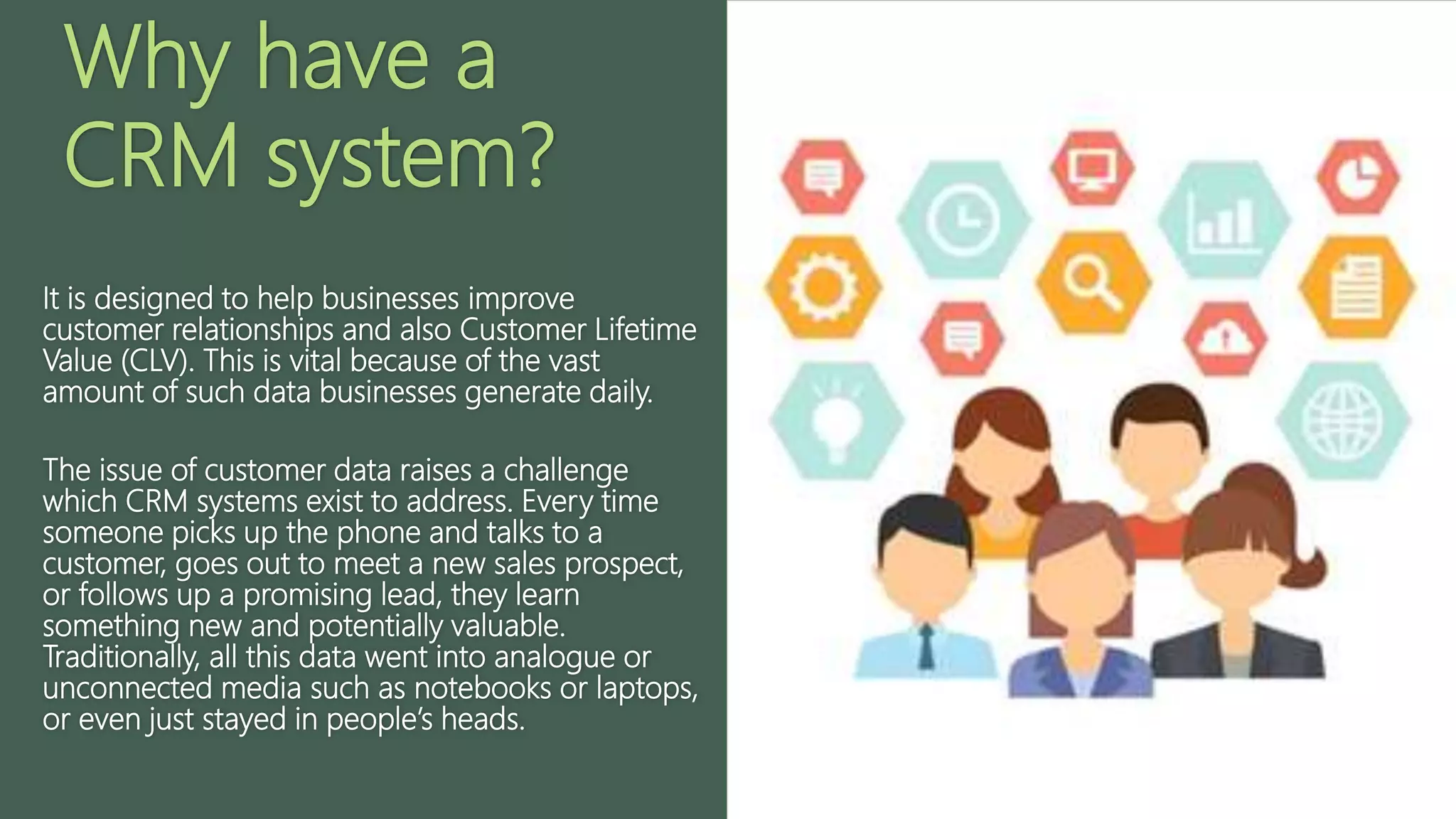
It is designed to help businesses improve
customer relationships and also Customer Lifetime
Value (CLV). This is vital because of the vast
amount of such data businesses generate daily.
The issue of customer data raises a challenge
which CRM systems exist to address. Every time
someone picks up the phone and talks to a
customer, goes out to meet a new sales prospect,
or follows up a promising lead, they learn
something new and potentially valuable.
Traditionally, all this data went into analogue or
unconnected media such as notebooks or laptops,
or even just stayed in people’s heads.
With no CRM...
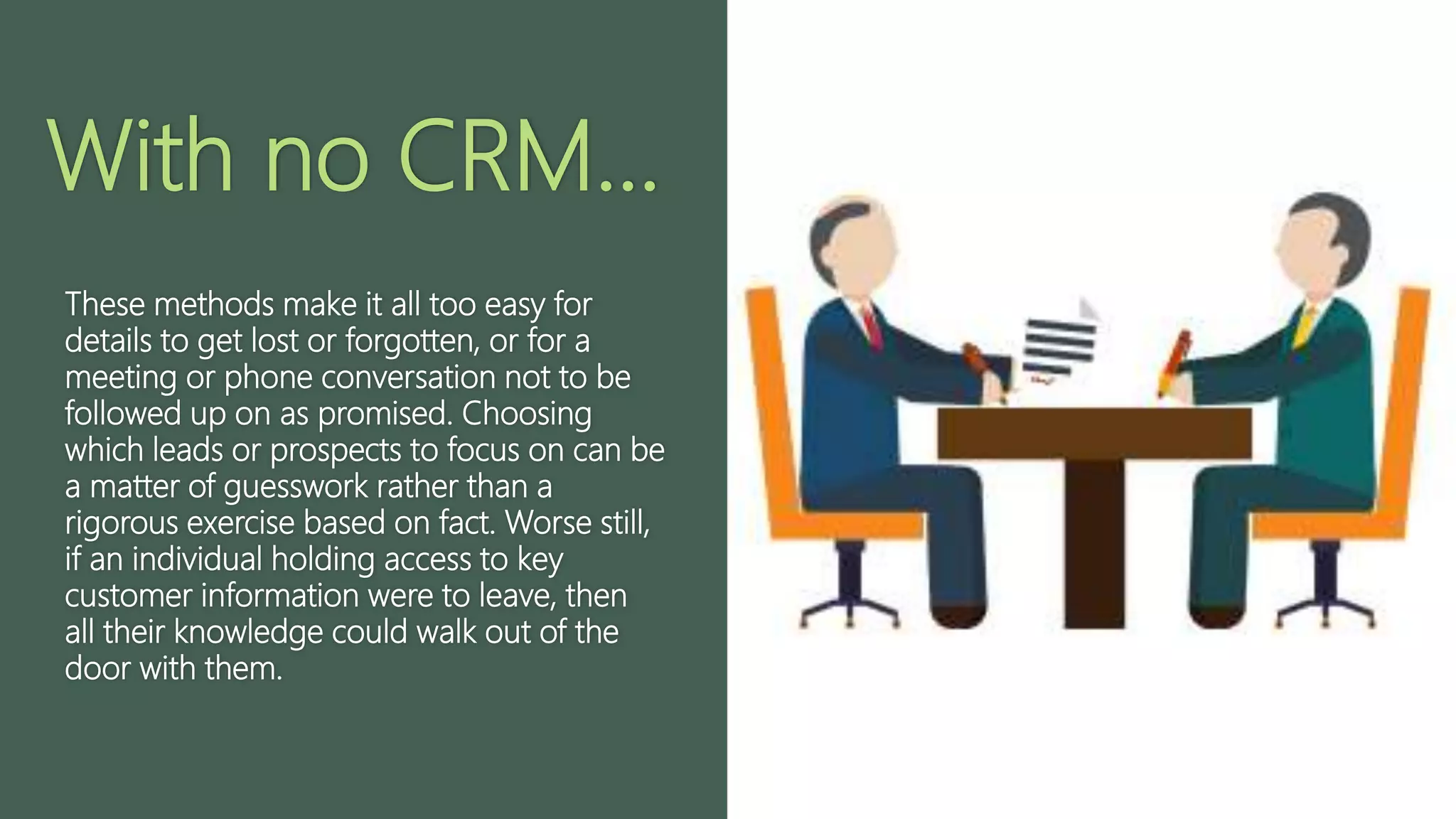
These methods make it all too easy for
details to get lost or forgotten, or for a
meeting or phone conversation not to be
followed up on as promised. Choosing
which leads or prospects to focus on can be
a matter of guesswork rather than a
rigorous exercise based on fact. Worse still,
if an individual holding access to key
customer information were to leave, then
all their knowledge could walk out of the
door with them.
A CRM helps ensure
accuracy and
efficiency
A customer relationship management
system aims to address challenges like
these. It takes customer data and turns it
into useful, actionable insight that can
transform a business. It helps everyone in a
business to easily update records and to
get access to the latest information. If
the system is cloud-based, they can do this
wherever they are, on any connected
device.
What does a CRM system do?
 A CRM system essentially provides a central place where businesses can store customer and prospect data,
track customer interactions, and share this information with colleagues. It allows businesses to manage
relationships with customers, helping the business to grow.
 With a CRM system in place, every question, every service request, every preference and every past contact
detail about every customer is instantly available, which means that every new interaction with them should
always be personalised, relevant and up to date.
 As well as tracking every phone call, email sent, meeting held and presentation delivered, CRM systems can
also be used to add notes, schedule follow-ups and organise the next steps that need to be taken. This
ensures that opportunities to close deals or grow customer accounts won’t be missed.
 By understanding customers better, cross-selling and up-selling opportunities become clearer too, giving
organisations a much better chance to win new business from existing customers.
What are the benefits
of CRM database
software?
It keeps everyone on the same page
Efficiency goes up
It generates much more personal
relationships
You boost customer satisfaction
Sales can close more deals, faster
It drives revenue growth.
Key features of a
CRM system
The key features of a CRM system typically include contact
management functionality, dashboard-style presentation of
information, and reports that analyse pipeline activity, along
with communication tools such as integrated email and
internal instant messaging:
Contact management
Lead management
Sales forecasting
Instant messaging between employees
Email tracking and integration with Outlook and Gmail
File and content sharing
Dashboard-based analytics
Contact management-
All the latest information about customers -- from contact details to service conversations -- is easily available to
access and update.
Lead management-
The system enables users to track pipeline activities, tasks and targets, all the way from prospect through to
conversion
Sales forecasting-
Forecasting reports enable salespeople to get better visibility over their pipelines, qualify leds more accurately,
see how close they are to hitting their targets. Sales managers can use reports to motivate and manage their
people.
Instant messaging between employees=
Real-time instant messaging functionality makes it easier for coworkers to ask and answer each other’s queries,
instance in support of a live sales opp or service interaction. Managers can check in on staff in the field, and
employees can ask for instant feedback or support as needed.
Email tracking and integration with Outlook and Gmail-
Syncing email clients instantly with the CRM system allows businesspeople to get a complete view of their
customers and leads without having to log in and out of different systems. Calendars and contacts can be viewed
across every device, and emails can be created and managed from within a single workflow.
File and content sharing-
Team members can upload information to a centrally stored location, and share easily and instantly with
coworkers.
Dashboard-based analytics-
Information is aggregated and presented in intuitive, meaningful dashboard displays that can be customised
based on each individual’s priorities.
CONCLUSION
Therefore the organization needs to
improve immensely on its CRM initiatives,
plans, strategies, and implementation
activities as the organization at present is
not achieving CRM objectives. Another
reason for the organization failing to
meet the CRM objectives can be
contributed to the fact that no proper
initiatives have been taken to improve
the basic CRM components. Failure to
measure current CRM initiatives that
have been rolled out also can be
concluded as a factor for the
organization not been up to the
benchmarked standard.

Crm database

  • 1.
  • 2.
    INTRODUCTION  Customer relationshipsare the basis of successful business efforts. Customer Relationship Management centers on strategies, practices, and implementation of technologies that ensure that customers remain loyal to organizations and continue to support their growth. In this, CRM Database Management is central to ensuring long-lasting success in building and maintaining high quality CRM efforts.  CRM databases are used for the storage and management of information related to or arising from customer interactions, customer contact details, survey and research results, communications, purchases, receipts, requests, complaints and other sources. A well-managed CRM database provides accurate information that ensures efficient and smooth communication with customers and delivery of customer service. The CRM Database is also a source of information on potential leads and includes vital information collected from different channels of customer engagement and interactions such as telephone, through the web, e-mail, social media etc. CRM Database Management is thus vital for the successful CRM efforts of businesses and will ensure the accuracy of business decision making.
  • 3.
    DEFINATION A CRM systemhelps businesses keep customer contact details up to date, track every customer interaction, and manage customer accounts.
  • 4.
    Why have a CRMsystem? It is designed to help businesses improve customer relationships and also Customer Lifetime Value (CLV). This is vital because of the vast amount of such data businesses generate daily. The issue of customer data raises a challenge which CRM systems exist to address. Every time someone picks up the phone and talks to a customer, goes out to meet a new sales prospect, or follows up a promising lead, they learn something new and potentially valuable. Traditionally, all this data went into analogue or unconnected media such as notebooks or laptops, or even just stayed in people’s heads.
  • 5.
    With no CRM... Thesemethods make it all too easy for details to get lost or forgotten, or for a meeting or phone conversation not to be followed up on as promised. Choosing which leads or prospects to focus on can be a matter of guesswork rather than a rigorous exercise based on fact. Worse still, if an individual holding access to key customer information were to leave, then all their knowledge could walk out of the door with them.
  • 6.
    A CRM helpsensure accuracy and efficiency A customer relationship management system aims to address challenges like these. It takes customer data and turns it into useful, actionable insight that can transform a business. It helps everyone in a business to easily update records and to get access to the latest information. If the system is cloud-based, they can do this wherever they are, on any connected device.
  • 7.
    What does aCRM system do?  A CRM system essentially provides a central place where businesses can store customer and prospect data, track customer interactions, and share this information with colleagues. It allows businesses to manage relationships with customers, helping the business to grow.  With a CRM system in place, every question, every service request, every preference and every past contact detail about every customer is instantly available, which means that every new interaction with them should always be personalised, relevant and up to date.  As well as tracking every phone call, email sent, meeting held and presentation delivered, CRM systems can also be used to add notes, schedule follow-ups and organise the next steps that need to be taken. This ensures that opportunities to close deals or grow customer accounts won’t be missed.  By understanding customers better, cross-selling and up-selling opportunities become clearer too, giving organisations a much better chance to win new business from existing customers.
  • 8.
    What are thebenefits of CRM database software? It keeps everyone on the same page Efficiency goes up It generates much more personal relationships You boost customer satisfaction Sales can close more deals, faster It drives revenue growth.
  • 9.
    Key features ofa CRM system The key features of a CRM system typically include contact management functionality, dashboard-style presentation of information, and reports that analyse pipeline activity, along with communication tools such as integrated email and internal instant messaging: Contact management Lead management Sales forecasting Instant messaging between employees Email tracking and integration with Outlook and Gmail File and content sharing Dashboard-based analytics
  • 10.
    Contact management- All thelatest information about customers -- from contact details to service conversations -- is easily available to access and update. Lead management- The system enables users to track pipeline activities, tasks and targets, all the way from prospect through to conversion Sales forecasting- Forecasting reports enable salespeople to get better visibility over their pipelines, qualify leds more accurately, see how close they are to hitting their targets. Sales managers can use reports to motivate and manage their people. Instant messaging between employees= Real-time instant messaging functionality makes it easier for coworkers to ask and answer each other’s queries, instance in support of a live sales opp or service interaction. Managers can check in on staff in the field, and employees can ask for instant feedback or support as needed.
  • 11.
    Email tracking andintegration with Outlook and Gmail- Syncing email clients instantly with the CRM system allows businesspeople to get a complete view of their customers and leads without having to log in and out of different systems. Calendars and contacts can be viewed across every device, and emails can be created and managed from within a single workflow. File and content sharing- Team members can upload information to a centrally stored location, and share easily and instantly with coworkers. Dashboard-based analytics- Information is aggregated and presented in intuitive, meaningful dashboard displays that can be customised based on each individual’s priorities.
  • 12.
    CONCLUSION Therefore the organizationneeds to improve immensely on its CRM initiatives, plans, strategies, and implementation activities as the organization at present is not achieving CRM objectives. Another reason for the organization failing to meet the CRM objectives can be contributed to the fact that no proper initiatives have been taken to improve the basic CRM components. Failure to measure current CRM initiatives that have been rolled out also can be concluded as a factor for the organization not been up to the benchmarked standard.