To Infinity and Beyond!
Cantor’s Infinity theorems
Oren Ish-Am
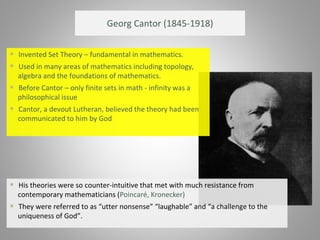
Georg Cantor (1845-1918)
 His theories were so counter-intuitive that met with much resistance from
contemporary mathematicians (Poincaré, Kronecker)
 They were referred to as “utter nonsense” “laughable” and “a challenge to the
uniqueness of God”.
 Invented Set Theory – fundamental in mathematics.
 Used in many areas of mathematics including topology,
algebra and the foundations of mathematics.
 Before Cantor – only finite sets in math - infinity was a
philosophical issue
 Cantor, a devout Lutheran, believed the theory had been
communicated to him by God
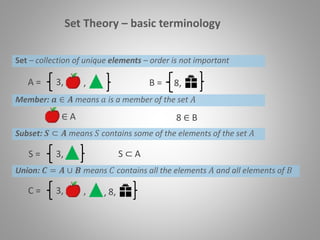
Set Theory – basic terminology
Set – collection of unique elements – order is not important
A = 3, , B = 8,
Member: 𝒂 ∈ 𝑨 means 𝑎 is a member of the set 𝐴
∈ A 8 ∈ B
Subset: 𝑺 ⊂ 𝑨 means 𝑆 contains some of the elements of the set 𝐴
S = 3, S ⊂ A
Union: 𝑪 = 𝑨 ∪ 𝑩 means 𝐶 contains all the elements 𝐴 and all elements of 𝐵
C = 3, , 8,,
Set Theory – basic terminology
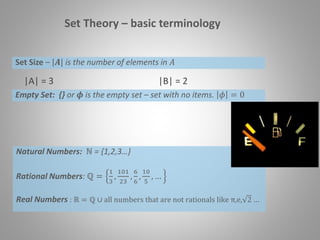
Set Size – |𝑨| is the number of elements in 𝐴
Empty Set: {} or 𝝓 is the empty set – set with no items. 𝜙 = 0
|A| = 3 |B| = 2
Natural Numbers: ℕ = {1,2,3…}
Rational Numbers: ℚ =
1
3
,
101
23
,
6
6
,
10
5
, …
Real Numbers : ℝ = ℚ ∪ all numbers that are not rationals like π,e, 2 …
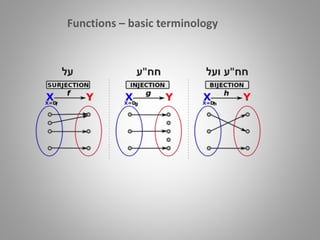
Functions – basic terminology
‫על‬ ‫חח‬"‫ע‬ ‫חח‬"‫ע‬‫ועל‬
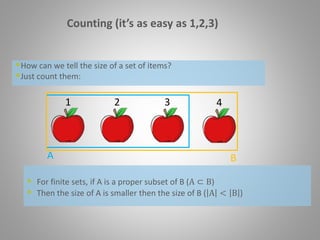
Counting (it’s as easy as 1,2,3)
How can we tell the size of a set of items?
Just count them:
21 3 4
A B
 For finite sets, if A is a proper subset of B (A ⊂ B)
 Then the size of A is smaller then the size of B ( A < B )
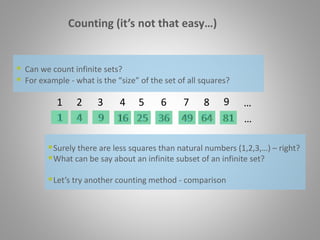
Counting (it’s not that easy…)
Surely there are less squares than natural numbers (1,2,3,…) – right?
What can be say about an infinite subset of an infinite set?
Let’s try another counting method - comparison
1 2 3 4 5 6 7 8 9 …
…
 Can we count infinite sets?
 For example - what is the “size” of the set of all squares?
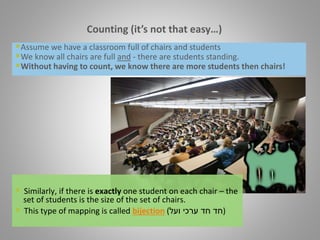
Assume we have a classroom full of chairs and students
We know all chairs are full and - there are students standing.
Without having to count, we know there are more students then chairs!
Counting (it’s not that easy…)
 Similarly, if there is exactly one student on each chair – the
set of students is the size of the set of chairs.
 This type of mapping is called bijection ( ‫חד‬‫חד‬‫ועל‬ ‫ערכי‬ )
Cardinality )‫עוצמה‬(
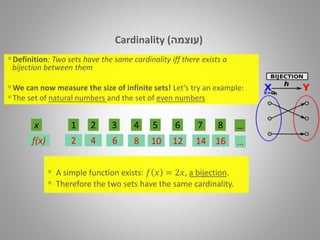
Definition: Two sets have the same cardinality iff there exists a
bijection between them
We can now measure the size of infinite sets! Let’s try an example:
The set of natural numbers and the set of even numbers
2 4 6 8 10 12 14 16 …f(x)
1 2 3 4 5 6 7 8 …x
 A simple function exists: 𝑓 𝑥 = 2𝑥, a bijection.
 Therefore the two sets have the same cardinality.
Cardinality )‫עוצמה‬(
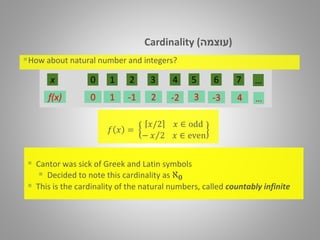
How about natural number and integers?
1 -1 2 -2 3 -3 4 …f(x) 0
1 2 3 4 5 6 7 …x 0
𝑓 𝑥 =
𝑥/2 𝑥 ∈ odd
− 𝑥 2 𝑥 ∈ even
 Cantor was sick of Greek and Latin symbols
 Decided to note this cardinality as ℵ 𝟎
 This is the cardinality of the natural numbers, called countably infinite
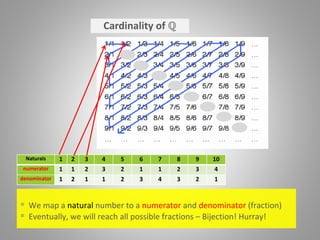
Cardinality of ℚ
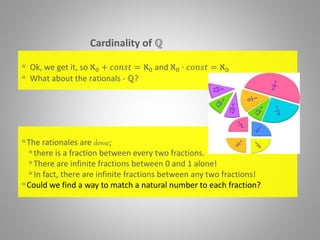
The rationales are dense;
there is a fraction between every two fractions.
There are infinite fractions between 0 and 1 alone!
In fact, there are infinite fractions between any two fractions!
Could we find a way to match a natural number to each fraction?
 Ok, we get it, so ℵ0 + 𝑐𝑜𝑛𝑠𝑡 = ℵ0 and ℵ0 ⋅ 𝑐𝑜𝑛𝑠𝑡 = ℵ0
 What about the rationals - ℚ?
Cardinality of ℚ
Naturals 1 2 3 4 5 6 7 8 9 10
numerator 1 1 2 3 2 1 1 2 3 4
denominator 1 2 1 1 2 3 4 3 2 1
 We map a natural number to a numerator and denominator (fraction)
 Eventually, we will reach all possible fractions – Bijection! Hurray!
Countably Infinite - ℵ 𝟎
Challenge: find the bijection from natural numbers to fractions.
This is the cardinality of
All finite strings
All equations
All functions you can write down a description of
All computer programs.
 Seems like one can find a clever bijection from the natural numbers
to any infinite set….right? Are we done here?
 Well… not so fast…
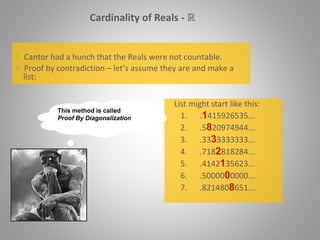
Cardinality of Reals - ℝ
List might start like this:
1. .1415926535...
2. .5820974944...
3. .3333333333...
4. .7182818284...
5. .4142135623...
6. .5000000000...
7. .8214808651...
 Cantor had a hunch that the Reals were not countable.
 Proof by contradiction – let’s assume they are and make a
list:
This method is called
Proof By Diagonalization
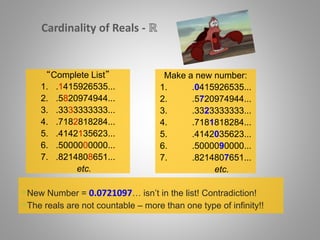
Cardinality of Reals - ℝ
New Number = 0.0721097… isn’t in the list! Contradiction!
The reals are not countable – more than one type of infinity!!
“Complete List”
1. .1415926535...
2. .5820974944...
3. .3333333333...
4. .7182818284...
5. .4142135623...
6. .5000000000...
7. .8214808651...
etc.
Make a new number:
1. .0415926535...
2. .5720974944...
3. .3323333333...
4. .7181818284...
5. .4142035623...
6. .5000090000...
7. .8214807651...
etc.
Cardinality of Reals
Easy! Just de-interleave the digits. For example
0.1809137360 … → 0.1017664 … , 0.893301 …
Therefore - ℵ is the cardinality of any continuum in ℝ 𝑛
Cantor: “I see this but I do not believe!”
0 1
 Cantor called this cardinality ℵ (or ℵ1 as we will soon see).
 ℵ is the cardinality of the continuum –all the points on the line:
0,1 , (−∞, ∞) both have cardinality ℵ. Can you find the bijection?
 What about the Unit Square? Can we map 0,1 → 0,1 × [0,1]?
Cardinality of Reals
This leads to some interesting “paradoxes” like the famous Banach-Tarsky:
Given a 3D solid ball, you can break it into a finite number of disjoint subsets,
which can be put back together in a different way to yield two identical copies
of the original ball.
 The reconstruction can work with as few as five “pieces”.
 Not pieces in the normal sense – more like sparse infinite sets of points
Cardinality of Reals
 ‫ספור‬ ‫אין‬ ‫או‬ ‫סוף‬ ‫אין‬?
Implications of ℵ0 < ℵ:
Most real numbers do not have a name.
They will not be the result of any formula or computer program.
Can we say they actually “exist” if they can never be witnessed??
 This has actual implications in mathematics!
We need to add the Axiom of Choice
More Power!
So are we done now? Countable infinity and continuum?
Power Set: For a set 𝑆 the power set 𝑃(𝑆) is the set of all subsets of 𝑆
including the empty set (𝜙 or {}) and 𝑆 itself.
 Example:
𝑆 = 1,2,3
𝑃 𝑆 = 𝜙, 1 , 2 , 3 , 1,2 , 1,3 , 2,3 , 1,2,3
 Challenge: prove that for any finite set 𝑆, 𝑃 𝑆 = 2 𝑆 (hint – think binary)
 What about infinite sets? Here Cantor came up with a simple and ingenious
proof that shows for any infinite set 𝐴: 𝑃 𝐴 > |𝐴|
Cantor’s Theorem
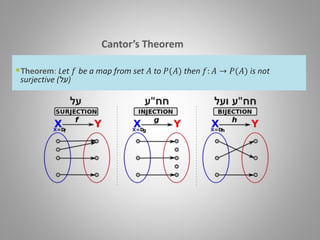
Theorem: Let 𝑓 be a map from set 𝐴 to 𝑃(𝐴) then 𝑓: 𝐴 → 𝑃(𝐴) is not
surjective (‫)על‬
‫על‬ ‫חח‬"‫ע‬ ‫חח‬"‫ע‬‫ועל‬
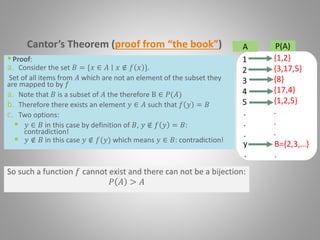
Cantor’s Theorem (proof from “the book”)
Proof:
a. Consider the set 𝐵 = {𝑥 ∈ 𝐴 ∣ 𝑥 ∉ 𝑓 𝑥 }.
Set of all items from 𝐴 which are not an element of the subset they
are mapped to by 𝑓
a. Note that 𝐵 is a subset of 𝐴 the therefore B ∈ 𝑃(𝐴)
b. Therefore there exists an element 𝑦 ∈ 𝐴 such that 𝑓 𝑦 = 𝐵
c. Two options:
 𝑦 ∈ 𝐵 in this case by definition of 𝐵, 𝑦 ∉ 𝑓 𝑦 = 𝐵:
contradiction!
 𝑦 ∉ 𝐵 in this case 𝑦 ∉ 𝑓(𝑦) which means 𝑦 ∈ 𝐵: contradiction!
So such a function 𝑓 cannot exist and there can not be a bijection:
𝑃 𝐴 > 𝐴
1
2
3
4
5
.
.
.
{1,2}
{3,17,5}
{8}
{17,4}
{1,2,5}
.
.
.
y
.
B={2,3,…}
.
A P(A)
Cardinality of Reals – connection to subsets of ℕ
Challenge: Prove that 2 ℕ = |ℝ| (hint – think binary. Again)
Let’s look at [0,1]: The binary representation of all numbers in [0,1] are all
the subsets of ℕ:
0.11000101… is the set {1,2,6,8,…}
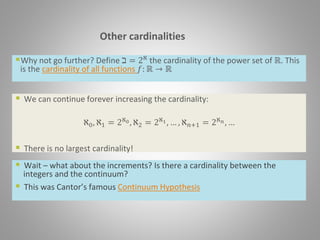
Other cardinalities
Why not go further? Define ℶ = 2ℵ
the cardinality of the power set of ℝ. This
is the cardinality of all functions 𝑓: ℝ → ℝ
 We can continue forever increasing the cardinality:
ℵ0, ℵ1 = 2ℵ0, ℵ2 = 2ℵ1, … , ℵ 𝑛+1 = 2ℵ 𝑛, …
 There is no largest cardinality!
 Wait – what about the increments? Is there a cardinality between the
integers and the continuum?
 This was Cantor’s famous Continuum Hypothesis
Continuum Hypothesis
CH is independent of the axioms of set theory. That is, either CH or its
negation can be added as an axiom to ZFC set theory, with the resulting
theory being consistent.
 Continuum Hypothesis (CH): There is no set whose cardinality is strictly
between that of the integers and the real numbers.
 Stated by Cantor in 1878 is became one of the most famous unprovable
hypotheses and drove Cantor crazy.
 Only in 1963 it was proved by Paul Cohen that….
Cardinality of Cardinalities
Just one last question to ask – exactly how many different cardinalities are
there?
 By iterating the power set we received the sets
ℕ , 𝑃 ℕ , 𝑃 𝑃 ℕ , P P 𝑃 ℕ , …
 With the cardinalities
ℵ0, ℵ1, ℵ2, ℵ3, …
 There are at least ℵ0 different cardinalities.
Are we good Vincent?
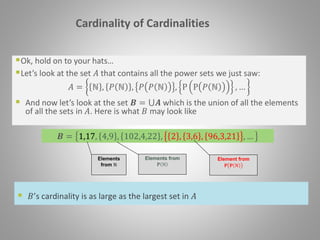
𝑩 = 1,17, 4,9 , 102,4,22 , 2 , 3,6 , 96,3,21 , …
Cardinality of Cardinalities
Ok, hold on to your hats…
Let’s look at the set 𝐴 that contains all the power sets we just saw:
𝐴 = ℕ , 𝑃 ℕ , 𝑃 𝑃 ℕ , P P 𝑃 ℕ , …
 And now let’s look at the set 𝑩 = ⋃𝑨 which is the union of all the elements
of all the sets in 𝐴. Here is what 𝐵 may look like
Elements
from ℕ
Elements from
𝐏 ℕ
Element from
𝐏 𝐏 ℕ
 𝐵’s cardinality is as large as the largest set in 𝐴
Cardinality of Cardinalities
The set 𝐵 𝑏𝑖𝑔𝑔𝑒𝑟 = 𝑃 𝐵 = 𝑃(⋃𝐴) - that cardinality is not in the ℵ 𝑛 list
In fact – for any set 𝑆 of sets, the set 𝑆 𝑏𝑖𝑔𝑔𝑒𝑟 = 𝑃 ⋃𝑆 will have a cardinality
not in 𝑆!
No set, no matter how large cannot hold all cardinalities.
So the collection of possible cardinalities is… is not even a set because it does
not have a cardinality.
Mathematicians call this a proper class, something like the set of all sets
(which is not permitted in set theory to avoid things like Russel’s paradox).
Thank You!

Cantor Infinity theorems

  • 1.
    To Infinity andBeyond! Cantor’s Infinity theorems Oren Ish-Am
  • 2.
    Georg Cantor (1845-1918) His theories were so counter-intuitive that met with much resistance from contemporary mathematicians (Poincaré, Kronecker)  They were referred to as “utter nonsense” “laughable” and “a challenge to the uniqueness of God”.  Invented Set Theory – fundamental in mathematics.  Used in many areas of mathematics including topology, algebra and the foundations of mathematics.  Before Cantor – only finite sets in math - infinity was a philosophical issue  Cantor, a devout Lutheran, believed the theory had been communicated to him by God
  • 3.
    Set Theory –basic terminology Set – collection of unique elements – order is not important A = 3, , B = 8, Member: 𝒂 ∈ 𝑨 means 𝑎 is a member of the set 𝐴 ∈ A 8 ∈ B Subset: 𝑺 ⊂ 𝑨 means 𝑆 contains some of the elements of the set 𝐴 S = 3, S ⊂ A Union: 𝑪 = 𝑨 ∪ 𝑩 means 𝐶 contains all the elements 𝐴 and all elements of 𝐵 C = 3, , 8,,
  • 4.
    Set Theory –basic terminology Set Size – |𝑨| is the number of elements in 𝐴 Empty Set: {} or 𝝓 is the empty set – set with no items. 𝜙 = 0 |A| = 3 |B| = 2 Natural Numbers: ℕ = {1,2,3…} Rational Numbers: ℚ = 1 3 , 101 23 , 6 6 , 10 5 , … Real Numbers : ℝ = ℚ ∪ all numbers that are not rationals like π,e, 2 …
  • 5.
    Functions – basicterminology ‫על‬ ‫חח‬"‫ע‬ ‫חח‬"‫ע‬‫ועל‬
  • 6.
    Counting (it’s aseasy as 1,2,3) How can we tell the size of a set of items? Just count them: 21 3 4 A B  For finite sets, if A is a proper subset of B (A ⊂ B)  Then the size of A is smaller then the size of B ( A < B )
  • 7.
    Counting (it’s notthat easy…) Surely there are less squares than natural numbers (1,2,3,…) – right? What can be say about an infinite subset of an infinite set? Let’s try another counting method - comparison 1 2 3 4 5 6 7 8 9 … …  Can we count infinite sets?  For example - what is the “size” of the set of all squares?
  • 8.
    Assume we havea classroom full of chairs and students We know all chairs are full and - there are students standing. Without having to count, we know there are more students then chairs! Counting (it’s not that easy…)  Similarly, if there is exactly one student on each chair – the set of students is the size of the set of chairs.  This type of mapping is called bijection ( ‫חד‬‫חד‬‫ועל‬ ‫ערכי‬ )
  • 9.
    Cardinality )‫עוצמה‬( Definition: Twosets have the same cardinality iff there exists a bijection between them We can now measure the size of infinite sets! Let’s try an example: The set of natural numbers and the set of even numbers 2 4 6 8 10 12 14 16 …f(x) 1 2 3 4 5 6 7 8 …x  A simple function exists: 𝑓 𝑥 = 2𝑥, a bijection.  Therefore the two sets have the same cardinality.
  • 10.
    Cardinality )‫עוצמה‬( How aboutnatural number and integers? 1 -1 2 -2 3 -3 4 …f(x) 0 1 2 3 4 5 6 7 …x 0 𝑓 𝑥 = 𝑥/2 𝑥 ∈ odd − 𝑥 2 𝑥 ∈ even  Cantor was sick of Greek and Latin symbols  Decided to note this cardinality as ℵ 𝟎  This is the cardinality of the natural numbers, called countably infinite
  • 11.
    Cardinality of ℚ Therationales are dense; there is a fraction between every two fractions. There are infinite fractions between 0 and 1 alone! In fact, there are infinite fractions between any two fractions! Could we find a way to match a natural number to each fraction?  Ok, we get it, so ℵ0 + 𝑐𝑜𝑛𝑠𝑡 = ℵ0 and ℵ0 ⋅ 𝑐𝑜𝑛𝑠𝑡 = ℵ0  What about the rationals - ℚ?
  • 12.
    Cardinality of ℚ Naturals1 2 3 4 5 6 7 8 9 10 numerator 1 1 2 3 2 1 1 2 3 4 denominator 1 2 1 1 2 3 4 3 2 1  We map a natural number to a numerator and denominator (fraction)  Eventually, we will reach all possible fractions – Bijection! Hurray!
  • 13.
    Countably Infinite -ℵ 𝟎 Challenge: find the bijection from natural numbers to fractions. This is the cardinality of All finite strings All equations All functions you can write down a description of All computer programs.  Seems like one can find a clever bijection from the natural numbers to any infinite set….right? Are we done here?  Well… not so fast…
  • 14.
    Cardinality of Reals- ℝ List might start like this: 1. .1415926535... 2. .5820974944... 3. .3333333333... 4. .7182818284... 5. .4142135623... 6. .5000000000... 7. .8214808651...  Cantor had a hunch that the Reals were not countable.  Proof by contradiction – let’s assume they are and make a list: This method is called Proof By Diagonalization
  • 15.
    Cardinality of Reals- ℝ New Number = 0.0721097… isn’t in the list! Contradiction! The reals are not countable – more than one type of infinity!! “Complete List” 1. .1415926535... 2. .5820974944... 3. .3333333333... 4. .7182818284... 5. .4142135623... 6. .5000000000... 7. .8214808651... etc. Make a new number: 1. .0415926535... 2. .5720974944... 3. .3323333333... 4. .7181818284... 5. .4142035623... 6. .5000090000... 7. .8214807651... etc.
  • 16.
    Cardinality of Reals Easy!Just de-interleave the digits. For example 0.1809137360 … → 0.1017664 … , 0.893301 … Therefore - ℵ is the cardinality of any continuum in ℝ 𝑛 Cantor: “I see this but I do not believe!” 0 1  Cantor called this cardinality ℵ (or ℵ1 as we will soon see).  ℵ is the cardinality of the continuum –all the points on the line: 0,1 , (−∞, ∞) both have cardinality ℵ. Can you find the bijection?  What about the Unit Square? Can we map 0,1 → 0,1 × [0,1]?
  • 17.
    Cardinality of Reals Thisleads to some interesting “paradoxes” like the famous Banach-Tarsky: Given a 3D solid ball, you can break it into a finite number of disjoint subsets, which can be put back together in a different way to yield two identical copies of the original ball.  The reconstruction can work with as few as five “pieces”.  Not pieces in the normal sense – more like sparse infinite sets of points
  • 18.
    Cardinality of Reals ‫ספור‬ ‫אין‬ ‫או‬ ‫סוף‬ ‫אין‬? Implications of ℵ0 < ℵ: Most real numbers do not have a name. They will not be the result of any formula or computer program. Can we say they actually “exist” if they can never be witnessed??  This has actual implications in mathematics! We need to add the Axiom of Choice
  • 19.
    More Power! So arewe done now? Countable infinity and continuum? Power Set: For a set 𝑆 the power set 𝑃(𝑆) is the set of all subsets of 𝑆 including the empty set (𝜙 or {}) and 𝑆 itself.  Example: 𝑆 = 1,2,3 𝑃 𝑆 = 𝜙, 1 , 2 , 3 , 1,2 , 1,3 , 2,3 , 1,2,3  Challenge: prove that for any finite set 𝑆, 𝑃 𝑆 = 2 𝑆 (hint – think binary)  What about infinite sets? Here Cantor came up with a simple and ingenious proof that shows for any infinite set 𝐴: 𝑃 𝐴 > |𝐴|
  • 20.
    Cantor’s Theorem Theorem: Let𝑓 be a map from set 𝐴 to 𝑃(𝐴) then 𝑓: 𝐴 → 𝑃(𝐴) is not surjective (‫)על‬ ‫על‬ ‫חח‬"‫ע‬ ‫חח‬"‫ע‬‫ועל‬
  • 21.
    Cantor’s Theorem (prooffrom “the book”) Proof: a. Consider the set 𝐵 = {𝑥 ∈ 𝐴 ∣ 𝑥 ∉ 𝑓 𝑥 }. Set of all items from 𝐴 which are not an element of the subset they are mapped to by 𝑓 a. Note that 𝐵 is a subset of 𝐴 the therefore B ∈ 𝑃(𝐴) b. Therefore there exists an element 𝑦 ∈ 𝐴 such that 𝑓 𝑦 = 𝐵 c. Two options:  𝑦 ∈ 𝐵 in this case by definition of 𝐵, 𝑦 ∉ 𝑓 𝑦 = 𝐵: contradiction!  𝑦 ∉ 𝐵 in this case 𝑦 ∉ 𝑓(𝑦) which means 𝑦 ∈ 𝐵: contradiction! So such a function 𝑓 cannot exist and there can not be a bijection: 𝑃 𝐴 > 𝐴 1 2 3 4 5 . . . {1,2} {3,17,5} {8} {17,4} {1,2,5} . . . y . B={2,3,…} . A P(A)
  • 22.
    Cardinality of Reals– connection to subsets of ℕ Challenge: Prove that 2 ℕ = |ℝ| (hint – think binary. Again) Let’s look at [0,1]: The binary representation of all numbers in [0,1] are all the subsets of ℕ: 0.11000101… is the set {1,2,6,8,…}
  • 23.
    Other cardinalities Why notgo further? Define ℶ = 2ℵ the cardinality of the power set of ℝ. This is the cardinality of all functions 𝑓: ℝ → ℝ  We can continue forever increasing the cardinality: ℵ0, ℵ1 = 2ℵ0, ℵ2 = 2ℵ1, … , ℵ 𝑛+1 = 2ℵ 𝑛, …  There is no largest cardinality!  Wait – what about the increments? Is there a cardinality between the integers and the continuum?  This was Cantor’s famous Continuum Hypothesis
  • 24.
    Continuum Hypothesis CH isindependent of the axioms of set theory. That is, either CH or its negation can be added as an axiom to ZFC set theory, with the resulting theory being consistent.  Continuum Hypothesis (CH): There is no set whose cardinality is strictly between that of the integers and the real numbers.  Stated by Cantor in 1878 is became one of the most famous unprovable hypotheses and drove Cantor crazy.  Only in 1963 it was proved by Paul Cohen that….
  • 25.
    Cardinality of Cardinalities Justone last question to ask – exactly how many different cardinalities are there?  By iterating the power set we received the sets ℕ , 𝑃 ℕ , 𝑃 𝑃 ℕ , P P 𝑃 ℕ , …  With the cardinalities ℵ0, ℵ1, ℵ2, ℵ3, …  There are at least ℵ0 different cardinalities. Are we good Vincent?
  • 26.
    𝑩 = 1,17,4,9 , 102,4,22 , 2 , 3,6 , 96,3,21 , … Cardinality of Cardinalities Ok, hold on to your hats… Let’s look at the set 𝐴 that contains all the power sets we just saw: 𝐴 = ℕ , 𝑃 ℕ , 𝑃 𝑃 ℕ , P P 𝑃 ℕ , …  And now let’s look at the set 𝑩 = ⋃𝑨 which is the union of all the elements of all the sets in 𝐴. Here is what 𝐵 may look like Elements from ℕ Elements from 𝐏 ℕ Element from 𝐏 𝐏 ℕ  𝐵’s cardinality is as large as the largest set in 𝐴
  • 27.
    Cardinality of Cardinalities Theset 𝐵 𝑏𝑖𝑔𝑔𝑒𝑟 = 𝑃 𝐵 = 𝑃(⋃𝐴) - that cardinality is not in the ℵ 𝑛 list In fact – for any set 𝑆 of sets, the set 𝑆 𝑏𝑖𝑔𝑔𝑒𝑟 = 𝑃 ⋃𝑆 will have a cardinality not in 𝑆! No set, no matter how large cannot hold all cardinalities. So the collection of possible cardinalities is… is not even a set because it does not have a cardinality. Mathematicians call this a proper class, something like the set of all sets (which is not permitted in set theory to avoid things like Russel’s paradox).
  • 28.

Editor's Notes

  • #4 Give slide with basic definitions – Set, member, Union, Subset, Intersection. And other set notation
  • #13 Add animation to cross off the main diagonal for repetition