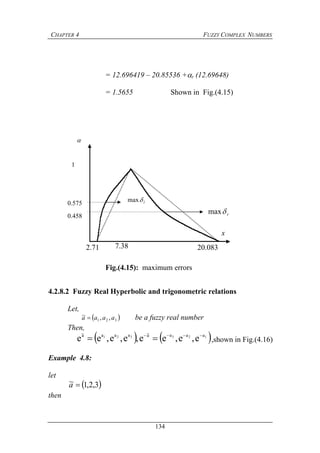
Zagazig University
Faculty of Engineering
Dept. of Eng. Physics & Maths.
FUZZY ALGEBRA
By
Eng. FARES EL-SAYED MOHAMMED FARES
THESIS
Submitted In Partial Fulfillment Of The Requirements
For The Degree Of Doctor Of Philosophy
In
Engineering Mathematics and Physics
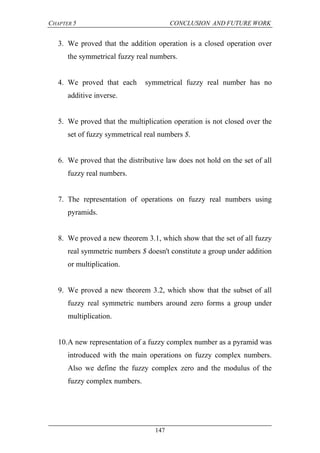
Supervisors
2006
Prof. Dr. SAMY EL-BADAWY
YEHIA
Professor of Math.
Dept. of Eng. Maths. And Physics
Faculty Of Engineering
Fayoum University
Prof. Dr. MOHAMED AFWAT
ABD EL-MAGEED
Professor of Math.
Dept. of Eng. Maths. And Physics
Faculty Of Engineering
Zagazig University
ACKNOWLEDGMENTS
I am deeply thankful to ALLAH, by the grace of whom
the start, the progress and the completion of this work was
possible
I wish to express my infinite gratitude and sincere
appreciation to Prof. Dr. Samy E. Yehia, Dean of the Faculty
of Engineering at Fayoum University, for his constructive and
supporting supervision to give me the opportunity to complete
my thesis.
I am very grateful to Prof. Dr. Mohamed Afwat Abd
El-Maged for his continuous guidance and simulating
supervision.
Thanks also to all those how have in one way or another
contributed to the successful achievement of this thesis.
iii
CONTENTS
Page
CHAPTER ( 1 ) ……………………………………………..1
FUZZY SETS
1.1 Definition Of Fuzzy .............................................................. 1
1.1.1 Expression Of Fuzzy Set ........................................... 1
1.1.2 Expansion Of Fuzzy Set............................................ 1
1.1.3 Relation Between Universal Set And Fuzzy Set....... 2
1.2 Expanding Concepts Of Fuzzy Set .................................... 2
1.2.1  - Cut Set ................................................................. 2
1.2.2 Convex Fuzzy Set...................................................... 4
1.2.3 Fuzzy Number ........................................................... 5
1.2.4 The Magnitude Of Fuzzy Set .................................... 6
1.2.5 Subset Of Fuzzy Set .................................................. 7
1.3 Standard Operation Of Fuzzy Set .................................... 8
1.3.1 Fuzzy Complement.................................................... 8
1.3.2 Fuzzy Partition.......................................................... 10
1.3.3 Fuzzy Union ............................................................. 10
1.3.4 Fuzzy Intersection .................................................... 11
1.3.5 Difference In Fuzzy Set............................................ 12
1.3.6 Distance In Fuzzy Set............................................... 13
1.3.7 Cartesian Product Of Fuzzy Set ............................... 13
1.3.8 Disjunctive Sum ....................................................... 14
1.4 Fuzzy Relation ..................................................................... 15
1.4.1 Definition Of Fuzzy Relation................................... 15
1.4.2 Operation Of Fuzzy Relation ................................... 17
1.4.3 Composition Of Fuzzy Relation............................... 18
1.4.4  - Cut Of Fuzzy Relation........................................ 19
1.5 Extension Of Fuzzy Set....................................................... 19
1.5.1 Extension By Relation.............................................. 19
1.5.2 Extension Principle................................................... 20
1.5.3 Extension By Fuzzy Relation................................... 20
1.6 Characteristics Of Fuzzy Relation..................................... 21
1.6.1 Reflexive Relation.................................................... 21
1.6.2 Symmetric Relation.................................................. 21
iv
1.6.3 Transitive Relation ................................................... 21
1.6.4 Fuzzy Equivalence Relation..................................... 22
1.6.5 Fuzzy Homomorphism............................................. 22
CHAPTER ( 2 ) ....................................................................25
FUZZY GROUPS, FUZZY RINGS AND FUZZY FIELDS
2.1 Fuzzy Subgroups ................................................................. 25
2.1.1 Level Subset Of Fuzzy Subset.................................. 26
2.1.2 Improper Fuzzy Subgroup........................................ 26
2.1.3 Order Of Fuzzy Subgroup........................................ 26
2.1.4 Normal Fuzzy Subgroups......................................... 27
2.1.5 Fuzzy Subgroups Of Cyclic Group .......................... 28
2.1.6 Conjugate Fuzzy Subgroups..................................... 28
2.1.7 Fuzzy Coset .............................................................. 29
2.1.8 Fuzzy Relation On a Group...................................... 33
2.1.9 Fuzzy Symmetric Groups......................................... 34
2.1.10 Positive Fuzzy Subgroup.......................................... 35
2.1.11 Pseudo Fuzzy Coset.................................................. 35
2.1.12 Congruence Classes.................................................. 40
2.1.13 Some Results Of Fuzzy Normal Subgroup .............. 40
2.1.14 Some Results Of Fuzzy Relations............................ 42
2.1.15 Linearly Independent Fuzzy Singletons .................. 42
2.2 Fuzzy Rings.......................................................................... 43
2.2.1 Fuzzy Subrings And Fuzzy Ideals............................ 43
2.2.2 Fuzzy Prime Ideal..................................................... 46
2.2.3 Irreducible Fuzzy Ideals ........................................... 47
2.2.4 Fuzzy Coset Of Fuzzy Ideal..................................... 48
2.2.5 Fuzzy Semi Prime Ideal ........................................... 48
2.2.6 L-Fuzzy Ideals.......................................................... 49
2.2.7 L-Prime Fuzzy Ideals ............................................... 50
2.2.8 L-Primary Fuzzy Ideals............................................ 52
2.2.9 L-Weak Primary Fuzzy Ideals.................................. 53
2.2.10 Fuzzy Nil-Redical..................................................... 53
2.2.11 Extension Of Fuzzy Subring And Fuzzy Ideals....... 56
2.2.12 Extension Of Fuzzy Prime Ideals............................. 57
2.2.13 F-Invariant ................................................................ 58
2.3 Fuzzy Fields.......................................................................... 58
v
CHAPTER ( 3 ).....................................................................63
FUZZY REAL NUMBERS
3.1 Concept Of Fuzzy Real Numbers ...................................... 64
3.1.1 Interval...................................................................... 64
3.1.2 Fuzzy Real Number.................................................. 64
3.1.3 Operations On Interval ............................................. 66
3.2 Operations On Fuzzy Real Numbers................................. 68
3.2.1 Operations Of -Cut Interval................................... 68
3.2.2 Operations On Fuzzy Real Numbers........................ 69
3.2.3 Examples On Fuzzy Real Number Operations ........ 70
3.3 Kinds Of Fuzzy Real Numbers .......................................... 75
3.3.1 Triangular Fuzzy Real Numbers .............................. 75
3.3.1.1 Definition Of Triangular Fuzzy Real Number . 75
3.3.1.2 Operation On Triangular Fuzzy Real Numbers 78
3.3.1.3 Operation On General Fuzzy Real Numbers.... 82
3.3.2 Trapezoidal Fuzzy Real Number............................. 100
3.3.2.1 Operation On trapezoidal Fuzzy Real Number 101
3.3.3 Bell Shape Fuzzy Real Number .............................. 104
3.4 Set of symmetrical fuzzy real numbers ............................ 105
CHAPTER ( 4 )....................................................................110
FUZZY COMPLEX NUMBERS
4.1 Introduction.................................................................................. 110
4.2 Operations of Fuzzy Complex Numbers ................................... 116
4.2.1 Addition of fuzzy complex numbers........................... 116
4.2.2 Multiplication of fuzzy complex numbers.................. 118
4.2.3 Multiplication of a fuzzy real number a~
by a fuzzy
complex number .
~
Z ..................................................... 123
4.2.4 Conjugate of fuzzy complex number .......................... 124
4.2.5 The modulus of complex fuzzy number...................... 125
4.2.6 Reciprocal of a fuzzy complex number ...................... 127
4.2.7 Definition of fuzzy complex zero ............................... 128
4.2.8 Exponential of fuzzy complex numbers .................... 130
4.2.8.1 Exponential of fuzzy real numbers................. 130
vi
4.2.8.2 Fuzzy Hyperbolic and trigonometric relation 134
4.2.8.3 Exponential of fuzzy complex numbers ........ 138
4.2.8.4 The square root of real fuzzy numbers............ 139
4.3 Fuzzy Complex Number In Trapezoidal Shape........................ 142
CHAPTER ( 5 )....................................................................146
Conclusion And Future Work
5.1 Conclusion .................................................................................... 146
5.2 Future Work................................................................................. 147
REFERENCES................................................................................... 149
Appendix (1) ....................................................................................... 156
CHAPTER 1 FUZZY SETS
1
Chapter (1)
FUZZY SETS
In this chapter, we will define basic operations on fuzzy sets. Each fuzzy
set A is defined in terms of a relevant classical set, X , by a function
analogous to the characteristic functions, called a membership function,
assign to each element x of X a number,  x , in the closed unit interval I
that characterizes the degree of membership of x in A.
1.1Definition of fuzzy set
1.1.1 Expression for fuzzy set
Membership function A
in crisp set maps whole in universal set X to
set {0, 1}.
}1,0{: X
A

Definition 1.1 (Member function of fuzzy set) in fuzzy sets, each
element is mapped to [0, 1] by membership function
]1,0[: X
A

where [0, 1] means real numbers between 0 and 1 (including 0,
1).Consequently, fuzzy set is ‘vague boundary set’ comparing with
crisp set.
1.1.2 Expansion of fuzzy set
Definition 1.2 (type-n fuzzy set) the value of membership degree might
include uncertainty. If the value of membership function is
given by a fuzzy set, it is a type-2 fuzzy set. This concept
can be extended up to type-n fuzzy set.
Definition 1.3 (level-k fuzzy set) the term “level-2 set” indicates fuzzy
sets whose elements are fuzzy sets. The term “level-1 set” is
applicable to fuzzy sets whose elements are no fuzzy sets
CHAPTER 1 FUZZY SETS
2
ordinary elements. In the same way, we can drive upto level-
k fuzzy set.
1.1.3 Relation between universal set and fuzzy set
If there are a universal set and a crisp set, we consider the set as a subset
of a universal set. In the same way, we regard a fuzzy set A as a subset of
universal set X.
Example 1.1 let X={a, b, c} be a universal set.
A1 = {(a, 0.5), (b, 1.0), (c, 0.5)} and
A2 = {(a, 1.0), (b, 1.0), (c, 0.5)}
Would be subsets of X.
XA 1
, XA 2
the collection of these subsets of X (including fuzzy set) is called power
set P(X).
1.2 Expanding Concepts of fuzzy set
1.2.1 α – Cut set
Definition 1.4 (α – Cut set) the α – Cut set A
is made up of members
whose membership is not less than α .
})({ 
 xXx
AA
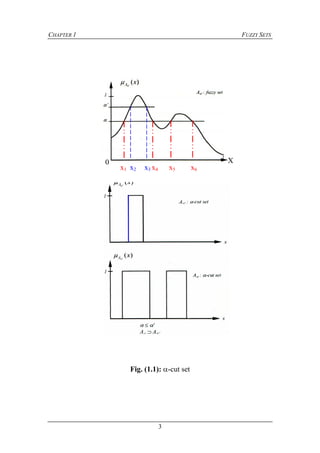
note that α is arbitrary. This α – cut set is a crisp set (Fig 1.1).
when two cut sets A
and A
exist and if   , then
AA  

CHAPTER 1 FUZZY SETS
3
Fig. (1.1): -cut set
X
x1 x2 x3 x4 x5 x6
0
CHAPTER 1 FUZZY SETS
4
Definition 1.5 (level set) the value α which explicitly shows the value of
the membership function, is in the range of [0, 1]. The
“level set “ is obtained by the α’s. that is,
},0,)({ Xxx
AA
  
1.2.2 Convex Fuzzy set
Definition 1.6 (convex fuzzy set) assuming universal set X is defined in
n-dimensional Euclidean Vector space 
n
. If all the α – cut
sets are convex, the fuzzy set with these α – cut sets is
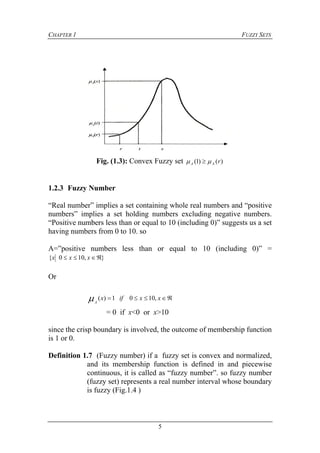
convex (Fig 1.2 ). In other words, if a relation:
)](),([)( srMint
AAA
 
where srt )1(   ]1,0[,,  
n
sr
holds the fuzzy set A is convex.
(Fig. 1.3 ) shows a convex fuzzy set.
Fig. (1.2): Convex Fuzzy set
CHAPTER 1 FUZZY SETS
5
Fig. (1.3): Convex Fuzzy set )()1( rAA  
1.2.3 Fuzzy Number
“Real number” implies a set containing whole real numbers and “positive
numbers” implies a set holding numbers excluding negative numbers.
“Positive numbers less than or equal to 10 (including 0)” suggests us a set
having numbers from 0 to 10. so
A=”positive numbers less than or equal to 10 (including 0)” =
},100{  xxx
Or
 xxifx
A
,1001)(
= 0 if x<0 or x>10
since the crisp boundary is involved, the outcome of membership function
is 1 or 0.
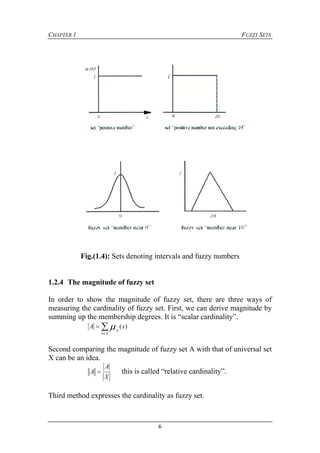
Definition 1.7 (Fuzzy number) if a fuzzy set is convex and normalized,
and its membership function is defined in and piecewise
continuous, it is called as “fuzzy number”. so fuzzy number
(fuzzy set) represents a real number interval whose boundary
is fuzzy (Fig.1.4 )
CHAPTER 1 FUZZY SETS
6
Fig.(1.4): Sets denoting intervals and fuzzy numbers
1.2.4 The magnitude of fuzzy set
In order to show the magnitude of fuzzy set, there are three ways of
measuring the cardinality of fuzzy set. First, we can derive magnitude by
summing up the membership degrees. It is “scalar cardinality”.


Xx
A
xA )(
Second comparing the magnitude of fuzzy set A with that of universal set
X can be an idea.
X
A
A  this is called “relative cardinality”.
Third method expresses the cardinality as fuzzy set.
CHAPTER 1 FUZZY SETS
7
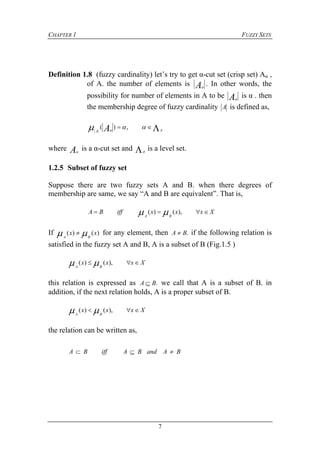
Definition 1.8 (fuzzy cardinality) let’s try to get α-cut set (crisp set) Aα ,
of A. the number of elements is A
. In other words, the
possibility for number of elements in A to be A
is α . then
the membership degree of fuzzy cardinality A is defined as,
 AA A  ,)(
where A
is a α-cut set and A
is a level set.
1.2.5 Subset of fuzzy set
Suppose there are two fuzzy sets A and B. when there degrees of
membership are same, we say “A and B are equivalent”. That is,
XxxxiffBA
BA
 ),()( 
If )()( xx
BA
  for any element, then .BA  if the following relation is
satisfied in the fuzzy set A and B, A is a subset of B (Fig.1.5 )
Xxxx
BA
 ),()( 
this relation is expressed as .BA  we call that A is a subset of B. in
addition, if the next relation holds, A is a proper subset of B.
Xxxx
BA
 ),()( 
the relation can be written as,
BAandBAiffBA 
CHAPTER 1 FUZZY SETS
8
Fig.(1.5): Subset A  B
1.3Standard operation of fuzzy set
1.3.1 Fuzzy complement
Complement set A of set A carries the sense of negation. Complement
set may be defined by the following function C,
]1,0[]1,0[: C
Complement function C is designed to map membership function )(x
A

of fuzzy set A to [0,1] and the mapped value is written as ))(( xC
A
 . To
be a fuzzy complement function, two axioms should be satisfied.
(Axiom C1) C(0)=1, C(1)=0 (boundary condition)
(Axiom C2) a, b[0,1]
if a<b, then )()( bCaC  (monotonic nonincreasing)
symbols a and b stand for membership value of member x in A. for
example, when
)).(())((),()(,,,)(,)( yCxCyxifXyxbyax
AAAAAA
 
C1 and C2 are fundamental requisites to be a complement function. These
two axioms are called “axiomatic skeleton”. For particular purposes, we
can insert additional requirements,
(Axiom C3) C is a continuous function.
CHAPTER 1 FUZZY SETS
9
(Axiom C4) C is involutive.
C(C(a))= a for all ]1,0[a
The above four axioms hold in standard complement operator
)(1)()(1))(( xxorxxC
AAAA
 
this standard function is shown in (Fig.1.6 ).
Fig. (1.6): Illustration of standard complement set function.
CHAPTER 1 FUZZY SETS
10
1.3.2 Fuzzy partition
Let A be a crisp set in universal set X and A be a complement set of A.
the condition XAandA
~
  result in couple (A, A ) which
decomposes X into two subsets.
Definition 1.9 (Fuzzy partition) in the same manner, consider a fuzzy set
satisfying A
And XA
~
 the pair ( A, A ) is defined as fuzzy partition. Usually, if m
subsets are defined in X, m-tuple (A1, A2, … , An )holding the following
conditions is called a fuzzy partition.
1.  Ai
i,
2. jiforAA ji
 
3. 

m
i
x
A
Xx
i1
1)(, 
1.3.3 Fuzzy union
In general sense, union of A and B is specified by a function of the form,
]1,0[]1,0[]1,0[: U
this union function calculates the membership degree of union BA
from those of A and B.
)](),([)( xxUx
BABA
 

this union function should obey next axioms.
(Axiom U1) U(0,0)=0, U(0,1)=1, U(1,0)=1, U(1,1)=1
so this union function follows properties of union operation of crisp sets
(boundary condition).
(Axiom U2) U(a,b)=U(b,a) commutativity holds.
(Axiom U3) if a ≤ a' and b ≤ b', U(a,b) ≤ U(a',b') then function U is
a monotonic function.
(Axiom U4) U(U(a,b),c) = U(a,U(b,c)) Associativity holds,
the above four statements are called as “Axiomatic skeleton”. It is often
to restrict the class of fuzzy unions by adding the following axioms.
CHAPTER 1 FUZZY SETS
11
(Axiom U5) function U is continous.
(Axiom U6) U(a,a) = a (idempotency)
1.3.4 Fuzzy intersection
In general sense, intersection BA is defined by the function I.
]1,0[]1,0[]1,0[: I
the argument of this function shows possibility for element x to be
involved in both fuzzy sets A and B.
)](),([)( xxIx
BABA
 

intersection function holds the following axioms.
(Axiom I1) I(1,1) =1, I(1,0) =0, I(0,1) =0, I(0,0) =0
function I follows the intersection operation of crisp set (boundary
condition).
(Axiom I2) I(a,b) = I(b,a), commutativity holds.
(Axiom I3) if a ≤ a' and b ≤ b', then I(a,b) ≤ I(a',b'), function I is
monotonic function
(Axiom I4) I(I(a,b),c) = I(a,I(b,c)) Associativity holds,
just like in the union function, these four axioms are the “Axiomatic
skeleton”, and the following two axioms can be added.
(Axiom I5) I is a continous function.
(Axiom I6) I(a,a) = a, I is idempotency.
CHAPTER 1 FUZZY SETS
12
1.3.5 Difference in fuzzy set
The difference in crisp set is defined as follows in (Fig.1.7 )
BABA 
Fig.(1.7): Difference A - B
In fuzzy set, there are two means of obtaining the difference :
1 Simple difference
Example 1.2 by using standard complement and intersection operations,
the difference operation would be simple. If we reconsider
the previous example, A-B would be ,
)}0,(),1,(),7.0,(),2.0,{( 4321 xxxxA 
)}1.0,(),1,(),3.0,(),5.0,{( 4321 xxxxB 
)}9.0,(),0,(),7.0,(),5.0,{( 4321 xxxxB 
)}.0,(),0,(),7.0,(),2.0,{( 4321 xxxxBABA 
2 Bounded difference
Definition 1.10 (Bounded difference) for novice-operator , we define
the membership function as,
)]()(,0[)( xxMaxx
BABA
 

by this definition, bounded difference of preceding two fuzzy sets is as
follows,
A  B= )}0,(),0,(),4.0,(),0,{( 4321 xxxx
CHAPTER 1 FUZZY SETS
13
1.3.6 Distance in fuzzy set
The concept “distance” is designated to describe the difference. But it has
different mathematical measure from the “distance” introduced in the
previous section. Measures for distance are defined in the following,
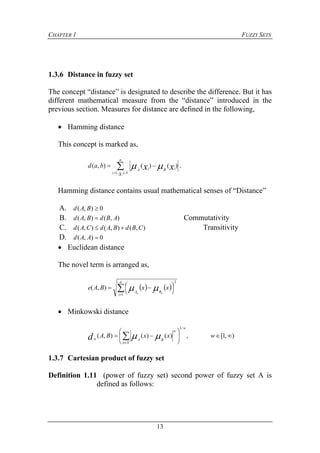
 Hamming distance
This concept is marked as,



n
Xi
iBiA
x
bad
i
xx,1
)()(),(  .
Hamming distance contains usual mathematical senses of “Distance”
A. 0),( BAd
B. ),(),( ABdBAd  Commutativity
C. ),(),(),( CBdBAdCAd  Transitivity
D. 0),( AAd
 Euclidean distance
The novel term is arranged as,
   




 
n
i
BA
xxBAe
nn
1
2
),( 
 Minkowski distance
),1[,)()(),(
/1






 
wxxBA
w
Xx
w
BAwd 
1.3.7 Cartesian product of fuzzy set
Definition 1.11 (power of fuzzy set) second power of fuzzy set A is
defined as follows:
CHAPTER 1 FUZZY SETS
14
Xxxx
AA
 ,)]([)( 22

Similarly mth
power of fuzzy set Am
may be computed as,
Xxxx m
A
m
A
 ,)]([)( 
this operator is frequently applied when dealing with the linguistic hedge
in expression of fuzzy set.
Definition 1.12 (Cartesian product) Cartesian product applied to multiple
fuzzy sets can be defined as follows,
Denoting )(),......,(),(
21
xxx
nAAA
 as membership functions of
AAA n
,......,, 21
.
For AxAxAx nn
 ...,,, 2211
.
Then, the probability for n-tuple ( xxx n
...,,, 21
) to be involved in fuzzy
set AAA n
 ......21
is,
)](),...,([),...,,( 121... 121
nAAnAAA
xxMinxxx
nn
 

.
1.3.8 Disjunctive sum
Disjunctive sum is the name of operation corresponding “exclusive OR”
logic, and it is expressed as the following (fig.1.8)
)()( BABABA 
CHAPTER 1 FUZZY SETS
15
Fig.(1.8): Disjunctive sum of two wisp sets.
Definition 1.13 (simple disjunctive sum) By means of fuzzy union and
fuzzy intersection, definition of the disjunctive sum in
fuzzy set is allowed just like in crisp set.
)(1)(),(1)( xxxx
BBAA
 
)](1),([)( xxMinx
BABA
 

)](),(1[)( xxMinx
BABA
 

)()( BABABA  , then
)]}(),(1[)],(1),([{)( xxMinxxMinMaxx
BABABA
 

(Disjoint sum) the key idea of “Exclusive OR” is elimination of common
area from the union of A and B. with this idea, we can define an operator
 for the exclusive OR disjoint sum as follows,
)()()( xxx
BABA
 

1.4 Fuzzy relation
1.4.1 Definition of fuzzy relation
If a crisp relation R represents that of form sets A to B, for x~ A and y~ B,
its membership function ),( yx
R
 is,










Ryxiff
Ryxiff
yx
R
),(0
),(1
),(
This membership function maps BA to set {0,1}.
CHAPTER 1 FUZZY SETS
16
}1,0{:  BA
R

We know that the relation R is considered as a set. Recalling the previous
fuzzy concept, we can define ambiguous relation.
Definition 1.14 (Fuzzy relation) Fuzzy relation has degree of
membership whose value lies in [0,1].
]1,0[:  BA
R

},,0),()),(),,{(( ByAxyxyxyxR
RR
 
),( yx
R
 is interpreted as strength of relation between x and y. when
),(),,(),( yxyxyx
RR
 is more strongly related than ),( yx  .
When a fuzzy relation BAR  is given, this relation R can be thought
as a fuzzy set in the space BA (Fig.1.9 ) illustrates that the fuzzy
relation R is a fuzzy set of pairs (a, b) of elements where BbAa ii 
~
, .
CHAPTER 1 FUZZY SETS
17
Fig.(1.9): Fuzzy relation as a fuzzy set.
Let’s assume a Cartesian product space X1  X2 composed of two sets X1
and X2.This space makes a set of pairs (x1, x2) for all
22
11 ,
Xx
Xx


Given a fuzzy relation R between two sets X1 and X2, this relation is a set
of pairs Rxx ),( 21
. Consequently, this fuzzy relation can be presumed to
be a fuzzy restriction to the set XX 21
 . Therefore, XXR 21
 .
Fuzzy binary relation can be extended to n-ary relation. If we assume X1,
X2, …, Xn to be fuzzy sets, fuzzy relation XXX n
R  21
can be
said to be a fuzzy set of tuple elements ),,,( 21 xxx n
 , where Xx 11
 ,
Xx 22
 , …, Xx nn
 .
1.4.2 Operation of fuzzy relation
We know now a relation is one kind of sets. Therefore we can apply
operations of fuzzy set to the relation. We assume BAR  and
BAS  .
1 Union relation
Union of two relation R and S is defined as follows:
BAyx  ),(
)],(),,([),( yxyxMaxyx
SRSR
 

),(),( yxyx
SR
 
the symbol  is used for Max operation. For n relations, we extend it to
the following,
CHAPTER 1 FUZZY SETS
18
),(),(
321
yxyx
iin RRRRRR
 
 
2 Intersection relation
The intersection relation SR  of set A and B is defined by the following
membership function,
)],(),,([),( yxyxMinyx
SRSR
 

),(),( yxyx
SR
 
the symbol  is for the Min operation. In the same manner, the
intersection relation for n-relations is defined by,
),(),(
321
yxyx
iin RRRRRR
 
 
3 Complement relation
Complement relation R for fuzzy relation R shall be defined by the
following membership function,
BAyx  ),(
),(1),( yxyx
RR
 
4 Inverse relation
When a fuzzy relation BAR  is given, the inverse relation of R-1
is
defined by the following membership function,
BAyx  ),(
),(),(
1
yxxy
RR
 

1.4.3 Composition of fuzzy relation
Definition 1.15 (Composition of fuzzy relation) two fuzzy relations R
and S are defined on sets A, B and C. that is,
CBSBAR  , .
CHAPTER 1 FUZZY SETS
19
The composition SRRS  of two relations R and S is expressed by the
relation from A to C, and this composition is defined by the following,
For ,),(,),( CBzyBAyx 
))],(),,(([),( zyyxMinyx
SR
y
RS Max  

)],(),([ zyyx
SR
y
  
RS  from this elaboration is a subset of CA . That is,
.CARS 
1.4.4 -cut of fuzzy relation
We have learned about -cut for fuzzy sets, and we know a fuzzy relation
is one kind of fuzzy sets. Therefore, we can apply the -cut to the fuzzy
relation.
Definition 1.16 (-cut relation) we can obtain -cut relation from a
fuzzy relation by taking the pairs which have membership
degrees not less than , assume BAR  , and R
is a
-cut relation. Then,
},,),(),{( ByAxyxyx
RR  
Note that R
is a crisp relation.
1.5 Extension of fuzzy set
1.5.1 Extension by relation
Definition 1.17 (extension of fuzzy set) let A and B be fuzzy sets and
R denote the relation from A to B. This relation can be
expressed by function f,
ByAx  ,
y = f (x) or x = f –1
(y)
CHAPTER 1 FUZZY SETS
20
Here we used the term i.e. functional. Without considering the strict
condition for being a function. Then we can obtain make fuzzy set B' in B
by R and A.
for y  B,
 
 
       
 
yfifxy A
yfx
Max
1
B'
1
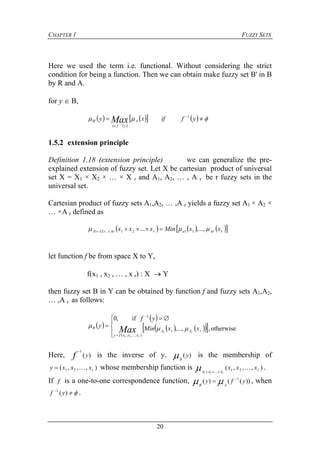
1.5.2 extension principle
Definition 1.18 (extension principle) we can generalize the pre-
explained extension of fuzzy set. Let X be cartesian product of universal
set X = X1 × X2 × … × X r and A1, A2, … , A r be r fuzzy sets in the
universal set.
Cartesian product of fuzzy sets A1,A2, … ,A r yields a fuzzy set A1 × A2 ×
… ×A r defined as
      rArarArAA xxMinxxx  ,...,... 1121...21 
let function f be from space X to Y,
f(x1 , x2 , … , x r) : X  Y
then fuzzy set B in Y can be obtained by function f and fuzzy sets A1,A2,
… ,A r as follows:
 
 
 
     


 



otherwise,,...,
if,0
1
,...,,
1
1
21
rAA
xxxfy
B xxMin
yf
y
r
r
Max 
Here, )(
1
yf

is the inverse of y. )(y
B
 is the membership of
),,,( 21 rxxxy  whose membership function is ),,,( 21
21
rAAA
xxx
r


 
.
If f is a one-to-one correspondence function, ))(()( 1
yfy
AB

  , when

)(1
yf .
CHAPTER 1 FUZZY SETS
21
1.5.3 Extension by fuzzy relation
Definition 1.19 (Extension of fuzzy relation) For a given fuzzy set A,
crisp set B and fuzzy relation BAR  , there might be a
mapping function expressing the fuzzy relation R.
membership function of fuzzy set B in B is defined as
follows:
For BBandByAx  ,
))],(),(([)(
)(1
yxxMiny
RA
yfx
B Max  


 .
1.6Characteristics of fuzzy relation
1.6.1 Reflexive relation
For all Ax  , if 1),( xx
R
 , we call this relation reflexive.
1.6.2 Symmetric relation
When fuzzy relation R is defined on AA , it is called symmetric if it
satisfies the following condition,
AAyx  ),(
   ),(),( xyyx
RR
we say “antisymmetric” for the following case,
yxAAyx  ,),(
0),(),(),(),(  xyyxorxyyx
RRRR

1.6.3 Transitive relation
Transitive relation is defined as,
      AAzxxyyx  ,,,,,
CHAPTER 1 FUZZY SETS
22
       zyyxMinMaxzx RR
y
R ,,,,  
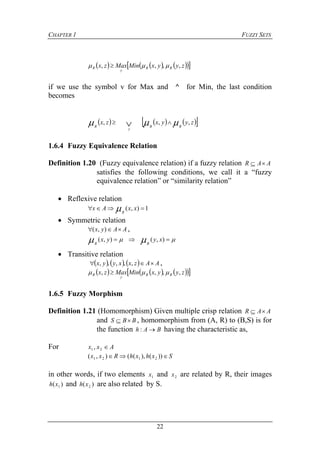
if we use the symbol v for Max and ^ for Min, the last condition
becomes
      zyyxzx
RR
y
R
,,,   
1.6.4 Fuzzy Equivalence Relation
Definition 1.20 (Fuzzy equivalence relation) if a fuzzy relation AAR 
satisfies the following conditions, we call it a “fuzzy
equivalence relation” or “similarity relation”
 Reflexive relation
1),(  xxAx
R

 Symmetric relation
AAyx  ),( ,
   ),(),( xyyx
RR
 Transitive relation
      AAzxxyyx  ,,,,, ,
       zyyxMinMaxzx RR
y
R ,,,,  
1.6.5 Fuzzy Morphism
Definition 1.21 (Homomorphism) Given multiple crisp relation AAR 
and BBS  , homomorphism from (A, R) to (B,S) is for
the function BAh : having the characteristic as,
For Axx 21 ,
SxhxhRxx  ))(),((),( 2121
in other words, if two elements 1x and 2x are related by R, their images
)( 1xh and )( 2xh are also related by S.
CHAPTER 1 FUZZY SETS
23
Definition 1.22 (Strong homomorphism) Given two crisp relations
AAR  and BBS  , if the function BAh : satisfies
the followings, it’s called “Strong homomorphism” from
(A, R) to (B, S),
 For all Axx 21 , ,
SxhxhRxx  ))(),((),( 2121
 For all Byy 21 , ,
If )(),( 2
1
21
1
1 yhxyhx 

Then RxxSyy  ),(),( 2121 .
In other words, the inverse image Rxx ),( 21 of Syy ),( 21 always stands
for the homomorphism related by R. here h, we see is a many-to-one
mapping function.
Definition 1.23 (Fuzzy homomorphism) if the relations AAR  and
BBS  are fuzzy relations, the above morphism is
extended to a fuzzy homomorphism as follows,
For all Axx 21 , and their images Bxhxh )(),( 21 ,
)](),([),( 2121 xhxhxx
SR
  .
In other words, the strength of the relation S for ))(),(( 21 xhxh is stronger
than or equal to that of R for ),( 21 xx .
If a homomorphism exists between fuzzy relations (A, R) and (B, S), the
homomorphism h partitions A into subsets nAAA ,,, 21  because it is a
many-to-one mapping.
niAx ji ,,2,1, 
Byxh i )( .
CHAPTER 1 FUZZY SETS
24
So to speak, image )( ixh of elements ix in jA is identical to element y in
B. in this manner, every element in A shall be mapped to one of B. if the
strength between jA and kA gets the maximum strength between between
xj  Ak , and xk  Ak , this morphism is replaced with fuzzy strong
homomorphism.
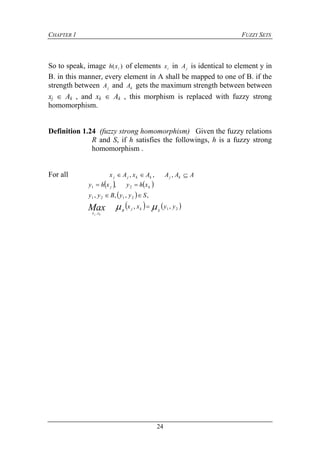
Definition 1.24 (fuzzy strong homomorphism) Given the fuzzy relations
R and S, if h satisfies the followings, h is a fuzzy strong
homomorphism .
For all AAAAxAx kjkkjj  ,,,
   
 
   21
,
2121
21
,,
,,,,
,
yyxx
SyyByy
xhyxhy
SkjR
xx
kj
Max
kj
 


CHAPTER 2 FUZZY GROUPS, FUZZY RINGS AND FUZZY FIELDS
25
Chapter (2)
FUZZY GROUPS, FUZZY RINGS AND FUZZY FIELDS
Rosenfield introduced the notion of fuzzy group and showed that many
group theory results can be extended in an elementary manner to develop
the theory of fuzzy group. The underlying logic of the theory of fuzzy
group is to provide a strict fuzzy algebraic structure where level subset of
a fuzzy group of a group G is a subgroup of the group. Reduced fuzzy
subgroup of a group using the general t-norm. However, Rosenfield used
the t-norm ‘min’ in his definition of fuzzy subgroup of a group. The
concepts of fuzzy normal subgroup and fuzzy coset were introduced [6].
2.1 Fuzzy subgroups
Definition 2.1.1: Let G be a group. A fuzzy subset A of a group G is
called a fuzzy subgroup of the group G if
i. μA (xy) = min {μA (x), μA (y)} for every x,y  G
and
ii. μA (x –1
) = μA (x) for every x  G.
Definition 2.1.2: Let G be a group and e denote the identity element of
the group G. A fuzzy subset A of the group G is called a
fuzzy subgroup of group G if
i. μA (xy –1
)  min { μA (x), μA (y)} for every x,y  G
and
ii. μA (e) = 1.
Theorem 2.1.1: A fuzzy subset A of a group G is a fuzzy subgroup of the
group G if and only if μA (xy –1
)  min { μA (x), μA (y)} for
every x, y  G.[87].
Theorem 2.1.2: Let A be a fuzzy subgroup of a group G and x  G. Then
μA (xy) = μA (y) for every yG if and only if:
μA (x) = μA (e). [87].
CHAPTER 2 FUZZY GROUPS, FUZZY RINGS AND FUZZY FIELDS
26
2.1.1 Level subset of the Fuzzy subset
Definition 2.1.3: Let A be a fuzzy subset of S. For t  [0,1] the set
At ={s  S / μA (x) = t} is called a level subset of the
fuzzy subset A.
Theorem 2.1.3: Let G be a group and A be a fuzzy subgroup of G. Then
the level subsets At, for t  [0,1], t  μA (e) is a
subgroup of G, where e is the identity of G. [87].
Theorem 2.1.4: Let A be a fuzzy subset of a group G. Then A is a fuzzy
subgroup of G if and only if t
AG is a subgroup (called
level subgroup) of the group G for every t  [0, μA (e)],
where e is the identity element of the group G. [87].
2.1.2 Improper Fuzzy Subgroup
Definition 2.1.4: A fuzzy subgroup A of a group G is called improper if
μA is constant on the group G, otherwise A is termed as
proper.
2.1.3 Order Of Fuzzy Subgroup
Definition 2.1.5: Let A be a fuzzy subgroup of a group G and H = {x 
G / μ (x) = μ (e)} then o (A), (order of A) is defined as
o (A) = o (H).
Theorem 2.1.5: Let A be a fuzzy subgroup of a finite group G then:
o (A) = o(G). [87].
Proof: Let A be a fuzzy subgroup of a finite group with e as its identity
element. Clearly H = {x G |μ (x) = μ(e)}is a subgroup of the
group G for H is a t-level subset of the group G where t = μ(e). By
Lagranges Theorem o(H) = o(G). Hence by the definition of the
order of the fuzzy subgroup of the group G we have o (A)=o (G).
CHAPTER 2 FUZZY GROUPS, FUZZY RINGS AND FUZZY FIELDS
27
2.1.4 Normal Fuzzy Subgroups
The notion of the normal subgroup is one of the central concepts of
classical group theory. It serves a powerful instrument for studying the
general structure of groups. Just as a normal subgroup plays an important
role in the classical group theory, a normal fuzzy subgroup plays a
similar role in the theory of fuzzy subgroup [66].
Definition 2.1.6: Let G be a group. A fuzzy subgroup A of G is called
normal if μA (x) = μA (y –1
x y) for all x,y  G.
Definition 2.1.7: We can define a fuzzy subgroup A of a group G to be
fuzzy normal subgroup of a group G if μA (xy) = μA
(yx)for every x,y  G. This is just an equivalent
formation of the normal fuzzy subgroup. Let A be a
fuzzy normal subgroup of a group G.
For t  [0,1], the set A t = {(x,y)  G × G / μA (xy –1
) =
t} is called the t-level relation of A. For the fuzzy
normal subgroup A of G and for t  [0,1], A t is a
congruence relation on the group G.
Theorem 2.1.6: Let A be a fuzzy normal subgroup of a group G. Then
for any g  G we have μA (gxg –1
) = μA (g –1
xg) for
every x  G. [87].
Theorem 2.1.7: A fuzzy subgroup A of a group G is normalized if and
only if μA (e) = 1, where e is the identity element of the
group G. [87].
Proof: If A is normalized then there exists x  G such that μA (x) = 1,
but by properties of a fuzzy subgroup A of the group G, μA (x)  μA
(e) for every x  G. Since μA (x) = 1 and μA (e)  μA (x) we have μA
(e)  1. But μA (e)  1. Hence μA (e) = 1. Conversely if μA (e) = 1
then by the definition of normalized fuzzy subset Ais normalized.
CHAPTER 2 FUZZY GROUPS, FUZZY RINGS AND FUZZY FIELDS
28
2.1.5 Fuzzy Subgroups Of a Cyclic Group
Theorem 2.1.8: Let G be a cyclic group of prime order. Then there exists
a fuzzy subgroup A of G such that μA (e) = to and μA (x)
= t1 for all x  e in G and to > t1. [87].
Theorem 2.1.9: Let G be a group of prime power order. Then G is cyclic
if and only if there exists a fuzzy subgroup A of G such
that for x, y  G,
i. If μA (x) = μA (y) then x= y.
ii. If μA (x)  μA (y) then xy.[87].
Theorem 2.1.10: Let G be a group of square free order. Let A be a
normal fuzzy subgroup of G. Then for x,y  G,
a. if o(x) / o(y) then μA (y)  μA (x).
b. if o(x) =o(y) then μA (y) = μA (x). [87].
Theorem 2.1.11: Suppose that G is a finite group and that G has a
composition chain e = A0 A1…A r = G where
Ai / Ai–1 is cyclic of prime order, i =1, 2, …, r. Then
there exists a composition chain of level subgroups of
some fuzzy subgroup A of G and this composition chain
is equivalent to 
e = A0 A1 …A r = G. [87].
2.1.6 Conjugate Fuzzy Subgroups
Definition 2.1.8: let A and B be two fuzzy subgroups of a group G. Then
A and B are said to be conjugate fuzzy subgroups of G
if for some g  G, μA (x) = μB (g –1
xg) for every x  G.
Theorem 2.1.12: If A and B are conjugate fuzzy subgroups of the group
G then o (A) = o (B). [87].
CHAPTER 2 FUZZY GROUPS, FUZZY RINGS AND FUZZY FIELDS
29
Theorem 2.1.13: Let A and B be any two improper fuzzy subgroups of a
group G. Then A and B are conjugate fuzzy subgroups
of the group G if and only if μA = μB. [87].
Definition 2.1.9: Let A and B be two fuzzy subsets of a group G. We say
that A and B are conjugate fuzzy subsets of the group G
if for some g  G we have μA (x) , μB (g –1
xg) for every
x  G.
Theorem 2.1.14: Let A and B be two fuzzy subsets of an abelian group
G. Then A and B are conjugate fuzzy subsets of the
group G if and only if μA = μB. [87].
Proof: Let A and B be conjugate fuzzy subsets of group G then for some
g  G we have
μA (x) = μB (g –1
xg) for every x  G
= μB (g –1
gx) for every x  G
= μB (x) for every x  G.
Hence μA (x) = μB (x).
Conversely if μA (x) = μB (x) then for the identity element e of
group G, we have μA (x) = μB (e –1
xe) for every x  G. Hence A
and B are conjugate fuzzy subsets of the group G.
Theorem 2.1.15: Let A be a fuzzy subgroup of a group G and B be a
fuzzy subset of the group G. If A and B. are conjugate
fuzzy subsets of the group G then B. is a fuzzy subgroup
of the group G. [87].
2.1.7 Fuzzy Coset
Definition 2.1.10: Let A be a fuzzy subgroup of a group G. For any a 
G, a A defined by (a μ) x = μA (a –1
x) for every x  G
is called the fuzzy coset of the group G determined by
a and μ.
Definition 2.1.11: Let A be a fuzzy subgroup of a group G. For any a 
G, a A defined by (a μA) (x) = μA (a –1
x) for every
x  G is called a fuzzy coset of A.
CHAPTER 2 FUZZY GROUPS, FUZZY RINGS AND FUZZY FIELDS
30
Example 2.1.1
Let  iG  ,1 be the group with respect to multiplication.
Define A ‫׃‬ G  [0, 1] as follows:
 











iixif
xif
xif
xA
,
4
1
11
1
2
1

The fuzzy cosets i and - i of  are calculated as follows:
 











ixif
ixif
xif
xi A
2
1
1
1,1
4
1

and











ixif
ixif
xif
xi A
2
1
1
1,1
4
1
))(( 
It is easy to see that these fuzzy cosets iA and - iA are neither
identical nor disjoint.
For (i)(i)  (-i)(i) implies i and - i are not identical and (i)(1)
= (-i)(1) implies i and - i are not disjoint.
Definition 2.1.12: Let A be a fuzzy subgroup of a group G. Then for any
a, b  G a fuzzy middle coset a A b of the group G is
defined by (a A b) (x) = A (a –1
x b –1
) for every x  G.
Example 2.1.2
Consider the infinite group Z = { 0, 1, -1, 2, -2, } with respect to
usual addition. Clearly 2Z is a proper subgroup of Z.
CHAPTER 2 FUZZY GROUPS, FUZZY RINGS AND FUZZY FIELDS
31
Define A ‫׃‬ Z  [0, 1] by
 






128.0
29.0
Zxif
Zxif
xA
It's easy to verify that A is a fuzzy subgroup of the group Z. for
any a2Z and b2Z+1 the fuzzy middle coset aAb is given by
 






129.0
28.0
)(
Zxif
Zxif
xba A
Hence it can be verified that this fuzzy middle coset is not a fuzzy
subgroup of Z.
We have the following theorem
Theorem 2.1.16: If A is a fuzzy subgroup of a group G then for any a 
G the fuzzy middle coset a A a –1
of the group G is also
a fuzzy subgroup of the group G. [87].
Theorem 2.1.17:Let A be any fuzzy subgroup of a group G and a A a –1
be a fuzzy middle coset of the group G then
o (a A a –1
) = o(A) for any a  G. [87].
Proof: Let A be a fuzzy subgroup of a group G and a  G. By Theorem
2.1.12 the fuzzy middle coset a Aa –1
is a fuzzy subgroup of the
group G. Further by the definition of a fuzzy middle coset of the
group G we have (a μA a –1
) (x) = μA (a –1
xa) for every x  G.
Hence for any a  G, A and a Aa –1
are conjugate fuzzy subgroups
of the group G as there exists a  G such that (a μA a –1
) (x) = μA
( a –1
xa) for every x  G. By using earlier theorems which states
o(a Aa –1
) = o(A) for any a  G.
Example 2.1.3
Let G = S3 the symmetric group of degree 3 and p1,p2,p3  [0,1]
such that p1≥ p2 ≥ p3.
CHAPTER 2 FUZZY GROUPS, FUZZY RINGS AND FUZZY FIELDS
32
Define A ‫׃‬ G  [0, 1] by
   








otherwiseifp
xifp
exifp
xA
3
2
1
12
Clearly A is a fuzzy subgroup of a group G and o(A) = number of
elements of the set {x  G  μA (x) = μA (e) }= number of elements
of the set {e}= 1. Now we can evaluate aAa-1
for every a  G as
follows
For a = e we have aAa-1
= A. Hence o(aAa-1
) = o(A) = 1
For a = (12) we have
   








otherwiseifp
xifp
exifp
xaa A
3
2
1
1
12)( 
Hence o(aAa-1
) =1. For the values of a = (13) and (132) we have
aAa-1
to be equal which is given by
   








otherwiseifp
xifp
exifp
xaa A
3
2
1
1
23)( 
Hence o(aAa-1
) =1. for a = (13) and (132). Now for a = (23) and
(123) we have aAa-1
to be equal which is given by
   








otherwiseifp
xifp
exifp
xaa A
3
2
1
1
13)( 
Thus o(aAa-1
) =1. Hence o(aAa-1
) = o(A) = 1 for any a  G
From this example we see the functions A and aAa-1
are not equal
for some a  G. Thus it's interesting to note that if A is fuzzy
CHAPTER 2 FUZZY GROUPS, FUZZY RINGS AND FUZZY FIELDS
33
subgroup of an abelian group G then the functions A and aAa-1
will
be equal for any a  G.
2.1.8 Fuzzy Relation On a Group
Definition 2.1.13: Let R A and R B be any two fuzzy relations on a group
G. Then R A and R B are said to be conjugate fuzzy
relations on a group G if there exists (g1 , g2)  G ×
G such that R A (x, y) =R B = (g1
–1
xg1 ,g2
–1
xg2 ) for
every (x,y)  G × G.
Definition 2.1.14: Let R A and R B be any two fuzzy relation on a group
G. Then R A and R B are said to be generalized
conjugate fuzzy relations on the group G if there
exists g  G such that R A (x,y) = R B (g –1
xg , g –1
yg) for every (x,y)  G × G.
Theorem 2.1.18: Let R A and R B be any two fuzzy relations on a group
G. If R A and R B are generalized conjugate fuzzy
relations on the group G then R A and R B are
conjugate fuzzy relations on the group G. [87].
Proof: Let R A and R B be generalized conjugate fuzzy relations on the
group G. Then there exists g  G such that R A (x, y) = R B (g –1
xg, g –1
yg) for every (x, y)  G × G.
Now choose g1 = g2 = g. Then for (g1, g2)  G ×G we have R A
(x,y) = R B (g1
–1
xg1, g2
–1
xg2) for every (x,y)  G × G. Thus R A
and R B are conjugate fuzzy relations on the group G.
Theorem 2.1.19: Let Aand B. be conjugate fuzzy subgroups of a group
G. Then
i. A×B. and B×Aare conjugate fuzzy relations on
the group G.
CHAPTER 2 FUZZY GROUPS, FUZZY RINGS AND FUZZY FIELDS
34
ii. A× B. and B× A are generalized conjugate fuzzy
relations on the group G only when at least one of A
or B. is a fuzzy normal subgroup of G. [87].
Theorem 2.1.20: Let R A be a similarity relation on a group G and R B
be a fuzzy relation on the group G. If R A and R B are
generalized conjugate fuzzy relations on the group G
then R B is a similarity relation on the group G. [87].
2.1.9 Fuzzy Symmetric Groups
Definition 2.1.15: Let Sn denotes the symmetric group on {1, 2,… n}.
Then we have the following:
i. Let F (Sn) denote the set of all fuzzy subgroups of
Sn.
ii. Let f  F (Sn) then Im f ={ f(x)| x  Sn}.
iii. Let f, g  F (Sn). If |Im (f)|<|Im (g)| then we write
f < g. By this rule we define max F (Sn).
iv. Let f be a fuzzy subgroup of Sn. If f = max F (Sn)
then we say that f is a fuzzy symmetric subgroup of
Sn.
Theorem 2.1.21: Let f be a fuzzy symmetric subgroup of the symmetric
group S3 then o (Im f) = 3. [87].
Definition 2.1.16: Let G (Sn) = {g / g is a fuzzy subgroup of Sn and g (C
( )) is a constant for every   Sn} where C (  )is
the conjugacy class of Sn containing  , which denotes
the set of all y  Sn such that y = x  x –1
for x  Sn. If
g = max G(Sn) then we call g as co-fuzzy symmetric
subgroup of Sn.
Theorem 2.1.22:
i. If g is a co-fuzzy symmetric subgroup of the
symmetric group S3 then o (Im (g)) = 3.
ii. If g is a co-fuzzy symmetric subgroup of S4 then,
o (Im (g)) = 4 and
CHAPTER 2 FUZZY GROUPS, FUZZY RINGS AND FUZZY FIELDS
35
iii. If g is a co-fuzzy symmetric subgroup of Sn (n =5)
then o (Im (g)) =3. [87].
Theorem 2.1.23: Every co- fuzzy symmetric subgroup of a symmetric
group Sn is a fuzzy symmetric subgroup of the
symmetric group Sn. [87].
Theorem 2.1.24: Every fuzzy symmetric subgroup of a symmetric group
Sn need not in general to be a co-fuzzy symmetric
subgroup of Sn. [87].
2.1.10 Positive Fuzzy Subgroup
Definition 2.1.17: A fuzzy subgroup A of a group G is said to be a
positive fuzzy subgroup of G if A is a positive fuzzy
subset of the group G.
2.1.11 Pseudo Fuzzy Coset
Definition 2.1.18: Let A be a fuzzy subgroup of a group G and a  G,
then the pseudo fuzzy coset (aA)P
is defined by
(a μA)P
(x) = p(a) μA (x) for every x  G and for
some p  P.
Theorem 2.1.25: Let A be a positive fuzzy subgroup of a group G then
any two pseudo fuzzy cosets of A are either identical
or disjoint. [87].
Theorem 2.1.26: Let A be a fuzzy subgroup of a group G then the
pseudo fuzzy coset (aA)P
is a fuzzy subgroup of the
group G for every a  G.
Proof: let A be a fuzzy subgroup of group G. for every x, y in G we have:
(a μA)p
(xy-1
) = p(a) μA (xy-1
)
≥ p(a) min { μA (x), μA (y)}
= min {p(a) μA (x), p(a), μA (y)}
= min {(a μA)p
(x), (a μA)p
(y)}.
CHAPTER 2 FUZZY GROUPS, FUZZY RINGS AND FUZZY FIELDS
36
That is (a μA)p
(xy-1
) ≥ min{(a μA)p
(x), (a μA)p
(y)} for every x, yG.
this proves that (a A)p
is a fuzzy subgroup of the group G.
Example 2.1.4
Let G be the klein four group. Then G = {e, a, b, ab} where a2
= e
= b2
, ab = ba and e is the identity element of G.
Define A ‫׃‬ G  [0, 1] as follows:
 











abbxif
exif
axif
xA
,
4
1
1
2
1

Take the +ve fuzzy subset p as follows:
















abxif
bxif
axif
exif
xp
4
1
3
1
2
1
1
)(
Now we calculate the pseudo fuzzy cosets of A. For the identity
element e of the group G we have (eA)p
= A .
   













abbxif
axif
exif
xa
p
A
,
8
1
4
1
2
1

CHAPTER 2 FUZZY GROUPS, FUZZY RINGS AND FUZZY FIELDS
37
   













abbxif
axif
exif
xb
p
A
,
12
1
6
1
3
1

and
   













abbxif
axif
exif
xab
p
A
,
16
1
8
1
4
1
)( 
Theorem 2.1.27: Let A be a fuzzy subgroup of a group G and R A : G 
G  [0 1] be given by R A (x,y) = μA (xy –1
) for every
x,y  G. Then
i. R A is a similarity relation on the group G only when
A is normalized
and
ii. A is a pre class of R A and in general the pseudo
fuzzy coset (aA)P
is a pre class of R A for any a  G.
[87].
Definition 2.1.19: Let A be a fuzzy subset of a non-empty set X and a 
X. We define the pseudo fuzzy coset (aA)P
for some p
 P by (a μA)P
(x) = p(a) μA (x) for every x  X.
Theorem 2.1.28: Let A and B be any two fuzzy subsets of a set X. Then
for a  X (aA)P
 (aB )P
if and only if A  B . [87].
Definition 2.1.20: Let A be a fuzzy subset of a set X. Then∑ = {B : B is
a fuzzy subset of a set X and B  A}is said to be a
fuzzy partition of A if
i. 

B
AB and
CHAPTER 2 FUZZY GROUPS, FUZZY RINGS AND FUZZY FIELDS
38
ii. Any two members of  are either identical or
disjoint
Theorem 2.1.29: Let A be a positive fuzzy subset of a set X then
i. any two pseudo fuzzy cosets of A are either
identical or disjoint.
ii.   Pp
P
AaA

 ,
iii.   
Xa
P
aA

   Pp
P
aA

and the equality holds good if
and only if P is normal ,
iv. The collection   XaaA
P
 is a fuzzy partition of A
if and only if P is normal. [87].
Theorem 2.1.30: Let A be a fuzzy subgroup of a group G and R A : G 
G  [0,1]be given by R A (x,y) = μA (xy –1
) for every
x,y  G. If B is a fuzzy subset of the group G such that
B  A then (aB)P
is pre class of R A for any a  G .
[87].
Definition 2.1.21: Let A and B be any two fuzzy subsets of a set X and p
 P. The pseudo fuzzy double coset (AxB)p
is defined
by (AxB)p
= (x A)P
 (x B)P
for x  X.
Example 1.2.5
Let X ={1,2,3} be a set. Take B and A to be any two fuzzy subsets
of X given by μA (1) = 0.2, μA (2) = 0.8, μA (3) = 0.4. μB (1) = 0.5,
μB (2) = 0.6 and μB (3) = 0.7 . Then the four +ve fuzzy subset p
such that p(1) = p(2) = p(3) = 0.1, we calculate the pseudo fuzzy
double coset (A x B)p
and this given below.
   









304.0
206.0
102.0
yif
yif
yif
yBxA
p
Theorem 2.1.31: Let A and B be any two positive fuzzy subsets of a set X
and p  P. The set of all pseudo fuzzy double cosets
{(BxA)P
| x  X} is a fuzzy partition of (B  A ) if and
only if p is normal. [87].
CHAPTER 2 FUZZY GROUPS, FUZZY RINGS AND FUZZY FIELDS
39
Theorem 2.1.32: Let A and B be any two fuzzy subgroups of a group G
and RB  A : G G  [ 0 ,1 ] be given by R B  A (x,y) =
(B  A )(xy –1
) for every x,y  G. Then
i. R B  A is a similarity relation on the group G only
when both B and A are normalized.
ii. (x A)P
is a pre class of R B  A for any x  G where
p  P. [87].
Theorem 2.1.33: Let  and B be any two fuzzy subgroups of a group G
and RA  B : G G  [ 0 ,1 ] be given by
R A  B (x,y) = (A  B )(xy –1
) for every x,y  G.
If B is any fuzzy subset of the group G such that η  A
 B then η is a pre class of R A  B . [87].
Example 2.1.6
Let G = { 1, , 2
}be the group with respect to the usual
multiplication, where  denotes the cube root of unity.
Define A, B : G  [0,1] by
 









2
5.0
6.0
10.1


xif
xif
xif
xA
and
 









2
3.0
4.0
15.0


xif
xif
xif
xB
We found that for every xG. RB  A(x,x) = (B  A )(xx –1
) =
(B  A )(1) = 0.5 .
Hence RB  A is not reflexive and hence RB  A is not a similarity
relation on the group G.
CHAPTER 2 FUZZY GROUPS, FUZZY RINGS AND FUZZY FIELDS
40
2.1.12 Congruence classes
Definition 2.1.22: Let A be a fuzzy normal subgroup of a group G and At
be a t-level congruence relation of A on G. Let C be a
non-empty subset of the group G. The congruence
class of At containing the element x of the group G is
denoted by [x]A.
The sets )(CAt ={x G  [x]A  C} and tA (C) = { x G  [x]A 
C   } are called respectively the lower and upper
approximations of the set C with respect to At .
Theorem 2.1.34: Let A be a fuzzy subgroup of a group G. The
congruence class [x]A of At containing the element x of
the group G exists only when A is a fuzzy normal
subgroup of the group G. [87].
2.1.13 Some results of fuzzy normal sub-group
Theorem 2.1.35: Let A be a fuzzy normal subgroup of a group G and t 
[0,1]. Then for every x  G, [x]A = x t
AG and t
AG is a
normal subgroup of the group G. [87].
Theorem 2.1.36:Let A be a fuzzy normal subgroup of a group G, t 
[0,1]and C be a non-empty subsets of the group G.
Then
i. )(CAt = t
AG (C)
ii. )()(ˆ ˆ
CGCA t
At  . [87].
Theorem 2.1.37: Let A andB be fuzzy normal subgroups of a group G
and t  [0,1]. Let C and D be non-empty subsets of the
group G. Then
i. tA (C) )(ˆ AA t
ii. )(ˆ)(ˆ)(ˆ DACADCA ttt 
iii. )()()( DACADCADC ttt  
iv. )()( DACADC tt
CHAPTER 2 FUZZY GROUPS, FUZZY RINGS AND FUZZY FIELDS
41
v. )(ˆ)(ˆ DACADC tt 
vi. )()()( DACADCA ttt 
vii. )(ˆ)(ˆ)(ˆ, DACADCADC ttt  
viii. )(ˆ)(ˆˆ CBCABA tttt  . [87].
Theorem 2.1.38:Let A be a fuzzy normal subgroup of a group G and t
[0,1]. If C and D are non-empty subsets of the group G
then )(ˆ)(ˆ)(ˆ CDADACA ttt  .
Proof: Let A be a fuzzy normal subgroup of a group G and t  [0,1]. Let
C and D be any two non-empty subsets of the group G, then
CD ={ab  a C and b  D}is a non-empty subset of the group G.
We have
)(ˆ CDAt = )(ˆ CDGt
A
= )(ˆ)(ˆ DGCG t
A
t
A
= )(ˆ)(ˆ DGCG tt
Hence )(ˆ)(ˆ)(ˆ CDADACA ttt  .
Theorem 2.1.39: Let A be a fuzzy normal subgroup of a group G and t
[0,1]. If C and D are non-empty subsets of the group G
then
).()()( CDADACA ttt 
Proof: Let A be a fuzzy normal subgroup of a group G, t  [0,1]and C
and D by any two non-empty subsets of the group G. Then CD is
non-empty as C and D are non-empty.
Consider )()()()()()( CDACDGDGCGDACA t
t
A
t
A
t
Att  .
Hence ).()()( CDADACA ttt 
Theorem 2.1.40: Let A and B be fuzzy normal subgroups of a group G
and t  [0, 1]. If A is a non-empty subset of the group
G then
i. )(ˆ)(ˆ)()ˆ( CBCACBA ttt 
CHAPTER 2 FUZZY GROUPS, FUZZY RINGS AND FUZZY FIELDS
42
ii. ).()()()( CBCACBA ttt  [87].
Theorem 2.1.41:Let A be a fuzzy normal subgroup of a group G and t 
[0,1].If C is a subgroup of the group G then )(ˆ CAt is a
subgroup of the group G.
Proof: Let A be a fuzzy normal subgroup of a group G and t 
[0,1].Then t
AG is a normal subgroup of a group G.C is a t
AGˆ rough
subgroup of the group G. By the definition of rough subgroup, we
have t
AGˆ (C) to be a subgroup of the group G. If A is a fuzzy
normal subgroup of a group G, t  [0,1]and C will be a non-empty
subset of the group G then tAˆ (C) = t
AGˆ (C) we have tAˆ (C) to be a
subgroup of the group G.
2.1.14 Some results of fuzzy relations
Definition 2.1.23: Let A be a fuzzy relation on S and let B be a fuzzy
subset of S. Then A is called a fuzzy relation on B if
μA (x, y) min (μB (x), μB (y)) for all x, y  S.
For any two fuzzy subsets B and A of S; the cartesian product of A
and C is defined by(μA  μB)(x, y)=min (μA (x), μB (y)) for all x, y
 S.
Let B be a fuzzy subset of S. Then the strongest fuzzy relation on B
is AB defined by AB (x, y) = (μB  μB )(x, y) = min (μB (x), μB (y)) for
all x, y  S.
Theorem 2.1.42:Let A and B be fuzzy subsets of S. Then
i. A  B is a fuzzy relation on S.
ii. (A  B )t =A t  B t for all t  [0, 1]. [87].
2.1.15 Linearly independent fuzzy singletons
Definition 2.1.24: A system of fuzzy singletons  ktkt xx )(,....,)( 11 where 0 <
ti < μA (xi) for i =1, 2, …, k is said to be linearly
CHAPTER 2 FUZZY GROUPS, FUZZY RINGS AND FUZZY FIELDS
43
independent in A if and only if
ttkkt k
xnxn 0)(....)( 111  implies n1x1 = ... =nk xk =0,
where ni  Z, i =1,2,…,k and t  [0,1]. A system of
fuzzy singletons is called dependent if it is not
independent.
An arbitrary system  of fuzzy singleton is independent in A if and
only if every finite sub-system of  is independent.
We let  denote a system of fuzzy singletons such that for all xt  ,
0 < t  μA (x).  *={x xt   } and  t = At   * for all,
t  [0, A(0)].
Theorem 2.1.43:  is independent in A if and only if the fuzzy subgroup
of G generated by  in A is a fuzzy direct sum of fuzzy
subgroup of G whose support is cycle i.e. for
 Iixtx iAiti i
 ),(0)(  holds    = .)( iti
Ii
x

 [87].
2.2 Fuzzy Rings
In 1982 LIU, W-J., defined and studied fuzzy subrings as well as
fuzzy ideals. Subsequently among ZHANG, Yue fuzzified certain
standard concepts on rings and ideals.
2.2.1 Fuzzy subrings and Fuzzy ideals
Definition 2.2.1: Let A be any fuzzy subset of a set S and let t  [0,1].
The set {s  S | μA (x)  t} is called a level subset of A
and is symbolized by At. Clearly At  As whenever
t > s.
Definition 2.2.2: Let ‘  ’ be a binary composition in a set S and µ, σ be
any two fuzzy subsets of S. The product µσ of µ and σ is
defined as follows:
CHAPTER 2 FUZZY GROUPS, FUZZY RINGS AND FUZZY FIELDS
44
(μA μB)(x) =
     









.,exp0
,minsup
Szyallforzyasressiblenotisif
Szywherezy BA
zyx


Definition2.2.3:A fuzzy subset A of a ring R is called a fuzzy subring of R
if for all x, y  R the following requirements are met
i. μA (x – y)  min (μA (x), μA (y))and
ii. μA (xy)  min (μA (x), μA (y))
Now if the condition (ii)is replaced by μA (xy)  max (μA (x), μB
(y)) then A will be called a fuzzy ideal of R.
Theorem 2.2.1: Let A be any fuzzy subring / fuzzy ideal of a ring R. If,
for some x, y  R, μA (x) < μB (y), then μA (x – y) = μA (x) =
μA (y – x). [87].
Definition 2.2.4: Let A be any fuzzy subring / fuzzy ideal of a ring R and
let 0  t  μA (0). The subring / ideal At is called a
level subring / level ideal of A.
Theorem 2.2.2: A fuzzy subset A of a ring R is a fuzzy ideal of R if and
only if the level subsets At , t  Im(A) are ideals of R.
[87].
Theorem 2.2.3: If A is any fuzzy ideal of a ring R, then two level ideals
1tA and 2tA (with t1 < t2) are equal if and only if there is
no x in R such that t1  μA (x)  t2. [87].
Theorem 2.2.4: The level ideals of a fuzzy ideal A form a chain. That is if
Im A = {t0 , t1 ,… , tn } with t0 > … > tn , then the chain
of level ideals of A will be given by
......10
RAAA nttt  [87].
Theorem 2.2.5: The intersection of any family of fuzzy subrings (fuzzy
ideals) of a ring R is again a fuzzy subring (fuzzy ideal)
of R. [87].
CHAPTER 2 FUZZY GROUPS, FUZZY RINGS AND FUZZY FIELDS
45
Theorem 2.2.6: Let A be any fuzzy subring and  be any fuzzy ideal of a
ring R. Then A   is a fuzzy ideal of the subring {x 
R / μA (x) = μA (0)}. [87].
Theorem 2.2.7: Let I0  I1    In = R be any chain of ideal of a ring
R. Let t0 , t1 , … , tn be some numbers lying in the
interval [0,1] such that t0 > t1 > … > tn. Then the fuzzy
subset A of R defined by
 







 niIIxift
Ixift
x
iii
o
A
,....,2, 1
0

is a fuzzy ideal of R with FA = {Ii  I =0, 1, 2, …, n. [87].
Definition 2.2.5: Let A and θ be any fuzzy ideals of a ring R. The product
A o θ of A and θ are defined by
         ,,minminsup iiA
zyx
zyxA
i
ii
 




where x, yi zi  R.
Notation: At times we also will make use of this notation. Let A (μ) be
any subset (fuzzy subset) of a ring R. The ideal (fuzzy subring
/fuzzy ideal) generated by A (μ) is denoted by A (μ).
Theorem 2.2.8: Let A be a fuzzy subset of a ring R with card Im A <8.
Define subrings Ri of R by
     zxRxR A
Rz
A  sup0

 and
        kizxRxRR A
RRz
Aii
i


 1,sup
1
1 
where k is such that Rk = R. Then k < card Im A. Also the fuzzy
subset A* of R is defined by
CHAPTER 2 FUZZY GROUPS, FUZZY RINGS AND FUZZY FIELDS
46
 
 
 













kiRRxifz
Rxifz
x
iiA
RRz
A
Rz
A
i
1, 1

0
sup
sup
1



is a fuzzy subring generated by A in R. [87].
Definition 2.2.6: If A is any fuzzy ideal of a ring R, then the fuzzy ideal
A' of R A defined by A'(Ax*) = μA(x) for all x  R is
called the fuzzy quotient ideal determined by A.
Theorem 2.2.9: If A is any fuzzy ideal of a ring R, then the map f : R 
RA defined by f(x) = Ax* for all x  R is a
homomorphism with kernel A t , where t = μA (0). [87].
Theorem 2.2.10: If A is any fuzzy ideal of a ring R, then each fuzzy ideal
of R A corresponds in a natural way to a fuzzy ideal of R.
Proof: Let A' be any fuzzy ideal of R A. It is entirely straightforward
matter to show that the fuzzy subset θ of R defined by θ (x) = A'
(Ax*) for all x  R, is a fuzzy ideal of R.
2.2.2 Fuzzy prime ideal
Definition 2.2.7: A non-constant fuzzy ideal A of a ring R is called fuzzy
prime if for any fuzzy ideals A1 and A2 of R the
condition A1 A2  A implies that either A1  A or A2 
A.
Theorem 2.2.11: The level ideal At , where t = μA (0) is a prime ideal of
the ring R. [87].
Definition 2.2.8: A fuzzy ideal A of a ring R, not necessarily non-
constant is called fuzzy prime if for any fuzzy ideals A1
and A2 of R the condition A1 A2  A implies that either
A1  A or A2  A.
CHAPTER 2 FUZZY GROUPS, FUZZY RINGS AND FUZZY FIELDS
47
Theorem 2.2.12: Any constant fuzzy ideal A of a ring R is fuzzy prime.
[87].
Theorem 2.2.13: If A is any non-constant fuzzy ideal of a ring R, then A
is fuzzy prime if and only if l  Im A: the ideal At , t =
μA (0) is prime and the chain of level ideals of A
consists of At  R. [87].
2.2.3 Irreducible fuzzy ideals
Definition 2.2.9: An ideal I of a ring R will be said to be irreducible if I
cannot be expressed as I1  I2 where I1 and I2 are any
two ideals of R properly containing I, otherwise I is
termed reducible.
Theorem 2.2.14: Any prime ideal of ring R is irreducible. [87].
Theorem 2.2.15: In a commutative ring with unity, any ideal, which is
both semiprime and irreducible, is prime. [87].
Theorem 2.2.16: Every ideal in a Noetherian ring is a finite intersection
of irreducible ideals. [87].
Theorem 2.2.17: Every irreducible ideal in a Noetherian ring is
primary. [87].
Definition 2.2.10: A fuzzy ideal A of a ring R is called fuzzy irreducible if
it is not a finite intersection of two fuzzy ideals of R
properly containing A, otherwise A is termed fuzzy
reducible.
Theorem 2.2.18: If A is any fuzzy prime ideal of a ring R, then A is fuzzy
irreducible. [87].
Theorem 2.2.19: If A is any non-constant fuzzy irreducible ideal of a
ring R, then the following are true.
i. 1  Im A .
ii. There exists α  [0,1] such that μA (x) = α for all
x  R  {x  R / μA (x) = 1}.
iii. The ideal {x  R / μA (x) = 1} is irreducible. [87].
CHAPTER 2 FUZZY GROUPS, FUZZY RINGS AND FUZZY FIELDS
48
2.2.4 Fuzzy coset of fuzzy ideal
Theorem 2.2.20:
i. Let A be any fuzzy ideal of a ring R and let
t = μA (0). Then the fuzzy subset A* of R/ At defined
by 
A (x + At) = μA (x) for all x  R, is a fuzzy ideal
of R/ At .
ii. If B is an ideal of R and θ is a fuzzy ideal of R/A such
that
θ (x + B) = θ(B) only when x  B, then there exists a
fuzzy ideal B of R such that At = B where t = μA (0)
and θ = A*.[87].
Definition 2.2.11: Let A be any fuzzy ideal of a ring R and let x  R. The
fuzzy subset Ax* of R defined by Ax*(r) = μA (r –x) for
all r  R is termed as the fuzzy coset determined by x
and A.
Theorem 2.2.21: Let A be any fuzzy ideal of a ring R. Then R A , the set
of all fuzzy cosets of A in R is a ring under the binary
compositions.

Ax* + Ay* = A*x+y and
Ax* Ay* = A*xy for all x,y  R. [87].
2.2.5 Fuzzy semiprime ideal
Definition 2.2.12: A fuzzy ideal A of a ring R is called fuzzy semiprime if
for any fuzzy ideal θ of R, the condition θ m
 A (m 
Z +
) implies θ  A.
Theorem 2.2.22: Let A be any fuzzy subset of a ring R. Then μA (x) = t if
and only if x  A t and x  As for all s > t. [87].
Theorem 2.2.23: A fuzzy ideal A of a ring R is fuzzy semiprime if and
only if A, t  Im A, is a semiprime ideal of R. [87].
CHAPTER 2 FUZZY GROUPS, FUZZY RINGS AND FUZZY FIELDS
49
Theorem 2.2.24: An ideal A of a ring R is semiprime if and only if ψA is
a fuzzy semiprime ideal of R. [87].
Theorem 2.2.25: If A is any fuzzy semiprime ideal of a ring R, then RA,
the ring of fuzzy cosets of A in R is free from non-zero
nilpotent elements. [87].
Theorem 2.2.26: Let A be any fuzzy ideal of a ring R such that Im A =
{t, s} with t > s. If the ring R A has no non-zero nilpotent
elements, then the fuzzy ideal A is fuzzy semiprime.
[87].
Theorem 2.2.27: A ring R is regular if and only if every fuzzy ideal of R
is idempotent. [87].
Theorem 2.2.28: A ring R is regular if and only if every fuzzy ideal of R
is fuzzy semiprime. [87].
2.2.6 L-Fuzzy ideals
We replace the interval [0, 1] by a finite lattice L which has 0 to be
the least element and 1 to be the largest element. All the while, fuzzy
ideals have been defined over [0, 1] when we define it over a lattice L we
call them L-fuzzy ideal [91].
Definition 2.2.13: An L-fuzzy ideal is a function J : R  L (R is a
commutative ring with identity L stands for a lattice
with 0 and 1) satisfying the following axioms
i. J (x + y)  J (x)  J(y).
ii. J (–x) = J(x).
iii. J (xy)  J(x)  J(y).
Theorem 2.2.29:
i. A function J : R  L is a fuzzy ideal if and only if
J (x – y)  J (x)  J(y) and
J (xy)  J(x)  J(y).
CHAPTER 2 FUZZY GROUPS, FUZZY RINGS AND FUZZY FIELDS
50
ii. If J: R  L is a fuzzy ideal then
a- J (0)  J(x)  J(1) for all x  R.
b- J (x-y) = J (0) implies J(x) = J(y)
for all x, y  R
c- The level cuts J α =x R J(x)  α
are ideals of R.
Conversely if each J a is an ideal
then J is a fuzzy ideal. [87].
Theorem 2.2.30: If f : R  R' is an epimorphism of rings, then there is
one to one correspondence between the ideals of R' and
those of R which are constant on ker f. If J is a fuzzy
ideal of R which is constant on ker f, then f (J) is the
corresponding fuzzy ideal of R'. If J' is a fuzzy ideal of
R', then,
f –1
(J') is the corresponding fuzzy ideal of R. [87].
2.2.7 L-Prime fuzzy ideals
By a prime fuzzy ideal we mean a non-constant fuzzy ideal
P : R  L satisfying the following condition of primeness
P (xy) = P(x) or
P (xy) = P(y) for all x, y  R.
Theorem 2.2.31: If P: R  L is a prime fuzzy ideal, then the set P(R) of
membership values of P is a totally ordered set with the
least element P(1) and the greatest element P(0). [87].
Theorem 2.2.32: A fuzzy ideal P: R  L is prime if and only if every
level cut Pα = {x  R | P(x)  α } is prime for all a >
P(1) For a = P(1), Pα = R. [87].
Theorem 2.2.33: Let Z be a non-empty subset of R. Z is a prime ideal of
R if and only if χz: R  L is a prime fuzzy ideal. [87].
Theorem 2.2.34: Let R be a principal ideal domain (PID). If P : R  L
is a prime fuzzy ideal and PP (0) ≠ 0, then P (R) has two
elements. P is properly fuzzy if and only if P(R) has
three elements. We see a properly fuzzy prime ideal of a
CHAPTER 2 FUZZY GROUPS, FUZZY RINGS AND FUZZY FIELDS
51
PID R is equivalent to the fuzzy ideal P : R  L of the
following type:
P(0) = 1,
P (x) = α
for all x  P1  {0}. P(x) = 0 for all x  R  P1 where P1 is a prime
ideal of R and 0 < α < 1. [87].
Definition 2.2.14: A finite strictly increasing sequence of prime ideals of
a ring R, P0  P1  P2  … Pn is called a chain of
prime ideals of length n. The supremum of the lengths
of all chains is called the dimension of R .
Definition 2.2.15: Let R be a ring. Then { |P(R)| ∕P:R  [0, 1] is a
prime fuzzy ideal} is called the fuzzy dimension of R.
Theorem 2.2.35:
i. The dimension of R is n (< ) if and only if its fuzzy
dimension is n + 2.
ii. An artinian ring has no properly fuzzy prime ideal.
iii. A Boolean ring has no properly fuzzy prime ideal. [87].
Theorem 2.2.36:
i. Let f : R  R' is an epimorphism of rings. If P: R  L
is a prime fuzzy ideal which is constant on ker f then,
f (P) : R' L is a prime fuzzy ideal.
ii. If f : R  R' is a homomorphism of rings. If P' : R'  L
is a fuzzy prime ideal then f –1
(P') is a prime fuzzy ideal
of R.
iii. Let f : R  R' be an epimorphism of ring.
(a) Let P : R  L be a fuzzy ideal which is constant on
ker f. Then P is prime if and only if f(P) : R'  L is
prime.
(b) Let P' : R'  L be a fuzzy ideal. Then P' is prime if
and only if f –1
(P') : R  L is prime. [87].
CHAPTER 2 FUZZY GROUPS, FUZZY RINGS AND FUZZY FIELDS
52
2.2.8 L-Primary fuzzy ideals
Definition 2.2.16: A fuzzy ideal Q : R  L is called primary if Q(xy) =
Q(0) implies Q(x) = Q(0) or Q(y n
) = Q(0) for some
integer n > 0.
Definition 2.2.17: A fuzzy ideal Q : R  L is called primary, if either Q
is the characteristic function of R or
i. Q is non-constant.
ii. A o B  Q  A  Q or B  Q is the intersection of
all prime fuzzy ideals.
Definition 2.2.18: A fuzzy ideal Q : R  L is called primary, if
i. Q is non-constant and
ii. for all x,y  R and r, s  L if x,y  Q then xr  Q or
yn
s  Q for some positive integer n.
Theorem 2.2.37:
i. Let Q be an ideal of R. The characteristic function χ Q is
a primary fuzzy ideal if and only if Q is a primary ideal.
ii. If Q : R  L is primary then its level cuts Q α = {x  R
∕Q(x)  α}, α  L, are primary.
iii. Every prime fuzzy ideal is primary. [87].
Theorem 2.2.38:
i. Let f : R  R' be an epimorphism of
rings. If Q : R  L is a primary fuzzy
ideal of R which is constant on ker f, then f(Q) is a
primary fuzzy ideal of R'.
ii. Let f : R  R' be a homomorphism of rings. If Q' : R' 
L is a primary fuzzy ideal of R' then f –1
(Q') is a
primary fuzzy ideal of R .
CHAPTER 2 FUZZY GROUPS, FUZZY RINGS AND FUZZY FIELDS
53
iii. Let f : R  R' be an epimorphism of rings and Q : R 
L and
Q':R'  L be a fuzzy ideals.
a) Q' is primary if and only if f –1
(Q') is
primary.
b) If Q is constant on ker f, then Q is primary if
and only if f (Q) is primary. [87].
2.2.9 L-weak primary fuzzy ideals
Definition 2.2.19: A fuzzy ideal J : R  L is said to be weak primary or
in short w-primary if J(xy) = J(x) or J(xy)  J(y n
) for
some integer n > 0.
Theorem 2.2.39: Every primary fuzzy ideal is w-primary. In particular,
every prime fuzzy ideal is w-primary. [87].
Theorem 2.2.40: A fuzzy ideal is w-primary if and only if each of its level
cuts is primary. [87].
Theorem 2.2.41: Let Q be an ideal of R. The characteristic function χ Q
is w-primary if and only if Q is primary. [87].
Theorem 2.2.42: Let f : R  R' be a homomorphism of rings, and Q : R
 L and Q' : R'  L be fuzzy ideals.
i. If f is w-primary then so is f –1
(Q').
ii. Let f be an epimorphism. Then Q is w-primary if and
only if f(Q) is w primary.
iii. Let f be an epimorphism then Q' is w-primary if
and only if f –1
(Q) is w-primary. [87].
2.2.10 Fuzzy nil-radical
Let I be an ideal of R, nil-radical defined as
I = {x R xn
 I ,n > 0 }.
CHAPTER 2 FUZZY GROUPS, FUZZY RINGS AND FUZZY FIELDS
54
Definition 2.2.20: If J : R  L is a fuzzy ideal, then the fuzzy set J : R
 L defined as J (x)=  { J (xn
)  n > 0 } is
called the fuzzy nil radical of J.
Theorem 2.2.43:
i. If J : R  L is a fuzzy ideal, then J is a fuzzy ideal.
ii. If I is an ideal of R, then 1X = χ I
.
iii. For any 0    1 and a fuzzy ideal J : R  L,( J )
where L is a totally ordered set, J = (x  R J(x) > )
and ( J ) ={x  R / )(xJ   }.
iv. In case of non-strict level cuts J  ( J ) . [87].
Theorem 2.2.44:
i. If f : R  R' is an epimorphism of rings and J : R  L is
a fuzzy ideal, then f ( J )  )(Jf . Further if J is
constant on ker f then f ( J ) = )(Jf .
ii. If f : R  R' is a homomorphism of rings and J' : R'  L is
a fuzzy ideal then f -1
( 'J ) = )'(1
Jf 
.[87].
Theorem 2.2.45: If J : R  L and K : R  L are fuzzy ideals, then the
following hold:
i.  J = J .
ii. If J  K, then J  K .
iii. KJ  = J  K .
iv. If J : R  L is a fuzzy ideal with supremum
property then J = ( J ) .
v. If P : R  L is prime then p = P.
vi. If Q : R  L is a primary fuzzy ideal with
supremum property then Q is the smallest prime
fuzzy ideal containing Q.
vii. If L is a totally ordered set and Q : R  L is a
primary fuzzy ideal, then Q is the smallest prime
CHAPTER 2 FUZZY GROUPS, FUZZY RINGS AND FUZZY FIELDS
55
fuzzy ideal containing Q. [87].
Definition 2.2.21: Let J :R  L be a fuzzy ideal and P : R  L denote a
prime fuzzy ideal containing J. The fuzzy ideal r (J) =
 {P | J  P} is called the prime fuzzy radical of J.
Theorems 2.2.46:
i. If J : R  L is a fuzzy ideal, then J  r(J).
ii. If L is a totally ordered set and J : R  L is a fuzzy ideal
then J  r(J). [87].
Definition 2.2.22: A fuzzy ideal S : R  L is called semiprime fuzzy
ideal if S(x 2
) = S(x) for all x  R.
Theorem 2.2.47:
i. Let S : R ( L be a fuzzy ideal, S is semiprime if and
only if its level cuts, Sα = (x ( R| S(x) ( α) are
semiprime ideals of R, for all α  L.
ii. Let S be an ideal of R . S is semiprime if and only if
its characteristic function χS is a semiprime fuzzy
ideal of R.
iii. Let f : R  R' be a homomorphism. If S' : R'. L is a
semiprime fuzzy ideal of R then f –1(S') is a
semiprime fuzzy ideal of R.
iv. Let f : R  R' be an epimorphism and S : R  L
be a semiprime fuzzy ideal of R which is constant on
ker f.
Then f(S) is a semiprime fuzzy ideal of R'. Thus by
the correspondence theorem between semiprime
fuzzy ideals of R' and those of R which are constant
on the kernel of f.
v. Every prime fuzzy ideal is semiprime fuzzy ideal.
vi. Intersection of semiprime fuzzy ideal is a
semiprime fuzzy ideal. In particular intersection of
prime fuzzy ideals is a semiprime fuzzy ideal.
vii. If S : R  L is a semiprime fuzzy ideal, then the
quotient ring R/S is prime. [87].
CHAPTER 2 FUZZY GROUPS, FUZZY RINGS AND FUZZY FIELDS
56
Theorem 2.2.48: If S : R  L is a fuzzy ideal then the following are equivalent
i. S is semiprime.
ii. Each level cut of S is semiprime.
iii. S(x n
) = x for all integers n > 0 and x  R.
iv. J 2
 S implies J S for all fuzzy ideals J : R  L.
v. J n
 S for n > 0 implies J  S for all fuzzy ideals
J : R  L.
vi. S = s where s is the fuzzy nil radical of S when L
is totally ordered and each of the above statements is
equivalent to the following:
a. S coincides with its prime fuzzy radical.
b. S =  {P / P  C} where C is a class of
prime fuzzy ideals. [87].
2.2.11 Extension of fuzzy subrings and fuzzy ideals
Let R be a subring of S. If I is an ideal of R, we let I e
denote the
ideal of S extended by I.
Theorem 2.2.49:Let R be a subring of S and let A be a fuzzy ideal of R
such that A has the sup property. If
 )Im(
)(
At
e
t SA


and for all s, t  Im (A),s  t, At  (As)e
=As, then A has a unique
extension to a fuzzy ideal A e
of S such that (A e
)t =(At )e
for all t 
Im (A) and Im(A e
)=Im(A). Let R be a commutative ring with
identity. Let M be a multiplicative system in R. Let N ={x  R | mx
=0 for some m  M}.Then N is an ideal of R. Unless otherwise
specified, we assume N =0 i.e. M is regular. Let RM denote the
quotient ring of R with respect to M. Since N =0,we can assume
that R  RM. If A is a fuzzy subring of R, we assume A(1)=A(0).
[87].
Theorem 2.2.50:Let A be a fuzzy subring of R such that A has the sup
property. Then A can be extended to a fuzzy subring A e
CHAPTER 2 FUZZY GROUPS, FUZZY RINGS AND FUZZY FIELDS
57
of RM such that for all x, y  R, y a unit. A e
(xy –1
) 
min {A e
(x), A e
(y)} if and only if for all s, t  Im (A) ,
s  t, At  (At )M =As where Ms =M  As for all,
s  Im (A). If either condition holds, A e
can be chosen
so that (Ae
)t = (At)M for all t  Im (A) and
Im (A e
)=Im(A). [87].
Theorem 2.2.51:Let A be a fuzzy subring of R such that A has the sup
property. Then A can be extended to a fuzzy quasi local
subring A e of RP  for all s, t  Im (A), s  t, At 
(As )P =As where Ps =P .As for all s  Im (A). [87].
Theorem 2.2.52:Let R be an integral domain and let Q denote the
quotient field of R. Let A be a fuzzy subring of R such
that A has the sup property. Let Qt denote the smallest
subfield of Q which contains At, for all t  Im (A).Then
A can be extended to a fuzzy subfield of Q if and only if
for all s, t Im (A),s  t, At  Qs =As . [87].
2.2.12 Extension of fuzzy prime ideals.
Let R and S be rings and let f be a homomorphism of R into S. Let
T denote f (R).If I is an ideal in R, then the ideal (f(I))e
(or simple I e
)
will be defined to be the ideal of S generated by f (I)and is called the
extended ideal or extension of I. If J is an ideal of S, the ideal J c
=f –1
(J)
is called the contracted ideal or the contraction of J [38].
Definition 2.2.23:Let A and B be fuzzy subsets of R and T respectively.
Define the fuzzy subsets f(A)of T and f –1
(B)of R by
f(A) (y)=sup { μA (x)  f(x) = y}
for all y  T, f –1
(B) (x) = B (f(x)) for all x  R .
Theorem 2.2.53:Suppose A and B are fuzzy ideals of R and T
respectively. Then
i. f (A) and f –1
(B) are fuzzy ideals of T and R
respectively.
ii. f (A) (0)=μA(0).
iii. f –1 (B) (0)= μB (0). [87].
CHAPTER 2 FUZZY GROUPS, FUZZY RINGS AND FUZZY FIELDS
58
Theorem 2.2.54:Let A be a fuzzy ideal of R. Then
i. f(A)  (f(A)) 
ii. if A has the sup property then f (A)) =f(A ).[87].
2.2.13 f-invariant
Definition 2.2.24:Let A be a fuzzy ideal of R. A is called f-invariant if
and only if for all x, y  R, f(x)=f(y)implies,
μA (x)= μA (y). [87].
Theorem 2.2.55:Let A be a fuzzy ideal of R. Then A is a fuzzy prime ideal
of R if and only if μA (0)=1,Im(A) = 2 and A is a
prime ideal of R. [87].
Theorem 2.2.56:Let A be an f-invariant fuzzy ideal of R such that A has
the sup property. If A is a prime ideal of R, then f (A)
is a prime ideal of T. [87].
Theorem 2.2.57:Let A be an f-invariant fuzzy ideal of R such that Im(A)
is finite. If A is a prime ideal of R then f (A)=(f(A))  .
[87].
Theorem 2.2.58:Let A be an f-invariant fuzzy ideal of R. If A is a fuzzy
prime ideal of R then f(A)is a fuzzy prime ideal of T.
[87].
2.3 Fuzzy Fields
Definition 2.3.1: Let F be a field, A fuzzy subfield of F is a function A
from F into the closed interval [0, 1] such that for all
x, y F
(μA (x –y)  min { μA (x), μA (y)} and
μA (xy –1
)  min { μA (x), μA (y)}; y  0.
Let A be a fuzzy subset of F and let A ={xF / μA (x)  μA (1)}
where 1 denotes the multiplicative identity of F. Let K be a subfield
of F and let S (F/K) denotes the set of all fuzzy subfields, A of F
CHAPTER 2 FUZZY GROUPS, FUZZY RINGS AND FUZZY FIELDS
59
such that K  A. Here we just recall certain properties of field
extensions F/K in terms of fuzzy subfields and conversely.
Let A be a fuzzy subset of the field F. For 0  t  1, let At ={x  F /
μA (x)  t}.Then A=At when t = μA (1).
Theorem 2.3.1:
i. If A is a fuzzy subset of F and s, t Im (A), the image of
A, then s  t if and only if As At and s =t if and only if
As =At.
ii. If A is a fuzzy subfield of F ,then for all x  F, x  0,
μA (0)  μA (1)  μA (x)= μA (–x)= μA (x –1
). [87].
Theorem 2.3.2: Let A be a fuzzy subset of F. If At is a subfield of F for all
t Im (A), then A is a fuzzy subfield of F. Conversely, if A
is a fuzzy subfield of F, then for all t such that 0  t  A
(1), At is a subfield of F. [87].
Theorem 2.3.3: Let S be a subset of F such that S (Cardinality of S) 
2.Then S is a subfield of F if and only if S, the
characteristic function of S, is a fuzzy subfield of F.
Recall if K be a subfield of F i.e. F is an extension field of
K then the field extension is denoted by F/K.
S(F/K)denotes the set of all fuzzy subfields A of F such
that A  K and A is a subfield of F. [87].
Theorem 2.3.4: Let F1  F2  Fi  be a strictly ascending chain of
subfields of F such that  Fi =F. Define the fuzzy subset
A of F by μA (x)=ti, if x  Fi  Fi–1 where ti > ti+1
for i =1,2, and Fo = .Then A is a fuzzy subfield of F.
Proof: Let x, y  F. Then x –y  Fi  Fi –1 for some i. Hence either
x  Fi –1 or y  Fi –1.Thus A(x –y) = ti  min { μA (x), μA (y)},
similarly μA (xy –1
) =min { μA (x), μA (y)} for y  0.
CHAPTER 2 FUZZY GROUPS, FUZZY RINGS AND FUZZY FIELDS
60
Theorem 2.3.5: Let F = F0  F1   Fi   be a strictly descending
chain of subfields of F. Define the fuzzy subset A of F by
μA (x) = ti –1 if x  Fi –1  Fi where ti –1 < ti <1 for i =1,2,
 and μA (x) =1 if x   Fi. Then A is a fuzzy subfield
of F. [87].
Theorem 2.3.6: Let F /K be a field extension and let B be a fuzzy subfield
of K. Let r =inf { μB (x) / x  K}.Define the fuzzy subset A
of F by μA (x) = μB (x) for all x  K and μA (x) = m for all
x  F  K where 0  m  r. Then A is a fuzzy subfield of
F. [87].
Theorem 2.3.7: If F is a finite field, then every fuzzy subfield of F is finite
valued. [87].
Theorem 2.3.8: Let F/K be a field extension. Then [F: K] <  if and only
if every A  S, (F/K) is finite valued. [87].
Theorem 2.3.9:
i. Suppose that F has characteristic p >0.Then F is finite if
and only if every fuzzy subfield A of F is finite-valued.
ii. Suppose that F has characteristic 0.
Then [F: Q] <  if and only if every fuzzy subfield A of F is finite
valued. [87].
Theorem 2.3.10: Suppose that F/K is finitely generated. Then F/K is
algebraic if and only if every A  S (F/K) is finite
valued. [87].
Theorem 2.3.11:F/K has no proper intermediate fields if and only if
every A  S (F/K) is three valued or less. [87].
Theorem 2.3.12: The following conditions are equivalent.
i. The intermediate fields of F/K are chained.
ii. There exists C  S (F/K) such that for all A  S (F/K). LA
 LC.
CHAPTER 2 FUZZY GROUPS, FUZZY RINGS AND FUZZY FIELDS
61
iii. For all A,B  S (F/K) and for all At  LA and Bs  LB
either At  Bs or Bs  At.
We give a necessary and sufficient condition for F/K to be simple.
[87].
Theorem 2.3.13:F/K is simple if and only if there exists c  F such that
for all AS (F/K) and for all x  F, μC (c) μA (x). [87].
Theorem 2.3.14: Suppose that [F: K] <. Then the following conditions
are equivalent.
i. F/K has a finite number of intermediate fields.
ii. There exists C1, C2,…,Cn  S(F/K) such that for all
A  S(F/K). LA  LC1    LCn.
iii. There exists c  F such that for all A  S (F/K)and for
all x  F, μC (c)  μA (x).
Theorem 2.3.15: Let F/K be a field extension where K has characteristic
p >0 and let c  F. Then
i. K(c) / K is separable algebraic if and only if for all A  S
(F/K), A(c) = A(c p
).
ii. K(c) / K is pinely inseparable if and only if there exists a
non-negative integer e such that for all A  S (F/K),
A (cpe
) = A(1).
iii. K(c) / K is inseparable if and only if there exists
A  S (F/K) such that A(c) < A(c p
) and there exists a
positive integer e such that for all A  S (F/K)
A(c p e
) = A(c p e-1
) [87].
Definition 2.3.2: A non-empty set (R, +,  ) with two binary operations
‘+’and '  ' is said to be a biring if R =R1  R2 where
R1 and R2 are proper subsets of R and
i. (R1, +,  ) is a ring.
ii. (R2, +,  ) is a ring.
CHAPTER 2 FUZZY GROUPS, FUZZY RINGS AND FUZZY FIELDS
62
Definition 2.3.3: A biring (R, +,  ) where R =R1  R2 is said to be a
bifield if (R1, +,  )and (R2,+,  )are fields. If the
characteristic of both R1 and R2 are finite then we say R
=R1  R2 is a bifield of finite characteristic.
If in R =R1  R2 one of R1 or R2 is a field of characteristic 0 and
one of R1 or R2 is of finite characteristic we do not associate any
characteristic with it. If either R1 or R2 in R =R1  R2 is zero
characteristic then we say R is a field of characteristic zero.
CHAPTER 3 FUZZY NUMBERS
63
Chapter (3)
FUZZY REAL NUMBERS
The concept of a fuzzy numbers arises from the fact that many
quantifiable phenomena do not end themselves to being characterized in
terms of absolutely precise numbers. For example most of us have
watches that are at least somewhat inaccurate, so we might say that the
time is now “about two o’clock.” Or , we may not wish to pin ourselves
down to an exact schedule and, thus, issue an invitation to dinner for
“around six-thirty.” In a grocery store, we are satisfied if a bunch of
banana weight “approximately four bounds.” Thus, a fuzzy number is one
which is described in terms of a number word and a linguistic modifier,
such as approximately, nearly, or around [4].
Intuitively, we can see that the concept captured by the linguistic
expression approximately six is fuzzy, because it includes some number
values on either side of its central value of six. Although the central value
is fully compatible with this concept, the number around the central value
are compatible with it to lesser degree. Intuitively, we feel that the degree
of compatibility of each number with the concept should express, in some
way dependent on the context, its proximity to the central value. That is,
the concept can be captured by a fuzzy set defined on the set of real
numbers. Its membership function should assign the degree of 1 to the
central value and degrees to other numbers that reflect their proximity to
the central value according to some rules. The membership function
should thus decrease from 1 to 0 on both sides of the central value. Fuzzy
sets of this kind are called fuzzy numbers [7].
It is not difficult to see that fuzzy number plays an important role in
many application, including decision making, approximate reasoning,
fuzzy control, and statistic with imprecise probabilities. We can imagine,
for example, a decision-making situation in which a stock analyst
concludes that if a particular stock reaches about $50, then the fund
manager should sell approximately half of her available shares. Before we
explore the implication of this concept, we must define the concept of
fuzzy number more precisely[10].
CHAPTER 3 FUZZY REAL NUMBERS
64
3.1 Concept of Fuzzy Number
3.1.1 Interval
When interval is defined on real number , this interval is said to
be a subset of . For instance, if interval is denoted as A = [a1, a3] a1, a3
  , a1 < a3, we may regard this as one kind of sets. Expressing the
interval as membership function is shown in the following (Fig 3.1) :
A(x) =










3
31
1
,0
,1
,0
ax
axa
ax
If a1 = a3, this interval indicates a point. That is, [a1, a1] = a1
3.1.2 Fuzzy Number
Fuzzy number is expressed as a fuzzy set defining a fuzzy interval
in the real number . Since the boundary of this interval is ambiguous, the
interval is also a fuzzy set. Generally a fuzzy interval is represented by
two end points a1 and a3 and a peak point a2 as (a1, a2, a3 ) (Fig 3.2). The
a-cut operation can be also applied to the fuzzy number. If we denote a-
cut interval for fuzzy number A as Aα, the obtained interval Aα is defined
as
Aα = [a1
(α)
, a3
(α)
]
Fig 3.1: Interval A=[a1,a3]
CHAPTER 3 FUZZY REAL NUMBERS
65
We can also know that it is an ordinary crisp interval (Fig 3.3). We
review here the definition of fuzzy number given in section 1.5.4.
Definition (Fuzzy number) is a fuzzy set satisfying the following
conditions
- Convex fuzzy set
- Normalized fuzzy set
- It’s membership function is piecewise continuous.
- It is defined on the real numbers.
Fuzzy number should be normalized and convexed. Here
the condition of normalization implies that maximum
membership value is 1.
x  , µA(x) = 1
The convex condition is that the line by α-cut is continuous and α-
cut interval satisfies the following relation.
Aα = [a1
(α)
, a3
(α)
]
(α′ < α)  (a1
(α′)
≤ a1
(α)
, a3
(α′)
≥ a3
(α)
)
Fig 3.2: Fuzzy number A=[a1,a2,a3]
CHAPTER 3 FUZZY REAL NUMBERS
66
The convex condition may also be written as,
(α′ < α)  (A α  A α′)
3.1.3 Operation of Interval
Operation of fuzzy number can be generalized from that of
crisp interval. Let’s have a look at the operations of interval.
 a1, a3, b1, b3  
A = [a1, a3], B = [b1, b3]
Assuming A and B as numbers expressed as interval, main
operations of interval are
i. Addition
[a1, a3] (+) [b1, b3] = [a1 + b1, a3 + b3]
ii. Subtraction
[a1, a3] (-) [b1, b3] = [a1 - b3, a3 - b1]
Fig 3.3: α-cut of fuzzy number (α’ < α)  (A α  A α′)
CHAPTER 3 FUZZY REAL NUMBERS
67
iii. Multiplication
[a1, a3] () [b1, b3] = [a1  b1  a1  b3  a3  b1  a3 
b3, a1  b1  a1  b3  a3  b1  a3  b3]
iv. Division
[a1, a3] (/) [b1, b3] = [a1 / b1  a1 / b3  a3 / b1  a3 / b3,
a1 / b1  a1 / b3  a3 / b1  a3 / b3]
excluding the case b1 = 0 or b3 = 0
v. Inverse interval
[a1, a3]
- 1
= [1 / a1  1 / a3, 1 / a1  1 / a3]
excluding the case a1 = 0 or a3 = 0
When previous sets A and B are defined in the positive real
number, the operations of multiplication, division, and inverse
interval are written as,
iii.' Multiplication
[a1, a3] () [b1, b3] = [a1 b1, a3  b3]
iv.' Division
[a1, a3] (/) [b1, b3] = [a1 / b3, a3 / b1]
v.' Inverse Interval
[a1, a3]
- 1
= [1 / a3, 1 / a1]
vi. Minimum
[a1, a3] () [b1, b3] = [a1  b1, a3  b3]
vii. Maximum
[a1, a3] () [b1, b3] = [a1  b1, a3  b3]
CHAPTER 3 FUZZY REAL NUMBERS
68
Example 3.1: There are two intervals A and B,
A = [3, 5], B = [-2, 7]
Then following operation might be set.
A(+)B = [3-2, 5+7] = [1, 12]
A(-)B = [3-7, 5 - (-2)] = [-4, 7]
A()B = [3(-2) 375(-2) 57, 3(-2) …]
= [-10, 35]
A(/)B = [3/(-2) 3/75/(-2) 5/7, 3/(-2) …]
= [5/7, 2.5]
















 
7
1
,
2
1
7
1
)2(
1
,
7
1
)2(
1
]7,2[ 11
B
3.2 Operation of Fuzzy Number
3.2.1 Operation of α-cut Interval
We referred to α-cut interval of fuzzy number A = [a1, a3] as crisp
set.
Aα = [a1
(α)
, a3
(α)
], α  [0, 1], a1, a3, a1
(α)
, a3
(α)
 
So A α is a crisp interval. As a result, the operations of interval
reviewed in the previous section can be applied to the α-cut interval Aα.
If α-cut interval Bα of fuzzy number B is given
B = [b1, b3], b1, b3  
Bα = [b1
(α)
, b3
(α)
], α  [0, 1], b1
(α)
, b3
(α)
 ,
CHAPTER 3 FUZZY REAL NUMBERS
69
operations between Aα and Bα can be described as follows :
[a1
(α)
, a3
(α)
] (+) [b1
(α)
, b3
(α)
] = [a1
(α)
+ b1
(α)
, a3
(α)
+ b3
(α)
]
[a1
(α)
, a3
(α)
] (- ) [b1
(α)
, b3
(α)
] = [a1
(α)
- b3
(α)
, a3
(α)
- b1
(α)
]
These operations can be also applicable to multiplication and
division in the same manner.
3.2.2 Operation of Fuzzy Number
Previous operations of interval are also applicable to fuzzy number.
Since outcome of fuzzy number (fuzzy set) is in the shape of fuzzy
set, the result is expressed in membership function.
 x, y, z  
i. Addition: A (+) B
))()(()()( yxz BA
yxz
BA   

ii. Subtraction: A (-) B
))()(()()( yxz BA
yxz
BA   

iii. Multiplication: A () B
))()(()()( yxz BA
yxz
BA   

iv. Division: A (/) B
))()(()(
/
(/) yxz BA
yxz
BA   
v. Minimum: A () B
))()(()()( yxz BA
yxz
BA   

vi. Maximum: A () B
))()(()()( yxz BA
yxz
BA   

CHAPTER 3 FUZZY REAL NUMBERS
70
We can multiply a scalar value to the interval. For instance,
multiplying a   ,
a[b1, b3] = [a  b1  a  b3, a  b1  a  b3]
Example 3.2
There is a scalar multiplication to interval. Note the scalar value is
negative.
-4.15 [-3.55, 0.21] = [(-4.15)  (-3.55)  (-4.15)  0.21, (-4.15) 
(-3.55)  (-4.15)  0.21]
= [14.73  -0.87, 14.73  -0.87]
= [-0.87, 14.73]
We can also multiply scalar value to α-cut interval of fuzzy
number.
   [0, 1], b1
(α)
, b3
(α)
 
a[b1
(α)
, b3
(α)
] = [a  b1
(α)
 a  b3
(α)
, a  b1
(α)
 a  b3
(α)
]
3.2.3 Examples of Fuzzy Number Operations
Example 3.3 : Addition A(+)B
For further understanding of fuzzy number operation, let us
consider two fuzzy sets A and B. Note that these fuzzy sets are
defined on discrete numbers for simplicity.
A = {(2, 1), (3, 0.5)}, B = {(3, 1), (4, 0.5)}
First of all our concern is an addition between A and B. To induce A(+)B,
for all x  A, y  B, z  A(+)B, we check each case as follows ( Fig. 3.4)
i. for z < 5,
CHAPTER 3 FUZZY REAL NUMBERS
71
µA(+)B (z) = 0
ii. z = 5
results from x + y = 2 + 3
µA (2)  µB (3) = 1  1 = 1
µA (+) B (5) =  325
(1) = 1
iii. z = 6
results from x + y = 3 + 3 or x + y = 2 + 4
µA(3)  µB(3) = 0.5  1 = 0.5
µA(2)  µB(4) = 1  0.5 = 0.5
5.0)5.0,5.0()6(
336
246
)(  


 BA
iv. z = 7
results from x + y = 3 + 4
µA(3)  µB(4) = 0.5  0.5 = 0.5
5.0)5.0()7(
437
)(  
 BA
v. for z > 7
µA(+)B (z) = 0
So A(+)B can be written as
A(+)B = {(5, 1), (6, 0.5), (7, 0.5)}
CHAPTER 3 FUZZY REAL NUMBERS
72
Fig. 3.4 Addition of fuzzy sets
(b) Fuzzy set B
CHAPTER 3 FUZZY REAL NUMBERS
73
Example 3.4 : Subtraction A(−)B
Let’s manipulate A(−)B between our previously defined fuzzy set A
and B. For x  A, y  B, z  A(−)B, fuzzy set A(−)B is defined as
follows (Fig 3.5).
i. for z < −2,
µA(−)B (z) = 0
ii. z = −2
results from x − y = 2 − 4
µA(2)  µB(4) = 1  0.5 = 0.5
µA(-)B (-2)=0.5
iii. z = −1
results from x − y = 2 − 3 or x − y = 3 − 4
µA(2)  µB(3) = 1  1 = 1
µA(3)  µB(4) = 0.5  0.5 = 0.5
1)5.0,1()1(
431
321
)(  


 BA
iv. z = 0
results from x − y = 3 − 3
µA(3)  µB(3) = 0.5  1 = 0.5
µA(−)B (0) = 0.5
CHAPTER 3 FUZZY REAL NUMBERS
74
v. for z ≥ 1
µA(−)B (z) = 0
So A(−)B is expressed as
A(−)B = {(-2, 0.5), (-1, 1), (0, 0.5)}
Example 3.5 : Max operation A()B
Let’s deal with the operation Max A()B between A and B.
For x  A, y  B, z  A()B, fuzzy set A()B is defined
by µA()B (z).
i. z ≤ 2
µA()B (z) = 0
ii. z = 3
From x  y = 2  3 and x  y = 3  3
µA(2)  µB(3) = 1  1 = 1
µA(3)  µB(3) = 0.5  1 = 0.5
Fig 3.5 Fuzzy set A(-)B
CHAPTER 3 FUZZY REAL NUMBERS
75
1)5.0,1()3(
333
323
)(  


 BA
iii. z = 4
From x  y = 2  4 and x  y = 3  4
µA(2)  µB(4) = 1  0.5 = 0.5
µA(3)  µB(4) = 0.5  0.5 = 0.5
1)5.0,5.0()4(
434
424
)(  


 BA
iv. z > 5
Impossible
µA()B(z) = 0
So A()B is defined to be
A()B = {(3, 1), (4, 0.5)}
So far we have seen the results of operations are fuzzy sets, and
thus we come to realize that the extension principle is applied to
the operation of fuzzy number.
3.3 Kinds of fuzzy numbers
There are two special classes of fuzzy number of most particular
use; they are triangular and trapezoidal fuzzy numbers.
3.3.1 Triangular fuzzy number
3.3.1.1 Definition of triangular fuzzy number
Among the various shapes of fuzzy number, triangular fuzzy
number(TFN) is the most popular one.
CHAPTER 3 FUZZY REAL NUMBERS
76
Definition(Triangular fuzzy number) It is a fuzzy number
represented with three points as follows:
A = (a1, a2, a3)
This representation is interpreted as membership functions(Fig3.6).



















3
32
23
3
21
12
1
1
)(
,0
,
,
,0
)(
ax
axa
aa
xa
axa
aa
ax
ax
xA
Now if you get crisp interval by α-cut operation, interval Aa shall be
obtained as follows   [0, 1].
From








23
)(
33
12
1
)(
1
,
aa
aa
aa
aa
we get
a1
(α)
= (a2 − a1)α + a1
Fig 3.6: Triangular fuzzy number A=(a1,a 2,a3)
CHAPTER 3 FUZZY REAL NUMBERS
77
a3
(α)
= − (a3 − a2)α + a3
Thus
Aα = [a1
(α)
, a3
(α)
]
= [(a2 − a1)α + a1, − (a3 − a2)α + a3]
Example 3.6 :
In the case of the triangular fuzzy number A = (−5, −1, 1) (Fig 3.7),
the membership function value will be,
















1,0
11,
2
1
15,
4
5
5,0
)()(
x
x
x
x
x
x
xA
-cut interval from this fuzzy number is
12
2
1
54
4
5






x
x
x
x
Fig 3.7:  =0.5 cut of triangular fuzzy number A=(-5,-1,1)
CHAPTER 3 FUZZY REAL NUMBERS
78
Aα = [a1
(α)
, a3
(α)
] = [4α − 5, −2α + 1]
If α = 0.5, substituting 0.5 for α, we get A0.5
A0.5 = [a1
(0.5)
, a3
(0.5)
] = [−3, 0]
3.3.1.2 Operations on Triangular Fuzzy Number
Some important properties of operations on triangular fuzzy
number are summarized.
(1) The results from addition or subtraction between triangular
fuzzy numbers result also triangular fuzzy numbers.
(2) The results from multiplication or division are not triangular
fuzzy numbers.
(3) Max or min operation does not give triangular fuzzy number.
But we often assume that the operational results of multiplication
or division to be TFNs as approximation values.
1) Operation of triangular fuzzy number
First, consider addition and subtraction. Here we need not use
membership function. Suppose that triangular fuzzy numbers A and
B are defined as,
A = (a1, a2, a3), B = (b1, b2, b3)
i. Addition
A(+)B = (a1, a2, a3) (+) (b1, b2, b3) : triangular fuzzy number
= (a1+b1,a2+b2,a3+b3)
CHAPTER 3 FUZZY REAL NUMBERS
79
ii. Subtraction
A(−)B = (a1, a2, a3) (−) (b1, b2, b3) : triangular fuzzy number
= (a1−b3,a2−b2,a3−b1)
iii. Symmetric image
−(A) = (−a3, −a2, −a1) : triangular fuzzy number
Example 3.7:
Let’s consider operation of fuzzy number A, B (Fig 3.8).
A = (−3, 2, 4), B = (−1, 0, 6)
A (+) B = (−4, 2, 10)
A (−) B = (−9, 2, 5)
CHAPTER 3 FUZZY REAL NUMBERS
80
Fig 3.8: A (+) B and A (−) B of triangular fuzzy numbers
CHAPTER 3 FUZZY REAL NUMBERS
81
2) Operations with α-cut
Example 5.8:
α-level intervals from α-cut operation in the above two triangular
fuzzy numbers A and B are
Aα = [a1
(α)
,a3
(α)
] = [(a2 − a1) α + a 1, − (a3 − a2) α + a3]
= [5α −3, −2α +4]
Bα = [b1
(α)
,b3
(α)
] = [(b2 − b1) α + b 1, − (b3 − b2) α + b3]
= [α −1, −6α +6]
Performing the addition of two α-cut intervals Aα and Bα,
Aα (+) Bα = [6α − 4, −8α + 10]
Especially for α = 0 and α = 1,
A0 (+) B0 = [−4, 10]
A1 (+) B1 = [2, 2] = 2
Three points from this procedure coincide with the three points of
triangular fuzzy number (-4, 2, 10) from the result A(+)B given in
the previous example.
Likewise, after obtaining Aα(−)Bα, let’s think of the case when α =
0 and α = 1.
Aα (−) Bα = [11α − 9, −3α + 5]
Substituting α = 0 and α = 1 for this equation,
A0 (−) B0 = [−9, 5]
A1 (−) B1 = [2, 2] = 2
These also coincide with the three points of A(−)B = (−9, 2, 5).
CHAPTER 3 FUZZY REAL NUMBERS
82
Consequently, we know that we can perform operations between
fuzzy numbers using α-cut interval.
3.3.1.3 Operation of general fuzzy numbers
Up to now, we have considered the simplified procedure of
addition and subtraction using three points of triangular fuzzy
number. However, fuzzy numbers may have general form, and thus
we have to deal the operations with their membership functions.
Example 3.9: Addition A (+) B
Here we have two triangular fuzzy numbers and will calculate the
addition operation using their membership functions.
A = (−3, 2, 4), B = (−1, 0, 6)


















4,0
42,
24
4
23,
32
3
3,0
)()(
x
x
x
x
x
x
xA


















6,0
60,
06
6
01,
10
1
1,0
)()(
y
y
y
y
y
y
yB
For the two fuzzy numbers x  A and y  B, z  A (+) B shall be
obtained by their membership functions.
Let’s think when z = 8. Addition to make z = 8 is possible for
following cases :
2 + 6, 3 + 5, 3.5 + 4.5, …
So :
CHAPTER 3 FUZZY REAL NUMBERS
83
A(+)B =  yxg
[A(2)  B(6), A(3)  B(5), A(3.5) 
B(4.5),…]
=  [1  0, 0.5  1/6, 0.25  0.25,…]
=  [0, 1/6, 0.25, …]
A new general method giving all details about addition operation offered
as follows :
we can construct the pyramid (Fig. 3.9) representing the
membership of the points (x, y) where,
   ,,,
~
,,,
~
321321 bbbByaaaAx 
its base is the rectangular fuzzy domain
  ,
~~
,
~
,
~
,
~~
BAyxByAxyxBA 
with vertices        0,,,0,,,0,,,0,, 13333111 babababa , the center of the
base is the point  0,, 22 ba . And its height is parallel to the axis μ
which is taken perpendicular to the base, wit length 1.

1b
2b
3b
1a 2a 3a
x
 0,, 13 ba
 0,, 33 ba
 0,, 31 ba
 0,, 11 ba
 0,, 22 ba
1
 1,, 22 ba
A
~
B
~


y

Fig 3.9 : BA
~~

CHAPTER 3 FUZZY REAL NUMBERS
84
Using this pyramid we can calculate the accurate value of the
membership of the number ByAxyxzBAz
~
,
~
,,
~~
 which
may be :
1. addition x + y
2. subtraction x - y
3. multiplication x . y
4. division x / y
the cases c
y
xcyxcyx  ,, have loci of straight lines in the
fuzzy domain but cyx  is a rectangular hyperbola.
first we find the equation of the straight lines in the fuzzy domain
connecting the center of the base with the vertices, which can take
the form
1.    
12
12
2
2
2211 ,,,
aa
bb
ax
by
baba






2.    
12
32
2
2
2231 ,,,
aa
bb
ax
by
baba






3.    
32
12
2
2
2213 ,,,
aa
bb
ax
by
baba






4.    
32
32
2
2
2233 ,,,
aa
bb
ax
by
baba






then we find the equation of each face of the pyramid where
II.
I.
CHAPTER 3 FUZZY REAL NUMBERS
85
32
3
32
12
1
12
1
:
1
:
bb
b
y
bb
bb
b
y
bb










where .321 bbb 
32
3
32
12
1
12
1
:
1
:
aa
a
x
aa
aa
a
x
aa










where .321 aaa 
Any one of the loci in I intersect the boundary of the fuzzy domain
and the lines in II in specified points whose memberships can be
determined from III.
 Addition operation
Example 3.10:
Represent the fuzzy number x+y=5 on the fuzzy domain BA
~~
 if
xA(-3, 2,4), yB(-1, 0,6). Hence find  5 in BA
~~
 .
Solution: Fig 3.10
First we find the equation of straight line     6,4,0,2
24
06
2
0





x
y
  )1.....(..........23  xy
The intersection of straight line 5 yx with the straight lin in(1):
III
4
9
4
11
4
20
4
11
114
563




y
x
x
xx
1.
2.
3.
4.
CHAPTER 3 FUZZY REAL NUMBERS
86
The required point is 





4
9
,
4
11
Equation of the plane       0,6,4,1,0,2,0,1,4:  ,
)2...(..........1cax 
substitute by the point )0,1,4(  in (2)
140 ca 
ac 41 
aax 4
substitute by point )1,0,2(
aa 421 
2
1
a
equation of plane  is :
)3(..........2
2
1
:  x
To find the membership of point 





4
9
,
4
11
2
4
11
2
1

8
5

The required point is 





8
5
,
4
9
,
4
11
equation of plane       1,0,2,0,6,4,0,6,3: 
2cby 
substitute by point )0,6,3(
260 cb 
bc 62 
bby 6
CHAPTER 3 FUZZY REAL NUMBERS
87
substitute by point (2, 0,1),
1
6
1
601


c
bb
equation of plane  is 1
6
1
:  y .------------------------(4)
By this method we can find the membership  of any point lying on the
straight line x+y=5 from equation (4).
For example ,
 0,6,3
A
~
5 yx

B
~
 0,6,4
 0,1,4  0,1,3 
 0,6,13 K
 0,1,42K
1

(0,5,0)
(1,4,0)
(2,3,0)
(3.5,1.5,0)
(2,0)
1/6
1/3
1/4
0
(2,0,1)
8
5
1 K






8
5
,
4
9,
4
11
Fig 3.10: Fuzzy number x+y =5
CHAPTER 3 FUZZY REAL NUMBERS
88
at
6
1
5
3
1
4
2
1
3






y
y
y
     
8
5
4
9
,
4
11
5.max
~~
55 





  yxBA
To compare with the method of three points representation (Fig 3.11), for
the given BABA
~~
:
~
,
~
 is given by:
The line D2 D3 passes through the point (2,1),(10,0), so its equation is:
102
01
10
0





x

8
10 x

At
8
5
,5  x (as given in Fig. 3.10)
Corresponds to what is denoted by a point K1 in "fuzzy addition "
using the pyramidical method.
2 10
μ
-4 0
D1
1 D2
D3 x
8
5
l
Fig. 3.11: BA
~~

CHAPTER 3 FUZZY REAL NUMBERS
89
Notes:
1. l in fig (3) corresponding to the triangle,    













8
5
,
4
9
,
4
11
,0,1,4,0,6,1
in fig (2).
2. The given pyramid represents the relation    BA
~~
  (i.e. infimum
    BA
~
,
~
 ).
3. When we draw the plane x+y=5 ( in the (x, y, µ) space ), it intersects
with the pyramid at the lines ., 2113 kkkk
4. The point 1k represents       5~~
5
~
,
~
5

BA
yx
ByAx
yx





.
5. In this way we obtain a graphical method to obtain
     BAorBAorBA
~
/
~~~~~
  .
 Product operation
Here we go to give an example on the previous method of the
product operation then we explain a new method for this operation
Example 3.11: Multiplication A () B
Let the triangular fuzzy numbers A and B be
A = (1, 2, 4), B = (2, 4, 6)













4,0
42,2
2
1
21,1
1,0
)()(
x
xx
xx
x
xA














6,0
64,3
2
1
42,1
2
1
2,0
)()(
y
yy
yy
y
yB
CHAPTER 3 FUZZY REAL NUMBERS
90
Calculating multiplication A () B of A and B, z = x  y = 8 is
possible
when z = 2  4 or z = 4  2
A()B =  8yx
[A(2)  B(4), A(4)  B(2),…]
=  [1  1, 0  0,…]
= 1
Also when z = x  y = 12, 3  4, 4  3, 2.5  4.8, . are possible.
A()B =  12yx
[A(3)  B(4), A(4)  B(3), A(2.5) 
B(4.8),…]
=  [0.5  1, 0  0.5/6, 0.75  0.6,…]
=  [0.5, 0, 0.6, …]
= 0.6
From this kind of method, if we come by membership function for
all z  A () B, we see fuzzy number as in Fig 3.12. However, since this
shape is in curve, it is not a triangular fuzzy number. For convenience, we
can express it as a triangular fuzzy number by approximating A () B.
   24,8,2 BA
We can see that two end points and one peak point are used in this
approximation.
Fig 3.12: Multiplication A () B of two triangular fuzzy numbers
CHAPTER 3 FUZZY REAL NUMBERS
91
A new general method giving all details about product operation offered
as follows :
We can construct the pyramid representing the membership of the points
(x,y) where :
Ax By
its base is the fuzzy domain
  BAyxByAxyxBA
~~
,
~
,
~
,
~~

and its height is parallel to the axis  ,which is taken perpendicular to the
base.
Example 3.12:
Find the membership of fuzzy number xy=12, in BA
~~
 if :
   6,4,2
~
,4,2,1
~
 ByAx using the pyramid method
Solution: Fig 3.13
First we find the equation of the straight line {(2,4),(4,6)}
2
1
24
46
2
4







xy
x
y
Intersection of straight line 2 xy with rectangular hyperbola 12xy
12)2( xx
01222
 xx
60555.2
2
2111.5
2
2111.72
2
4842




x
)5.....(..........60555.2x
Equation of plane       0,2,4,1,4,2,0,6,4:
)6.....(..........: bax 
CHAPTER 3 FUZZY REAL NUMBERS
92
Substitute by point (4,6,0) in (6)
abba 440 
)7.....(..........4aax 
Substitute by point (2,4,1) in (7)
2
1
421  aaa
 the equation of  will be :
)8.....(..........2
2
1
:  x
which gives the value of  at the points: 42  x :
at
2
1
3
4
1
2
7




x
x
from (5) we get the value of  for x=2.60555
 9..........697224362.02
2
60555.2

Equation of the plane       0,6,1,1,4,2,0,6,4:
)10.....(..........: cby 
Substitute by point (4,6,0) in (10)
bccb 660 
)11.....(..........6bby 
Substitute by point (2,4,1) in (11)
3,
2
1
2641


cb
bbb
 The equation of  will be :
CHAPTER 3 FUZZY REAL NUMBERS
93
3
2
1
:  y
which gives the value of  at any point 64  y of the number xy=12
at
4
1
5.5  y
        69722.06.4,6.212.max
~~
1212   yxBA
To compare with the - cut method: fig.3.14
12xy
Aα = [(2 − 1)α +1, − (4−2)α +4]
= [α +1, −2 α +4]
Bα = [(4 − 2)α +2, − (6−4)α +6]
A
~
B
~
Fig. 3.13: Fuzzy number xy=12

1 2 4
2
4
6
1
 0.2.1
 0,2,4
 0,6,4 0,6,1
 0,4,2
 0,6,2
 0,3,4
xy = 12


(2.6,4.6,0.69722)
(2,4,1)
4
12
1
 4,3
x
y
CHAPTER 3 FUZZY REAL NUMBERS
94
= [2α +2, −2 α +6]
Aα () Bα = [α +1, −2 α +4] () [2α +2, −2 α +6]
= [(α +1)(2α +2), (−2α + 4) (−2α +6)]
= [2α2
+4α +2, 4α2
−20α +24]
but 12xy  4α2
−20α +24
 1224204 2
 
012204 2
 
0352
 
2
12255 

2
135
 69722.0
2
6055.35



69722.01  
To compare with the three point representation method:
The equation of the line A2A3 gives:
16
1
248
01
24
0






x

75.0
16
12
16
24
16
12
16
24
16
1
2  x
0 2 8 12 24
1
Three point method.
0.75
Pyramid and -cut method.
0.69722
A1
A2
A3
l
Fig.3.14 comparison between pyramid method and other
h d
CHAPTER 3 FUZZY REAL NUMBERS
95
 for 12xy from fig.3.12 and from (5):  =0.69722 which is the
same accurate result.
Note that the segmen l in Fig.(3.14) corresponds to the part of the
hyperbolic cylinder xy=12 guided by the points (2,6,0) , (4,3,0) ,
(2.6,4.6,0.69722) in Fig.(3.13).
 Division operation
We can construct the pyramid representing the membership of the points
(x,y) where :
Ax
~
 By
~
 ,
its base is the fuzzy domain,
  
B
A
y
xByAxyx
B
A ~
~
,
~
,
~
,~
~

and its height is parallel to the axis  ,which taken perpendicular to the
base.
Example 3.14:
Find the fuzzy number, 1,~
~
~

y
x
z
B
A
Zz if:
   6,4,2
~
,4,2,1
~
 ByAx
Solution: Fig 3.15
First we find the equation of the straight line QA:     6,4,4,2
QA: 61
42
24
4
2






xy
x
y
……….(12)
The point of intersection of(12) with 1
y
x x=y substitute in
(12).
Then:
336  yxxx
then  = .5.023
2
1

CHAPTER 3 FUZZY REAL NUMBERS
96
Fig.3.15: Fuzzy number BA
~~
equation of plane      1,4,20,6,4,0,2,4:,:  bax  :
abba 440 
2
1
421  aaa
2
2
1
:  x ……….(13)
substitute by y=3 in (13).
  5.01 z ……….(14)
Note:     5.03,31.max~
~
11 












 
y
x
B
A
6
y
x1 2 3 4
2
4
(1,2,0)
(1,6,0) (4,6,0)
(4,2,0)
Q
(2,4,0)
(4,4)
0
μ

(2,4,1)
(3,3,0.5)
 A
~
 B
~
1z
CHAPTER 3 FUZZY REAL NUMBERS
97
comparing this result with the accurate method of the fuzzy division. (Fig.
3.16).
    26,2224,1
~~
BA
)16.3.(
22
24
,
26
1
Fig














putting z




22
24
at z=1
2
1
242224  
i.e   )15(..........
2
1
1 z
From (14), (15) we find that the pyramid method gives the accurate
results.
Taking z=1.5 i.e )16(..........5.1
y
x
Then
5.1
x
y 
0 1/6 1/2 1 2
1
Z
~
μ


22
24



26
1


x
l
0.5
Fig.3.16:
B
A
Z ~
~
~

CHAPTER 3 FUZZY REAL NUMBERS
98
)17(..........2.026.3
2
1
2
2
1
6.395.26
5.1
6
5.1 


 x
xxx
x
xy
z

the pyramid gives μ(1.5)=0.2
By the accurate method :















22
24
,
26
1
~
~
B
A
putting 5.1
22
24





2.0
5
1
153324  
i.e. )18(..........2.0)5.1(~~ BA

from (17) & (18) the pyramid method gives the same result as the
accurate method.
Note that the segment l in Fig. (3.16) corresponds to the triangle
(4,4,0),(2,2,0),(3,3,0.5) in Fig. (3.15).
Remark:
1. If   thenaaaA ,,, 321
  






123321
1
,
1
,
1
,,
11
aaaaaaA






 
1
3
3
11
,1,1
a
a
a
a
AA ,
IAAa
a






 1
,1,
1
(Fig 3.17)
2.    123321 ,,,, aaaaaaAA  ,
  ,0, . (Fig. 3.17)
CHAPTER 3 FUZZY REAL NUMBERS
99
Lemma 3.1
The distributive law,
A·(B+C)=A·B+A·C
does not always hold on the set of all fuzzy real numbers.
Now we are going to show that by some examples:
Example 3.15 :
let A=[1+α, 3- α], B=[-4+2 α, -1- α], C=[1+ α, 4-2 α]
Solution :
L.H.S = A·(B+C) = [1+α, 3- α]([-3+3α, 3-3α])
= [(3-α)(-3+3α), (3-α)(3-3α)]
= [-9+12α-3α2
, 9-12α+3α2
]……………(1)
0
α
x
1
- 
Fig. 3.17
(-,0,)
α
a
1 a1
x
1






a
a
,1,
1
CHAPTER 3 FUZZY REAL NUMBERS
100
R.H.S = A·B+A·C = [(3-α)(-4+2α), (1+α)(-1-α)]+[(1+α)(1+α),(3-α)(4-
2α)]
= [-12+10α-2α2
, -1-2α-α2
]+[1+2α+α2
, 12-10α+2α2
]
= [-11+12α-α2
, 11-12α+α2
]…………….(2)
from (1) & (2)  A·(B+C) ≠ A·B+A·C
Example 3.16 :
let A=[2+α, 5-2α], B=[-6+3α, -1-2α], C=[1+2α, 6-3α]
Solution :
L.H.S = A·(B+C) = [2+α, 5-2α]([-5+5α, 5-5α])
= [(5-2α)(-5+5α), (5-2α)(5-5α)]
= [-25+35α-10α2
, 25-35α+10α2
]……………(3)
R.H.S = A·B+A·C = [2+α, 5-2α] [-6+3α, -1-2α]+[2+α, 5-2α] [1+2α, 6-3α]
= [-30+27α-6α2
, -2-5α-2α2
]+[2+5α+2α2
, 30-27α+6α2
]
= [-28+32α-4α2
, 28-32α+4α2
]…………….(4)
from (3) & (4)  A·(B+C) ≠ A·B+A·C
3.3.2 Trapezoidal Fuzzy Real Number
Another shape of fuzzy number is trapezoidal fuzzy number. This
shape is originated from the fact that there are interval of points
whose membership degree is maximum (α = 1).
Definition (Trapezoidal fuzzy number) we can define trapezoidal
fuzzy number A as
A = (a1, a2, a3, a4)
The membership function of this fuzzy number will be interpreted
as follows(Fig 3.18).
CHAPTER 3 FUZZY REAL NUMBERS
101





















4
43
34
4
32
21
12
1
1
)(
,0
,
,1
,
,0
)(
ax
axa
aa
xa
axa
axa
aa
ax
ax
xA
Fig 3.18: Trapezoidal fuzzy number A = (a1, a2, a3, a4)
α-cut interval for this shape is written below.
α  [0, 1]
Aα = [(a2− a1 )α + a1, − (a4 − a3)α + a4]
When a2 = a3, the trapezoidal fuzzy number coincides with
triangular one.
3.3.2.1 Operations on Trapezoidal Fuzzy Numbers
Let’s talk about the operations of trapezoidal fuzzy number as in
the triangular fuzzy number,
1) Addition and subtraction between two trapezoidal fuzzy numbers
become trapezoidal fuzzy number.
CHAPTER 3 FUZZY REAL NUMBERS
102
2) Multiplication, division, and inverse need not to be trapezoidal
fuzzy number.
3) Max and Min of fuzzy number is not always in the form of
trapezoidal fuzzy number.
But in many cases, the operation results from multiplication or
division are approximated trapezoidal shape. As in triangular fuzzy
number, addition and subtraction are simply defined, and
multiplication and division operations should be done by using
membership functions.
i. Addition
A(+)B = (a1, a2, a3, a4) (+) (b1, b2, b3, b4)
= (a 1+ b1, a 2+ b2, a 3+ b3, a4 +b4)
ii. Subtraction
A(−)B = (a1 −b4, a2 −b3, a3 −b2 , a4 −b1)
Example 3.17: Multiplication
Multiply two trapezoidal fuzzy numbers as follows:
A = (1, 5, 6, 9)
B = (2, 3, 5, 8)
For exact value of the calculation, the membership functions shall
be used and the result is described in Fig 3.19. For the
approximation of operation results, we use α-cut interval.
Aα = [4α + 1, −3α + 9]
Bα = [α + 2, −3α + 8]
Since, for all α  [0, 1], each element for each interval is positive,
multiplication between α-cut intervals will be
CHAPTER 3 FUZZY REAL NUMBERS
103
Aα () Bα = [(4α +1)(α +2), (−3α +9)( −3α +8)]
= [4α2
+9α +2, 9α2
− 51α +72]
If α = 0,
A0 () B0 = [2, 72]
If α = 1,
A1 () B1 = [4+9+2, 9−51+72]
= [15, 30]
So using four points in α = 0 and α = 1, we can visualize the
approximated value as trapezoidal fuzzy number as Fig 3.19.
   72,30,15,2 BA
Fig 3.19: Multiplication of trapezoidal fuzzy number A () B
CHAPTER 3 FUZZY REAL NUMBERS
104
By generalizing trapezoidal fuzzy number, we can get flat fuzzy
number. In other words, flat fuzzy number is for fuzzy number A
satisfying the following.
m1, m2  , m1 < m2
µA(x) = 1, m1 ≤ x ≤ m2
In this case, not like trapezoidal form, membership function in
x < m1 and x > m2 need not be a line as shown in Fig 3.20.
Fig 3.20: Flat fuzzy number
3.3.3 Bell Shape Fuzzy Number
Bell shape fuzzy number is often used in practical applications and
its function is defined as follows (Fig. 3.21)
 
 







 
 2
2
2
exp
f
f
f
mx
x


when f is the mean of the function, f is the standard deviation.
CHAPTER 3 FUZZY REAL NUMBERS
105
Fig 3.21: Bell shape fuzzy number
3.4 Set of symmetrical fuzzy real numbers
A fuzzy real symmetric number a~ is defined as a~ = 321 ,, aaa ,
where 231 2aaa  and   231231 ,,~ aaaaaaa  
Let us denote the set of all fuzzy symmetric real numbers by S ,
Fig.(3.22).
Fig. 3.22 : symmetric fuzzy real number a~
1

0 1a 2a 3a
a~
x
// //
CHAPTER 3 FUZZY REAL NUMBERS
106
We define any fuzzy number a~ belonging to S as follows:
1) There exist one and only one real number
x such that   1x .
2) α-cut of a~ is closed interval.
3) Convex fuzzy sets.
4) The membership function is symmetrical
around core point.
it is clear that the set of all fuzzy real symmetric numbers S does
not constitutes a fuzzy group under addition since:
      3131 ,
~
,,~ bbbaaa and
  Sccc   31 ,~ Fig.(3.23)
Fig. 3.23
where
,2312 bbbb 
 
x
1
0 1b 2b 3b
b
~
x
1
0 1c 2c 3c
c~
// /// ///
CHAPTER 3 FUZZY REAL NUMBERS
107
2312 cccc 
1)      Sbababa   3311 ,
~~
2) abba ~~~~ 
3)   Saaaa  123 ,,~
4) 0
~~~  aa (i.e) additive inverse does not exist.
5)     cbacba ~~~~~~  .
But in general if     Sbbbbaaaa  321321 ,,
~
,,,~ then
Sba 
~~ .
Proof
since if
22331122 babababa  (1)
where
312312 2,2 bbbaaa  (2)
02 331122  bababa (3)
then substituting by (2) in (3):
    0
2
1
33113131  bababbaa
0
2
1
2
1
2
1
2
1
13313311  babababa
    03131  bbaa
which implies that 31 aa  or 31 bb 
(i.e.) in order that :
Sba 
~~ then 31 aa  or 31 bb 
i.e. ba
~~  in general S and the general set of all fuzzy symmetric real
numbers does not constitute a fuzzy group, under addition or
multiplication.
Since .
~~,
~
,~ SbaSba 
CHAPTER 3 FUZZY REAL NUMBERS
108
Theorem 3.1:
The set of all fuzzy real symmetric numbers S in general does not
constitute a group under addition or multiplication.
We are going to prove the following
Theorem 3.2:
The subset of all fuzzy real symmetric numbers S which are in the form
  0,,0,~  aaaa forms a fuzzy group under multiplication.
Proof:
The subset of S in which every number  aaa ,0,~  , forms a subgroup
of S .
      Scccandbbbaaa  ,0,~,0,
~
,,0,~ (Fig. 3.24)
Fig. 3.24
1.       Sababbbaaba  ,0,,0,,0,
~~ and ,
2.   cabacba ~~~~~~~ 
since,
 cba ~~~  =     cbcbaa ,0,,0,     cbacba  ,0,

0 xa bab
CHAPTER 3 FUZZY REAL NUMBERS
109
 acabacab  ,0,
   acacabab ,0,0, 
caba ~~~~ 
3. if     aaaathenaaa ~,0,~,0,~ 
0
~~2~~~~  aaaaa
Moreover ,
The number  1,0,1
~
U is the unit element in the considered subset,
since,
 aaa ,0,~ 
   1,0,1,0,
~~  aaUa
  aaa ~,0, 
   aaaU ,0,1,0,1~~

  aaa ~,0, 
aUaaU ~~~~~

also the relation:
   bbaaba ,0,,0,
~~ 
 abab ,0,
   aabbab ,0,,0,~~

 abab ,0,
abba ~~~~ 
i.e. the product is commutative.
Also, if we take 






aa
1
,0,
1
to be the multiplicative inverse of  aaa ,0,~ 
where    1,0,1,0,
1
,0,
1






 aa
aa
and ,
1
,0,
1
S
aa






 i.e. if we take for
every  aaa ,0,~  , 






aaa
1
,0,
1
~
1
as the multiplicative inverse, then the
considered subset is a fuzzy abelian group under multiplication.
CHAPTER 4 FUZZY COMPLEX NUMBERS
110
Chapter (4)
FUZZY COMPLEX NUMBERS
4.1 Introduction
Let f :
21
RC  i.e.
2
),(~: Ryxiyxzf 
Then  ,,2
IRC  where I is an endomorphism, I :P(x, y)  P*
(-y,x)
I2
:P(x,y)  P**
(-x,-y), ,2
RP Fig.(4.1).
I2
= -identity
),,(: yxiyxzf  , is the conjugate of complex number Z
A complex number iyxz  can be represented by an ordered pair (x,y)
which are the coordinates of a point P in R2
where x is a real number, y is
a real number and i = 1 .
y
),( xyP 
y-
 yxp ,
y
 yxp 
,  yxp ,
Xx-
y-
x
Fig. (4.1): Complex number
x
CHAPTER 4 FUZZY COMPLEX NUMBERS
111
Definition (4.1)
Let  321 ,,~ aaaa  , ),,(
~
321 bbbb  be two fuzzy real numbers. We can
define a fuzzy complex number: biaZ
~~~
 where 1i .
For brevity we write:  baZ
~
,~~
 ,
Where a~ is the fuzzy real part and b
~
is the fuzzy imaginary part.
Also Z
~
can be written in the form     321321 ,,,,,
~
bbbaaaZ  or in the
form as:
          233121233121 ,,,
~
bbbbbbaaaaaaZ   ……..(1)
For any number: z = x+iy
       2121 ,.inf,
~
,~,,
~
, uubuyandauxZuzwhere  
We represent the fuzzy complex number Z
~
by a pyramid, its base is the
fuzzy domain ba
~~  , its vertex is the point 1,, 22 ba .
The vertices of the base are ).0,,(),0,,(),0,,(),0,,( 33133111 babababa
For any Zz
~
 , let
      y,x.minzdefinecanwethen,b
~
),y(,a~),x(,iyxz 2121 
where denotes the membership of z in 21,andZ
~
 denote the
memberships of x and y respectively in .
~~ banda Fig. (4.2).
CHAPTER 4 FUZZY COMPLEX NUMBERS
112
Hence, a~ is represented by a triangle in the (x-) plane Fig.(4.3).
(i) for   ,:
12
1
121
aa
ax
xaxa


 
(ii) for  
23
3
132
aa
xa
xaxa


 

1a 2a 3a
1
1
x
x
0
Fig. (4.3): Fuzzy number a~
Z
~
x

y
 1,, 22 ba
 0,, 31 ba  0,, 33 ba
),,( 13 oba
 0,, 11 ba
b
~
a~
3a
b3
b2
b1
a1 a2
x
y
μ1
μ2
(x,y,μ)
٠
Fig. (4.2): Fuzzy complex number Z
~
CHAPTER 4 FUZZY COMPLEX NUMBERS
113
b
~
is represented by a triangle in the  y plane :Fig. (4.4).
(i) for :21 byb   
12
1
2
bb
by
y



(ii) for 32 byb   
23
3
2
bb
yb
y



biaZ
~~~
 is represented by a pyramid ,its base is the fuzzy domain ba
~~ 
the point  ,iyx  , lies on the surface of the pyramid, in the face:
defined by the set of points:      1,,,0,,0,, 223313 bababa as shown in
Fig.(4.5)
 0,, 33 ba
)0,,( 13 ba
),( iyx 
)1,,( 22 ba
x
3a2a1a
1
1b
3b
2b
a~
b
~
Fig. (4.5): bia
~~ 
y
x
0
1b 2b 3by
y

1
2
0
Fig. (4.4): Fuzzy number b
~
Y
CHAPTER 4 FUZZY COMPLEX NUMBERS
114
the equation of the face is in the form : cax 
substituting with )1,,()0,,( 2213 baandba we get :
23
3
aa
xa


 …………………………………(2)
which will indicate the minimum of     yx 21 , 
Example 4.1:
Let biaZ
~~~
 ,where    6,4,1
~
,7,4,2~  ba .Represent Z
~
,and if   Zi
~
,36   ,
find   Zini
~
36  .
Solution:
The fuzzy complex number biaZ
~~~
 which can be written as :
    6,4,1,7,4,2
~
Z or can be written as:
     26,31,37,22
~
Z
Is shown in Fig. 4.6.
To find Z
~
in3i)(6 :
(i) using the pyramid method:
We find the equation of the face : cax  passing through the
points (7,6,0), (7,1,0), (4,4,1) and containing the given point 6+3i:
3
1
3
7
6
3
1
6xfor,
3
7
x
3
1
: 
(ii) using the method of min.     yx 21 ,  :
we take the triangle in the plane (x-μ), Fig.(4.6).
The equation of the line joining the two points (7,0), (4,1) is
x
3
1
3
7

at x = 6
3
1
1  
then, we take the triangle in the plane (y-μ), Fig.(4.6).
CHAPTER 4 FUZZY COMPLEX NUMBERS
115
x
1 2 3 4 5 6 7
6
5
4
3
2
1
Fig.(4. 6): Fuzzy number biaZ
~~~

(7+6i,0)
(2+6i,0)
(4+4i,1)
(6+3i,  )
(7+i,0)(2+i,0)



3
2
2 
3
1
1 
The equation of the line joining the two points (1,0), (4,1) is:
3
1
3
1
 y
 at y =3
3
2
2  
then the minimum     
3
1
3
2
,
3
1
.miny,x 21







 .
Then  
3
1
36  i which is the same result as obtained from the
pyramid method.
Y
CHAPTER 4 FUZZY COMPLEX NUMBERS
116
4.2 Operation On Fuzzy Complex Numbers
4.2.1 Addition Of Two Fuzzy Complex Numbers
Let, as before ]y~,x~[Z
~
 and
      321321 ,,,,,~,~~
nnnmmmnmM  or in α-form:
M
~
     233121 , mmmmmm   ,     233121 , nnnnnn   (3)
Then,
   nmyxMZ ~,~~,~~~

   ]~~,~~[ nymx 
          321321321321 ,,,,,,,,, nnnyyymmmxxx 
    332211332211 ,,,,, nynynymxmxmx  ,………(4)
or in α-form
  MZ
~~
       223333112211 , mxmxmxmxmxmx   ,
      223333112211 , nynynynynyny   …. (5)
Example 4.2:
Let     6,3,1;5,3,2
~
Z ,     11,8,7,9,8,6
~
M , find MZ
~~
 .
Hence if :
  .M
~
Z
~
inmzfind,M
~
i97m,Z
~
i42z 
Solution. Shown in Fig. (4.7).
    17,11,8,14,11,8
~~
 MZ or in α form,
          366,131,355,232
~
 Z
     36,21,25,2 
CHAPTER 4 FUZZY COMPLEX NUMBERS
117
     311,7,9,26
~
M
     617,38,314,38
~~
 MZ .
Let MZimzMimZiz
~~
)139(
~
97,
~
42 
In  -form,      617,38,314,38)
~~
(  MZ
3
1
3
2
,
3
1
),()13,9(
3
2
136171113
3
1
938119
21
2
1










MinMin 


Using the pyramid method:
The equation of the face  containing (9+13i) passes through the points
(8,8,0), (11,11,1), (8,17,0).
Let cax  : , ………………………………………..(6)
substitute by the point (8,8,0):
acca 880  ,
then substitute by the point (11,11,1):
3
1
8111  aaa , then
 
3
1
3
8
9
3
1
13,9
3
8
x
3
1
: 
the pyramidical method gives the same result
CHAPTER 4 FUZZY COMPLEX NUMBERS
118
4.2.2 Multiplication Of Two Fuzzy Complex Numbers
1- Using the accurate pyramid method.
Let :
    dcMbaZ
~
,~~
,
~
,~~

Where :
    233121 ,~ aaaaaaa  
    233121 ,
~
bbbbbbb  
    233121 ,~ ccccccc  
    233121 ,
~
ddddddd  
Then:
  cbdadbcaMZ ~~~~,
~~~~~~
 ……………..(7)
Where:
x٠ ٨ ١١ ١٤٩
٨
١٣
١١
١٧ (14,17,0)
(14,8,0)(8,8,0)
(8,17,0)
(11,11,1)
Fig. (4.7): MZ
~~


Y
CHAPTER 4 FUZZY COMPLEX NUMBERS
119
      
      










2323
2
23323333
1212
2
12112111
(
),(~~
ccaaaacccaca
ccaaaacccaca
ca



      
      










2323
2
23323333
1212
2
12112111
(
),(~~
ddbbbbdddbdb
ddbbbbdddbdb
db



      
      










2323
2
23323333
1212
2
12112111
(
),(~~
ddaaaadddada
ddaaaadddada
da



      
      










2323
2
23323333
1212
2
12112111
(
),(~~
ccbbbbcccbcb
ccbbbbcccbcb
cb



Example 4. 3:
Let     6,3,1,5,3,2
~
Z ,     11,8,7,9,8,6
~
M . Find MZ
~~
 and if
  .
~
.
~
.,
~
97,
~
24 MZinmzfindMimZiz 
Solution: Shown in Fig.(4.8).
In  form:
     36,21
~
,25,2~  ba
     311,7
~
,9,26~  dc
 22
22345,21012~~  ca
 22
95166,2157
~~
  db
 22
63755,914
~~   da
 22
33354,4146~~
  cb
  3838,76154
~~~~ 2
 dbca
 22
970109,52320~~~~   cbda
   222
970109,52320,3838,76154
~~
 MZ
CHAPTER 4 FUZZY COMPLEX NUMBERS
120
To find  mz  in MZ
~~
 ,
    M
~
,i97m,Z
~
,i24z 21  .......................... (8)
Then :        M
~
Z
~
,i50101436,1828mz 
α 2
76154 x 3838rx 2
52320  y 2
970109  ry
0.0 -54 38 20 109
0.2 -42.08 30.4 24.8 95.36
0.4 -30.72 22.8 30 82.44
0.6 -19.92 15.2 35.6 70.24
0.8 -9.68 7.6 41.6 58.76
1.0 0 0 48 48
0.2
x
x-
y
38,20,0)( (38,109,0)
(-54,20,0) (-54,109,0)
Fig.(4.8): MZ
~~

0.4
0.6
0.8
1.0
α
0
(0,48,1)
CHAPTER 4 FUZZY COMPLEX NUMBERS
121
M
~
Z
~
),i5010(),mz( 
By using equation (8):
The real part of: )3838(010  mz where (0) is the peak point on the
fuzzy real number (-54,0,38), then:
.737.0
38
28
103838 11  
The imaginary part of  2
9701094850mz  where (48) is
the peak point of the fuzzy real number (20,48,109), then:
  96179.050970109 2
2
22 
Then: .737.0)96179.0,737.0(min),(min)50,10( 21 
2-Using approximate pyramid method:
Let    dcMbaZ
~
,~~
,
~
,~~

   vucbdadbcaMZ ~,~~~~~,
~~~~~~
 , where )v,v,v(v~),u,u,u(u~
321321  ,
then we get  MZ
~~
 .
            23312123312 ,,,
~~
vvvvvvuuuuuuMZ   . (9)
Example 4.4 :
Let     6,3,1,5,3,2
~
Z ,     11,8,7,9,8,6
~
M . Find MZ
~~
 and if
  .
~
.
~
.,
~
97,
~
24 MZinmzfindMimZiz 
Solution : Shown in Fig. (4.9)
                  9,8,66,3,111,8,75,3,2,11,8,76,3,19,8,65,3,2M
~
Z
~

          54,24,655,24,14,7,24,6645,24,12 
    109,48,20,38,0,54 .
In - form:
      61109,2820,3838,5454)M
~
Z
~
( , Fig. (4.9).
To find  mz  in MZ
~~

CHAPTER 4 FUZZY COMPLEX NUMBERS
122
x0-54 10 38
(-54,109,0)
),50,10( (0,48,1)
50
48
(-54,20,0) (38,20,0)
20

y
(38,109,0)
109
Fig. (4. 9): MZ
~~

    M
~
,i97m,Z
~
,i24z 21 
Then:        M
~
Z
~
,i50101436,1828mz 
But     ,i5010,mz the face : cax:  : passing through the
points (38,20,0), (38, 109,0), (0, 48, 1).
Substitute by the point (38,20,0) in cax  ,
acca 38380  ,
then substitute by the point (0,48,1),
,then,
38
1
aa3801 
1
38
x
:  ,
at: x=10 737.0
38
28
 
Which is the same result obtained by the accurate method.
CHAPTER 4 FUZZY COMPLEX NUMBERS
123
4.2.3 Multiplication of a fuzzy real number a~ by a fuzzy complex
number .
~
Z
Let ),,(~
321 aaaa  be a fuzzy real number and
      321321 ,,,,,~,~~
yyyxxxyxZ  ,
be a fuzzy complex number then ,we can define the multiplication:
 ,~,~~~~ yxaZa 
 ,~~,~~ yaxa 
        321321321321 ,,,,,,,,, yyyaaaxxxaaa 
    
    .,,,max,,,,,min
,,,,max,,,,,min
331331112233133111
331331112233133111
yayayayayayayayaya
xaxaxaxaxaxaxaxaxa
Example 4.4
Let )6,3,1(~ a be a fuzzy real number and ,     7,3,1,5,4,2
~
Z be a
fuzzy complex number then,
    7,3,1,5,4,2)6,3,1(
~~ Za
    42,9,7,30,12,12  .
We are going to prove :
Lemma 1
The product of two fuzzy complex numbers is commutative
Proof:
Let MZ
~
,
~
be two complex numbers
      
      
 
 xvyuyvxuZM
uyvxvyuxMZ
vvvuuuvuM
yyyxxxyxZ
~~~~,~~~~~~
~~~~,~~~~~~
,,,,,~,~~
,,,,,~,~~
321321
321321




but xvvxyuuyyvvyxuux ~~~~,~~~~,~~~~,~~~~ 
CHAPTER 4 FUZZY COMPLEX NUMBERS
124
Since the product of two fuzzy numbers is commutative
Then
ZMMZ
~~~~
 .................................................................................(10)
Lemma 2
The distributive law holds on the set of all fuzzy complex numbers.
Proof:
 NMZ
~
,
~
,
~
the set of all fuzzy complex numbers, let
     
               wvtuyxwtvuyxNMZ
wtNvuMyxZ
~~,~~~,~~,~~,~~,~~~~
~,
~~
,~,~~
,~,~~


    tyuywxvxwyvytxux
~~~~~~~~,~~~~~~~~  .
       
         
    .t
~
y~w~x~u~y~v~x~,w~y~t
~
x~v~y~u~x~
t
~
y~w~x~,w~y~t
~
x~u~y~v~x~,v~y~u~x~
w~,t
~
y~,x~v~,u~y~,x~N
~
Z
~
M
~
Z
~



Then,
  NZMZNMZ
~~~~~~~
 . .............................................................(11)
4.2.4 Conjugate Of A Fuzzy Complex Number
Let,
      123321 ,,,,,~,~~
yyyxxxyxZ  Then,
    1331321 ,0,,2,2,2
~~
yyyyxxxZZ  , Fig..(4.10) .......................(12)
or in α-form
Z
~
     233121 , xxxxxx   ,     233121 , yyyyyy   .......(13)
  ZZ
~~
          13131331233121 ,,22,22 yyyyyyyyxxxxxx   
CHAPTER 4 FUZZY COMPLEX NUMBERS
125
4.2.5 The modulus of complex fuzzy number:
Let us define:
Z
~
Z
~
Z
~ 2

to be the modulus of .
~
Z
Example 4.5
Let,
    6,3,1,5,3,2
~
Z
then,
    1,3,6,5,3,2
~
Z
Fig. (4.10): Conjugate fuzzy complex numbers ZZandZZ
~~~
,
~

x
α
y
z~z~
zz ~~
1x
2x
3x
12x
22x
32x
1y 2y 3y
1
31 yy 
CHAPTER 4 FUZZY COMPLEX NUMBERS
126
         1,3,6,5,3,26,3,1,5,3,2
~~
 ZZ
        30,9,22,9,30,36,9,125,9,4 
    28,0,28,61,18,5 
Then we can write
    28,0,28,61,18,5
~~
 ZZ Which is a fuzzy complex number, since
(-28,0,28) is not yet the fuzzy real zero .
ZZZ
~~~ 2
 ,
then
    28,0,28,61,18,5
~ 2
Z
In α form:
     36,21,25,2
~
Z
    21,36,25,2
~
Z
            
   

36,2125,2
21,3625,2,36,2125,2
~~ 2222

 ZZ
             222222
252,62730,36,2125,2
~~
  ZZ
   22
62730,252  
=     ,9363642025,44144 2222
 
   22
43228,43228  
CHAPTER 4 FUZZY COMPLEX NUMBERS
127
Then,
        2222
2
43228,43228,615613,585
~
 Z
which is fuzzy complex number.
Note:
Any fuzzy real number a~ can be written as a fuzzy complex
number  0
~
,~.
~
aZ  ,and any number bi
~
can be written as a fuzzy
complex number  bZ
~
,0
~~
 .
4.2.6 Reciprocal Of A Fuzzy Complex Number
Let,
 yxZ ~,~~

 yxZ ~,~~

  xyyxyyxxZ ~~~~,~~~~~ 2
 a fuzzy complex number,
since the fuzzy zero real number is not yet defined, and the
additive inverse of a fuzzy real number does not exist.
 
     xyyxyyxx
yx
Z
Z
Z ~~~~,~~~~
~,~
~
~
~
1
2


 ............................................(14)
Note: We can define the division of two complex numbers using
equation (23).
Example 4.6:
Let,
    6,3,1,5,3,2
~
Z ,
CHAPTER 4 FUZZY COMPLEX NUMBERS
128
then,     1,3,6,5,3,2Z
~

    28,0,28,61,18,5
~~~ 2
 ZZZ ,
and,
    
    
    28,0,28,61,18,5
1,3,6,5,3,2
6,3,1,5,3,2
1
~
1



Z
4.2.7 Definition of fuzzy complex zero.
Let us define :
      0,0,0,0,0,00
~
,0
~~
O
to be a fuzzy complex zero, then
let,
    ,,,,,,
~
fedcbaZ 
then,
         fedcbaZO ,,,,,0,0,0,0,0,0
~~

    fedcba ,,,,,
OZZ
~~~
 ,
but in α form
           000,000,000,000
~
 O
we get:
               effdedbccaba   ,,,0,0,0,0
          effdedbccaba   ,,,
which yields:
 OZZZO
~~~~~
 .
CHAPTER 4 FUZZY COMPLEX NUMBERS
129
The addition of fuzzy complex numbers is so commutative. Since,
 ZMMZ
~~~~
two complex fuzzy numbers Z
~
and M
~
.
Let     fedcbaZ ,,,,,
~
 ,
    defabcZ  ,,,,,
~
     )11.4.(,0,,,0,
~~
FigdffdaccaZZ 
In α form:
               01,1,1,1
~~
 dfdfacacZZ 
Then the additive inverse does not exist.
Theorem 4.1.:
The set of all fuzzy complex numbers does not constitute a group
on addition.
0
df 
fd 
ac 
ca 
1

Fig. (4.11): 0
~~~
 ZZ
CHAPTER 4 FUZZY COMPLEX NUMBERS
130
4.2.8 Exponential of fuzzy complex number
4.2.8.1 Exponential of fuzzy real number [4]
let  321 ,,~ aaaa  be a fuzzy real number then  321
,,
~ aaaa
eeee 
and we can obtain  
a
e
~
and a
e
~
.
First method: (Approximate method)
Example 4.7:
Let
)3,2,1(~ a
then,
1. ),,( 321~
eeeea
 Shown in Fig. (4.12)

x
1
0
3
e1
e 2
e
Fig.(4.12): Approximate method   a
eex
~3,2,1

CHAPTER 4 FUZZY COMPLEX NUMBERS
131
2. In the α -form: Shown in Fig (4.13)
)](),([)( 233121~
eeeeeeea
 
Now we can plot )(
~a
e by calculating :
 )( 121
eee   )( 233
eee 
0.0 2.71828 20.85536
0.2 3.65243 17.55257
0.4 4.58659 15.00694
0.6 5.51474 12.46764
0.8 6.45490 9.928351
1.0 7.38905 7.389055
Second method (Accurate method)
]3,1[~  a

x
1
0
2.718 7.38 20.855
Fig. (4.13):Approximate method  )(
~a
ex 
CHAPTER 4 FUZZY COMPLEX NUMBERS
132
],[ 31~  
 eeea
We can plot the curve a
ex
~

    
 31
,, eexx r Shown in Fig.(4.14)
We can find max. error or max. deviation of  
a
ex  from
 a
ex
~

 
 1
ex

 3
exr
0 2.71828 20.08356
0.2 3.32011 16.44464
0.4 4.05519 13.46373
0.6 4.95303 11.02317
0.8 6.04964 9.250133
1.00 7.389055 7.389055
7.380 20.0832.71
1

Fig.(4.14): accurate method
a
ex
~

CHAPTER 4 FUZZY COMPLEX NUMBERS
133
and of a
ex
~
 from  
a
ex
~

note that:
a
ex
~
 and  
a
ex
~
 have the same curve, and the deviation
does not exist.
Let
 
 

 aa
ee 
~
is the deviation of a
ex
~
 from
 
a
ex
~

      23312131
,, eeeeeeee  
 

    23331211
, eeeeeeee  
 
    233121
, eeeeee 

  


       

 


  1212121
11,0 eeneeneeefor
541329.0 
 1211
max eeee e
 
  
57594.067075.42467.5max 
for 233
, eeer 

 23
3 een  
  23
3 eenr  
= 3-2.541328 = 0.4586752
 2333
max eeee rr
r
 
 
CHAPTER 4 FUZZY COMPLEX NUMBERS
134
= 12.696419 – 20.85536 +r (12.69648)
= 1.5655 Shown in Fig.(4.15)
4.2.8.2 Fuzzy Real Hyperbolic and trigonometric relations
Let,
 321 ,,~ aaaa  be a fuzzy real number
Then,
   123321 aaaa~aaaa~
e,e,ee,e,e,ee 
 ,shown in Fig.(4.16)
Example 4.8:
let
 3,2,1~ a
then
7.38 20.0832.71
1
x

rmax
458.0
lmax
575.0
Fig.(4.15): maximum errors
CHAPTER 4 FUZZY COMPLEX NUMBERS
135
 321~
,, eeeea

since
 1,2,3~  a
then
 123~
,, 
 eeee a
 132231~~
,, 
 eeeeeeee aa
 332211~~
,, 
 eeeeeeee aa
To calculate aa ~sinh,~cosh :
aa
eea
~~~cosh2 

   123321
,,,, aaaaaa
eeeeee 

aa
eea
~~~sinh2 

   123321
,,,, aaaaaa
eeeeee 

 132231
,,~cosh2 aaaaaa
eeeeeea 

 332211
,,~sinh2 aaaaaa
eeeeeea 

1
0
x1
e 2
e
3
e1
e2
e3
e
a
e
~a
e
~

Fig.(4.16)
CHAPTER 4 FUZZY COMPLEX NUMBERS
136
in α form :
    233121 ,~ aaaaaaa  
 aa
eea
~~
~cosh2 

 aa
eea
~~
~sinh2 

Example 4.9
Let,
 4,3,1~ a
 
 4314,3,1~
,, eeeeea

then ,
   
 1341,3,44,3,1~
,, 
 eeeeee a
     1,3,44,3,1
4,3,1cosh2~cosh2 
 eea
     1,3,44,3,1
4,3,1sinh2~sinh2 
 eea
In α form
 
  
 4214,21~
,eeeea
then,
   
  21421,44,21~
, 
 eeeee a
     
  214421
,,4,21cosh2~cosh2 
 eeeea
  214421
, 
 eeee
     
  214421
,,4,21sinh2~sinh2 
 eeeea
  
 442121
, eeee
Note : If a~ is a fuzzy real number then , we can have :
CHAPTER 4 FUZZY COMPLEX NUMBERS
137
2
~cosh
~~


aa
ee
a


 ,
2
~sinh
~~


aa
ee
a



Since, for fuzzy real number a~ :
aiaeai ~sin~cos
~

aiae ai ~sin~cos
~

2
~cos
2
~cos
~~~~ a
ee
ai
ee
a
aaiai





2
~sin
2
~sin
~~~ aaiaai
ee
aii
i
ee
a





Then : aiai ~sinh~sin  .
Since ,we can deduce that:
aia ~cosh~cos  .............................................................................. (15)
aai ~cosh~cos  .............................................................................. (16)
aiai ~sinh~sin  ............................................................................... (17)
aiai ~sinh~sin  ........................................................................ (18)
from (15),(16),(17)and(18) respectively, writing ai~ as a fuzzy
complex number  ao ~,~ ,then, trigonometric and hyperbolic relations of
fuzzy complex numbers can be introduced in the form:
   aa ~,0
~
cos0
~
,~cosh  ……………………………………
 aa ~,0
~
cosh0
~
,~cos 





……………………………………







(19)
CHAPTER 4 FUZZY COMPLEX NUMBERS
138
   aa ~,0
~
sinh~sin,0
~
 or,……………………………………….
   aa ~sinh,0
~~,0
~
sin  …………………………………..
(19) and (20) give a relation between the fuzzy hyperbolic and fuzzy
trigonometric functions where,
     aaiaaiaai ~sinh,0~sinh,~sin,0
~~sin,~,0
~~ 
 .
4.2.8.3 Exponential of fuzzy complex numbers
We can define the exponential of a fuzzy complex number as follows:
let  yxZ ~,~~
 be a fuzzy complex number ,
then
   yxyixyxZ
eeeeee
~,0
~~~~~,~~

 yiyex ~sin~cos
~
 ,
from (19),(20).
    yoyee xZ ~,~sinh~,0
~
cosh
~~

Similarly,
    yyee XZ ~,0
~
sinh~,0
~
cosh
~~

 yxZ
ee ZZ
~,~sinh
~
sinh
2
~~

 
 y~,0
~
sinheX
~
 ...................................................................(21)
D





(20)
CHAPTER 4 FUZZY COMPLEX NUMBERS
139
And,
 yxZ
ee ZZ
~,~cosh
~
cosh
2
~~

 
 y~,0
~
cosheX
~
 ............................................................................ (22)
From (21) and (22) a definition for the hyperbolic functions of a fuzzy
complex number  yxZ ~,~~
 can be introduced:
 
 .~,0
~
cosh
~
cosh
,~,0
~
sinh
~
sinh
~
~
yeZ
yeZ
X
X


4.2.8.4 The square root of a real fuzzy number:
Example 4.11
 9,4,1~ a
  ba
~
3,2,1~ 
    499,141~  a
  59,31~ a
     59,31
~
3,1~  ba
     3,13,1
~~
bb
      2222
69,213,1
~~
 bb
 
 4,41
9,10




CHAPTER 4 FUZZY COMPLEX NUMBERS
140
 9,4,1
~~
bb only true at 1,0  
at
2
1
 








 4
25
,
4
9
b
~
b
~
2
13
,
2
5
a~
2
1
2
1
2
1
Example 4.12
 9,4,1~ a
  59,31~ a
 3,2,1~ a
     3,1~a
  59,31~ a
   aaa ~~~ 
 311 
331203
312
1
1 









12
5
4
9
31  
12
27
12
17
12
5
1
12
5
1max 













 
083.050.1417.1 
   593 R
CHAPTER 4 FUZZY COMPLEX NUMBERS
141
  055925
592
1
1 








R
4
11
5
4
25
59
2
5
59  
20
11

05.05.245.2
20
125
20
49
20
55
9
20
11
3max 





 R
New remark:
The fuzzy complex number can be written in terms of its fuzzy
modulus and fuzzy argument where:
 
~
,0
~
~~
erZ  ,  
~
,0
~
~~
esW  ...................................................................(23)
If , ],y~,x~[Z
~
 where,   ),,(~,,,~
)321321 yyyyxxxx  ,
Then,
22~ yxr  ,
 2
3
2
3
2
2
2
2
2
1
2
1 ,, yxyxyx  ,












 
1
31
2
21
3
11
1
3
2
2
3
111
tan,tan,tan,,tan~
~
tan
~
x
y
x
y
x
y
x
y
x
y
x
y
x
y
 ,
We can define the division of two complex numbers using (23) as:
 
 
 

 ~~
,0
~
~
,~
~
,0
~
~
~
~
~
~
~

 e
s
r
es
er
W
Z
o
.
Example 4.13:
Find arctan a~ if 





 3,1,
3
1~a .
CHAPTER 4 FUZZY COMPLEX NUMBERS
142
Solution:






 
3tan,1tan,
3
1
tan~tan 1111
a







3
,
4
,
6

4.3. Fuzzy complex Number in a trapezoidal shape
Let     ),,,(
~
,,,,~,
~
,~~
43214321 yyyybxxxxabaZ  then,
))y,y,y,y(),x,x,x,x((Z
~
43214321
 ...........................................(24)
Let      byaxwhereZiyxz
~
,,~,
~
, 21  
We have two methods to find  iyx  , the first is pyramidical
method where:
1- We get the equation of the face  of the pyramid in which the
point   ,iyx  lies, let it be nlx 1:  ,if it is perpendicular
to x plane and nmy 2:  , if  perpendicular to  y
plane.
2- Substitute with x or y of the point x+iy to find  . Shown in Fig.
(4.17).
The second is the minimum method where  21,.min   .
Then  .,min 21  
CHAPTER 4 FUZZY COMPLEX NUMBERS
143
Example 4.14:
Represent     10,8,6,3,9,6,4,2
~
Z and find  i78z  in Z
~
.
Solution:
. The fuzzy complex number Z
~
is represented by truncated pyramid,
its base is a rectangle with vertices (9,3,0), (9,10,0), (2,10,0), (2,3,0)  x-
y plane, the upper base is at a height = 1 with vertices (4,6,1), (4,8,1),
(6,8,1), (6,6,1). To find  i78  in Z
~
:
(1)Using the pyramid method: Shown in Fig. (4.18).
The point         1,i86,1,i66,0,i109,0,i39:facethe),i78( 
.We find the equation of the plan :
cax  : , then we substituting with the two points     1,8,6,0,3,9 then:
Fig. (4.17) Fuzzy complex Number in a trapezoidal shape
y
x
α
1
x1
x2
x3
x4
y1 y2 y3 y4
CHAPTER 4 FUZZY COMPLEX NUMBERS
144
:isofequationthe3c
3
1
aa3a9a61
,a9cca90


.3
3
1
:  x We substitute with x=8 then:
 
3
1
38
3
1
78  i ...........................................................................(25)
(2)Using the minimum method: Fig. (4.19, 4.20).
To find   :~81 ain we find the equation of the line:     :0,9,1,6
,3
33
1
96
01
9
0
1
1





 x
x


then, at x=8
3
1
1  
0
٢ 4 6 8 9 x
3
6
8
10
y
b
~
a~

(9+3i,0)=(9,3,0)
(8+7i,  )=(8,7,  )
(9+10i,0)=(9,10,0)
(6+6i,1)
(6+8i,1)
Fig. (4.18): Pyramid method
CHAPTER 4 FUZZY COMPLEX NUMBERS
145
To find :)10,8,6,3(
~
)7(2 bin we find that :
6<7<8,       .17186 2  
The min.  
3
1
1,
3
1
.min, 21







 ........................................................(26)
From (25), (26) we find that  
3
1
78  iz , by using the pyramid method
or the minimum method.
2
(6,1)
0
4 6 8 ٩
(9,0)
a~
1

x
Fig.(4. 19): a~
٣ ٦ ٧ ٨ ١٠
0
(6,1) (8,1)
2
b
~

y
Fig. (4.20) b
~
CHAPTER 5 CONCLUSION AND FUTURE WORK
146
Chapter 5
CONCLUSION AND FUTURE WORK
5.1 Conclusion
Fuzzy real numbers can be considered as a good development in
the field of engineering mathematics. The aim of this work was to study
the structure of fuzzy real numbers and extend this study to fuzzy
complex numbers.
Based on this work the following new conclusions are presented :
1. We prove a new method (pyramidical method) giving all details
about operations on fuzzy real numbers.This method conistitutes
from some definite steps ,
a) Conistitute a pyramid from the given numbers BA
~
,
~
which
represent the general fuzzy operation    BA
~~
  .
b) We trace the surface cyx  .
c) This suface will intersect the pyramid at a curve.
d) The maximum value of this curve gives   ByAxcyx
~
,
~
,  .
e) By this method we can obtain a graphical method to obtain
    .~
~~~
,
~~





B
AorBABA 
2. We construct a computer program to calculate the membership of
any element resulting from any operation on fuzzy real numbers
using pyramidical method .This program based on (MAPLE 10).
(Appendix 1).
CHAPTER 5 CONCLUSION AND FUTURE WORK
147
3. We proved that the addition operation is a closed operation over
the symmetrical fuzzy real numbers.
4. We proved that each symmetrical fuzzy real number has no
additive inverse.
5. We proved that the multiplication operation is not closed over the
set of fuzzy symmetrical real numbers $.
6. We proved that the distributive law does not hold on the set of all
fuzzy real numbers.
7. The representation of operations on fuzzy real numbers using
pyramids.
8. We proved a new theorem 3.1, which show that the set of all fuzzy
real symmetric numbers $ doesn't constitute a group under addition
or multiplication.
9. We proved a new theorem 3.2, which show that the subset of all
fuzzy real symmetric numbers around zero forms a group under
multiplication.
10.A new representation of a fuzzy complex number as a pyramid was
introduced with the main operations on fuzzy complex numbers.
Also we define the fuzzy complex zero and the modulus of the
fuzzy complex numbers.
CHAPTER 5 CONCLUSION AND FUTURE WORK
148
11.We proved a new theorem 4.1, which illustrate that the fuzzy
complex number does not constitute an additive group.
12.Exponential, trigonometric and hyperbolic functions of fuzzy
complex numbers are derived.
5.2 Future Work
We wish to apply these new conclusions to the field of engineering
mathematics specially in electrical engineering.
English Summary
i
SUMMARY
Fuzzy sets are considered as a basic concept in the possibility theory, and
also as an effective tool for digital and linguistic analysis for fuzzy rule-
based systems.
Since Dr. LOTFI A.ZADAH published his theory on fuzzy set, many
researches on fuzzy algebra have been developing especially fuzzy
groups and fuzzy rings. Also many applications have appeared in
computer science, artificial intelligence, decision analysis, expert system
and operation researches.
This thesis consists of 5 chapters as follows:
Chapter 1:
In this chapter we introduce the definitions, main operations and
relations of fuzzy sets. Also we study the extension of fuzzy sets
and characteristics of fuzzy equivalence relation.
Chapter 2:
This chapter is divided into three parts:
The first part is fuzzy group:
In this part we study fuzzy subgroups, normal fuzzy subgroups,
cyclic fuzzy subgroups, conjugate fuzzy subgroups, fuzzy cosets,
fuzzy relation on group, symmetric fuzzy subgroups, positive fuzzy
subgroups, fuzzy equivalence classes and some results on fuzzy
group.
The second part is fuzzy rings:
In this part we study fuzzy subrings, fuzzy ideals, irreducible fuzzy
ideals and other kinds of fuzzy ideals.
Also we study L-fuzzy ideals and extension of fuzzy subrings.
The third part is fuzzy fields:
In this part we introduce some definitions and theories of fuzzy
fields.
English Summary
ii
Chapter 3:
In this chapter we study fuzzy real numbers, where we define the
interval, fuzzy number, operation on fuzzy numbers and intervals
by using α-cut and extension principle which simplified by some
examples. Also the kind of fuzzy real number such as triangular
shape, trapezoidal shape and bell shape which have been studied.
We explain a new method (pyramidical method) giving all details
about operations on fuzzy real numbers. The set of symmetric
fuzzy real numbers is studied, we prove theorems (3.1) where we
prove that the set of all fuzzy real symmetric numbers does not
constitute a group under addition or multiplication and (3.2) where
we show that the set of symmetric fuzzy real number around zero
constitute a fuzzy group under multiplication.
Chapter 4:
In this chapter we study fuzzy complex numbers and their
definitions. Also operations, conjugate, modulus, fuzzy complex
zero, identity and inverse of fuzzy complex numbers are studied.
We prove theorem (4.1) which illustrate that the fuzzy complex
numbers does not constitute an additive group.
Exponential, trigonometric, hyperbolic functions of fuzzy complex
numbers are derived.
Chapter 5:
The conclusion, recommendation and the future work for this topic
are exist in this chapter.
REFERENCES
149
REFERENCES
1. Abdel Wahab M.EL-Abyad, Said Anwar Gouda, Nehad M.Morsi
and S.E.Yehia, On compatibility of two extension algorithms with
the extensions principle of Zadeh, the journal of fuzzy mathematics
vol.3,No.2(1995), Los Angeles .
2. Abou-Zaid, S., On fuzzy subnear-rings and ideals, Fuzzy Sets and
Systems, 44, 139-146 (1991).
3. Abu Osman, M.T., On the direct product of fuzzy subgroups,
Fuzzy Sets and Systems, 19, 177-191 (1986).
4. Ahsan, J., Saifullah, K., and Khan, M.F., Semigroups characterized
by their fuzzy ideals, Fuzzy Systems Math., 9, 29-32 (1995).
5. Ahsanullah, T. M. G, On Fuzzy Neighbourhood modules and
algebra, Fuzzy Sets and Systems, 35, 219-229 (1990).
6. Ajmal, naseem, and Thomas, K.V., Lattices of fuzzy subgroups
and fuzzy normal subgroups, Inform. Sci., 76, 1-11 (1994).
7. Ajmal, Naseem, Fuzzy groups with sup property, Fuzzy Sets and
Systems, 93, 247-264 (1996).
8. Ajmal, Naseem, Homomorphism of fuzzy subgroups
correspondence theorem and fuzzy quotient groups, Fuzzy Sets and
Systems, 61, 329-339 (1994).
9. Allen, P.J., A fundamental theorem of homomorphism for
semirings, Proc. Amer. Math. Soc., 21, 412-416 (1969).
10.AL-Thukair, F.A., Fuzzy congruence pairs of inverse semigroups,
Fuzzy Sets and Systems, 56, 117-122 (1993).
11.Anthony, J.M., and Sherwood, H., A characterization of fuzzy
subgroups, Fuzzy Sets and Systems, 7, 297-305 (1982).
12.ASAAD, Mohammed, Groups and fuzzy subgroups, Fuzzy Sets
and Systems, 39, 323-328 (1991).
REFERENCES
150
13.Atif, M. Mishref, A., On the free product, Fuzzy Sets and Systems,
81, 287- 289 (1996).
14.Barnes, W.E., Introduction to Abstract Algebra, D.C. Heath,
Boston, (1963).
15.Bhakat, Sandeep Kumar and DAS, P., Fuzzy subrings and ideals
redefined, Fuzzy Sets and Systems, 81, 383-393 (1996).
16.Bhutani, Kiran R., Fuzzy sets, fuzzy relations and fuzzy groups:
some interrelations, Inform. Sci., 73, 107-115 (1993).
17.Birkhoff, G., Lattice Theory, 25, AMS, New York, 3rd. ed.,
(1973).
18.Biswas, B.K. and Dutta, T.K., On fuzzy congruence of a near-ring
module, Fuzzy Sets and Systems, 112, 343-348 (2000).
19.Burton, D.M., A first course in Rings and Ideals, Addison-Wesley,
Reading, MA, 1970.
20.DAS, P.S., Fuzzy groups and level subgroups, J. Math. Anal.
Appl., 84, 264-269 (1989).
21.Dimiter Driankov, Hans Hellendoorm, Michael Reinfrank. An
introduction to fuzzy control, Spring Berlin Heidelberg(1993).
22.Dixit, V.N, Rajesh Kumar, and Ajmal, Naseem, Fuzzy ideals and
fuzzy prime ideals of a ring, Fuzzy Sets and Systems, 44, 127-138
(1991).
23.Dixit, V.N, Rajesh Kumar, and Ajmal, Naseem, On Fuzzy Rings,
Fuzzy Sets and Systems, 49, 205-213 (1992).
24.Dutta, T.K, and Biswas B.K., Fuzzy prime ideals of a semiring,
Bull. Malaysian Math. Soc., 17, 9-16 (1994).
25.El-Seddeek A.L., S.E. Yehia, N.S.Ali, Master thesis (Fuzzy Ideal
and Fuzzy Real Numbers), Faculty of Eng., Cairo University 2002.
26.Fuchs, L., Infinite abelian groups, Vol. I, Pure and Appl. Math.,
Vol. 36, Academic Press, New York, 1970.
REFERENCES
151
27.George J.Kiler , Ute H.St.Clair, Bo Yuan, Fuzzy set theory
"foundation and applications", Prentice Hall PTR.(1997).
28.Hall, Marshall, The theory of groups, Macmillan, New York, 1959.
29.Hans J.Zimmermann, Fuzzy set theory and its applications, Kluwer
Academic Publishers, Third Edition (1988).
30.J.J.Buckley. Fuzzy complex numbers, Fuzzy Sets and Systems
33(1998).
31.Jacobson, Nathan, Basic Algebra I, Freeman, New York, 1974.
32.John N. Mordeson, Lecture notes in fuzzy mathematics and
computer science "L-subspaces and L-subfields", Creighton Univ.,
Omaha, Nebraska 68178 USA(1996).
33.John N.Mordeson, Yu Yandong, Shih-Cherg, Lecture notes in
fuzzy mathematics and computer science "elements of algebra",
Creighton Univ., Omaha, Nebraska 68178 USA(1994).
34.Kim, Chang Bum, and Park, Mi-Ae, k-Fuzzy ideals in semirings,
Fuzzy Sets and Systems, 81, 281-286 (1996).
35.Kim, Jin Bai, and Choi, Kun Hyuck, Fuzzy symmetric groups, J.
Fuzzy Math., 3, 465-470 (1995).
36.Kim, S.D., and Kim, H.S., On fuzzy-ideals of near-rings, Bull.
Korean Math. Soc., 33, 593-601 (1996).
37.Klir, George J., and Yuan, Bo, Fuzzy sets and fuzzy logic : Theory
and Applications, Prentice-Hall, Englewood Cliffs, NJ, 1988.
38.Kovacs, Margit and Tran, Lam Hach, Algebraic structure of
centered Mfuzzy numbers, 39, 91-93 (1991).
39.Kumbhojkar, H.V. and Bapat, M. S., Correspondence theorem for
fuzzy ideals, Fuzzy Sets and Systems, 41, 213-219 (1991).
40.Kumbhojkar, H.V. and Bapat, M. S., On prime and primary fuzzy
ideals and their radicals, Fuzzy Sets and Systems, 53, 203-216
(1993).
REFERENCES
152
41.Kumbhojkar, H.V. and Bapat, M. S., On semiprime fuzzy ideals,
Fuzzy Sets and Systems, 60, 219-223 (1993).
42.Kumbhojkar, H.V., Spectrum of prime fuzzy ideals, Fuzzy Sets
and Systems, 62, 101-109 (1994).
43.Kuroki, N., and WANG, P.P., The lower and upper approximations
in a fuzzy group, Inform. Sci., 90, 203-220 (1991).
44.Kuroki, N., Fuzzy congruences and fuzzy normal subgroups,
Inform. Sci., 60, 247-259 (1992).
45.Kuroki, N., Fuzzy semiprime ideals in semigroups, Fuzzy Sets and
Systems, 8, 71-80 (1982).
46.Kuroki, N., On fuzzy semigroups, Inform. Sci., 53, 203-236
(1991).
47.Lan, Shu, and Yin, Pen Jia, Fuzzy complete sets, Fuzzy Sets and
Systems, 131, 393-398 (2002).
48.Liu, W-J., Fuzzy invariant subgroups and fuzzy ideals, Fuzzy Sets
and Systems, 8, 133-139 (1982).
49.Liu, W-J., Operations on fuzzy ideals, Fuzzy Sets and Systems, 11,
31-41 (1983).
50.Li-Xin Wang, A course in fuzzy system and control, Prentice-Hall
international Inc. (1994).
51.Malik, Davender S. and Mordeson, John N., Extensions of fuzzy
subrings and fuzzy ideals, Fuzzy Sets and Systems, 45, 245-251
(1992).
52.Malik, Davender S. and Mordeson, John N., Fuzzy direct sums of
fuzzy rings, Fuzzy Sets and Systems, 45, 83-91 (1992).
53.Malik, Davender S. and Mordeson, John N., Fuzzy homomorphism
of rings, Fuzzy Sets and Systems, 46, 139-146 (1992).
REFERENCES
153
54.Malik, Davender S. and Mordeson, John N., Fuzzy Maximal,
Radical and Primary Ideals of a Ring, Inform. Sci., 53, 237-250
(1991).
55.Malik, Davender S. and Mordeson, John N., Fuzzy primary
representations of Fuzzy Ideals, Inform. Sci., 55, 151-165 (1991).
56.Malik, Davender S. and Mordeson, John N., Fuzzy relations on
rings and groups, Fuzzy Sets and Systems, 43, 117-123 (1991).
57.Malik, Davender S. and Mordeson, John N., Fuzzy subgroups of
abelian groups, Chinese J. of Math., 19, 129-145 (1992).
58.Malik, Davender S., Mordeson, John N. and Nair, Premchand. S.,
Fuzzy generators and fuzzy direct sums of abelian groups, Fuzzy
Sets and Systems, 50, 193-199 (1992).
59.Malik, Davender S., Mordeson, John N. and Nair, Premchand. S.,
Fuzzy normal subgroups in fuzzy subgroups, J. Korean Math.
Society, 29, 1-8 (1992).
60.Martinez, Luis, Prime and L-fuzzy ideals of L-fuzzy rings, Fuzzy
Sets and Systems, 101, 489-494 (1999).
61.Meiyappan D., Studies on fuzzy subgroups, Ph.D. Thesis, IIT
(Madras), June1998. Research Guide: W. B. Vasantha Kandasamy.
62.Milan Mares, Computation over fuzzy quantities, ERC Press
Inc.(1994).
63.Mordeson, John. N., and Malik, Davender S., Fuzzy commutative
algebra, World Sci. Pub. Co., Singapore, 2002.
64.Mordeson, John. N., Invariants of fuzzy subgroups, Fuzzy Sets and
Systems, 63, 81-85 (1994).
65.Mordeson, John. N., Rough set theory applied to (fuzzy) ideal
theory, Fuzzy Sets and Systems, 121, 315-324 (2001).
66.Morsi, Nehad N., Note on "Normal fuzzy subgroups and fuzzy
normal series of finite groups", Fuzzy Sets and Systems, 87, 255-
256 (1997).
REFERENCES
154
67.Mukherjee, N.P., and Bhattacharya, P., Fuzzy normal subgroups
and fuzzy cosets, Inform. Sci., 34, 225-239 (1984).
68.Mukherjee, T.K., and Sen, M.K., Fuzzy prime ideals in rings,
Fuzzy Sets and Systems, 32, 337-341 (1989).
69.Mukherjee, T.K., and Sen, M.K., On fuzzy ideals of a ring, Fuzzy
Sets and Systems, 21, 99-104 (1987).
70.Nanda, Sudarsan, Fuzzy algebras over fuzzy fields, Fuzzy Sets and
Systems, 37, 99-103 (1990).
71.Nehad N. Morsi and S.E. Yehia, Continuity of fuzzy multiplication
in the N-ecludean space, Fuzzy sets and Systems , 46(1992)97-106.
72.Nehad N. Morsi, S.E. Yehia, Fuzzy quotient groups, Information
Sciences , 81(1994) 180-191.
73.Rajesh Kumar, Fuzzy irreducible ideals in rings, Fuzzy Sets and
Systems, 42, 369-379 (1991).
74.Rajesh Kumar, Fuzzy nil-radicals and fuzzy semiprimary ideals of
rings, Fuzzy Sets and Systems, 51, 345-350 (1992).
75.Rajesh Kumar, Fuzzy primary ideals : some ring theoretic
analogues, Bull. Cal. Math. Soc., 84, 301-08 (1992).
76.Rajesh Kumar, Fuzzy subgroups, fuzzy ideals and fuzzy cosets:
Some properties, Fuzzy Sets and Systems, 48, 267-274 (1992).
77.Ray, Suryansu, The lattice of all idempotent fuzzy subsets of a
groupoid, 96, 239-245 (1998).
78.Rosenfield, A., Fuzzy groups, J. Math. Anal Appl., 35, 512-517
(1971).
79.S.E. Yehia, Fuzzy ideals and fuzzy sub-algebra, Fuzzy sets and
Systems, 80(1996)237-244.
80.S.E. Yehia, Fuzzy partitions and fuzzy quotient rings, Fuzzy Sets
and Systems, 54(1993)57-62.
REFERENCES
155
81.S.E. Yehia, Inner product and isomirty in fuzzy vector spaces,
Warwick Univ., December (1999).
82.S.E. Yehia, Research of fuzzy ideals(1996).
83.S.E. Yehia, The adjoint representation of fuzzy Lie algebra, Fuzzy
Sets and Systems, 119(2001)409-417.
84.Scott, W.R., Group Theory, Prentice-Hall, Englewood Cliffs, NJ,
1964.
85.Vasantha W.B. Kandasamy and Meiyappan, D., Fuzzy continuous
map on groups, Progress. Math., 32, 39-49 (1998).
86.Vasantha W.B. Kandasamy and Meiyappan, D., Fuzzy symmetric
subgroups and conjugate fuzzy subgroups of a group, J. Fuzzy
Math., IFMI, 6, 905-913 (1998).
87.W.B. Vasantha Kandasamy. Smarandache Fuzzy Algebra,
American Research press (2003) .
88.W.B.Vasantha Kandasamy and Meiyappan, D., Pseudo fuzzy
cosets of fuzzy subsets, fuzzy subgroups and their generalization,
Vikram Math. J., 17, 33-44 (1997).
89.Xie, Xiang-Yun, On prime, quasi-prime, weakly quasi-prime fuzzy
left ideals of semigroups, Fuzzy Sets and Systems, 123, 239-249
(2001).
90.Xie, Xiang-Yun, Prime fuzzy ideals of a semigroup, J. Fuzzy
Math., 8, 231- 241 (2000).
91.Zadeh, L.A., Similarity relations and fuzzy orderings, Inform. Sci.,
3, 177- 200 (1971).
92.Zariski, O., and Samuel, P., Commutative Algebra, D. Van
Nostrand, Princeton, NJ, 1958.
93.ZHANG, Yue, Prime L-fuzzy ideals and primary L-fuzzy ideals,
Fuzzy Sets and Systems, 27, 345-350 (1988).
١
‫اﻟﺮﺳﺎﻟﺔ‬‫ﻣﻠﺨﺺ‬
‫ة‬ ‫الفازي‬ ‫ات‬ ‫المجموع‬ ‫ر‬ ‫تعتب‬Fuzzy Sets‫ة‬ ‫اإلمكاني‬ ‫ة‬ ‫نظري‬ ‫ي‬ ‫ف‬ ‫ي‬ ‫أساس‬ ‫دأ‬ ‫مب‬
Possibility Theory‫ة‬‫لألنظم‬ ‫اللغوي‬ ‫و‬ ‫الرقمي‬ ‫للتحليل‬ ‫جيدة‬ ‫أداة‬ ‫أيضا‬ ‫تعتبر‬ ‫و‬
‫الفازية‬ ‫القواعد‬ ‫على‬ ‫المبنية‬Fuzzy rule-based systems.
‫الم‬ ‫الع‬ ‫ل‬ ‫توص‬ ‫أن‬ ‫ذ‬ ‫من‬ ‫و‬"Lotfi A.Zadah"‫نظر‬ ‫ي‬ ‫إل‬‫ة‬ ‫الفازي‬ ‫ات‬ ‫المجموع‬ ‫ة‬ ‫ي‬
Fuzzy Set Theory‫ة‬ ‫خاص‬ ‫و‬ ‫ازي‬ ‫الف‬ ‫الجبر‬ ‫ب‬ ‫ة‬ ‫الخاص‬ ‫اث‬ ‫األبح‬ ‫ت‬ ‫توال‬ ،
‫الفازية‬ ‫الحلقات‬ ‫و‬ ‫الزمرات‬Fuzzy Groups and Fuzzy Rings‫ك‬‫ذل‬ ‫ذ‬‫من‬ ‫و‬
‫خاصة‬ ‫و‬ ‫تتوالى‬ ‫األبحاث‬ ‫ھذه‬ ‫تطبيقات‬ ‫فبدأت‬ ً‫ال‬‫مذھ‬ ‫تطورا‬ ‫األبحاث‬ ‫تطورت‬ ‫الحين‬
‫اآللي‬ ‫التحكم‬ ‫مجال‬ ‫في‬Automatic Fuzzy Control.
‫ھي‬ ‫أبواب‬ ‫خمسة‬ ‫علي‬ ‫الرسالة‬ ‫اشتملت‬ ‫وقد‬:
‫األول‬ ‫الباب‬:
‫عليھا‬ ‫الفازية‬ ‫العالقات‬ ‫و‬ ‫األساسية‬ ‫العمليات‬ ‫و‬ ‫الفازية‬ ‫المجموعات‬ ‫بتعريف‬ ‫يختص‬
‫واص‬‫الخ‬ ‫ض‬‫بع‬ ‫و‬ ‫ة‬‫الفازي‬ ‫افؤ‬‫التك‬ ‫ة‬‫عالق‬ ‫و‬ ‫ة‬‫الفازي‬ ‫العالقات‬ ‫علي‬ ‫العمليات‬ ‫كذلك‬ ‫و‬
‫ات‬‫بالمجموع‬ ‫ة‬‫الخاص‬ ‫رى‬‫األخ‬ ‫ة‬‫الفازي‬‫ة‬‫المجموع‬ ‫و‬ ‫ع‬‫القط‬ ‫دأ‬‫مب‬ ‫ف‬‫تعري‬ ‫م‬‫ت‬ ‫ث‬‫حي‬
‫و‬ ‫ة‬‫الجزئي‬ ‫ة‬‫الفازي‬ ‫ة‬‫والمجموع‬ ‫ة‬‫المحدب‬ ‫ة‬‫الفازي‬‫و‬ ‫اد‬‫االتح‬ ‫ات‬‫عملي‬ ‫رف‬‫تع‬ ‫ا‬‫أيض‬ ‫م‬‫ت‬
‫ي‬ ‫عل‬ ‫داد‬ ‫االمت‬ ‫دأ‬ ‫مب‬ ‫ف‬ ‫تعري‬ ‫م‬ ‫ت‬ ‫ذلك‬ ‫ك‬ ‫و‬ ‫ة‬ ‫الفازي‬ ‫ات‬ ‫المجموع‬ ‫ين‬ ‫ب‬ ‫رق‬ ‫الف‬ ‫و‬ ‫اطع‬ ‫التق‬
‫الفازية‬ ‫المجموعة‬.
‫و‬ ‫ا‬ ‫عليھ‬ ‫ع‬ ‫القط‬ ‫دأ‬ ‫مب‬ ‫ف‬ ‫تعري‬ ‫و‬ ‫ة‬ ‫الفازي‬ ‫ات‬ ‫العالق‬ ‫ة‬ ‫دراس‬ ‫م‬ ‫ت‬ ‫ا‬ ‫أيض‬‫ات‬ ‫العملي‬ ‫ذلك‬ ‫ك‬
‫علي‬ ‫ية‬ ‫األساس‬‫ھ‬‫م‬ ‫ت‬ ‫ذلك‬ ‫ك‬ ‫و‬ ‫ة‬ ‫االنتقالي‬ ‫و‬ ‫ة‬ ‫المتماثل‬ ‫و‬ ‫ية‬ ‫العكس‬ ‫ات‬ ‫العالق‬ ‫ف‬ ‫وتعري‬ ‫ا‬
‫الــ‬ ‫تعريف‬fuzzy homomorphism‫بأنواعه‬.
‫الثاني‬ ‫الباب‬:
‫المج‬ ‫و‬ ‫ة‬ ‫الفازي‬ ‫ات‬ ‫الحلق‬ ‫و‬ ‫ة‬ ‫الفازي‬ ‫ر‬ ‫الزم‬ ‫ة‬ ‫بدراس‬ ‫ق‬ ‫ويتعل‬‫ا‬‫ة‬ ‫الفازي‬ ‫الت‬‫ت‬ ‫تم‬ ‫ث‬ ‫حي‬
‫تمت‬ ‫و‬ ‫الجزئية‬ ‫الفازية‬ ‫الزمرة‬ ‫دراسة‬‫و‬ ‫ع‬‫القط‬ ‫دأ‬‫مب‬ ‫دراسة‬normal subgroup,
order‫و‬‫الفازية‬ ‫المترافقة‬ ‫الجزئية‬ ‫الزمرة‬ ‫و‬ ‫الفازية‬ ‫الدائرية‬ ‫الجزئية‬ ‫الزمرة‬ ‫كذلك‬
‫أيضا‬ ‫و‬fuzzy coset‫األم‬ ‫من‬ ‫عدد‬ ‫علي‬ ‫الباب‬ ‫ھذا‬ ‫احتوى‬‫ات‬‫النظري‬ ‫يح‬‫لتوض‬ ‫ثلة‬
‫ات‬ ‫التعريف‬ ‫و‬‫ات‬ ‫العالق‬ ‫ة‬ ‫بخاص‬ ‫و‬ ‫ر‬ ‫الزم‬ ‫ي‬ ‫عل‬ ‫ة‬ ‫الفازي‬ ‫ات‬ ‫العالق‬ ‫ة‬ ‫دراس‬ ‫ت‬ ‫تم‬ ‫و‬ ،
‫ا‬‫و‬ ‫افؤ‬ ‫التك‬ ‫ول‬ ‫فص‬ ‫و‬ ‫ة‬ ‫الموجب‬ ‫ة‬ ‫الفازي‬ ‫ر‬ ‫الزم‬ ‫و‬ ‫ة‬ ‫المتماثل‬ ‫ة‬ ‫الفازي‬ ‫ر‬ ‫الزم‬ ‫و‬ ‫ة‬ ‫لمترافق‬
‫الزمر‬ ‫علي‬ ‫النتائج‬ ‫بعض‬ ‫علي‬ ‫الباب‬ ‫يحتوي‬.
‫ر‬‫غي‬ ‫ة‬‫الفازي‬ ‫ات‬‫المثالي‬ ‫و‬ ‫ة‬‫األولي‬ ‫الفازية‬ ‫والمثاليات‬ ‫الحلقات‬ ‫دراسة‬ ‫تمت‬ ‫كما‬‫ال‬‫ة‬‫قابل‬
‫ات‬‫المثالي‬ ‫ن‬‫م‬ ‫ري‬‫أخ‬ ‫أنواع‬ ‫و‬ ‫لالختزال‬،‫الش‬ ‫ي‬‫عل‬ ‫اب‬‫الب‬ ‫وي‬‫احت‬ ‫ا‬‫كم‬‫الفازي‬ ‫بكات‬‫ة‬
٢
‫بھا‬ ‫المتعلقة‬ ‫النظريات‬ ‫و‬ ‫األولية‬،‫ات‬‫النظري‬ ‫ديم‬‫تق‬ ‫و‬ ‫ة‬‫الفازي‬ ‫االت‬‫المج‬ ‫ة‬‫دراس‬ ‫تم‬ ‫و‬
‫بھا‬ ‫الخاصة‬.
‫الثالث‬ ‫الباب‬:
‫باألعدا‬ ‫يتعلق‬ ‫و‬‫د‬‫ات‬‫والعملي‬ ‫ازي‬‫الف‬ ‫دد‬‫الع‬ ‫و‬ ‫رة‬‫الفت‬ ‫تعريف‬ ‫تم‬ ‫حيث‬ ‫الفازية‬ ‫الحقيقية‬
‫ية‬ ‫األساس‬‫رات‬ ‫الفت‬ ‫ي‬ ‫عل‬‫مة‬ ‫القس‬ ‫و‬ ‫رب‬ ‫الض‬ ‫و‬ ‫رح‬ ‫الط‬ ‫و‬ ‫الجمع‬ ‫ك‬‫ي‬ ‫عل‬ ‫ات‬ ‫العملي‬ ‫و‬
‫ع‬ ‫القط‬ ‫دأ‬ ‫مب‬ ‫تخدام‬ ‫باس‬ ‫ة‬ ‫الفازي‬ ‫داد‬ ‫األع‬α-cut‫داد‬ ‫االمت‬ ‫دأ‬ ‫مب‬ ‫و‬extension
principle‫و‬ ، ‫التوضيحية‬ ‫األمثلة‬ ‫بعض‬ ‫تقديم‬ ‫تم‬ ‫و‬‫تم‬ ‫كذلك‬‫داد‬‫األع‬ ‫أنواع‬ ‫دراسة‬
‫رس‬‫الج‬ ‫و‬ ‫رف‬‫المنح‬ ‫به‬‫وش‬ ‫ة‬‫كالمثلثي‬ ‫ة‬‫الفازي‬ ‫ة‬‫الحقيقي‬‫ا‬‫عليھ‬ ‫ية‬‫األساس‬ ‫ات‬‫العملي‬ ‫و‬.
‫و‬‫دة‬‫جدي‬ ‫ة‬ ‫طريق‬ ‫ل‬‫عم‬ ‫م‬‫ت‬)‫ة‬ ‫الھرمي‬ ‫ة‬ ‫الطريق‬(‫ى‬ ‫عل‬ ‫ية‬‫األساس‬ ‫ات‬‫العملي‬ ‫ة‬‫كاف‬ ‫ل‬‫لتمثي‬
‫م‬ ‫ت‬ ‫ا‬ ‫وأيض‬ ،‫ة‬ ‫الفازي‬ ‫ة‬ ‫الحقيقي‬ ‫داد‬ ‫األع‬‫ة‬ ‫دراس‬‫ة‬ ‫الفازي‬ ‫ة‬ ‫الحقيقي‬ ‫داد‬ ‫األع‬ ‫ة‬ ‫مجموع‬
‫ات‬‫النظري‬ ‫ات‬‫إثب‬ ‫و‬ ‫ازي‬‫الف‬ ‫الحقيقي‬ ‫الصفري‬ ‫العدد‬ ‫تعريف‬ ‫تم‬ ‫حيث‬ ‫المتماثلة‬(3.1)
‫أن‬ ‫إثبات‬ ‫تم‬ ‫حيث‬‫مجموعة‬‫الم‬ ‫ة‬‫الفازي‬ ‫ة‬‫الحقيقي‬ ‫داد‬‫األع‬‫ة‬‫تماثل‬‫ت‬‫تح‬ ‫رة‬‫زم‬ ‫ون‬‫تك‬ ‫ال‬
‫ة‬ ‫النظري‬ ‫ات‬ ‫إثب‬ ‫م‬ ‫ت‬ ‫ذلك‬ ‫ك‬ ‫و‬ ‫رب‬ ‫الض‬ ‫أو‬ ‫ع‬ ‫الجم‬ ‫ة‬ ‫عملي‬)٣.٢(‫أن‬ ‫ات‬ ‫إثب‬ ‫م‬ ‫ت‬ ‫ث‬ ‫حي‬
‫المتماثلة‬ ‫الفازية‬ ‫الحقيقية‬ ‫األعداد‬‫الصفر‬ ‫حول‬‫زمرة‬ ‫تكون‬‫الضرب‬ ‫عملية‬ ‫تحت‬.
‫الرابع‬ ‫الباب‬:
‫ا‬‫تعريفھ‬ ‫م‬‫ت‬ ‫ث‬‫حي‬ ‫ة‬‫المركب‬ ‫الفازية‬ ‫األعداد‬ ‫علي‬ ‫يحتوي‬ ‫و‬‫اعي‬‫رب‬ ‫رم‬‫كھ‬ ‫ا‬‫تمثيلھ‬ ‫و‬‫و‬
‫تم‬ ‫كذلك‬‫ات‬‫العملي‬ ‫ديم‬‫تق‬ ‫و‬ ‫ق‬‫المراف‬ ‫الفازي‬ ‫المركب‬ ‫العدد‬ ‫تعريف‬‫الجمع‬‫ك‬ ‫ية‬‫األساس‬
‫مة‬‫القس‬ ‫و‬ ‫الضرب‬ ‫و‬ ‫الطرح‬ ‫و‬‫و‬ ‫ة‬‫الفازي‬ ‫ة‬‫المركب‬ ‫داد‬‫األع‬ ‫ي‬‫عل‬‫اد‬‫إيج‬modulus
‫ديم‬ ‫تق‬ ‫و‬ ‫ازي‬ ‫الف‬ ‫ب‬ ‫المرك‬ ‫فري‬ ‫الص‬ ‫دد‬ ‫الع‬ ‫ف‬ ‫تعري‬ ‫ديم‬ ‫تق‬ ‫و‬ ‫ازي‬ ‫الف‬ ‫ب‬ ‫المرك‬ ‫دد‬ ‫الع‬
‫رب‬‫الض‬ ‫وس‬‫المعك‬ ‫و‬ ‫ازي‬‫الف‬ ‫ب‬‫المرك‬ ‫دة‬‫الوح‬ ‫دد‬‫لع‬ ‫تعريف‬‫ازي‬‫الف‬ ‫ب‬‫المرك‬ ‫دد‬‫للع‬ ‫ي‬
‫م‬ ‫ت‬ ‫ذلك‬ ‫وك‬‫ك‬ ‫رف‬ ‫المنح‬ ‫بة‬ ‫ش‬ ‫ب‬ ‫المرك‬ ‫دد‬ ‫الع‬ ‫ل‬ ‫تمثي‬‫به‬ ‫ش‬‫رم‬ ‫الھ‬‫م‬ ‫ت‬ ‫ذلك‬ ‫ك‬ ‫و‬‫تنتاج‬ ‫اس‬
‫ة‬‫النظري‬(4.1)‫ة‬‫الفازي‬ ‫ة‬‫المركب‬ ‫داد‬‫األع‬ ‫أن‬ ‫ات‬‫إثب‬ ‫م‬‫ت‬ ‫ث‬‫حي‬‫ال‬‫م‬‫ت‬ ‫ا‬‫كم‬ ‫رة‬‫زم‬ ‫ون‬‫تك‬
‫و‬ ‫ة‬‫المثلثي‬ ‫و‬ ‫ة‬‫الزائدي‬ ‫دوال‬‫ال‬ ‫تنتاج‬‫اس‬ ‫و‬ ‫ازي‬‫الف‬ ‫ب‬‫المرك‬ ‫دد‬‫للع‬ ‫ية‬‫األس‬ ‫الدالة‬ ‫دراسة‬
‫الج‬ ‫استنتاج‬‫الفازي‬ ‫للعدد‬ ‫التربيعي‬ ‫ذر‬‫ا‬‫لحقيقي‬.
‫الخامس‬ ‫الباب‬:
‫للبحث‬ ‫المستقبلية‬ ‫النقاط‬ ‫كذلك‬ ‫و‬ ‫التعليق‬ ‫و‬ ‫االستنتاج‬ ‫علي‬ ‫الباب‬ ‫ھذا‬ ‫يحتوي‬.
‫و‬ ‫ي‬‫عرب‬ ‫ر‬‫آخ‬ ‫و‬ ‫إنجليزي‬ ‫ملخص‬ ‫و‬ ‫بالمحتويات‬ ‫قائمة‬ ‫علي‬ ‫الرسالة‬ ‫تحتوي‬ ‫كذلك‬ ‫و‬
‫العلمية‬ ‫بالمراجع‬ ‫قائمة‬ ‫كذلك‬.
‫الزقازيق‬ ‫جامعة‬
‫الھندسة‬ ‫كلية‬
‫الھندسية‬ ‫الفيزياء‬ ‫و‬ ‫الرياضيات‬ ‫قسم‬
‫من‬ ‫مقدمة‬ ‫رسالة‬
‫المھندس‬
‫محمد‬ ‫السيد‬ ‫فارس‬
‫بقسم‬ ‫المساعد‬ ‫المدرس‬‫و‬ ‫الفيزياء‬‫الھندسية‬ ‫الرياضيات‬
‫الفلسفة‬ ‫دكتوراه‬ ‫درجة‬ ‫على‬ ‫للحصول‬ ‫المتطلبات‬ ‫من‬ ‫كجزء‬
‫الرياضيات‬ ‫فى‬‫والفيزياء‬‫الھندسية‬
‫اإلشراف‬
٢٠٠٦
‫دكتور‬ ‫أستاذ‬
‫يحيى‬ ‫البدوى‬ ‫سامى‬
‫الھندسية‬ ‫الفيزياء‬ ‫و‬ ‫الرياضيات‬ ‫قسم‬
‫الھندسة‬ ‫كلية‬–‫جامعة‬‫الفيوم‬
‫الفيوم‬ ‫فرع‬
‫دكتور‬ ‫أستاذ‬
‫المجيد‬ ‫عبد‬ ‫عفوت‬ ‫محمد‬
‫الھندسية‬ ‫والرياضيات‬ ‫الفيزياء‬ ‫قسم‬
‫الھندسة‬ ‫كلية‬–‫الزقازيق‬ ‫جامعة‬

Aljabar Fuzzy

  • 1.
    Zagazig University Faculty ofEngineering Dept. of Eng. Physics & Maths. FUZZY ALGEBRA By Eng. FARES EL-SAYED MOHAMMED FARES THESIS Submitted In Partial Fulfillment Of The Requirements For The Degree Of Doctor Of Philosophy In Engineering Mathematics and Physics Supervisors 2006 Prof. Dr. SAMY EL-BADAWY YEHIA Professor of Math. Dept. of Eng. Maths. And Physics Faculty Of Engineering Fayoum University Prof. Dr. MOHAMED AFWAT ABD EL-MAGEED Professor of Math. Dept. of Eng. Maths. And Physics Faculty Of Engineering Zagazig University
  • 2.
    ACKNOWLEDGMENTS I am deeplythankful to ALLAH, by the grace of whom the start, the progress and the completion of this work was possible I wish to express my infinite gratitude and sincere appreciation to Prof. Dr. Samy E. Yehia, Dean of the Faculty of Engineering at Fayoum University, for his constructive and supporting supervision to give me the opportunity to complete my thesis. I am very grateful to Prof. Dr. Mohamed Afwat Abd El-Maged for his continuous guidance and simulating supervision. Thanks also to all those how have in one way or another contributed to the successful achievement of this thesis.
  • 3.
    iii CONTENTS Page CHAPTER ( 1) ……………………………………………..1 FUZZY SETS 1.1 Definition Of Fuzzy .............................................................. 1 1.1.1 Expression Of Fuzzy Set ........................................... 1 1.1.2 Expansion Of Fuzzy Set............................................ 1 1.1.3 Relation Between Universal Set And Fuzzy Set....... 2 1.2 Expanding Concepts Of Fuzzy Set .................................... 2 1.2.1  - Cut Set ................................................................. 2 1.2.2 Convex Fuzzy Set...................................................... 4 1.2.3 Fuzzy Number ........................................................... 5 1.2.4 The Magnitude Of Fuzzy Set .................................... 6 1.2.5 Subset Of Fuzzy Set .................................................. 7 1.3 Standard Operation Of Fuzzy Set .................................... 8 1.3.1 Fuzzy Complement.................................................... 8 1.3.2 Fuzzy Partition.......................................................... 10 1.3.3 Fuzzy Union ............................................................. 10 1.3.4 Fuzzy Intersection .................................................... 11 1.3.5 Difference In Fuzzy Set............................................ 12 1.3.6 Distance In Fuzzy Set............................................... 13 1.3.7 Cartesian Product Of Fuzzy Set ............................... 13 1.3.8 Disjunctive Sum ....................................................... 14 1.4 Fuzzy Relation ..................................................................... 15 1.4.1 Definition Of Fuzzy Relation................................... 15 1.4.2 Operation Of Fuzzy Relation ................................... 17 1.4.3 Composition Of Fuzzy Relation............................... 18 1.4.4  - Cut Of Fuzzy Relation........................................ 19 1.5 Extension Of Fuzzy Set....................................................... 19 1.5.1 Extension By Relation.............................................. 19 1.5.2 Extension Principle................................................... 20 1.5.3 Extension By Fuzzy Relation................................... 20 1.6 Characteristics Of Fuzzy Relation..................................... 21 1.6.1 Reflexive Relation.................................................... 21 1.6.2 Symmetric Relation.................................................. 21
  • 4.
    iv 1.6.3 Transitive Relation................................................... 21 1.6.4 Fuzzy Equivalence Relation..................................... 22 1.6.5 Fuzzy Homomorphism............................................. 22 CHAPTER ( 2 ) ....................................................................25 FUZZY GROUPS, FUZZY RINGS AND FUZZY FIELDS 2.1 Fuzzy Subgroups ................................................................. 25 2.1.1 Level Subset Of Fuzzy Subset.................................. 26 2.1.2 Improper Fuzzy Subgroup........................................ 26 2.1.3 Order Of Fuzzy Subgroup........................................ 26 2.1.4 Normal Fuzzy Subgroups......................................... 27 2.1.5 Fuzzy Subgroups Of Cyclic Group .......................... 28 2.1.6 Conjugate Fuzzy Subgroups..................................... 28 2.1.7 Fuzzy Coset .............................................................. 29 2.1.8 Fuzzy Relation On a Group...................................... 33 2.1.9 Fuzzy Symmetric Groups......................................... 34 2.1.10 Positive Fuzzy Subgroup.......................................... 35 2.1.11 Pseudo Fuzzy Coset.................................................. 35 2.1.12 Congruence Classes.................................................. 40 2.1.13 Some Results Of Fuzzy Normal Subgroup .............. 40 2.1.14 Some Results Of Fuzzy Relations............................ 42 2.1.15 Linearly Independent Fuzzy Singletons .................. 42 2.2 Fuzzy Rings.......................................................................... 43 2.2.1 Fuzzy Subrings And Fuzzy Ideals............................ 43 2.2.2 Fuzzy Prime Ideal..................................................... 46 2.2.3 Irreducible Fuzzy Ideals ........................................... 47 2.2.4 Fuzzy Coset Of Fuzzy Ideal..................................... 48 2.2.5 Fuzzy Semi Prime Ideal ........................................... 48 2.2.6 L-Fuzzy Ideals.......................................................... 49 2.2.7 L-Prime Fuzzy Ideals ............................................... 50 2.2.8 L-Primary Fuzzy Ideals............................................ 52 2.2.9 L-Weak Primary Fuzzy Ideals.................................. 53 2.2.10 Fuzzy Nil-Redical..................................................... 53 2.2.11 Extension Of Fuzzy Subring And Fuzzy Ideals....... 56 2.2.12 Extension Of Fuzzy Prime Ideals............................. 57 2.2.13 F-Invariant ................................................................ 58 2.3 Fuzzy Fields.......................................................................... 58
  • 5.
    v CHAPTER ( 3).....................................................................63 FUZZY REAL NUMBERS 3.1 Concept Of Fuzzy Real Numbers ...................................... 64 3.1.1 Interval...................................................................... 64 3.1.2 Fuzzy Real Number.................................................. 64 3.1.3 Operations On Interval ............................................. 66 3.2 Operations On Fuzzy Real Numbers................................. 68 3.2.1 Operations Of -Cut Interval................................... 68 3.2.2 Operations On Fuzzy Real Numbers........................ 69 3.2.3 Examples On Fuzzy Real Number Operations ........ 70 3.3 Kinds Of Fuzzy Real Numbers .......................................... 75 3.3.1 Triangular Fuzzy Real Numbers .............................. 75 3.3.1.1 Definition Of Triangular Fuzzy Real Number . 75 3.3.1.2 Operation On Triangular Fuzzy Real Numbers 78 3.3.1.3 Operation On General Fuzzy Real Numbers.... 82 3.3.2 Trapezoidal Fuzzy Real Number............................. 100 3.3.2.1 Operation On trapezoidal Fuzzy Real Number 101 3.3.3 Bell Shape Fuzzy Real Number .............................. 104 3.4 Set of symmetrical fuzzy real numbers ............................ 105 CHAPTER ( 4 )....................................................................110 FUZZY COMPLEX NUMBERS 4.1 Introduction.................................................................................. 110 4.2 Operations of Fuzzy Complex Numbers ................................... 116 4.2.1 Addition of fuzzy complex numbers........................... 116 4.2.2 Multiplication of fuzzy complex numbers.................. 118 4.2.3 Multiplication of a fuzzy real number a~ by a fuzzy complex number . ~ Z ..................................................... 123 4.2.4 Conjugate of fuzzy complex number .......................... 124 4.2.5 The modulus of complex fuzzy number...................... 125 4.2.6 Reciprocal of a fuzzy complex number ...................... 127 4.2.7 Definition of fuzzy complex zero ............................... 128 4.2.8 Exponential of fuzzy complex numbers .................... 130 4.2.8.1 Exponential of fuzzy real numbers................. 130
  • 6.
    vi 4.2.8.2 Fuzzy Hyperbolicand trigonometric relation 134 4.2.8.3 Exponential of fuzzy complex numbers ........ 138 4.2.8.4 The square root of real fuzzy numbers............ 139 4.3 Fuzzy Complex Number In Trapezoidal Shape........................ 142 CHAPTER ( 5 )....................................................................146 Conclusion And Future Work 5.1 Conclusion .................................................................................... 146 5.2 Future Work................................................................................. 147 REFERENCES................................................................................... 149 Appendix (1) ....................................................................................... 156
  • 7.
    CHAPTER 1 FUZZYSETS 1 Chapter (1) FUZZY SETS In this chapter, we will define basic operations on fuzzy sets. Each fuzzy set A is defined in terms of a relevant classical set, X , by a function analogous to the characteristic functions, called a membership function, assign to each element x of X a number,  x , in the closed unit interval I that characterizes the degree of membership of x in A. 1.1Definition of fuzzy set 1.1.1 Expression for fuzzy set Membership function A in crisp set maps whole in universal set X to set {0, 1}. }1,0{: X A  Definition 1.1 (Member function of fuzzy set) in fuzzy sets, each element is mapped to [0, 1] by membership function ]1,0[: X A  where [0, 1] means real numbers between 0 and 1 (including 0, 1).Consequently, fuzzy set is ‘vague boundary set’ comparing with crisp set. 1.1.2 Expansion of fuzzy set Definition 1.2 (type-n fuzzy set) the value of membership degree might include uncertainty. If the value of membership function is given by a fuzzy set, it is a type-2 fuzzy set. This concept can be extended up to type-n fuzzy set. Definition 1.3 (level-k fuzzy set) the term “level-2 set” indicates fuzzy sets whose elements are fuzzy sets. The term “level-1 set” is applicable to fuzzy sets whose elements are no fuzzy sets
  • 8.
    CHAPTER 1 FUZZYSETS 2 ordinary elements. In the same way, we can drive upto level- k fuzzy set. 1.1.3 Relation between universal set and fuzzy set If there are a universal set and a crisp set, we consider the set as a subset of a universal set. In the same way, we regard a fuzzy set A as a subset of universal set X. Example 1.1 let X={a, b, c} be a universal set. A1 = {(a, 0.5), (b, 1.0), (c, 0.5)} and A2 = {(a, 1.0), (b, 1.0), (c, 0.5)} Would be subsets of X. XA 1 , XA 2 the collection of these subsets of X (including fuzzy set) is called power set P(X). 1.2 Expanding Concepts of fuzzy set 1.2.1 α – Cut set Definition 1.4 (α – Cut set) the α – Cut set A is made up of members whose membership is not less than α . })({   xXx AA note that α is arbitrary. This α – cut set is a crisp set (Fig 1.1). when two cut sets A and A exist and if   , then AA   
  • 9.
    CHAPTER 1 FUZZYSETS 3 Fig. (1.1): -cut set X x1 x2 x3 x4 x5 x6 0
  • 10.
    CHAPTER 1 FUZZYSETS 4 Definition 1.5 (level set) the value α which explicitly shows the value of the membership function, is in the range of [0, 1]. The “level set “ is obtained by the α’s. that is, },0,)({ Xxx AA    1.2.2 Convex Fuzzy set Definition 1.6 (convex fuzzy set) assuming universal set X is defined in n-dimensional Euclidean Vector space  n . If all the α – cut sets are convex, the fuzzy set with these α – cut sets is convex (Fig 1.2 ). In other words, if a relation: )](),([)( srMint AAA   where srt )1(   ]1,0[,,   n sr holds the fuzzy set A is convex. (Fig. 1.3 ) shows a convex fuzzy set. Fig. (1.2): Convex Fuzzy set
  • 11.
    CHAPTER 1 FUZZYSETS 5 Fig. (1.3): Convex Fuzzy set )()1( rAA   1.2.3 Fuzzy Number “Real number” implies a set containing whole real numbers and “positive numbers” implies a set holding numbers excluding negative numbers. “Positive numbers less than or equal to 10 (including 0)” suggests us a set having numbers from 0 to 10. so A=”positive numbers less than or equal to 10 (including 0)” = },100{  xxx Or  xxifx A ,1001)( = 0 if x<0 or x>10 since the crisp boundary is involved, the outcome of membership function is 1 or 0. Definition 1.7 (Fuzzy number) if a fuzzy set is convex and normalized, and its membership function is defined in and piecewise continuous, it is called as “fuzzy number”. so fuzzy number (fuzzy set) represents a real number interval whose boundary is fuzzy (Fig.1.4 )
  • 12.
    CHAPTER 1 FUZZYSETS 6 Fig.(1.4): Sets denoting intervals and fuzzy numbers 1.2.4 The magnitude of fuzzy set In order to show the magnitude of fuzzy set, there are three ways of measuring the cardinality of fuzzy set. First, we can derive magnitude by summing up the membership degrees. It is “scalar cardinality”.   Xx A xA )( Second comparing the magnitude of fuzzy set A with that of universal set X can be an idea. X A A  this is called “relative cardinality”. Third method expresses the cardinality as fuzzy set.
  • 13.
    CHAPTER 1 FUZZYSETS 7 Definition 1.8 (fuzzy cardinality) let’s try to get α-cut set (crisp set) Aα , of A. the number of elements is A . In other words, the possibility for number of elements in A to be A is α . then the membership degree of fuzzy cardinality A is defined as,  AA A  ,)( where A is a α-cut set and A is a level set. 1.2.5 Subset of fuzzy set Suppose there are two fuzzy sets A and B. when there degrees of membership are same, we say “A and B are equivalent”. That is, XxxxiffBA BA  ),()(  If )()( xx BA   for any element, then .BA  if the following relation is satisfied in the fuzzy set A and B, A is a subset of B (Fig.1.5 ) Xxxx BA  ),()(  this relation is expressed as .BA  we call that A is a subset of B. in addition, if the next relation holds, A is a proper subset of B. Xxxx BA  ),()(  the relation can be written as, BAandBAiffBA 
  • 14.
    CHAPTER 1 FUZZYSETS 8 Fig.(1.5): Subset A  B 1.3Standard operation of fuzzy set 1.3.1 Fuzzy complement Complement set A of set A carries the sense of negation. Complement set may be defined by the following function C, ]1,0[]1,0[: C Complement function C is designed to map membership function )(x A  of fuzzy set A to [0,1] and the mapped value is written as ))(( xC A  . To be a fuzzy complement function, two axioms should be satisfied. (Axiom C1) C(0)=1, C(1)=0 (boundary condition) (Axiom C2) a, b[0,1] if a<b, then )()( bCaC  (monotonic nonincreasing) symbols a and b stand for membership value of member x in A. for example, when )).(())((),()(,,,)(,)( yCxCyxifXyxbyax AAAAAA   C1 and C2 are fundamental requisites to be a complement function. These two axioms are called “axiomatic skeleton”. For particular purposes, we can insert additional requirements, (Axiom C3) C is a continuous function.
  • 15.
    CHAPTER 1 FUZZYSETS 9 (Axiom C4) C is involutive. C(C(a))= a for all ]1,0[a The above four axioms hold in standard complement operator )(1)()(1))(( xxorxxC AAAA   this standard function is shown in (Fig.1.6 ). Fig. (1.6): Illustration of standard complement set function.
  • 16.
    CHAPTER 1 FUZZYSETS 10 1.3.2 Fuzzy partition Let A be a crisp set in universal set X and A be a complement set of A. the condition XAandA ~   result in couple (A, A ) which decomposes X into two subsets. Definition 1.9 (Fuzzy partition) in the same manner, consider a fuzzy set satisfying A And XA ~  the pair ( A, A ) is defined as fuzzy partition. Usually, if m subsets are defined in X, m-tuple (A1, A2, … , An )holding the following conditions is called a fuzzy partition. 1.  Ai i, 2. jiforAA ji   3.   m i x A Xx i1 1)(,  1.3.3 Fuzzy union In general sense, union of A and B is specified by a function of the form, ]1,0[]1,0[]1,0[: U this union function calculates the membership degree of union BA from those of A and B. )](),([)( xxUx BABA    this union function should obey next axioms. (Axiom U1) U(0,0)=0, U(0,1)=1, U(1,0)=1, U(1,1)=1 so this union function follows properties of union operation of crisp sets (boundary condition). (Axiom U2) U(a,b)=U(b,a) commutativity holds. (Axiom U3) if a ≤ a' and b ≤ b', U(a,b) ≤ U(a',b') then function U is a monotonic function. (Axiom U4) U(U(a,b),c) = U(a,U(b,c)) Associativity holds, the above four statements are called as “Axiomatic skeleton”. It is often to restrict the class of fuzzy unions by adding the following axioms.
  • 17.
    CHAPTER 1 FUZZYSETS 11 (Axiom U5) function U is continous. (Axiom U6) U(a,a) = a (idempotency) 1.3.4 Fuzzy intersection In general sense, intersection BA is defined by the function I. ]1,0[]1,0[]1,0[: I the argument of this function shows possibility for element x to be involved in both fuzzy sets A and B. )](),([)( xxIx BABA    intersection function holds the following axioms. (Axiom I1) I(1,1) =1, I(1,0) =0, I(0,1) =0, I(0,0) =0 function I follows the intersection operation of crisp set (boundary condition). (Axiom I2) I(a,b) = I(b,a), commutativity holds. (Axiom I3) if a ≤ a' and b ≤ b', then I(a,b) ≤ I(a',b'), function I is monotonic function (Axiom I4) I(I(a,b),c) = I(a,I(b,c)) Associativity holds, just like in the union function, these four axioms are the “Axiomatic skeleton”, and the following two axioms can be added. (Axiom I5) I is a continous function. (Axiom I6) I(a,a) = a, I is idempotency.
  • 18.
    CHAPTER 1 FUZZYSETS 12 1.3.5 Difference in fuzzy set The difference in crisp set is defined as follows in (Fig.1.7 ) BABA  Fig.(1.7): Difference A - B In fuzzy set, there are two means of obtaining the difference : 1 Simple difference Example 1.2 by using standard complement and intersection operations, the difference operation would be simple. If we reconsider the previous example, A-B would be , )}0,(),1,(),7.0,(),2.0,{( 4321 xxxxA  )}1.0,(),1,(),3.0,(),5.0,{( 4321 xxxxB  )}9.0,(),0,(),7.0,(),5.0,{( 4321 xxxxB  )}.0,(),0,(),7.0,(),2.0,{( 4321 xxxxBABA  2 Bounded difference Definition 1.10 (Bounded difference) for novice-operator , we define the membership function as, )]()(,0[)( xxMaxx BABA    by this definition, bounded difference of preceding two fuzzy sets is as follows, A  B= )}0,(),0,(),4.0,(),0,{( 4321 xxxx
  • 19.
    CHAPTER 1 FUZZYSETS 13 1.3.6 Distance in fuzzy set The concept “distance” is designated to describe the difference. But it has different mathematical measure from the “distance” introduced in the previous section. Measures for distance are defined in the following,  Hamming distance This concept is marked as,    n Xi iBiA x bad i xx,1 )()(),(  . Hamming distance contains usual mathematical senses of “Distance” A. 0),( BAd B. ),(),( ABdBAd  Commutativity C. ),(),(),( CBdBAdCAd  Transitivity D. 0),( AAd  Euclidean distance The novel term is arranged as,           n i BA xxBAe nn 1 2 ),(   Minkowski distance ),1[,)()(),( /1         wxxBA w Xx w BAwd  1.3.7 Cartesian product of fuzzy set Definition 1.11 (power of fuzzy set) second power of fuzzy set A is defined as follows:
  • 20.
    CHAPTER 1 FUZZYSETS 14 Xxxx AA  ,)]([)( 22  Similarly mth power of fuzzy set Am may be computed as, Xxxx m A m A  ,)]([)(  this operator is frequently applied when dealing with the linguistic hedge in expression of fuzzy set. Definition 1.12 (Cartesian product) Cartesian product applied to multiple fuzzy sets can be defined as follows, Denoting )(),......,(),( 21 xxx nAAA  as membership functions of AAA n ,......,, 21 . For AxAxAx nn  ...,,, 2211 . Then, the probability for n-tuple ( xxx n ...,,, 21 ) to be involved in fuzzy set AAA n  ......21 is, )](),...,([),...,,( 121... 121 nAAnAAA xxMinxxx nn    . 1.3.8 Disjunctive sum Disjunctive sum is the name of operation corresponding “exclusive OR” logic, and it is expressed as the following (fig.1.8) )()( BABABA 
  • 21.
    CHAPTER 1 FUZZYSETS 15 Fig.(1.8): Disjunctive sum of two wisp sets. Definition 1.13 (simple disjunctive sum) By means of fuzzy union and fuzzy intersection, definition of the disjunctive sum in fuzzy set is allowed just like in crisp set. )(1)(),(1)( xxxx BBAA   )](1),([)( xxMinx BABA    )](),(1[)( xxMinx BABA    )()( BABABA  , then )]}(),(1[)],(1),([{)( xxMinxxMinMaxx BABABA    (Disjoint sum) the key idea of “Exclusive OR” is elimination of common area from the union of A and B. with this idea, we can define an operator  for the exclusive OR disjoint sum as follows, )()()( xxx BABA    1.4 Fuzzy relation 1.4.1 Definition of fuzzy relation If a crisp relation R represents that of form sets A to B, for x~ A and y~ B, its membership function ),( yx R  is,           Ryxiff Ryxiff yx R ),(0 ),(1 ),( This membership function maps BA to set {0,1}.
  • 22.
    CHAPTER 1 FUZZYSETS 16 }1,0{:  BA R  We know that the relation R is considered as a set. Recalling the previous fuzzy concept, we can define ambiguous relation. Definition 1.14 (Fuzzy relation) Fuzzy relation has degree of membership whose value lies in [0,1]. ]1,0[:  BA R  },,0),()),(),,{(( ByAxyxyxyxR RR   ),( yx R  is interpreted as strength of relation between x and y. when ),(),,(),( yxyxyx RR  is more strongly related than ),( yx  . When a fuzzy relation BAR  is given, this relation R can be thought as a fuzzy set in the space BA (Fig.1.9 ) illustrates that the fuzzy relation R is a fuzzy set of pairs (a, b) of elements where BbAa ii  ~ , .
  • 23.
    CHAPTER 1 FUZZYSETS 17 Fig.(1.9): Fuzzy relation as a fuzzy set. Let’s assume a Cartesian product space X1  X2 composed of two sets X1 and X2.This space makes a set of pairs (x1, x2) for all 22 11 , Xx Xx   Given a fuzzy relation R between two sets X1 and X2, this relation is a set of pairs Rxx ),( 21 . Consequently, this fuzzy relation can be presumed to be a fuzzy restriction to the set XX 21  . Therefore, XXR 21  . Fuzzy binary relation can be extended to n-ary relation. If we assume X1, X2, …, Xn to be fuzzy sets, fuzzy relation XXX n R  21 can be said to be a fuzzy set of tuple elements ),,,( 21 xxx n  , where Xx 11  , Xx 22  , …, Xx nn  . 1.4.2 Operation of fuzzy relation We know now a relation is one kind of sets. Therefore we can apply operations of fuzzy set to the relation. We assume BAR  and BAS  . 1 Union relation Union of two relation R and S is defined as follows: BAyx  ),( )],(),,([),( yxyxMaxyx SRSR    ),(),( yxyx SR   the symbol  is used for Max operation. For n relations, we extend it to the following,
  • 24.
    CHAPTER 1 FUZZYSETS 18 ),(),( 321 yxyx iin RRRRRR     2 Intersection relation The intersection relation SR  of set A and B is defined by the following membership function, )],(),,([),( yxyxMinyx SRSR    ),(),( yxyx SR   the symbol  is for the Min operation. In the same manner, the intersection relation for n-relations is defined by, ),(),( 321 yxyx iin RRRRRR     3 Complement relation Complement relation R for fuzzy relation R shall be defined by the following membership function, BAyx  ),( ),(1),( yxyx RR   4 Inverse relation When a fuzzy relation BAR  is given, the inverse relation of R-1 is defined by the following membership function, BAyx  ),( ),(),( 1 yxxy RR    1.4.3 Composition of fuzzy relation Definition 1.15 (Composition of fuzzy relation) two fuzzy relations R and S are defined on sets A, B and C. that is, CBSBAR  , .
  • 25.
    CHAPTER 1 FUZZYSETS 19 The composition SRRS  of two relations R and S is expressed by the relation from A to C, and this composition is defined by the following, For ,),(,),( CBzyBAyx  ))],(),,(([),( zyyxMinyx SR y RS Max    )],(),([ zyyx SR y    RS  from this elaboration is a subset of CA . That is, .CARS  1.4.4 -cut of fuzzy relation We have learned about -cut for fuzzy sets, and we know a fuzzy relation is one kind of fuzzy sets. Therefore, we can apply the -cut to the fuzzy relation. Definition 1.16 (-cut relation) we can obtain -cut relation from a fuzzy relation by taking the pairs which have membership degrees not less than , assume BAR  , and R is a -cut relation. Then, },,),(),{( ByAxyxyx RR   Note that R is a crisp relation. 1.5 Extension of fuzzy set 1.5.1 Extension by relation Definition 1.17 (extension of fuzzy set) let A and B be fuzzy sets and R denote the relation from A to B. This relation can be expressed by function f, ByAx  , y = f (x) or x = f –1 (y)
  • 26.
    CHAPTER 1 FUZZYSETS 20 Here we used the term i.e. functional. Without considering the strict condition for being a function. Then we can obtain make fuzzy set B' in B by R and A. for y  B,               yfifxy A yfx Max 1 B' 1 1.5.2 extension principle Definition 1.18 (extension principle) we can generalize the pre- explained extension of fuzzy set. Let X be cartesian product of universal set X = X1 × X2 × … × X r and A1, A2, … , A r be r fuzzy sets in the universal set. Cartesian product of fuzzy sets A1,A2, … ,A r yields a fuzzy set A1 × A2 × … ×A r defined as       rArarArAA xxMinxxx  ,...,... 1121...21  let function f be from space X to Y, f(x1 , x2 , … , x r) : X  Y then fuzzy set B in Y can be obtained by function f and fuzzy sets A1,A2, … ,A r as follows:                    otherwise,,..., if,0 1 ,...,, 1 1 21 rAA xxxfy B xxMin yf y r r Max  Here, )( 1 yf  is the inverse of y. )(y B  is the membership of ),,,( 21 rxxxy  whose membership function is ),,,( 21 21 rAAA xxx r     . If f is a one-to-one correspondence function, ))(()( 1 yfy AB    , when  )(1 yf .
  • 27.
    CHAPTER 1 FUZZYSETS 21 1.5.3 Extension by fuzzy relation Definition 1.19 (Extension of fuzzy relation) For a given fuzzy set A, crisp set B and fuzzy relation BAR  , there might be a mapping function expressing the fuzzy relation R. membership function of fuzzy set B in B is defined as follows: For BBandByAx  , ))],(),(([)( )(1 yxxMiny RA yfx B Max      . 1.6Characteristics of fuzzy relation 1.6.1 Reflexive relation For all Ax  , if 1),( xx R  , we call this relation reflexive. 1.6.2 Symmetric relation When fuzzy relation R is defined on AA , it is called symmetric if it satisfies the following condition, AAyx  ),(    ),(),( xyyx RR we say “antisymmetric” for the following case, yxAAyx  ,),( 0),(),(),(),(  xyyxorxyyx RRRR  1.6.3 Transitive relation Transitive relation is defined as,       AAzxxyyx  ,,,,,
  • 28.
    CHAPTER 1 FUZZYSETS 22        zyyxMinMaxzx RR y R ,,,,   if we use the symbol v for Max and ^ for Min, the last condition becomes       zyyxzx RR y R ,,,    1.6.4 Fuzzy Equivalence Relation Definition 1.20 (Fuzzy equivalence relation) if a fuzzy relation AAR  satisfies the following conditions, we call it a “fuzzy equivalence relation” or “similarity relation”  Reflexive relation 1),(  xxAx R   Symmetric relation AAyx  ),( ,    ),(),( xyyx RR  Transitive relation       AAzxxyyx  ,,,,, ,        zyyxMinMaxzx RR y R ,,,,   1.6.5 Fuzzy Morphism Definition 1.21 (Homomorphism) Given multiple crisp relation AAR  and BBS  , homomorphism from (A, R) to (B,S) is for the function BAh : having the characteristic as, For Axx 21 , SxhxhRxx  ))(),((),( 2121 in other words, if two elements 1x and 2x are related by R, their images )( 1xh and )( 2xh are also related by S.
  • 29.
    CHAPTER 1 FUZZYSETS 23 Definition 1.22 (Strong homomorphism) Given two crisp relations AAR  and BBS  , if the function BAh : satisfies the followings, it’s called “Strong homomorphism” from (A, R) to (B, S),  For all Axx 21 , , SxhxhRxx  ))(),((),( 2121  For all Byy 21 , , If )(),( 2 1 21 1 1 yhxyhx   Then RxxSyy  ),(),( 2121 . In other words, the inverse image Rxx ),( 21 of Syy ),( 21 always stands for the homomorphism related by R. here h, we see is a many-to-one mapping function. Definition 1.23 (Fuzzy homomorphism) if the relations AAR  and BBS  are fuzzy relations, the above morphism is extended to a fuzzy homomorphism as follows, For all Axx 21 , and their images Bxhxh )(),( 21 , )](),([),( 2121 xhxhxx SR   . In other words, the strength of the relation S for ))(),(( 21 xhxh is stronger than or equal to that of R for ),( 21 xx . If a homomorphism exists between fuzzy relations (A, R) and (B, S), the homomorphism h partitions A into subsets nAAA ,,, 21  because it is a many-to-one mapping. niAx ji ,,2,1,  Byxh i )( .
  • 30.
    CHAPTER 1 FUZZYSETS 24 So to speak, image )( ixh of elements ix in jA is identical to element y in B. in this manner, every element in A shall be mapped to one of B. if the strength between jA and kA gets the maximum strength between between xj  Ak , and xk  Ak , this morphism is replaced with fuzzy strong homomorphism. Definition 1.24 (fuzzy strong homomorphism) Given the fuzzy relations R and S, if h satisfies the followings, h is a fuzzy strong homomorphism . For all AAAAxAx kjkkjj  ,,,          21 , 2121 21 ,, ,,,, , yyxx SyyByy xhyxhy SkjR xx kj Max kj    
  • 31.
    CHAPTER 2 FUZZYGROUPS, FUZZY RINGS AND FUZZY FIELDS 25 Chapter (2) FUZZY GROUPS, FUZZY RINGS AND FUZZY FIELDS Rosenfield introduced the notion of fuzzy group and showed that many group theory results can be extended in an elementary manner to develop the theory of fuzzy group. The underlying logic of the theory of fuzzy group is to provide a strict fuzzy algebraic structure where level subset of a fuzzy group of a group G is a subgroup of the group. Reduced fuzzy subgroup of a group using the general t-norm. However, Rosenfield used the t-norm ‘min’ in his definition of fuzzy subgroup of a group. The concepts of fuzzy normal subgroup and fuzzy coset were introduced [6]. 2.1 Fuzzy subgroups Definition 2.1.1: Let G be a group. A fuzzy subset A of a group G is called a fuzzy subgroup of the group G if i. μA (xy) = min {μA (x), μA (y)} for every x,y  G and ii. μA (x –1 ) = μA (x) for every x  G. Definition 2.1.2: Let G be a group and e denote the identity element of the group G. A fuzzy subset A of the group G is called a fuzzy subgroup of group G if i. μA (xy –1 )  min { μA (x), μA (y)} for every x,y  G and ii. μA (e) = 1. Theorem 2.1.1: A fuzzy subset A of a group G is a fuzzy subgroup of the group G if and only if μA (xy –1 )  min { μA (x), μA (y)} for every x, y  G.[87]. Theorem 2.1.2: Let A be a fuzzy subgroup of a group G and x  G. Then μA (xy) = μA (y) for every yG if and only if: μA (x) = μA (e). [87].
  • 32.
    CHAPTER 2 FUZZYGROUPS, FUZZY RINGS AND FUZZY FIELDS 26 2.1.1 Level subset of the Fuzzy subset Definition 2.1.3: Let A be a fuzzy subset of S. For t  [0,1] the set At ={s  S / μA (x) = t} is called a level subset of the fuzzy subset A. Theorem 2.1.3: Let G be a group and A be a fuzzy subgroup of G. Then the level subsets At, for t  [0,1], t  μA (e) is a subgroup of G, where e is the identity of G. [87]. Theorem 2.1.4: Let A be a fuzzy subset of a group G. Then A is a fuzzy subgroup of G if and only if t AG is a subgroup (called level subgroup) of the group G for every t  [0, μA (e)], where e is the identity element of the group G. [87]. 2.1.2 Improper Fuzzy Subgroup Definition 2.1.4: A fuzzy subgroup A of a group G is called improper if μA is constant on the group G, otherwise A is termed as proper. 2.1.3 Order Of Fuzzy Subgroup Definition 2.1.5: Let A be a fuzzy subgroup of a group G and H = {x  G / μ (x) = μ (e)} then o (A), (order of A) is defined as o (A) = o (H). Theorem 2.1.5: Let A be a fuzzy subgroup of a finite group G then: o (A) = o(G). [87]. Proof: Let A be a fuzzy subgroup of a finite group with e as its identity element. Clearly H = {x G |μ (x) = μ(e)}is a subgroup of the group G for H is a t-level subset of the group G where t = μ(e). By Lagranges Theorem o(H) = o(G). Hence by the definition of the order of the fuzzy subgroup of the group G we have o (A)=o (G).
  • 33.
    CHAPTER 2 FUZZYGROUPS, FUZZY RINGS AND FUZZY FIELDS 27 2.1.4 Normal Fuzzy Subgroups The notion of the normal subgroup is one of the central concepts of classical group theory. It serves a powerful instrument for studying the general structure of groups. Just as a normal subgroup plays an important role in the classical group theory, a normal fuzzy subgroup plays a similar role in the theory of fuzzy subgroup [66]. Definition 2.1.6: Let G be a group. A fuzzy subgroup A of G is called normal if μA (x) = μA (y –1 x y) for all x,y  G. Definition 2.1.7: We can define a fuzzy subgroup A of a group G to be fuzzy normal subgroup of a group G if μA (xy) = μA (yx)for every x,y  G. This is just an equivalent formation of the normal fuzzy subgroup. Let A be a fuzzy normal subgroup of a group G. For t  [0,1], the set A t = {(x,y)  G × G / μA (xy –1 ) = t} is called the t-level relation of A. For the fuzzy normal subgroup A of G and for t  [0,1], A t is a congruence relation on the group G. Theorem 2.1.6: Let A be a fuzzy normal subgroup of a group G. Then for any g  G we have μA (gxg –1 ) = μA (g –1 xg) for every x  G. [87]. Theorem 2.1.7: A fuzzy subgroup A of a group G is normalized if and only if μA (e) = 1, where e is the identity element of the group G. [87]. Proof: If A is normalized then there exists x  G such that μA (x) = 1, but by properties of a fuzzy subgroup A of the group G, μA (x)  μA (e) for every x  G. Since μA (x) = 1 and μA (e)  μA (x) we have μA (e)  1. But μA (e)  1. Hence μA (e) = 1. Conversely if μA (e) = 1 then by the definition of normalized fuzzy subset Ais normalized.
  • 34.
    CHAPTER 2 FUZZYGROUPS, FUZZY RINGS AND FUZZY FIELDS 28 2.1.5 Fuzzy Subgroups Of a Cyclic Group Theorem 2.1.8: Let G be a cyclic group of prime order. Then there exists a fuzzy subgroup A of G such that μA (e) = to and μA (x) = t1 for all x  e in G and to > t1. [87]. Theorem 2.1.9: Let G be a group of prime power order. Then G is cyclic if and only if there exists a fuzzy subgroup A of G such that for x, y  G, i. If μA (x) = μA (y) then x= y. ii. If μA (x)  μA (y) then xy.[87]. Theorem 2.1.10: Let G be a group of square free order. Let A be a normal fuzzy subgroup of G. Then for x,y  G, a. if o(x) / o(y) then μA (y)  μA (x). b. if o(x) =o(y) then μA (y) = μA (x). [87]. Theorem 2.1.11: Suppose that G is a finite group and that G has a composition chain e = A0 A1…A r = G where Ai / Ai–1 is cyclic of prime order, i =1, 2, …, r. Then there exists a composition chain of level subgroups of some fuzzy subgroup A of G and this composition chain is equivalent to  e = A0 A1 …A r = G. [87]. 2.1.6 Conjugate Fuzzy Subgroups Definition 2.1.8: let A and B be two fuzzy subgroups of a group G. Then A and B are said to be conjugate fuzzy subgroups of G if for some g  G, μA (x) = μB (g –1 xg) for every x  G. Theorem 2.1.12: If A and B are conjugate fuzzy subgroups of the group G then o (A) = o (B). [87].
  • 35.
    CHAPTER 2 FUZZYGROUPS, FUZZY RINGS AND FUZZY FIELDS 29 Theorem 2.1.13: Let A and B be any two improper fuzzy subgroups of a group G. Then A and B are conjugate fuzzy subgroups of the group G if and only if μA = μB. [87]. Definition 2.1.9: Let A and B be two fuzzy subsets of a group G. We say that A and B are conjugate fuzzy subsets of the group G if for some g  G we have μA (x) , μB (g –1 xg) for every x  G. Theorem 2.1.14: Let A and B be two fuzzy subsets of an abelian group G. Then A and B are conjugate fuzzy subsets of the group G if and only if μA = μB. [87]. Proof: Let A and B be conjugate fuzzy subsets of group G then for some g  G we have μA (x) = μB (g –1 xg) for every x  G = μB (g –1 gx) for every x  G = μB (x) for every x  G. Hence μA (x) = μB (x). Conversely if μA (x) = μB (x) then for the identity element e of group G, we have μA (x) = μB (e –1 xe) for every x  G. Hence A and B are conjugate fuzzy subsets of the group G. Theorem 2.1.15: Let A be a fuzzy subgroup of a group G and B be a fuzzy subset of the group G. If A and B. are conjugate fuzzy subsets of the group G then B. is a fuzzy subgroup of the group G. [87]. 2.1.7 Fuzzy Coset Definition 2.1.10: Let A be a fuzzy subgroup of a group G. For any a  G, a A defined by (a μ) x = μA (a –1 x) for every x  G is called the fuzzy coset of the group G determined by a and μ. Definition 2.1.11: Let A be a fuzzy subgroup of a group G. For any a  G, a A defined by (a μA) (x) = μA (a –1 x) for every x  G is called a fuzzy coset of A.
  • 36.
    CHAPTER 2 FUZZYGROUPS, FUZZY RINGS AND FUZZY FIELDS 30 Example 2.1.1 Let  iG  ,1 be the group with respect to multiplication. Define A ‫׃‬ G  [0, 1] as follows:              iixif xif xif xA , 4 1 11 1 2 1  The fuzzy cosets i and - i of  are calculated as follows:              ixif ixif xif xi A 2 1 1 1,1 4 1  and            ixif ixif xif xi A 2 1 1 1,1 4 1 ))((  It is easy to see that these fuzzy cosets iA and - iA are neither identical nor disjoint. For (i)(i)  (-i)(i) implies i and - i are not identical and (i)(1) = (-i)(1) implies i and - i are not disjoint. Definition 2.1.12: Let A be a fuzzy subgroup of a group G. Then for any a, b  G a fuzzy middle coset a A b of the group G is defined by (a A b) (x) = A (a –1 x b –1 ) for every x  G. Example 2.1.2 Consider the infinite group Z = { 0, 1, -1, 2, -2, } with respect to usual addition. Clearly 2Z is a proper subgroup of Z.
  • 37.
    CHAPTER 2 FUZZYGROUPS, FUZZY RINGS AND FUZZY FIELDS 31 Define A ‫׃‬ Z  [0, 1] by         128.0 29.0 Zxif Zxif xA It's easy to verify that A is a fuzzy subgroup of the group Z. for any a2Z and b2Z+1 the fuzzy middle coset aAb is given by         129.0 28.0 )( Zxif Zxif xba A Hence it can be verified that this fuzzy middle coset is not a fuzzy subgroup of Z. We have the following theorem Theorem 2.1.16: If A is a fuzzy subgroup of a group G then for any a  G the fuzzy middle coset a A a –1 of the group G is also a fuzzy subgroup of the group G. [87]. Theorem 2.1.17:Let A be any fuzzy subgroup of a group G and a A a –1 be a fuzzy middle coset of the group G then o (a A a –1 ) = o(A) for any a  G. [87]. Proof: Let A be a fuzzy subgroup of a group G and a  G. By Theorem 2.1.12 the fuzzy middle coset a Aa –1 is a fuzzy subgroup of the group G. Further by the definition of a fuzzy middle coset of the group G we have (a μA a –1 ) (x) = μA (a –1 xa) for every x  G. Hence for any a  G, A and a Aa –1 are conjugate fuzzy subgroups of the group G as there exists a  G such that (a μA a –1 ) (x) = μA ( a –1 xa) for every x  G. By using earlier theorems which states o(a Aa –1 ) = o(A) for any a  G. Example 2.1.3 Let G = S3 the symmetric group of degree 3 and p1,p2,p3  [0,1] such that p1≥ p2 ≥ p3.
  • 38.
    CHAPTER 2 FUZZYGROUPS, FUZZY RINGS AND FUZZY FIELDS 32 Define A ‫׃‬ G  [0, 1] by             otherwiseifp xifp exifp xA 3 2 1 12 Clearly A is a fuzzy subgroup of a group G and o(A) = number of elements of the set {x  G  μA (x) = μA (e) }= number of elements of the set {e}= 1. Now we can evaluate aAa-1 for every a  G as follows For a = e we have aAa-1 = A. Hence o(aAa-1 ) = o(A) = 1 For a = (12) we have             otherwiseifp xifp exifp xaa A 3 2 1 1 12)(  Hence o(aAa-1 ) =1. For the values of a = (13) and (132) we have aAa-1 to be equal which is given by             otherwiseifp xifp exifp xaa A 3 2 1 1 23)(  Hence o(aAa-1 ) =1. for a = (13) and (132). Now for a = (23) and (123) we have aAa-1 to be equal which is given by             otherwiseifp xifp exifp xaa A 3 2 1 1 13)(  Thus o(aAa-1 ) =1. Hence o(aAa-1 ) = o(A) = 1 for any a  G From this example we see the functions A and aAa-1 are not equal for some a  G. Thus it's interesting to note that if A is fuzzy
  • 39.
    CHAPTER 2 FUZZYGROUPS, FUZZY RINGS AND FUZZY FIELDS 33 subgroup of an abelian group G then the functions A and aAa-1 will be equal for any a  G. 2.1.8 Fuzzy Relation On a Group Definition 2.1.13: Let R A and R B be any two fuzzy relations on a group G. Then R A and R B are said to be conjugate fuzzy relations on a group G if there exists (g1 , g2)  G × G such that R A (x, y) =R B = (g1 –1 xg1 ,g2 –1 xg2 ) for every (x,y)  G × G. Definition 2.1.14: Let R A and R B be any two fuzzy relation on a group G. Then R A and R B are said to be generalized conjugate fuzzy relations on the group G if there exists g  G such that R A (x,y) = R B (g –1 xg , g –1 yg) for every (x,y)  G × G. Theorem 2.1.18: Let R A and R B be any two fuzzy relations on a group G. If R A and R B are generalized conjugate fuzzy relations on the group G then R A and R B are conjugate fuzzy relations on the group G. [87]. Proof: Let R A and R B be generalized conjugate fuzzy relations on the group G. Then there exists g  G such that R A (x, y) = R B (g –1 xg, g –1 yg) for every (x, y)  G × G. Now choose g1 = g2 = g. Then for (g1, g2)  G ×G we have R A (x,y) = R B (g1 –1 xg1, g2 –1 xg2) for every (x,y)  G × G. Thus R A and R B are conjugate fuzzy relations on the group G. Theorem 2.1.19: Let Aand B. be conjugate fuzzy subgroups of a group G. Then i. A×B. and B×Aare conjugate fuzzy relations on the group G.
  • 40.
    CHAPTER 2 FUZZYGROUPS, FUZZY RINGS AND FUZZY FIELDS 34 ii. A× B. and B× A are generalized conjugate fuzzy relations on the group G only when at least one of A or B. is a fuzzy normal subgroup of G. [87]. Theorem 2.1.20: Let R A be a similarity relation on a group G and R B be a fuzzy relation on the group G. If R A and R B are generalized conjugate fuzzy relations on the group G then R B is a similarity relation on the group G. [87]. 2.1.9 Fuzzy Symmetric Groups Definition 2.1.15: Let Sn denotes the symmetric group on {1, 2,… n}. Then we have the following: i. Let F (Sn) denote the set of all fuzzy subgroups of Sn. ii. Let f  F (Sn) then Im f ={ f(x)| x  Sn}. iii. Let f, g  F (Sn). If |Im (f)|<|Im (g)| then we write f < g. By this rule we define max F (Sn). iv. Let f be a fuzzy subgroup of Sn. If f = max F (Sn) then we say that f is a fuzzy symmetric subgroup of Sn. Theorem 2.1.21: Let f be a fuzzy symmetric subgroup of the symmetric group S3 then o (Im f) = 3. [87]. Definition 2.1.16: Let G (Sn) = {g / g is a fuzzy subgroup of Sn and g (C ( )) is a constant for every   Sn} where C (  )is the conjugacy class of Sn containing  , which denotes the set of all y  Sn such that y = x  x –1 for x  Sn. If g = max G(Sn) then we call g as co-fuzzy symmetric subgroup of Sn. Theorem 2.1.22: i. If g is a co-fuzzy symmetric subgroup of the symmetric group S3 then o (Im (g)) = 3. ii. If g is a co-fuzzy symmetric subgroup of S4 then, o (Im (g)) = 4 and
  • 41.
    CHAPTER 2 FUZZYGROUPS, FUZZY RINGS AND FUZZY FIELDS 35 iii. If g is a co-fuzzy symmetric subgroup of Sn (n =5) then o (Im (g)) =3. [87]. Theorem 2.1.23: Every co- fuzzy symmetric subgroup of a symmetric group Sn is a fuzzy symmetric subgroup of the symmetric group Sn. [87]. Theorem 2.1.24: Every fuzzy symmetric subgroup of a symmetric group Sn need not in general to be a co-fuzzy symmetric subgroup of Sn. [87]. 2.1.10 Positive Fuzzy Subgroup Definition 2.1.17: A fuzzy subgroup A of a group G is said to be a positive fuzzy subgroup of G if A is a positive fuzzy subset of the group G. 2.1.11 Pseudo Fuzzy Coset Definition 2.1.18: Let A be a fuzzy subgroup of a group G and a  G, then the pseudo fuzzy coset (aA)P is defined by (a μA)P (x) = p(a) μA (x) for every x  G and for some p  P. Theorem 2.1.25: Let A be a positive fuzzy subgroup of a group G then any two pseudo fuzzy cosets of A are either identical or disjoint. [87]. Theorem 2.1.26: Let A be a fuzzy subgroup of a group G then the pseudo fuzzy coset (aA)P is a fuzzy subgroup of the group G for every a  G. Proof: let A be a fuzzy subgroup of group G. for every x, y in G we have: (a μA)p (xy-1 ) = p(a) μA (xy-1 ) ≥ p(a) min { μA (x), μA (y)} = min {p(a) μA (x), p(a), μA (y)} = min {(a μA)p (x), (a μA)p (y)}.
  • 42.
    CHAPTER 2 FUZZYGROUPS, FUZZY RINGS AND FUZZY FIELDS 36 That is (a μA)p (xy-1 ) ≥ min{(a μA)p (x), (a μA)p (y)} for every x, yG. this proves that (a A)p is a fuzzy subgroup of the group G. Example 2.1.4 Let G be the klein four group. Then G = {e, a, b, ab} where a2 = e = b2 , ab = ba and e is the identity element of G. Define A ‫׃‬ G  [0, 1] as follows:              abbxif exif axif xA , 4 1 1 2 1  Take the +ve fuzzy subset p as follows:                 abxif bxif axif exif xp 4 1 3 1 2 1 1 )( Now we calculate the pseudo fuzzy cosets of A. For the identity element e of the group G we have (eA)p = A .                  abbxif axif exif xa p A , 8 1 4 1 2 1 
  • 43.
    CHAPTER 2 FUZZYGROUPS, FUZZY RINGS AND FUZZY FIELDS 37                  abbxif axif exif xb p A , 12 1 6 1 3 1  and                  abbxif axif exif xab p A , 16 1 8 1 4 1 )(  Theorem 2.1.27: Let A be a fuzzy subgroup of a group G and R A : G  G  [0 1] be given by R A (x,y) = μA (xy –1 ) for every x,y  G. Then i. R A is a similarity relation on the group G only when A is normalized and ii. A is a pre class of R A and in general the pseudo fuzzy coset (aA)P is a pre class of R A for any a  G. [87]. Definition 2.1.19: Let A be a fuzzy subset of a non-empty set X and a  X. We define the pseudo fuzzy coset (aA)P for some p  P by (a μA)P (x) = p(a) μA (x) for every x  X. Theorem 2.1.28: Let A and B be any two fuzzy subsets of a set X. Then for a  X (aA)P  (aB )P if and only if A  B . [87]. Definition 2.1.20: Let A be a fuzzy subset of a set X. Then∑ = {B : B is a fuzzy subset of a set X and B  A}is said to be a fuzzy partition of A if i.   B AB and
  • 44.
    CHAPTER 2 FUZZYGROUPS, FUZZY RINGS AND FUZZY FIELDS 38 ii. Any two members of  are either identical or disjoint Theorem 2.1.29: Let A be a positive fuzzy subset of a set X then i. any two pseudo fuzzy cosets of A are either identical or disjoint. ii.   Pp P AaA   , iii.    Xa P aA     Pp P aA  and the equality holds good if and only if P is normal , iv. The collection   XaaA P  is a fuzzy partition of A if and only if P is normal. [87]. Theorem 2.1.30: Let A be a fuzzy subgroup of a group G and R A : G  G  [0,1]be given by R A (x,y) = μA (xy –1 ) for every x,y  G. If B is a fuzzy subset of the group G such that B  A then (aB)P is pre class of R A for any a  G . [87]. Definition 2.1.21: Let A and B be any two fuzzy subsets of a set X and p  P. The pseudo fuzzy double coset (AxB)p is defined by (AxB)p = (x A)P  (x B)P for x  X. Example 1.2.5 Let X ={1,2,3} be a set. Take B and A to be any two fuzzy subsets of X given by μA (1) = 0.2, μA (2) = 0.8, μA (3) = 0.4. μB (1) = 0.5, μB (2) = 0.6 and μB (3) = 0.7 . Then the four +ve fuzzy subset p such that p(1) = p(2) = p(3) = 0.1, we calculate the pseudo fuzzy double coset (A x B)p and this given below.              304.0 206.0 102.0 yif yif yif yBxA p Theorem 2.1.31: Let A and B be any two positive fuzzy subsets of a set X and p  P. The set of all pseudo fuzzy double cosets {(BxA)P | x  X} is a fuzzy partition of (B  A ) if and only if p is normal. [87].
  • 45.
    CHAPTER 2 FUZZYGROUPS, FUZZY RINGS AND FUZZY FIELDS 39 Theorem 2.1.32: Let A and B be any two fuzzy subgroups of a group G and RB  A : G G  [ 0 ,1 ] be given by R B  A (x,y) = (B  A )(xy –1 ) for every x,y  G. Then i. R B  A is a similarity relation on the group G only when both B and A are normalized. ii. (x A)P is a pre class of R B  A for any x  G where p  P. [87]. Theorem 2.1.33: Let  and B be any two fuzzy subgroups of a group G and RA  B : G G  [ 0 ,1 ] be given by R A  B (x,y) = (A  B )(xy –1 ) for every x,y  G. If B is any fuzzy subset of the group G such that η  A  B then η is a pre class of R A  B . [87]. Example 2.1.6 Let G = { 1, , 2 }be the group with respect to the usual multiplication, where  denotes the cube root of unity. Define A, B : G  [0,1] by            2 5.0 6.0 10.1   xif xif xif xA and            2 3.0 4.0 15.0   xif xif xif xB We found that for every xG. RB  A(x,x) = (B  A )(xx –1 ) = (B  A )(1) = 0.5 . Hence RB  A is not reflexive and hence RB  A is not a similarity relation on the group G.
  • 46.
    CHAPTER 2 FUZZYGROUPS, FUZZY RINGS AND FUZZY FIELDS 40 2.1.12 Congruence classes Definition 2.1.22: Let A be a fuzzy normal subgroup of a group G and At be a t-level congruence relation of A on G. Let C be a non-empty subset of the group G. The congruence class of At containing the element x of the group G is denoted by [x]A. The sets )(CAt ={x G  [x]A  C} and tA (C) = { x G  [x]A  C   } are called respectively the lower and upper approximations of the set C with respect to At . Theorem 2.1.34: Let A be a fuzzy subgroup of a group G. The congruence class [x]A of At containing the element x of the group G exists only when A is a fuzzy normal subgroup of the group G. [87]. 2.1.13 Some results of fuzzy normal sub-group Theorem 2.1.35: Let A be a fuzzy normal subgroup of a group G and t  [0,1]. Then for every x  G, [x]A = x t AG and t AG is a normal subgroup of the group G. [87]. Theorem 2.1.36:Let A be a fuzzy normal subgroup of a group G, t  [0,1]and C be a non-empty subsets of the group G. Then i. )(CAt = t AG (C) ii. )()(ˆ ˆ CGCA t At  . [87]. Theorem 2.1.37: Let A andB be fuzzy normal subgroups of a group G and t  [0,1]. Let C and D be non-empty subsets of the group G. Then i. tA (C) )(ˆ AA t ii. )(ˆ)(ˆ)(ˆ DACADCA ttt  iii. )()()( DACADCADC ttt   iv. )()( DACADC tt
  • 47.
    CHAPTER 2 FUZZYGROUPS, FUZZY RINGS AND FUZZY FIELDS 41 v. )(ˆ)(ˆ DACADC tt  vi. )()()( DACADCA ttt  vii. )(ˆ)(ˆ)(ˆ, DACADCADC ttt   viii. )(ˆ)(ˆˆ CBCABA tttt  . [87]. Theorem 2.1.38:Let A be a fuzzy normal subgroup of a group G and t [0,1]. If C and D are non-empty subsets of the group G then )(ˆ)(ˆ)(ˆ CDADACA ttt  . Proof: Let A be a fuzzy normal subgroup of a group G and t  [0,1]. Let C and D be any two non-empty subsets of the group G, then CD ={ab  a C and b  D}is a non-empty subset of the group G. We have )(ˆ CDAt = )(ˆ CDGt A = )(ˆ)(ˆ DGCG t A t A = )(ˆ)(ˆ DGCG tt Hence )(ˆ)(ˆ)(ˆ CDADACA ttt  . Theorem 2.1.39: Let A be a fuzzy normal subgroup of a group G and t [0,1]. If C and D are non-empty subsets of the group G then ).()()( CDADACA ttt  Proof: Let A be a fuzzy normal subgroup of a group G, t  [0,1]and C and D by any two non-empty subsets of the group G. Then CD is non-empty as C and D are non-empty. Consider )()()()()()( CDACDGDGCGDACA t t A t A t Att  . Hence ).()()( CDADACA ttt  Theorem 2.1.40: Let A and B be fuzzy normal subgroups of a group G and t  [0, 1]. If A is a non-empty subset of the group G then i. )(ˆ)(ˆ)()ˆ( CBCACBA ttt 
  • 48.
    CHAPTER 2 FUZZYGROUPS, FUZZY RINGS AND FUZZY FIELDS 42 ii. ).()()()( CBCACBA ttt  [87]. Theorem 2.1.41:Let A be a fuzzy normal subgroup of a group G and t  [0,1].If C is a subgroup of the group G then )(ˆ CAt is a subgroup of the group G. Proof: Let A be a fuzzy normal subgroup of a group G and t  [0,1].Then t AG is a normal subgroup of a group G.C is a t AGˆ rough subgroup of the group G. By the definition of rough subgroup, we have t AGˆ (C) to be a subgroup of the group G. If A is a fuzzy normal subgroup of a group G, t  [0,1]and C will be a non-empty subset of the group G then tAˆ (C) = t AGˆ (C) we have tAˆ (C) to be a subgroup of the group G. 2.1.14 Some results of fuzzy relations Definition 2.1.23: Let A be a fuzzy relation on S and let B be a fuzzy subset of S. Then A is called a fuzzy relation on B if μA (x, y) min (μB (x), μB (y)) for all x, y  S. For any two fuzzy subsets B and A of S; the cartesian product of A and C is defined by(μA  μB)(x, y)=min (μA (x), μB (y)) for all x, y  S. Let B be a fuzzy subset of S. Then the strongest fuzzy relation on B is AB defined by AB (x, y) = (μB  μB )(x, y) = min (μB (x), μB (y)) for all x, y  S. Theorem 2.1.42:Let A and B be fuzzy subsets of S. Then i. A  B is a fuzzy relation on S. ii. (A  B )t =A t  B t for all t  [0, 1]. [87]. 2.1.15 Linearly independent fuzzy singletons Definition 2.1.24: A system of fuzzy singletons  ktkt xx )(,....,)( 11 where 0 < ti < μA (xi) for i =1, 2, …, k is said to be linearly
  • 49.
    CHAPTER 2 FUZZYGROUPS, FUZZY RINGS AND FUZZY FIELDS 43 independent in A if and only if ttkkt k xnxn 0)(....)( 111  implies n1x1 = ... =nk xk =0, where ni  Z, i =1,2,…,k and t  [0,1]. A system of fuzzy singletons is called dependent if it is not independent. An arbitrary system  of fuzzy singleton is independent in A if and only if every finite sub-system of  is independent. We let  denote a system of fuzzy singletons such that for all xt  , 0 < t  μA (x).  *={x xt   } and  t = At   * for all, t  [0, A(0)]. Theorem 2.1.43:  is independent in A if and only if the fuzzy subgroup of G generated by  in A is a fuzzy direct sum of fuzzy subgroup of G whose support is cycle i.e. for  Iixtx iAiti i  ),(0)(  holds    = .)( iti Ii x   [87]. 2.2 Fuzzy Rings In 1982 LIU, W-J., defined and studied fuzzy subrings as well as fuzzy ideals. Subsequently among ZHANG, Yue fuzzified certain standard concepts on rings and ideals. 2.2.1 Fuzzy subrings and Fuzzy ideals Definition 2.2.1: Let A be any fuzzy subset of a set S and let t  [0,1]. The set {s  S | μA (x)  t} is called a level subset of A and is symbolized by At. Clearly At  As whenever t > s. Definition 2.2.2: Let ‘  ’ be a binary composition in a set S and µ, σ be any two fuzzy subsets of S. The product µσ of µ and σ is defined as follows:
  • 50.
    CHAPTER 2 FUZZYGROUPS, FUZZY RINGS AND FUZZY FIELDS 44 (μA μB)(x) =                .,exp0 ,minsup Szyallforzyasressiblenotisif Szywherezy BA zyx   Definition2.2.3:A fuzzy subset A of a ring R is called a fuzzy subring of R if for all x, y  R the following requirements are met i. μA (x – y)  min (μA (x), μA (y))and ii. μA (xy)  min (μA (x), μA (y)) Now if the condition (ii)is replaced by μA (xy)  max (μA (x), μB (y)) then A will be called a fuzzy ideal of R. Theorem 2.2.1: Let A be any fuzzy subring / fuzzy ideal of a ring R. If, for some x, y  R, μA (x) < μB (y), then μA (x – y) = μA (x) = μA (y – x). [87]. Definition 2.2.4: Let A be any fuzzy subring / fuzzy ideal of a ring R and let 0  t  μA (0). The subring / ideal At is called a level subring / level ideal of A. Theorem 2.2.2: A fuzzy subset A of a ring R is a fuzzy ideal of R if and only if the level subsets At , t  Im(A) are ideals of R. [87]. Theorem 2.2.3: If A is any fuzzy ideal of a ring R, then two level ideals 1tA and 2tA (with t1 < t2) are equal if and only if there is no x in R such that t1  μA (x)  t2. [87]. Theorem 2.2.4: The level ideals of a fuzzy ideal A form a chain. That is if Im A = {t0 , t1 ,… , tn } with t0 > … > tn , then the chain of level ideals of A will be given by ......10 RAAA nttt  [87]. Theorem 2.2.5: The intersection of any family of fuzzy subrings (fuzzy ideals) of a ring R is again a fuzzy subring (fuzzy ideal) of R. [87].
  • 51.
    CHAPTER 2 FUZZYGROUPS, FUZZY RINGS AND FUZZY FIELDS 45 Theorem 2.2.6: Let A be any fuzzy subring and  be any fuzzy ideal of a ring R. Then A   is a fuzzy ideal of the subring {x  R / μA (x) = μA (0)}. [87]. Theorem 2.2.7: Let I0  I1    In = R be any chain of ideal of a ring R. Let t0 , t1 , … , tn be some numbers lying in the interval [0,1] such that t0 > t1 > … > tn. Then the fuzzy subset A of R defined by           niIIxift Ixift x iii o A ,....,2, 1 0  is a fuzzy ideal of R with FA = {Ii I =0, 1, 2, …, n. [87]. Definition 2.2.5: Let A and θ be any fuzzy ideals of a ring R. The product A o θ of A and θ are defined by          ,,minminsup iiA zyx zyxA i ii       where x, yi zi  R. Notation: At times we also will make use of this notation. Let A (μ) be any subset (fuzzy subset) of a ring R. The ideal (fuzzy subring /fuzzy ideal) generated by A (μ) is denoted by A (μ). Theorem 2.2.8: Let A be a fuzzy subset of a ring R with card Im A <8. Define subrings Ri of R by      zxRxR A Rz A  sup0   and         kizxRxRR A RRz Aii i    1,sup 1 1  where k is such that Rk = R. Then k < card Im A. Also the fuzzy subset A* of R is defined by
  • 52.
    CHAPTER 2 FUZZYGROUPS, FUZZY RINGS AND FUZZY FIELDS 46                    kiRRxifz Rxifz x iiA RRz A Rz A i 1, 1 0 sup sup 1    is a fuzzy subring generated by A in R. [87]. Definition 2.2.6: If A is any fuzzy ideal of a ring R, then the fuzzy ideal A' of R A defined by A'(Ax*) = μA(x) for all x  R is called the fuzzy quotient ideal determined by A. Theorem 2.2.9: If A is any fuzzy ideal of a ring R, then the map f : R  RA defined by f(x) = Ax* for all x  R is a homomorphism with kernel A t , where t = μA (0). [87]. Theorem 2.2.10: If A is any fuzzy ideal of a ring R, then each fuzzy ideal of R A corresponds in a natural way to a fuzzy ideal of R. Proof: Let A' be any fuzzy ideal of R A. It is entirely straightforward matter to show that the fuzzy subset θ of R defined by θ (x) = A' (Ax*) for all x  R, is a fuzzy ideal of R. 2.2.2 Fuzzy prime ideal Definition 2.2.7: A non-constant fuzzy ideal A of a ring R is called fuzzy prime if for any fuzzy ideals A1 and A2 of R the condition A1 A2  A implies that either A1  A or A2  A. Theorem 2.2.11: The level ideal At , where t = μA (0) is a prime ideal of the ring R. [87]. Definition 2.2.8: A fuzzy ideal A of a ring R, not necessarily non- constant is called fuzzy prime if for any fuzzy ideals A1 and A2 of R the condition A1 A2  A implies that either A1  A or A2  A.
  • 53.
    CHAPTER 2 FUZZYGROUPS, FUZZY RINGS AND FUZZY FIELDS 47 Theorem 2.2.12: Any constant fuzzy ideal A of a ring R is fuzzy prime. [87]. Theorem 2.2.13: If A is any non-constant fuzzy ideal of a ring R, then A is fuzzy prime if and only if l  Im A: the ideal At , t = μA (0) is prime and the chain of level ideals of A consists of At  R. [87]. 2.2.3 Irreducible fuzzy ideals Definition 2.2.9: An ideal I of a ring R will be said to be irreducible if I cannot be expressed as I1  I2 where I1 and I2 are any two ideals of R properly containing I, otherwise I is termed reducible. Theorem 2.2.14: Any prime ideal of ring R is irreducible. [87]. Theorem 2.2.15: In a commutative ring with unity, any ideal, which is both semiprime and irreducible, is prime. [87]. Theorem 2.2.16: Every ideal in a Noetherian ring is a finite intersection of irreducible ideals. [87]. Theorem 2.2.17: Every irreducible ideal in a Noetherian ring is primary. [87]. Definition 2.2.10: A fuzzy ideal A of a ring R is called fuzzy irreducible if it is not a finite intersection of two fuzzy ideals of R properly containing A, otherwise A is termed fuzzy reducible. Theorem 2.2.18: If A is any fuzzy prime ideal of a ring R, then A is fuzzy irreducible. [87]. Theorem 2.2.19: If A is any non-constant fuzzy irreducible ideal of a ring R, then the following are true. i. 1  Im A . ii. There exists α  [0,1] such that μA (x) = α for all x  R {x  R / μA (x) = 1}. iii. The ideal {x  R / μA (x) = 1} is irreducible. [87].
  • 54.
    CHAPTER 2 FUZZYGROUPS, FUZZY RINGS AND FUZZY FIELDS 48 2.2.4 Fuzzy coset of fuzzy ideal Theorem 2.2.20: i. Let A be any fuzzy ideal of a ring R and let t = μA (0). Then the fuzzy subset A* of R/ At defined by  A (x + At) = μA (x) for all x  R, is a fuzzy ideal of R/ At . ii. If B is an ideal of R and θ is a fuzzy ideal of R/A such that θ (x + B) = θ(B) only when x  B, then there exists a fuzzy ideal B of R such that At = B where t = μA (0) and θ = A*.[87]. Definition 2.2.11: Let A be any fuzzy ideal of a ring R and let x  R. The fuzzy subset Ax* of R defined by Ax*(r) = μA (r –x) for all r  R is termed as the fuzzy coset determined by x and A. Theorem 2.2.21: Let A be any fuzzy ideal of a ring R. Then R A , the set of all fuzzy cosets of A in R is a ring under the binary compositions.  Ax* + Ay* = A*x+y and Ax* Ay* = A*xy for all x,y  R. [87]. 2.2.5 Fuzzy semiprime ideal Definition 2.2.12: A fuzzy ideal A of a ring R is called fuzzy semiprime if for any fuzzy ideal θ of R, the condition θ m  A (m  Z + ) implies θ  A. Theorem 2.2.22: Let A be any fuzzy subset of a ring R. Then μA (x) = t if and only if x  A t and x  As for all s > t. [87]. Theorem 2.2.23: A fuzzy ideal A of a ring R is fuzzy semiprime if and only if A, t  Im A, is a semiprime ideal of R. [87].
  • 55.
    CHAPTER 2 FUZZYGROUPS, FUZZY RINGS AND FUZZY FIELDS 49 Theorem 2.2.24: An ideal A of a ring R is semiprime if and only if ψA is a fuzzy semiprime ideal of R. [87]. Theorem 2.2.25: If A is any fuzzy semiprime ideal of a ring R, then RA, the ring of fuzzy cosets of A in R is free from non-zero nilpotent elements. [87]. Theorem 2.2.26: Let A be any fuzzy ideal of a ring R such that Im A = {t, s} with t > s. If the ring R A has no non-zero nilpotent elements, then the fuzzy ideal A is fuzzy semiprime. [87]. Theorem 2.2.27: A ring R is regular if and only if every fuzzy ideal of R is idempotent. [87]. Theorem 2.2.28: A ring R is regular if and only if every fuzzy ideal of R is fuzzy semiprime. [87]. 2.2.6 L-Fuzzy ideals We replace the interval [0, 1] by a finite lattice L which has 0 to be the least element and 1 to be the largest element. All the while, fuzzy ideals have been defined over [0, 1] when we define it over a lattice L we call them L-fuzzy ideal [91]. Definition 2.2.13: An L-fuzzy ideal is a function J : R  L (R is a commutative ring with identity L stands for a lattice with 0 and 1) satisfying the following axioms i. J (x + y)  J (x)  J(y). ii. J (–x) = J(x). iii. J (xy)  J(x)  J(y). Theorem 2.2.29: i. A function J : R  L is a fuzzy ideal if and only if J (x – y)  J (x)  J(y) and J (xy)  J(x)  J(y).
  • 56.
    CHAPTER 2 FUZZYGROUPS, FUZZY RINGS AND FUZZY FIELDS 50 ii. If J: R  L is a fuzzy ideal then a- J (0)  J(x)  J(1) for all x  R. b- J (x-y) = J (0) implies J(x) = J(y) for all x, y  R c- The level cuts J α =x R J(x)  α are ideals of R. Conversely if each J a is an ideal then J is a fuzzy ideal. [87]. Theorem 2.2.30: If f : R  R' is an epimorphism of rings, then there is one to one correspondence between the ideals of R' and those of R which are constant on ker f. If J is a fuzzy ideal of R which is constant on ker f, then f (J) is the corresponding fuzzy ideal of R'. If J' is a fuzzy ideal of R', then, f –1 (J') is the corresponding fuzzy ideal of R. [87]. 2.2.7 L-Prime fuzzy ideals By a prime fuzzy ideal we mean a non-constant fuzzy ideal P : R  L satisfying the following condition of primeness P (xy) = P(x) or P (xy) = P(y) for all x, y  R. Theorem 2.2.31: If P: R  L is a prime fuzzy ideal, then the set P(R) of membership values of P is a totally ordered set with the least element P(1) and the greatest element P(0). [87]. Theorem 2.2.32: A fuzzy ideal P: R  L is prime if and only if every level cut Pα = {x  R | P(x)  α } is prime for all a > P(1) For a = P(1), Pα = R. [87]. Theorem 2.2.33: Let Z be a non-empty subset of R. Z is a prime ideal of R if and only if χz: R  L is a prime fuzzy ideal. [87]. Theorem 2.2.34: Let R be a principal ideal domain (PID). If P : R  L is a prime fuzzy ideal and PP (0) ≠ 0, then P (R) has two elements. P is properly fuzzy if and only if P(R) has three elements. We see a properly fuzzy prime ideal of a
  • 57.
    CHAPTER 2 FUZZYGROUPS, FUZZY RINGS AND FUZZY FIELDS 51 PID R is equivalent to the fuzzy ideal P : R  L of the following type: P(0) = 1, P (x) = α for all x  P1 {0}. P(x) = 0 for all x  R P1 where P1 is a prime ideal of R and 0 < α < 1. [87]. Definition 2.2.14: A finite strictly increasing sequence of prime ideals of a ring R, P0  P1  P2  … Pn is called a chain of prime ideals of length n. The supremum of the lengths of all chains is called the dimension of R . Definition 2.2.15: Let R be a ring. Then { |P(R)| ∕P:R  [0, 1] is a prime fuzzy ideal} is called the fuzzy dimension of R. Theorem 2.2.35: i. The dimension of R is n (< ) if and only if its fuzzy dimension is n + 2. ii. An artinian ring has no properly fuzzy prime ideal. iii. A Boolean ring has no properly fuzzy prime ideal. [87]. Theorem 2.2.36: i. Let f : R  R' is an epimorphism of rings. If P: R  L is a prime fuzzy ideal which is constant on ker f then, f (P) : R' L is a prime fuzzy ideal. ii. If f : R  R' is a homomorphism of rings. If P' : R'  L is a fuzzy prime ideal then f –1 (P') is a prime fuzzy ideal of R. iii. Let f : R  R' be an epimorphism of ring. (a) Let P : R  L be a fuzzy ideal which is constant on ker f. Then P is prime if and only if f(P) : R'  L is prime. (b) Let P' : R'  L be a fuzzy ideal. Then P' is prime if and only if f –1 (P') : R  L is prime. [87].
  • 58.
    CHAPTER 2 FUZZYGROUPS, FUZZY RINGS AND FUZZY FIELDS 52 2.2.8 L-Primary fuzzy ideals Definition 2.2.16: A fuzzy ideal Q : R  L is called primary if Q(xy) = Q(0) implies Q(x) = Q(0) or Q(y n ) = Q(0) for some integer n > 0. Definition 2.2.17: A fuzzy ideal Q : R  L is called primary, if either Q is the characteristic function of R or i. Q is non-constant. ii. A o B  Q  A  Q or B  Q is the intersection of all prime fuzzy ideals. Definition 2.2.18: A fuzzy ideal Q : R  L is called primary, if i. Q is non-constant and ii. for all x,y  R and r, s  L if x,y  Q then xr  Q or yn s  Q for some positive integer n. Theorem 2.2.37: i. Let Q be an ideal of R. The characteristic function χ Q is a primary fuzzy ideal if and only if Q is a primary ideal. ii. If Q : R  L is primary then its level cuts Q α = {x  R ∕Q(x)  α}, α  L, are primary. iii. Every prime fuzzy ideal is primary. [87]. Theorem 2.2.38: i. Let f : R  R' be an epimorphism of rings. If Q : R  L is a primary fuzzy ideal of R which is constant on ker f, then f(Q) is a primary fuzzy ideal of R'. ii. Let f : R  R' be a homomorphism of rings. If Q' : R'  L is a primary fuzzy ideal of R' then f –1 (Q') is a primary fuzzy ideal of R .
  • 59.
    CHAPTER 2 FUZZYGROUPS, FUZZY RINGS AND FUZZY FIELDS 53 iii. Let f : R  R' be an epimorphism of rings and Q : R  L and Q':R'  L be a fuzzy ideals. a) Q' is primary if and only if f –1 (Q') is primary. b) If Q is constant on ker f, then Q is primary if and only if f (Q) is primary. [87]. 2.2.9 L-weak primary fuzzy ideals Definition 2.2.19: A fuzzy ideal J : R  L is said to be weak primary or in short w-primary if J(xy) = J(x) or J(xy)  J(y n ) for some integer n > 0. Theorem 2.2.39: Every primary fuzzy ideal is w-primary. In particular, every prime fuzzy ideal is w-primary. [87]. Theorem 2.2.40: A fuzzy ideal is w-primary if and only if each of its level cuts is primary. [87]. Theorem 2.2.41: Let Q be an ideal of R. The characteristic function χ Q is w-primary if and only if Q is primary. [87]. Theorem 2.2.42: Let f : R  R' be a homomorphism of rings, and Q : R  L and Q' : R'  L be fuzzy ideals. i. If f is w-primary then so is f –1 (Q'). ii. Let f be an epimorphism. Then Q is w-primary if and only if f(Q) is w primary. iii. Let f be an epimorphism then Q' is w-primary if and only if f –1 (Q) is w-primary. [87]. 2.2.10 Fuzzy nil-radical Let I be an ideal of R, nil-radical defined as I = {x R xn  I ,n > 0 }.
  • 60.
    CHAPTER 2 FUZZYGROUPS, FUZZY RINGS AND FUZZY FIELDS 54 Definition 2.2.20: If J : R  L is a fuzzy ideal, then the fuzzy set J : R  L defined as J (x)=  { J (xn )  n > 0 } is called the fuzzy nil radical of J. Theorem 2.2.43: i. If J : R  L is a fuzzy ideal, then J is a fuzzy ideal. ii. If I is an ideal of R, then 1X = χ I . iii. For any 0    1 and a fuzzy ideal J : R  L,( J ) where L is a totally ordered set, J = (x  R J(x) > ) and ( J ) ={x  R / )(xJ   }. iv. In case of non-strict level cuts J  ( J ) . [87]. Theorem 2.2.44: i. If f : R  R' is an epimorphism of rings and J : R  L is a fuzzy ideal, then f ( J )  )(Jf . Further if J is constant on ker f then f ( J ) = )(Jf . ii. If f : R  R' is a homomorphism of rings and J' : R'  L is a fuzzy ideal then f -1 ( 'J ) = )'(1 Jf  .[87]. Theorem 2.2.45: If J : R  L and K : R  L are fuzzy ideals, then the following hold: i.  J = J . ii. If J  K, then J  K . iii. KJ  = J  K . iv. If J : R  L is a fuzzy ideal with supremum property then J = ( J ) . v. If P : R  L is prime then p = P. vi. If Q : R  L is a primary fuzzy ideal with supremum property then Q is the smallest prime fuzzy ideal containing Q. vii. If L is a totally ordered set and Q : R  L is a primary fuzzy ideal, then Q is the smallest prime
  • 61.
    CHAPTER 2 FUZZYGROUPS, FUZZY RINGS AND FUZZY FIELDS 55 fuzzy ideal containing Q. [87]. Definition 2.2.21: Let J :R  L be a fuzzy ideal and P : R  L denote a prime fuzzy ideal containing J. The fuzzy ideal r (J) =  {P | J  P} is called the prime fuzzy radical of J. Theorems 2.2.46: i. If J : R  L is a fuzzy ideal, then J  r(J). ii. If L is a totally ordered set and J : R  L is a fuzzy ideal then J  r(J). [87]. Definition 2.2.22: A fuzzy ideal S : R  L is called semiprime fuzzy ideal if S(x 2 ) = S(x) for all x  R. Theorem 2.2.47: i. Let S : R ( L be a fuzzy ideal, S is semiprime if and only if its level cuts, Sα = (x ( R| S(x) ( α) are semiprime ideals of R, for all α  L. ii. Let S be an ideal of R . S is semiprime if and only if its characteristic function χS is a semiprime fuzzy ideal of R. iii. Let f : R  R' be a homomorphism. If S' : R'. L is a semiprime fuzzy ideal of R then f –1(S') is a semiprime fuzzy ideal of R. iv. Let f : R  R' be an epimorphism and S : R  L be a semiprime fuzzy ideal of R which is constant on ker f. Then f(S) is a semiprime fuzzy ideal of R'. Thus by the correspondence theorem between semiprime fuzzy ideals of R' and those of R which are constant on the kernel of f. v. Every prime fuzzy ideal is semiprime fuzzy ideal. vi. Intersection of semiprime fuzzy ideal is a semiprime fuzzy ideal. In particular intersection of prime fuzzy ideals is a semiprime fuzzy ideal. vii. If S : R  L is a semiprime fuzzy ideal, then the quotient ring R/S is prime. [87].
  • 62.
    CHAPTER 2 FUZZYGROUPS, FUZZY RINGS AND FUZZY FIELDS 56 Theorem 2.2.48: If S : R  L is a fuzzy ideal then the following are equivalent i. S is semiprime. ii. Each level cut of S is semiprime. iii. S(x n ) = x for all integers n > 0 and x  R. iv. J 2  S implies J S for all fuzzy ideals J : R  L. v. J n  S for n > 0 implies J  S for all fuzzy ideals J : R  L. vi. S = s where s is the fuzzy nil radical of S when L is totally ordered and each of the above statements is equivalent to the following: a. S coincides with its prime fuzzy radical. b. S =  {P / P  C} where C is a class of prime fuzzy ideals. [87]. 2.2.11 Extension of fuzzy subrings and fuzzy ideals Let R be a subring of S. If I is an ideal of R, we let I e denote the ideal of S extended by I. Theorem 2.2.49:Let R be a subring of S and let A be a fuzzy ideal of R such that A has the sup property. If  )Im( )( At e t SA   and for all s, t  Im (A),s  t, At  (As)e =As, then A has a unique extension to a fuzzy ideal A e of S such that (A e )t =(At )e for all t  Im (A) and Im(A e )=Im(A). Let R be a commutative ring with identity. Let M be a multiplicative system in R. Let N ={x  R | mx =0 for some m  M}.Then N is an ideal of R. Unless otherwise specified, we assume N =0 i.e. M is regular. Let RM denote the quotient ring of R with respect to M. Since N =0,we can assume that R  RM. If A is a fuzzy subring of R, we assume A(1)=A(0). [87]. Theorem 2.2.50:Let A be a fuzzy subring of R such that A has the sup property. Then A can be extended to a fuzzy subring A e
  • 63.
    CHAPTER 2 FUZZYGROUPS, FUZZY RINGS AND FUZZY FIELDS 57 of RM such that for all x, y  R, y a unit. A e (xy –1 )  min {A e (x), A e (y)} if and only if for all s, t  Im (A) , s  t, At  (At )M =As where Ms =M  As for all, s  Im (A). If either condition holds, A e can be chosen so that (Ae )t = (At)M for all t  Im (A) and Im (A e )=Im(A). [87]. Theorem 2.2.51:Let A be a fuzzy subring of R such that A has the sup property. Then A can be extended to a fuzzy quasi local subring A e of RP  for all s, t  Im (A), s  t, At  (As )P =As where Ps =P .As for all s  Im (A). [87]. Theorem 2.2.52:Let R be an integral domain and let Q denote the quotient field of R. Let A be a fuzzy subring of R such that A has the sup property. Let Qt denote the smallest subfield of Q which contains At, for all t  Im (A).Then A can be extended to a fuzzy subfield of Q if and only if for all s, t Im (A),s  t, At  Qs =As . [87]. 2.2.12 Extension of fuzzy prime ideals. Let R and S be rings and let f be a homomorphism of R into S. Let T denote f (R).If I is an ideal in R, then the ideal (f(I))e (or simple I e ) will be defined to be the ideal of S generated by f (I)and is called the extended ideal or extension of I. If J is an ideal of S, the ideal J c =f –1 (J) is called the contracted ideal or the contraction of J [38]. Definition 2.2.23:Let A and B be fuzzy subsets of R and T respectively. Define the fuzzy subsets f(A)of T and f –1 (B)of R by f(A) (y)=sup { μA (x)  f(x) = y} for all y  T, f –1 (B) (x) = B (f(x)) for all x  R . Theorem 2.2.53:Suppose A and B are fuzzy ideals of R and T respectively. Then i. f (A) and f –1 (B) are fuzzy ideals of T and R respectively. ii. f (A) (0)=μA(0). iii. f –1 (B) (0)= μB (0). [87].
  • 64.
    CHAPTER 2 FUZZYGROUPS, FUZZY RINGS AND FUZZY FIELDS 58 Theorem 2.2.54:Let A be a fuzzy ideal of R. Then i. f(A)  (f(A))  ii. if A has the sup property then f (A)) =f(A ).[87]. 2.2.13 f-invariant Definition 2.2.24:Let A be a fuzzy ideal of R. A is called f-invariant if and only if for all x, y  R, f(x)=f(y)implies, μA (x)= μA (y). [87]. Theorem 2.2.55:Let A be a fuzzy ideal of R. Then A is a fuzzy prime ideal of R if and only if μA (0)=1,Im(A) = 2 and A is a prime ideal of R. [87]. Theorem 2.2.56:Let A be an f-invariant fuzzy ideal of R such that A has the sup property. If A is a prime ideal of R, then f (A) is a prime ideal of T. [87]. Theorem 2.2.57:Let A be an f-invariant fuzzy ideal of R such that Im(A) is finite. If A is a prime ideal of R then f (A)=(f(A))  . [87]. Theorem 2.2.58:Let A be an f-invariant fuzzy ideal of R. If A is a fuzzy prime ideal of R then f(A)is a fuzzy prime ideal of T. [87]. 2.3 Fuzzy Fields Definition 2.3.1: Let F be a field, A fuzzy subfield of F is a function A from F into the closed interval [0, 1] such that for all x, y F (μA (x –y)  min { μA (x), μA (y)} and μA (xy –1 )  min { μA (x), μA (y)}; y  0. Let A be a fuzzy subset of F and let A ={xF / μA (x)  μA (1)} where 1 denotes the multiplicative identity of F. Let K be a subfield of F and let S (F/K) denotes the set of all fuzzy subfields, A of F
  • 65.
    CHAPTER 2 FUZZYGROUPS, FUZZY RINGS AND FUZZY FIELDS 59 such that K  A. Here we just recall certain properties of field extensions F/K in terms of fuzzy subfields and conversely. Let A be a fuzzy subset of the field F. For 0  t  1, let At ={x  F / μA (x)  t}.Then A=At when t = μA (1). Theorem 2.3.1: i. If A is a fuzzy subset of F and s, t Im (A), the image of A, then s  t if and only if As At and s =t if and only if As =At. ii. If A is a fuzzy subfield of F ,then for all x  F, x  0, μA (0)  μA (1)  μA (x)= μA (–x)= μA (x –1 ). [87]. Theorem 2.3.2: Let A be a fuzzy subset of F. If At is a subfield of F for all t Im (A), then A is a fuzzy subfield of F. Conversely, if A is a fuzzy subfield of F, then for all t such that 0  t  A (1), At is a subfield of F. [87]. Theorem 2.3.3: Let S be a subset of F such that S (Cardinality of S)  2.Then S is a subfield of F if and only if S, the characteristic function of S, is a fuzzy subfield of F. Recall if K be a subfield of F i.e. F is an extension field of K then the field extension is denoted by F/K. S(F/K)denotes the set of all fuzzy subfields A of F such that A  K and A is a subfield of F. [87]. Theorem 2.3.4: Let F1  F2  Fi  be a strictly ascending chain of subfields of F such that  Fi =F. Define the fuzzy subset A of F by μA (x)=ti, if x  Fi Fi–1 where ti > ti+1 for i =1,2, and Fo = .Then A is a fuzzy subfield of F. Proof: Let x, y  F. Then x –y  Fi Fi –1 for some i. Hence either x  Fi –1 or y  Fi –1.Thus A(x –y) = ti  min { μA (x), μA (y)}, similarly μA (xy –1 ) =min { μA (x), μA (y)} for y  0.
  • 66.
    CHAPTER 2 FUZZYGROUPS, FUZZY RINGS AND FUZZY FIELDS 60 Theorem 2.3.5: Let F = F0  F1   Fi   be a strictly descending chain of subfields of F. Define the fuzzy subset A of F by μA (x) = ti –1 if x  Fi –1 Fi where ti –1 < ti <1 for i =1,2,  and μA (x) =1 if x   Fi. Then A is a fuzzy subfield of F. [87]. Theorem 2.3.6: Let F /K be a field extension and let B be a fuzzy subfield of K. Let r =inf { μB (x) / x  K}.Define the fuzzy subset A of F by μA (x) = μB (x) for all x  K and μA (x) = m for all x  F K where 0  m  r. Then A is a fuzzy subfield of F. [87]. Theorem 2.3.7: If F is a finite field, then every fuzzy subfield of F is finite valued. [87]. Theorem 2.3.8: Let F/K be a field extension. Then [F: K] <  if and only if every A  S, (F/K) is finite valued. [87]. Theorem 2.3.9: i. Suppose that F has characteristic p >0.Then F is finite if and only if every fuzzy subfield A of F is finite-valued. ii. Suppose that F has characteristic 0. Then [F: Q] <  if and only if every fuzzy subfield A of F is finite valued. [87]. Theorem 2.3.10: Suppose that F/K is finitely generated. Then F/K is algebraic if and only if every A  S (F/K) is finite valued. [87]. Theorem 2.3.11:F/K has no proper intermediate fields if and only if every A  S (F/K) is three valued or less. [87]. Theorem 2.3.12: The following conditions are equivalent. i. The intermediate fields of F/K are chained. ii. There exists C  S (F/K) such that for all A  S (F/K). LA  LC.
  • 67.
    CHAPTER 2 FUZZYGROUPS, FUZZY RINGS AND FUZZY FIELDS 61 iii. For all A,B  S (F/K) and for all At  LA and Bs  LB either At  Bs or Bs  At. We give a necessary and sufficient condition for F/K to be simple. [87]. Theorem 2.3.13:F/K is simple if and only if there exists c  F such that for all AS (F/K) and for all x  F, μC (c) μA (x). [87]. Theorem 2.3.14: Suppose that [F: K] <. Then the following conditions are equivalent. i. F/K has a finite number of intermediate fields. ii. There exists C1, C2,…,Cn  S(F/K) such that for all A  S(F/K). LA  LC1    LCn. iii. There exists c  F such that for all A  S (F/K)and for all x  F, μC (c)  μA (x). Theorem 2.3.15: Let F/K be a field extension where K has characteristic p >0 and let c  F. Then i. K(c) / K is separable algebraic if and only if for all A  S (F/K), A(c) = A(c p ). ii. K(c) / K is pinely inseparable if and only if there exists a non-negative integer e such that for all A  S (F/K), A (cpe ) = A(1). iii. K(c) / K is inseparable if and only if there exists A  S (F/K) such that A(c) < A(c p ) and there exists a positive integer e such that for all A  S (F/K) A(c p e ) = A(c p e-1 ) [87]. Definition 2.3.2: A non-empty set (R, +,  ) with two binary operations ‘+’and '  ' is said to be a biring if R =R1  R2 where R1 and R2 are proper subsets of R and i. (R1, +,  ) is a ring. ii. (R2, +,  ) is a ring.
  • 68.
    CHAPTER 2 FUZZYGROUPS, FUZZY RINGS AND FUZZY FIELDS 62 Definition 2.3.3: A biring (R, +,  ) where R =R1  R2 is said to be a bifield if (R1, +,  )and (R2,+,  )are fields. If the characteristic of both R1 and R2 are finite then we say R =R1  R2 is a bifield of finite characteristic. If in R =R1  R2 one of R1 or R2 is a field of characteristic 0 and one of R1 or R2 is of finite characteristic we do not associate any characteristic with it. If either R1 or R2 in R =R1  R2 is zero characteristic then we say R is a field of characteristic zero.
  • 69.
    CHAPTER 3 FUZZYNUMBERS 63 Chapter (3) FUZZY REAL NUMBERS The concept of a fuzzy numbers arises from the fact that many quantifiable phenomena do not end themselves to being characterized in terms of absolutely precise numbers. For example most of us have watches that are at least somewhat inaccurate, so we might say that the time is now “about two o’clock.” Or , we may not wish to pin ourselves down to an exact schedule and, thus, issue an invitation to dinner for “around six-thirty.” In a grocery store, we are satisfied if a bunch of banana weight “approximately four bounds.” Thus, a fuzzy number is one which is described in terms of a number word and a linguistic modifier, such as approximately, nearly, or around [4]. Intuitively, we can see that the concept captured by the linguistic expression approximately six is fuzzy, because it includes some number values on either side of its central value of six. Although the central value is fully compatible with this concept, the number around the central value are compatible with it to lesser degree. Intuitively, we feel that the degree of compatibility of each number with the concept should express, in some way dependent on the context, its proximity to the central value. That is, the concept can be captured by a fuzzy set defined on the set of real numbers. Its membership function should assign the degree of 1 to the central value and degrees to other numbers that reflect their proximity to the central value according to some rules. The membership function should thus decrease from 1 to 0 on both sides of the central value. Fuzzy sets of this kind are called fuzzy numbers [7]. It is not difficult to see that fuzzy number plays an important role in many application, including decision making, approximate reasoning, fuzzy control, and statistic with imprecise probabilities. We can imagine, for example, a decision-making situation in which a stock analyst concludes that if a particular stock reaches about $50, then the fund manager should sell approximately half of her available shares. Before we explore the implication of this concept, we must define the concept of fuzzy number more precisely[10].
  • 70.
    CHAPTER 3 FUZZYREAL NUMBERS 64 3.1 Concept of Fuzzy Number 3.1.1 Interval When interval is defined on real number , this interval is said to be a subset of . For instance, if interval is denoted as A = [a1, a3] a1, a3   , a1 < a3, we may regard this as one kind of sets. Expressing the interval as membership function is shown in the following (Fig 3.1) : A(x) =           3 31 1 ,0 ,1 ,0 ax axa ax If a1 = a3, this interval indicates a point. That is, [a1, a1] = a1 3.1.2 Fuzzy Number Fuzzy number is expressed as a fuzzy set defining a fuzzy interval in the real number . Since the boundary of this interval is ambiguous, the interval is also a fuzzy set. Generally a fuzzy interval is represented by two end points a1 and a3 and a peak point a2 as (a1, a2, a3 ) (Fig 3.2). The a-cut operation can be also applied to the fuzzy number. If we denote a- cut interval for fuzzy number A as Aα, the obtained interval Aα is defined as Aα = [a1 (α) , a3 (α) ] Fig 3.1: Interval A=[a1,a3]
  • 71.
    CHAPTER 3 FUZZYREAL NUMBERS 65 We can also know that it is an ordinary crisp interval (Fig 3.3). We review here the definition of fuzzy number given in section 1.5.4. Definition (Fuzzy number) is a fuzzy set satisfying the following conditions - Convex fuzzy set - Normalized fuzzy set - It’s membership function is piecewise continuous. - It is defined on the real numbers. Fuzzy number should be normalized and convexed. Here the condition of normalization implies that maximum membership value is 1. x  , µA(x) = 1 The convex condition is that the line by α-cut is continuous and α- cut interval satisfies the following relation. Aα = [a1 (α) , a3 (α) ] (α′ < α)  (a1 (α′) ≤ a1 (α) , a3 (α′) ≥ a3 (α) ) Fig 3.2: Fuzzy number A=[a1,a2,a3]
  • 72.
    CHAPTER 3 FUZZYREAL NUMBERS 66 The convex condition may also be written as, (α′ < α)  (A α  A α′) 3.1.3 Operation of Interval Operation of fuzzy number can be generalized from that of crisp interval. Let’s have a look at the operations of interval.  a1, a3, b1, b3   A = [a1, a3], B = [b1, b3] Assuming A and B as numbers expressed as interval, main operations of interval are i. Addition [a1, a3] (+) [b1, b3] = [a1 + b1, a3 + b3] ii. Subtraction [a1, a3] (-) [b1, b3] = [a1 - b3, a3 - b1] Fig 3.3: α-cut of fuzzy number (α’ < α)  (A α  A α′)
  • 73.
    CHAPTER 3 FUZZYREAL NUMBERS 67 iii. Multiplication [a1, a3] () [b1, b3] = [a1  b1  a1  b3  a3  b1  a3  b3, a1  b1  a1  b3  a3  b1  a3  b3] iv. Division [a1, a3] (/) [b1, b3] = [a1 / b1  a1 / b3  a3 / b1  a3 / b3, a1 / b1  a1 / b3  a3 / b1  a3 / b3] excluding the case b1 = 0 or b3 = 0 v. Inverse interval [a1, a3] - 1 = [1 / a1  1 / a3, 1 / a1  1 / a3] excluding the case a1 = 0 or a3 = 0 When previous sets A and B are defined in the positive real number, the operations of multiplication, division, and inverse interval are written as, iii.' Multiplication [a1, a3] () [b1, b3] = [a1 b1, a3  b3] iv.' Division [a1, a3] (/) [b1, b3] = [a1 / b3, a3 / b1] v.' Inverse Interval [a1, a3] - 1 = [1 / a3, 1 / a1] vi. Minimum [a1, a3] () [b1, b3] = [a1  b1, a3  b3] vii. Maximum [a1, a3] () [b1, b3] = [a1  b1, a3  b3]
  • 74.
    CHAPTER 3 FUZZYREAL NUMBERS 68 Example 3.1: There are two intervals A and B, A = [3, 5], B = [-2, 7] Then following operation might be set. A(+)B = [3-2, 5+7] = [1, 12] A(-)B = [3-7, 5 - (-2)] = [-4, 7] A()B = [3(-2) 375(-2) 57, 3(-2) …] = [-10, 35] A(/)B = [3/(-2) 3/75/(-2) 5/7, 3/(-2) …] = [5/7, 2.5]                   7 1 , 2 1 7 1 )2( 1 , 7 1 )2( 1 ]7,2[ 11 B 3.2 Operation of Fuzzy Number 3.2.1 Operation of α-cut Interval We referred to α-cut interval of fuzzy number A = [a1, a3] as crisp set. Aα = [a1 (α) , a3 (α) ], α  [0, 1], a1, a3, a1 (α) , a3 (α)   So A α is a crisp interval. As a result, the operations of interval reviewed in the previous section can be applied to the α-cut interval Aα. If α-cut interval Bα of fuzzy number B is given B = [b1, b3], b1, b3   Bα = [b1 (α) , b3 (α) ], α  [0, 1], b1 (α) , b3 (α)  ,
  • 75.
    CHAPTER 3 FUZZYREAL NUMBERS 69 operations between Aα and Bα can be described as follows : [a1 (α) , a3 (α) ] (+) [b1 (α) , b3 (α) ] = [a1 (α) + b1 (α) , a3 (α) + b3 (α) ] [a1 (α) , a3 (α) ] (- ) [b1 (α) , b3 (α) ] = [a1 (α) - b3 (α) , a3 (α) - b1 (α) ] These operations can be also applicable to multiplication and division in the same manner. 3.2.2 Operation of Fuzzy Number Previous operations of interval are also applicable to fuzzy number. Since outcome of fuzzy number (fuzzy set) is in the shape of fuzzy set, the result is expressed in membership function.  x, y, z   i. Addition: A (+) B ))()(()()( yxz BA yxz BA     ii. Subtraction: A (-) B ))()(()()( yxz BA yxz BA     iii. Multiplication: A () B ))()(()()( yxz BA yxz BA     iv. Division: A (/) B ))()(()( / (/) yxz BA yxz BA    v. Minimum: A () B ))()(()()( yxz BA yxz BA     vi. Maximum: A () B ))()(()()( yxz BA yxz BA    
  • 76.
    CHAPTER 3 FUZZYREAL NUMBERS 70 We can multiply a scalar value to the interval. For instance, multiplying a   , a[b1, b3] = [a  b1  a  b3, a  b1  a  b3] Example 3.2 There is a scalar multiplication to interval. Note the scalar value is negative. -4.15 [-3.55, 0.21] = [(-4.15)  (-3.55)  (-4.15)  0.21, (-4.15)  (-3.55)  (-4.15)  0.21] = [14.73  -0.87, 14.73  -0.87] = [-0.87, 14.73] We can also multiply scalar value to α-cut interval of fuzzy number.    [0, 1], b1 (α) , b3 (α)   a[b1 (α) , b3 (α) ] = [a  b1 (α)  a  b3 (α) , a  b1 (α)  a  b3 (α) ] 3.2.3 Examples of Fuzzy Number Operations Example 3.3 : Addition A(+)B For further understanding of fuzzy number operation, let us consider two fuzzy sets A and B. Note that these fuzzy sets are defined on discrete numbers for simplicity. A = {(2, 1), (3, 0.5)}, B = {(3, 1), (4, 0.5)} First of all our concern is an addition between A and B. To induce A(+)B, for all x  A, y  B, z  A(+)B, we check each case as follows ( Fig. 3.4) i. for z < 5,
  • 77.
    CHAPTER 3 FUZZYREAL NUMBERS 71 µA(+)B (z) = 0 ii. z = 5 results from x + y = 2 + 3 µA (2)  µB (3) = 1  1 = 1 µA (+) B (5) =  325 (1) = 1 iii. z = 6 results from x + y = 3 + 3 or x + y = 2 + 4 µA(3)  µB(3) = 0.5  1 = 0.5 µA(2)  µB(4) = 1  0.5 = 0.5 5.0)5.0,5.0()6( 336 246 )(      BA iv. z = 7 results from x + y = 3 + 4 µA(3)  µB(4) = 0.5  0.5 = 0.5 5.0)5.0()7( 437 )(    BA v. for z > 7 µA(+)B (z) = 0 So A(+)B can be written as A(+)B = {(5, 1), (6, 0.5), (7, 0.5)}
  • 78.
    CHAPTER 3 FUZZYREAL NUMBERS 72 Fig. 3.4 Addition of fuzzy sets (b) Fuzzy set B
  • 79.
    CHAPTER 3 FUZZYREAL NUMBERS 73 Example 3.4 : Subtraction A(−)B Let’s manipulate A(−)B between our previously defined fuzzy set A and B. For x  A, y  B, z  A(−)B, fuzzy set A(−)B is defined as follows (Fig 3.5). i. for z < −2, µA(−)B (z) = 0 ii. z = −2 results from x − y = 2 − 4 µA(2)  µB(4) = 1  0.5 = 0.5 µA(-)B (-2)=0.5 iii. z = −1 results from x − y = 2 − 3 or x − y = 3 − 4 µA(2)  µB(3) = 1  1 = 1 µA(3)  µB(4) = 0.5  0.5 = 0.5 1)5.0,1()1( 431 321 )(      BA iv. z = 0 results from x − y = 3 − 3 µA(3)  µB(3) = 0.5  1 = 0.5 µA(−)B (0) = 0.5
  • 80.
    CHAPTER 3 FUZZYREAL NUMBERS 74 v. for z ≥ 1 µA(−)B (z) = 0 So A(−)B is expressed as A(−)B = {(-2, 0.5), (-1, 1), (0, 0.5)} Example 3.5 : Max operation A()B Let’s deal with the operation Max A()B between A and B. For x  A, y  B, z  A()B, fuzzy set A()B is defined by µA()B (z). i. z ≤ 2 µA()B (z) = 0 ii. z = 3 From x  y = 2  3 and x  y = 3  3 µA(2)  µB(3) = 1  1 = 1 µA(3)  µB(3) = 0.5  1 = 0.5 Fig 3.5 Fuzzy set A(-)B
  • 81.
    CHAPTER 3 FUZZYREAL NUMBERS 75 1)5.0,1()3( 333 323 )(      BA iii. z = 4 From x  y = 2  4 and x  y = 3  4 µA(2)  µB(4) = 1  0.5 = 0.5 µA(3)  µB(4) = 0.5  0.5 = 0.5 1)5.0,5.0()4( 434 424 )(      BA iv. z > 5 Impossible µA()B(z) = 0 So A()B is defined to be A()B = {(3, 1), (4, 0.5)} So far we have seen the results of operations are fuzzy sets, and thus we come to realize that the extension principle is applied to the operation of fuzzy number. 3.3 Kinds of fuzzy numbers There are two special classes of fuzzy number of most particular use; they are triangular and trapezoidal fuzzy numbers. 3.3.1 Triangular fuzzy number 3.3.1.1 Definition of triangular fuzzy number Among the various shapes of fuzzy number, triangular fuzzy number(TFN) is the most popular one.
  • 82.
    CHAPTER 3 FUZZYREAL NUMBERS 76 Definition(Triangular fuzzy number) It is a fuzzy number represented with three points as follows: A = (a1, a2, a3) This representation is interpreted as membership functions(Fig3.6).                    3 32 23 3 21 12 1 1 )( ,0 , , ,0 )( ax axa aa xa axa aa ax ax xA Now if you get crisp interval by α-cut operation, interval Aa shall be obtained as follows   [0, 1]. From         23 )( 33 12 1 )( 1 , aa aa aa aa we get a1 (α) = (a2 − a1)α + a1 Fig 3.6: Triangular fuzzy number A=(a1,a 2,a3)
  • 83.
    CHAPTER 3 FUZZYREAL NUMBERS 77 a3 (α) = − (a3 − a2)α + a3 Thus Aα = [a1 (α) , a3 (α) ] = [(a2 − a1)α + a1, − (a3 − a2)α + a3] Example 3.6 : In the case of the triangular fuzzy number A = (−5, −1, 1) (Fig 3.7), the membership function value will be,                 1,0 11, 2 1 15, 4 5 5,0 )()( x x x x x x xA -cut interval from this fuzzy number is 12 2 1 54 4 5       x x x x Fig 3.7:  =0.5 cut of triangular fuzzy number A=(-5,-1,1)
  • 84.
    CHAPTER 3 FUZZYREAL NUMBERS 78 Aα = [a1 (α) , a3 (α) ] = [4α − 5, −2α + 1] If α = 0.5, substituting 0.5 for α, we get A0.5 A0.5 = [a1 (0.5) , a3 (0.5) ] = [−3, 0] 3.3.1.2 Operations on Triangular Fuzzy Number Some important properties of operations on triangular fuzzy number are summarized. (1) The results from addition or subtraction between triangular fuzzy numbers result also triangular fuzzy numbers. (2) The results from multiplication or division are not triangular fuzzy numbers. (3) Max or min operation does not give triangular fuzzy number. But we often assume that the operational results of multiplication or division to be TFNs as approximation values. 1) Operation of triangular fuzzy number First, consider addition and subtraction. Here we need not use membership function. Suppose that triangular fuzzy numbers A and B are defined as, A = (a1, a2, a3), B = (b1, b2, b3) i. Addition A(+)B = (a1, a2, a3) (+) (b1, b2, b3) : triangular fuzzy number = (a1+b1,a2+b2,a3+b3)
  • 85.
    CHAPTER 3 FUZZYREAL NUMBERS 79 ii. Subtraction A(−)B = (a1, a2, a3) (−) (b1, b2, b3) : triangular fuzzy number = (a1−b3,a2−b2,a3−b1) iii. Symmetric image −(A) = (−a3, −a2, −a1) : triangular fuzzy number Example 3.7: Let’s consider operation of fuzzy number A, B (Fig 3.8). A = (−3, 2, 4), B = (−1, 0, 6) A (+) B = (−4, 2, 10) A (−) B = (−9, 2, 5)
  • 86.
    CHAPTER 3 FUZZYREAL NUMBERS 80 Fig 3.8: A (+) B and A (−) B of triangular fuzzy numbers
  • 87.
    CHAPTER 3 FUZZYREAL NUMBERS 81 2) Operations with α-cut Example 5.8: α-level intervals from α-cut operation in the above two triangular fuzzy numbers A and B are Aα = [a1 (α) ,a3 (α) ] = [(a2 − a1) α + a 1, − (a3 − a2) α + a3] = [5α −3, −2α +4] Bα = [b1 (α) ,b3 (α) ] = [(b2 − b1) α + b 1, − (b3 − b2) α + b3] = [α −1, −6α +6] Performing the addition of two α-cut intervals Aα and Bα, Aα (+) Bα = [6α − 4, −8α + 10] Especially for α = 0 and α = 1, A0 (+) B0 = [−4, 10] A1 (+) B1 = [2, 2] = 2 Three points from this procedure coincide with the three points of triangular fuzzy number (-4, 2, 10) from the result A(+)B given in the previous example. Likewise, after obtaining Aα(−)Bα, let’s think of the case when α = 0 and α = 1. Aα (−) Bα = [11α − 9, −3α + 5] Substituting α = 0 and α = 1 for this equation, A0 (−) B0 = [−9, 5] A1 (−) B1 = [2, 2] = 2 These also coincide with the three points of A(−)B = (−9, 2, 5).
  • 88.
    CHAPTER 3 FUZZYREAL NUMBERS 82 Consequently, we know that we can perform operations between fuzzy numbers using α-cut interval. 3.3.1.3 Operation of general fuzzy numbers Up to now, we have considered the simplified procedure of addition and subtraction using three points of triangular fuzzy number. However, fuzzy numbers may have general form, and thus we have to deal the operations with their membership functions. Example 3.9: Addition A (+) B Here we have two triangular fuzzy numbers and will calculate the addition operation using their membership functions. A = (−3, 2, 4), B = (−1, 0, 6)                   4,0 42, 24 4 23, 32 3 3,0 )()( x x x x x x xA                   6,0 60, 06 6 01, 10 1 1,0 )()( y y y y y y yB For the two fuzzy numbers x  A and y  B, z  A (+) B shall be obtained by their membership functions. Let’s think when z = 8. Addition to make z = 8 is possible for following cases : 2 + 6, 3 + 5, 3.5 + 4.5, … So :
  • 89.
    CHAPTER 3 FUZZYREAL NUMBERS 83 A(+)B =  yxg [A(2)  B(6), A(3)  B(5), A(3.5)  B(4.5),…] =  [1  0, 0.5  1/6, 0.25  0.25,…] =  [0, 1/6, 0.25, …] A new general method giving all details about addition operation offered as follows : we can construct the pyramid (Fig. 3.9) representing the membership of the points (x, y) where,    ,,, ~ ,,, ~ 321321 bbbByaaaAx  its base is the rectangular fuzzy domain   , ~~ , ~ , ~ , ~~ BAyxByAxyxBA  with vertices        0,,,0,,,0,,,0,, 13333111 babababa , the center of the base is the point  0,, 22 ba . And its height is parallel to the axis μ which is taken perpendicular to the base, wit length 1.  1b 2b 3b 1a 2a 3a x  0,, 13 ba  0,, 33 ba  0,, 31 ba  0,, 11 ba  0,, 22 ba 1  1,, 22 ba A ~ B ~   y  Fig 3.9 : BA ~~ 
  • 90.
    CHAPTER 3 FUZZYREAL NUMBERS 84 Using this pyramid we can calculate the accurate value of the membership of the number ByAxyxzBAz ~ , ~ ,, ~~  which may be : 1. addition x + y 2. subtraction x - y 3. multiplication x . y 4. division x / y the cases c y xcyxcyx  ,, have loci of straight lines in the fuzzy domain but cyx  is a rectangular hyperbola. first we find the equation of the straight lines in the fuzzy domain connecting the center of the base with the vertices, which can take the form 1.     12 12 2 2 2211 ,,, aa bb ax by baba       2.     12 32 2 2 2231 ,,, aa bb ax by baba       3.     32 12 2 2 2213 ,,, aa bb ax by baba       4.     32 32 2 2 2233 ,,, aa bb ax by baba       then we find the equation of each face of the pyramid where II. I.
  • 91.
    CHAPTER 3 FUZZYREAL NUMBERS 85 32 3 32 12 1 12 1 : 1 : bb b y bb bb b y bb           where .321 bbb  32 3 32 12 1 12 1 : 1 : aa a x aa aa a x aa           where .321 aaa  Any one of the loci in I intersect the boundary of the fuzzy domain and the lines in II in specified points whose memberships can be determined from III.  Addition operation Example 3.10: Represent the fuzzy number x+y=5 on the fuzzy domain BA ~~  if xA(-3, 2,4), yB(-1, 0,6). Hence find  5 in BA ~~  . Solution: Fig 3.10 First we find the equation of straight line     6,4,0,2 24 06 2 0      x y   )1.....(..........23  xy The intersection of straight line 5 yx with the straight lin in(1): III 4 9 4 11 4 20 4 11 114 563     y x x xx 1. 2. 3. 4.
  • 92.
    CHAPTER 3 FUZZYREAL NUMBERS 86 The required point is       4 9 , 4 11 Equation of the plane       0,6,4,1,0,2,0,1,4:  , )2...(..........1cax  substitute by the point )0,1,4(  in (2) 140 ca  ac 41  aax 4 substitute by point )1,0,2( aa 421  2 1 a equation of plane  is : )3(..........2 2 1 :  x To find the membership of point       4 9 , 4 11 2 4 11 2 1  8 5  The required point is       8 5 , 4 9 , 4 11 equation of plane       1,0,2,0,6,4,0,6,3:  2cby  substitute by point )0,6,3( 260 cb  bc 62  bby 6
  • 93.
    CHAPTER 3 FUZZYREAL NUMBERS 87 substitute by point (2, 0,1), 1 6 1 601   c bb equation of plane  is 1 6 1 :  y .------------------------(4) By this method we can find the membership  of any point lying on the straight line x+y=5 from equation (4). For example ,  0,6,3 A ~ 5 yx  B ~  0,6,4  0,1,4  0,1,3   0,6,13 K  0,1,42K 1  (0,5,0) (1,4,0) (2,3,0) (3.5,1.5,0) (2,0) 1/6 1/3 1/4 0 (2,0,1) 8 5 1 K       8 5 , 4 9, 4 11 Fig 3.10: Fuzzy number x+y =5
  • 94.
    CHAPTER 3 FUZZYREAL NUMBERS 88 at 6 1 5 3 1 4 2 1 3       y y y       8 5 4 9 , 4 11 5.max ~~ 55         yxBA To compare with the method of three points representation (Fig 3.11), for the given BABA ~~ : ~ , ~  is given by: The line D2 D3 passes through the point (2,1),(10,0), so its equation is: 102 01 10 0      x  8 10 x  At 8 5 ,5  x (as given in Fig. 3.10) Corresponds to what is denoted by a point K1 in "fuzzy addition " using the pyramidical method. 2 10 μ -4 0 D1 1 D2 D3 x 8 5 l Fig. 3.11: BA ~~ 
  • 95.
    CHAPTER 3 FUZZYREAL NUMBERS 89 Notes: 1. l in fig (3) corresponding to the triangle,                  8 5 , 4 9 , 4 11 ,0,1,4,0,6,1 in fig (2). 2. The given pyramid represents the relation    BA ~~   (i.e. infimum     BA ~ , ~  ). 3. When we draw the plane x+y=5 ( in the (x, y, µ) space ), it intersects with the pyramid at the lines ., 2113 kkkk 4. The point 1k represents       5~~ 5 ~ , ~ 5  BA yx ByAx yx      . 5. In this way we obtain a graphical method to obtain      BAorBAorBA ~ / ~~~~~   .  Product operation Here we go to give an example on the previous method of the product operation then we explain a new method for this operation Example 3.11: Multiplication A () B Let the triangular fuzzy numbers A and B be A = (1, 2, 4), B = (2, 4, 6)              4,0 42,2 2 1 21,1 1,0 )()( x xx xx x xA               6,0 64,3 2 1 42,1 2 1 2,0 )()( y yy yy y yB
  • 96.
    CHAPTER 3 FUZZYREAL NUMBERS 90 Calculating multiplication A () B of A and B, z = x  y = 8 is possible when z = 2  4 or z = 4  2 A()B =  8yx [A(2)  B(4), A(4)  B(2),…] =  [1  1, 0  0,…] = 1 Also when z = x  y = 12, 3  4, 4  3, 2.5  4.8, . are possible. A()B =  12yx [A(3)  B(4), A(4)  B(3), A(2.5)  B(4.8),…] =  [0.5  1, 0  0.5/6, 0.75  0.6,…] =  [0.5, 0, 0.6, …] = 0.6 From this kind of method, if we come by membership function for all z  A () B, we see fuzzy number as in Fig 3.12. However, since this shape is in curve, it is not a triangular fuzzy number. For convenience, we can express it as a triangular fuzzy number by approximating A () B.    24,8,2 BA We can see that two end points and one peak point are used in this approximation. Fig 3.12: Multiplication A () B of two triangular fuzzy numbers
  • 97.
    CHAPTER 3 FUZZYREAL NUMBERS 91 A new general method giving all details about product operation offered as follows : We can construct the pyramid representing the membership of the points (x,y) where : Ax By its base is the fuzzy domain   BAyxByAxyxBA ~~ , ~ , ~ , ~~  and its height is parallel to the axis  ,which is taken perpendicular to the base. Example 3.12: Find the membership of fuzzy number xy=12, in BA ~~  if :    6,4,2 ~ ,4,2,1 ~  ByAx using the pyramid method Solution: Fig 3.13 First we find the equation of the straight line {(2,4),(4,6)} 2 1 24 46 2 4        xy x y Intersection of straight line 2 xy with rectangular hyperbola 12xy 12)2( xx 01222  xx 60555.2 2 2111.5 2 2111.72 2 4842     x )5.....(..........60555.2x Equation of plane       0,2,4,1,4,2,0,6,4: )6.....(..........: bax 
  • 98.
    CHAPTER 3 FUZZYREAL NUMBERS 92 Substitute by point (4,6,0) in (6) abba 440  )7.....(..........4aax  Substitute by point (2,4,1) in (7) 2 1 421  aaa  the equation of  will be : )8.....(..........2 2 1 :  x which gives the value of  at the points: 42  x : at 2 1 3 4 1 2 7     x x from (5) we get the value of  for x=2.60555  9..........697224362.02 2 60555.2  Equation of the plane       0,6,1,1,4,2,0,6,4: )10.....(..........: cby  Substitute by point (4,6,0) in (10) bccb 660  )11.....(..........6bby  Substitute by point (2,4,1) in (11) 3, 2 1 2641   cb bbb  The equation of  will be :
  • 99.
    CHAPTER 3 FUZZYREAL NUMBERS 93 3 2 1 :  y which gives the value of  at any point 64  y of the number xy=12 at 4 1 5.5  y         69722.06.4,6.212.max ~~ 1212   yxBA To compare with the - cut method: fig.3.14 12xy Aα = [(2 − 1)α +1, − (4−2)α +4] = [α +1, −2 α +4] Bα = [(4 − 2)α +2, − (6−4)α +6] A ~ B ~ Fig. 3.13: Fuzzy number xy=12  1 2 4 2 4 6 1  0.2.1  0,2,4  0,6,4 0,6,1  0,4,2  0,6,2  0,3,4 xy = 12   (2.6,4.6,0.69722) (2,4,1) 4 12 1  4,3 x y
  • 100.
    CHAPTER 3 FUZZYREAL NUMBERS 94 = [2α +2, −2 α +6] Aα () Bα = [α +1, −2 α +4] () [2α +2, −2 α +6] = [(α +1)(2α +2), (−2α + 4) (−2α +6)] = [2α2 +4α +2, 4α2 −20α +24] but 12xy  4α2 −20α +24  1224204 2   012204 2   0352   2 12255   2 135  69722.0 2 6055.35    69722.01   To compare with the three point representation method: The equation of the line A2A3 gives: 16 1 248 01 24 0       x  75.0 16 12 16 24 16 12 16 24 16 1 2  x 0 2 8 12 24 1 Three point method. 0.75 Pyramid and -cut method. 0.69722 A1 A2 A3 l Fig.3.14 comparison between pyramid method and other h d
  • 101.
    CHAPTER 3 FUZZYREAL NUMBERS 95  for 12xy from fig.3.12 and from (5):  =0.69722 which is the same accurate result. Note that the segmen l in Fig.(3.14) corresponds to the part of the hyperbolic cylinder xy=12 guided by the points (2,6,0) , (4,3,0) , (2.6,4.6,0.69722) in Fig.(3.13).  Division operation We can construct the pyramid representing the membership of the points (x,y) where : Ax ~  By ~  , its base is the fuzzy domain,    B A y xByAxyx B A ~ ~ , ~ , ~ ,~ ~  and its height is parallel to the axis  ,which taken perpendicular to the base. Example 3.14: Find the fuzzy number, 1,~ ~ ~  y x z B A Zz if:    6,4,2 ~ ,4,2,1 ~  ByAx Solution: Fig 3.15 First we find the equation of the straight line QA:     6,4,4,2 QA: 61 42 24 4 2       xy x y ……….(12) The point of intersection of(12) with 1 y x x=y substitute in (12). Then: 336  yxxx then  = .5.023 2 1 
  • 102.
    CHAPTER 3 FUZZYREAL NUMBERS 96 Fig.3.15: Fuzzy number BA ~~ equation of plane      1,4,20,6,4,0,2,4:,:  bax  : abba 440  2 1 421  aaa 2 2 1 :  x ……….(13) substitute by y=3 in (13).   5.01 z ……….(14) Note:     5.03,31.max~ ~ 11                y x B A 6 y x1 2 3 4 2 4 (1,2,0) (1,6,0) (4,6,0) (4,2,0) Q (2,4,0) (4,4) 0 μ  (2,4,1) (3,3,0.5)  A ~  B ~ 1z
  • 103.
    CHAPTER 3 FUZZYREAL NUMBERS 97 comparing this result with the accurate method of the fuzzy division. (Fig. 3.16).     26,2224,1 ~~ BA )16.3.( 22 24 , 26 1 Fig               putting z     22 24 at z=1 2 1 242224   i.e   )15(.......... 2 1 1 z From (14), (15) we find that the pyramid method gives the accurate results. Taking z=1.5 i.e )16(..........5.1 y x Then 5.1 x y  0 1/6 1/2 1 2 1 Z ~ μ   22 24    26 1   x l 0.5 Fig.3.16: B A Z ~ ~ ~ 
  • 104.
    CHAPTER 3 FUZZYREAL NUMBERS 98 )17(..........2.026.3 2 1 2 2 1 6.395.26 5.1 6 5.1     x xxx x xy z  the pyramid gives μ(1.5)=0.2 By the accurate method :                22 24 , 26 1 ~ ~ B A putting 5.1 22 24      2.0 5 1 153324   i.e. )18(..........2.0)5.1(~~ BA  from (17) & (18) the pyramid method gives the same result as the accurate method. Note that the segment l in Fig. (3.16) corresponds to the triangle (4,4,0),(2,2,0),(3,3,0.5) in Fig. (3.15). Remark: 1. If   thenaaaA ,,, 321          123321 1 , 1 , 1 ,, 11 aaaaaaA         1 3 3 11 ,1,1 a a a a AA , IAAa a        1 ,1, 1 (Fig 3.17) 2.    123321 ,,,, aaaaaaAA  ,   ,0, . (Fig. 3.17)
  • 105.
    CHAPTER 3 FUZZYREAL NUMBERS 99 Lemma 3.1 The distributive law, A·(B+C)=A·B+A·C does not always hold on the set of all fuzzy real numbers. Now we are going to show that by some examples: Example 3.15 : let A=[1+α, 3- α], B=[-4+2 α, -1- α], C=[1+ α, 4-2 α] Solution : L.H.S = A·(B+C) = [1+α, 3- α]([-3+3α, 3-3α]) = [(3-α)(-3+3α), (3-α)(3-3α)] = [-9+12α-3α2 , 9-12α+3α2 ]……………(1) 0 α x 1 -  Fig. 3.17 (-,0,) α a 1 a1 x 1       a a ,1, 1
  • 106.
    CHAPTER 3 FUZZYREAL NUMBERS 100 R.H.S = A·B+A·C = [(3-α)(-4+2α), (1+α)(-1-α)]+[(1+α)(1+α),(3-α)(4- 2α)] = [-12+10α-2α2 , -1-2α-α2 ]+[1+2α+α2 , 12-10α+2α2 ] = [-11+12α-α2 , 11-12α+α2 ]…………….(2) from (1) & (2)  A·(B+C) ≠ A·B+A·C Example 3.16 : let A=[2+α, 5-2α], B=[-6+3α, -1-2α], C=[1+2α, 6-3α] Solution : L.H.S = A·(B+C) = [2+α, 5-2α]([-5+5α, 5-5α]) = [(5-2α)(-5+5α), (5-2α)(5-5α)] = [-25+35α-10α2 , 25-35α+10α2 ]……………(3) R.H.S = A·B+A·C = [2+α, 5-2α] [-6+3α, -1-2α]+[2+α, 5-2α] [1+2α, 6-3α] = [-30+27α-6α2 , -2-5α-2α2 ]+[2+5α+2α2 , 30-27α+6α2 ] = [-28+32α-4α2 , 28-32α+4α2 ]…………….(4) from (3) & (4)  A·(B+C) ≠ A·B+A·C 3.3.2 Trapezoidal Fuzzy Real Number Another shape of fuzzy number is trapezoidal fuzzy number. This shape is originated from the fact that there are interval of points whose membership degree is maximum (α = 1). Definition (Trapezoidal fuzzy number) we can define trapezoidal fuzzy number A as A = (a1, a2, a3, a4) The membership function of this fuzzy number will be interpreted as follows(Fig 3.18).
  • 107.
    CHAPTER 3 FUZZYREAL NUMBERS 101                      4 43 34 4 32 21 12 1 1 )( ,0 , ,1 , ,0 )( ax axa aa xa axa axa aa ax ax xA Fig 3.18: Trapezoidal fuzzy number A = (a1, a2, a3, a4) α-cut interval for this shape is written below. α  [0, 1] Aα = [(a2− a1 )α + a1, − (a4 − a3)α + a4] When a2 = a3, the trapezoidal fuzzy number coincides with triangular one. 3.3.2.1 Operations on Trapezoidal Fuzzy Numbers Let’s talk about the operations of trapezoidal fuzzy number as in the triangular fuzzy number, 1) Addition and subtraction between two trapezoidal fuzzy numbers become trapezoidal fuzzy number.
  • 108.
    CHAPTER 3 FUZZYREAL NUMBERS 102 2) Multiplication, division, and inverse need not to be trapezoidal fuzzy number. 3) Max and Min of fuzzy number is not always in the form of trapezoidal fuzzy number. But in many cases, the operation results from multiplication or division are approximated trapezoidal shape. As in triangular fuzzy number, addition and subtraction are simply defined, and multiplication and division operations should be done by using membership functions. i. Addition A(+)B = (a1, a2, a3, a4) (+) (b1, b2, b3, b4) = (a 1+ b1, a 2+ b2, a 3+ b3, a4 +b4) ii. Subtraction A(−)B = (a1 −b4, a2 −b3, a3 −b2 , a4 −b1) Example 3.17: Multiplication Multiply two trapezoidal fuzzy numbers as follows: A = (1, 5, 6, 9) B = (2, 3, 5, 8) For exact value of the calculation, the membership functions shall be used and the result is described in Fig 3.19. For the approximation of operation results, we use α-cut interval. Aα = [4α + 1, −3α + 9] Bα = [α + 2, −3α + 8] Since, for all α  [0, 1], each element for each interval is positive, multiplication between α-cut intervals will be
  • 109.
    CHAPTER 3 FUZZYREAL NUMBERS 103 Aα () Bα = [(4α +1)(α +2), (−3α +9)( −3α +8)] = [4α2 +9α +2, 9α2 − 51α +72] If α = 0, A0 () B0 = [2, 72] If α = 1, A1 () B1 = [4+9+2, 9−51+72] = [15, 30] So using four points in α = 0 and α = 1, we can visualize the approximated value as trapezoidal fuzzy number as Fig 3.19.    72,30,15,2 BA Fig 3.19: Multiplication of trapezoidal fuzzy number A () B
  • 110.
    CHAPTER 3 FUZZYREAL NUMBERS 104 By generalizing trapezoidal fuzzy number, we can get flat fuzzy number. In other words, flat fuzzy number is for fuzzy number A satisfying the following. m1, m2  , m1 < m2 µA(x) = 1, m1 ≤ x ≤ m2 In this case, not like trapezoidal form, membership function in x < m1 and x > m2 need not be a line as shown in Fig 3.20. Fig 3.20: Flat fuzzy number 3.3.3 Bell Shape Fuzzy Number Bell shape fuzzy number is often used in practical applications and its function is defined as follows (Fig. 3.21)               2 2 2 exp f f f mx x   when f is the mean of the function, f is the standard deviation.
  • 111.
    CHAPTER 3 FUZZYREAL NUMBERS 105 Fig 3.21: Bell shape fuzzy number 3.4 Set of symmetrical fuzzy real numbers A fuzzy real symmetric number a~ is defined as a~ = 321 ,, aaa , where 231 2aaa  and   231231 ,,~ aaaaaaa   Let us denote the set of all fuzzy symmetric real numbers by S , Fig.(3.22). Fig. 3.22 : symmetric fuzzy real number a~ 1  0 1a 2a 3a a~ x // //
  • 112.
    CHAPTER 3 FUZZYREAL NUMBERS 106 We define any fuzzy number a~ belonging to S as follows: 1) There exist one and only one real number x such that   1x . 2) α-cut of a~ is closed interval. 3) Convex fuzzy sets. 4) The membership function is symmetrical around core point. it is clear that the set of all fuzzy real symmetric numbers S does not constitutes a fuzzy group under addition since:       3131 , ~ ,,~ bbbaaa and   Sccc   31 ,~ Fig.(3.23) Fig. 3.23 where ,2312 bbbb    x 1 0 1b 2b 3b b ~ x 1 0 1c 2c 3c c~ // /// ///
  • 113.
    CHAPTER 3 FUZZYREAL NUMBERS 107 2312 cccc  1)      Sbababa   3311 , ~~ 2) abba ~~~~  3)   Saaaa  123 ,,~ 4) 0 ~~~  aa (i.e) additive inverse does not exist. 5)     cbacba ~~~~~~  . But in general if     Sbbbbaaaa  321321 ,, ~ ,,,~ then Sba  ~~ . Proof since if 22331122 babababa  (1) where 312312 2,2 bbbaaa  (2) 02 331122  bababa (3) then substituting by (2) in (3):     0 2 1 33113131  bababbaa 0 2 1 2 1 2 1 2 1 13313311  babababa     03131  bbaa which implies that 31 aa  or 31 bb  (i.e.) in order that : Sba  ~~ then 31 aa  or 31 bb  i.e. ba ~~  in general S and the general set of all fuzzy symmetric real numbers does not constitute a fuzzy group, under addition or multiplication. Since . ~~, ~ ,~ SbaSba 
  • 114.
    CHAPTER 3 FUZZYREAL NUMBERS 108 Theorem 3.1: The set of all fuzzy real symmetric numbers S in general does not constitute a group under addition or multiplication. We are going to prove the following Theorem 3.2: The subset of all fuzzy real symmetric numbers S which are in the form   0,,0,~  aaaa forms a fuzzy group under multiplication. Proof: The subset of S in which every number  aaa ,0,~  , forms a subgroup of S .       Scccandbbbaaa  ,0,~,0, ~ ,,0,~ (Fig. 3.24) Fig. 3.24 1.       Sababbbaaba  ,0,,0,,0, ~~ and , 2.   cabacba ~~~~~~~  since,  cba ~~~  =     cbcbaa ,0,,0,     cbacba  ,0,  0 xa bab
  • 115.
    CHAPTER 3 FUZZYREAL NUMBERS 109  acabacab  ,0,    acacabab ,0,0,  caba ~~~~  3. if     aaaathenaaa ~,0,~,0,~  0 ~~2~~~~  aaaaa Moreover , The number  1,0,1 ~ U is the unit element in the considered subset, since,  aaa ,0,~     1,0,1,0, ~~  aaUa   aaa ~,0,     aaaU ,0,1,0,1~~    aaa ~,0,  aUaaU ~~~~~  also the relation:    bbaaba ,0,,0, ~~   abab ,0,    aabbab ,0,,0,~~   abab ,0, abba ~~~~  i.e. the product is commutative. Also, if we take        aa 1 ,0, 1 to be the multiplicative inverse of  aaa ,0,~  where    1,0,1,0, 1 ,0, 1        aa aa and , 1 ,0, 1 S aa        i.e. if we take for every  aaa ,0,~  ,        aaa 1 ,0, 1 ~ 1 as the multiplicative inverse, then the considered subset is a fuzzy abelian group under multiplication.
  • 116.
    CHAPTER 4 FUZZYCOMPLEX NUMBERS 110 Chapter (4) FUZZY COMPLEX NUMBERS 4.1 Introduction Let f : 21 RC  i.e. 2 ),(~: Ryxiyxzf  Then  ,,2 IRC  where I is an endomorphism, I :P(x, y)  P* (-y,x) I2 :P(x,y)  P** (-x,-y), ,2 RP Fig.(4.1). I2 = -identity ),,(: yxiyxzf  , is the conjugate of complex number Z A complex number iyxz  can be represented by an ordered pair (x,y) which are the coordinates of a point P in R2 where x is a real number, y is a real number and i = 1 . y ),( xyP  y-  yxp , y  yxp  ,  yxp , Xx- y- x Fig. (4.1): Complex number x
  • 117.
    CHAPTER 4 FUZZYCOMPLEX NUMBERS 111 Definition (4.1) Let  321 ,,~ aaaa  , ),,( ~ 321 bbbb  be two fuzzy real numbers. We can define a fuzzy complex number: biaZ ~~~  where 1i . For brevity we write:  baZ ~ ,~~  , Where a~ is the fuzzy real part and b ~ is the fuzzy imaginary part. Also Z ~ can be written in the form     321321 ,,,,, ~ bbbaaaZ  or in the form as:           233121233121 ,,, ~ bbbbbbaaaaaaZ   ……..(1) For any number: z = x+iy        2121 ,.inf, ~ ,~,, ~ , uubuyandauxZuzwhere   We represent the fuzzy complex number Z ~ by a pyramid, its base is the fuzzy domain ba ~~  , its vertex is the point 1,, 22 ba . The vertices of the base are ).0,,(),0,,(),0,,(),0,,( 33133111 babababa For any Zz ~  , let       y,x.minzdefinecanwethen,b ~ ),y(,a~),x(,iyxz 2121  where denotes the membership of z in 21,andZ ~  denote the memberships of x and y respectively in . ~~ banda Fig. (4.2).
  • 118.
    CHAPTER 4 FUZZYCOMPLEX NUMBERS 112 Hence, a~ is represented by a triangle in the (x-) plane Fig.(4.3). (i) for   ,: 12 1 121 aa ax xaxa     (ii) for   23 3 132 aa xa xaxa      1a 2a 3a 1 1 x x 0 Fig. (4.3): Fuzzy number a~ Z ~ x  y  1,, 22 ba  0,, 31 ba  0,, 33 ba ),,( 13 oba  0,, 11 ba b ~ a~ 3a b3 b2 b1 a1 a2 x y μ1 μ2 (x,y,μ) ٠ Fig. (4.2): Fuzzy complex number Z ~
  • 119.
    CHAPTER 4 FUZZYCOMPLEX NUMBERS 113 b ~ is represented by a triangle in the  y plane :Fig. (4.4). (i) for :21 byb    12 1 2 bb by y    (ii) for 32 byb    23 3 2 bb yb y    biaZ ~~~  is represented by a pyramid ,its base is the fuzzy domain ba ~~  the point  ,iyx  , lies on the surface of the pyramid, in the face: defined by the set of points:      1,,,0,,0,, 223313 bababa as shown in Fig.(4.5)  0,, 33 ba )0,,( 13 ba ),( iyx  )1,,( 22 ba x 3a2a1a 1 1b 3b 2b a~ b ~ Fig. (4.5): bia ~~  y x 0 1b 2b 3by y  1 2 0 Fig. (4.4): Fuzzy number b ~ Y
  • 120.
    CHAPTER 4 FUZZYCOMPLEX NUMBERS 114 the equation of the face is in the form : cax  substituting with )1,,()0,,( 2213 baandba we get : 23 3 aa xa    …………………………………(2) which will indicate the minimum of     yx 21 ,  Example 4.1: Let biaZ ~~~  ,where    6,4,1 ~ ,7,4,2~  ba .Represent Z ~ ,and if   Zi ~ ,36   , find   Zini ~ 36  . Solution: The fuzzy complex number biaZ ~~~  which can be written as :     6,4,1,7,4,2 ~ Z or can be written as:      26,31,37,22 ~ Z Is shown in Fig. 4.6. To find Z ~ in3i)(6 : (i) using the pyramid method: We find the equation of the face : cax  passing through the points (7,6,0), (7,1,0), (4,4,1) and containing the given point 6+3i: 3 1 3 7 6 3 1 6xfor, 3 7 x 3 1 :  (ii) using the method of min.     yx 21 ,  : we take the triangle in the plane (x-μ), Fig.(4.6). The equation of the line joining the two points (7,0), (4,1) is x 3 1 3 7  at x = 6 3 1 1   then, we take the triangle in the plane (y-μ), Fig.(4.6).
  • 121.
    CHAPTER 4 FUZZYCOMPLEX NUMBERS 115 x 1 2 3 4 5 6 7 6 5 4 3 2 1 Fig.(4. 6): Fuzzy number biaZ ~~~  (7+6i,0) (2+6i,0) (4+4i,1) (6+3i,  ) (7+i,0)(2+i,0)    3 2 2  3 1 1  The equation of the line joining the two points (1,0), (4,1) is: 3 1 3 1  y  at y =3 3 2 2   then the minimum      3 1 3 2 , 3 1 .miny,x 21         . Then   3 1 36  i which is the same result as obtained from the pyramid method. Y
  • 122.
    CHAPTER 4 FUZZYCOMPLEX NUMBERS 116 4.2 Operation On Fuzzy Complex Numbers 4.2.1 Addition Of Two Fuzzy Complex Numbers Let, as before ]y~,x~[Z ~  and       321321 ,,,,,~,~~ nnnmmmnmM  or in α-form: M ~      233121 , mmmmmm   ,     233121 , nnnnnn   (3) Then,    nmyxMZ ~,~~,~~~     ]~~,~~[ nymx            321321321321 ,,,,,,,,, nnnyyymmmxxx      332211332211 ,,,,, nynynymxmxmx  ,………(4) or in α-form   MZ ~~        223333112211 , mxmxmxmxmxmx   ,       223333112211 , nynynynynyny   …. (5) Example 4.2: Let     6,3,1;5,3,2 ~ Z ,     11,8,7,9,8,6 ~ M , find MZ ~~  . Hence if :   .M ~ Z ~ inmzfind,M ~ i97m,Z ~ i42z  Solution. Shown in Fig. (4.7).     17,11,8,14,11,8 ~~  MZ or in α form,           366,131,355,232 ~  Z      36,21,25,2 
  • 123.
    CHAPTER 4 FUZZYCOMPLEX NUMBERS 117      311,7,9,26 ~ M      617,38,314,38 ~~  MZ . Let MZimzMimZiz ~~ )139( ~ 97, ~ 42  In  -form,      617,38,314,38) ~~ (  MZ 3 1 3 2 , 3 1 ),()13,9( 3 2 136171113 3 1 938119 21 2 1           MinMin    Using the pyramid method: The equation of the face  containing (9+13i) passes through the points (8,8,0), (11,11,1), (8,17,0). Let cax  : , ………………………………………..(6) substitute by the point (8,8,0): acca 880  , then substitute by the point (11,11,1): 3 1 8111  aaa , then   3 1 3 8 9 3 1 13,9 3 8 x 3 1 :  the pyramidical method gives the same result
  • 124.
    CHAPTER 4 FUZZYCOMPLEX NUMBERS 118 4.2.2 Multiplication Of Two Fuzzy Complex Numbers 1- Using the accurate pyramid method. Let :     dcMbaZ ~ ,~~ , ~ ,~~  Where :     233121 ,~ aaaaaaa       233121 , ~ bbbbbbb       233121 ,~ ccccccc       233121 , ~ ddddddd   Then:   cbdadbcaMZ ~~~~, ~~~~~~  ……………..(7) Where: x٠ ٨ ١١ ١٤٩ ٨ ١٣ ١١ ١٧ (14,17,0) (14,8,0)(8,8,0) (8,17,0) (11,11,1) Fig. (4.7): MZ ~~   Y
  • 125.
    CHAPTER 4 FUZZYCOMPLEX NUMBERS 119                         2323 2 23323333 1212 2 12112111 ( ),(~~ ccaaaacccaca ccaaaacccaca ca                            2323 2 23323333 1212 2 12112111 ( ),(~~ ddbbbbdddbdb ddbbbbdddbdb db                            2323 2 23323333 1212 2 12112111 ( ),(~~ ddaaaadddada ddaaaadddada da                            2323 2 23323333 1212 2 12112111 ( ),(~~ ccbbbbcccbcb ccbbbbcccbcb cb    Example 4. 3: Let     6,3,1,5,3,2 ~ Z ,     11,8,7,9,8,6 ~ M . Find MZ ~~  and if   . ~ . ~ ., ~ 97, ~ 24 MZinmzfindMimZiz  Solution: Shown in Fig.(4.8). In  form:      36,21 ~ ,25,2~  ba      311,7 ~ ,9,26~  dc  22 22345,21012~~  ca  22 95166,2157 ~~   db  22 63755,914 ~~   da  22 33354,4146~~   cb   3838,76154 ~~~~ 2  dbca  22 970109,52320~~~~   cbda    222 970109,52320,3838,76154 ~~  MZ
  • 126.
    CHAPTER 4 FUZZYCOMPLEX NUMBERS 120 To find  mz  in MZ ~~  ,     M ~ ,i97m,Z ~ ,i24z 21  .......................... (8) Then :        M ~ Z ~ ,i50101436,1828mz  α 2 76154 x 3838rx 2 52320  y 2 970109  ry 0.0 -54 38 20 109 0.2 -42.08 30.4 24.8 95.36 0.4 -30.72 22.8 30 82.44 0.6 -19.92 15.2 35.6 70.24 0.8 -9.68 7.6 41.6 58.76 1.0 0 0 48 48 0.2 x x- y 38,20,0)( (38,109,0) (-54,20,0) (-54,109,0) Fig.(4.8): MZ ~~  0.4 0.6 0.8 1.0 α 0 (0,48,1)
  • 127.
    CHAPTER 4 FUZZYCOMPLEX NUMBERS 121 M ~ Z ~ ),i5010(),mz(  By using equation (8): The real part of: )3838(010  mz where (0) is the peak point on the fuzzy real number (-54,0,38), then: .737.0 38 28 103838 11   The imaginary part of  2 9701094850mz  where (48) is the peak point of the fuzzy real number (20,48,109), then:   96179.050970109 2 2 22  Then: .737.0)96179.0,737.0(min),(min)50,10( 21  2-Using approximate pyramid method: Let    dcMbaZ ~ ,~~ , ~ ,~~     vucbdadbcaMZ ~,~~~~~, ~~~~~~  , where )v,v,v(v~),u,u,u(u~ 321321  , then we get  MZ ~~  .             23312123312 ,,, ~~ vvvvvvuuuuuuMZ   . (9) Example 4.4 : Let     6,3,1,5,3,2 ~ Z ,     11,8,7,9,8,6 ~ M . Find MZ ~~  and if   . ~ . ~ ., ~ 97, ~ 24 MZinmzfindMimZiz  Solution : Shown in Fig. (4.9)                   9,8,66,3,111,8,75,3,2,11,8,76,3,19,8,65,3,2M ~ Z ~            54,24,655,24,14,7,24,6645,24,12      109,48,20,38,0,54 . In - form:       61109,2820,3838,5454)M ~ Z ~ ( , Fig. (4.9). To find  mz  in MZ ~~ 
  • 128.
    CHAPTER 4 FUZZYCOMPLEX NUMBERS 122 x0-54 10 38 (-54,109,0) ),50,10( (0,48,1) 50 48 (-54,20,0) (38,20,0) 20  y (38,109,0) 109 Fig. (4. 9): MZ ~~      M ~ ,i97m,Z ~ ,i24z 21  Then:        M ~ Z ~ ,i50101436,1828mz  But     ,i5010,mz the face : cax:  : passing through the points (38,20,0), (38, 109,0), (0, 48, 1). Substitute by the point (38,20,0) in cax  , acca 38380  , then substitute by the point (0,48,1), ,then, 38 1 aa3801  1 38 x :  , at: x=10 737.0 38 28   Which is the same result obtained by the accurate method.
  • 129.
    CHAPTER 4 FUZZYCOMPLEX NUMBERS 123 4.2.3 Multiplication of a fuzzy real number a~ by a fuzzy complex number . ~ Z Let ),,(~ 321 aaaa  be a fuzzy real number and       321321 ,,,,,~,~~ yyyxxxyxZ  , be a fuzzy complex number then ,we can define the multiplication:  ,~,~~~~ yxaZa   ,~~,~~ yaxa          321321321321 ,,,,,,,,, yyyaaaxxxaaa           .,,,max,,,,,min ,,,,max,,,,,min 331331112233133111 331331112233133111 yayayayayayayayaya xaxaxaxaxaxaxaxaxa Example 4.4 Let )6,3,1(~ a be a fuzzy real number and ,     7,3,1,5,4,2 ~ Z be a fuzzy complex number then,     7,3,1,5,4,2)6,3,1( ~~ Za     42,9,7,30,12,12  . We are going to prove : Lemma 1 The product of two fuzzy complex numbers is commutative Proof: Let MZ ~ , ~ be two complex numbers                  xvyuyvxuZM uyvxvyuxMZ vvvuuuvuM yyyxxxyxZ ~~~~,~~~~~~ ~~~~,~~~~~~ ,,,,,~,~~ ,,,,,~,~~ 321321 321321     but xvvxyuuyyvvyxuux ~~~~,~~~~,~~~~,~~~~ 
  • 130.
    CHAPTER 4 FUZZYCOMPLEX NUMBERS 124 Since the product of two fuzzy numbers is commutative Then ZMMZ ~~~~  .................................................................................(10) Lemma 2 The distributive law holds on the set of all fuzzy complex numbers. Proof:  NMZ ~ , ~ , ~ the set of all fuzzy complex numbers, let                      wvtuyxwtvuyxNMZ wtNvuMyxZ ~~,~~~,~~,~~,~~,~~~~ ~, ~~ ,~,~~ ,~,~~       tyuywxvxwyvytxux ~~~~~~~~,~~~~~~~~  .                       .t ~ y~w~x~u~y~v~x~,w~y~t ~ x~v~y~u~x~ t ~ y~w~x~,w~y~t ~ x~u~y~v~x~,v~y~u~x~ w~,t ~ y~,x~v~,u~y~,x~N ~ Z ~ M ~ Z ~    Then,   NZMZNMZ ~~~~~~~  . .............................................................(11) 4.2.4 Conjugate Of A Fuzzy Complex Number Let,       123321 ,,,,,~,~~ yyyxxxyxZ  Then,     1331321 ,0,,2,2,2 ~~ yyyyxxxZZ  , Fig..(4.10) .......................(12) or in α-form Z ~      233121 , xxxxxx   ,     233121 , yyyyyy   .......(13)   ZZ ~~           13131331233121 ,,22,22 yyyyyyyyxxxxxx   
  • 131.
    CHAPTER 4 FUZZYCOMPLEX NUMBERS 125 4.2.5 The modulus of complex fuzzy number: Let us define: Z ~ Z ~ Z ~ 2  to be the modulus of . ~ Z Example 4.5 Let,     6,3,1,5,3,2 ~ Z then,     1,3,6,5,3,2 ~ Z Fig. (4.10): Conjugate fuzzy complex numbers ZZandZZ ~~~ , ~  x α y z~z~ zz ~~ 1x 2x 3x 12x 22x 32x 1y 2y 3y 1 31 yy 
  • 132.
    CHAPTER 4 FUZZYCOMPLEX NUMBERS 126          1,3,6,5,3,26,3,1,5,3,2 ~~  ZZ         30,9,22,9,30,36,9,125,9,4      28,0,28,61,18,5  Then we can write     28,0,28,61,18,5 ~~  ZZ Which is a fuzzy complex number, since (-28,0,28) is not yet the fuzzy real zero . ZZZ ~~~ 2  , then     28,0,28,61,18,5 ~ 2 Z In α form:      36,21,25,2 ~ Z     21,36,25,2 ~ Z                   36,2125,2 21,3625,2,36,2125,2 ~~ 2222   ZZ              222222 252,62730,36,2125,2 ~~   ZZ    22 62730,252   =     ,9363642025,44144 2222      22 43228,43228  
  • 133.
    CHAPTER 4 FUZZYCOMPLEX NUMBERS 127 Then,         2222 2 43228,43228,615613,585 ~  Z which is fuzzy complex number. Note: Any fuzzy real number a~ can be written as a fuzzy complex number  0 ~ ,~. ~ aZ  ,and any number bi ~ can be written as a fuzzy complex number  bZ ~ ,0 ~~  . 4.2.6 Reciprocal Of A Fuzzy Complex Number Let,  yxZ ~,~~   yxZ ~,~~    xyyxyyxxZ ~~~~,~~~~~ 2  a fuzzy complex number, since the fuzzy zero real number is not yet defined, and the additive inverse of a fuzzy real number does not exist.        xyyxyyxx yx Z Z Z ~~~~,~~~~ ~,~ ~ ~ ~ 1 2    ............................................(14) Note: We can define the division of two complex numbers using equation (23). Example 4.6: Let,     6,3,1,5,3,2 ~ Z ,
  • 134.
    CHAPTER 4 FUZZYCOMPLEX NUMBERS 128 then,     1,3,6,5,3,2Z ~      28,0,28,61,18,5 ~~~ 2  ZZZ , and,               28,0,28,61,18,5 1,3,6,5,3,2 6,3,1,5,3,2 1 ~ 1    Z 4.2.7 Definition of fuzzy complex zero. Let us define :       0,0,0,0,0,00 ~ ,0 ~~ O to be a fuzzy complex zero, then let,     ,,,,,, ~ fedcbaZ  then,          fedcbaZO ,,,,,0,0,0,0,0,0 ~~      fedcba ,,,,, OZZ ~~~  , but in α form            000,000,000,000 ~  O we get:                effdedbccaba   ,,,0,0,0,0           effdedbccaba   ,,, which yields:  OZZZO ~~~~~  .
  • 135.
    CHAPTER 4 FUZZYCOMPLEX NUMBERS 129 The addition of fuzzy complex numbers is so commutative. Since,  ZMMZ ~~~~ two complex fuzzy numbers Z ~ and M ~ . Let     fedcbaZ ,,,,, ~  ,     defabcZ  ,,,,, ~      )11.4.(,0,,,0, ~~ FigdffdaccaZZ  In α form:                01,1,1,1 ~~  dfdfacacZZ  Then the additive inverse does not exist. Theorem 4.1.: The set of all fuzzy complex numbers does not constitute a group on addition. 0 df  fd  ac  ca  1  Fig. (4.11): 0 ~~~  ZZ
  • 136.
    CHAPTER 4 FUZZYCOMPLEX NUMBERS 130 4.2.8 Exponential of fuzzy complex number 4.2.8.1 Exponential of fuzzy real number [4] let  321 ,,~ aaaa  be a fuzzy real number then  321 ,, ~ aaaa eeee  and we can obtain   a e ~ and a e ~ . First method: (Approximate method) Example 4.7: Let )3,2,1(~ a then, 1. ),,( 321~ eeeea  Shown in Fig. (4.12)  x 1 0 3 e1 e 2 e Fig.(4.12): Approximate method   a eex ~3,2,1 
  • 137.
    CHAPTER 4 FUZZYCOMPLEX NUMBERS 131 2. In the α -form: Shown in Fig (4.13) )](),([)( 233121~ eeeeeeea   Now we can plot )( ~a e by calculating :  )( 121 eee   )( 233 eee  0.0 2.71828 20.85536 0.2 3.65243 17.55257 0.4 4.58659 15.00694 0.6 5.51474 12.46764 0.8 6.45490 9.928351 1.0 7.38905 7.389055 Second method (Accurate method) ]3,1[~  a  x 1 0 2.718 7.38 20.855 Fig. (4.13):Approximate method  )( ~a ex 
  • 138.
    CHAPTER 4 FUZZYCOMPLEX NUMBERS 132 ],[ 31~    eeea We can plot the curve a ex ~        31 ,, eexx r Shown in Fig.(4.14) We can find max. error or max. deviation of   a ex  from  a ex ~     1 ex   3 exr 0 2.71828 20.08356 0.2 3.32011 16.44464 0.4 4.05519 13.46373 0.6 4.95303 11.02317 0.8 6.04964 9.250133 1.00 7.389055 7.389055 7.380 20.0832.71 1  Fig.(4.14): accurate method a ex ~ 
  • 139.
    CHAPTER 4 FUZZYCOMPLEX NUMBERS 133 and of a ex ~  from   a ex ~  note that: a ex ~  and   a ex ~  have the same curve, and the deviation does not exist. Let       aa ee  ~ is the deviation of a ex ~  from   a ex ~        23312131 ,, eeeeeeee          23331211 , eeeeeeee         233121 , eeeeee                       1212121 11,0 eeneeneeefor 541329.0   1211 max eeee e      57594.067075.42467.5max  for 233 , eeer    23 3 een     23 3 eenr   = 3-2.541328 = 0.4586752  2333 max eeee rr r    
  • 140.
    CHAPTER 4 FUZZYCOMPLEX NUMBERS 134 = 12.696419 – 20.85536 +r (12.69648) = 1.5655 Shown in Fig.(4.15) 4.2.8.2 Fuzzy Real Hyperbolic and trigonometric relations Let,  321 ,,~ aaaa  be a fuzzy real number Then,    123321 aaaa~aaaa~ e,e,ee,e,e,ee   ,shown in Fig.(4.16) Example 4.8: let  3,2,1~ a then 7.38 20.0832.71 1 x  rmax 458.0 lmax 575.0 Fig.(4.15): maximum errors
  • 141.
    CHAPTER 4 FUZZYCOMPLEX NUMBERS 135  321~ ,, eeeea  since  1,2,3~  a then  123~ ,,   eeee a  132231~~ ,,   eeeeeeee aa  332211~~ ,,   eeeeeeee aa To calculate aa ~sinh,~cosh : aa eea ~~~cosh2      123321 ,,,, aaaaaa eeeeee   aa eea ~~~sinh2      123321 ,,,, aaaaaa eeeeee    132231 ,,~cosh2 aaaaaa eeeeeea    332211 ,,~sinh2 aaaaaa eeeeeea   1 0 x1 e 2 e 3 e1 e2 e3 e a e ~a e ~  Fig.(4.16)
  • 142.
    CHAPTER 4 FUZZYCOMPLEX NUMBERS 136 in α form :     233121 ,~ aaaaaaa    aa eea ~~ ~cosh2    aa eea ~~ ~sinh2   Example 4.9 Let,  4,3,1~ a    4314,3,1~ ,, eeeeea  then ,      1341,3,44,3,1~ ,,   eeeeee a      1,3,44,3,1 4,3,1cosh2~cosh2   eea      1,3,44,3,1 4,3,1sinh2~sinh2   eea In α form       4214,21~ ,eeeea then,       21421,44,21~ ,   eeeee a         214421 ,,4,21cosh2~cosh2   eeeea   214421 ,   eeee         214421 ,,4,21sinh2~sinh2   eeeea     442121 , eeee Note : If a~ is a fuzzy real number then , we can have :
  • 143.
    CHAPTER 4 FUZZYCOMPLEX NUMBERS 137 2 ~cosh ~~   aa ee a    , 2 ~sinh ~~   aa ee a    Since, for fuzzy real number a~ : aiaeai ~sin~cos ~  aiae ai ~sin~cos ~  2 ~cos 2 ~cos ~~~~ a ee ai ee a aaiai      2 ~sin 2 ~sin ~~~ aaiaai ee aii i ee a      Then : aiai ~sinh~sin  . Since ,we can deduce that: aia ~cosh~cos  .............................................................................. (15) aai ~cosh~cos  .............................................................................. (16) aiai ~sinh~sin  ............................................................................... (17) aiai ~sinh~sin  ........................................................................ (18) from (15),(16),(17)and(18) respectively, writing ai~ as a fuzzy complex number  ao ~,~ ,then, trigonometric and hyperbolic relations of fuzzy complex numbers can be introduced in the form:    aa ~,0 ~ cos0 ~ ,~cosh  ……………………………………  aa ~,0 ~ cosh0 ~ ,~cos       ……………………………………        (19)
  • 144.
    CHAPTER 4 FUZZYCOMPLEX NUMBERS 138    aa ~,0 ~ sinh~sin,0 ~  or,……………………………………….    aa ~sinh,0 ~~,0 ~ sin  ………………………………….. (19) and (20) give a relation between the fuzzy hyperbolic and fuzzy trigonometric functions where,      aaiaaiaai ~sinh,0~sinh,~sin,0 ~~sin,~,0 ~~   . 4.2.8.3 Exponential of fuzzy complex numbers We can define the exponential of a fuzzy complex number as follows: let  yxZ ~,~~  be a fuzzy complex number , then    yxyixyxZ eeeeee ~,0 ~~~~~,~~   yiyex ~sin~cos ~  , from (19),(20).     yoyee xZ ~,~sinh~,0 ~ cosh ~~  Similarly,     yyee XZ ~,0 ~ sinh~,0 ~ cosh ~~   yxZ ee ZZ ~,~sinh ~ sinh 2 ~~     y~,0 ~ sinheX ~  ...................................................................(21) D      (20)
  • 145.
    CHAPTER 4 FUZZYCOMPLEX NUMBERS 139 And,  yxZ ee ZZ ~,~cosh ~ cosh 2 ~~     y~,0 ~ cosheX ~  ............................................................................ (22) From (21) and (22) a definition for the hyperbolic functions of a fuzzy complex number  yxZ ~,~~  can be introduced:    .~,0 ~ cosh ~ cosh ,~,0 ~ sinh ~ sinh ~ ~ yeZ yeZ X X   4.2.8.4 The square root of a real fuzzy number: Example 4.11  9,4,1~ a   ba ~ 3,2,1~      499,141~  a   59,31~ a      59,31 ~ 3,1~  ba      3,13,1 ~~ bb       2222 69,213,1 ~~  bb    4,41 9,10    
  • 146.
    CHAPTER 4 FUZZYCOMPLEX NUMBERS 140  9,4,1 ~~ bb only true at 1,0   at 2 1            4 25 , 4 9 b ~ b ~ 2 13 , 2 5 a~ 2 1 2 1 2 1 Example 4.12  9,4,1~ a   59,31~ a  3,2,1~ a      3,1~a   59,31~ a    aaa ~~~   311  331203 312 1 1           12 5 4 9 31   12 27 12 17 12 5 1 12 5 1max                 083.050.1417.1     593 R
  • 147.
    CHAPTER 4 FUZZYCOMPLEX NUMBERS 141   055925 592 1 1          R 4 11 5 4 25 59 2 5 59   20 11  05.05.245.2 20 125 20 49 20 55 9 20 11 3max        R New remark: The fuzzy complex number can be written in terms of its fuzzy modulus and fuzzy argument where:   ~ ,0 ~ ~~ erZ  ,   ~ ,0 ~ ~~ esW  ...................................................................(23) If , ],y~,x~[Z ~  where,   ),,(~,,,~ )321321 yyyyxxxx  , Then, 22~ yxr  ,  2 3 2 3 2 2 2 2 2 1 2 1 ,, yxyxyx  ,               1 31 2 21 3 11 1 3 2 2 3 111 tan,tan,tan,,tan~ ~ tan ~ x y x y x y x y x y x y x y  , We can define the division of two complex numbers using (23) as:         ~~ ,0 ~ ~ ,~ ~ ,0 ~ ~ ~ ~ ~ ~ ~   e s r es er W Z o . Example 4.13: Find arctan a~ if        3,1, 3 1~a .
  • 148.
    CHAPTER 4 FUZZYCOMPLEX NUMBERS 142 Solution:         3tan,1tan, 3 1 tan~tan 1111 a        3 , 4 , 6  4.3. Fuzzy complex Number in a trapezoidal shape Let     ),,,( ~ ,,,,~, ~ ,~~ 43214321 yyyybxxxxabaZ  then, ))y,y,y,y(),x,x,x,x((Z ~ 43214321  ...........................................(24) Let      byaxwhereZiyxz ~ ,,~, ~ , 21   We have two methods to find  iyx  , the first is pyramidical method where: 1- We get the equation of the face  of the pyramid in which the point   ,iyx  lies, let it be nlx 1:  ,if it is perpendicular to x plane and nmy 2:  , if  perpendicular to  y plane. 2- Substitute with x or y of the point x+iy to find  . Shown in Fig. (4.17). The second is the minimum method where  21,.min   . Then  .,min 21  
  • 149.
    CHAPTER 4 FUZZYCOMPLEX NUMBERS 143 Example 4.14: Represent     10,8,6,3,9,6,4,2 ~ Z and find  i78z  in Z ~ . Solution: . The fuzzy complex number Z ~ is represented by truncated pyramid, its base is a rectangle with vertices (9,3,0), (9,10,0), (2,10,0), (2,3,0)  x- y plane, the upper base is at a height = 1 with vertices (4,6,1), (4,8,1), (6,8,1), (6,6,1). To find  i78  in Z ~ : (1)Using the pyramid method: Shown in Fig. (4.18). The point         1,i86,1,i66,0,i109,0,i39:facethe),i78(  .We find the equation of the plan : cax  : , then we substituting with the two points     1,8,6,0,3,9 then: Fig. (4.17) Fuzzy complex Number in a trapezoidal shape y x α 1 x1 x2 x3 x4 y1 y2 y3 y4
  • 150.
    CHAPTER 4 FUZZYCOMPLEX NUMBERS 144 :isofequationthe3c 3 1 aa3a9a61 ,a9cca90   .3 3 1 :  x We substitute with x=8 then:   3 1 38 3 1 78  i ...........................................................................(25) (2)Using the minimum method: Fig. (4.19, 4.20). To find   :~81 ain we find the equation of the line:     :0,9,1,6 ,3 33 1 96 01 9 0 1 1       x x   then, at x=8 3 1 1   0 ٢ 4 6 8 9 x 3 6 8 10 y b ~ a~  (9+3i,0)=(9,3,0) (8+7i,  )=(8,7,  ) (9+10i,0)=(9,10,0) (6+6i,1) (6+8i,1) Fig. (4.18): Pyramid method
  • 151.
    CHAPTER 4 FUZZYCOMPLEX NUMBERS 145 To find :)10,8,6,3( ~ )7(2 bin we find that : 6<7<8,       .17186 2   The min.   3 1 1, 3 1 .min, 21         ........................................................(26) From (25), (26) we find that   3 1 78  iz , by using the pyramid method or the minimum method. 2 (6,1) 0 4 6 8 ٩ (9,0) a~ 1  x Fig.(4. 19): a~ ٣ ٦ ٧ ٨ ١٠ 0 (6,1) (8,1) 2 b ~  y Fig. (4.20) b ~
  • 152.
    CHAPTER 5 CONCLUSIONAND FUTURE WORK 146 Chapter 5 CONCLUSION AND FUTURE WORK 5.1 Conclusion Fuzzy real numbers can be considered as a good development in the field of engineering mathematics. The aim of this work was to study the structure of fuzzy real numbers and extend this study to fuzzy complex numbers. Based on this work the following new conclusions are presented : 1. We prove a new method (pyramidical method) giving all details about operations on fuzzy real numbers.This method conistitutes from some definite steps , a) Conistitute a pyramid from the given numbers BA ~ , ~ which represent the general fuzzy operation    BA ~~   . b) We trace the surface cyx  . c) This suface will intersect the pyramid at a curve. d) The maximum value of this curve gives   ByAxcyx ~ , ~ ,  . e) By this method we can obtain a graphical method to obtain     .~ ~~~ , ~~      B AorBABA  2. We construct a computer program to calculate the membership of any element resulting from any operation on fuzzy real numbers using pyramidical method .This program based on (MAPLE 10). (Appendix 1).
  • 153.
    CHAPTER 5 CONCLUSIONAND FUTURE WORK 147 3. We proved that the addition operation is a closed operation over the symmetrical fuzzy real numbers. 4. We proved that each symmetrical fuzzy real number has no additive inverse. 5. We proved that the multiplication operation is not closed over the set of fuzzy symmetrical real numbers $. 6. We proved that the distributive law does not hold on the set of all fuzzy real numbers. 7. The representation of operations on fuzzy real numbers using pyramids. 8. We proved a new theorem 3.1, which show that the set of all fuzzy real symmetric numbers $ doesn't constitute a group under addition or multiplication. 9. We proved a new theorem 3.2, which show that the subset of all fuzzy real symmetric numbers around zero forms a group under multiplication. 10.A new representation of a fuzzy complex number as a pyramid was introduced with the main operations on fuzzy complex numbers. Also we define the fuzzy complex zero and the modulus of the fuzzy complex numbers.
  • 154.
    CHAPTER 5 CONCLUSIONAND FUTURE WORK 148 11.We proved a new theorem 4.1, which illustrate that the fuzzy complex number does not constitute an additive group. 12.Exponential, trigonometric and hyperbolic functions of fuzzy complex numbers are derived. 5.2 Future Work We wish to apply these new conclusions to the field of engineering mathematics specially in electrical engineering.
  • 155.
    English Summary i SUMMARY Fuzzy setsare considered as a basic concept in the possibility theory, and also as an effective tool for digital and linguistic analysis for fuzzy rule- based systems. Since Dr. LOTFI A.ZADAH published his theory on fuzzy set, many researches on fuzzy algebra have been developing especially fuzzy groups and fuzzy rings. Also many applications have appeared in computer science, artificial intelligence, decision analysis, expert system and operation researches. This thesis consists of 5 chapters as follows: Chapter 1: In this chapter we introduce the definitions, main operations and relations of fuzzy sets. Also we study the extension of fuzzy sets and characteristics of fuzzy equivalence relation. Chapter 2: This chapter is divided into three parts: The first part is fuzzy group: In this part we study fuzzy subgroups, normal fuzzy subgroups, cyclic fuzzy subgroups, conjugate fuzzy subgroups, fuzzy cosets, fuzzy relation on group, symmetric fuzzy subgroups, positive fuzzy subgroups, fuzzy equivalence classes and some results on fuzzy group. The second part is fuzzy rings: In this part we study fuzzy subrings, fuzzy ideals, irreducible fuzzy ideals and other kinds of fuzzy ideals. Also we study L-fuzzy ideals and extension of fuzzy subrings. The third part is fuzzy fields: In this part we introduce some definitions and theories of fuzzy fields.
  • 156.
    English Summary ii Chapter 3: Inthis chapter we study fuzzy real numbers, where we define the interval, fuzzy number, operation on fuzzy numbers and intervals by using α-cut and extension principle which simplified by some examples. Also the kind of fuzzy real number such as triangular shape, trapezoidal shape and bell shape which have been studied. We explain a new method (pyramidical method) giving all details about operations on fuzzy real numbers. The set of symmetric fuzzy real numbers is studied, we prove theorems (3.1) where we prove that the set of all fuzzy real symmetric numbers does not constitute a group under addition or multiplication and (3.2) where we show that the set of symmetric fuzzy real number around zero constitute a fuzzy group under multiplication. Chapter 4: In this chapter we study fuzzy complex numbers and their definitions. Also operations, conjugate, modulus, fuzzy complex zero, identity and inverse of fuzzy complex numbers are studied. We prove theorem (4.1) which illustrate that the fuzzy complex numbers does not constitute an additive group. Exponential, trigonometric, hyperbolic functions of fuzzy complex numbers are derived. Chapter 5: The conclusion, recommendation and the future work for this topic are exist in this chapter.
  • 157.
    REFERENCES 149 REFERENCES 1. Abdel WahabM.EL-Abyad, Said Anwar Gouda, Nehad M.Morsi and S.E.Yehia, On compatibility of two extension algorithms with the extensions principle of Zadeh, the journal of fuzzy mathematics vol.3,No.2(1995), Los Angeles . 2. Abou-Zaid, S., On fuzzy subnear-rings and ideals, Fuzzy Sets and Systems, 44, 139-146 (1991). 3. Abu Osman, M.T., On the direct product of fuzzy subgroups, Fuzzy Sets and Systems, 19, 177-191 (1986). 4. Ahsan, J., Saifullah, K., and Khan, M.F., Semigroups characterized by their fuzzy ideals, Fuzzy Systems Math., 9, 29-32 (1995). 5. Ahsanullah, T. M. G, On Fuzzy Neighbourhood modules and algebra, Fuzzy Sets and Systems, 35, 219-229 (1990). 6. Ajmal, naseem, and Thomas, K.V., Lattices of fuzzy subgroups and fuzzy normal subgroups, Inform. Sci., 76, 1-11 (1994). 7. Ajmal, Naseem, Fuzzy groups with sup property, Fuzzy Sets and Systems, 93, 247-264 (1996). 8. Ajmal, Naseem, Homomorphism of fuzzy subgroups correspondence theorem and fuzzy quotient groups, Fuzzy Sets and Systems, 61, 329-339 (1994). 9. Allen, P.J., A fundamental theorem of homomorphism for semirings, Proc. Amer. Math. Soc., 21, 412-416 (1969). 10.AL-Thukair, F.A., Fuzzy congruence pairs of inverse semigroups, Fuzzy Sets and Systems, 56, 117-122 (1993). 11.Anthony, J.M., and Sherwood, H., A characterization of fuzzy subgroups, Fuzzy Sets and Systems, 7, 297-305 (1982). 12.ASAAD, Mohammed, Groups and fuzzy subgroups, Fuzzy Sets and Systems, 39, 323-328 (1991).
  • 158.
    REFERENCES 150 13.Atif, M. Mishref,A., On the free product, Fuzzy Sets and Systems, 81, 287- 289 (1996). 14.Barnes, W.E., Introduction to Abstract Algebra, D.C. Heath, Boston, (1963). 15.Bhakat, Sandeep Kumar and DAS, P., Fuzzy subrings and ideals redefined, Fuzzy Sets and Systems, 81, 383-393 (1996). 16.Bhutani, Kiran R., Fuzzy sets, fuzzy relations and fuzzy groups: some interrelations, Inform. Sci., 73, 107-115 (1993). 17.Birkhoff, G., Lattice Theory, 25, AMS, New York, 3rd. ed., (1973). 18.Biswas, B.K. and Dutta, T.K., On fuzzy congruence of a near-ring module, Fuzzy Sets and Systems, 112, 343-348 (2000). 19.Burton, D.M., A first course in Rings and Ideals, Addison-Wesley, Reading, MA, 1970. 20.DAS, P.S., Fuzzy groups and level subgroups, J. Math. Anal. Appl., 84, 264-269 (1989). 21.Dimiter Driankov, Hans Hellendoorm, Michael Reinfrank. An introduction to fuzzy control, Spring Berlin Heidelberg(1993). 22.Dixit, V.N, Rajesh Kumar, and Ajmal, Naseem, Fuzzy ideals and fuzzy prime ideals of a ring, Fuzzy Sets and Systems, 44, 127-138 (1991). 23.Dixit, V.N, Rajesh Kumar, and Ajmal, Naseem, On Fuzzy Rings, Fuzzy Sets and Systems, 49, 205-213 (1992). 24.Dutta, T.K, and Biswas B.K., Fuzzy prime ideals of a semiring, Bull. Malaysian Math. Soc., 17, 9-16 (1994). 25.El-Seddeek A.L., S.E. Yehia, N.S.Ali, Master thesis (Fuzzy Ideal and Fuzzy Real Numbers), Faculty of Eng., Cairo University 2002. 26.Fuchs, L., Infinite abelian groups, Vol. I, Pure and Appl. Math., Vol. 36, Academic Press, New York, 1970.
  • 159.
    REFERENCES 151 27.George J.Kiler ,Ute H.St.Clair, Bo Yuan, Fuzzy set theory "foundation and applications", Prentice Hall PTR.(1997). 28.Hall, Marshall, The theory of groups, Macmillan, New York, 1959. 29.Hans J.Zimmermann, Fuzzy set theory and its applications, Kluwer Academic Publishers, Third Edition (1988). 30.J.J.Buckley. Fuzzy complex numbers, Fuzzy Sets and Systems 33(1998). 31.Jacobson, Nathan, Basic Algebra I, Freeman, New York, 1974. 32.John N. Mordeson, Lecture notes in fuzzy mathematics and computer science "L-subspaces and L-subfields", Creighton Univ., Omaha, Nebraska 68178 USA(1996). 33.John N.Mordeson, Yu Yandong, Shih-Cherg, Lecture notes in fuzzy mathematics and computer science "elements of algebra", Creighton Univ., Omaha, Nebraska 68178 USA(1994). 34.Kim, Chang Bum, and Park, Mi-Ae, k-Fuzzy ideals in semirings, Fuzzy Sets and Systems, 81, 281-286 (1996). 35.Kim, Jin Bai, and Choi, Kun Hyuck, Fuzzy symmetric groups, J. Fuzzy Math., 3, 465-470 (1995). 36.Kim, S.D., and Kim, H.S., On fuzzy-ideals of near-rings, Bull. Korean Math. Soc., 33, 593-601 (1996). 37.Klir, George J., and Yuan, Bo, Fuzzy sets and fuzzy logic : Theory and Applications, Prentice-Hall, Englewood Cliffs, NJ, 1988. 38.Kovacs, Margit and Tran, Lam Hach, Algebraic structure of centered Mfuzzy numbers, 39, 91-93 (1991). 39.Kumbhojkar, H.V. and Bapat, M. S., Correspondence theorem for fuzzy ideals, Fuzzy Sets and Systems, 41, 213-219 (1991). 40.Kumbhojkar, H.V. and Bapat, M. S., On prime and primary fuzzy ideals and their radicals, Fuzzy Sets and Systems, 53, 203-216 (1993).
  • 160.
    REFERENCES 152 41.Kumbhojkar, H.V. andBapat, M. S., On semiprime fuzzy ideals, Fuzzy Sets and Systems, 60, 219-223 (1993). 42.Kumbhojkar, H.V., Spectrum of prime fuzzy ideals, Fuzzy Sets and Systems, 62, 101-109 (1994). 43.Kuroki, N., and WANG, P.P., The lower and upper approximations in a fuzzy group, Inform. Sci., 90, 203-220 (1991). 44.Kuroki, N., Fuzzy congruences and fuzzy normal subgroups, Inform. Sci., 60, 247-259 (1992). 45.Kuroki, N., Fuzzy semiprime ideals in semigroups, Fuzzy Sets and Systems, 8, 71-80 (1982). 46.Kuroki, N., On fuzzy semigroups, Inform. Sci., 53, 203-236 (1991). 47.Lan, Shu, and Yin, Pen Jia, Fuzzy complete sets, Fuzzy Sets and Systems, 131, 393-398 (2002). 48.Liu, W-J., Fuzzy invariant subgroups and fuzzy ideals, Fuzzy Sets and Systems, 8, 133-139 (1982). 49.Liu, W-J., Operations on fuzzy ideals, Fuzzy Sets and Systems, 11, 31-41 (1983). 50.Li-Xin Wang, A course in fuzzy system and control, Prentice-Hall international Inc. (1994). 51.Malik, Davender S. and Mordeson, John N., Extensions of fuzzy subrings and fuzzy ideals, Fuzzy Sets and Systems, 45, 245-251 (1992). 52.Malik, Davender S. and Mordeson, John N., Fuzzy direct sums of fuzzy rings, Fuzzy Sets and Systems, 45, 83-91 (1992). 53.Malik, Davender S. and Mordeson, John N., Fuzzy homomorphism of rings, Fuzzy Sets and Systems, 46, 139-146 (1992).
  • 161.
    REFERENCES 153 54.Malik, Davender S.and Mordeson, John N., Fuzzy Maximal, Radical and Primary Ideals of a Ring, Inform. Sci., 53, 237-250 (1991). 55.Malik, Davender S. and Mordeson, John N., Fuzzy primary representations of Fuzzy Ideals, Inform. Sci., 55, 151-165 (1991). 56.Malik, Davender S. and Mordeson, John N., Fuzzy relations on rings and groups, Fuzzy Sets and Systems, 43, 117-123 (1991). 57.Malik, Davender S. and Mordeson, John N., Fuzzy subgroups of abelian groups, Chinese J. of Math., 19, 129-145 (1992). 58.Malik, Davender S., Mordeson, John N. and Nair, Premchand. S., Fuzzy generators and fuzzy direct sums of abelian groups, Fuzzy Sets and Systems, 50, 193-199 (1992). 59.Malik, Davender S., Mordeson, John N. and Nair, Premchand. S., Fuzzy normal subgroups in fuzzy subgroups, J. Korean Math. Society, 29, 1-8 (1992). 60.Martinez, Luis, Prime and L-fuzzy ideals of L-fuzzy rings, Fuzzy Sets and Systems, 101, 489-494 (1999). 61.Meiyappan D., Studies on fuzzy subgroups, Ph.D. Thesis, IIT (Madras), June1998. Research Guide: W. B. Vasantha Kandasamy. 62.Milan Mares, Computation over fuzzy quantities, ERC Press Inc.(1994). 63.Mordeson, John. N., and Malik, Davender S., Fuzzy commutative algebra, World Sci. Pub. Co., Singapore, 2002. 64.Mordeson, John. N., Invariants of fuzzy subgroups, Fuzzy Sets and Systems, 63, 81-85 (1994). 65.Mordeson, John. N., Rough set theory applied to (fuzzy) ideal theory, Fuzzy Sets and Systems, 121, 315-324 (2001). 66.Morsi, Nehad N., Note on "Normal fuzzy subgroups and fuzzy normal series of finite groups", Fuzzy Sets and Systems, 87, 255- 256 (1997).
  • 162.
    REFERENCES 154 67.Mukherjee, N.P., andBhattacharya, P., Fuzzy normal subgroups and fuzzy cosets, Inform. Sci., 34, 225-239 (1984). 68.Mukherjee, T.K., and Sen, M.K., Fuzzy prime ideals in rings, Fuzzy Sets and Systems, 32, 337-341 (1989). 69.Mukherjee, T.K., and Sen, M.K., On fuzzy ideals of a ring, Fuzzy Sets and Systems, 21, 99-104 (1987). 70.Nanda, Sudarsan, Fuzzy algebras over fuzzy fields, Fuzzy Sets and Systems, 37, 99-103 (1990). 71.Nehad N. Morsi and S.E. Yehia, Continuity of fuzzy multiplication in the N-ecludean space, Fuzzy sets and Systems , 46(1992)97-106. 72.Nehad N. Morsi, S.E. Yehia, Fuzzy quotient groups, Information Sciences , 81(1994) 180-191. 73.Rajesh Kumar, Fuzzy irreducible ideals in rings, Fuzzy Sets and Systems, 42, 369-379 (1991). 74.Rajesh Kumar, Fuzzy nil-radicals and fuzzy semiprimary ideals of rings, Fuzzy Sets and Systems, 51, 345-350 (1992). 75.Rajesh Kumar, Fuzzy primary ideals : some ring theoretic analogues, Bull. Cal. Math. Soc., 84, 301-08 (1992). 76.Rajesh Kumar, Fuzzy subgroups, fuzzy ideals and fuzzy cosets: Some properties, Fuzzy Sets and Systems, 48, 267-274 (1992). 77.Ray, Suryansu, The lattice of all idempotent fuzzy subsets of a groupoid, 96, 239-245 (1998). 78.Rosenfield, A., Fuzzy groups, J. Math. Anal Appl., 35, 512-517 (1971). 79.S.E. Yehia, Fuzzy ideals and fuzzy sub-algebra, Fuzzy sets and Systems, 80(1996)237-244. 80.S.E. Yehia, Fuzzy partitions and fuzzy quotient rings, Fuzzy Sets and Systems, 54(1993)57-62.
  • 163.
    REFERENCES 155 81.S.E. Yehia, Innerproduct and isomirty in fuzzy vector spaces, Warwick Univ., December (1999). 82.S.E. Yehia, Research of fuzzy ideals(1996). 83.S.E. Yehia, The adjoint representation of fuzzy Lie algebra, Fuzzy Sets and Systems, 119(2001)409-417. 84.Scott, W.R., Group Theory, Prentice-Hall, Englewood Cliffs, NJ, 1964. 85.Vasantha W.B. Kandasamy and Meiyappan, D., Fuzzy continuous map on groups, Progress. Math., 32, 39-49 (1998). 86.Vasantha W.B. Kandasamy and Meiyappan, D., Fuzzy symmetric subgroups and conjugate fuzzy subgroups of a group, J. Fuzzy Math., IFMI, 6, 905-913 (1998). 87.W.B. Vasantha Kandasamy. Smarandache Fuzzy Algebra, American Research press (2003) . 88.W.B.Vasantha Kandasamy and Meiyappan, D., Pseudo fuzzy cosets of fuzzy subsets, fuzzy subgroups and their generalization, Vikram Math. J., 17, 33-44 (1997). 89.Xie, Xiang-Yun, On prime, quasi-prime, weakly quasi-prime fuzzy left ideals of semigroups, Fuzzy Sets and Systems, 123, 239-249 (2001). 90.Xie, Xiang-Yun, Prime fuzzy ideals of a semigroup, J. Fuzzy Math., 8, 231- 241 (2000). 91.Zadeh, L.A., Similarity relations and fuzzy orderings, Inform. Sci., 3, 177- 200 (1971). 92.Zariski, O., and Samuel, P., Commutative Algebra, D. Van Nostrand, Princeton, NJ, 1958. 93.ZHANG, Yue, Prime L-fuzzy ideals and primary L-fuzzy ideals, Fuzzy Sets and Systems, 27, 345-350 (1988).
  • 164.
    ١ ‫اﻟﺮﺳﺎﻟﺔ‬‫ﻣﻠﺨﺺ‬ ‫ة‬ ‫الفازي‬ ‫ات‬‫المجموع‬ ‫ر‬ ‫تعتب‬Fuzzy Sets‫ة‬ ‫اإلمكاني‬ ‫ة‬ ‫نظري‬ ‫ي‬ ‫ف‬ ‫ي‬ ‫أساس‬ ‫دأ‬ ‫مب‬ Possibility Theory‫ة‬‫لألنظم‬ ‫اللغوي‬ ‫و‬ ‫الرقمي‬ ‫للتحليل‬ ‫جيدة‬ ‫أداة‬ ‫أيضا‬ ‫تعتبر‬ ‫و‬ ‫الفازية‬ ‫القواعد‬ ‫على‬ ‫المبنية‬Fuzzy rule-based systems. ‫الم‬ ‫الع‬ ‫ل‬ ‫توص‬ ‫أن‬ ‫ذ‬ ‫من‬ ‫و‬"Lotfi A.Zadah"‫نظر‬ ‫ي‬ ‫إل‬‫ة‬ ‫الفازي‬ ‫ات‬ ‫المجموع‬ ‫ة‬ ‫ي‬ Fuzzy Set Theory‫ة‬ ‫خاص‬ ‫و‬ ‫ازي‬ ‫الف‬ ‫الجبر‬ ‫ب‬ ‫ة‬ ‫الخاص‬ ‫اث‬ ‫األبح‬ ‫ت‬ ‫توال‬ ، ‫الفازية‬ ‫الحلقات‬ ‫و‬ ‫الزمرات‬Fuzzy Groups and Fuzzy Rings‫ك‬‫ذل‬ ‫ذ‬‫من‬ ‫و‬ ‫خاصة‬ ‫و‬ ‫تتوالى‬ ‫األبحاث‬ ‫ھذه‬ ‫تطبيقات‬ ‫فبدأت‬ ً‫ال‬‫مذھ‬ ‫تطورا‬ ‫األبحاث‬ ‫تطورت‬ ‫الحين‬ ‫اآللي‬ ‫التحكم‬ ‫مجال‬ ‫في‬Automatic Fuzzy Control. ‫ھي‬ ‫أبواب‬ ‫خمسة‬ ‫علي‬ ‫الرسالة‬ ‫اشتملت‬ ‫وقد‬: ‫األول‬ ‫الباب‬: ‫عليھا‬ ‫الفازية‬ ‫العالقات‬ ‫و‬ ‫األساسية‬ ‫العمليات‬ ‫و‬ ‫الفازية‬ ‫المجموعات‬ ‫بتعريف‬ ‫يختص‬ ‫واص‬‫الخ‬ ‫ض‬‫بع‬ ‫و‬ ‫ة‬‫الفازي‬ ‫افؤ‬‫التك‬ ‫ة‬‫عالق‬ ‫و‬ ‫ة‬‫الفازي‬ ‫العالقات‬ ‫علي‬ ‫العمليات‬ ‫كذلك‬ ‫و‬ ‫ات‬‫بالمجموع‬ ‫ة‬‫الخاص‬ ‫رى‬‫األخ‬ ‫ة‬‫الفازي‬‫ة‬‫المجموع‬ ‫و‬ ‫ع‬‫القط‬ ‫دأ‬‫مب‬ ‫ف‬‫تعري‬ ‫م‬‫ت‬ ‫ث‬‫حي‬ ‫و‬ ‫ة‬‫الجزئي‬ ‫ة‬‫الفازي‬ ‫ة‬‫والمجموع‬ ‫ة‬‫المحدب‬ ‫ة‬‫الفازي‬‫و‬ ‫اد‬‫االتح‬ ‫ات‬‫عملي‬ ‫رف‬‫تع‬ ‫ا‬‫أيض‬ ‫م‬‫ت‬ ‫ي‬ ‫عل‬ ‫داد‬ ‫االمت‬ ‫دأ‬ ‫مب‬ ‫ف‬ ‫تعري‬ ‫م‬ ‫ت‬ ‫ذلك‬ ‫ك‬ ‫و‬ ‫ة‬ ‫الفازي‬ ‫ات‬ ‫المجموع‬ ‫ين‬ ‫ب‬ ‫رق‬ ‫الف‬ ‫و‬ ‫اطع‬ ‫التق‬ ‫الفازية‬ ‫المجموعة‬. ‫و‬ ‫ا‬ ‫عليھ‬ ‫ع‬ ‫القط‬ ‫دأ‬ ‫مب‬ ‫ف‬ ‫تعري‬ ‫و‬ ‫ة‬ ‫الفازي‬ ‫ات‬ ‫العالق‬ ‫ة‬ ‫دراس‬ ‫م‬ ‫ت‬ ‫ا‬ ‫أيض‬‫ات‬ ‫العملي‬ ‫ذلك‬ ‫ك‬ ‫علي‬ ‫ية‬ ‫األساس‬‫ھ‬‫م‬ ‫ت‬ ‫ذلك‬ ‫ك‬ ‫و‬ ‫ة‬ ‫االنتقالي‬ ‫و‬ ‫ة‬ ‫المتماثل‬ ‫و‬ ‫ية‬ ‫العكس‬ ‫ات‬ ‫العالق‬ ‫ف‬ ‫وتعري‬ ‫ا‬ ‫الــ‬ ‫تعريف‬fuzzy homomorphism‫بأنواعه‬. ‫الثاني‬ ‫الباب‬: ‫المج‬ ‫و‬ ‫ة‬ ‫الفازي‬ ‫ات‬ ‫الحلق‬ ‫و‬ ‫ة‬ ‫الفازي‬ ‫ر‬ ‫الزم‬ ‫ة‬ ‫بدراس‬ ‫ق‬ ‫ويتعل‬‫ا‬‫ة‬ ‫الفازي‬ ‫الت‬‫ت‬ ‫تم‬ ‫ث‬ ‫حي‬ ‫تمت‬ ‫و‬ ‫الجزئية‬ ‫الفازية‬ ‫الزمرة‬ ‫دراسة‬‫و‬ ‫ع‬‫القط‬ ‫دأ‬‫مب‬ ‫دراسة‬normal subgroup, order‫و‬‫الفازية‬ ‫المترافقة‬ ‫الجزئية‬ ‫الزمرة‬ ‫و‬ ‫الفازية‬ ‫الدائرية‬ ‫الجزئية‬ ‫الزمرة‬ ‫كذلك‬ ‫أيضا‬ ‫و‬fuzzy coset‫األم‬ ‫من‬ ‫عدد‬ ‫علي‬ ‫الباب‬ ‫ھذا‬ ‫احتوى‬‫ات‬‫النظري‬ ‫يح‬‫لتوض‬ ‫ثلة‬ ‫ات‬ ‫التعريف‬ ‫و‬‫ات‬ ‫العالق‬ ‫ة‬ ‫بخاص‬ ‫و‬ ‫ر‬ ‫الزم‬ ‫ي‬ ‫عل‬ ‫ة‬ ‫الفازي‬ ‫ات‬ ‫العالق‬ ‫ة‬ ‫دراس‬ ‫ت‬ ‫تم‬ ‫و‬ ، ‫ا‬‫و‬ ‫افؤ‬ ‫التك‬ ‫ول‬ ‫فص‬ ‫و‬ ‫ة‬ ‫الموجب‬ ‫ة‬ ‫الفازي‬ ‫ر‬ ‫الزم‬ ‫و‬ ‫ة‬ ‫المتماثل‬ ‫ة‬ ‫الفازي‬ ‫ر‬ ‫الزم‬ ‫و‬ ‫ة‬ ‫لمترافق‬ ‫الزمر‬ ‫علي‬ ‫النتائج‬ ‫بعض‬ ‫علي‬ ‫الباب‬ ‫يحتوي‬. ‫ر‬‫غي‬ ‫ة‬‫الفازي‬ ‫ات‬‫المثالي‬ ‫و‬ ‫ة‬‫األولي‬ ‫الفازية‬ ‫والمثاليات‬ ‫الحلقات‬ ‫دراسة‬ ‫تمت‬ ‫كما‬‫ال‬‫ة‬‫قابل‬ ‫ات‬‫المثالي‬ ‫ن‬‫م‬ ‫ري‬‫أخ‬ ‫أنواع‬ ‫و‬ ‫لالختزال‬،‫الش‬ ‫ي‬‫عل‬ ‫اب‬‫الب‬ ‫وي‬‫احت‬ ‫ا‬‫كم‬‫الفازي‬ ‫بكات‬‫ة‬
  • 165.
    ٢ ‫بھا‬ ‫المتعلقة‬ ‫النظريات‬‫و‬ ‫األولية‬،‫ات‬‫النظري‬ ‫ديم‬‫تق‬ ‫و‬ ‫ة‬‫الفازي‬ ‫االت‬‫المج‬ ‫ة‬‫دراس‬ ‫تم‬ ‫و‬ ‫بھا‬ ‫الخاصة‬. ‫الثالث‬ ‫الباب‬: ‫باألعدا‬ ‫يتعلق‬ ‫و‬‫د‬‫ات‬‫والعملي‬ ‫ازي‬‫الف‬ ‫دد‬‫الع‬ ‫و‬ ‫رة‬‫الفت‬ ‫تعريف‬ ‫تم‬ ‫حيث‬ ‫الفازية‬ ‫الحقيقية‬ ‫ية‬ ‫األساس‬‫رات‬ ‫الفت‬ ‫ي‬ ‫عل‬‫مة‬ ‫القس‬ ‫و‬ ‫رب‬ ‫الض‬ ‫و‬ ‫رح‬ ‫الط‬ ‫و‬ ‫الجمع‬ ‫ك‬‫ي‬ ‫عل‬ ‫ات‬ ‫العملي‬ ‫و‬ ‫ع‬ ‫القط‬ ‫دأ‬ ‫مب‬ ‫تخدام‬ ‫باس‬ ‫ة‬ ‫الفازي‬ ‫داد‬ ‫األع‬α-cut‫داد‬ ‫االمت‬ ‫دأ‬ ‫مب‬ ‫و‬extension principle‫و‬ ، ‫التوضيحية‬ ‫األمثلة‬ ‫بعض‬ ‫تقديم‬ ‫تم‬ ‫و‬‫تم‬ ‫كذلك‬‫داد‬‫األع‬ ‫أنواع‬ ‫دراسة‬ ‫رس‬‫الج‬ ‫و‬ ‫رف‬‫المنح‬ ‫به‬‫وش‬ ‫ة‬‫كالمثلثي‬ ‫ة‬‫الفازي‬ ‫ة‬‫الحقيقي‬‫ا‬‫عليھ‬ ‫ية‬‫األساس‬ ‫ات‬‫العملي‬ ‫و‬. ‫و‬‫دة‬‫جدي‬ ‫ة‬ ‫طريق‬ ‫ل‬‫عم‬ ‫م‬‫ت‬)‫ة‬ ‫الھرمي‬ ‫ة‬ ‫الطريق‬(‫ى‬ ‫عل‬ ‫ية‬‫األساس‬ ‫ات‬‫العملي‬ ‫ة‬‫كاف‬ ‫ل‬‫لتمثي‬ ‫م‬ ‫ت‬ ‫ا‬ ‫وأيض‬ ،‫ة‬ ‫الفازي‬ ‫ة‬ ‫الحقيقي‬ ‫داد‬ ‫األع‬‫ة‬ ‫دراس‬‫ة‬ ‫الفازي‬ ‫ة‬ ‫الحقيقي‬ ‫داد‬ ‫األع‬ ‫ة‬ ‫مجموع‬ ‫ات‬‫النظري‬ ‫ات‬‫إثب‬ ‫و‬ ‫ازي‬‫الف‬ ‫الحقيقي‬ ‫الصفري‬ ‫العدد‬ ‫تعريف‬ ‫تم‬ ‫حيث‬ ‫المتماثلة‬(3.1) ‫أن‬ ‫إثبات‬ ‫تم‬ ‫حيث‬‫مجموعة‬‫الم‬ ‫ة‬‫الفازي‬ ‫ة‬‫الحقيقي‬ ‫داد‬‫األع‬‫ة‬‫تماثل‬‫ت‬‫تح‬ ‫رة‬‫زم‬ ‫ون‬‫تك‬ ‫ال‬ ‫ة‬ ‫النظري‬ ‫ات‬ ‫إثب‬ ‫م‬ ‫ت‬ ‫ذلك‬ ‫ك‬ ‫و‬ ‫رب‬ ‫الض‬ ‫أو‬ ‫ع‬ ‫الجم‬ ‫ة‬ ‫عملي‬)٣.٢(‫أن‬ ‫ات‬ ‫إثب‬ ‫م‬ ‫ت‬ ‫ث‬ ‫حي‬ ‫المتماثلة‬ ‫الفازية‬ ‫الحقيقية‬ ‫األعداد‬‫الصفر‬ ‫حول‬‫زمرة‬ ‫تكون‬‫الضرب‬ ‫عملية‬ ‫تحت‬. ‫الرابع‬ ‫الباب‬: ‫ا‬‫تعريفھ‬ ‫م‬‫ت‬ ‫ث‬‫حي‬ ‫ة‬‫المركب‬ ‫الفازية‬ ‫األعداد‬ ‫علي‬ ‫يحتوي‬ ‫و‬‫اعي‬‫رب‬ ‫رم‬‫كھ‬ ‫ا‬‫تمثيلھ‬ ‫و‬‫و‬ ‫تم‬ ‫كذلك‬‫ات‬‫العملي‬ ‫ديم‬‫تق‬ ‫و‬ ‫ق‬‫المراف‬ ‫الفازي‬ ‫المركب‬ ‫العدد‬ ‫تعريف‬‫الجمع‬‫ك‬ ‫ية‬‫األساس‬ ‫مة‬‫القس‬ ‫و‬ ‫الضرب‬ ‫و‬ ‫الطرح‬ ‫و‬‫و‬ ‫ة‬‫الفازي‬ ‫ة‬‫المركب‬ ‫داد‬‫األع‬ ‫ي‬‫عل‬‫اد‬‫إيج‬modulus ‫ديم‬ ‫تق‬ ‫و‬ ‫ازي‬ ‫الف‬ ‫ب‬ ‫المرك‬ ‫فري‬ ‫الص‬ ‫دد‬ ‫الع‬ ‫ف‬ ‫تعري‬ ‫ديم‬ ‫تق‬ ‫و‬ ‫ازي‬ ‫الف‬ ‫ب‬ ‫المرك‬ ‫دد‬ ‫الع‬ ‫رب‬‫الض‬ ‫وس‬‫المعك‬ ‫و‬ ‫ازي‬‫الف‬ ‫ب‬‫المرك‬ ‫دة‬‫الوح‬ ‫دد‬‫لع‬ ‫تعريف‬‫ازي‬‫الف‬ ‫ب‬‫المرك‬ ‫دد‬‫للع‬ ‫ي‬ ‫م‬ ‫ت‬ ‫ذلك‬ ‫وك‬‫ك‬ ‫رف‬ ‫المنح‬ ‫بة‬ ‫ش‬ ‫ب‬ ‫المرك‬ ‫دد‬ ‫الع‬ ‫ل‬ ‫تمثي‬‫به‬ ‫ش‬‫رم‬ ‫الھ‬‫م‬ ‫ت‬ ‫ذلك‬ ‫ك‬ ‫و‬‫تنتاج‬ ‫اس‬ ‫ة‬‫النظري‬(4.1)‫ة‬‫الفازي‬ ‫ة‬‫المركب‬ ‫داد‬‫األع‬ ‫أن‬ ‫ات‬‫إثب‬ ‫م‬‫ت‬ ‫ث‬‫حي‬‫ال‬‫م‬‫ت‬ ‫ا‬‫كم‬ ‫رة‬‫زم‬ ‫ون‬‫تك‬ ‫و‬ ‫ة‬‫المثلثي‬ ‫و‬ ‫ة‬‫الزائدي‬ ‫دوال‬‫ال‬ ‫تنتاج‬‫اس‬ ‫و‬ ‫ازي‬‫الف‬ ‫ب‬‫المرك‬ ‫دد‬‫للع‬ ‫ية‬‫األس‬ ‫الدالة‬ ‫دراسة‬ ‫الج‬ ‫استنتاج‬‫الفازي‬ ‫للعدد‬ ‫التربيعي‬ ‫ذر‬‫ا‬‫لحقيقي‬. ‫الخامس‬ ‫الباب‬: ‫للبحث‬ ‫المستقبلية‬ ‫النقاط‬ ‫كذلك‬ ‫و‬ ‫التعليق‬ ‫و‬ ‫االستنتاج‬ ‫علي‬ ‫الباب‬ ‫ھذا‬ ‫يحتوي‬. ‫و‬ ‫ي‬‫عرب‬ ‫ر‬‫آخ‬ ‫و‬ ‫إنجليزي‬ ‫ملخص‬ ‫و‬ ‫بالمحتويات‬ ‫قائمة‬ ‫علي‬ ‫الرسالة‬ ‫تحتوي‬ ‫كذلك‬ ‫و‬ ‫العلمية‬ ‫بالمراجع‬ ‫قائمة‬ ‫كذلك‬.
  • 166.
    ‫الزقازيق‬ ‫جامعة‬ ‫الھندسة‬ ‫كلية‬ ‫الھندسية‬‫الفيزياء‬ ‫و‬ ‫الرياضيات‬ ‫قسم‬ ‫من‬ ‫مقدمة‬ ‫رسالة‬ ‫المھندس‬ ‫محمد‬ ‫السيد‬ ‫فارس‬ ‫بقسم‬ ‫المساعد‬ ‫المدرس‬‫و‬ ‫الفيزياء‬‫الھندسية‬ ‫الرياضيات‬ ‫الفلسفة‬ ‫دكتوراه‬ ‫درجة‬ ‫على‬ ‫للحصول‬ ‫المتطلبات‬ ‫من‬ ‫كجزء‬ ‫الرياضيات‬ ‫فى‬‫والفيزياء‬‫الھندسية‬ ‫اإلشراف‬ ٢٠٠٦ ‫دكتور‬ ‫أستاذ‬ ‫يحيى‬ ‫البدوى‬ ‫سامى‬ ‫الھندسية‬ ‫الفيزياء‬ ‫و‬ ‫الرياضيات‬ ‫قسم‬ ‫الھندسة‬ ‫كلية‬–‫جامعة‬‫الفيوم‬ ‫الفيوم‬ ‫فرع‬ ‫دكتور‬ ‫أستاذ‬ ‫المجيد‬ ‫عبد‬ ‫عفوت‬ ‫محمد‬ ‫الھندسية‬ ‫والرياضيات‬ ‫الفيزياء‬ ‫قسم‬ ‫الھندسة‬ ‫كلية‬–‫الزقازيق‬ ‫جامعة‬