Managed Forest Contribution to 
Carbon Sequestration Under a 
Rising Carbon Dioxide Regime 
Chris A. Maier 
Research Biological Scientist 
USFS, Southern Research Station - RWU 4160 
Forest Genetics and Ecosystems Productivity 
Research Triangle Park, NC 
919-549-4072 
cmaier@fs.fed.us 
2014 Southeastern Regional Forest 
Landowner and Manager Conference, 
Valdosta, GA
SRS-4160 – Forest Genetics and Ecosystems 
Productivity 
USDA Forest Service 
Research and Development 
www.fs.fed.us/research 
Southern Research Station (SRS) 
www.srs.fs.fed.us 
Mission: To advance the scientific 
understanding of the roles of genetics, 
environment, and their interactions to 
provide guidelines and tools for 
improving the sustainable productivity 
of southern forest ecosystems. 
Research Focal areas: 
Genetics and Genomics 
Physiological Processes 
Carbon and Nutrient Cycling 
* 
*
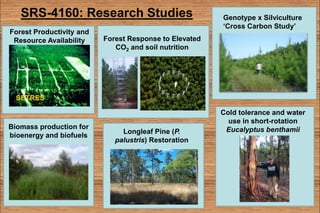
SRS-4160: Research Studies 
Forest Productivity and 
Resource Availability Forest Response to Elevated 
CO2 and soil nutrition 
Longleaf Pine (P. 
palustris) Restoration 
Genotype x Silviculture 
‘Cross Carbon Study’ 
Cold tolerance and water 
use in short-rotation 
Eucalyptus benthamii 
SETRES 
Biomass production for 
bioenergy and biofuels
Managed forest contribution to carbon 
sequestration under a rising atmospheric CO2 
• Objectives: 
– Forest carbon is a cycle 
– Define forest carbon sequestration 
– Summarize what is known about how rising CO2 
affects tree growth and forest health. 
– Carbon management under rising CO2. What can 
be done to increase or enhance carbon 
sequestration?
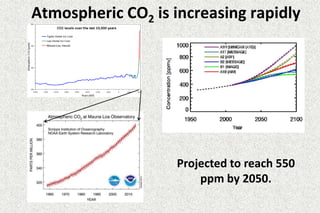
Atmospheric CO2 is increasing rapidly 
Projected to reach 550 
ppm by 2050.
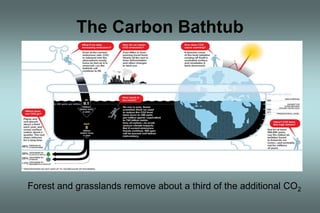
The Carbon Bathtub 
Forest and grasslands remove about a third of the additional CO2
Atmospheric CO2 is an environmental paradox 
(Beedlow et al. 2004) 
– CO2 is a substrate for photosynthesis and essential 
for all life 
• Photosynthesis increases with increasing CO2 
• Plant growth benefits from elevated CO2: “CO2 fertilization effect” 
– Greenhouse gas 
• Rising atmospheric CO2 and other greenhouse gases (e.g. CH4, 
CFCs, and others) will most likely occur in conjunction with cyclical or 
linear changes in other climatic factors (temperature and precipitation 
regimes. 
• Changes in climate will be more severe in some areas 
• However, only modest changes in temperature and precipitation are 
predicted for most of the southern US through 2050.
Can forest management be optimized to 
harness the benefits and mitigate the 
problems associated with increases in 
atmospheric CO2? 
Forest Carbon Sequestration: 
the absorption and storage of 
carbon from the atmosphere in plant biomass, 
detritus, soil, and products
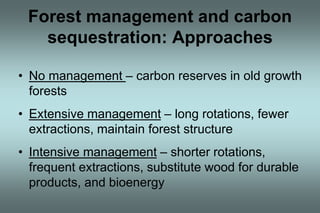
Forest management and carbon 
sequestration: Approaches 
• No management – carbon reserves in old growth 
forests 
• Extensive management – long rotations, fewer 
extractions, maintain forest structure 
• Intensive management – shorter rotations, 
frequent extractions, substitute wood for durable 
products, and bioenergy
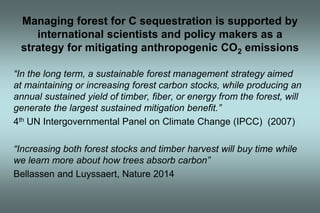
Managing forest for C sequestration is supported by 
international scientists and policy makers as a 
strategy for mitigating anthropogenic CO2 emissions 
“In the long term, a sustainable forest management strategy aimed 
at maintaining or increasing forest carbon stocks, while producing an 
annual sustained yield of timber, fiber, or energy from the forest, will 
generate the largest sustained mitigation benefit.” 
4th UN Intergovernmental Panel on Climate Change (IPCC) (2007) 
“Increasing both forest stocks and timber harvest will buy time while 
we learn more about how trees absorb carbon” 
Bellassen and Luyssaert, Nature 2014
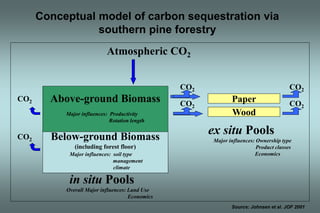
Paper 
Wood 
Above-ground Biomass 
Major influences: Productivity 
Rotation length 
Major influences: soil type 
management 
climate 
in situ Pools 
ex situ Pools 
Atmospheric CO2 
Below-ground Biomass 
(including forest floor) 
Overall Major influences: Land Use 
Economics 
Major influences: Ownership type 
Product classes 
Economics 
CO2 
CO2 
CO2 
CO2 
CO2 
CO2 
Conceptual model of carbon sequestration via 
southern pine forestry 
Source: Johnsen et al. JOF 2001
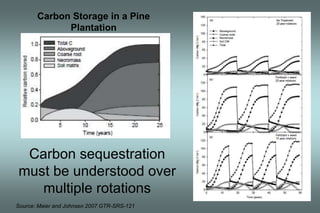
Carbon Storage in a Pine 
Plantation 
Carbon sequestration 
must be understood over 
multiple rotations 
Source: Maier and Johnsen 2007 GTR-SRS-121
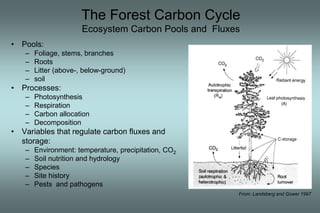
The Forest Carbon Cycle 
Ecosystem Carbon Pools and Fluxes 
• Pools: 
– Foliage, stems, branches 
– Roots 
– Litter (above-, below-ground) 
– soil 
• Processes: 
– Photosynthesis 
– Respiration 
– Carbon allocation 
– Decomposition 
• Variables that regulate carbon fluxes and 
storage: 
– Environment: temperature, precipitation, CO2 
– Soil nutrition and hydrology 
– Species 
– Site history 
– Pests and pathogens 
From: Landsberg and Gower 1997
Photosynthesis: “CO2 fertilization effect" 
6CO2 + 6H2O + energy C6H12O6 + 6O2 
Pinus taeda 
Eucalyptus benthamii 
0 200 400 600 800 1000 1200 1400 1600 1800 2000 
[CO2] (ppm) 
Net Photosynthesis ( mol m-2s-1) 
40 
30 
20 
10 
0 
• Photosynthesis increases with CO2 
• 30-50% at 550 ppm 
• Elevated CO2 decreases stomatal conductance 
and increases water use efficiency 
sugar
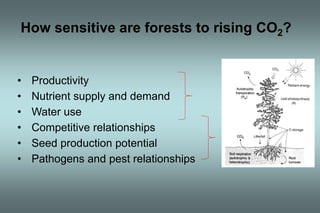
How sensitive are forests to rising CO2? 
• Productivity 
• Nutrient supply and demand 
• Water use 
• Competitive relationships 
• Seed production potential 
• Pathogens and pest relationships
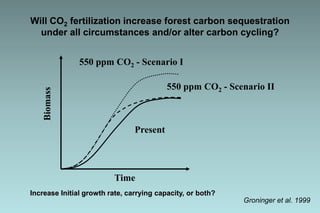
Will CO2 fertilization increase forest carbon sequestration 
under all circumstances and/or alter carbon cycling? 
Biomass 
550 ppm CO2 - Scenario I 
Present 
550 ppm CO2 - Scenario II 
Increase Initial growth rate, carrying capacity, or both? 
Groninger et al. 1999 
Time
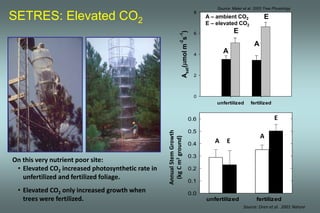
Source: Maier et al. 2002 Tree Physiology 
current year, July 
SETRES: Elevated CO2 A – ambient CO2 
ambient CO2 
amb+200 CO 
E – elevated CO2 
unfertilized fertilized 
Asat( mol m-2s-1) 
8 
6 
4 
2 
0 
unfertilized fertilized 
0.6 
0.5 
0.4 
0.3 
0.2 
0.1 
0.0 
Annual Stem Growth 
(kg C m2 ground) 
A 
E 
A 
E 
On this very nutrient poor site: 
• Elevated CO2 increased photosynthetic rate in 
unfertilized and fertilized foliage. 
• Elevated CO2 only increased growth when 
trees were fertilized. 
Source: Oren et al. 2001 Nature 
A 
A 
E 
E
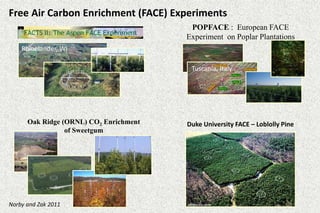
Free Air Carbon Enrichment (FACE) Experiments 
POPFACE : European FACE 
Experiment on Poplar Plantations 
Rhinelander, WI 
Oak Ridge (ORNL) CO2 Enrichment 
of Sweetgum 
Duke University FACE – Loblolly Pine 
Norby and Zak 2011 
Tuscania, Italy
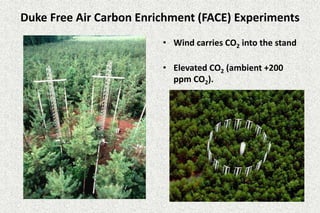
Duke Free Air Carbon Enrichment (FACE) Experiments 
• Wind carries CO2 into the stand 
• Elevated CO2 (ambient +200 
ppm CO2).
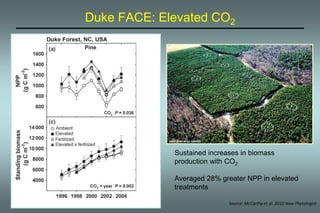
Duke FACE: Elevated CO2 
Sustained increases in biomass 
production with CO2 
Averaged 28% greater NPP in elevated 
treatments 
Source: McCarthy et al. 2010 New Phytologist
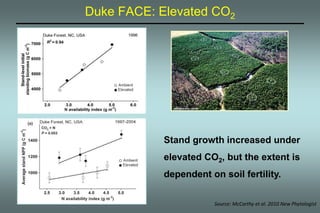
Duke FACE: Elevated CO2 
Stand growth increased under 
elevated CO2, but the extent is 
dependent on soil fertility. 
Source: McCarthy et al. 2010 New Phytologist
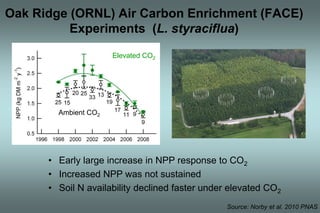
Oak Ridge (ORNL) Air Carbon Enrichment (FACE) 
Experiments (L. styraciflua) 
Elevated CO2 
Ambient CO2 
• Early large increase in NPP response to CO2 
• Increased NPP was not sustained 
• Soil N availability declined faster under elevated CO2 
Source: Norby et al. 2010 PNAS
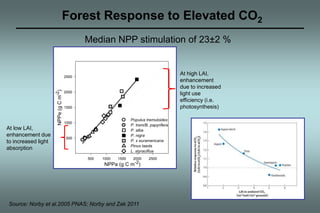
Forest Response to Elevated CO2 
Median NPP stimulation of 23±2 % 
Populus tremuloides 
P. trem/B. papyrifera 
P. alba 
P. nigra 
P. x euramericana 
Pinus taeda 
L. styraciflua 
500 1000 1500 2000 2500 
NPPa (g C m-2) 
NPPe (g C m-2) 
2500 
2000 
1500 
1000 
500 
Source: Norby et al.2005 PNAS; Norby and Zak 2011 
At high LAI, 
enhancement 
due to increased 
light use 
efficiency (i.e. 
photosynthesis) 
At low LAI, 
enhancement due 
to increased light 
absorption
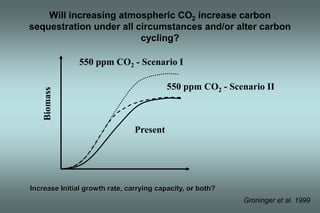
Will increasing atmospheric CO2 increase carbon 
sequestration under all circumstances and/or alter carbon 
cycling? 
Biomass 
550 ppm CO2 - Scenario I 
Present 
550 ppm CO2 - Scenario II 
Increase Initial growth rate, carrying capacity, or both? 
Groninger et al. 1999
Do forest use less water under 
elevated CO2? 
• Theory suggests that rising CO2 concentrations 
should decrease stomatal conductance and reduce 
forest water use. 
• Direct effects of elevated CO2 on canopy or stand 
water use are more difficult to assess. 
• Data indicates that closed-canopy forests reduce 
water use 4-11% under elevated CO2 
• Response in younger stands is uncertain
Fecundity and Pest 
Relationships 
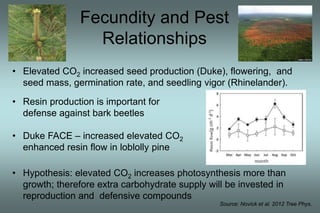
• Elevated CO2 increased seed production (Duke), flowering, and 
seed mass, germination rate, and seedling vigor (Rhinelander). 
• Resin production is important for 
defense against bark beetles 
• Duke FACE – increased elevated CO2 
enhanced resin flow in loblolly pine 
• Hypothesis: elevated CO2 increases photosynthesis more than 
growth; therefore extra carbohydrate supply will be invested in 
reproduction and defensive compounds 
Source: Novick et al. 2012 Tree Phys. 
Resin flow
Competitive 
Relationships 
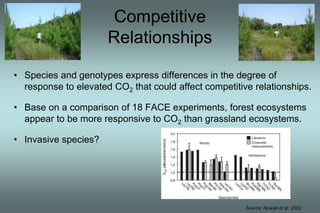
• Species and genotypes express differences in the degree of 
response to elevated CO2 that could affect competitive relationships. 
• Base on a comparison of 18 FACE experiments, forest ecosystems 
appear to be more responsive to CO2 than grassland ecosystems. 
• Invasive species? 
Source: Nowak et al. 2002
Summary of Elevated CO2 Research 
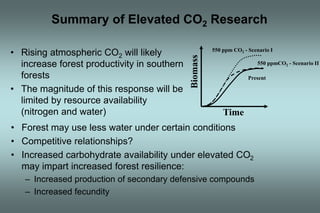
• Rising atmospheric CO2 will likely 
increase forest productivity in southern 
forests 
• The magnitude of this response will be 
limited by resource availability 
(nitrogen and water) 
Biomass 
550 ppm CO2 - Scenario I 
Present 
• Forest may use less water under certain conditions 
• Competitive relationships? 
• Increased carbohydrate availability under elevated CO2 
may impart increased forest resilience: 
– Increased production of secondary defensive compounds 
– Increased fecundity 
550 ppmCO2 - Scenario II 
Time
Management Implications 
• Should a forest manager base management decisions based on the certainty of rising CO2 
concentrations? Probably not directly. 
• Management decisions (e.g. species, genotypes, fertilization, weed control), environmental 
variability, and disease will likely have a much larger impact on forest growth than elevated 
CO2. 
• However, the potential positive effects of CO2 should not be ignored. 
– Forest process models suggest potential increases of 20% over the next 30 years from 
elevated CO2 
– Leverage CO2 fertilization effect through good silviculture 
– Increase the efficiency of fertilizer use, primarily nitrogen 
– Good weed control 
– Maintain soil organic matter 
– Utilize genetically improve seedlings (MCP, varietals) 
Good Forest Management is Good Carbon Management
Resources 
www.fs.usda.gov/ccrc/ 
www.taccimo.sgcp.ncsu.edu 
www.pinemap.org 
www.floridaclimateinstitute.org/ 
www.nc-climate.ncsu.edu/ 
www.seclimate.org/

“Managed forest contribution to carbon sequestration under a rising carbon dioxide regime” Chris Maier, Research Biological Scientist; USFS, Southern Research Station - RWU 4160; Forest Genetics and Ecosystems Productivity

  • 1.
    Managed Forest Contributionto Carbon Sequestration Under a Rising Carbon Dioxide Regime Chris A. Maier Research Biological Scientist USFS, Southern Research Station - RWU 4160 Forest Genetics and Ecosystems Productivity Research Triangle Park, NC 919-549-4072 cmaier@fs.fed.us 2014 Southeastern Regional Forest Landowner and Manager Conference, Valdosta, GA
  • 2.
    SRS-4160 – ForestGenetics and Ecosystems Productivity USDA Forest Service Research and Development www.fs.fed.us/research Southern Research Station (SRS) www.srs.fs.fed.us Mission: To advance the scientific understanding of the roles of genetics, environment, and their interactions to provide guidelines and tools for improving the sustainable productivity of southern forest ecosystems. Research Focal areas: Genetics and Genomics Physiological Processes Carbon and Nutrient Cycling * *
  • 3.
    SRS-4160: Research Studies Forest Productivity and Resource Availability Forest Response to Elevated CO2 and soil nutrition Longleaf Pine (P. palustris) Restoration Genotype x Silviculture ‘Cross Carbon Study’ Cold tolerance and water use in short-rotation Eucalyptus benthamii SETRES Biomass production for bioenergy and biofuels
  • 4.
    Managed forest contributionto carbon sequestration under a rising atmospheric CO2 • Objectives: – Forest carbon is a cycle – Define forest carbon sequestration – Summarize what is known about how rising CO2 affects tree growth and forest health. – Carbon management under rising CO2. What can be done to increase or enhance carbon sequestration?
  • 5.
    Atmospheric CO2 isincreasing rapidly Projected to reach 550 ppm by 2050.
  • 6.
    The Carbon Bathtub Forest and grasslands remove about a third of the additional CO2
  • 7.
    Atmospheric CO2 isan environmental paradox (Beedlow et al. 2004) – CO2 is a substrate for photosynthesis and essential for all life • Photosynthesis increases with increasing CO2 • Plant growth benefits from elevated CO2: “CO2 fertilization effect” – Greenhouse gas • Rising atmospheric CO2 and other greenhouse gases (e.g. CH4, CFCs, and others) will most likely occur in conjunction with cyclical or linear changes in other climatic factors (temperature and precipitation regimes. • Changes in climate will be more severe in some areas • However, only modest changes in temperature and precipitation are predicted for most of the southern US through 2050.
  • 8.
    Can forest managementbe optimized to harness the benefits and mitigate the problems associated with increases in atmospheric CO2? Forest Carbon Sequestration: the absorption and storage of carbon from the atmosphere in plant biomass, detritus, soil, and products
  • 9.
    Forest management andcarbon sequestration: Approaches • No management – carbon reserves in old growth forests • Extensive management – long rotations, fewer extractions, maintain forest structure • Intensive management – shorter rotations, frequent extractions, substitute wood for durable products, and bioenergy
  • 10.
    Managing forest forC sequestration is supported by international scientists and policy makers as a strategy for mitigating anthropogenic CO2 emissions “In the long term, a sustainable forest management strategy aimed at maintaining or increasing forest carbon stocks, while producing an annual sustained yield of timber, fiber, or energy from the forest, will generate the largest sustained mitigation benefit.” 4th UN Intergovernmental Panel on Climate Change (IPCC) (2007) “Increasing both forest stocks and timber harvest will buy time while we learn more about how trees absorb carbon” Bellassen and Luyssaert, Nature 2014
  • 11.
    Paper Wood Above-groundBiomass Major influences: Productivity Rotation length Major influences: soil type management climate in situ Pools ex situ Pools Atmospheric CO2 Below-ground Biomass (including forest floor) Overall Major influences: Land Use Economics Major influences: Ownership type Product classes Economics CO2 CO2 CO2 CO2 CO2 CO2 Conceptual model of carbon sequestration via southern pine forestry Source: Johnsen et al. JOF 2001
  • 12.
    Carbon Storage ina Pine Plantation Carbon sequestration must be understood over multiple rotations Source: Maier and Johnsen 2007 GTR-SRS-121
  • 13.
    The Forest CarbonCycle Ecosystem Carbon Pools and Fluxes • Pools: – Foliage, stems, branches – Roots – Litter (above-, below-ground) – soil • Processes: – Photosynthesis – Respiration – Carbon allocation – Decomposition • Variables that regulate carbon fluxes and storage: – Environment: temperature, precipitation, CO2 – Soil nutrition and hydrology – Species – Site history – Pests and pathogens From: Landsberg and Gower 1997
  • 14.
    Photosynthesis: “CO2 fertilizationeffect" 6CO2 + 6H2O + energy C6H12O6 + 6O2 Pinus taeda Eucalyptus benthamii 0 200 400 600 800 1000 1200 1400 1600 1800 2000 [CO2] (ppm) Net Photosynthesis ( mol m-2s-1) 40 30 20 10 0 • Photosynthesis increases with CO2 • 30-50% at 550 ppm • Elevated CO2 decreases stomatal conductance and increases water use efficiency sugar
  • 15.
    How sensitive areforests to rising CO2? • Productivity • Nutrient supply and demand • Water use • Competitive relationships • Seed production potential • Pathogens and pest relationships
  • 16.
    Will CO2 fertilizationincrease forest carbon sequestration under all circumstances and/or alter carbon cycling? Biomass 550 ppm CO2 - Scenario I Present 550 ppm CO2 - Scenario II Increase Initial growth rate, carrying capacity, or both? Groninger et al. 1999 Time
  • 17.
    Source: Maier etal. 2002 Tree Physiology current year, July SETRES: Elevated CO2 A – ambient CO2 ambient CO2 amb+200 CO E – elevated CO2 unfertilized fertilized Asat( mol m-2s-1) 8 6 4 2 0 unfertilized fertilized 0.6 0.5 0.4 0.3 0.2 0.1 0.0 Annual Stem Growth (kg C m2 ground) A E A E On this very nutrient poor site: • Elevated CO2 increased photosynthetic rate in unfertilized and fertilized foliage. • Elevated CO2 only increased growth when trees were fertilized. Source: Oren et al. 2001 Nature A A E E
  • 18.
    Free Air CarbonEnrichment (FACE) Experiments POPFACE : European FACE Experiment on Poplar Plantations Rhinelander, WI Oak Ridge (ORNL) CO2 Enrichment of Sweetgum Duke University FACE – Loblolly Pine Norby and Zak 2011 Tuscania, Italy
  • 19.
    Duke Free AirCarbon Enrichment (FACE) Experiments • Wind carries CO2 into the stand • Elevated CO2 (ambient +200 ppm CO2).
  • 20.
    Duke FACE: ElevatedCO2 Sustained increases in biomass production with CO2 Averaged 28% greater NPP in elevated treatments Source: McCarthy et al. 2010 New Phytologist
  • 21.
    Duke FACE: ElevatedCO2 Stand growth increased under elevated CO2, but the extent is dependent on soil fertility. Source: McCarthy et al. 2010 New Phytologist
  • 22.
    Oak Ridge (ORNL)Air Carbon Enrichment (FACE) Experiments (L. styraciflua) Elevated CO2 Ambient CO2 • Early large increase in NPP response to CO2 • Increased NPP was not sustained • Soil N availability declined faster under elevated CO2 Source: Norby et al. 2010 PNAS
  • 23.
    Forest Response toElevated CO2 Median NPP stimulation of 23±2 % Populus tremuloides P. trem/B. papyrifera P. alba P. nigra P. x euramericana Pinus taeda L. styraciflua 500 1000 1500 2000 2500 NPPa (g C m-2) NPPe (g C m-2) 2500 2000 1500 1000 500 Source: Norby et al.2005 PNAS; Norby and Zak 2011 At high LAI, enhancement due to increased light use efficiency (i.e. photosynthesis) At low LAI, enhancement due to increased light absorption
  • 24.
    Will increasing atmosphericCO2 increase carbon sequestration under all circumstances and/or alter carbon cycling? Biomass 550 ppm CO2 - Scenario I Present 550 ppm CO2 - Scenario II Increase Initial growth rate, carrying capacity, or both? Groninger et al. 1999
  • 25.
    Do forest useless water under elevated CO2? • Theory suggests that rising CO2 concentrations should decrease stomatal conductance and reduce forest water use. • Direct effects of elevated CO2 on canopy or stand water use are more difficult to assess. • Data indicates that closed-canopy forests reduce water use 4-11% under elevated CO2 • Response in younger stands is uncertain
  • 26.
    Fecundity and Pest Relationships • Elevated CO2 increased seed production (Duke), flowering, and seed mass, germination rate, and seedling vigor (Rhinelander). • Resin production is important for defense against bark beetles • Duke FACE – increased elevated CO2 enhanced resin flow in loblolly pine • Hypothesis: elevated CO2 increases photosynthesis more than growth; therefore extra carbohydrate supply will be invested in reproduction and defensive compounds Source: Novick et al. 2012 Tree Phys. Resin flow
  • 27.
    Competitive Relationships •Species and genotypes express differences in the degree of response to elevated CO2 that could affect competitive relationships. • Base on a comparison of 18 FACE experiments, forest ecosystems appear to be more responsive to CO2 than grassland ecosystems. • Invasive species? Source: Nowak et al. 2002
  • 28.
    Summary of ElevatedCO2 Research • Rising atmospheric CO2 will likely increase forest productivity in southern forests • The magnitude of this response will be limited by resource availability (nitrogen and water) Biomass 550 ppm CO2 - Scenario I Present • Forest may use less water under certain conditions • Competitive relationships? • Increased carbohydrate availability under elevated CO2 may impart increased forest resilience: – Increased production of secondary defensive compounds – Increased fecundity 550 ppmCO2 - Scenario II Time
  • 29.
    Management Implications •Should a forest manager base management decisions based on the certainty of rising CO2 concentrations? Probably not directly. • Management decisions (e.g. species, genotypes, fertilization, weed control), environmental variability, and disease will likely have a much larger impact on forest growth than elevated CO2. • However, the potential positive effects of CO2 should not be ignored. – Forest process models suggest potential increases of 20% over the next 30 years from elevated CO2 – Leverage CO2 fertilization effect through good silviculture – Increase the efficiency of fertilizer use, primarily nitrogen – Good weed control – Maintain soil organic matter – Utilize genetically improve seedlings (MCP, varietals) Good Forest Management is Good Carbon Management
  • 30.
    Resources www.fs.usda.gov/ccrc/ www.taccimo.sgcp.ncsu.edu www.pinemap.org www.floridaclimateinstitute.org/ www.nc-climate.ncsu.edu/ www.seclimate.org/