Direct and indirect effects of climate change on plant
processes:
• Phenology,
• Net carbon assimilation,
• Water relation,
• Grain development and quality,
• Nutrient acquisition and yield
PRESENTATION ON
Presented by: Deshmukh Pravin Laxman
Ph.D.-II Semester (Fruit science)
Department of Horticulture,
PGI, Dr. PDKV. Akola.
#
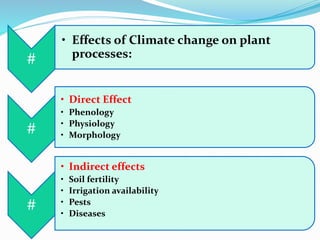
• Effects of Climate change on plant
processes:
#
• Direct Effect
• Phenology
• Physiology
• Morphology
#
• Indirect effects
• Soil fertility
• Irrigation availability
• Pests
• Diseases
Climate :-
Climate is weather conditions related to longer
areas like zone, state country. Longer duration of time like
month, season or year.
Climate change:-
Climate change is a significant and lasting
change in the statistical distribution of weather patterns
over periods ranging from decades to millions of years. It
may be a change in average weather conditions, or in the
distribution of weather around the average conditions.
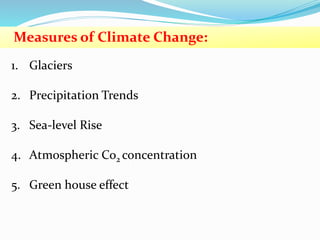
Measures of Climate Change:
1. Glaciers
2. Precipitation Trends
3. Sea-level Rise
4. Atmospheric Co2 concentration
5. Green house effect
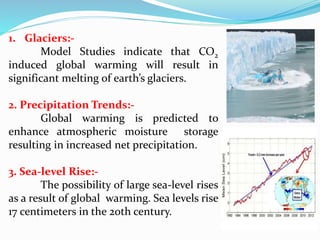
1. Glaciers:-
Model Studies indicate that CO2
induced global warming will result in
significant melting of earth’s glaciers.
2. Precipitation Trends:-
Global warming is predicted to
enhance atmospheric moisture storage
resulting in increased net precipitation.
3. Sea-level Rise:-
The possibility of large sea-level rises
as a result of global warming. Sea levels rise
17 centimeters in the 20th century.
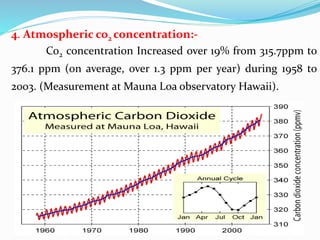
4. Atmospheric co2 concentration:-
Co2 concentration Increased over 19% from 315.7ppm to
376.1 ppm (on average, over 1.3 ppm per year) during 1958 to
2003. (Measurement at Mauna Loa observatory Hawaii).
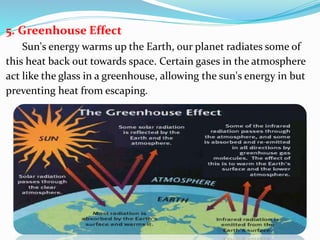
5. Greenhouse Effect
Sun's energy warms up the Earth, our planet radiates some of
this heat back out towards space. Certain gases in the atmosphere
act like the glass in a greenhouse, allowing the sun's energy in but
preventing heat from escaping.
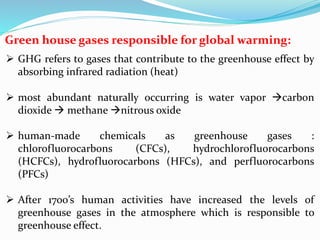
Green house gases responsible for global warming:
 GHG refers to gases that contribute to the greenhouse effect by
absorbing infrared radiation (heat)
 most abundant naturally occurring is water vapor carbon
dioxide  methane nitrous oxide
 human-made chemicals as greenhouse gases :
chlorofluorocarbons (CFCs), hydrochlorofluorocarbons
(HCFCs), hydrofluorocarbons (HFCs), and perfluorocarbons
(PFCs)
 After 1700’s human activities have increased the levels of
greenhouse gases in the atmosphere which is responsible to
greenhouse effect.
 Climate is the most dominating factor influencing the
suitability of a crop to a particular region. The yield potential
of a crop mainly depends on climatic conditions.
 More than 50% of variation in yield of a crop is due to climate
differences.
 Climate change directly affects rate of physiological process
and biochemical processes.
 Excess carbon dioxide in the atmosphere has the potential to
increase crop growth.
 Eg. Elevated levels of carbon dioxide reduce the protein
content of wheat grain.
Direct effect of Climate Change on Plant
Processes:
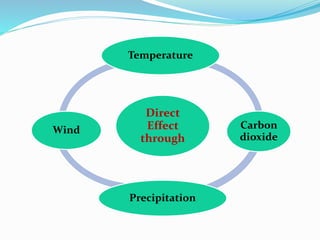
Direct
Effect
through
Temperature
Carbon
dioxide
Precipitation
Wind
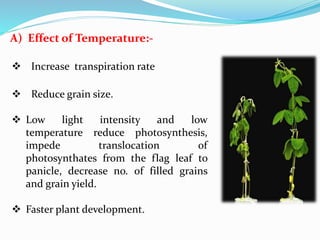
A) Effect of Temperature:-
 Increase transpiration rate
 Reduce grain size.
 Low light intensity and low
temperature reduce photosynthesis,
impede translocation of
photosynthates from the flag leaf to
panicle, decrease no. of filled grains
and grain yield.
 Faster plant development.
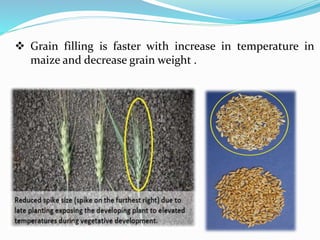
 Grain filling is faster with increase in temperature in
maize and decrease grain weight .
B) Effect of atmospheric CO2 concentration:-
 Reduced transpiration.
 Gas exchange is reduced for both C3 and C4 plants.
 Change in a quality of biomass – more sugar
 Increases in atmospheric CO2 concentration affect plants
photosynthesis, resulting in increases in plant water use
efficiency, enhanced photosynthetic capacity and increased
growth.
 Increased CO2 can also lead to increased Carbon: Nitrogen
ratio in the leaves of plants.
• Growth of plants at elevated CO2 concentrations of 475–600
ppm increases leaf photosynthetic rates by an average of 40%
(Ainsworth & Rogers 2007)
• Environmental factor that interacts with elevated CO2 is
atmospheric ozone (O3), a gaseous toxin.
Dec, 2015 397.22ppm (last weak)
Dec, 2014 394.17ppm (1 year ago)
Recent Data
( According to IPCC Report, 2015)
C) Effect of Rainfall:-
 Cell growth, cell development and protein synthesis are
adversely affected by the rainfall.
 Stomatal closure due to water stress restrict carbon dioxide
intake leading to reduced photosynthesis.
 Water stess is affects fixation, uptake and assimilation of
nitrogen.
 The promoting growth hormones like cytokinin, gibberellic acid
and indol acetic acid decreases.
 Increase in abscisic acid content under stressed conditions
cause stomatal closure leading to restricted water loss from
leaves.
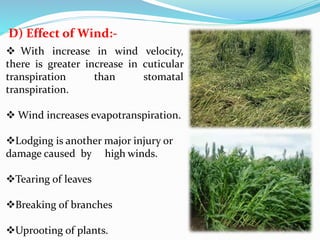
D) Effect of Wind:-
 With increase in wind velocity,
there is greater increase in cuticular
transpiration than stomatal
transpiration.
 Wind increases evapotranspiration.
Lodging is another major injury or
damage caused by high winds.
Tearing of leaves
Breaking of branches
Uprooting of plants.
Lodging in rice
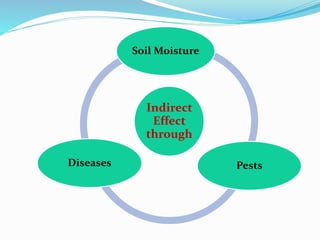
Indirect
Effect
through
Soil Moisture
PestsDiseases
 Climate change may also impact indirectly on crops through
effects on pests and disease.
 wheat and oats become more susceptible to rust diseases
with increased temperature.
 Climate fluctuations suitable for pathogen growth and
reproduction at certain level.
 Warmer winter temperatures could be important in
increasing insect populations (Harrington et al. 2001).
Pests and diseases:-
Indirect effect of Climate Change on Plant
Processes:
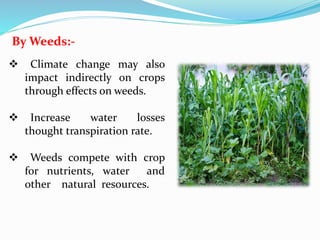
By Weeds:-
 Climate change may also
impact indirectly on crops
through effects on weeds.
 Increase water losses
thought transpiration rate.
 Weeds compete with crop
for nutrients, water and
other natural resources.
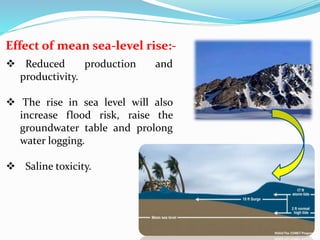
Effect of mean sea-level rise:-
 Reduced production and
productivity.
 The rise in sea level will also
increase flood risk, raise the
groundwater table and prolong
water logging.
 Saline toxicity.
Direct and indirect effects of climate change on
Phenology
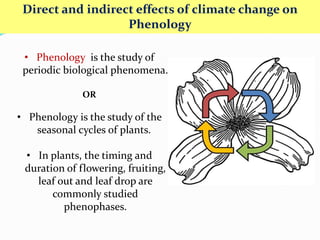
• Phenology is the study of
periodic biological phenomena.
OR
• Phenology is the study of the
seasonal cycles of plants.
• In plants, the timing and
duration of flowering, fruiting,
leaf out and leaf drop are
commonly studied
phenophases.
Temperature Effects on Phenological Development and
Yield of Muskmelon
 A growth chamber experiment was conducted with two
cultivars of muskmelon (`Gold Rush' and `Mission') to
determine how main vine leaf appearance rates responded to
temperature.
 They identified three cardinal temperatures for leaf
appearance rate:
 The base temperature (10 0C) at which leaf appearance rate was
zero;
 An optimum temperature (34 0C) at which the rate of leaf
appearance was maximal;
 An upper threshold temperature (45 0C) at which leaf
appearance rate returned to zero. Baker and Reddy (2001)
Mango malformation in relation to physiological
parameters under elevated temperature
•An experiment conducted to elevate the temperature around
mango trees in cv. Amrapali
•By covering it with colourless polythene sheet (400 gauge)
during genesis of flowers.
•Polythene cover raised the average max. and min. temperature by
4.1o and 0.89oC respectively around trees.
•Internal temperature also increased by 1.8oC, which altered the
physiological attributes, resulting in an early emergence of
panicles with faster growth, early fruit set and inhibition of floral
malformation in them. Singh et al. (1998)
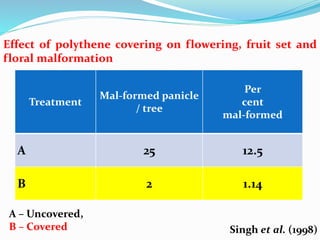
Effect of polythene covering on flowering, fruit set and
floral malformation
A – Uncovered,
B – Covered Singh et al. (1998)
Treatment
Mal-formed panicle
/ tree
Per
cent
mal-formed
A 25 12.5
B 2 1.14
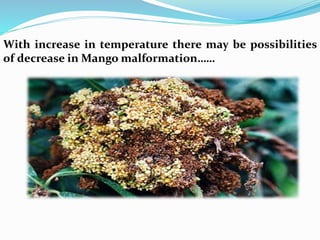
With increase in temperature there may be possibilities
of decrease in Mango malformation……
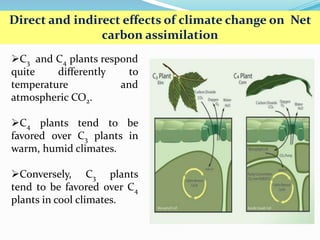
C3 and C4 plants respond
quite differently to
temperature and
atmospheric CO2.
C4 plants tend to be
favored over C3 plants in
warm, humid climates.
Conversely, C3 plants
tend to be favored over C4
plants in cool climates.
Direct and indirect effects of climate change on Net
carbon assimilation
A doubling of atmospheric CO2 typically result in short term
irreversible decrease in leaf dark respiration.
The photorespiration is inhibited by an increased CO2 which
will be advantageous for C3 plants but not for C4 plants.
The gross photosynthesis increases with rise increase in CO2
concentration in C3 plants but not for C4 plants.
Photorespiration and gross photosynthesis will increase with
temperature due to higher enzymatic rates, diffusion and
transport.
At higher than current ambient CO2 conc. Plants reduce the
apertures of the small pores in their leaves. These apertures
permit CO2 and water vapor exchange
These change in plant function, foster greater growth with less
water demand and end result in decrease in whole plant water
use.
A secondary effect of the stomata closure response to increased
CO2 is to increase leaf temperature by 1-3 0C. This occurs
because there is less water evaporated at leaf surface to cool it.
This ultimately increases transpiration in long term basis and
counteract the water saving benefit from a CO2 doubling.
Direct and indirect effects of climate change on Water
relation:
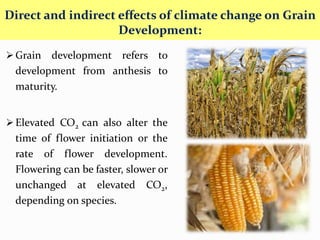
Grain development refers to
development from anthesis to
maturity.
Elevated CO2 can also alter the
time of flower initiation or the
rate of flower development.
Flowering can be faster, slower or
unchanged at elevated CO2,
depending on species.
Direct and indirect effects of climate change on Grain
Development:
At 1 0C warming would reduce crop duration by about 21 days
(8%) and the reproductive period by about 2 days (5%) per
degree. However these responses show considerable
differences among varieties.
Extreme cold may kill wheat and late frost induce sterility.
Chilling temperature below 5 0C and hot temperature above
30 0C at anthesis can damage the pollens formation which in
turn reduce grain set and can decrease yield. There is wide
range of susceptibility among varieties.
Elevated CO2 tends to increase mass per grain and decrease
percentage of nitrogen because of increased carbohydrate
supply from photosynthesis, either during grain filling or
reserve. Elevated CO2 does not alter the composition of
carbohydrates.
Elevated CO2 is expected to decrease protein concentration,
while ozone pollution and warming can increase concentration.
High temperature reduce test weight, grain elongation and
aroma in basmati rice
Direct and indirect effects of climate change on Grain
Quality:
Global warming may be to blame for the disappointing
basmati produced in the 2006-2007 experiment.
Temperatures that year crossed 26 degree Celsius in
September when the basmati flowers and, 15 to 20 days later,
when the grain begins to fill out, because of which a
shrivelling of the grain was seen.
The extra heat, prevented the food stored by the plant from
travelling to the grain. Consequently, it failed to grow to the
right length. The heat also destroyed fatty acids stored in
the grain which give the basmati its distinct fragrance when
cooked.
Nutrient use efficiency increases under elevated CO2 while
nutrient uptake efficiency generally declines.
The greatest absolute increase in the productivity as a result of
elevated CO2 exposure will occur only when the soil N and P
availability is high.
CO2 increase may stimulate mycorrhizal activity also increase
biological nitrogen fixation
CO2 fertilization will produce more litter with higher C/N
ratio. This litter decomposes slowly and can act as a negative
feedback on nutrient availability.
Direct and indirect effects of climate change on
Nutrient acquisition:
Recent re-analyses of FACE studies shows that, at 550 ppm
CO2 conc. yields increase under unstressed condition by 10-
25% for C3 crops and by 0-10% for C4 crops.
The optimum daily mean temp. for rice is 23-26 0C. As air
temp. deviates from this optimum, yield declines to near zero
at temp. below 15-18 0C or above 36-40 0C; depending on
cultivar.
This effect is mainly due to spikelet sterility induced either by
low or high temperature.
Direct and indirect effects of climate change on Yield:
Even 1 0C rise in the earth’s surface temperature, could cost
wheat production drop by 4-5 M.T. and it is estimated that
due to temperature rise our country may loose even up to 125
M.T. of cereal’s production.(FAO)
In South Asia, the drop in yields of non-irrigated wheat and
rice will be significant for temperature rise beyond 2.5 0C
incurring loss of farm-level revenue of 9%-25%.
Rain-fed wheat grown at 450 ppm CO2 demonstrated yield
increase with temperature increase up to 0.8 0C, but declines
with temperature increases beyond 1.5 0C.
Climate change effect on plant

Climate change effect on plant

  • 2.
    Direct and indirecteffects of climate change on plant processes: • Phenology, • Net carbon assimilation, • Water relation, • Grain development and quality, • Nutrient acquisition and yield PRESENTATION ON Presented by: Deshmukh Pravin Laxman Ph.D.-II Semester (Fruit science) Department of Horticulture, PGI, Dr. PDKV. Akola.
  • 3.
    # • Effects ofClimate change on plant processes: # • Direct Effect • Phenology • Physiology • Morphology # • Indirect effects • Soil fertility • Irrigation availability • Pests • Diseases
  • 4.
    Climate :- Climate isweather conditions related to longer areas like zone, state country. Longer duration of time like month, season or year. Climate change:- Climate change is a significant and lasting change in the statistical distribution of weather patterns over periods ranging from decades to millions of years. It may be a change in average weather conditions, or in the distribution of weather around the average conditions.
  • 5.
    Measures of ClimateChange: 1. Glaciers 2. Precipitation Trends 3. Sea-level Rise 4. Atmospheric Co2 concentration 5. Green house effect
  • 6.
    1. Glaciers:- Model Studiesindicate that CO2 induced global warming will result in significant melting of earth’s glaciers. 2. Precipitation Trends:- Global warming is predicted to enhance atmospheric moisture storage resulting in increased net precipitation. 3. Sea-level Rise:- The possibility of large sea-level rises as a result of global warming. Sea levels rise 17 centimeters in the 20th century.
  • 7.
    4. Atmospheric co2concentration:- Co2 concentration Increased over 19% from 315.7ppm to 376.1 ppm (on average, over 1.3 ppm per year) during 1958 to 2003. (Measurement at Mauna Loa observatory Hawaii).
  • 8.
    5. Greenhouse Effect Sun'senergy warms up the Earth, our planet radiates some of this heat back out towards space. Certain gases in the atmosphere act like the glass in a greenhouse, allowing the sun's energy in but preventing heat from escaping.
  • 9.
    Green house gasesresponsible for global warming:  GHG refers to gases that contribute to the greenhouse effect by absorbing infrared radiation (heat)  most abundant naturally occurring is water vapor carbon dioxide  methane nitrous oxide  human-made chemicals as greenhouse gases : chlorofluorocarbons (CFCs), hydrochlorofluorocarbons (HCFCs), hydrofluorocarbons (HFCs), and perfluorocarbons (PFCs)  After 1700’s human activities have increased the levels of greenhouse gases in the atmosphere which is responsible to greenhouse effect.
  • 10.
     Climate isthe most dominating factor influencing the suitability of a crop to a particular region. The yield potential of a crop mainly depends on climatic conditions.  More than 50% of variation in yield of a crop is due to climate differences.  Climate change directly affects rate of physiological process and biochemical processes.  Excess carbon dioxide in the atmosphere has the potential to increase crop growth.  Eg. Elevated levels of carbon dioxide reduce the protein content of wheat grain. Direct effect of Climate Change on Plant Processes:
  • 11.
  • 12.
    A) Effect ofTemperature:-  Increase transpiration rate  Reduce grain size.  Low light intensity and low temperature reduce photosynthesis, impede translocation of photosynthates from the flag leaf to panicle, decrease no. of filled grains and grain yield.  Faster plant development.
  • 13.
     Grain fillingis faster with increase in temperature in maize and decrease grain weight .
  • 14.
    B) Effect ofatmospheric CO2 concentration:-  Reduced transpiration.  Gas exchange is reduced for both C3 and C4 plants.  Change in a quality of biomass – more sugar  Increases in atmospheric CO2 concentration affect plants photosynthesis, resulting in increases in plant water use efficiency, enhanced photosynthetic capacity and increased growth.  Increased CO2 can also lead to increased Carbon: Nitrogen ratio in the leaves of plants.
  • 15.
    • Growth ofplants at elevated CO2 concentrations of 475–600 ppm increases leaf photosynthetic rates by an average of 40% (Ainsworth & Rogers 2007) • Environmental factor that interacts with elevated CO2 is atmospheric ozone (O3), a gaseous toxin. Dec, 2015 397.22ppm (last weak) Dec, 2014 394.17ppm (1 year ago) Recent Data ( According to IPCC Report, 2015)
  • 16.
    C) Effect ofRainfall:-  Cell growth, cell development and protein synthesis are adversely affected by the rainfall.  Stomatal closure due to water stress restrict carbon dioxide intake leading to reduced photosynthesis.  Water stess is affects fixation, uptake and assimilation of nitrogen.  The promoting growth hormones like cytokinin, gibberellic acid and indol acetic acid decreases.  Increase in abscisic acid content under stressed conditions cause stomatal closure leading to restricted water loss from leaves.
  • 17.
    D) Effect ofWind:-  With increase in wind velocity, there is greater increase in cuticular transpiration than stomatal transpiration.  Wind increases evapotranspiration. Lodging is another major injury or damage caused by high winds. Tearing of leaves Breaking of branches Uprooting of plants. Lodging in rice
  • 18.
  • 19.
     Climate changemay also impact indirectly on crops through effects on pests and disease.  wheat and oats become more susceptible to rust diseases with increased temperature.  Climate fluctuations suitable for pathogen growth and reproduction at certain level.  Warmer winter temperatures could be important in increasing insect populations (Harrington et al. 2001). Pests and diseases:- Indirect effect of Climate Change on Plant Processes:
  • 20.
    By Weeds:-  Climatechange may also impact indirectly on crops through effects on weeds.  Increase water losses thought transpiration rate.  Weeds compete with crop for nutrients, water and other natural resources.
  • 21.
    Effect of meansea-level rise:-  Reduced production and productivity.  The rise in sea level will also increase flood risk, raise the groundwater table and prolong water logging.  Saline toxicity.
  • 22.
    Direct and indirecteffects of climate change on Phenology • Phenology is the study of periodic biological phenomena. OR • Phenology is the study of the seasonal cycles of plants. • In plants, the timing and duration of flowering, fruiting, leaf out and leaf drop are commonly studied phenophases.
  • 23.
    Temperature Effects onPhenological Development and Yield of Muskmelon  A growth chamber experiment was conducted with two cultivars of muskmelon (`Gold Rush' and `Mission') to determine how main vine leaf appearance rates responded to temperature.  They identified three cardinal temperatures for leaf appearance rate:  The base temperature (10 0C) at which leaf appearance rate was zero;  An optimum temperature (34 0C) at which the rate of leaf appearance was maximal;  An upper threshold temperature (45 0C) at which leaf appearance rate returned to zero. Baker and Reddy (2001)
  • 24.
    Mango malformation inrelation to physiological parameters under elevated temperature •An experiment conducted to elevate the temperature around mango trees in cv. Amrapali •By covering it with colourless polythene sheet (400 gauge) during genesis of flowers. •Polythene cover raised the average max. and min. temperature by 4.1o and 0.89oC respectively around trees. •Internal temperature also increased by 1.8oC, which altered the physiological attributes, resulting in an early emergence of panicles with faster growth, early fruit set and inhibition of floral malformation in them. Singh et al. (1998)
  • 25.
    Effect of polythenecovering on flowering, fruit set and floral malformation A – Uncovered, B – Covered Singh et al. (1998) Treatment Mal-formed panicle / tree Per cent mal-formed A 25 12.5 B 2 1.14
  • 26.
    With increase intemperature there may be possibilities of decrease in Mango malformation……
  • 27.
    C3 and C4plants respond quite differently to temperature and atmospheric CO2. C4 plants tend to be favored over C3 plants in warm, humid climates. Conversely, C3 plants tend to be favored over C4 plants in cool climates. Direct and indirect effects of climate change on Net carbon assimilation
  • 28.
    A doubling ofatmospheric CO2 typically result in short term irreversible decrease in leaf dark respiration. The photorespiration is inhibited by an increased CO2 which will be advantageous for C3 plants but not for C4 plants. The gross photosynthesis increases with rise increase in CO2 concentration in C3 plants but not for C4 plants. Photorespiration and gross photosynthesis will increase with temperature due to higher enzymatic rates, diffusion and transport.
  • 29.
    At higher thancurrent ambient CO2 conc. Plants reduce the apertures of the small pores in their leaves. These apertures permit CO2 and water vapor exchange These change in plant function, foster greater growth with less water demand and end result in decrease in whole plant water use. A secondary effect of the stomata closure response to increased CO2 is to increase leaf temperature by 1-3 0C. This occurs because there is less water evaporated at leaf surface to cool it. This ultimately increases transpiration in long term basis and counteract the water saving benefit from a CO2 doubling. Direct and indirect effects of climate change on Water relation:
  • 30.
    Grain development refersto development from anthesis to maturity. Elevated CO2 can also alter the time of flower initiation or the rate of flower development. Flowering can be faster, slower or unchanged at elevated CO2, depending on species. Direct and indirect effects of climate change on Grain Development:
  • 31.
    At 1 0Cwarming would reduce crop duration by about 21 days (8%) and the reproductive period by about 2 days (5%) per degree. However these responses show considerable differences among varieties. Extreme cold may kill wheat and late frost induce sterility. Chilling temperature below 5 0C and hot temperature above 30 0C at anthesis can damage the pollens formation which in turn reduce grain set and can decrease yield. There is wide range of susceptibility among varieties.

  • 32.
    Elevated CO2 tendsto increase mass per grain and decrease percentage of nitrogen because of increased carbohydrate supply from photosynthesis, either during grain filling or reserve. Elevated CO2 does not alter the composition of carbohydrates. Elevated CO2 is expected to decrease protein concentration, while ozone pollution and warming can increase concentration. High temperature reduce test weight, grain elongation and aroma in basmati rice Direct and indirect effects of climate change on Grain Quality:
  • 33.
    Global warming maybe to blame for the disappointing basmati produced in the 2006-2007 experiment. Temperatures that year crossed 26 degree Celsius in September when the basmati flowers and, 15 to 20 days later, when the grain begins to fill out, because of which a shrivelling of the grain was seen. The extra heat, prevented the food stored by the plant from travelling to the grain. Consequently, it failed to grow to the right length. The heat also destroyed fatty acids stored in the grain which give the basmati its distinct fragrance when cooked.
  • 34.
    Nutrient use efficiencyincreases under elevated CO2 while nutrient uptake efficiency generally declines. The greatest absolute increase in the productivity as a result of elevated CO2 exposure will occur only when the soil N and P availability is high. CO2 increase may stimulate mycorrhizal activity also increase biological nitrogen fixation CO2 fertilization will produce more litter with higher C/N ratio. This litter decomposes slowly and can act as a negative feedback on nutrient availability. Direct and indirect effects of climate change on Nutrient acquisition:
  • 35.
    Recent re-analyses ofFACE studies shows that, at 550 ppm CO2 conc. yields increase under unstressed condition by 10- 25% for C3 crops and by 0-10% for C4 crops. The optimum daily mean temp. for rice is 23-26 0C. As air temp. deviates from this optimum, yield declines to near zero at temp. below 15-18 0C or above 36-40 0C; depending on cultivar. This effect is mainly due to spikelet sterility induced either by low or high temperature. Direct and indirect effects of climate change on Yield:
  • 36.
    Even 1 0Crise in the earth’s surface temperature, could cost wheat production drop by 4-5 M.T. and it is estimated that due to temperature rise our country may loose even up to 125 M.T. of cereal’s production.(FAO) In South Asia, the drop in yields of non-irrigated wheat and rice will be significant for temperature rise beyond 2.5 0C incurring loss of farm-level revenue of 9%-25%. Rain-fed wheat grown at 450 ppm CO2 demonstrated yield increase with temperature increase up to 0.8 0C, but declines with temperature increases beyond 1.5 0C.