2
Minimum Temperature ˃Maximum Temperature
Global warming
Tropical Latitudes Temperate Latitudes
˃
PRECIPITATION
increase between 30N and 30S
.
while tropical and subtropical areas will
.
receive less rainfall
Anticipated changes for
precipitation are more
variable
.
Global climate change changes in [CO2], temperature, and precipitation
By the year 2100, atmospheric CO2 concentration ([CO2]) is
projected .to reach 540 to 970 ppm
[
CO2
]
1.4
to 5.8O
C
3.
3
OVERVIEW OF THE
GROWTHRESPONSE OF
PLANTS TO GLOBAL
CLIMATE CHANGE
*
The Growth Response
of C 3 and C4 Plants to
Elevated [CO2 ]
*
Interaction of Water
Availability with the
Growth Response to
Elevated [CO2 ]
*
Interaction of
Temperature with the
Growth Response to
[CO2 ]
4.
4
*
The Growth
Response ofC 3
and C4 Plants to
Elevated [CO2 ]
wheat (Triticum aestivum)
,
rice (Oryzasativa)
,
potato (Solanum tuberosum)
,
grape (Vitis vinifera)
,
cotton (Gossypium hirsutum)
,
soybean (Glycine max)
,
sunflower (Helianthus annuus)
,
rapeseed (Brassica napus)
.
C 3
Long-term
Short-term
Rising atmospheric [CO2] enhances
C3 photosynthetic rates by
stimulating the carboxylation
reaction of Rubisco while
suppressing its oxygenation
.
exposure to elevated [CO2] can
reduce the stimulation of C3
photosynthesis in a process termed
photosynthetic acclimation(Moore et
al. 1999)
C4
elevated [CO2] has a small or no effect on C4
photosynthesis (Ghannoum et al. 2000)
.
maize (Zea mays)
,
sugarcane (Saccharum officinarum)
,
.
sorghum (Sorghum bicolor)
5.
5
Under well-watered conditions,elevated [CO2]
enhances the growth of C 3 and
C4 plants via two routes
First, by enhancing leaf CO2 assimilation rates
This effect is seen in C4 plants only when C4
photosynthesis is not CO2-saturated, such
as under high light intensity and high soil
nitrogen (N) supply (Ghannoum et al. 1997
;
Ghannoum and Conroy 1998
.)
*
Secondly, elevated [CO] reduces stomatal conductance to
water vapor, which in turn reduces the leaf transpiration
rate. Lower leaf E can improve shoot water relations (Knapp
et al. 1993; Seneweera et al. 1998, 2001; Niklaus and Körner
2004) and increase leaf temperature (Idso et al. 1987; Wall
et al. 2001; Siebke et al. 2002)
.
both factors can lead to enhanced growth
6.
6
*
Interaction of WaterAvailability with the Growth Response to Elevated [CO2 ]
Under water stress, the growth response to elevated [CO2] is maintained or increased
in some plants relative to their response under well-watered conditions
(
There are two main explanations for this observation
)
First, elevated-[CO2]- induced reductions in plant E
lead to soil water conservation. This slows down
the development of water stress, thus providing
more water and time for photosynthesis and
growth. This explanation has been corroborated by
many studies
The second explanation is that elevated [CO2] can
directly alleviate the adverse effects of water stress
on leaf water relations
In the latter case, elevated
[
CO2
]
is thought to alleviate the
CO2 limitation caused by reduced
gs under drought
.
*
Interaction of Temperature with the Growth Response to [CO2 ]
َ
In general, the growth response to elevated [CO2] increases with temperature for most C3 plants
Higher temperatures reduce Rubisco specificity for CO2 and CO2 solubility relative to O2
.
Higher air temperatures interact with the growth response to elevated [CO2] by affecting a
multitude of processes, such as photosynthesis, photorespiration, respiration,
transpiration, .vegetative growth, and yield
In wheat, a moderate increase in temperature can offset the
.
benefits bestowed by high [CO2] on yield
7.
7
Nutrient Demand of
Plantsunder Global
Climate Change
*
Overview of
Mineral Nutrient
Demands under
Climate Change
*
Demand for
Nutrients — The
Critical Leaf
Nutrient
Concentration
-
Determination of Critical
Concentration
-
Influence of High [CO2 ] on
Critical Nutrient
Concentration
-
Physiological Basis for Changes in Critical
Concentrations at High [CO2 ]
*
The Lower End of the
Scale — Nutrient
Deficiency and
Elevated [CO2 ]
*
Climate, Rising [CO2 ]
and Plant Nutrition
*
Implications of Rising [CO2 ] and Climate Change for
Mineral Nutrition in
C 3 and C4 Plants
8.
8
*
Overview of
Mineral Nutrient
Demandsunder
Climate Change
Nitrogen (N)
Phosphorus (P)
15
and 2 g kg1
-
Nitrogen and P are of particular interest when considering the impact of
rising [CO2] and climate change because these nutrients commonly inhibit
productivity of crops
.
-
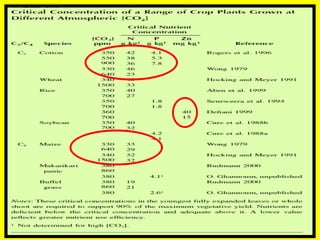
The critical concentration: the leaf nutrient concentration required to support
.
the maximum genetic growth
A lower critical concentration reflects a lower nutrient demand by
.
the crop if productivity remains the same and vice versa
9.
9
What is theleaf nutrient concentration required to
(
1
)
realize a growth response to high [CO2]
(
2
)
allow aboveground growth to continue
(
3
)
ensure plant survival
?
Demand for
Nutrients —
The Critical
Leaf Nutrient
Concentration
-
Determination of Critical Concentration
plants are grown in the field or in pots with a
range of nutrient supplies, and a specific plant
part (usually the youngest fully expanded leaf) is
sampled at different times during
development for measurement of mineral
nutrient concentration (The 90% level is chosen )
C3
C4
the critical N concentrations
the critical P concentration Same or
critical N concentrations critical P concentration
?
Concentration
(
function of
)
the nutrient requirements of the biochemical
reactions, particularly photosynthesis
the dry mass accumulated as structural
material
Why might the demand for P in C3 plants increase as the atmospheric
[CO2] rises? CO2 fixation , Pi
What is the explanation for the reduced demand for N in leaves of C3
plants at high [CO2]? Rubisco , photorespiration
11
*
The Lower Endof the
Scale — Nutrient
Deficiency and
Elevated [CO2 ]
The minimum concentration required to obtain a growth
enhancement at high [CO2] depends on the activity of both the
source and sink, Deficiency of a number of nutrients reduces
sink generation, and this is thought to be a key factor
determining .the response of plants to high [CO2]
*
Climate, Rising [CO2 ]
and Plant Nutrition
Crop duration would be reduced/ flowering occurring earlier/ develop
faster at higher temperatures
sink demand is increased more than source activity
How might climatic change affect nutrient demand
?
There have been no studies
,
*
Implications of
Rising [CO2 ] and
Climate Change for
Mineral Nutrition in
C 3 and C4 Plants
fertilizer management [
CO2
=]
320 to 350 ppm
a value of 37 g N kg1 for wheat grown at a [CO2] of 550 ppm
Overfertilization with N not only leads to eutrophication of groundwater, but
also causes soil acidity, which is a major
problem in countries such as Australia
.
12.
12
Water Demand
of Plantsunder
Global Climate
Change
*
Stomatal Conductance
at Elevated [CO2 ]
*
Leaf Transpiration
at Elevated [CO2 ]
-
Interaction of Water Availability and
Temperature with Elevated [CO2 ]-
Induced Changes in
Leaf Transpiration
.
*
Plant Transpiration
and Water Use at
Elevated [CO2 ]
-
Interaction of Water Availability
and Temperature with Elevated
[CO2 ]-Induced Changes in Plant
Transpiration and Water Use
.
*
Canopy Transpiration
and Water Use under
Global
Climate Change
*
Implications of
Climate Change for
Plant Water
Demands
13.
13
*
Stomatal Conductance
at Elevated[CO2 ]
Elevated [CO2] causes a reduction in gs in response to increasing Ci
Changes in stomatal sensitivity, frequency, or pore size can have significant
implications for leaf E
.
*
Leaf Transpiration
at Elevated [CO2 ]
-
Interaction of Water Availability and
Temperature with Elevated [CO2 ]-
Induced Changes in
Leaf Transpiration
.
E = gs * VPDl VPD = leaf-to-air vapor pressure difference
(
depends on air temperature and humidity
)
Warmer air
temperatures will
impact leaf E by
affecting VPDl in
two main ways
First, warmer air has a greater water vapor holding capacity
and, hence, will increase the evaporative gradient at the leaf
surface
.
Secondly, higher air temperature will tend to increase Tl
and, hence, VPDl
14.
14
*
Plant Transpiration
and WaterUse at
Elevated [CO2 ]
Elevated [CO2] can promote growth by improving shoot
water relations of many plant species, particularly under
conditions of atmospheric and soil water deficits
-
Interaction of Water Availability and
Temperature with Elevated [CO2 ]-
Induced Changes in Plant Transpiration
and Water Use
.
Water savings early in the drying cycle, when stress is mild to
moderate, allow the high-[CO2]-grown plants to
photosynthesise and grow for longer under more favorable
Conditions
.
Increased air temperature can also interact with plant water
use and E at elevated [CO2]
.
high temperatures will also tend to diminish the beneficial
effects of high [CO2] on plant E and water use
.
*
Canopy Transpiration and Water
Use under Global
Climate Change
Canopy structure adds extra layers of complexity to the influence of
changes in gs on E, Depending on canopy structure and wind speed and
direction, substantial gradients of water vapor pressure and heat may
develop vertically and horizontally within and across the canopy.
Consequently, high-[CO2]-induced partial stomatal closure will affect leaf
E to different extents depending on the leaf position in the canopy
.
In the first season, decreases in gs at high [CO2] were offset by increases
in leaf area
.
15.
15
*
Implications of ClimateChange for Plant Water Demands
Elevated [CO2] will tend always to reduce gs more than leaf E, and reduce leaf E less
than plant E and even less than canopy E
.
At the plant level, reduction in water demands at elevated [CO2] will mainly depend
on reductions in gs, increases in leaf area and temperature
.
In general, increased air temperature will tend to offset this response while reduced
precipitation will tend to enhance it
.


![2
Minimum Temperature ˃ Maximum Temperature
Global warming
Tropical Latitudes Temperate Latitudes
˃
PRECIPITATION
increase between 30N and 30S
.
while tropical and subtropical areas will
.
receive less rainfall
Anticipated changes for
precipitation are more
variable
.
Global climate change changes in [CO2], temperature, and precipitation
By the year 2100, atmospheric CO2 concentration ([CO2]) is
projected .to reach 540 to 970 ppm
[
CO2
]
1.4
to 5.8O
C](https://image.slidesharecdn.com/climatechangeready-250328202202-a1b6acf9/85/CLIMATE-CHANGE-ready-pptx-Autosaved-pptx-2-320.jpg)
![3
OVERVIEW OF THE
GROWTH RESPONSE OF
PLANTS TO GLOBAL
CLIMATE CHANGE
*
The Growth Response
of C 3 and C4 Plants to
Elevated [CO2 ]
*
Interaction of Water
Availability with the
Growth Response to
Elevated [CO2 ]
*
Interaction of
Temperature with the
Growth Response to
[CO2 ]](https://image.slidesharecdn.com/climatechangeready-250328202202-a1b6acf9/85/CLIMATE-CHANGE-ready-pptx-Autosaved-pptx-3-320.jpg)
![4
*
The Growth
Response of C 3
and C4 Plants to
Elevated [CO2 ]
wheat (Triticum aestivum)
,
rice (Oryzasativa)
,
potato (Solanum tuberosum)
,
grape (Vitis vinifera)
,
cotton (Gossypium hirsutum)
,
soybean (Glycine max)
,
sunflower (Helianthus annuus)
,
rapeseed (Brassica napus)
.
C 3
Long-term
Short-term
Rising atmospheric [CO2] enhances
C3 photosynthetic rates by
stimulating the carboxylation
reaction of Rubisco while
suppressing its oxygenation
.
exposure to elevated [CO2] can
reduce the stimulation of C3
photosynthesis in a process termed
photosynthetic acclimation(Moore et
al. 1999)
C4
elevated [CO2] has a small or no effect on C4
photosynthesis (Ghannoum et al. 2000)
.
maize (Zea mays)
,
sugarcane (Saccharum officinarum)
,
.
sorghum (Sorghum bicolor)](https://image.slidesharecdn.com/climatechangeready-250328202202-a1b6acf9/85/CLIMATE-CHANGE-ready-pptx-Autosaved-pptx-4-320.jpg)
![5
Under well-watered conditions, elevated [CO2]
enhances the growth of C 3 and
C4 plants via two routes
First, by enhancing leaf CO2 assimilation rates
This effect is seen in C4 plants only when C4
photosynthesis is not CO2-saturated, such
as under high light intensity and high soil
nitrogen (N) supply (Ghannoum et al. 1997
;
Ghannoum and Conroy 1998
.)
*
Secondly, elevated [CO] reduces stomatal conductance to
water vapor, which in turn reduces the leaf transpiration
rate. Lower leaf E can improve shoot water relations (Knapp
et al. 1993; Seneweera et al. 1998, 2001; Niklaus and Körner
2004) and increase leaf temperature (Idso et al. 1987; Wall
et al. 2001; Siebke et al. 2002)
.
both factors can lead to enhanced growth](https://image.slidesharecdn.com/climatechangeready-250328202202-a1b6acf9/85/CLIMATE-CHANGE-ready-pptx-Autosaved-pptx-5-320.jpg)
![6
*
Interaction of Water Availability with the Growth Response to Elevated [CO2 ]
Under water stress, the growth response to elevated [CO2] is maintained or increased
in some plants relative to their response under well-watered conditions
(
There are two main explanations for this observation
)
First, elevated-[CO2]- induced reductions in plant E
lead to soil water conservation. This slows down
the development of water stress, thus providing
more water and time for photosynthesis and
growth. This explanation has been corroborated by
many studies
The second explanation is that elevated [CO2] can
directly alleviate the adverse effects of water stress
on leaf water relations
In the latter case, elevated
[
CO2
]
is thought to alleviate the
CO2 limitation caused by reduced
gs under drought
.
*
Interaction of Temperature with the Growth Response to [CO2 ]
َ
In general, the growth response to elevated [CO2] increases with temperature for most C3 plants
Higher temperatures reduce Rubisco specificity for CO2 and CO2 solubility relative to O2
.
Higher air temperatures interact with the growth response to elevated [CO2] by affecting a
multitude of processes, such as photosynthesis, photorespiration, respiration,
transpiration, .vegetative growth, and yield
In wheat, a moderate increase in temperature can offset the
.
benefits bestowed by high [CO2] on yield](https://image.slidesharecdn.com/climatechangeready-250328202202-a1b6acf9/85/CLIMATE-CHANGE-ready-pptx-Autosaved-pptx-6-320.jpg)
![7
Nutrient Demand of
Plants under Global
Climate Change
*
Overview of
Mineral Nutrient
Demands under
Climate Change
*
Demand for
Nutrients — The
Critical Leaf
Nutrient
Concentration
-
Determination of Critical
Concentration
-
Influence of High [CO2 ] on
Critical Nutrient
Concentration
-
Physiological Basis for Changes in Critical
Concentrations at High [CO2 ]
*
The Lower End of the
Scale — Nutrient
Deficiency and
Elevated [CO2 ]
*
Climate, Rising [CO2 ]
and Plant Nutrition
*
Implications of Rising [CO2 ] and Climate Change for
Mineral Nutrition in
C 3 and C4 Plants](https://image.slidesharecdn.com/climatechangeready-250328202202-a1b6acf9/85/CLIMATE-CHANGE-ready-pptx-Autosaved-pptx-7-320.jpg)
![8
*
Overview of
Mineral Nutrient
Demands under
Climate Change
Nitrogen (N)
Phosphorus (P)
15
and 2 g kg1
-
Nitrogen and P are of particular interest when considering the impact of
rising [CO2] and climate change because these nutrients commonly inhibit
productivity of crops
.
-
The critical concentration: the leaf nutrient concentration required to support
.
the maximum genetic growth
A lower critical concentration reflects a lower nutrient demand by
.
the crop if productivity remains the same and vice versa](https://image.slidesharecdn.com/climatechangeready-250328202202-a1b6acf9/85/CLIMATE-CHANGE-ready-pptx-Autosaved-pptx-8-320.jpg)
![9
What is the leaf nutrient concentration required to
(
1
)
realize a growth response to high [CO2]
(
2
)
allow aboveground growth to continue
(
3
)
ensure plant survival
?
Demand for
Nutrients —
The Critical
Leaf Nutrient
Concentration
-
Determination of Critical Concentration
plants are grown in the field or in pots with a
range of nutrient supplies, and a specific plant
part (usually the youngest fully expanded leaf) is
sampled at different times during
development for measurement of mineral
nutrient concentration (The 90% level is chosen )
C3
C4
the critical N concentrations
the critical P concentration Same or
critical N concentrations critical P concentration
?
Concentration
(
function of
)
the nutrient requirements of the biochemical
reactions, particularly photosynthesis
the dry mass accumulated as structural
material
Why might the demand for P in C3 plants increase as the atmospheric
[CO2] rises? CO2 fixation , Pi
What is the explanation for the reduced demand for N in leaves of C3
plants at high [CO2]? Rubisco , photorespiration](https://image.slidesharecdn.com/climatechangeready-250328202202-a1b6acf9/85/CLIMATE-CHANGE-ready-pptx-Autosaved-pptx-9-320.jpg)
![11
*
The Lower End of the
Scale — Nutrient
Deficiency and
Elevated [CO2 ]
The minimum concentration required to obtain a growth
enhancement at high [CO2] depends on the activity of both the
source and sink, Deficiency of a number of nutrients reduces
sink generation, and this is thought to be a key factor
determining .the response of plants to high [CO2]
*
Climate, Rising [CO2 ]
and Plant Nutrition
Crop duration would be reduced/ flowering occurring earlier/ develop
faster at higher temperatures
sink demand is increased more than source activity
How might climatic change affect nutrient demand
?
There have been no studies
,
*
Implications of
Rising [CO2 ] and
Climate Change for
Mineral Nutrition in
C 3 and C4 Plants
fertilizer management [
CO2
=]
320 to 350 ppm
a value of 37 g N kg1 for wheat grown at a [CO2] of 550 ppm
Overfertilization with N not only leads to eutrophication of groundwater, but
also causes soil acidity, which is a major
problem in countries such as Australia
.](https://image.slidesharecdn.com/climatechangeready-250328202202-a1b6acf9/85/CLIMATE-CHANGE-ready-pptx-Autosaved-pptx-11-320.jpg)
![12
Water Demand
of Plants under
Global Climate
Change
*
Stomatal Conductance
at Elevated [CO2 ]
*
Leaf Transpiration
at Elevated [CO2 ]
-
Interaction of Water Availability and
Temperature with Elevated [CO2 ]-
Induced Changes in
Leaf Transpiration
.
*
Plant Transpiration
and Water Use at
Elevated [CO2 ]
-
Interaction of Water Availability
and Temperature with Elevated
[CO2 ]-Induced Changes in Plant
Transpiration and Water Use
.
*
Canopy Transpiration
and Water Use under
Global
Climate Change
*
Implications of
Climate Change for
Plant Water
Demands](https://image.slidesharecdn.com/climatechangeready-250328202202-a1b6acf9/85/CLIMATE-CHANGE-ready-pptx-Autosaved-pptx-12-320.jpg)
![13
*
Stomatal Conductance
at Elevated [CO2 ]
Elevated [CO2] causes a reduction in gs in response to increasing Ci
Changes in stomatal sensitivity, frequency, or pore size can have significant
implications for leaf E
.
*
Leaf Transpiration
at Elevated [CO2 ]
-
Interaction of Water Availability and
Temperature with Elevated [CO2 ]-
Induced Changes in
Leaf Transpiration
.
E = gs * VPDl VPD = leaf-to-air vapor pressure difference
(
depends on air temperature and humidity
)
Warmer air
temperatures will
impact leaf E by
affecting VPDl in
two main ways
First, warmer air has a greater water vapor holding capacity
and, hence, will increase the evaporative gradient at the leaf
surface
.
Secondly, higher air temperature will tend to increase Tl
and, hence, VPDl](https://image.slidesharecdn.com/climatechangeready-250328202202-a1b6acf9/85/CLIMATE-CHANGE-ready-pptx-Autosaved-pptx-13-320.jpg)
![14
*
Plant Transpiration
and Water Use at
Elevated [CO2 ]
Elevated [CO2] can promote growth by improving shoot
water relations of many plant species, particularly under
conditions of atmospheric and soil water deficits
-
Interaction of Water Availability and
Temperature with Elevated [CO2 ]-
Induced Changes in Plant Transpiration
and Water Use
.
Water savings early in the drying cycle, when stress is mild to
moderate, allow the high-[CO2]-grown plants to
photosynthesise and grow for longer under more favorable
Conditions
.
Increased air temperature can also interact with plant water
use and E at elevated [CO2]
.
high temperatures will also tend to diminish the beneficial
effects of high [CO2] on plant E and water use
.
*
Canopy Transpiration and Water
Use under Global
Climate Change
Canopy structure adds extra layers of complexity to the influence of
changes in gs on E, Depending on canopy structure and wind speed and
direction, substantial gradients of water vapor pressure and heat may
develop vertically and horizontally within and across the canopy.
Consequently, high-[CO2]-induced partial stomatal closure will affect leaf
E to different extents depending on the leaf position in the canopy
.
In the first season, decreases in gs at high [CO2] were offset by increases
in leaf area
.](https://image.slidesharecdn.com/climatechangeready-250328202202-a1b6acf9/85/CLIMATE-CHANGE-ready-pptx-Autosaved-pptx-14-320.jpg)
![15
*
Implications of Climate Change for Plant Water Demands
Elevated [CO2] will tend always to reduce gs more than leaf E, and reduce leaf E less
than plant E and even less than canopy E
.
At the plant level, reduction in water demands at elevated [CO2] will mainly depend
on reductions in gs, increases in leaf area and temperature
.
In general, increased air temperature will tend to offset this response while reduced
precipitation will tend to enhance it
.](https://image.slidesharecdn.com/climatechangeready-250328202202-a1b6acf9/85/CLIMATE-CHANGE-ready-pptx-Autosaved-pptx-15-320.jpg)


