CANNING
GOAL- CANNING
The goal of the canning process is to-
destroy any microorganisms in the food
prevent recontamination by microorganisms.
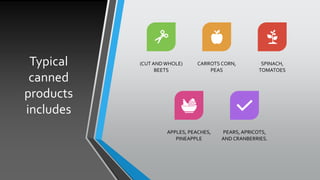
Typical
canned
products
includes
(CUT ANDWHOLE)
BEETS
CARROTS CORN,
PEAS
SPINACH,
TOMATOES
APPLES, PEACHES,
PINEAPPLE
PEARS, APRICOTS,
AND CRANBERRIES.
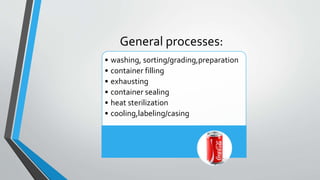
General processes:
• washing, sorting/grading,preparation
• container filling
• exhausting
• container sealing
• heat sterilization
• cooling,labeling/casing
DIFFERENCES IN FRUITS ANDVEGETABLE
CANNING
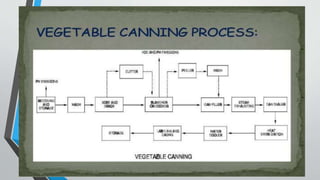
Most of the fruits are not blanched prior to can filling whereas
many of the vegetables undergo this step.
Canned vegetables generally require more severe processing
than do fruits because the vegetables have much lower acidity
and contain more heat-resistant soil organisms.
Many vegetables also require more cooking than fruits to
develop their most desirable flavor and texture.
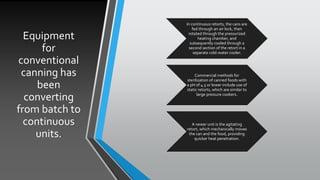
Equipment
for
conventional
canning has
been
converting
from batch to
continuous
units.
In continuous retorts, the cans are
fed through an air lock, then
rotated through the pressurized
heating chamber, and
subsequently cooled through a
second section of the retort in a
separate cold-water cooler.
Commercial methods for
sterilization of canned foods with
a pH of 4.5 or lower include use of
static retorts, which are similar to
large pressure cookers.
A newer unit is the agitating
retort, which mechanically moves
the can and the food, providing
quicker heat penetration.
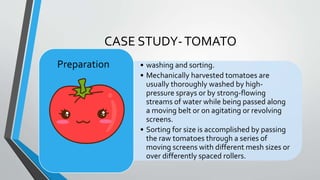
CASE STUDY-TOMATO
• washing and sorting.
• Mechanically harvested tomatoes are
usually thoroughly washed by high-
pressure sprays or by strong-flowing
streams of water while being passed along
a moving belt or on agitating or revolving
screens.
• Sorting for size is accomplished by passing
the raw tomatoes through a series of
moving screens with different mesh sizes or
over differently spaced rollers.
Preparation
Peeling And Coring
Formerly, tomatoes were
initially scalded followed by
hand peeling, but steam
peeling and lye peeling have
also become widely used.
1
Coring is done by a water-
powered device with a small
turbine wheel. A special
blade mounted on the
turbine wheel spins and
removes the tomato cores.
2
This Photo by Unknown Author is licensed under CC BY-NC-ND
Filling ->
The containers are filled
with the solid product and
then usually topped with a
light puree of tomato juice.
Acidification of canned
whole tomatoes with 0.1 to
0.2 percent citric acid has
been suggested as a means
of increasing acidity to a
safer and more desirable
level.
Because of the increased
sourness of the acidified
product, the addition of 2 to
3 percent sucrose is used to
balance the taste.The
addition of salt is important
for palatability.
This Photo by Unknown Author is licensed under CC BY-NC-ND
EXHAUSTING
The objective of exhausting
containers is to remove air
so that the pressure inside
the container following
heat treatment and cooling
will be less than
atmospheric.
Vacuum in the can may be
obtained by the use of heat
or by mechanical means.
Vacuum also may be
produced mechanically by
sealing containers in a
chamber under a high
vacuum.
SEALING
In sealing lids on metal
cans, a double seam is
created by interlocking the
curl of the lid and flange of
the can.
Many closing machines are
equipped to create vacuum
in the headspace either
mechanically or by steam-
flow before lids are sealed.
HEAT
STERILIZATION
DURING PROCESSING,
MICROORGANISMS THAT
CAN CAUSE SPOILAGE
ARE DESTROYED BY
HEAT.
ACIDIC PRODUCTS, SUCH
AS TOMATOES, ARE
READILY PRESERVED AT
100°C (212°F).
THE CONTAINERS
HOLDING THESE
PRODUCTS ARE
PROCESSED IN
ATMOSPHERIC STEAM OR
HOT-WATER COOKERS.
THE ROTARY
CONTINUOUS COOKERS,
WHICH OPERATE AT
100°C (212°F), HAVE
LARGELY REPLACED
RETORTS AND OPEN-
STILL COOKERS FOR
PROCESSING CANNED
TOMATOES.
Cooling
After heat sterilization,
containers are quickly
cooled to prevent
overcooking.
Containers may be
quick cooled by adding
water to the cooker
under air pressure or by
conveying the
containers from the
cooker to a rotary cooler
equipped with a cold-
water spray.
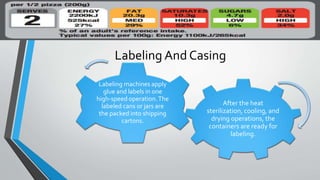
Labeling And Casing
After the heat
sterilization, cooling, and
drying operations, the
containers are ready for
labeling.
Labeling machines apply
glue and labels in one
high-speed operation.The
labeled cans or jars are
the packed into shipping
cartons.
Canning
Canning

Canning

  • 1.
  • 2.
    GOAL- CANNING The goalof the canning process is to- destroy any microorganisms in the food prevent recontamination by microorganisms.
  • 3.
  • 4.
    General processes: • washing,sorting/grading,preparation • container filling • exhausting • container sealing • heat sterilization • cooling,labeling/casing
  • 5.
    DIFFERENCES IN FRUITSANDVEGETABLE CANNING Most of the fruits are not blanched prior to can filling whereas many of the vegetables undergo this step. Canned vegetables generally require more severe processing than do fruits because the vegetables have much lower acidity and contain more heat-resistant soil organisms. Many vegetables also require more cooking than fruits to develop their most desirable flavor and texture.
  • 6.
    Equipment for conventional canning has been converting from batchto continuous units. In continuous retorts, the cans are fed through an air lock, then rotated through the pressurized heating chamber, and subsequently cooled through a second section of the retort in a separate cold-water cooler. Commercial methods for sterilization of canned foods with a pH of 4.5 or lower include use of static retorts, which are similar to large pressure cookers. A newer unit is the agitating retort, which mechanically moves the can and the food, providing quicker heat penetration.
  • 9.
    CASE STUDY-TOMATO • washingand sorting. • Mechanically harvested tomatoes are usually thoroughly washed by high- pressure sprays or by strong-flowing streams of water while being passed along a moving belt or on agitating or revolving screens. • Sorting for size is accomplished by passing the raw tomatoes through a series of moving screens with different mesh sizes or over differently spaced rollers. Preparation
  • 10.
    Peeling And Coring Formerly,tomatoes were initially scalded followed by hand peeling, but steam peeling and lye peeling have also become widely used. 1 Coring is done by a water- powered device with a small turbine wheel. A special blade mounted on the turbine wheel spins and removes the tomato cores. 2 This Photo by Unknown Author is licensed under CC BY-NC-ND
  • 11.
    Filling -> The containersare filled with the solid product and then usually topped with a light puree of tomato juice. Acidification of canned whole tomatoes with 0.1 to 0.2 percent citric acid has been suggested as a means of increasing acidity to a safer and more desirable level. Because of the increased sourness of the acidified product, the addition of 2 to 3 percent sucrose is used to balance the taste.The addition of salt is important for palatability. This Photo by Unknown Author is licensed under CC BY-NC-ND
  • 12.
    EXHAUSTING The objective ofexhausting containers is to remove air so that the pressure inside the container following heat treatment and cooling will be less than atmospheric. Vacuum in the can may be obtained by the use of heat or by mechanical means. Vacuum also may be produced mechanically by sealing containers in a chamber under a high vacuum.
  • 13.
    SEALING In sealing lidson metal cans, a double seam is created by interlocking the curl of the lid and flange of the can. Many closing machines are equipped to create vacuum in the headspace either mechanically or by steam- flow before lids are sealed.
  • 14.
    HEAT STERILIZATION DURING PROCESSING, MICROORGANISMS THAT CANCAUSE SPOILAGE ARE DESTROYED BY HEAT. ACIDIC PRODUCTS, SUCH AS TOMATOES, ARE READILY PRESERVED AT 100°C (212°F). THE CONTAINERS HOLDING THESE PRODUCTS ARE PROCESSED IN ATMOSPHERIC STEAM OR HOT-WATER COOKERS. THE ROTARY CONTINUOUS COOKERS, WHICH OPERATE AT 100°C (212°F), HAVE LARGELY REPLACED RETORTS AND OPEN- STILL COOKERS FOR PROCESSING CANNED TOMATOES.
  • 15.
    Cooling After heat sterilization, containersare quickly cooled to prevent overcooking. Containers may be quick cooled by adding water to the cooker under air pressure or by conveying the containers from the cooker to a rotary cooler equipped with a cold- water spray.
  • 16.
    Labeling And Casing Afterthe heat sterilization, cooling, and drying operations, the containers are ready for labeling. Labeling machines apply glue and labels in one high-speed operation.The labeled cans or jars are the packed into shipping cartons.