ADVANCES IN FOOD
PROCESSING AND
PRESERVATION BY CANNING
SUBMITTED BY- AKANKSHA
M.SC FOODTECHNOLOGY
SUBMITTEDTO- ANIL KUMAR CHAUHAN
H.O.D AND PROFESSOR, DSFT
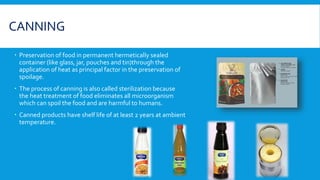
CANNING
 Preservation of food in permanent hermetically sealed
container (like glass, jar, pouches and tin)through the
application of heat as principal factor in the preservation of
spoilage.
 The process of canning is also called sterilization because
the heat treatment of food eliminates all microorganism
which can spoil the food and are harmful to humans.
 Canned products have shelf life of at least 2 years at ambient
temperature.
PRESENT STATUS OF CANNING IN INDIA
 The fruit and vegetable industry is able to utilize only 2.1% of total production for conversion
into products like juices, squashes, cordial, pulps, jams, jellies, pickles, chutneys against 40-60%
in developed countries.
 In India first fruit and vegetable processing factory was established in 1935 at Bombay
which was followed up by setting up units in Madras,Calcutta, Uttar Pradesh and the
Punjab.
 Government of India has also established NHB for increasing production of fruits and
vegetables and their preservation to reduce post harvest losses.
 A Fruit preservation and canning institute was established at lucknow in 1949 by the
government of India.
FLOWCHART OF CANNING
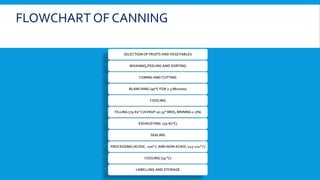
SELECTION OF FRUITS AND VEGETABLES
WASHING,PEELING AND SORTING
CORING AND CUTTING
BLANCHING (90°C FOR 2-5 Minutes)
COOLING
FILLING (79-82° C)SYRUP 20-55° BRIX, BRINING 1-3%)
EXHAUSTING (79-82°C)
SEALING
PROCESSING (ACIDIC -100° C AND NON ACIDIC-115-121° C)
COOLING (39 °C)
LABELLING AND STORAGE
EQUIPMENTS USED IN CANNING INDUSTRY
HOW CANNING PRESERVE FOOD
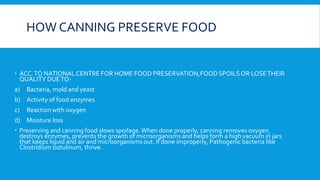
 ACC.TO NATIONAL CENTRE FOR HOME FOOD PRESERVATION,FOOD SPOILSOR LOSETHEIR
QUALITY DUETO-
a) Bacteria, mold and yeast
b) Activity of food enzymes
c) Reaction with oxygen
d) Moisture loss
 Preserving and canning food slows spoilage.When done properly, canning removes oxygen,
destroys enzymes, prevents the growth of microorganisms and helps form a high vacuum in jars
that keeps liquid and air and microorganisms out. If done improperly, Pathogenic bacteria like
Clostridium botulinum, thrive.
FACTORS AFFECTING CANNING
TIME ANDTEMPERTURE COMBINATION
 PHYSICAL STATE OFTHE RAW MATERIAL LIKE SOLID, LIQUID
SUGAR,FAT,STARCH.
 CONSISTENCY
 ALTITUDE – FOR EVERY INCREASEOF 152M ABOVE MEAN SEA LEVEL IN
ALTITUDE,THE B.P OFWATER DECREASES BY ABOUT 1°CAND PROCESSING
TIME IS INCREASED BY 2 MINUTES.
 FULLNESSOF PACK
 INITIALTEMPERATURE OF FOOD
 THE HEAT RESISTANCE OF MICROORGANISMSOR ENZYMES LIKELYTO
BE PRESENT INTHE FOOD
CONTINUED….
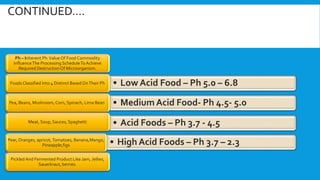
Ph – Inherent Ph Value Of Food Commodity
InfluenceThe Processing ScheduleToAchieve
Required DestructionOf Microorganism.
• Low Acid Food – Ph 5.0 – 6.8
Foods Classified Into 4 Distinct Based OnTheir Ph
• Medium Acid Food- Ph 4.5- 5.0
Pea, Beans, Mushroom, Corn, Spinach, Lima Bean.
• Acid Foods – Ph 3.7 - 4.5
Meat, Soup, Sauces, Spaghetti
• High Acid Foods – Ph 3.7 – 2.3
Pear, Oranges, apricot,Tomatoes, Banana,Mango,
Pineapple,figs
PickledAnd Fermented Product Like Jam, Jellies,
Sauerkraut, berries.
CANNINGTYPES
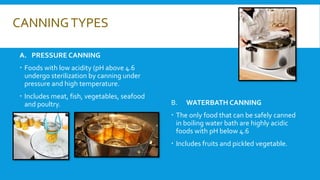
A. PRESSURE CANNING
 Foods with low acidity (pH above 4.6
undergo sterilization by canning under
pressure and high temperature.
 Includes meat, fish, vegetables, seafood
and poultry. B. WATERBATH CANNING
 The only food that can be safely canned
in boiling water bath are highly acidic
foods with pH below 4.6
 Includes fruits and pickled vegetable.
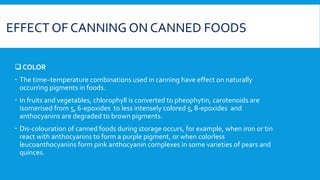
EFFECT OF CANNING ON CANNED FOODS
 COLOR
 The time–temperature combinations used in canning have effect on naturally
occurring pigments in foods.
 In fruits and vegetables, chlorophyll is converted to pheophytin, carotenoids are
isomerised from 5, 6-epoxides to less intensely colored 5, 8-epoxides and
anthocyanins are degraded to brown pigments.
 Dis-colouration of canned foods during storage occurs, for example, when iron or tin
react with anthocyanins to form a purple pigment, or when colorless
leucoanthocyanins form pink anthocyanin complexes in some varieties of pears and
quinces.
CONTINUED…
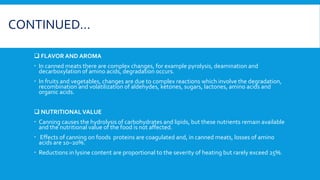
 FLAVOR AND AROMA
 In canned meats there are complex changes, for example pyrolysis, deamination and
decarboxylation of amino acids, degradation occurs.
 In fruits and vegetables, changes are due to complex reactions which involve the degradation,
recombination and volatilization of aldehydes, ketones, sugars, lactones, amino acids and
organic acids.
 NUTRITIONAL VALUE
 Canning causes the hydrolysis of carbohydrates and lipids, but these nutrients remain available
and the nutritional value of the food is not affected.
 Effects of canning on foods proteins are coagulated and, in canned meats, losses of amino
acids are 10–20%.
 Reductions in lysine content are proportional to the severity of heating but rarely exceed 25%.
TEXTURE ANDVISCOSITY
 In canned meats, changes in texture are caused by coagulation and a loss of water
holding capacity of proteins, which produces shrinkage and stiffening of effects of
Canning on foods proteins, which produces shrinkage and stiffening of muscle tissues.
 The texture of solid fruit and vegetable pieces is softer than the unprocessed food due
to solubilization of pectic materials and a loss of cell turgor but is considerably firmer
than canned products.
CONTINUED…
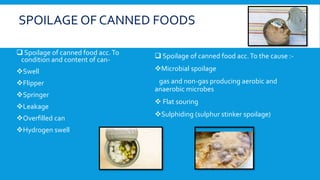
SPOILAGE OF CANNED FOODS
 Spoilage of canned food acc.To
condition and content of can-
Swell
Flipper
Springer
Leakage
Overfilled can
Hydrogen swell
 Spoilage of canned food acc.To the cause :-
Microbial spoilage
gas and non-gas producing aerobic and
anaerobic microbes
 Flat souring
Sulphiding (sulphur stinker spoilage)
ASEPTIC CANNING
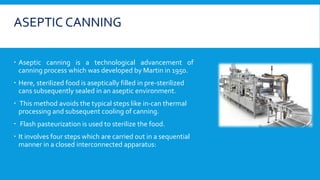
 Aseptic canning is a technological advancement of
canning process which was developed by Martin in 1950.
 Here, sterilized food is aseptically filled in pre-sterilized
cans subsequently sealed in an aseptic environment.
 This method avoids the typical steps like in-can thermal
processing and subsequent cooling of canning.
 Flash pasteurization is used to sterilize the food.
 It involves four steps which are carried out in a sequential
manner in a closed interconnected apparatus:
CONTINUED…
(A) sterilization of food by appropriate flash heating, holding and cooling
(B) sterilization of cans and lids with super heated steam
(c) aseptic filling of cooled sterile food into sterile cans, and
(d) aseptic sealing of cans with lids
Example-tetra pack system . aseptic canning yields better quality of product in terms of
color, flavor, texture and nutrient retention and shelf life.
Packaging innovation
The advancement in packaging is the growing demand in canned food market.With an
increase in demand for chemical free canned food products manufacturers are focusing
on innovations in packaging and started offering food BPA free containers.
TATA STEEL MOBILE CANNING
 Mobile canning is a brilliant idea as there is overall reduction in the use of
preservatives( transportation and storage of fresh produce) which means fewer
chemical in ground and water.
 There's no water used during can production, no volatile organic compounds
emissions, and the cans themselves are fully recyclable which fits perfectly withTata
Steel's vision of sustainability.
 The aim is that two years from now, the mobile canning trucks hit the markets,it will
present an invaluable opportunity to Governments and grocery chains alike to bring
prosperity to farmers.They will aid in vastly improving the quality of produce available
to end customers.
MOBILE CANNING CONCEPTTO CUT FOOD LOSS
 Across the world a third of fruit and vegetables is
lost before it even reaches consumer.
 Tata Steel’s mobile can making concept has been
developed to tackle this issue.
 In India, 44% of food harvested is lost before it
reaches the consumer in the handling, storage
,processing and packaging stages.
 In India alone, it has the potential to save 84
million tonnes of food per year.
RESEARCHES ON ADVANCEMENT IN
CANNING
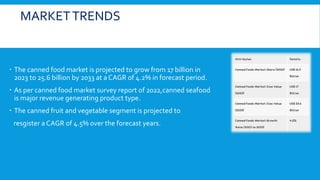
MARKETTRENDS
 The canned food market is projected to grow from 17 billion in
2023 to 25.6 billion by 2033 at a CAGR of 4.2% in forecast period.
 As per canned food market survey report of 2022,canned seafood
is major revenue generating product type.
 The canned fruit and vegetable segment is projected to
resgister a CAGR of 4.5% over the forecast years.
CONCLUSION
 In an ever expanding global market, the need for technological advances that lead to increasing
productivity, better product quality with enhanced safety assurance, and all at lower and lower
cost, advances in automation and intelligent on-line control will continue at a rapid pace.
New developments that are likely to occur soonest will be the
application of computer-based retort control systems for on-line correction of process deviations.
CANNING[1].pptx

CANNING[1].pptx

  • 1.
    ADVANCES IN FOOD PROCESSINGAND PRESERVATION BY CANNING SUBMITTED BY- AKANKSHA M.SC FOODTECHNOLOGY SUBMITTEDTO- ANIL KUMAR CHAUHAN H.O.D AND PROFESSOR, DSFT
  • 2.
    CANNING  Preservation offood in permanent hermetically sealed container (like glass, jar, pouches and tin)through the application of heat as principal factor in the preservation of spoilage.  The process of canning is also called sterilization because the heat treatment of food eliminates all microorganism which can spoil the food and are harmful to humans.  Canned products have shelf life of at least 2 years at ambient temperature.
  • 3.
    PRESENT STATUS OFCANNING IN INDIA  The fruit and vegetable industry is able to utilize only 2.1% of total production for conversion into products like juices, squashes, cordial, pulps, jams, jellies, pickles, chutneys against 40-60% in developed countries.  In India first fruit and vegetable processing factory was established in 1935 at Bombay which was followed up by setting up units in Madras,Calcutta, Uttar Pradesh and the Punjab.  Government of India has also established NHB for increasing production of fruits and vegetables and their preservation to reduce post harvest losses.  A Fruit preservation and canning institute was established at lucknow in 1949 by the government of India.
  • 4.
    FLOWCHART OF CANNING SELECTIONOF FRUITS AND VEGETABLES WASHING,PEELING AND SORTING CORING AND CUTTING BLANCHING (90°C FOR 2-5 Minutes) COOLING FILLING (79-82° C)SYRUP 20-55° BRIX, BRINING 1-3%) EXHAUSTING (79-82°C) SEALING PROCESSING (ACIDIC -100° C AND NON ACIDIC-115-121° C) COOLING (39 °C) LABELLING AND STORAGE
  • 5.
    EQUIPMENTS USED INCANNING INDUSTRY
  • 6.
    HOW CANNING PRESERVEFOOD  ACC.TO NATIONAL CENTRE FOR HOME FOOD PRESERVATION,FOOD SPOILSOR LOSETHEIR QUALITY DUETO- a) Bacteria, mold and yeast b) Activity of food enzymes c) Reaction with oxygen d) Moisture loss  Preserving and canning food slows spoilage.When done properly, canning removes oxygen, destroys enzymes, prevents the growth of microorganisms and helps form a high vacuum in jars that keeps liquid and air and microorganisms out. If done improperly, Pathogenic bacteria like Clostridium botulinum, thrive.
  • 7.
    FACTORS AFFECTING CANNING TIMEANDTEMPERTURE COMBINATION  PHYSICAL STATE OFTHE RAW MATERIAL LIKE SOLID, LIQUID SUGAR,FAT,STARCH.  CONSISTENCY  ALTITUDE – FOR EVERY INCREASEOF 152M ABOVE MEAN SEA LEVEL IN ALTITUDE,THE B.P OFWATER DECREASES BY ABOUT 1°CAND PROCESSING TIME IS INCREASED BY 2 MINUTES.  FULLNESSOF PACK  INITIALTEMPERATURE OF FOOD  THE HEAT RESISTANCE OF MICROORGANISMSOR ENZYMES LIKELYTO BE PRESENT INTHE FOOD
  • 8.
    CONTINUED…. Ph – InherentPh Value Of Food Commodity InfluenceThe Processing ScheduleToAchieve Required DestructionOf Microorganism. • Low Acid Food – Ph 5.0 – 6.8 Foods Classified Into 4 Distinct Based OnTheir Ph • Medium Acid Food- Ph 4.5- 5.0 Pea, Beans, Mushroom, Corn, Spinach, Lima Bean. • Acid Foods – Ph 3.7 - 4.5 Meat, Soup, Sauces, Spaghetti • High Acid Foods – Ph 3.7 – 2.3 Pear, Oranges, apricot,Tomatoes, Banana,Mango, Pineapple,figs PickledAnd Fermented Product Like Jam, Jellies, Sauerkraut, berries.
  • 9.
    CANNINGTYPES A. PRESSURE CANNING Foods with low acidity (pH above 4.6 undergo sterilization by canning under pressure and high temperature.  Includes meat, fish, vegetables, seafood and poultry. B. WATERBATH CANNING  The only food that can be safely canned in boiling water bath are highly acidic foods with pH below 4.6  Includes fruits and pickled vegetable.
  • 10.
    EFFECT OF CANNINGON CANNED FOODS  COLOR  The time–temperature combinations used in canning have effect on naturally occurring pigments in foods.  In fruits and vegetables, chlorophyll is converted to pheophytin, carotenoids are isomerised from 5, 6-epoxides to less intensely colored 5, 8-epoxides and anthocyanins are degraded to brown pigments.  Dis-colouration of canned foods during storage occurs, for example, when iron or tin react with anthocyanins to form a purple pigment, or when colorless leucoanthocyanins form pink anthocyanin complexes in some varieties of pears and quinces.
  • 11.
    CONTINUED…  FLAVOR ANDAROMA  In canned meats there are complex changes, for example pyrolysis, deamination and decarboxylation of amino acids, degradation occurs.  In fruits and vegetables, changes are due to complex reactions which involve the degradation, recombination and volatilization of aldehydes, ketones, sugars, lactones, amino acids and organic acids.  NUTRITIONAL VALUE  Canning causes the hydrolysis of carbohydrates and lipids, but these nutrients remain available and the nutritional value of the food is not affected.  Effects of canning on foods proteins are coagulated and, in canned meats, losses of amino acids are 10–20%.  Reductions in lysine content are proportional to the severity of heating but rarely exceed 25%.
  • 12.
    TEXTURE ANDVISCOSITY  Incanned meats, changes in texture are caused by coagulation and a loss of water holding capacity of proteins, which produces shrinkage and stiffening of effects of Canning on foods proteins, which produces shrinkage and stiffening of muscle tissues.  The texture of solid fruit and vegetable pieces is softer than the unprocessed food due to solubilization of pectic materials and a loss of cell turgor but is considerably firmer than canned products. CONTINUED…
  • 13.
    SPOILAGE OF CANNEDFOODS  Spoilage of canned food acc.To condition and content of can- Swell Flipper Springer Leakage Overfilled can Hydrogen swell  Spoilage of canned food acc.To the cause :- Microbial spoilage gas and non-gas producing aerobic and anaerobic microbes  Flat souring Sulphiding (sulphur stinker spoilage)
  • 14.
    ASEPTIC CANNING  Asepticcanning is a technological advancement of canning process which was developed by Martin in 1950.  Here, sterilized food is aseptically filled in pre-sterilized cans subsequently sealed in an aseptic environment.  This method avoids the typical steps like in-can thermal processing and subsequent cooling of canning.  Flash pasteurization is used to sterilize the food.  It involves four steps which are carried out in a sequential manner in a closed interconnected apparatus:
  • 15.
    CONTINUED… (A) sterilization offood by appropriate flash heating, holding and cooling (B) sterilization of cans and lids with super heated steam (c) aseptic filling of cooled sterile food into sterile cans, and (d) aseptic sealing of cans with lids Example-tetra pack system . aseptic canning yields better quality of product in terms of color, flavor, texture and nutrient retention and shelf life. Packaging innovation The advancement in packaging is the growing demand in canned food market.With an increase in demand for chemical free canned food products manufacturers are focusing on innovations in packaging and started offering food BPA free containers.
  • 16.
    TATA STEEL MOBILECANNING  Mobile canning is a brilliant idea as there is overall reduction in the use of preservatives( transportation and storage of fresh produce) which means fewer chemical in ground and water.  There's no water used during can production, no volatile organic compounds emissions, and the cans themselves are fully recyclable which fits perfectly withTata Steel's vision of sustainability.  The aim is that two years from now, the mobile canning trucks hit the markets,it will present an invaluable opportunity to Governments and grocery chains alike to bring prosperity to farmers.They will aid in vastly improving the quality of produce available to end customers.
  • 17.
    MOBILE CANNING CONCEPTTOCUT FOOD LOSS  Across the world a third of fruit and vegetables is lost before it even reaches consumer.  Tata Steel’s mobile can making concept has been developed to tackle this issue.  In India, 44% of food harvested is lost before it reaches the consumer in the handling, storage ,processing and packaging stages.  In India alone, it has the potential to save 84 million tonnes of food per year.
  • 18.
  • 19.
    MARKETTRENDS  The cannedfood market is projected to grow from 17 billion in 2023 to 25.6 billion by 2033 at a CAGR of 4.2% in forecast period.  As per canned food market survey report of 2022,canned seafood is major revenue generating product type.  The canned fruit and vegetable segment is projected to resgister a CAGR of 4.5% over the forecast years.
  • 20.
    CONCLUSION  In anever expanding global market, the need for technological advances that lead to increasing productivity, better product quality with enhanced safety assurance, and all at lower and lower cost, advances in automation and intelligent on-line control will continue at a rapid pace. New developments that are likely to occur soonest will be the application of computer-based retort control systems for on-line correction of process deviations.