Targeting & Voter Contact  Contact:  [email_address]
I. Targeting
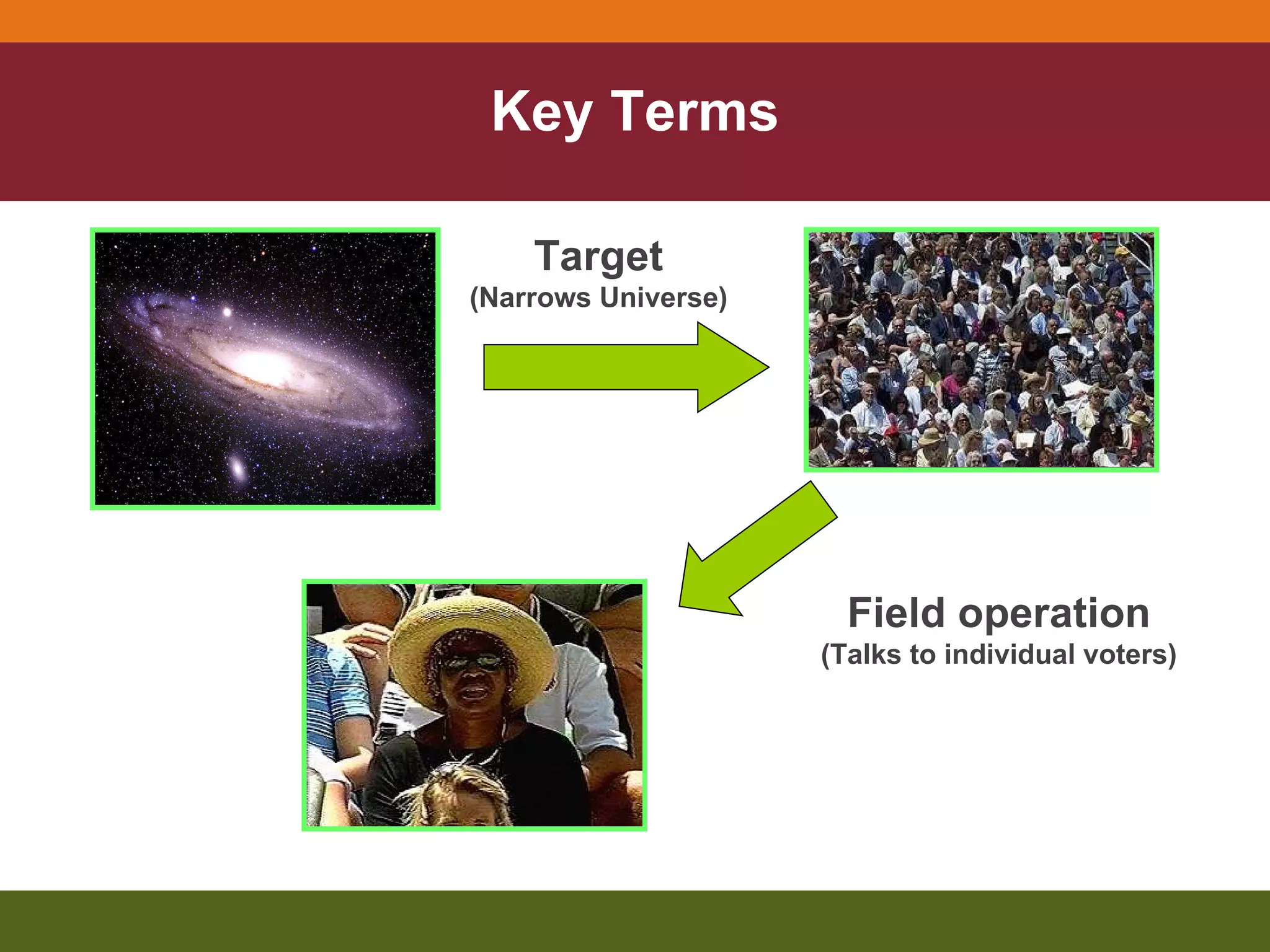
Key Terms Target (Narrows Universe) Field operation (Talks to individual voters)
Targeting #1 Determine the overall vote goal - how many votes you need to win. # 2 Identify where you will go to find those votes on a precinct level.
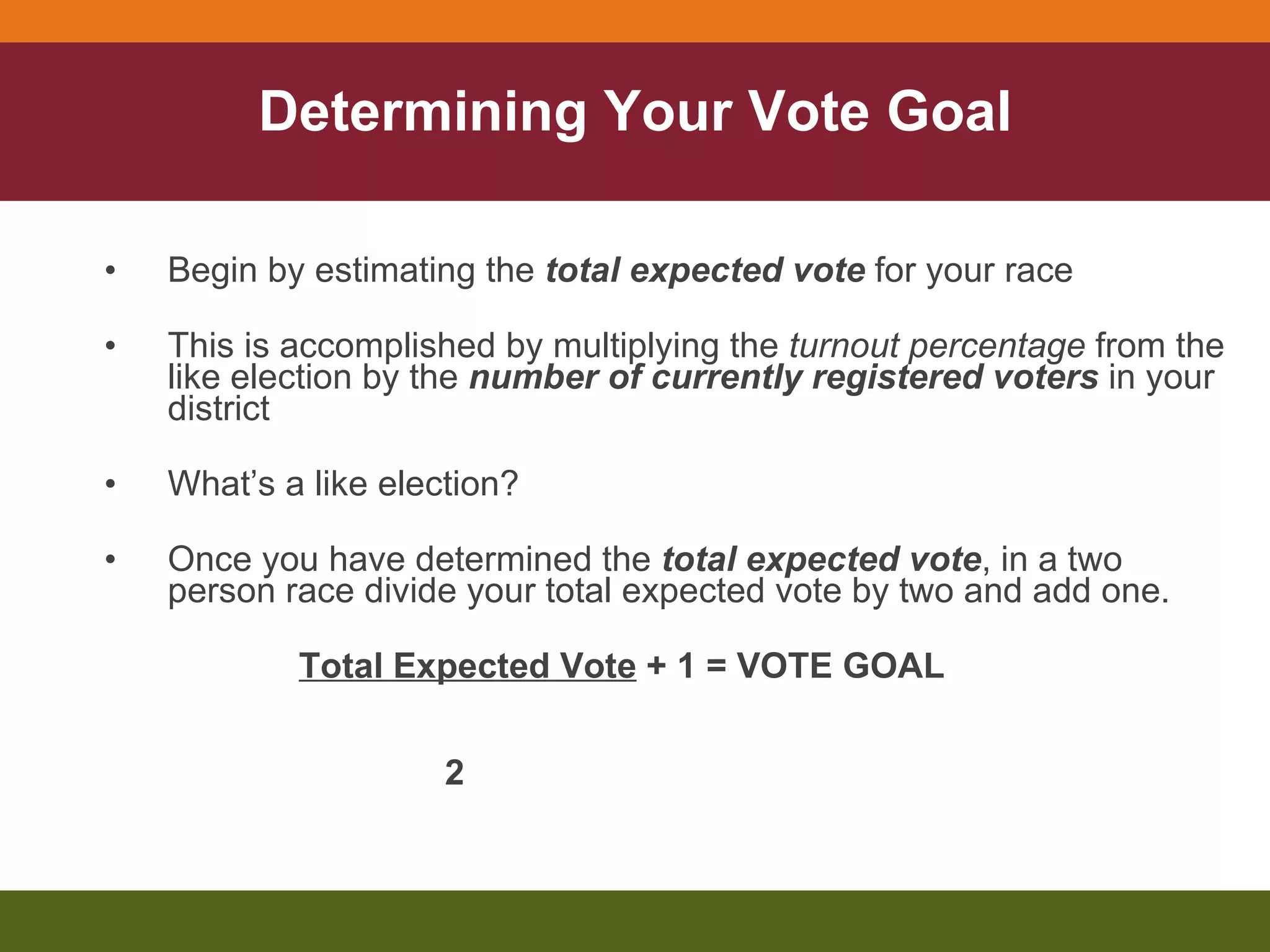
Determining Your Vote Goal Begin by estimating the  total expected vote  for your race This is accomplished by multiplying the  turnout percentage  from the like election by the  number of currently registered voters  in your district What’s a like election? Once you have determined the  total expected vote , in a two person race divide your total expected vote by two and add one. Total Expected Vote  + 1 = VOTE GOAL  2
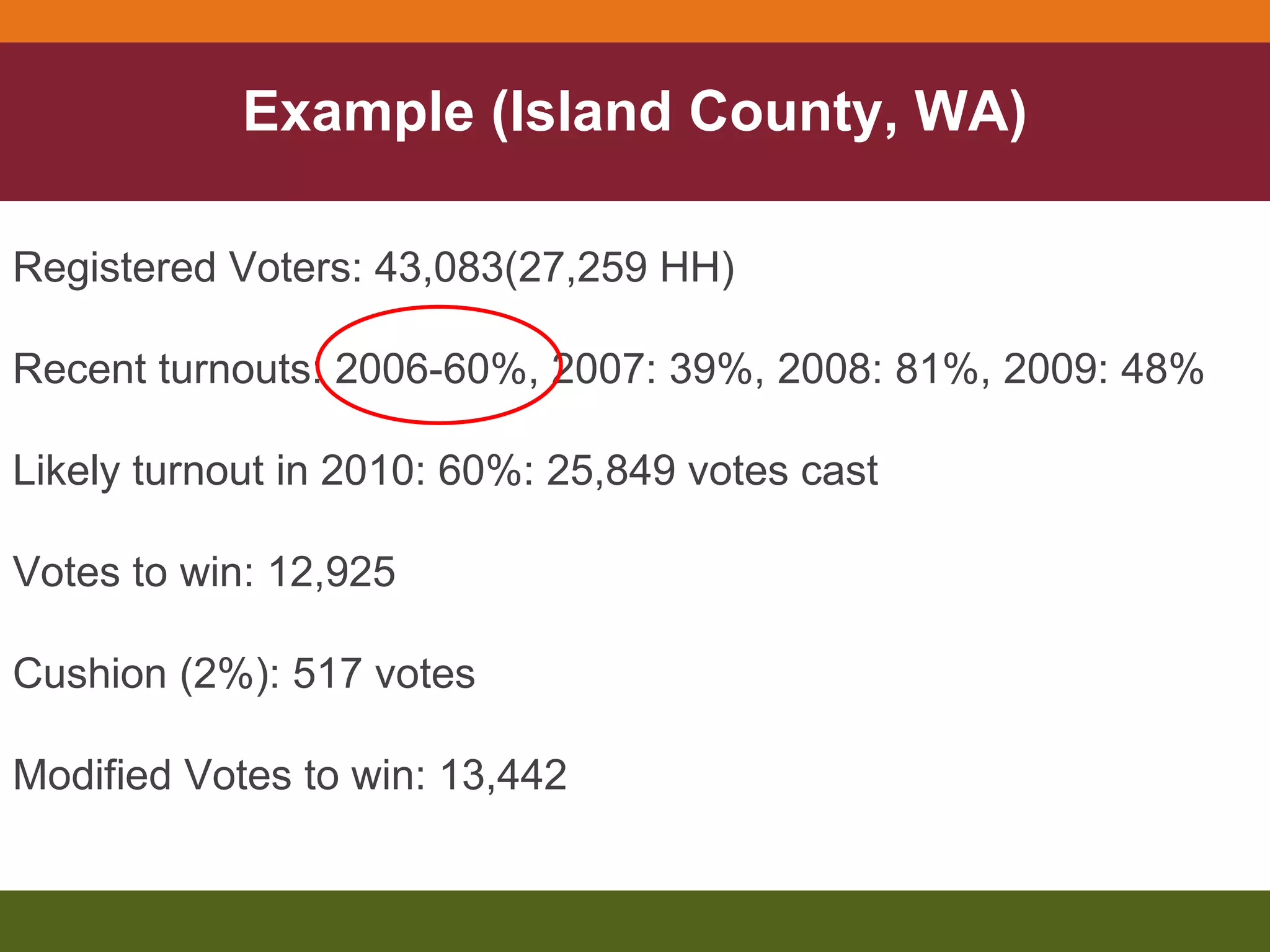
Example (Island County, WA) Registered Voters: 43,083(27,259 HH) Recent turnouts: 2006-60%, 2007: 39%, 2008: 81%, 2009: 48% Likely turnout in 2010: 60%: 25,849 votes cast Votes to win: 12,925 Cushion (2%): 517 votes Modified Votes to win: 13,442
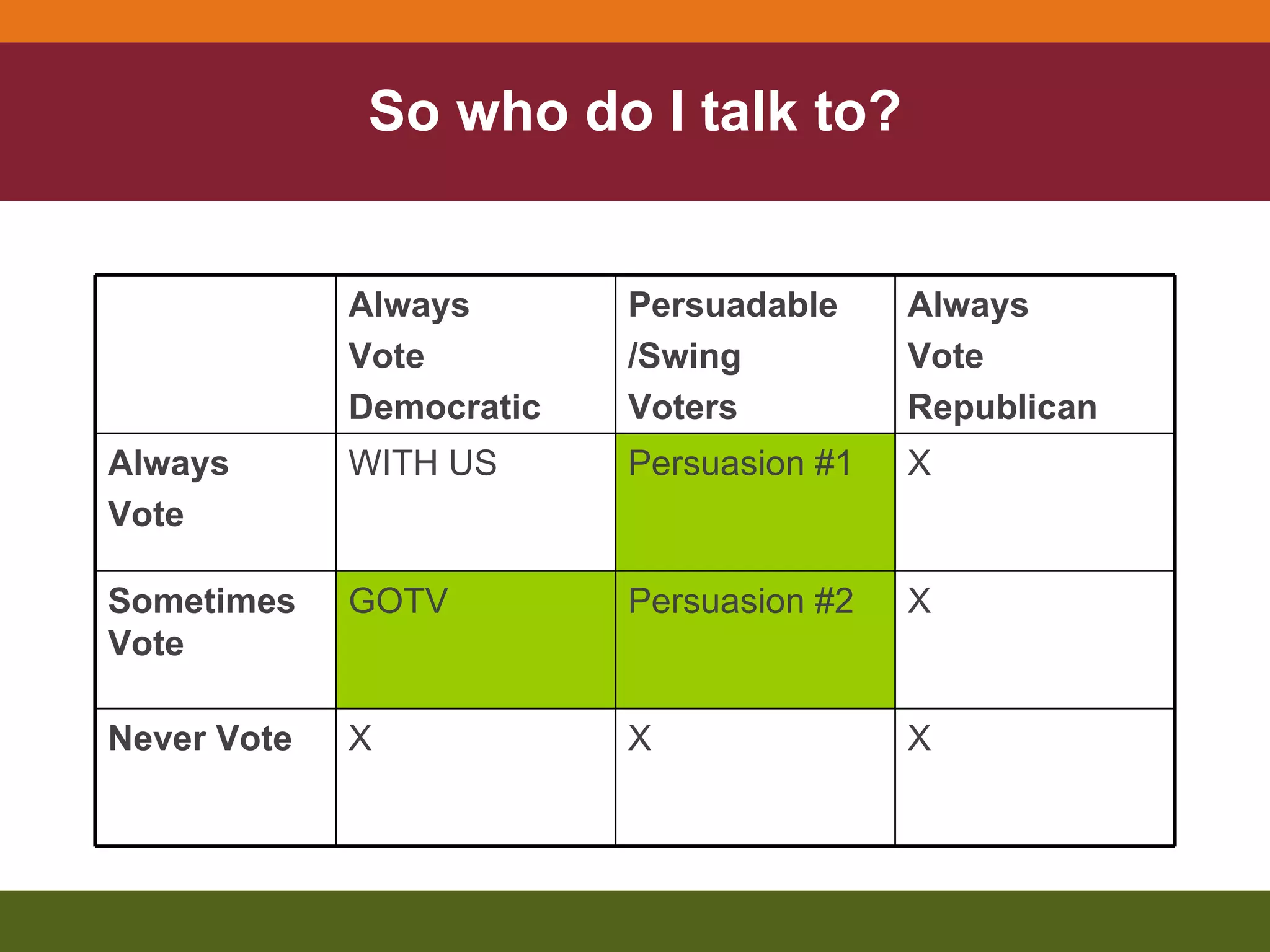
So who do I talk to? X X X Never Vote X Persuasion #2 GOTV Sometimes Vote X Persuasion #1 WITH US Always Vote Always  Vote Republican   Persuadable  /Swing Voters   Always  Vote  Democratic
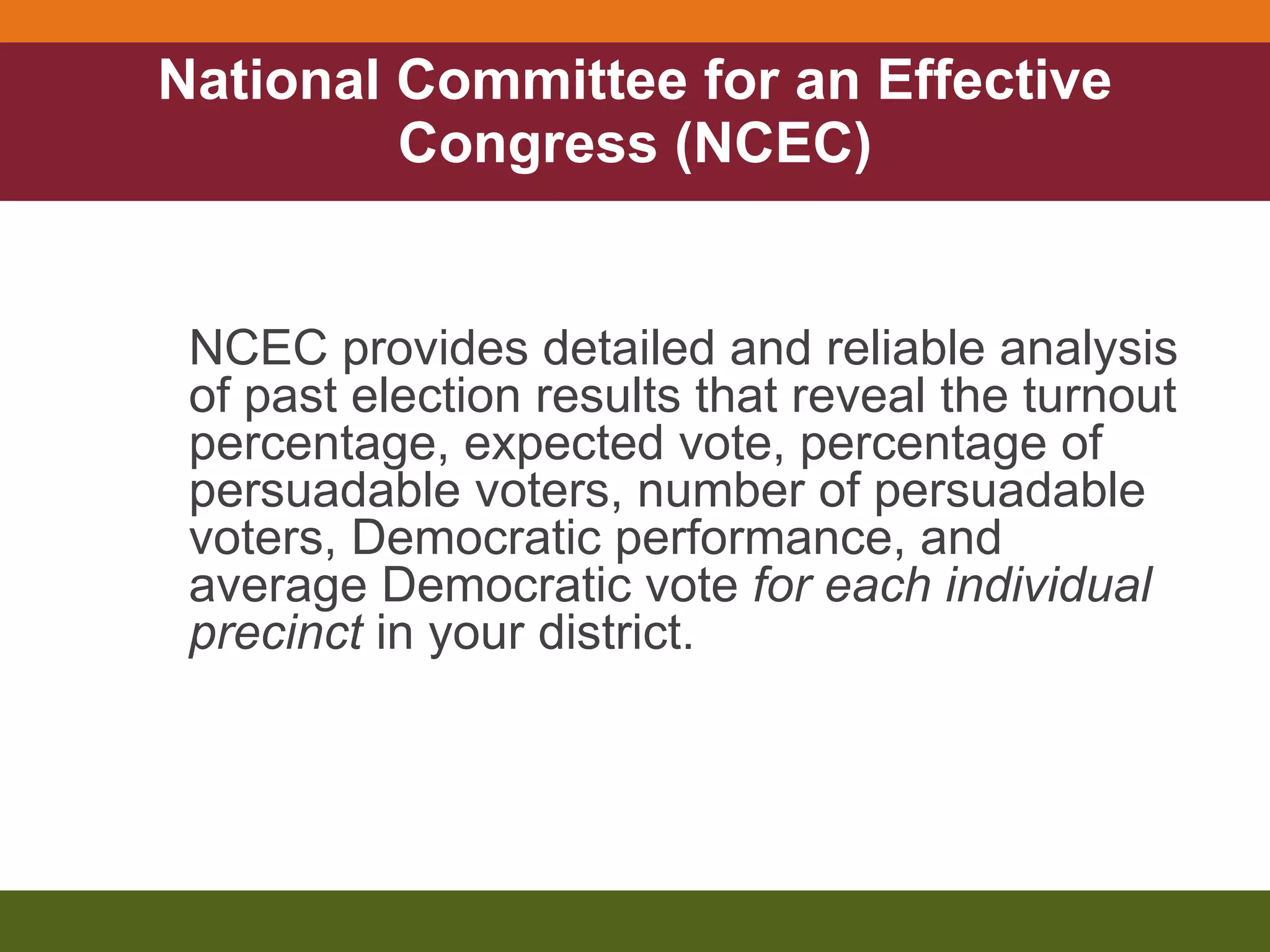
National Committee for an Effective Congress (NCEC) NCEC provides detailed and reliable analysis of past election results that reveal the turnout percentage, expected vote, percentage of persuadable voters, number of persuadable voters, Democratic performance, and average Democratic vote  for each individual precinct  in your district.
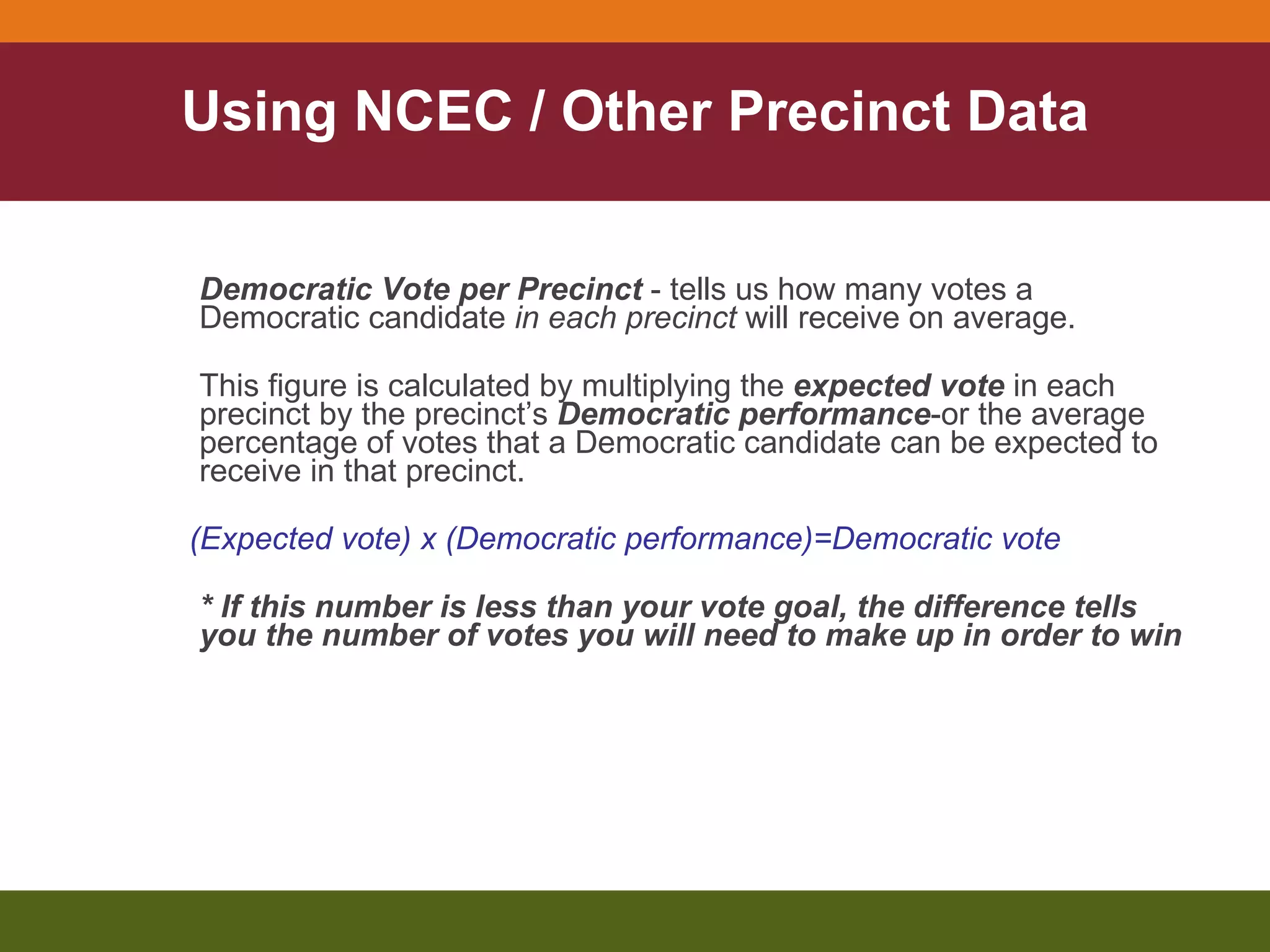
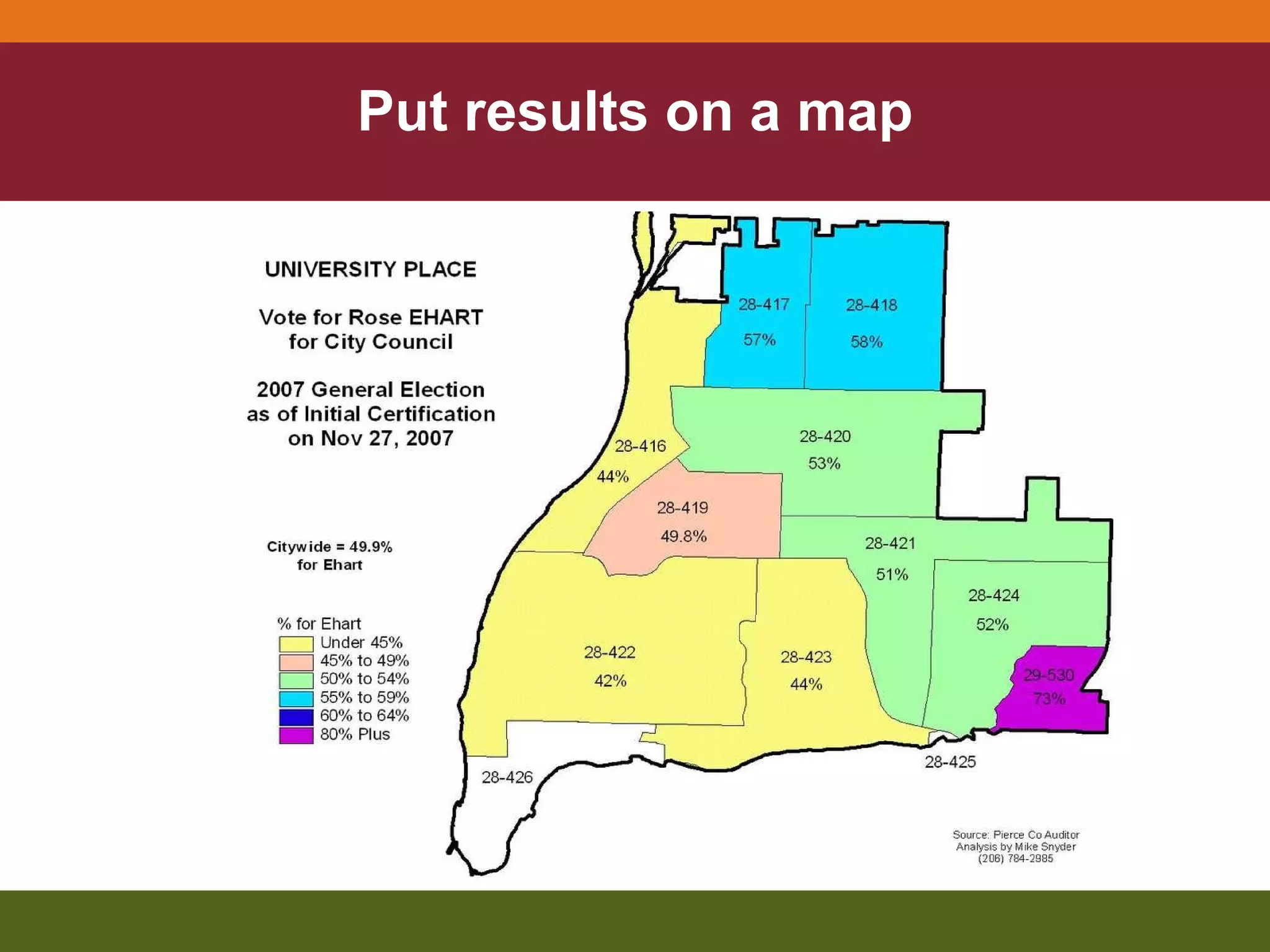
Using NCEC / Other Precinct Data Democratic Vote per Precinct  - tells us how many votes a Democratic candidate  in each precinct  will receive on average.  This figure is calculated by multiplying the  expected vote  in each precinct by the precinct’s  Democratic performance -or the average percentage of votes that a Democratic candidate can be expected to receive in that precinct. (Expected vote) x (Democratic performance)=Democratic vote * If this number is less than your vote goal, the difference tells you the number of votes you will need to make up in order to win
Put results on a map
Increasing Voter Performance Democratic performance : you will need to persuade Republicans and Independents to vote for you with the use of targeted voter contact and earned and paid media. *  As a rule, if your goal is to increase performance, you should reach out to persuadable voters in high Democratic performing precincts specifically. Voter turnout : you will need to spur infrequently voting Democrats to show up on Election Day.  Identify and prioritize precincts with a  high Democratic performance  and a  low turnout percentage , spend time registering new voters there, and put a heavy emphasis on GOTV activity on the infrequent voting Democrats in those areas.
Individual Voter Level Using a voter file Party registration / identification Voter History data (1/4, 2/4, etc.) Ethnicity Other voters in household
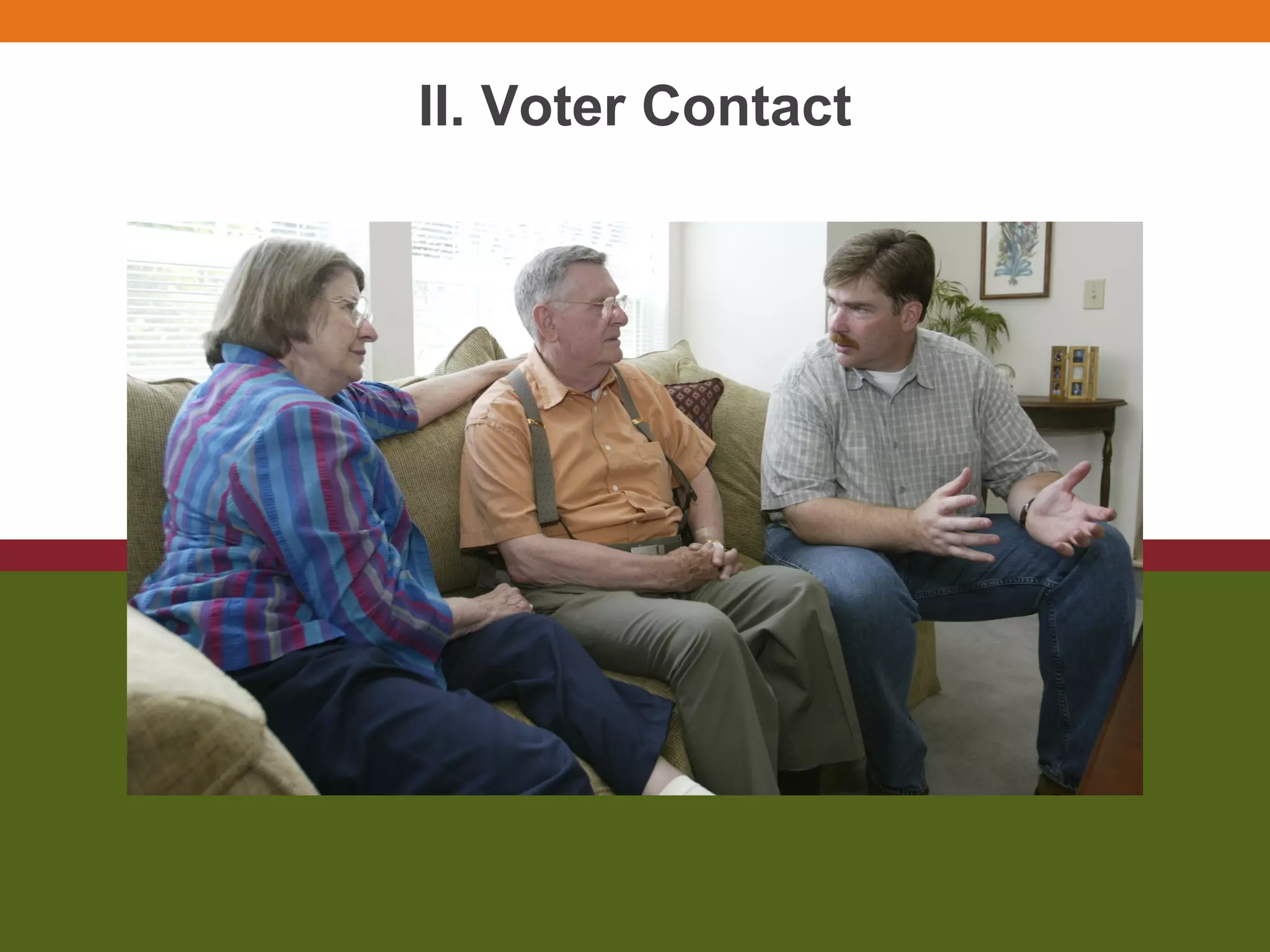
II. Voter Contact
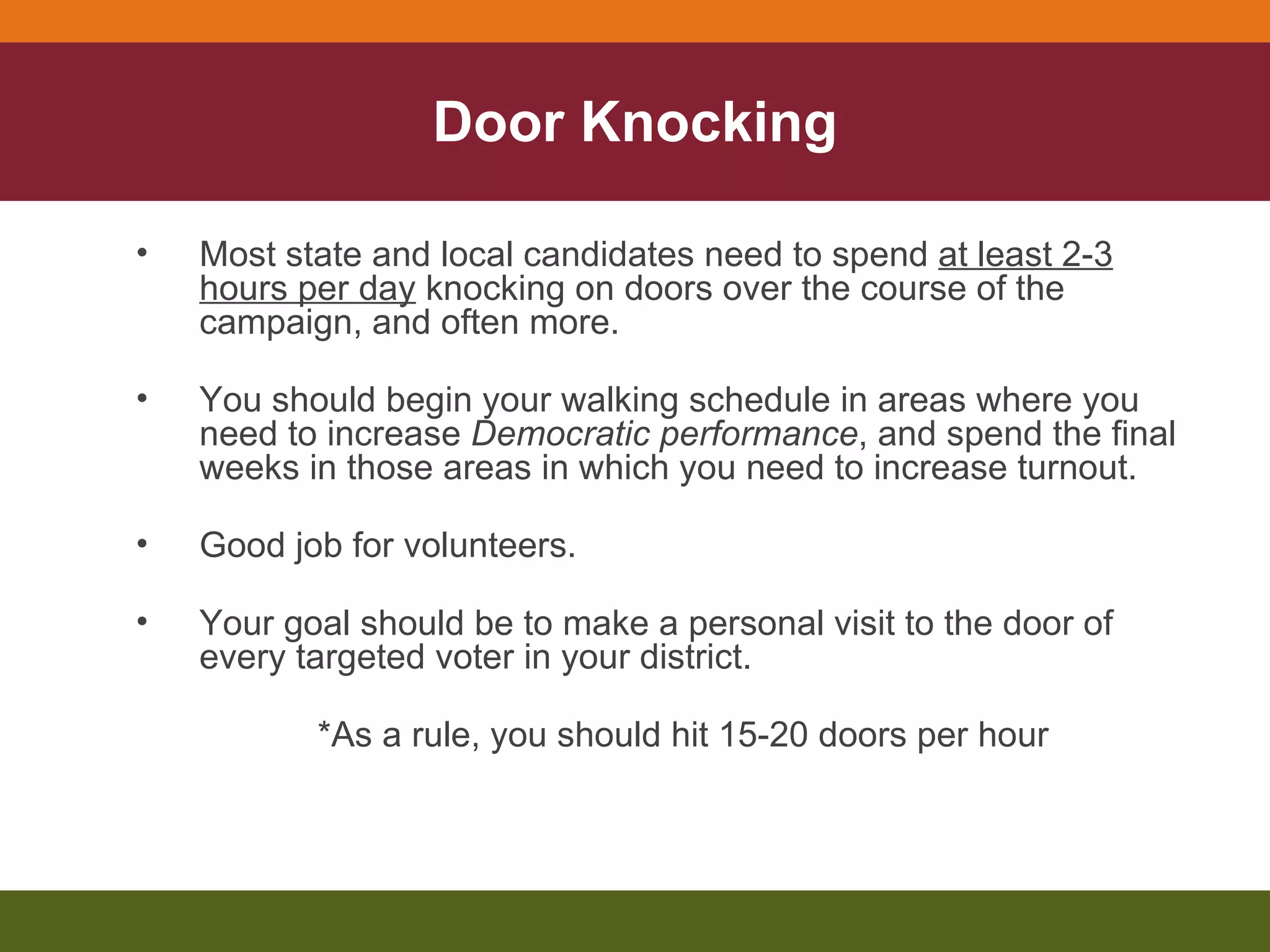
Door Knocking Most state and local candidates need to spend  at least 2-3 hours per day  knocking on doors over the course of the campaign, and often more. You should begin your walking schedule in areas where you need to increase  Democratic performance , and spend the final weeks in those areas in which you need to increase turnout. Good job for volunteers. Your goal should be to make a personal visit to the door of every targeted voter in your district. *As a rule, you should hit 15-20 doors per hour
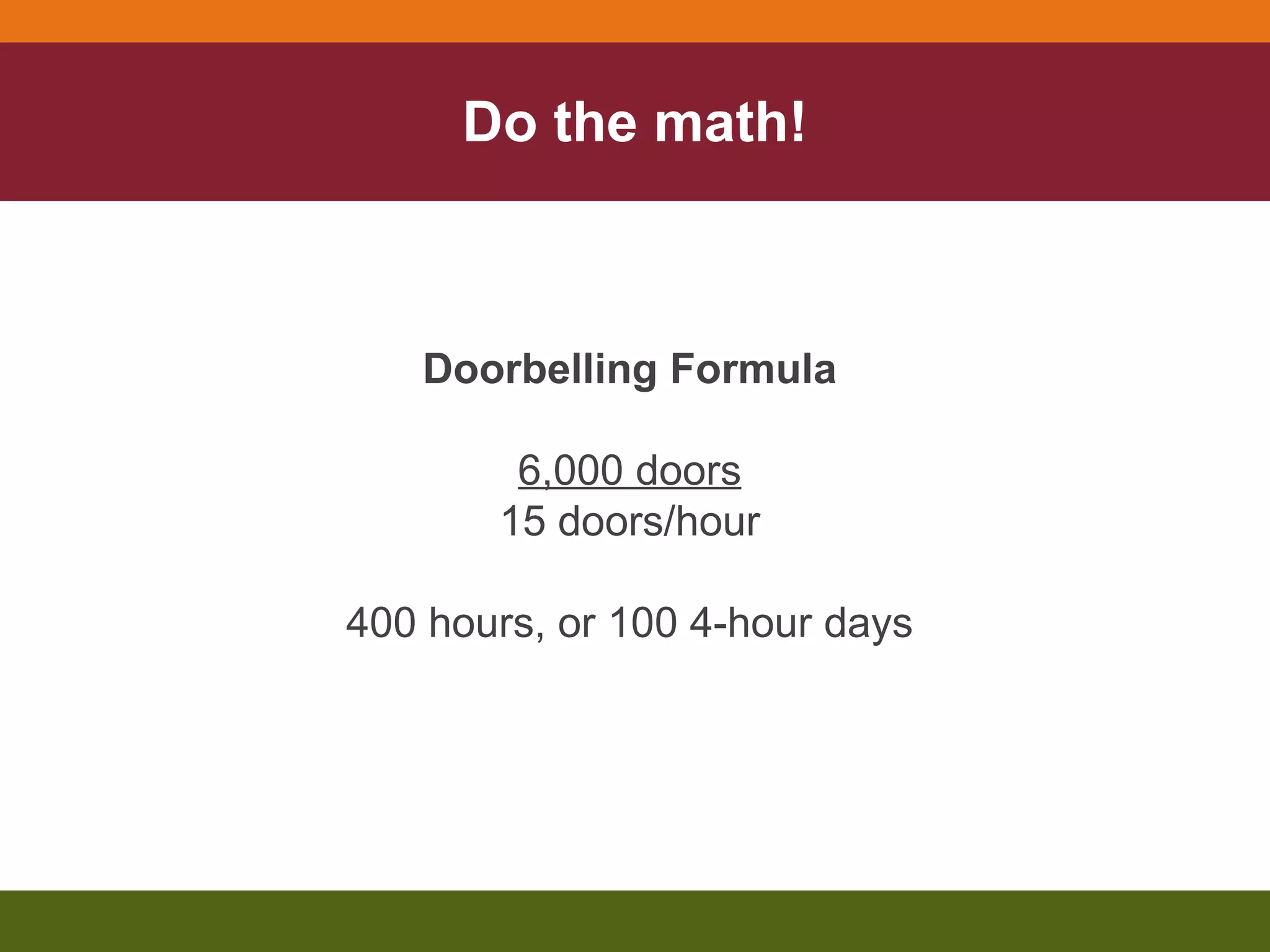
Do the math! Doorbelling Formula 6,000 doors 15 doors/hour 400 hours, or 100 4-hour days
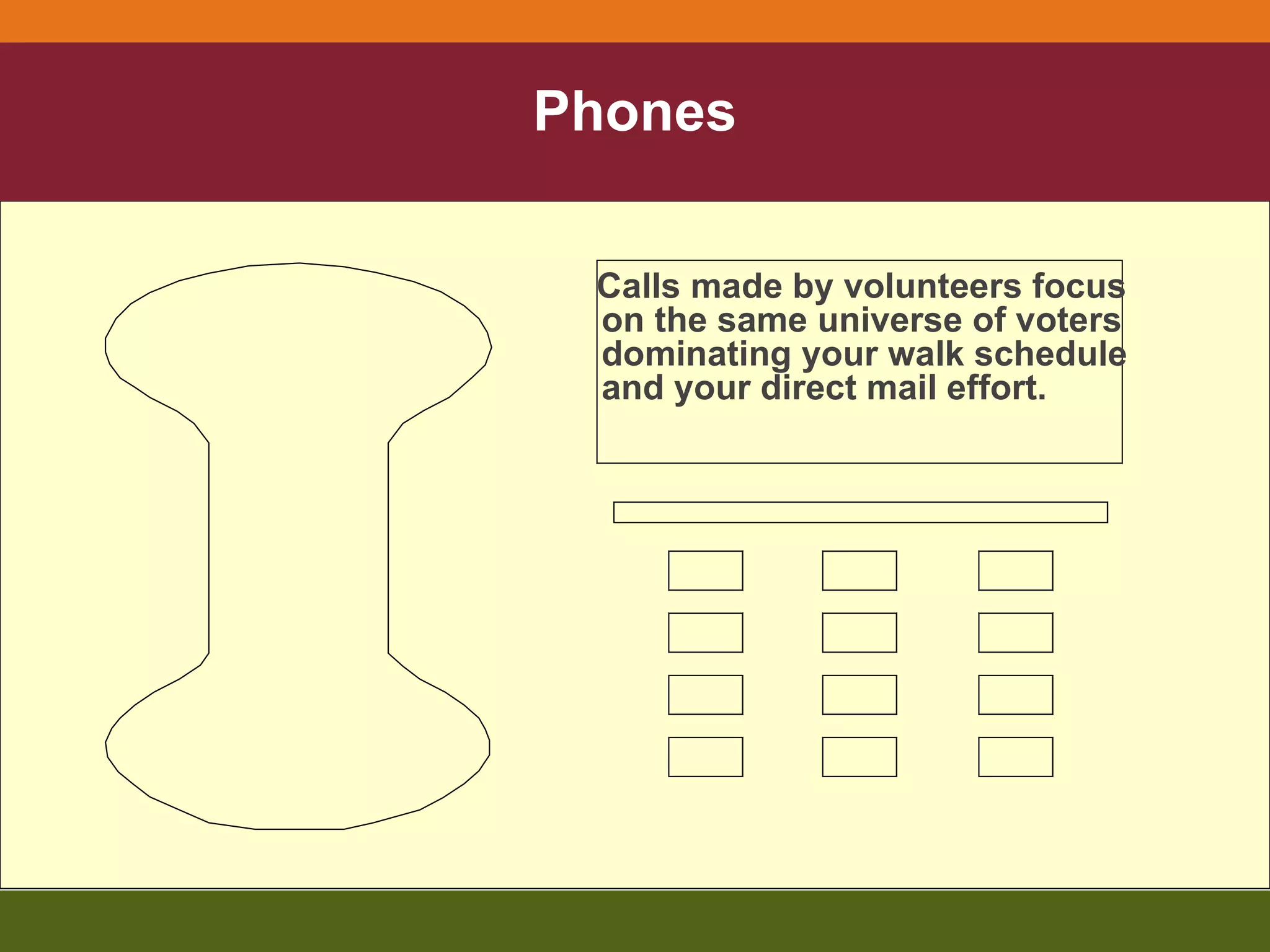
Phones Calls made by volunteers focus on the same universe of voters dominating your walk schedule and your direct mail effort.
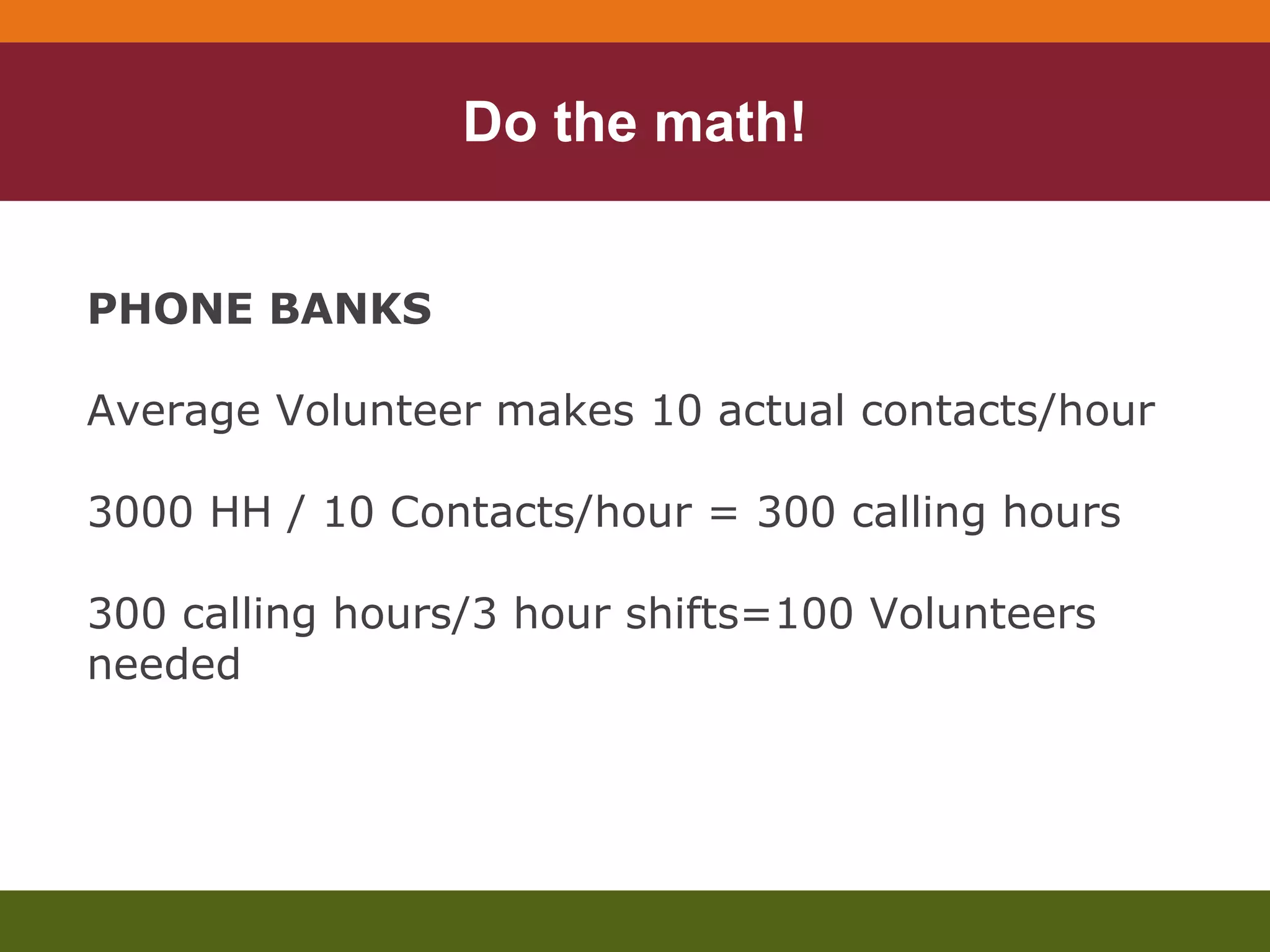
Do the math! PHONE BANKS Average Volunteer makes 10 actual contacts/hour  3000 HH / 10 Contacts/hour = 300 calling hours 300 calling hours/3 hour shifts=100 Volunteers needed
Direct Mail Aim at targeted voters, and aim often. Takes up a large portion of the campaign budget. Have your campaign conduct additional analysis on the voters themselves using available voter file enhancements to determine which message will be most effective with each group of voters.
Contact: Progressive Majority www. progressivemajority .org

Candidate Training - Targeting and Voter Contact

  • 1.
    Targeting & VoterContact Contact: [email_address]
  • 2.
  • 3.
    Key Terms Target(Narrows Universe) Field operation (Talks to individual voters)
  • 4.
    Targeting #1 Determinethe overall vote goal - how many votes you need to win. # 2 Identify where you will go to find those votes on a precinct level.
  • 5.
    Determining Your VoteGoal Begin by estimating the total expected vote for your race This is accomplished by multiplying the turnout percentage from the like election by the number of currently registered voters in your district What’s a like election? Once you have determined the total expected vote , in a two person race divide your total expected vote by two and add one. Total Expected Vote + 1 = VOTE GOAL 2
  • 6.
    Example (Island County,WA) Registered Voters: 43,083(27,259 HH) Recent turnouts: 2006-60%, 2007: 39%, 2008: 81%, 2009: 48% Likely turnout in 2010: 60%: 25,849 votes cast Votes to win: 12,925 Cushion (2%): 517 votes Modified Votes to win: 13,442
  • 7.
    So who doI talk to? X X X Never Vote X Persuasion #2 GOTV Sometimes Vote X Persuasion #1 WITH US Always Vote Always Vote Republican Persuadable /Swing Voters Always Vote Democratic
  • 8.
    National Committee foran Effective Congress (NCEC) NCEC provides detailed and reliable analysis of past election results that reveal the turnout percentage, expected vote, percentage of persuadable voters, number of persuadable voters, Democratic performance, and average Democratic vote for each individual precinct in your district.
  • 9.
    Using NCEC /Other Precinct Data Democratic Vote per Precinct - tells us how many votes a Democratic candidate in each precinct will receive on average. This figure is calculated by multiplying the expected vote in each precinct by the precinct’s Democratic performance -or the average percentage of votes that a Democratic candidate can be expected to receive in that precinct. (Expected vote) x (Democratic performance)=Democratic vote * If this number is less than your vote goal, the difference tells you the number of votes you will need to make up in order to win
  • 10.
  • 11.
    Increasing Voter PerformanceDemocratic performance : you will need to persuade Republicans and Independents to vote for you with the use of targeted voter contact and earned and paid media. * As a rule, if your goal is to increase performance, you should reach out to persuadable voters in high Democratic performing precincts specifically. Voter turnout : you will need to spur infrequently voting Democrats to show up on Election Day. Identify and prioritize precincts with a high Democratic performance and a low turnout percentage , spend time registering new voters there, and put a heavy emphasis on GOTV activity on the infrequent voting Democrats in those areas.
  • 12.
    Individual Voter LevelUsing a voter file Party registration / identification Voter History data (1/4, 2/4, etc.) Ethnicity Other voters in household
  • 13.
  • 14.
    Door Knocking Moststate and local candidates need to spend at least 2-3 hours per day knocking on doors over the course of the campaign, and often more. You should begin your walking schedule in areas where you need to increase Democratic performance , and spend the final weeks in those areas in which you need to increase turnout. Good job for volunteers. Your goal should be to make a personal visit to the door of every targeted voter in your district. *As a rule, you should hit 15-20 doors per hour
  • 15.
    Do the math!Doorbelling Formula 6,000 doors 15 doors/hour 400 hours, or 100 4-hour days
  • 16.
    Phones Calls madeby volunteers focus on the same universe of voters dominating your walk schedule and your direct mail effort.
  • 17.
    Do the math!PHONE BANKS Average Volunteer makes 10 actual contacts/hour 3000 HH / 10 Contacts/hour = 300 calling hours 300 calling hours/3 hour shifts=100 Volunteers needed
  • 18.
    Direct Mail Aimat targeted voters, and aim often. Takes up a large portion of the campaign budget. Have your campaign conduct additional analysis on the voters themselves using available voter file enhancements to determine which message will be most effective with each group of voters.
  • 19.
    Contact: Progressive Majoritywww. progressivemajority .org