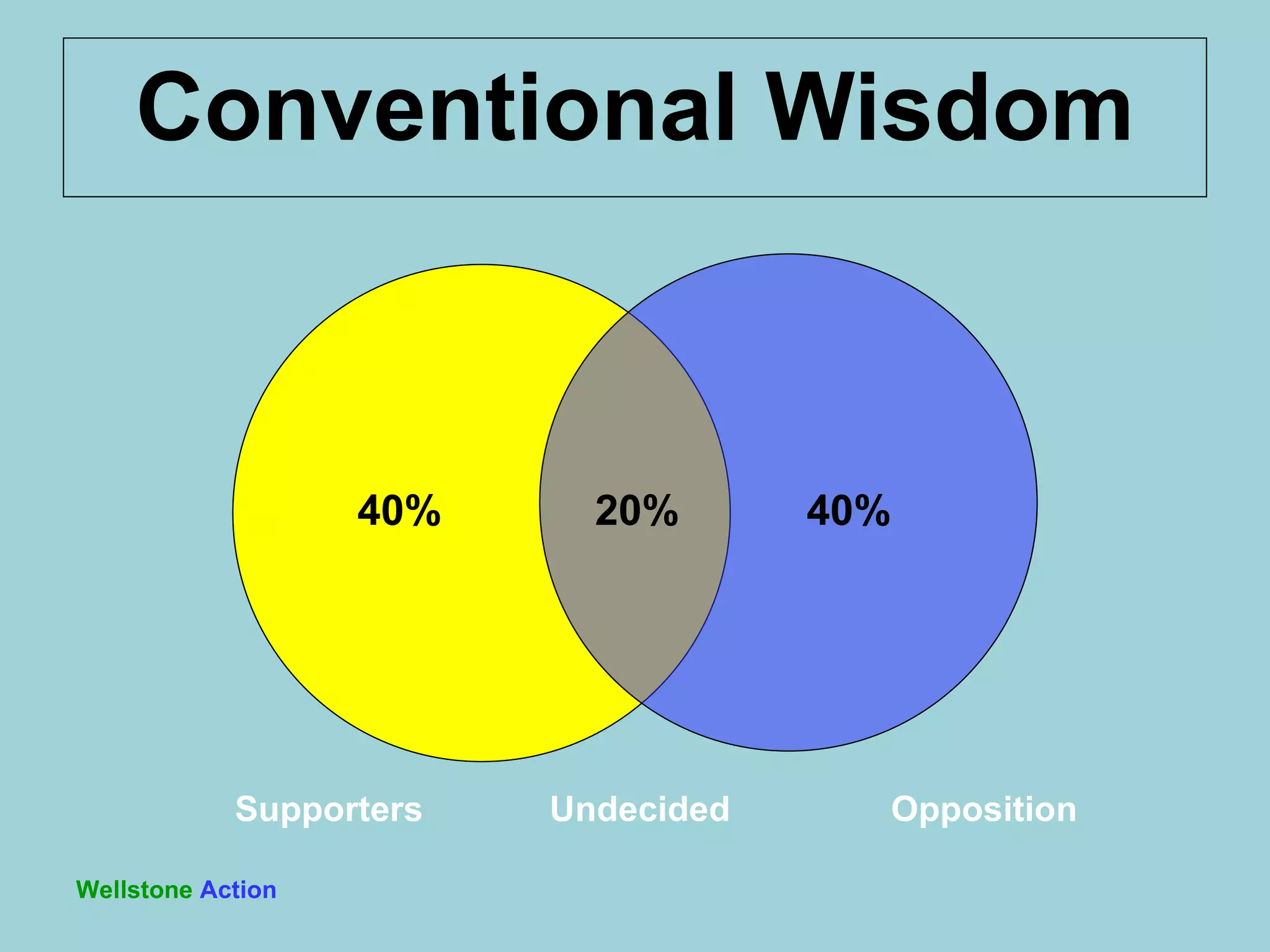
Wellstone   Action Basebuilding and Elections
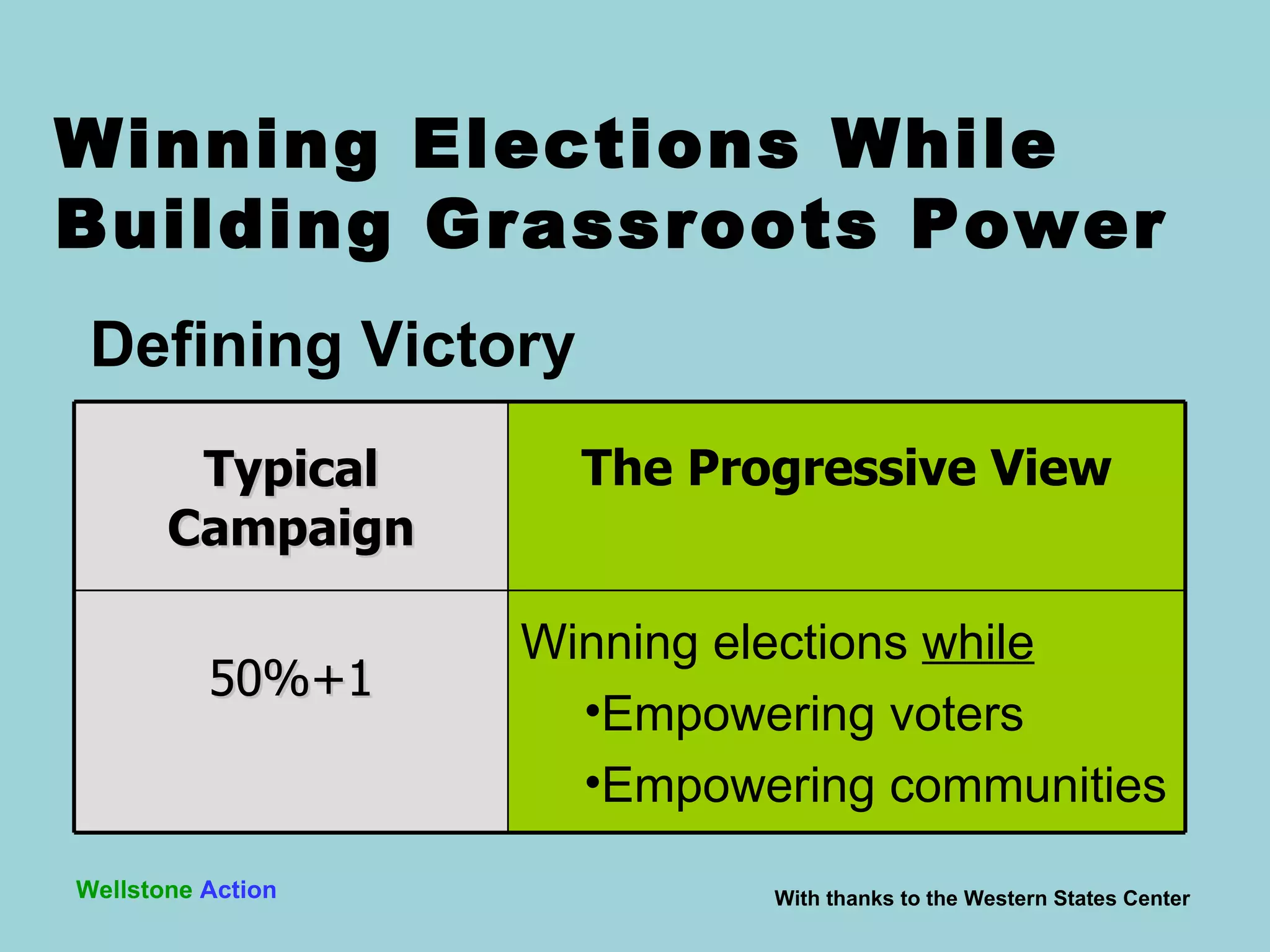
Winning Elections While Building Grassroots Power  Defining Victory With thanks to the Western States Center Wellstone   Action Typical Campaign 50%+1 The Progressive View Winning elections   while Empowering voters Empowering communities
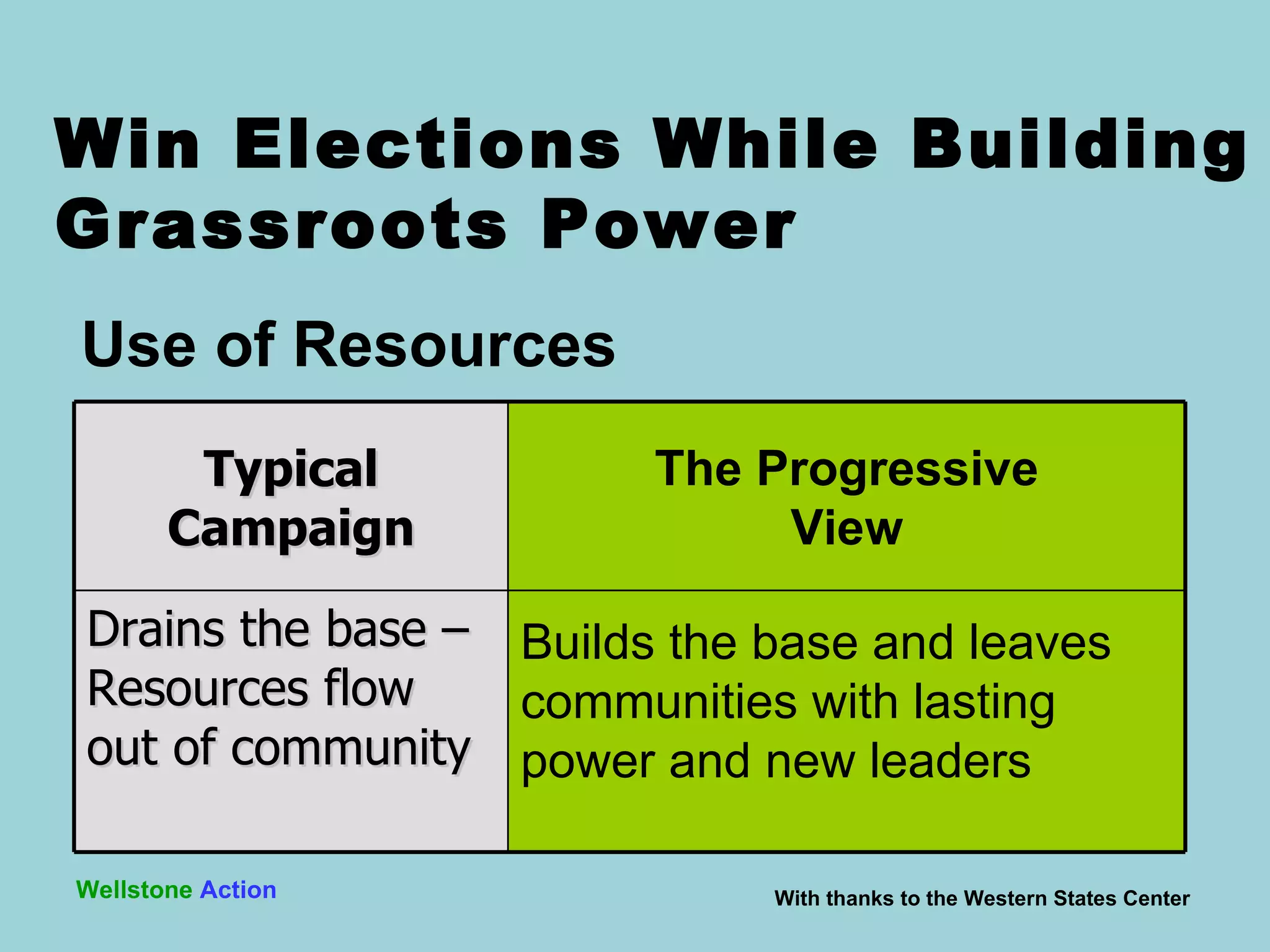
Win Elections While Building Grassroots Power  Use of Resources With thanks to the Western States Center Wellstone   Action Typical Campaign Drains the base –Resources flow out of community The Progressive View Builds the base and leaves communities with lasting power and new leaders
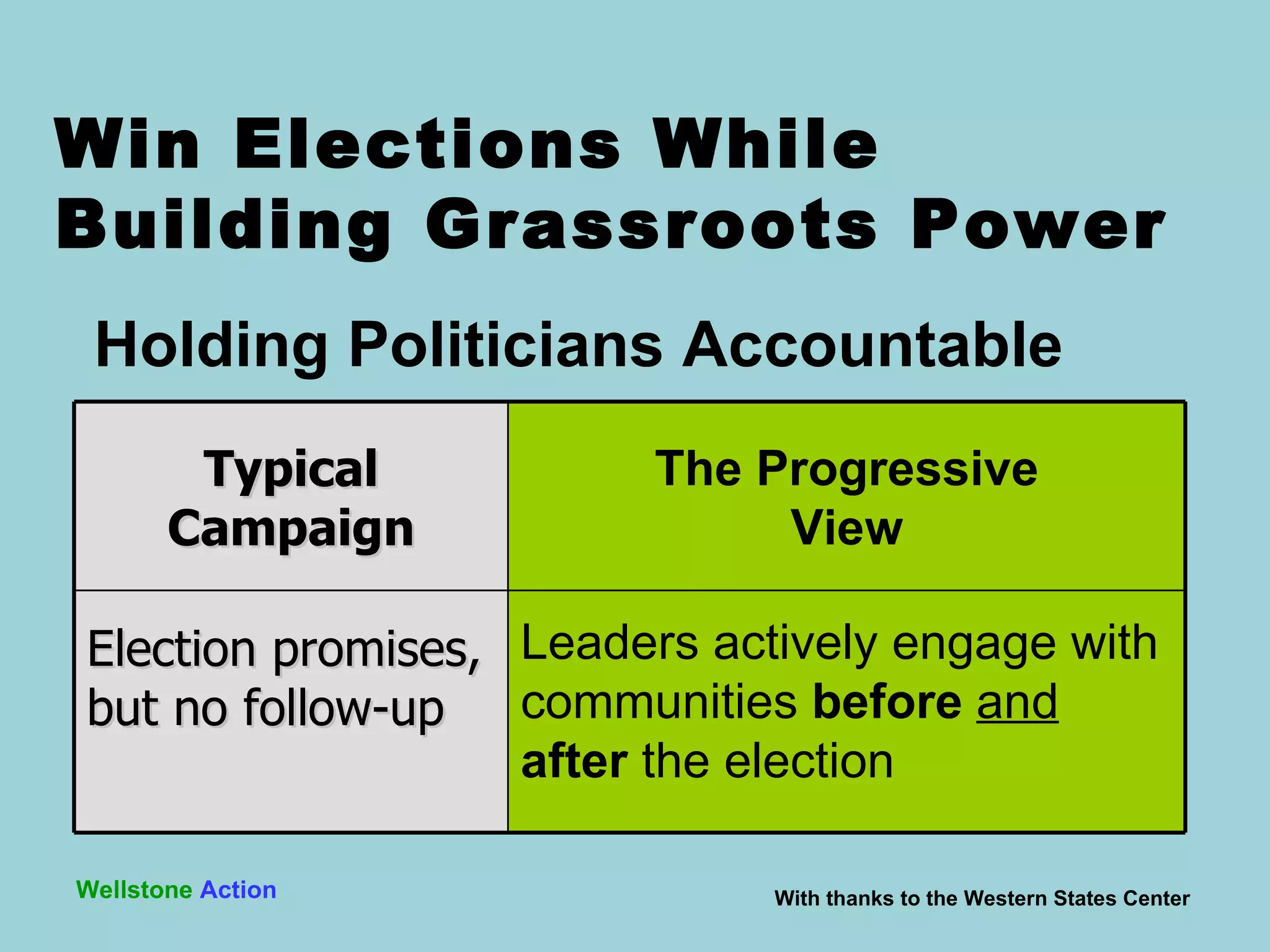
Win Elections While Building Grassroots Power  Holding Politicians Accountable With thanks to the Western States Center Wellstone   Action Typical Campaign Election promises, but no follow-up The Progressive View Leaders actively engage with communities  before   and   after  the election
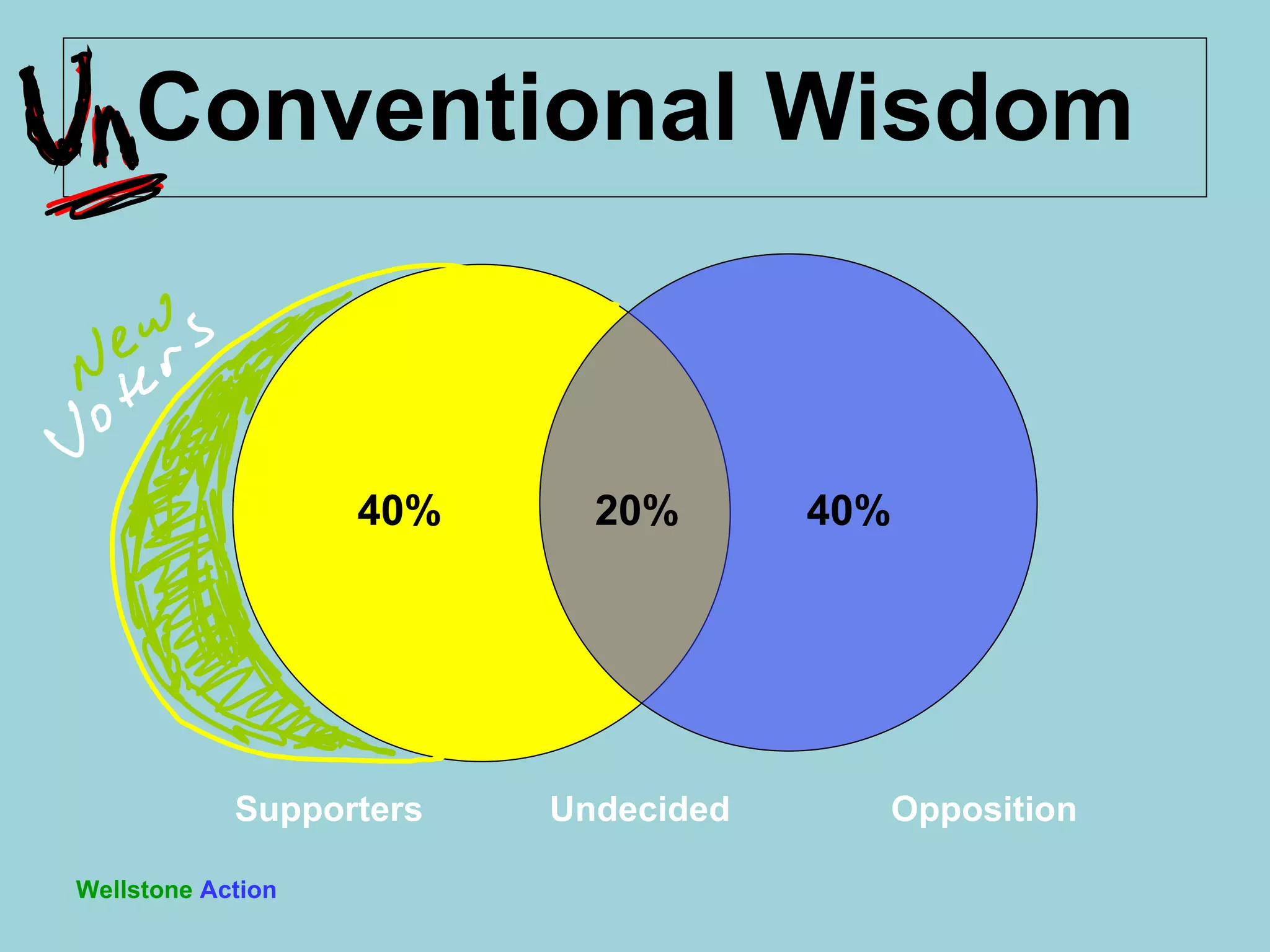
Conventional Wisdom Wellstone   Action Supporters Undecided Opposition 40% 20% 40%
Bring people into the process Teach skills and leadership Help communities and constituencies be  “players” Bring community issues to the forefront Wellstone   Action Using Elections to  Build and Expand the Base
Wellstone   Action So… What do we mean by a  base ?
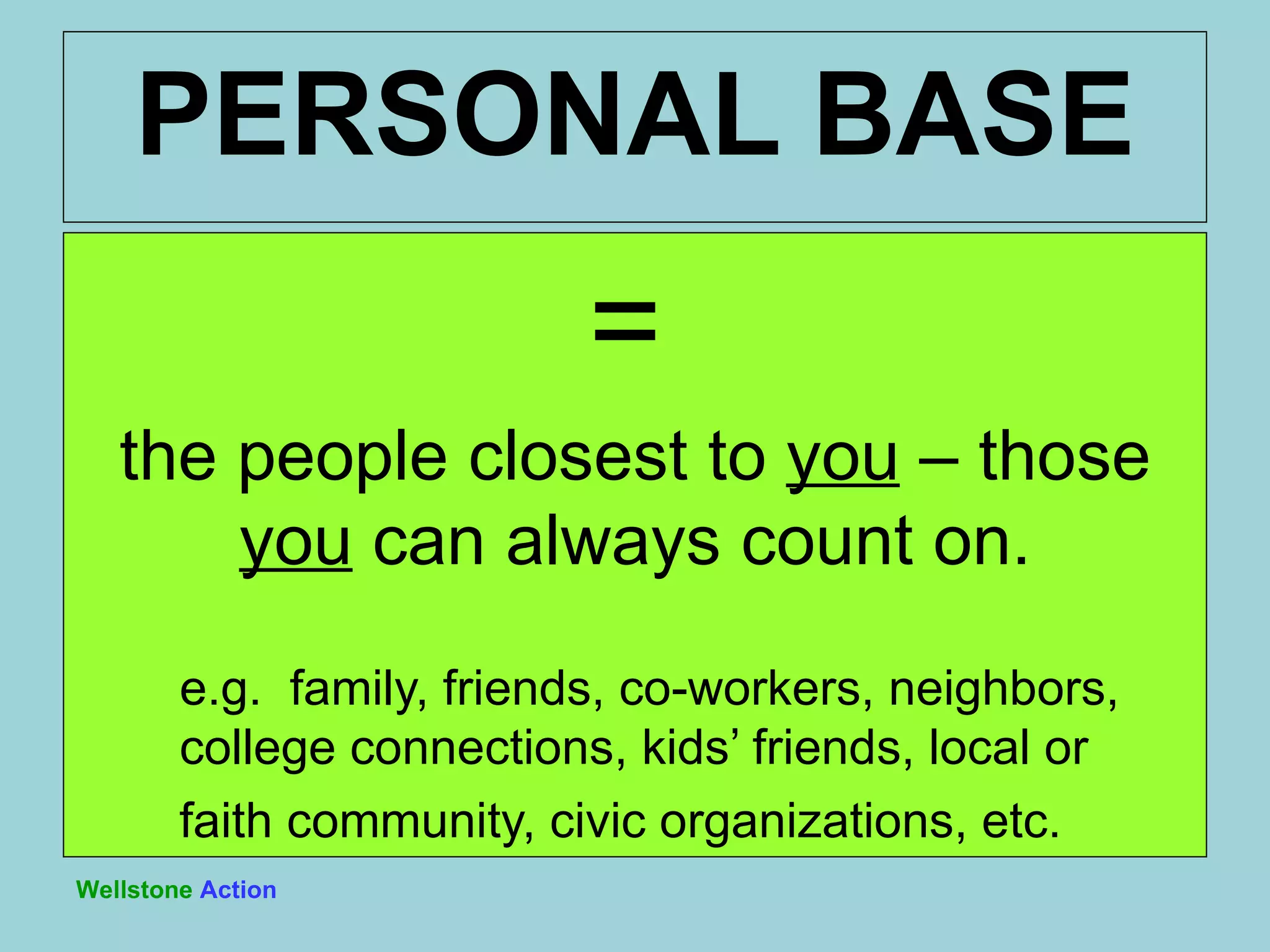
PERSONAL BASE =   the people closest to  you  – those  you  can always count on. e.g.  family, friends, co-workers, neighbors, college connections, kids ’ friends, local or faith community, civic organizations, etc.   Wellstone   Action
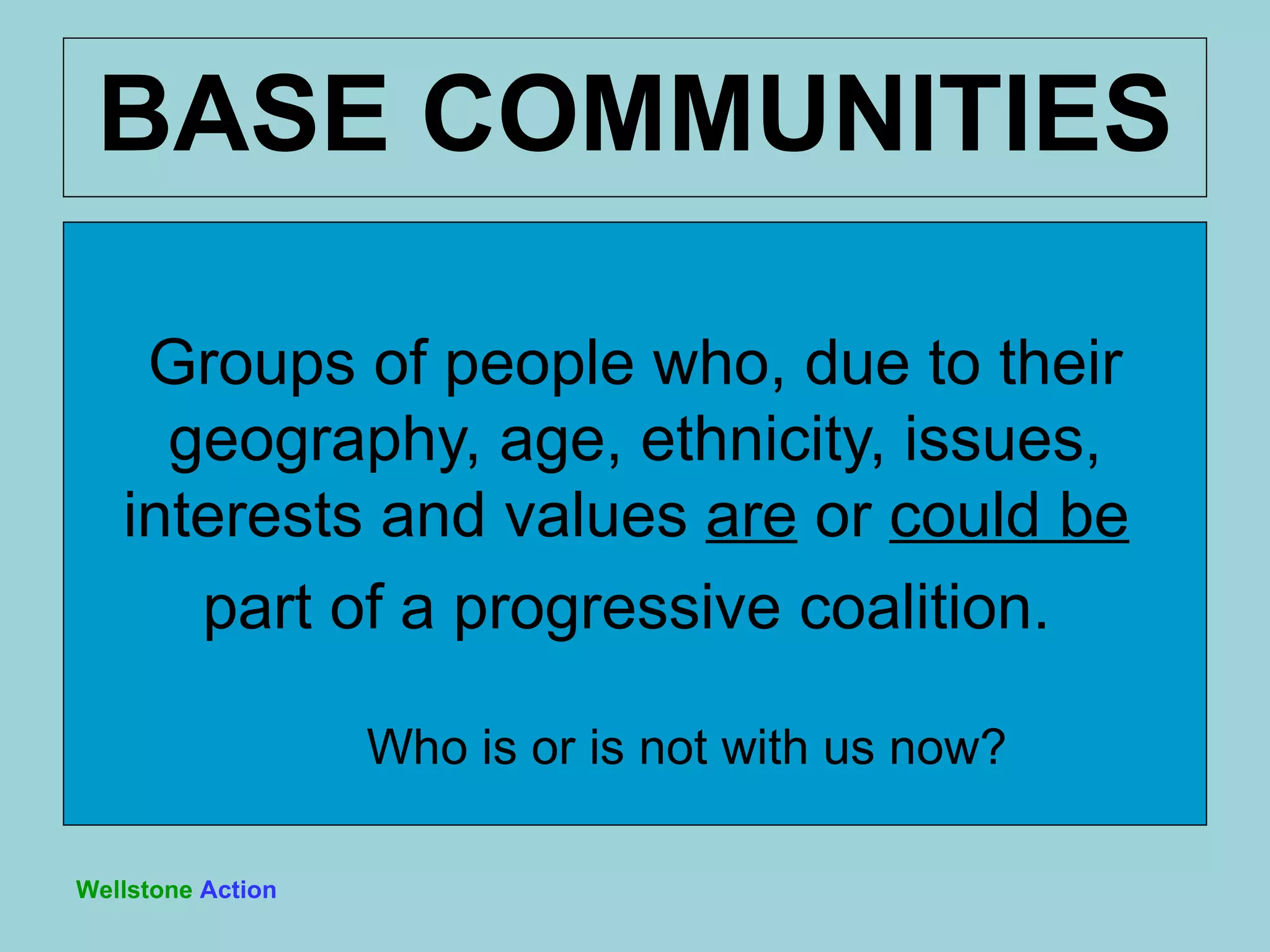
Groups of people who, due to their geography, age, ethnicity, issues, interests and values  are  or  could be   part of a progressive coalition.  Who is or is not with us now? BASE COMMUNITIES Wellstone   Action
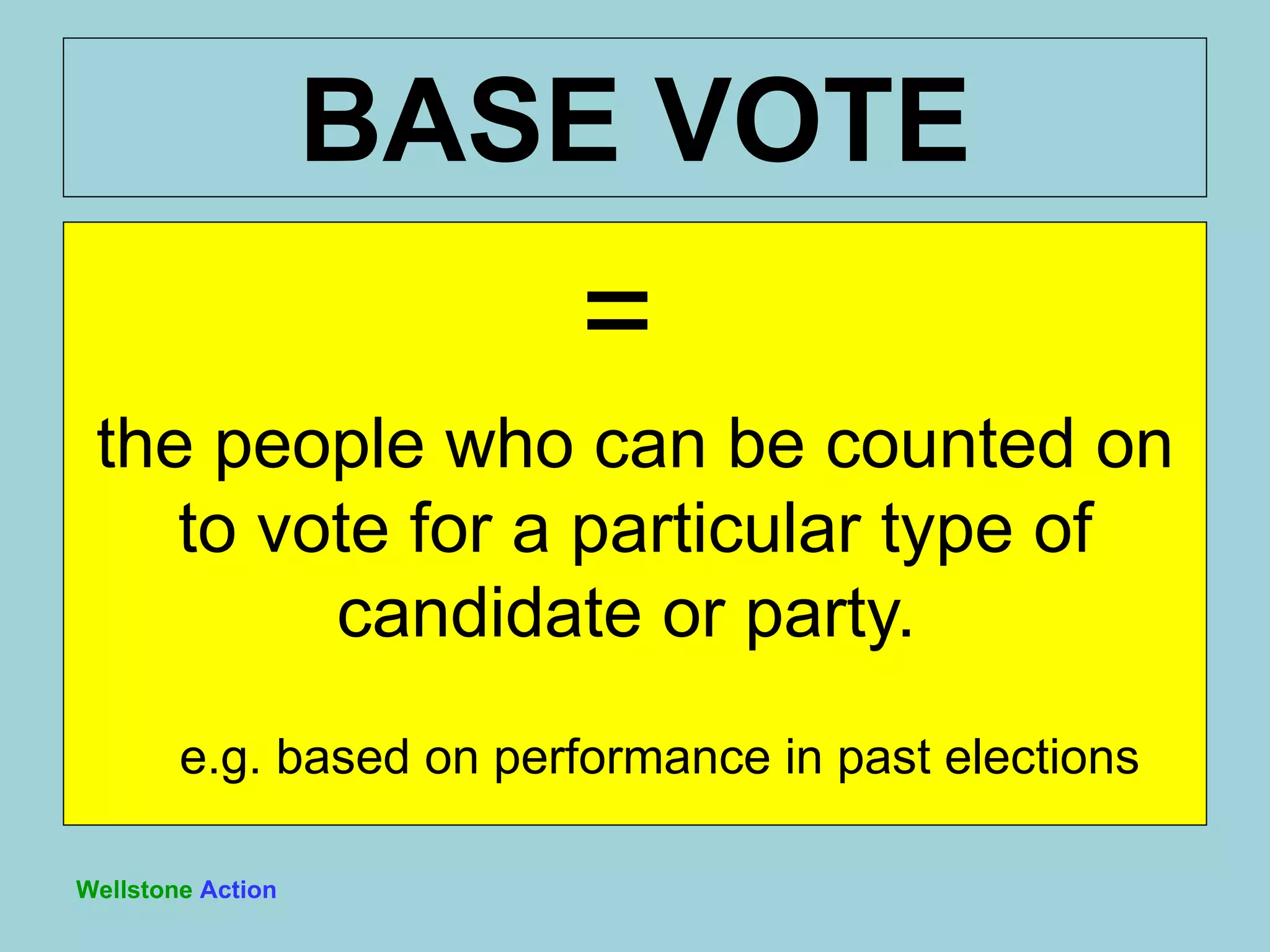
=  the people who can be counted on to vote for a particular type of candidate or party.   e.g. based on performance in past elections BASE VOTE Wellstone   Action
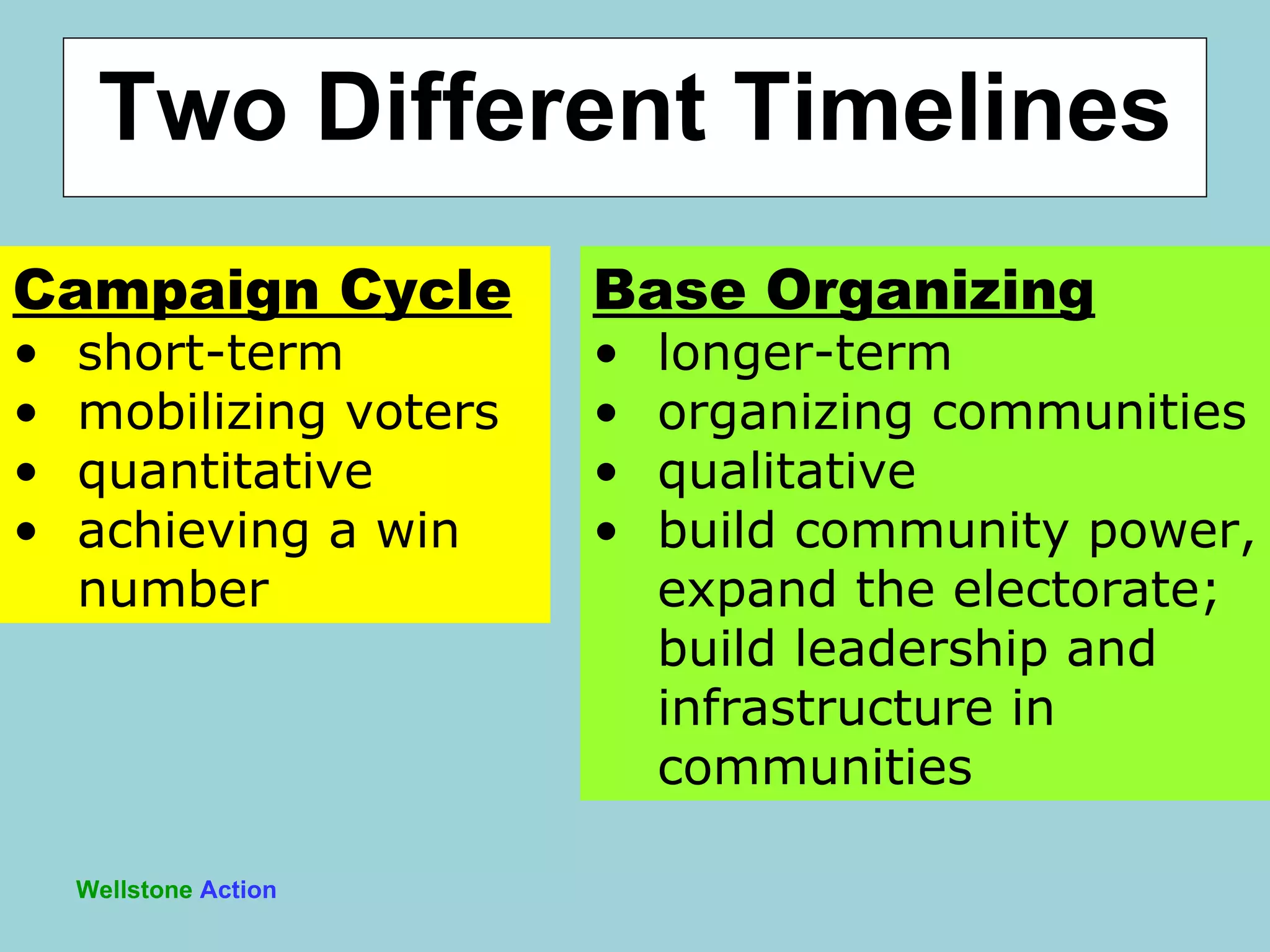
Wellstone   Action Two Different Timelines Campaign Cycle   short-term mobilizing voters quantitative achieving a win number Base Organizing   longer-term organizing communities qualitative build community power, expand the electorate; build leadership and infrastructure in communities
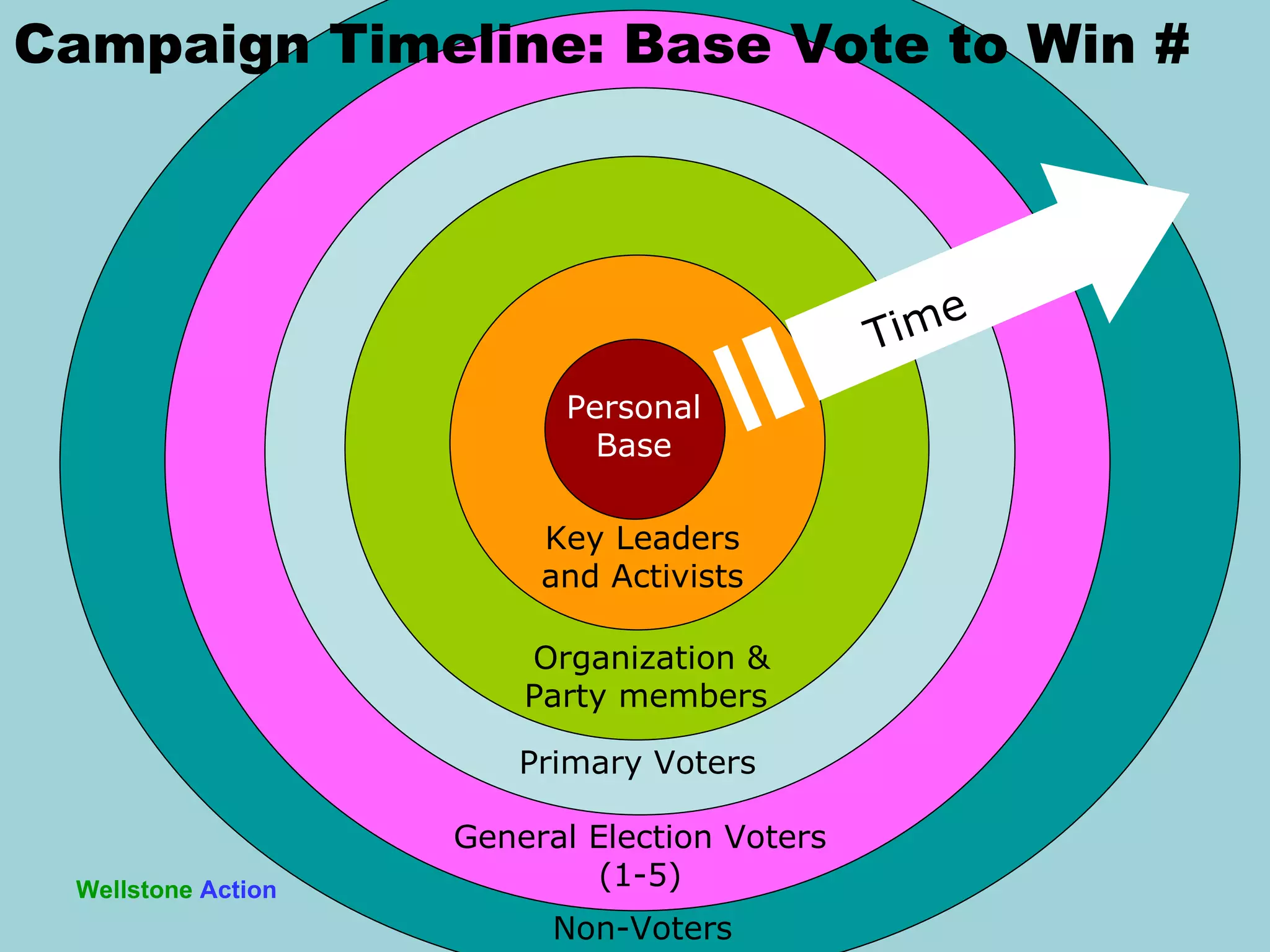
Wellstone   Action Campaign Timeline: Base Vote to Win # Non-Voters General Election Voters (1-5) Primary Voters Organization & Party members  Key Leaders and Activists Personal  Base Time
Wellstone   Action Too often –   This approach means little or no outreach to under-represented voters.
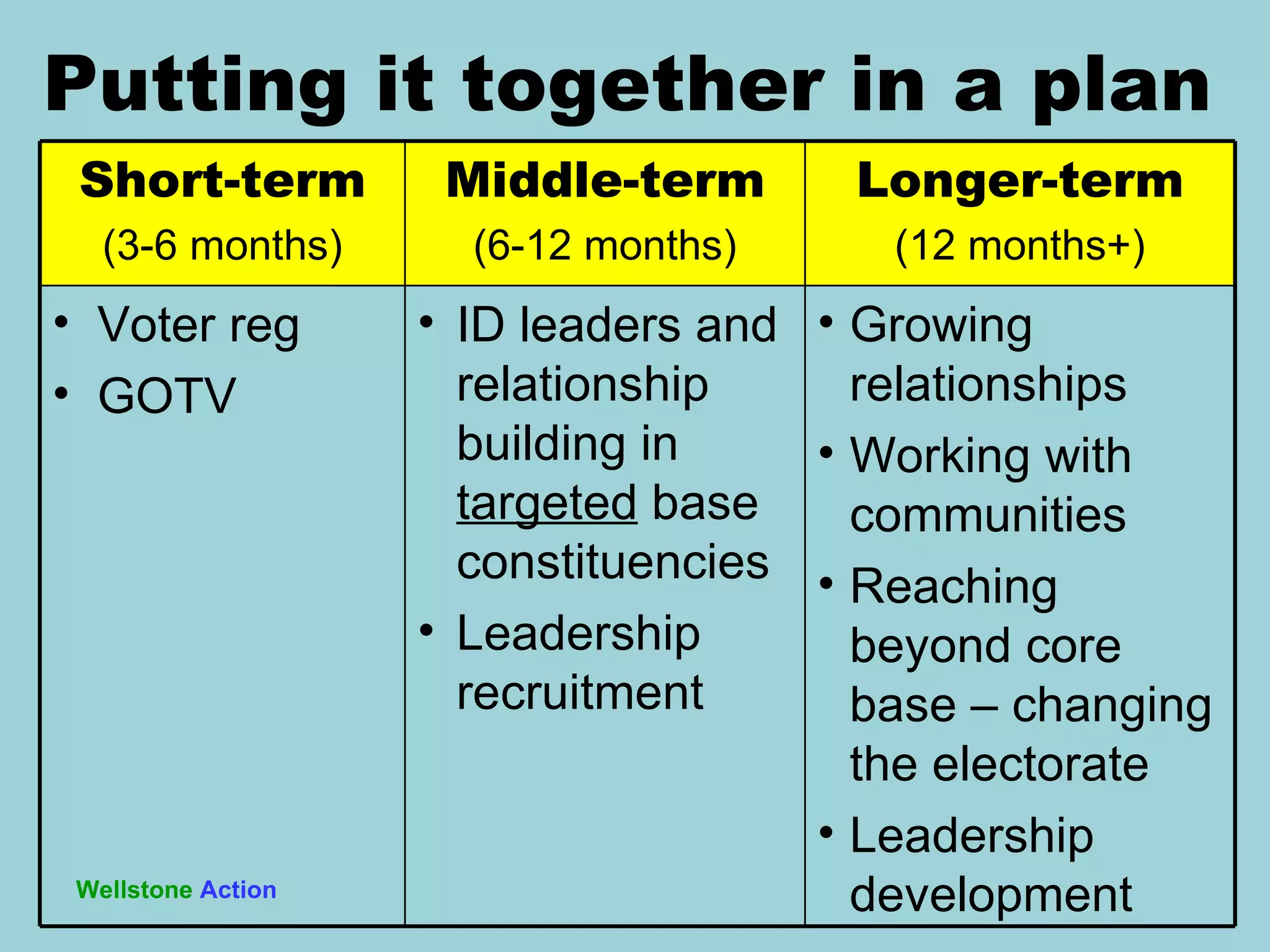
Wellstone   Action Putting it together in a plan Short-term (3-6 months) Middle-term (6-12 months) Longer-term (12 months+) Voter reg GOTV ID leaders and relationship building in  targeted  base constituencies Leadership recruitment Growing relationships Working with communities Reaching beyond core base – changing the electorate Leadership development
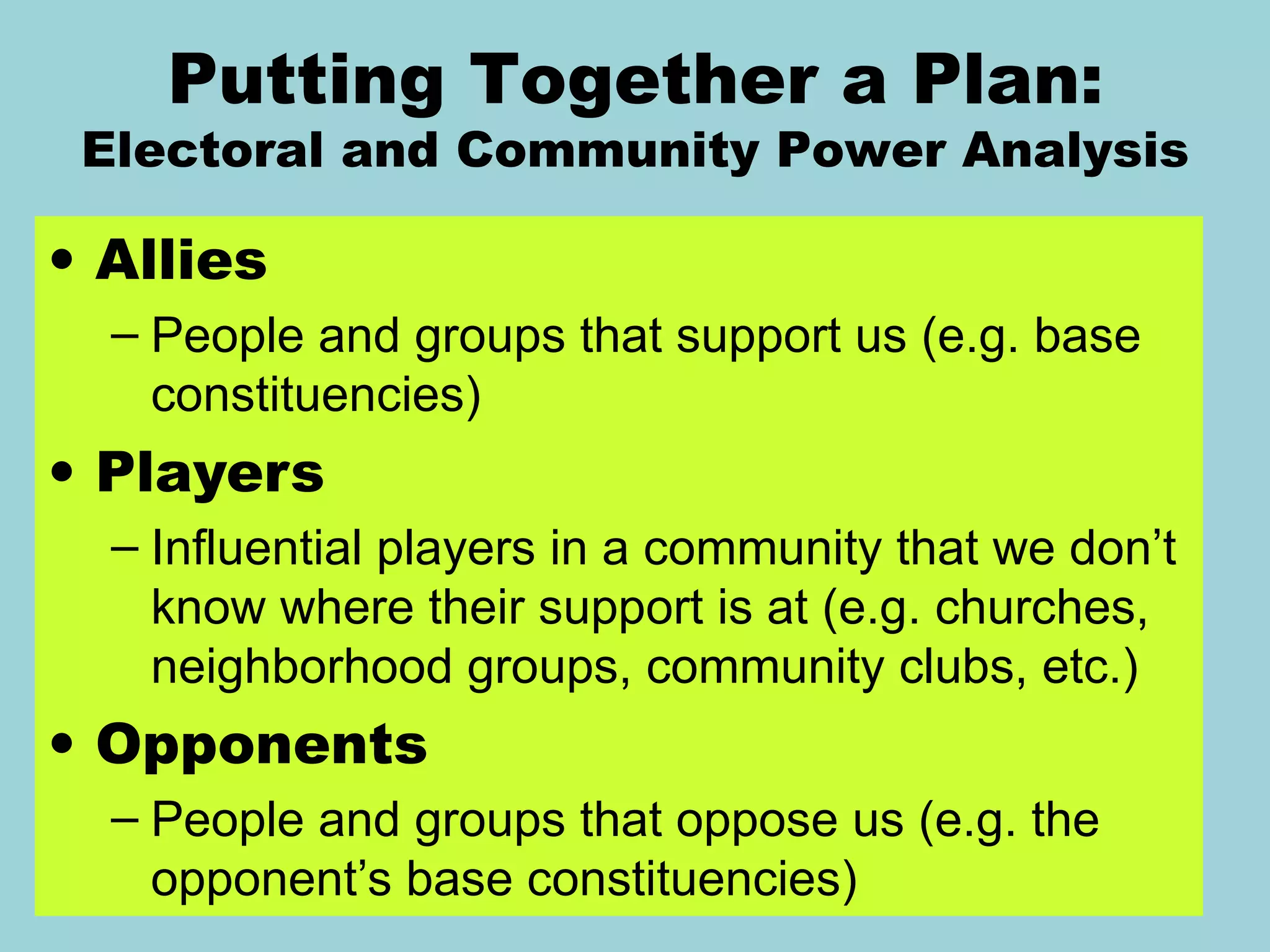
Allies People and groups that support us (e.g. base constituencies) Players Influential players in a community that we don ’t know where their support is at (e.g. churches, neighborhood groups, community clubs, etc.) Opponents People and groups that oppose us (e.g. the opponent ’s base constituencies) Wellstone   Action Putting Together a Plan: Electoral and Community Power Analysis
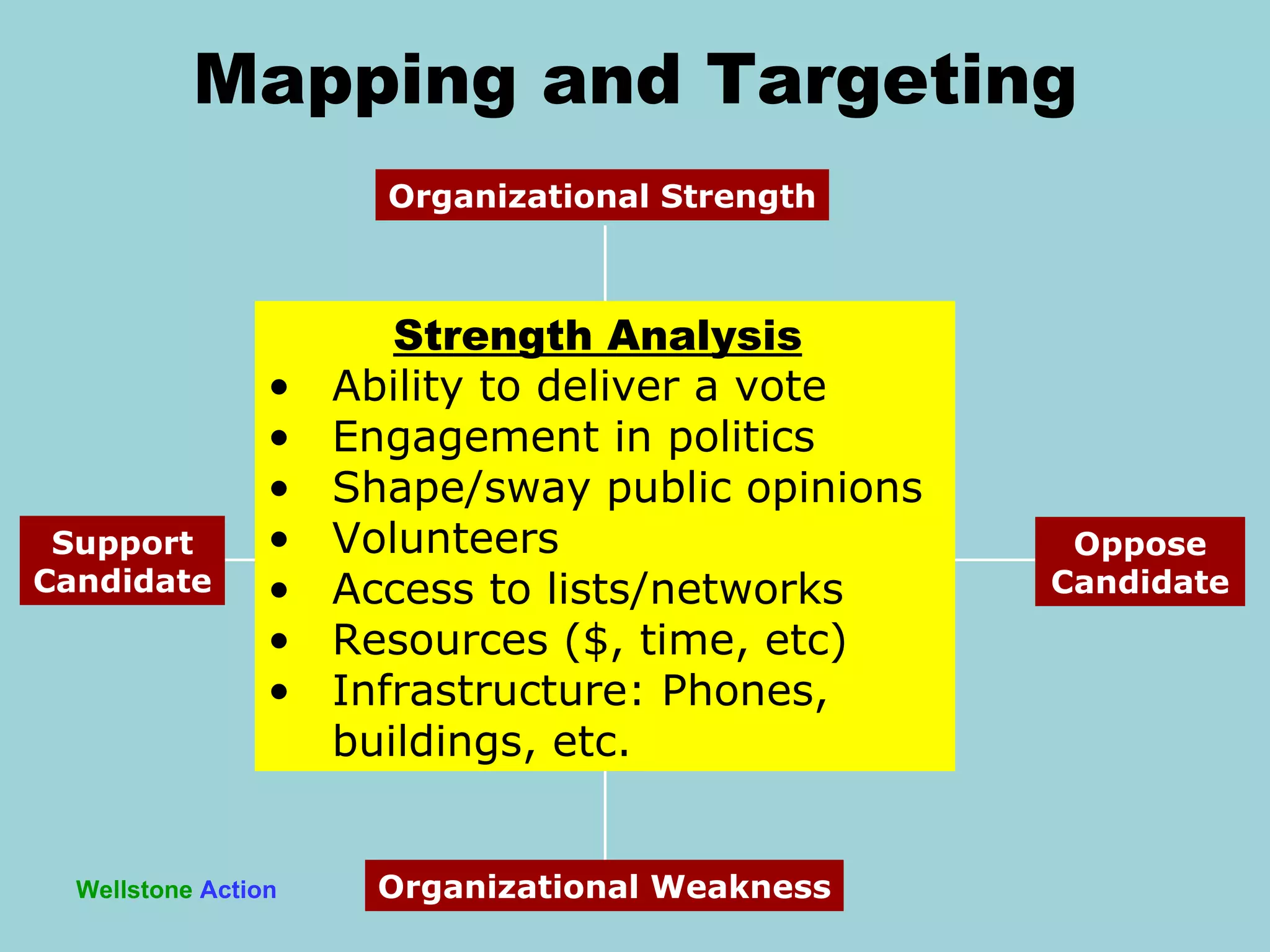
Wellstone   Action Mapping and Targeting Strength Analysis   Ability to deliver a vote Engagement in politics Shape/sway public opinions Volunteers Access to lists/networks Resources ($, time, etc) Infrastructure: Phones, buildings, etc. Organizational Strength Organizational Weakness Oppose Candidate Support Candidate Don ’t Know
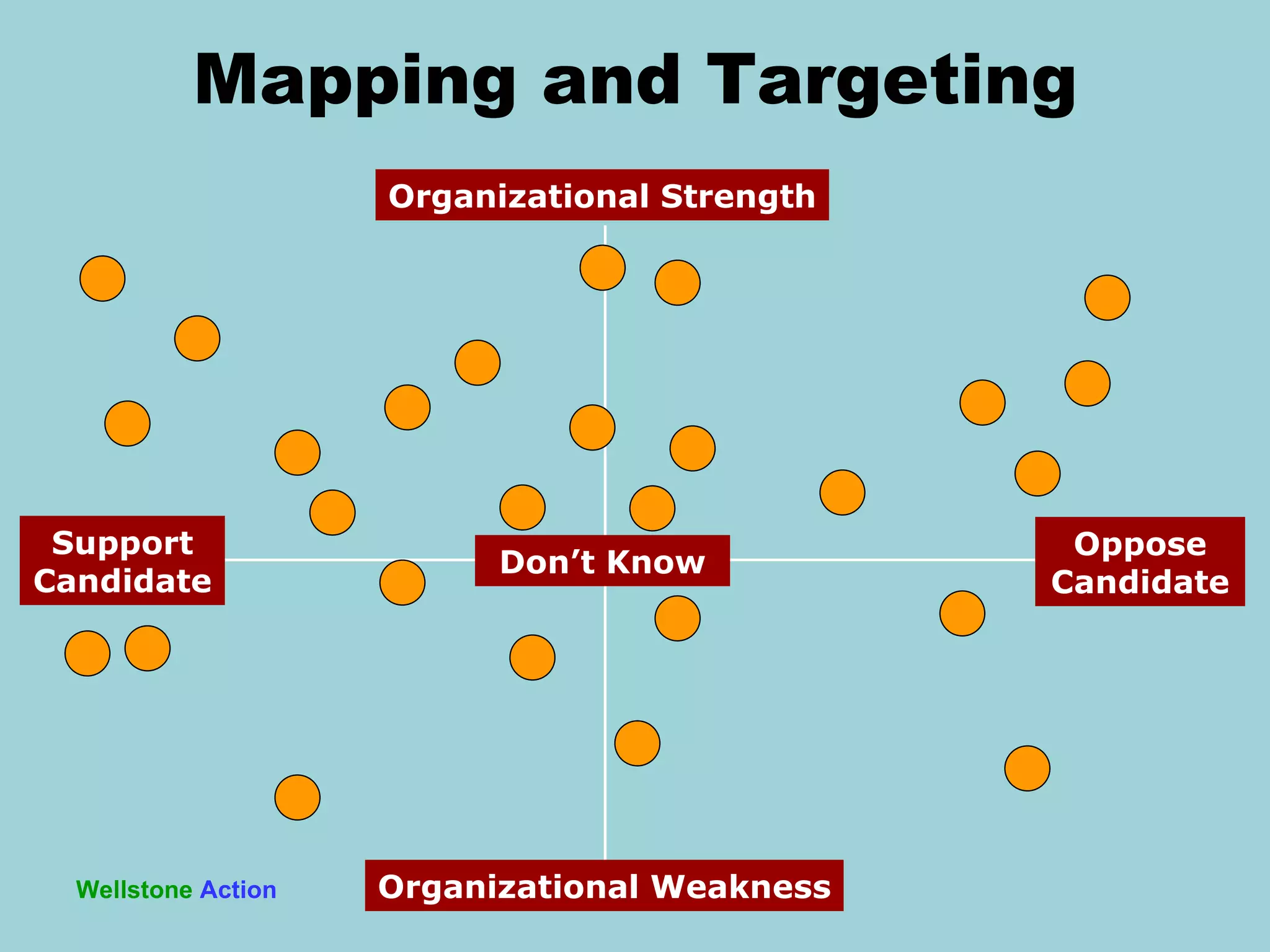
Wellstone   Action Mapping and Targeting Organizational Strength Organizational Weakness Oppose Candidate Support Candidate Don ’t Know
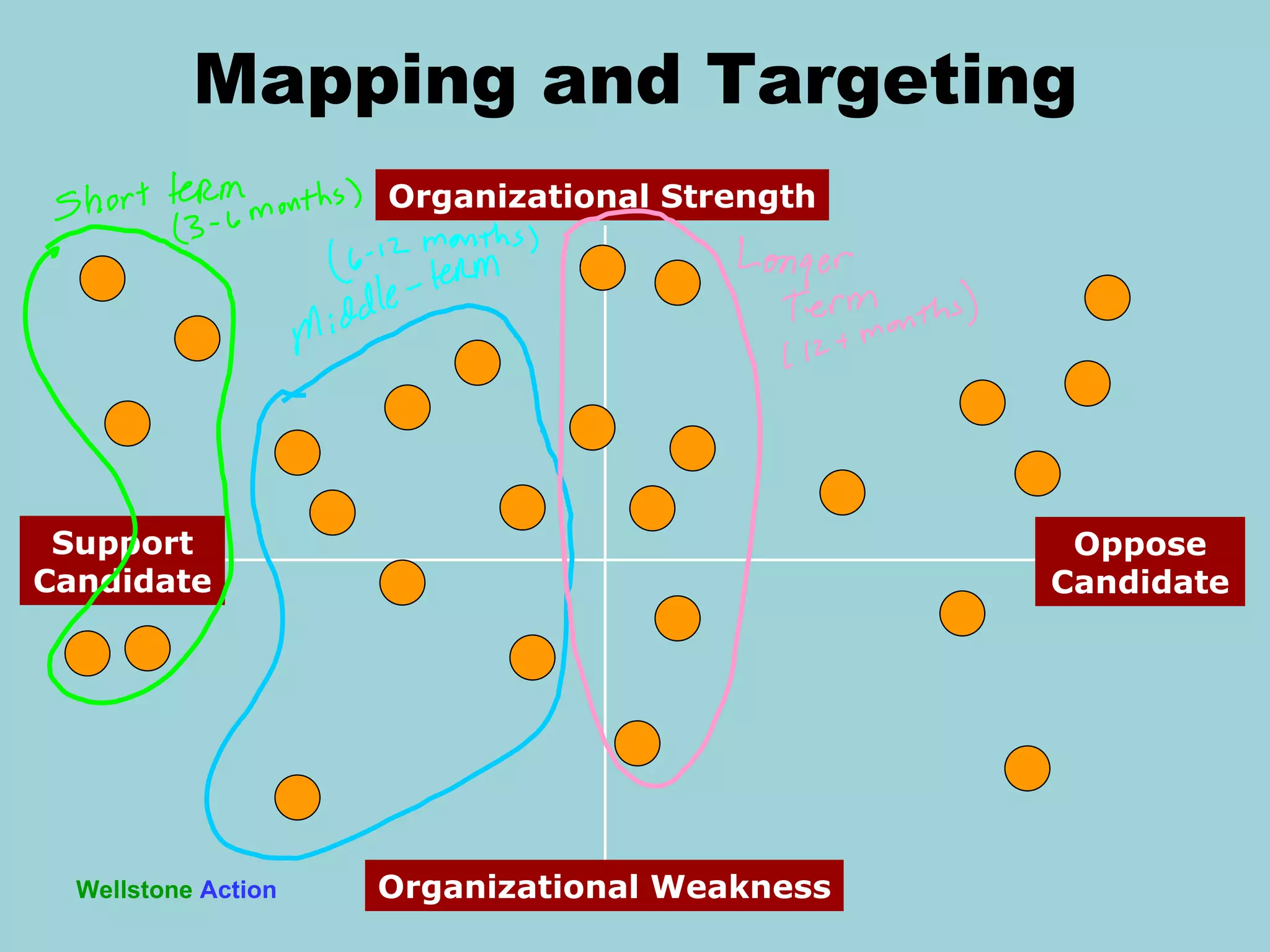
Wellstone   Action Mapping and Targeting Organizational Strength Organizational Weakness Oppose Candidate Support Candidate
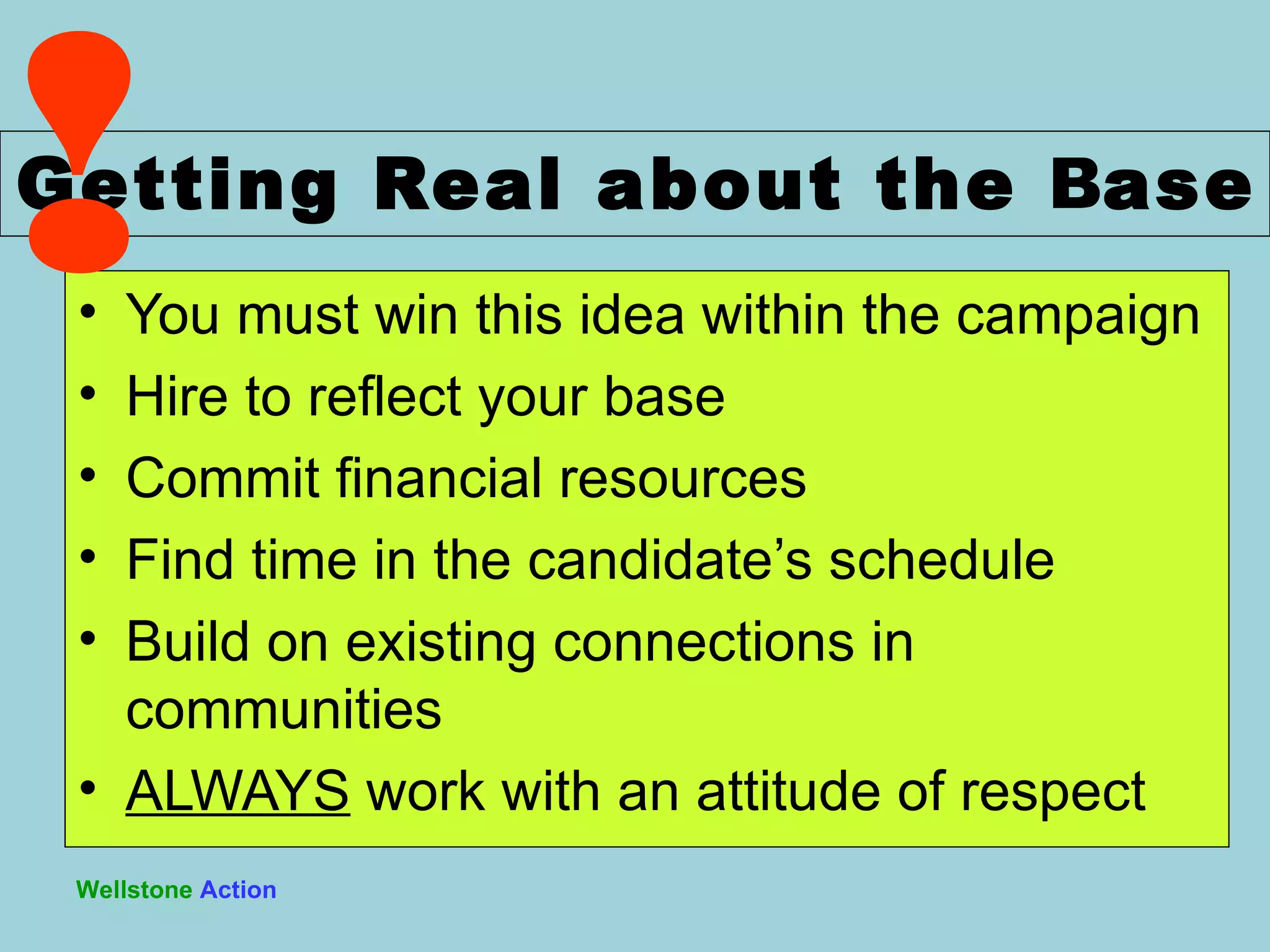
You must win this idea within the campaign Hire to reflect your base Commit financial resources Find time in the candidate ’s schedule Build on existing connections in communities ALWAYS  work with an attitude of respect Getting Real about the  B ase Wellstone   Action !
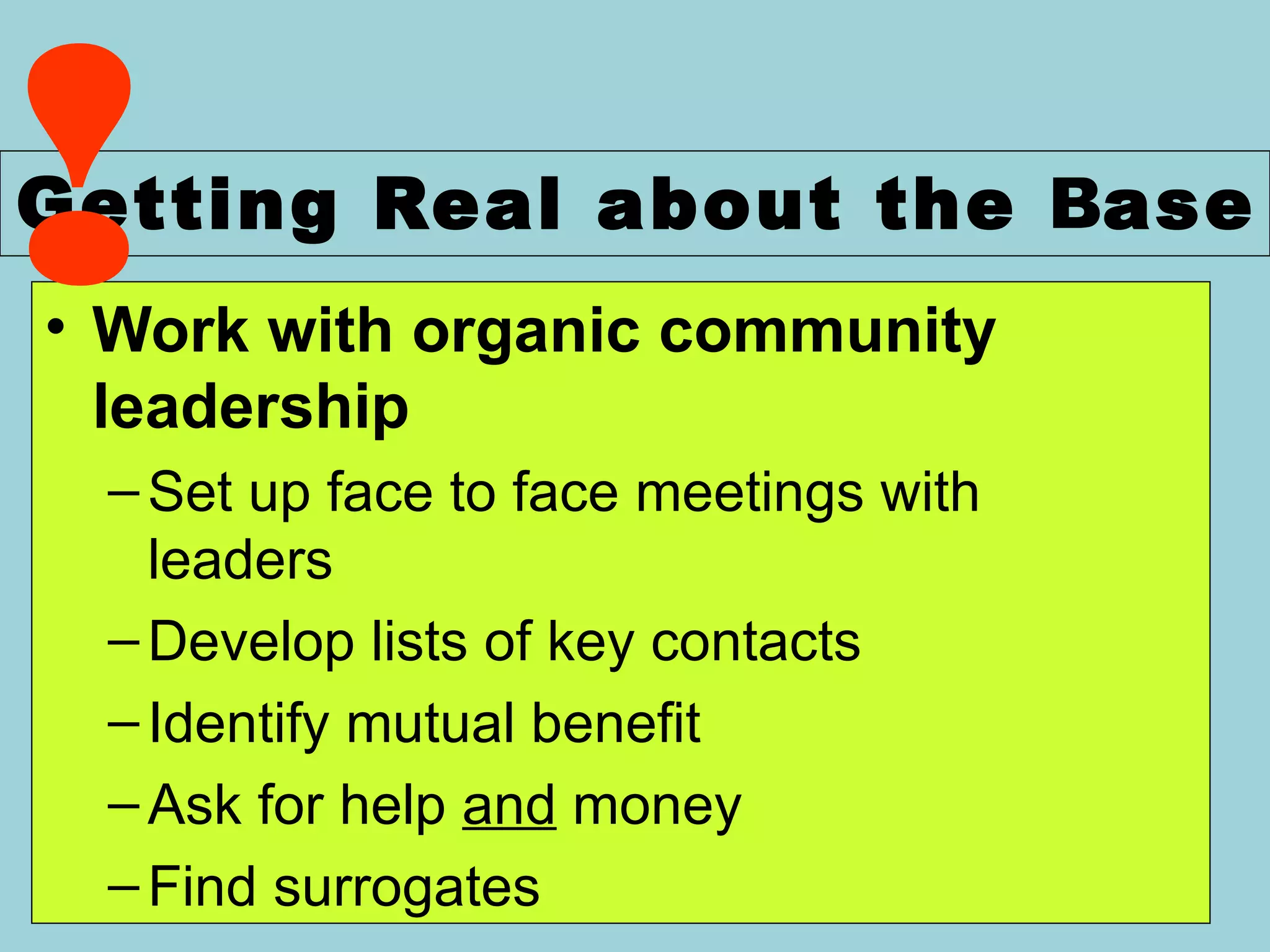
Work with organic community leadership Set up face to face meetings with  leaders Develop lists of key contacts Identify mutual benefit Ask for help  and  money Find surrogates Getting Real about the  B ase Wellstone   Action !
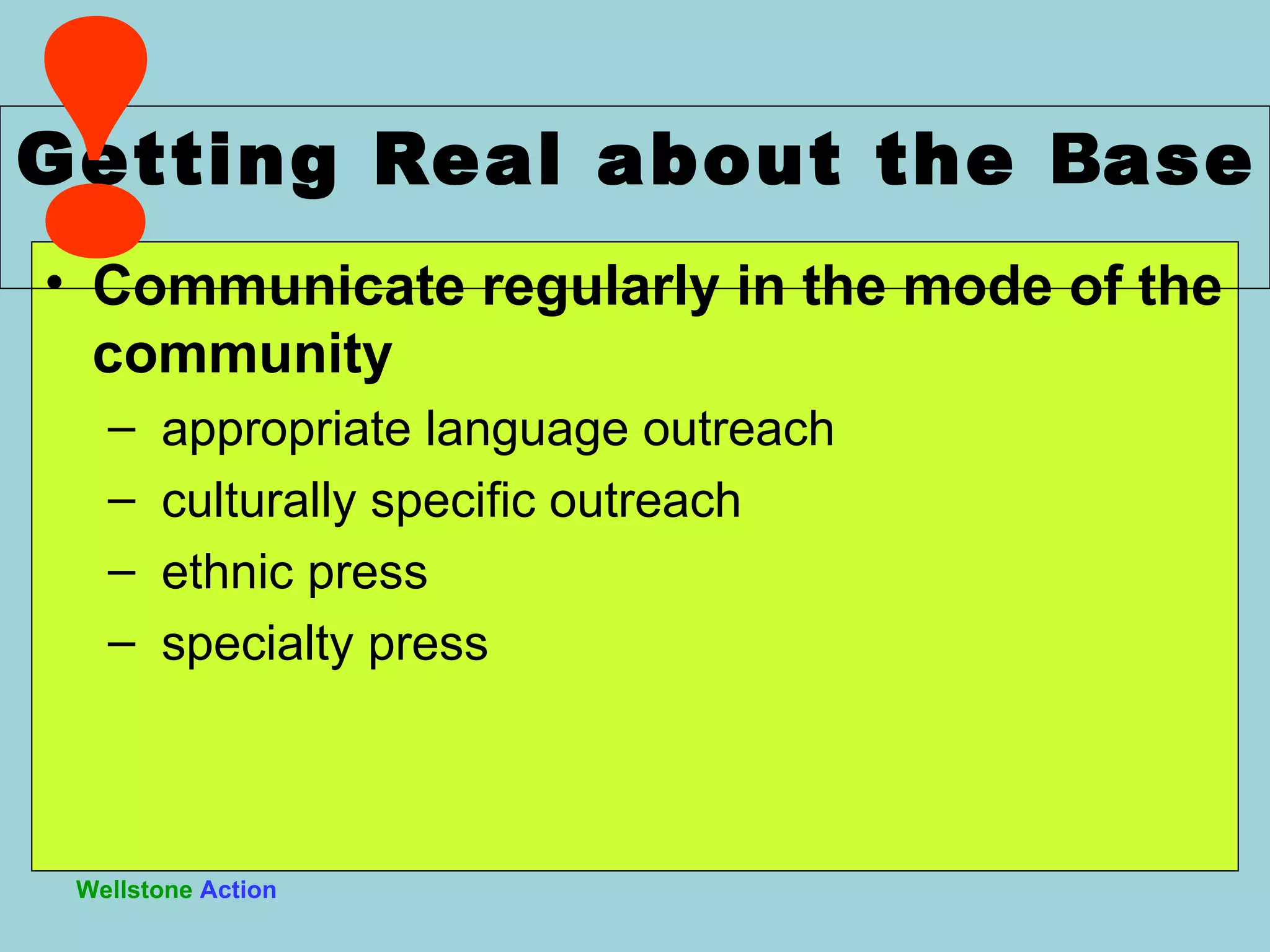
Communicate regularly in the mode of the community appropriate language outreach culturally specific outreach ethnic press specialty press Getting Real about the  B ase  Wellstone   Action !

Base Building

  • 1.
    Wellstone Action Basebuilding and Elections
  • 2.
    Winning Elections WhileBuilding Grassroots Power Defining Victory With thanks to the Western States Center Wellstone Action Typical Campaign 50%+1 The Progressive View Winning elections while Empowering voters Empowering communities
  • 3.
    Win Elections WhileBuilding Grassroots Power Use of Resources With thanks to the Western States Center Wellstone Action Typical Campaign Drains the base –Resources flow out of community The Progressive View Builds the base and leaves communities with lasting power and new leaders
  • 4.
    Win Elections WhileBuilding Grassroots Power Holding Politicians Accountable With thanks to the Western States Center Wellstone Action Typical Campaign Election promises, but no follow-up The Progressive View Leaders actively engage with communities before and after the election
  • 5.
    Conventional Wisdom Wellstone Action Supporters Undecided Opposition 40% 20% 40%
  • 6.
    Conventional Wisdom Wellstone Action Supporters Undecided Opposition 40% 20% 40%
  • 7.
    Bring people intothe process Teach skills and leadership Help communities and constituencies be “players” Bring community issues to the forefront Wellstone Action Using Elections to Build and Expand the Base
  • 8.
    Wellstone Action So… What do we mean by a base ?
  • 9.
    PERSONAL BASE = the people closest to you – those you can always count on. e.g. family, friends, co-workers, neighbors, college connections, kids ’ friends, local or faith community, civic organizations, etc. Wellstone Action
  • 10.
    Groups of peoplewho, due to their geography, age, ethnicity, issues, interests and values are or could be part of a progressive coalition. Who is or is not with us now? BASE COMMUNITIES Wellstone Action
  • 11.
    = thepeople who can be counted on to vote for a particular type of candidate or party. e.g. based on performance in past elections BASE VOTE Wellstone Action
  • 12.
    Wellstone Action Two Different Timelines Campaign Cycle short-term mobilizing voters quantitative achieving a win number Base Organizing longer-term organizing communities qualitative build community power, expand the electorate; build leadership and infrastructure in communities
  • 13.
    Wellstone Action Campaign Timeline: Base Vote to Win # Non-Voters General Election Voters (1-5) Primary Voters Organization & Party members Key Leaders and Activists Personal Base Time
  • 14.
    Wellstone Action Too often – This approach means little or no outreach to under-represented voters.
  • 15.
    Wellstone Action Putting it together in a plan Short-term (3-6 months) Middle-term (6-12 months) Longer-term (12 months+) Voter reg GOTV ID leaders and relationship building in targeted base constituencies Leadership recruitment Growing relationships Working with communities Reaching beyond core base – changing the electorate Leadership development
  • 16.
    Allies People andgroups that support us (e.g. base constituencies) Players Influential players in a community that we don ’t know where their support is at (e.g. churches, neighborhood groups, community clubs, etc.) Opponents People and groups that oppose us (e.g. the opponent ’s base constituencies) Wellstone Action Putting Together a Plan: Electoral and Community Power Analysis
  • 17.
    Wellstone Action Mapping and Targeting Strength Analysis Ability to deliver a vote Engagement in politics Shape/sway public opinions Volunteers Access to lists/networks Resources ($, time, etc) Infrastructure: Phones, buildings, etc. Organizational Strength Organizational Weakness Oppose Candidate Support Candidate Don ’t Know
  • 18.
    Wellstone Action Mapping and Targeting Organizational Strength Organizational Weakness Oppose Candidate Support Candidate Don ’t Know
  • 19.
    Wellstone Action Mapping and Targeting Organizational Strength Organizational Weakness Oppose Candidate Support Candidate
  • 20.
    You must winthis idea within the campaign Hire to reflect your base Commit financial resources Find time in the candidate ’s schedule Build on existing connections in communities ALWAYS work with an attitude of respect Getting Real about the B ase Wellstone Action !
  • 21.
    Work with organiccommunity leadership Set up face to face meetings with leaders Develop lists of key contacts Identify mutual benefit Ask for help and money Find surrogates Getting Real about the B ase Wellstone Action !
  • 22.
    Communicate regularly inthe mode of the community appropriate language outreach culturally specific outreach ethnic press specialty press Getting Real about the B ase Wellstone Action !

Editor's Notes

  • #3 Elections can be won in such a way that power is built up in the grassroots. First principle in doing this is to understand that winning is more than 50% plus 1.
  • #4 Elections can be won in such a way that power is built up in the grassroots. First principle in doing this is to understand that winning is more than 50% plus 1.
  • #5 Elections can be won in such a way that power is built up in the grassroots. First principle in doing this is to understand that winning is more than 50% plus 1.
  • #6 Conventional wisdom – assumes a fixed electorate
  • #7 Unconventional wisdom – we can (and increasingly only can we win) by enlarging the electorate – growing the base by adding new voters.
  • #8 This is not only an effective way to win elections, but to develop new leadership.
  • #9 Let ’s back up and start with what we mean by a base. Brainstorm … Is there such a thing as a natural base?
  • #10 These are the folks that you can absolutely count on – they are who you fundraise from – they will be the first to step up to help. You do not claim a base – the base claims you. Where do you find it? Where do you spend your time? Where are you most comfortable? Where do you hang out? Who do you want to be with?
  • #11 “ Nostalgic” Base – base is defined by the sectors of US society generally associated with a particular political party Discuss traditional base of the Republican Party and the Democratic Party Discuss who among the traditional base of the Democratic Party is relatively less engaged right now such as working class people, African Americans, youth, immigrants, WHY Progressive Base – defined as the group of people who SHOULD be voting for progressive and/or liberal candidates based on their self interest. Tease this out. We actually have to focus on our base and work hard for its support. A candidate and a campaign that wants to represent a broad and diverse group of people can TAKE NO ONE FOR GRANTED OR ASSUME THAT GROUP OR COMMUNITY IS WITH THEM. They have to earn those votes. We need to continue to communicate with our base – those who ARE registered to vote and ACTUALLY vote – with us on our issues. We have to have candidates and campaigns that are actually in relationship with communities and their leaders – this means showing up not just when someone ’s vote is needed, but when the needed in the community.
  • #12 This is the traditional electoral understanding of base – this is based on past performance, targeting, and the target of traditional base mobilization efforts.
  • #13 These are in tension. Elections are a very short timeline on very finite resources. It is about prioritizing and choosing where to invest those limited resources with the biggest payback in winning a vote. It is about numbers and mobilizing and quantity. Organizing is about quality, building lasting relationships, and expanding the electorate. The immediate payback is sometimes difficult to determine. BUT it has to be done. There is a tension between the two – as a campaign manager I know that. I want to talk about how we build basebuilding into campaigns and how basebuilding continues beyond the campaign to expand and enlarge the base for the next election.
  • #14 This is the typical basebuilding approach of an electoral campaign. Start with Personal base and work outwards as the election develops. Key leaders of base or supporting groups and party activists (leaders, officers, caucus attendees) Organization and party members – these are partisan identifying party members – “yellow dog” and members of endorsing organizations Primary voters are more general, but the segment to target is partisan primary voters (as opposed to swing voters) General election voters are IDed 1-5 with 1s being key support targets; 2s and 3s being key persuasion targets. Non-voters are those folks not yet in the electorate - -they are the target of voter registration and are the least likely to vote (and hence often have the least priority) – Note: this is part of the tension, because although this is true, the aim of this talk is to discuss how we can incorporate basebuilding into an electoral timeframe yet still be targeted.
  • #15 Here ’s the secret – if we do not do basebuilding beyond this immediate short-term electoral model, we will not win – our base will shrink and the circles will constrict.
  • #16 Given that all election plans involve a timeline, there are different types of activities that are most appropriate at various times.
  • #17 Basebuilding is still targeted! To help prioritize who to prioritize as far as outreach we can map the community as to the “players”
  • #18 These players (groups and people) can be located on a grid according to strength and support. Some of the criteria that can be used to analyze strength include: Strength Analysis Ability to deliver a vote Volunteers Access to lists/networks Resources ($, time, etc) Phones, buildings, etc.
  • #20 This map can become the basis for targeting which groups/leaders to prioritize with what kinds of actions/when.