DEVELOPING A
DEVELOPING A
CAMPAIGN PLAN
CAMPAIGN PLAN
Campaign Skills 101
The National Democratic Institute
INTRODUCTIONS/
INTRODUCTIONS/
GROUND RULES
GROUND RULES
• Introductions
• Ground Rules
• Ice Breaker
Photo: NDI
CAMPAIGN PLAN OBJECTIVES
• To become familiar with the main
elements of a campaign plan
• To practice using tools to identify and
manage campaign resources
CAMPAIGN PLAN TOPICS
Campaign Steps
• Goal setting
• Voter targeting
• Research
• Message
• Voter contact
• Budget
• Fundraising
• Election day
Campaign
Resources
• People
• Money
• Time
• Info
Image: www.pixabay.com
KEY TERMS
KEY TERMS
• Constituency
• Message
• Voter contact
• Field plan
• Paid media
• Earned media
• Door-to-door/canvassing
• Get Out the Vote (GOTV)
CONGRATULATIONS!
CONGRATULATIONS!
You decided to run!
Now what?
Photo: NDI
WHAT IS A CAMPAIGN PLAN?
• Roadmap that outlines what you are
going to achieve, when, how and with
what resources
• Management tool
• Measures progress
• Keeps you organized, proactive,
focused and on track
NO PLAN = PROBLEM
NO PLAN = PROBLEM
Photo: Michal Zacharzewski / RGBstock
Photo: www.pixabay.com
Image: www.rgbstock.com
CHARACTERISTICS OF AN
EFFECTIVE PLAN
EFFECTIVE PLAN
• Written
• Flexible
• Understandable
• Includes the obvious
• Research-based
• Has clear goals and objectives
CAMPAIGN STEPS
CAMPAIGN STEPS
RESEARCH
RESEARCH
Knowledge is power!
•Electoral context
•Self research
•Opposition research
•Issue research
RESEARCH: ELECTORAL
RESEARCH: ELECTORAL
CONTEXT
CONTEXT
• Election system/rules
• District characteristics
• Voter characteristics
• Past elections
• Main factors affecting
election
Image: www.rfairfaxdemocrats.org
OPPOSITION RESEARCH
OPPOSITION RESEARCH
• Identify viable opponents
• Research
–Personal and professional
background
–Previous statements/positions
–Resources and support base
–Weaknesses AND strengths
GOAL SETTING
GOAL SETTING
• Goal is usually to win election
• How many votes do you need?
• Example: Majoritarian
–100,000 eligible voters
–60,000 likely to vote
–Need 30,001 votes
TARGETING VOTERS
TARGETING VOTERS
• Can’t please everyone
• Don’t need 100% of voters
• Maximize time and resources
• Focus on “persuadables” not strong
supporters or opponents
TARGETING VOTERS
TARGETING VOTERS
Choosing the right target means aiming
for the middle
Firmly
Opposed
Soft
Opponent Undecided
True
Believer
Soft
Supporter
Target Audience
800,000 citizens and 500,000 eligible voters
300,000
50,000
60,000
5,000
55,000
30,000
URBAN
RURAL
70%
30%
EXERCISE: VOTER TARGETING
MESSAGE
MESSAGE
• Single idea/theme
• Your values
• What you repeat over and over
• What you want people to remember
• How you connect with and persuade
voters
Why am I asking for your support?
CHARACTERISTICS OF AN
EFFECTIVE MESSAGE
EFFECTIVE MESSAGE
• Clear and concise
• Compelling
• Contrasting
• Connected
• Consistently delivered
• Credible
• Clear
MESSAGE EXAMPLE
MESSAGE EXAMPLE
“It’s time for a change: time to support
our schools, time to address government
corruption, time to bring jobs back to
our town. As a teacher and community
activist, I want to lead that change.”
What we say about us What we say about
them
What they say about
themselves
What they say about
us
EXERCISE: MESSAGE BOX
MESSENGERS
MESSENGERS
• Use real, relatable people
• Use credible people
• Trustworthiness and sincerity are key
DETERMING ISSUE IMPORTANCE
AND POSITION
AND POSITION
• Tying issues to your message
• Example: Clinton: “Change or more of
the same?”
Photo: AP
EXERCISE: DETERMINING ISSUE
IMPORTANCE AND POSITION
• Issue selection
–How important is the issue?
–Who has the better position?
GETTING THE MESSAGE OUT
• Media
• Print
• Electronic
• Social
• Voter Contact
Photo: Susan Markham, NDI
TRADITIONAL MEDIA
TRADITIONAL MEDIA
Print
• Newspapers
• Magazines
Electronic
• Television
• Radio
Photo: A. Elwallani, NDI
Photo: Sanja Gjenero for rgbstock.com
• Facebook
• Twitter
• YouTube
• Personal/organization
website
COMMON SOCIAL MEDIA SITES
VOTER CONTACT
VOTER CONTACT
• Getting your message out
• Strategic and organized
• Many delivery methods
• Choose most convenient methods to
target voters
• Use resources wisely and efficiently
INDIRECT VS. DIRECT VOTER
CONTACT
CONTACT
• Direct requires more
time and people
• Indirect requires more
money
Photo: Amy Hamelin, NDI
DIRECT VOTER CONTACT
Tactic Cost
Manpower
Needed
Time Efficiency Effectiveness
Door-to-door 1 5 5 1 5
Small personal
events
1 4 4 2 4
Town meetings
and other events
1-3 3 3 3 3
Candidate “meet
and greets”
1 2 2 4 2
Distribution at
gathering places
1 3 2 3 3
Phone banks 3 5 4 3 3
INDIRECT VOTER CONTACT
Tactic Cost
Manpower
Needed
Time Efficiency Effectiveness
Literature
distribution
3-5 1-3 1 4-5 1-2
TV, radio and
newspaper ads
5 1 2 5 1
Letters to
newspaper
1 1 1 4 2
TV, radio debates 1 1-2 2 5 2-3
Big events 4-5 3 3 3 3-4
Posters and
billboards
2-3 1-3 2 2 1
Mail and e-mail 2-1 1 1 3 1-2
Social media 1 1 1 3 2
VOTER CONTACT PLAN EXAMPLE
Method # Voters When Where Cost # Volunteers
Door to door
3,000 May
Weekend
Homes $500 50
Direct mail
6,000 April Homes $2,500 10
TV ads
12,000 June
Evening
$5,000 3
Newspaper ads
10,000 June
Sunday
paper
$4,000 2
Small Events
1,000 May
Evenings
Host’s
home
Covered
by host
35
TOTAL 32,000 $12,000 100
EXERCISE: VOTER CONTACT
PLAN
PLAN
Photo: Amy Hamelin, NDI
DELIVER AND PROTECT
DELIVER AND PROTECT
• Get Out the Vote (GOTV)
• Poll watching
Photo: NDI
CAMPAIGN RESOURCES
CAMPAIGN RESOURCES
• People
• Money
• Time
• Information
Photo and images: www.pixababy.com
CAMPAIGN TEAM QUESTIONS
• What activities?
• What skills?
• What functions?
• Where can I find the right people?
• Who is responsible for what?
CAMPAIGN TEAM POSITIONS
• Manager
• Field organizer
• Communications officer
• Volunteer coordinator
• Fundraiser
• Press officer
Photo: Amy Hamelin, NDI
CAMPAIGN TEAM POSITIONS
• Researcher
• Technology officer
• New media officer
• Office manager
• Database manager
VOLUNTEER RECRUITMENT
AND MANAGEMENT
AND MANAGEMENT
• Family and friends
• Local schools/universities
• Local civic/religious organizations
VOLUNTEER ASSIGNMENTS
• Phone banks
• Door to door
• Internet research
• Mailings or leaflet drops
• Event organizing
• Data entry
• Press clips
• Thank you letters and other
correspondence
BUDGET
BUDGET
• Anticipate costs and timing
• Manage expenditures and revenues
• Research costs
• Track cash flow
• Ensures no money left on Election Day
and no debt
EXAMPLE:BUDGET
EXAMPLE:BUDGET
Month 1 Month 2 Month 3 Month 4 Month 5
Office
Phones/credit 400 300 400 800 1000
Supplies (paper, pens) 100 100 100 200 300
Equipment rental 150 150 150 150 150
Printing
Flyers/Leaflets 150 150 250 500
Paraphernalia 500
Fundraising
Events 1500 800 200 1000
Meetings 200 200 500
Voter Contact
Canvassing 250 250 500 1000
GOTV 2000
Media
Radio Ads 1000
Website 200 200 200 200 200
TOTAL EXPENSES 2500 1200 2250 2800 7650
EXERCISE:
EXERCISE: DEVELOPING YOUR
DEVELOPING YOUR
BUDGET
BUDGET
Photo: NDI
FUNDRAISING
FUNDRAISING
FUNDRAISING
FUNDRAISING
• Who can give, when, how often, and
how much?
• Other fundraising tools such as events
• In-kind contributions
• Say thank you
EXAMPLE:FUNDRAISING PLAN
REVENUE Month 1 Month 2 Month 3 Month 4 Month 5
Candidate
contributions 1000 1000 500
Political Party
contributions 5000 1550
Donations 500 250 500 1000 2500
Fundraising events
income 2000 600 300
TOTAL EXPENSES 2500 1200 2250 2800 7650
TOTAL INCOME 8500 250 2100 2550 3000
CASH FLOW 6000 -950 -150 -250 -4650
CASH-ON-HAND 6000 5050 4900 4650 0
TIMELINE
TIMELINE
• Start from election day and work
backwards
• Refer to campaign plan
• What needs to happen?
• By when?
• By whom?
• With what resources?
• Include key dates and deadlines
EXAMPLE:TIMELINE
EXAMPLE:TIMELINE
DATE ACTIVITY RESPONSIBLE RESOURCES
After
Election
Day
Finalize all tasks, pay
workers
-Appreciation party
Campaign Manager, Office
Manager, Finance Director
-Campaign Team
Money
-Venue, food, small
gifts
Election
Day
GOTV – door-to-door -Campaign Manager/Field
Director
-Database Manager
-Volunteer Coordinator
GOTV leaflet
Script for volunteers
Lists of target voters
Maps of areas
200 Volunteers
Observation at polls
and vote count
-Campaign Manager and
Field Director
-Volunteer Coordinator
Check list
50 Volunteers
Candidate Press
Events
-Campaign Manager and
Press Officer
-Candidate
Press packets
Election day speech
Election
Day
minus 1
Voter Contact Field Director and Volunteer
Coordinator
Persuasion leaflet
150 Volunteers
Candidate Visits to
community leaders
Candidate and Campaign
Manager
Small thank you gifts
for leaders
Candidate Press
Events
Candidate and Press Officer Press packets
Speech
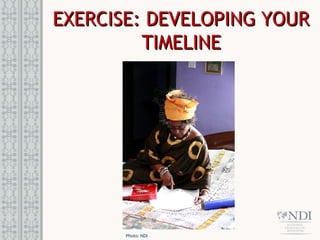
EXERCISE: DEVELOPING YOUR
TIMELINE
TIMELINE
Photo: NDI
DATA AND LIST MANAGEMENT
• Lists of:
–Supporters
–Potential donors
–Volunteers
–Press contacts
–Persuadable
voter
–Opinion leaders
• Sources of
information:
–Official voter list
–Candidate
contacts
–Supporter’s
contacts
–Party lists
DATA AND LIST MANAGEMENT
• Full name
• Gender
• Age range/date
of birth
• Phone number(s)
• Mailing address
• Email
• Polling station
• Party affiliation
• Voting intention
• Voting history
• Donor history
• Volunteer history
CAMPAIGN PLAN REVIEW
Photo: NDI
Steps
• Goal setting
• Voter targeting
• Research
• Message
• Voter contact
• Budget
• Fundraising
• Election day
Resources
• People
• Money
• Time
• Info

Developing a Campaign Plan for future.ppt

  • 1.
    DEVELOPING A DEVELOPING A CAMPAIGNPLAN CAMPAIGN PLAN Campaign Skills 101 The National Democratic Institute
  • 2.
    INTRODUCTIONS/ INTRODUCTIONS/ GROUND RULES GROUND RULES •Introductions • Ground Rules • Ice Breaker Photo: NDI
  • 3.
    CAMPAIGN PLAN OBJECTIVES CAMPAIGNPLAN OBJECTIVES • To become familiar with the main elements of a campaign plan • To practice using tools to identify and manage campaign resources
  • 4.
    CAMPAIGN PLAN TOPICS CAMPAIGNPLAN TOPICS Campaign Steps • Goal setting • Voter targeting • Research • Message • Voter contact • Budget • Fundraising • Election day Campaign Resources • People • Money • Time • Info Image: www.pixabay.com Image: www.pixabay.com
  • 5.
    KEY TERMS KEY TERMS •Constituency • Message • Voter contact • Field plan • Paid media • Earned media • Door-to-door/canvassing • Get Out the Vote (GOTV)
  • 6.
  • 7.
    WHAT IS ACAMPAIGN PLAN? WHAT IS A CAMPAIGN PLAN? • Roadmap that outlines what you are going to achieve, when, how and with what resources • Management tool • Measures progress • Keeps you organized, proactive, focused and on track
  • 8.
    NO PLAN =PROBLEM NO PLAN = PROBLEM Photo: Michal Zacharzewski / RGBstock Photo: www.pixabay.com Photo: www.pixabay.com Image: www.rgbstock.com
  • 9.
    CHARACTERISTICS OF AN CHARACTERISTICSOF AN EFFECTIVE PLAN EFFECTIVE PLAN • Written • Flexible • Understandable • Includes the obvious • Research-based • Has clear goals and objectives
  • 10.
  • 11.
    RESEARCH RESEARCH Knowledge is power! •Electoralcontext •Self research •Opposition research •Issue research
  • 12.
    RESEARCH: ELECTORAL RESEARCH: ELECTORAL CONTEXT CONTEXT •Election system/rules • District characteristics • Voter characteristics • Past elections • Main factors affecting election Image: www.rfairfaxdemocrats.org
  • 13.
    OPPOSITION RESEARCH OPPOSITION RESEARCH •Identify viable opponents • Research –Personal and professional background –Previous statements/positions –Resources and support base –Weaknesses AND strengths
  • 14.
    GOAL SETTING GOAL SETTING •Goal is usually to win election • How many votes do you need? • Example: Majoritarian –100,000 eligible voters –60,000 likely to vote –Need 30,001 votes
  • 15.
    TARGETING VOTERS TARGETING VOTERS •Can’t please everyone • Don’t need 100% of voters • Maximize time and resources • Focus on “persuadables” not strong supporters or opponents
  • 16.
    TARGETING VOTERS TARGETING VOTERS Choosingthe right target means aiming for the middle Firmly Opposed Soft Opponent Undecided True Believer Soft Supporter Target Audience
  • 17.
    800,000 citizens and500,000 eligible voters 300,000 50,000 60,000 5,000 55,000 30,000 URBAN RURAL 70% 30% EXERCISE: VOTER TARGETING EXERCISE: VOTER TARGETING
  • 18.
    MESSAGE MESSAGE • Single idea/theme •Your values • What you repeat over and over • What you want people to remember • How you connect with and persuade voters Why am I asking for your support?
  • 19.
    CHARACTERISTICS OF AN CHARACTERISTICSOF AN EFFECTIVE MESSAGE EFFECTIVE MESSAGE • Clear and concise • Compelling • Contrasting • Connected • Consistently delivered • Credible • Clear
  • 20.
    MESSAGE EXAMPLE MESSAGE EXAMPLE “It’stime for a change: time to support our schools, time to address government corruption, time to bring jobs back to our town. As a teacher and community activist, I want to lead that change.”
  • 21.
    What we sayabout us What we say about them What they say about themselves What they say about us EXERCISE: MESSAGE BOX EXERCISE: MESSAGE BOX
  • 22.
    MESSENGERS MESSENGERS • Use real,relatable people • Use credible people • Trustworthiness and sincerity are key
  • 23.
    DETERMING ISSUE IMPORTANCE DETERMINGISSUE IMPORTANCE AND POSITION AND POSITION • Tying issues to your message • Example: Clinton: “Change or more of the same?” Photo: AP
  • 24.
    EXERCISE: DETERMINING ISSUE EXERCISE:DETERMINING ISSUE IMPORTANCE AND POSITION IMPORTANCE AND POSITION • Issue selection –How important is the issue? –Who has the better position?
  • 25.
    GETTING THE MESSAGEOUT GETTING THE MESSAGE OUT • Media • Print • Electronic • Social • Voter Contact Photo: Susan Markham, NDI
  • 26.
    TRADITIONAL MEDIA TRADITIONAL MEDIA Print •Newspapers • Magazines Electronic • Television • Radio Photo: A. Elwallani, NDI Photo: Sanja Gjenero for rgbstock.com
  • 27.
    • Facebook • Twitter •YouTube • Personal/organization website COMMON SOCIAL MEDIA SITES COMMON SOCIAL MEDIA SITES
  • 28.
    VOTER CONTACT VOTER CONTACT •Getting your message out • Strategic and organized • Many delivery methods • Choose most convenient methods to target voters • Use resources wisely and efficiently
  • 29.
    INDIRECT VS. DIRECTVOTER INDIRECT VS. DIRECT VOTER CONTACT CONTACT • Direct requires more time and people • Indirect requires more money Photo: Amy Hamelin, NDI
  • 30.
    DIRECT VOTER CONTACT DIRECTVOTER CONTACT Tactic Cost Manpower Needed Time Efficiency Effectiveness Door-to-door 1 5 5 1 5 Small personal events 1 4 4 2 4 Town meetings and other events 1-3 3 3 3 3 Candidate “meet and greets” 1 2 2 4 2 Distribution at gathering places 1 3 2 3 3 Phone banks 3 5 4 3 3
  • 31.
    INDIRECT VOTER CONTACT INDIRECTVOTER CONTACT Tactic Cost Manpower Needed Time Efficiency Effectiveness Literature distribution 3-5 1-3 1 4-5 1-2 TV, radio and newspaper ads 5 1 2 5 1 Letters to newspaper 1 1 1 4 2 TV, radio debates 1 1-2 2 5 2-3 Big events 4-5 3 3 3 3-4 Posters and billboards 2-3 1-3 2 2 1 Mail and e-mail 2-1 1 1 3 1-2 Social media 1 1 1 3 2
  • 32.
    VOTER CONTACT PLANEXAMPLE VOTER CONTACT PLAN EXAMPLE Method # Voters When Where Cost # Volunteers Door to door 3,000 May Weekend Homes $500 50 Direct mail 6,000 April Homes $2,500 10 TV ads 12,000 June Evening $5,000 3 Newspaper ads 10,000 June Sunday paper $4,000 2 Small Events 1,000 May Evenings Host’s home Covered by host 35 TOTAL 32,000 $12,000 100
  • 33.
    EXERCISE: VOTER CONTACT EXERCISE:VOTER CONTACT PLAN PLAN Photo: Amy Hamelin, NDI
  • 34.
    DELIVER AND PROTECT DELIVERAND PROTECT • Get Out the Vote (GOTV) • Poll watching Photo: NDI
  • 35.
    CAMPAIGN RESOURCES CAMPAIGN RESOURCES •People • Money • Time • Information Photo and images: www.pixababy.com
  • 36.
    CAMPAIGN TEAM QUESTIONS CAMPAIGNTEAM QUESTIONS • What activities? • What skills? • What functions? • Where can I find the right people? • Who is responsible for what?
  • 37.
    CAMPAIGN TEAM POSITIONS CAMPAIGNTEAM POSITIONS • Manager • Field organizer • Communications officer • Volunteer coordinator • Fundraiser • Press officer Photo: Amy Hamelin, NDI
  • 38.
    CAMPAIGN TEAM POSITIONS CAMPAIGNTEAM POSITIONS • Researcher • Technology officer • New media officer • Office manager • Database manager
  • 39.
    VOLUNTEER RECRUITMENT VOLUNTEER RECRUITMENT ANDMANAGEMENT AND MANAGEMENT • Family and friends • Local schools/universities • Local civic/religious organizations
  • 40.
    VOLUNTEER ASSIGNMENTS VOLUNTEER ASSIGNMENTS •Phone banks • Door to door • Internet research • Mailings or leaflet drops • Event organizing • Data entry • Press clips • Thank you letters and other correspondence
  • 41.
    BUDGET BUDGET • Anticipate costsand timing • Manage expenditures and revenues • Research costs • Track cash flow • Ensures no money left on Election Day and no debt
  • 42.
    EXAMPLE:BUDGET EXAMPLE:BUDGET Month 1 Month2 Month 3 Month 4 Month 5 Office Phones/credit 400 300 400 800 1000 Supplies (paper, pens) 100 100 100 200 300 Equipment rental 150 150 150 150 150 Printing Flyers/Leaflets 150 150 250 500 Paraphernalia 500 Fundraising Events 1500 800 200 1000 Meetings 200 200 500 Voter Contact Canvassing 250 250 500 1000 GOTV 2000 Media Radio Ads 1000 Website 200 200 200 200 200 TOTAL EXPENSES 2500 1200 2250 2800 7650
  • 43.
  • 44.
  • 45.
    FUNDRAISING FUNDRAISING • Who cangive, when, how often, and how much? • Other fundraising tools such as events • In-kind contributions • Say thank you
  • 46.
    EXAMPLE:FUNDRAISING PLAN EXAMPLE:FUNDRAISING PLAN REVENUEMonth 1 Month 2 Month 3 Month 4 Month 5 Candidate contributions 1000 1000 500 Political Party contributions 5000 1550 Donations 500 250 500 1000 2500 Fundraising events income 2000 600 300 TOTAL EXPENSES 2500 1200 2250 2800 7650 TOTAL INCOME 8500 250 2100 2550 3000 CASH FLOW 6000 -950 -150 -250 -4650 CASH-ON-HAND 6000 5050 4900 4650 0
  • 47.
    TIMELINE TIMELINE • Start fromelection day and work backwards • Refer to campaign plan • What needs to happen? • By when? • By whom? • With what resources? • Include key dates and deadlines
  • 48.
    EXAMPLE:TIMELINE EXAMPLE:TIMELINE DATE ACTIVITY RESPONSIBLERESOURCES After Election Day Finalize all tasks, pay workers -Appreciation party Campaign Manager, Office Manager, Finance Director -Campaign Team Money -Venue, food, small gifts Election Day GOTV – door-to-door -Campaign Manager/Field Director -Database Manager -Volunteer Coordinator GOTV leaflet Script for volunteers Lists of target voters Maps of areas 200 Volunteers Observation at polls and vote count -Campaign Manager and Field Director -Volunteer Coordinator Check list 50 Volunteers Candidate Press Events -Campaign Manager and Press Officer -Candidate Press packets Election day speech Election Day minus 1 Voter Contact Field Director and Volunteer Coordinator Persuasion leaflet 150 Volunteers Candidate Visits to community leaders Candidate and Campaign Manager Small thank you gifts for leaders Candidate Press Events Candidate and Press Officer Press packets Speech
  • 49.
    EXERCISE: DEVELOPING YOUR EXERCISE:DEVELOPING YOUR TIMELINE TIMELINE Photo: NDI
  • 50.
    DATA AND LISTMANAGEMENT DATA AND LIST MANAGEMENT • Lists of: –Supporters –Potential donors –Volunteers –Press contacts –Persuadable voter –Opinion leaders • Sources of information: –Official voter list –Candidate contacts –Supporter’s contacts –Party lists
  • 51.
    DATA AND LISTMANAGEMENT DATA AND LIST MANAGEMENT • Full name • Gender • Age range/date of birth • Phone number(s) • Mailing address • Email • Polling station • Party affiliation • Voting intention • Voting history • Donor history • Volunteer history
  • 52.
    CAMPAIGN PLAN REVIEW CAMPAIGNPLAN REVIEW Photo: NDI Steps • Goal setting • Voter targeting • Research • Message • Voter contact • Budget • Fundraising • Election day Resources • People • Money • Time • Info

Editor's Notes

  • #1 See the Trainer's Guide for overall guidance on using this presentation. The Trainer's Guide serves as a companion resource and outlines the objectives of the session and materials needed as well as provides additional guidance on conducting the training session. Please note that the Guide includes complete instructions on how to facilitate some of the exercises referenced in this PowerPoint presentation and additional information on the content of certain slides.     Please adapt the PowerPoint presentation, exercises, examples and handouts in advance of your workshop. They have been created for a global audience and need to be adapted to better suit the local context, the background of your participants and their level of experience. Terms, images and examples from the participants’ country or region should be used as much as possible so that they are relevant and contextually appropriate.  This presentation draws on resources created by other NDI teams and offices such as the campaign modules developed by NDI’s Middle East and North Africa team for their regional campaign schools and the online campaign presentations developed by NDI Egypt. This presentation also builds on the Getting Ready to Run and Campaign Plan presentation created by EMILY’s List. This presentation and guide were developed by Amy Hamelin. NDI would also like to acknowledge those who contributed including Caroline Hubbard, Susan Kemp, Susan Markham, Allison Muehlenbeck, Crystal Rosario and Rebecca Turkington.
  • #2 SLIDE CONTENT: To begin the session, introduce yourself and other staff, trainers and resource persons. Provide the participants an opportunity to introduce themselves and establish ground rules for the training. TRAINER NOTE: It will be important to establish a rapport among participants. If this is the first presentation of a training workshop, be sure to build in time for participants to get to know one another and establish ground rules for their interaction and participation. Guidance on ice breakers and ground rules can be found in the “Training and Facilitation” folder. You might also establish ground rules by asking participants to give suggestions and agreeing as a group. You can write the rules on a flip chart and hang it on the wall for reference during the training session.
  • #3 SLIDE CONTENT: The objective for this session is to: Become familiar with the main elements of a campaign plan and practice using tools to identify and manage campaign resources. TRAINER NOTE: Provide an overview of the session’s objectives so that participants understand its purpose and have realistic expectations about what to expect. You may also wish to ask participants what expectations they have for the session. What do they hope to get out of it? You can then relate their expectations to the objectives and suggest how unrelated expectations might be met in other ways.
  • #4 SLIDE CONTENT: The topics we will cover today include: Campaign Steps Goal setting: How many votes do you need to win the race? Voter targeting: Which voters do you need to win? Research on the electoral context, the candidate, your opponents, and the issues. Message: What is your message to voters? Why should they vote for you? Voter contact: How will you communicate your message? Election day: How will you make sure your supporters get out and vote and that the elections go according to the rules? Campaign Resources that you will need to implement this plan People: the key to success is a well-managed campaign team of staff and volunteers. Money: it’s crucial to develop an accurate budget for how much it will cost to run your campaign and to develop a fundraising strategy Time: There’s a lot to do and only so much time. Develop an effective timeline that includes all campaign activities. Information: A successful campaign requires good information, for example, about voters, their preferences, and how to reach them. TRAINER NOTE: Give the participants a brief overview of the topics to be covered so they have a sense of where you are heading in the presentation. Summarize the main concepts that will be addressed.
  • #5 SLIDE CONTENT: There are a few key terms to define as we begin so that we share a common understanding throughout our discussions. Campaigning comes with its own set of vocabulary and jargon. Among the regularly used terms are: Constituency Message Voter contact Field plan Paid media Earned media Door-to-door/canvassing Get Out the Vote (GOTV) TRAINER NOTE: Ask the participants to define the terms first and then decide on a common definition based on their responses and the definitions included in the Trainer’s Guide. What do these terms mean in the context of the lives and work of the participants? You might also ask them to suggest other terms relating to running for office that they think need to be defined at the onset. You should let them know that they are welcome to stop and ask for clarification at any point during the session if there is a term with which they are unfamiliar or one which they believe requires further discussion. Please see the Trainer’s Guide for complete definitions of each term.
  • #6 SLIDE CONTENT:Congratulations! You’ve decided to run for office and secured your party’s nomination! Now what? It feels like you walked a thousand miles to get to this point but the truth is that your journey has just begun. The good news is that there is a clear path ahead. There are a number of steps that have been tried and tested the world over. Steps that are more likely to lead to success if you follow them carefully. And there is a definitive list of resources that you will need to implement these steps: people, money, time and information. So where do you begin? Where do all of these steps and resources come together in one place? In your campaign plan, of course! TRAINER NOTE: Keep in mind that while these steps and resources are common around the world, the nature of a given campaign will vary tremendously depending on the electoral system, the level of support from the party, the characteristics of the electoral district, etc. For example, a candidate campaigning as a part of a party list in a closed list proportional representation electoral system will, in essence, focus on campaigning for the party. On the other hand, a candidate running in a multi-member district in a first-past-the-post electoral system will, while still running on a party ticket, be campaigning as an individual. Be sure to review this presentation well in advance of the training and adapt it based on the system and characteristics in place in the target country.
  • #7 SLIDE CONTENT: So what is a campaign plan, exactly? In simple terms, it is a written document that outlines what you are going to achieve in your electoral campaign and how you are going achieve it. It is a roadmap that will guide you and your team through the busy and challenging days of the campaign and election, help make sure you have all the resources you need and ensure you are conducting the types of activities that will get you to your goal. That all sounds good, but why do I need to take the time to develop a plan? There is so much to do! Shouldn’t I just get started? Consider this: A plan is a management tool. This becomes even more important when you have a big team of paid staff and volunteers. It helps to keep everyone on the same page. It also diminishes demands on the campaign manager’s and candidate’s time. Instead of coming to them to ask what they should be doing, staff and volunteers can refer to the plan and keep things moving. A plan provides quantifiable means of measuring progress or lack thereof. If you regularly review your plan, you will quickly note if you have not met your fundraising goals or if you forgot to carry out an important activity. A plan keeps you organized, proactive and focused on the right priorities. It’s very easy to get distracted by and to simply react to everything that goes on around campaigns. A good plan helps you to ignore all the “noise” and focus on what is important in helping you to reach your goal. A plan gets your campaign back on track after a distraction. Every so often campaigns are forced to deal with unanticipated situations such as allegations, false or true, about the candidate. However, once these situations are addressed, you need to get right back to your plan.
  • #8 SLIDE CONTENT: What could go wrong if you DIDN’T have a plan? Let’s walk through a non-campaign related scenario that will help us see the folly in not having a solid plan. It’s Thursday morning and you have an important business meeting across town. Your goal is to impress your contacts and convince them to give you their business. You prepared a presentation that you think will be convincing but that’s where your planning ended. You leave your house with more than enough time to get to the meeting and to run the errands that you need to before you arrive. Unfortunately, you didn’t make a list of all of things you needed to take with you. When you get to the store to pick up copies of your presentation, you realize that you forgot to bring your notes which include detailed financial calculations that you don’t have in your head. You go back to your house to pick them up. You also forgot to make a list of all of the errands you had to run and to plot them out on the map. After you leave your house, you realize you forgot to go to the repair shop to pick up the shoes you were planning to wear. It’s near the copy shop which is in the opposite direction of the meeting. Despite all the problems, you are still feeling confident. You see that a new coffee shop has opened and decide that this would be a good time to try it despite the long line. Unfortunately, you forgot to listen to the traffic report on the news that morning. There has been a big accident on the road that you are planning to take and you get stuck in traffic. At this point, the meeting is just minutes from starting. Unfortunately, you didn’t take the time to carefully review the map before you left and you aren’t familiar with the area where the meeting is taking place. You end up having to stop several times to ask for directions. You walk into the meeting 15 minutes late. But because you are so late and so disorganized, your potential business partner decides to award the contract to your competition. TRAINER NOTE: Briefly discuss the scenario with participants. What went wrong? How could these problems have been prevented? What does this situation tell you about the importance of having a detailed campaign plan?
  • #9 SLIDE CONTENT: Lets talk briefly about the characteristics of an effective campaign plan before we go into detail on its contents. Written: A plan is not a plan unless it is written down. You may have thought through a comprehensive, well thought out plan, but if it isn’t written down somewhere, it cannot be shared with other team members, and it cannot be implemented. Flexible: A strong plan is one that is regularly reviewed and updated based on the challenges, opportunities, information and resources that arise in an electoral campaign. The situation often changes quickly and there are often unforeseen circumstances. Your plan needs to be adaptable. Understandable: The plan needs to be clear. Anyone on your campaign team should be able to pick it up and be able to understand its intent. Includes the obvious: Don’t assume anything. Write down all of the details, even if they seem obvious to you. They may not be obvious to someone else. It’s also hard to remember everything when you are in campaign mode. Research-based: Don’t build a campaign around a set of assumptions you have about your electoral district, about your opponents, and about what the voters want. The more research you do, the better informed the plan, and the more likely you are to reach your goal. Clear goals and objectives: Speaking of goals, your plan needs to have one. It also needs to identify objectives that will lead to that goal. This will be one of the first steps in developing your plan because you need to know where you are going if you are ever going to get there!
  • #10 SLIDE CONTENT: Nobody wins or looses on Election Day, but during the months and weeks before the election. To make sure you have done everything possible to win, you can use these six steps as a guide to developing a winning campaign plan. There are many ways to construct a campaign plan, and how you do this in practice should reflect your own needs and assets, the type of election you are facing and what the election law allows. However, the following elements should be considered and included within this context, and should work together as the building blocks of your plan. We’ll go over these steps very quickly and then will go into more detail on each one. 1. Research: collecting information you need for planning your campaign. 2. Goal setting: deciding what you want to accomplish. 3. Targeting: determining which voters you will be focused on. 4. Message development: formulating what you will be saying in your campaign. 5. Voter contact: conducting activities to get your message out to the voters you need to win the election. 6. Deliver and Protect : conducting activities to make sure that your supporters get out and vote and having your team monitor the election process to ensure that it is free from fraud and manipulation. TRAINER NOTE: It would be worth asking participants early on in this session if they have any experience in running or supporting campaigns. Invite them to share their experiences at appropriate points throughout the session. For example, you might ask them if their campaign followed these steps. If so, which did they find to be the most challenging?
  • #11 SLIDE CONTENT: Knowledge is power. That’s definitely true in an election context. Research entails gathering, analyzing, and using appropriate quantitative and qualitative information to support each step of your campaign. Keep in mind that this is not a one-time activity at the beginning of your campaign. Your team needs to continue conducting research and gathering information throughout the campaign process, allowing you to revise your plan based on new developments. There are many different ways to obtain information, from Internet searches and asking around to door-to-door surveys and polls. There are several different areas of research that are key to developing a solid campaign plan: Electoral context: Understand the electoral laws as well as the political context in your district Self research: Carefully review your personal and professional background to identify strengths and accomplishments that can be used in your favor and any potential weaknesses and issues that may be used against you. Opposition research: Consider some of the issues that might be used against your opponents. What are their strengths? Their weaknesses? What are they likely to campaign on? Issue research: Gather background information on important issues that you will discuss on the campaign trail, such as education, unemployment, and health care. Seek information and data from relevant international organizations, civil society groups and academics. There is no need to start from scratch but be sure that the information you receive is unbiased and accurate. TRAINER NOTE: For more information on self-research see the Deciding to Run for Elected Office and Understanding the Nomination Process presentations respectively. For more information on issue research, see the module on Advocacy and Research.
  • #12 SLIDE CONTENT: To develop a successful campaign plan, you must have a solid understanding of the electoral rules and context in your constituency. Be sure to research the following: 1. Election rules: What electoral system is in place (proportional or majoritarian or a combination of the two)? What procedures must you follow to become a candidate? What are the campaign finance regulations? Are there any regulations on campaigning such as where you can hang posters or when the campaign period ends? Is there any public funding for elections in the form of cash payments or access to advertising time on radio or television? 2. Characteristics of the district: How big is your district? How many people live there? Is it rural or urban, or a combination? What is the political landscape of the district and who are the main political players? Does your party have a lot of support? What are the main economic activities? 3. Characteristics of the voters: Can you get an accurate list of voters in your district and how? What is the demographic make-up of the voters (age, gender, education level, professions, income, religious or ethnic background, etc.)? Where do people live (rural or urban areas, apartment buildings or houses)? Where do they get their information on politics? Is the district generally politically conservative or liberal or is it mixed? 4. Past elections: What was the voter turnout? In general, who voted and who didn’t (Youth? Elderly? Women?)? Who won and who lost and what was the difference in votes between them? Is the incumbent eligible to run again or will this be an open seat? How much money was spent on the last campaign? Have women been successful in electoral campaigns in this district? 5. Main factors affecting this election: What are the priority local issues? What regional or national issues are important for voters in your district? Are there other electoral races at the regional or national level that could influence the elections in your district either positively or negatively?
  • #13 SLIDE CONTENT: Once you have determined your strengths and weaknesses, the next logical step is to repeat the process for your opponents. If you are facing several opponents, you should determine which ones are your strongest competitors for the loyalty of voters you hope to attract and focus on them. Why is opposition research so important? Too often campaigns view opposition research as looking for the one scandal that will finish off their opponent's campaign. Researching your opponent and waging a negative campaign are two entirely different things. Opposition research helps you to identify patterns of behavior that you can use to persuade voters to either vote against your opponent or for you. You will use this to create a contrast between your and your opponent when you develop your message. You must be prepared for what your opponent will say and do. Research their personal and professional background such as their family connections, education, previous jobs, policy positions and organizational affiliations. Find out what previous public statements or important votes/decisions the opponents have made, particularly around policy issues that you know will be important during this election. Explore what financial and human resources and support systems (individuals, organizations, etc.) the opponents bring to the campaign. Don’t forget to identify weaknesses as well as strengths. As you gather your opposition research, document your information sources and be sure that they are credible and fact-based. TRAINER NOTE: Ask participants if they know of any examples in which opposition research made the difference in an election campaign. Provide participants with a copy of the handout which they can use to organize their research after the workshop ends. HANDOUT 1: Campaign Research Questions
  • #14 SLIDE CONTENT: Your campaign goal is a clear statement of what you want to achieve. In most but not all cases, your goal is to win the election. Alternately, do you want to increase your party’s support in the area by 5%? Are you running for better name recognition in this race, with the goal of winning a seat in the next election? Your goal should be a short, well-defined declaration of what you realistically want to accomplish. Assuming your goal is to win the election, you need to answer one key question based on your initial research. How many votes do you need? Let’s assume, for example, that your district has close to 100,000 eligible voters, and you are running under a majoritarian system that requires a runoff if no candidates gets an absolute majority. Based on your research, you estimate voter turnout to be around 60 percent which means that 60,000 votes will likely be cast. That means in order to win outright and avoid a runoff you would need a minimum of 30,001 votes. If you have strong opponents your goal might be to win enough votes to get into the runoff, but you still need to make a realistic estimation of how many votes you would need. TRAINER NOTE: Keep in mind that determining the number of votes needed will depend to some degree on the type of electoral system (Majoritarian with a runoff between the top two candidates? Open list proportional representation?). It will also depend on the presence or absence of quotas and how they are implemented. Please adjust this presentation accordingly to make it more relevant for your participants.
  • #15 SLIDE CONTENT: So we know we need lots of support to reach our goal. You can never please everyone and will always have both support and opposition. This is because different people have different needs, priorities, and concerns. If you tried to convince everyone to vote for you, you would have to say different and even opposing things to get their support. In the end, you would lose everyone’s trust – and their votes. Anyway, it never takes the support of one hundred percent of voters to win. The most it takes is an absolute majority (50% plus 1). Why would anybody waste time and money trying to convince everyone when it isn’t possible or necessary? Voter targeting is a technique used to identify and focus on voters that can be persuaded to support you. A common campaign mistake is focusing on the wrong target audience, either your strong supporters or your enemies, who are unlikely to change their position. There will always be “true believers” who support you unconditionally and they make up your base. On the other hand, all other candidates have their own true believers and, by extension, these people will be firmly opposed to you. Targeting is about focusing your resources on people that you can convince to vote for you, the undecided and/or neutral people in the middle. These “persuadables” should be the target of your campaign, but keep in mind that you do not need to target all of them, just as many of them as you need to win!
  • #16 SLIDE CONTENT: Once you have determined the number of votes you need to win, you need to figure out approximately how many people fall into the five groups of voters illustrated on this slide. If we do not have enough votes within our True Believers group, we are going to search for the remaining votes within Soft Supporters or Undecided voters. If this is not enough, then we’ll have to work for the support of our Soft Opponents. So who are these people and how do we find them? Unfortunately there isn’t a magic list that gives you the names of each individual in each group. But if you think creatively, you can get a general idea of who they are based on geographic and/or demographic trends and interests. For example, voters who live in rural areas where there are lots of farms would likely support a candidate who proposes to establish a minimum price for produce but urban voters who end up paying more for these products would not. You should also consider groups of voters based on demographic characteristics like age, sex, education, income, profession, religion, race, etc. Young people are likely to support a candidate who promotes subsidized university education for students while associations for retired people would likely be unhappy about the idea of their tax dollars supporting such a program. Look at it from the opposite direction and consider who would support your opponents based on their policies and platforms. The research that you conducted as a first step in developing your campaign plan should provide you with most of the information you need to successfully identify your target voters. Don’t forget that not everyone you identify as a potential supporter will actually vote on election day. This means that you need to target more people than you need AND that you need to focus some of your campaign resources on doing everything you can to make sure that as many of them as possible actually do. We’ll talk more about “getting out the vote” later in this session.
  • #17 SLIDE CONTENT: And now, let’s practice! We are going to give you information about an imaginary district. After analyzing the information, you’ll be asked to do the Targeting exercise. EXERCISE: Voter Targeting See the Trainer’s Guide for complete instructions on how to complete this exercise. HANDOUT 2: Voter Targeting Exercise
  • #18 SLIDE CONTENT: After you have identified your goal and your target voters, you have to decide what you will tell them to attract their attention and inspire them to support you. Your message is your statement of purpose that communicates to voters who you are, what you stand for, and what makes you different from other candidates in the race. Your message cannot be about everything you ever wanted your constituency to learn about you and your political views, because people will only give you a limited amount of their time and attention. So what exactly is a message? Your message should be: A single idea or theme What you care about (your values) What you repeat over and over What you want people to remember How you connect with and persuade voters to support you Able to answer the question “Why am I asking for your support?” In summary, according to Paul Tully, the former Executive Director of the U.S. Democratic National Committee, “A message is a limited body of truthful information which is consistently conveyed by a candidate and an organization in order to provide the persuasive reasons for an audience to choose our candidate.” TRAINER NOTE: There is more in-depth content on messaging is available in the “Messaging” presentation in the Communications module.
  • #19 SLIDE CONTENT: When it comes to the content of the message, what should we keep in mind? What are the characteristics of an effective message? Concise: It must be short and easy to remember. Compelling : It must be persuasive and speak to hearts, minds and values of voters. Contrasting : It must show contrast between you and your opponent. Connected : It must be closely related to the issues that voters care about – those that have an impact on their daily lives. Consistently delivered: It must be repeated over and over and in the same words no matter who on the campaign team delivers the message. Credible: It needs to be consistent with the values, background, and record of the candidate. Clear: It should be free of jargon and easy to understand, using every day language. TRAINER NOTE: Begin by asking participants, “What do you believe are the characteristics of an effective message?” Then compare their responses with the characteristics on this slide. For full explanations of each of the characteristics, please see the Trainer’s Guide. Adapt examples for the context and participants as need be.
  • #20 SLIDE CONTENT: Let’s have a look at an example that illustrates some of these characteristics.   TRAINER NOTE: After reading the example to participants, ask them to identify which of the characteristics the example demonstrates. For example, the message is concise and uses clear, every day language.
  • #21 SLIDE CONTENT: We’re going to do an exercise now called “Message Box.” This is a tool to help us as we develop our messages. American political strategist Paul Tully designed the “message box” exercise to help candidates think through the development of their messages and their election strategies. It helps you consider what opponents will be saying about you, but also how you will respond to any attacks on you or your campaign. EXERCISE: Message Box See the Trainer’s Guide for a complete set of instructions for how to facilitate this exercise. HANDOUT 3: MESSAGE BOX
  • #22 SLIDE CONTENT: Keep in mind that the messenger does not always have to be the candidate. Asking a “surrogate” to speak on your behalf can be very effective. This is someone who is outside of the process but can speak in support of the candidate. In the case of a candidate for mayor, a good messenger may be a former mayor – someone who knows the job and the candidate’s qualifications and is in a good position to know whether she would be good for the job. Here are some guidelines to consider when thinking about who to approach about helping you to deliver your message: Select real people – people who look, live, and are like the audience you want to address. People tend to trust those they feel they can relate to. Use people who have established credibility on an issue. If they don’t already know something about the issue, it will be harder for your audience to trust what they have to say. Remember that trustworthiness and sincerity are the most important traits of a messenger EXERCISE: As a group, brainstorm some general categories of people that would make good messengers for a campaign. Ask why these kinds of people make good messengers.
  • #23 SLIDE CONTENT: As you develop your message you want to also think through priority issues and how you will connect those with your message. As we have learned, your campaign message is not your program or the list of issues you will address. Still, your campaign should address issues that are important to you – and to your target voters/audience. Think of your campaign's message as the trunk of a large tree, strong, stable and well rooted in your candidate's values and personal experience. The campaign issues that you will discuss are the tree branches, covering a wide area but all firmly connected to your message, the trunk. Similarly, your campaign must cover a broad range of issues that concern your target audience. However, in order to address these issues effectively and avoid confusing your target audience with multiple and incoherent ideas, you must tie all of your issues to your campaign message. Bill Clinton's 1992 campaign against President George Bush provides an example of how to do this. Clinton's message was simple: "After twelve years of Republican party leadership resulting in social stagnation and economic recession, the American people are ready for change. The choice is clear: change or more of the same.” The Clinton campaign did an excellent job of tying each campaign issue to this message. If, for example, Clinton talked about health care reform, the message was “Change or more of the same?” If he talked about education, the economy, social welfare or any other topic, the message was always, “Change or more of the same?” It should be noted that the Clinton message strategy met all of the criteria for a good message and followed the recommendations outlined here. The message was based on solid research. Political polls and focus groups showed that the American people were, in fact, ready for change.
  • #24 SLIDE CONTENT: As you consider what issues your campaign will address, there are two important questions to ask yourself. First, how important is this particular issue to your target voters? Hopefully you have some indication of which issues resonate with your target voters based on your initial research. Second, which candidate has the better position on this issue in the eyes of the voters? Too often, candidates either focus on issues that are not important to voters, ignoring more important issues, or they focus on issues where their opponents' can claim with a certain amount of credibility to have a better position on the issue. Instead, you should focus on the most important issues that you are best positioned to address. EXERCISE: Determining Issue Importance and Position Provide the handout and read through it with participants. Give them 10-15 minutes to complete a graph of their own and then debrief on the experience. HANDOUT 4: Determining Issue Importance and Position
  • #25 SLIDE CONTENT: Now that you’ve developed your message, the next step is to figure out how best to get it out to as many target voters as possible – as often as possible. Let’s first consider some of the more traditional methods such as harnessing print, electronic, and social media before we move on to methods that are more specific to voter contact during election campaigns. TRAINER NOTE: For more detailed information on communications, see the Communications module and associated presentations on messaging, working with the media, and social and new media.
  • #26 SLIDE CONTENT: How can you use print and electronic media outlets to get your message out? What forms of media will you use? There is “earned media”, or free coverage from events, protests, or opinion pieces, as well as “paid media”, or advertising that you spend campaign funds on. While it is relatively easy to “earn” media on the day you launch your campaign and on election day, itself, you will need a healthy budget for paid media. There are several different ways to use print media such as newspapers and magazines to convey your message. You can write and send press releases in hopes that they will use it to prepare a story using what you have provided as the basis. Alternately, a press release can be used to advertise an event in the hopes that journalists will come and cover it. You could also write a letter to the editor. Depending on your budget, you can also pay for an advertisement. There are a number of different ways that you can try to get coverage on radio and television programs. -Send press releases to invite journalists to cover events. -Send information to the producers of talk show programs and ask them to devote a show or a segment of a show to one of your campaign issues. Do some research first to identify the shows that tend to cover similar issues so you can target the ones that are most likely to welcome your idea. -There are many TV and radio shows that have call-in segments. If they are focusing on an issue of interest to your campaign, use the opportunity to call in and air your views.
  • #27 SLIDE CONTENT: These days there are countless social media platforms to get your message out. These can be an extremely cost-effective method of voter outreach during campaigns. How will you use social media in your campaign? -Facebook is good for connecting with supporters, reaching new groups, and updating them about the latest developments and upcoming events. -Twitter is good for providing the latest news and very short messages to your network. -YouTube can be used to share videos that give your supporters the opportunity to hear from you directly or see your campaign messages. You can embed YouTube videos in other social media platforms. -Don’t forget to create a personal or organizational website as it allows you provide more detailed information. Use social media platforms to drive people to your website where they can find out more. TRAINER NOTE: If your participants are not familiar with some of these websites, it may be helpful to show them and briefly explain how each one works and the main differences between them. Keep in mind this may not be relevant if social media site are not used by many in the country.
  • #28 SLIDE CONTENT: Winning or losing an election depends on how successful you are in developing an effective message and getting it out to your target voters. On Election Day, voters evaluate candidates and their campaign efforts. They will assess many different aspects of each campaign such as the leadership qualities of the candidates, their political platforms and proposed policies, and their backgrounds and experience. But voters won’t have anything to assess if you aren’t successful in communicating with them regularly in the months and weeks before Election Day. Communication with voters cannot be random and ad-hoc. On the contrary, it has to be strategic and organized, and building a voter contact plan is key to successful communication. Convincing people that you are the best candidate and that your policies will improve their lives and society in general is a process for which effective communication is crucial. Developing a good message is one part of it, but as we all know, there are many ways to deliver that message. Choosing the most appropriate methods for message delivery will vary depending on the campaign resources and your target voters. There are two basic principles in developing effective voter contact plans. The first is choosing the most convenient communication channels for your target audiences. If most of your target voters are young people, using social media would be an effective approach but it wouldn’t work so well if your support base was among elderly people. The second principle is using your resources wisely and efficiently.
  • #29 SLIDE CONTENT: There are two major categories of voter contact channels, direct and indirect. Direct contact includes going door-to-door, hosting small events with the candidate, and organizing “town hall” meetings. Indirect contact includes television and radio advertisements, campaign posters and billboards, and campaign literature. Your campaign has to develop a strategy that combines both methods and allows you to deliver your message the greatest number of times to the greatest number of persuadable voters. Direct voter contact is more time consuming and it requires a lot of volunteers to deliver your message. Campaigns with lots of volunteers but a small budget should concentrate on direct contact tools. Conversely, campaigns with lots of money and very few volunteers should concentrate on indirect contact. This does not mean that you should completely neglect the other method. Keep in mind that a campaign with many volunteers can use them to raise money to fund indirect contact, such as printing and mailing campaign literature, while a campaign with a lot of money can afford to hire people to carry out direct contact, such as canvassing. Both approaches are important and they should be used in your campaign, but in a way that maximizes your resources to reach as many of your targeted voters as possible as many times as possible. 
  • #30 SLIDE CONTENT: The following assessments analyze tactics based on five criteria: cost, manpower needed, time required, efficiency (average number of people reached at a time), and effectiveness (capacity to persuade an individual). We have graded each of the tactics on a scale from 1 to 5 with 1 being the lowest and 5 being the highest. If a tactic receives a 5 for manpower, it means that it requires a lot of volunteers. If a tactic receives a 1 for cost, it means that it is inexpensive. Keep in mind that a 1 is the best score for cost, manpower, and time because you want to use as little of these resources as possible while a 5 is the best score for efficiency and effectiveness. Door-to-door is the most effective tactic and is inexpensive. The only disadvantage is that it does not reach many people at one time and it requires lots of volunteers and plenty of time. Small personal events are gatherings of 20-30 people and the candidate. They are time consuming and require human resources. Costs are relatively low and are often covered by the hosts. Town meetings usually focus on a particular issue and give the candidate access to 100 or more people at a time. It takes time and people to plan and execute. Costs can vary. Candidate “meet and greet” events strengthen your connection with supporters and include a few dozen voters at a time. These events are very inexpensive. Distributions of campaign literature at common gathering places are easy to organize. This tool allows direct communication with people and does not require much time, volunteers, or money. The purpose of a phone bank is to make a large volume of calls to the electorate. It requires updated contact lists of voters, trained volunteers, and money to cover the cost of the calls. TRAINER NOTE: Ask participants which of these tactics are commonly used in their community. Can you think of other direct methods that are effective here? For more detailed information on each of the tactics, see the Trainer’s Guide.
  • #31 SLIDE CONTENT: Let’s go over some of the indirect voter contact techniques. Literature distribution includes having volunteers deliver leaflets to homes or paying a newspaper or magazine to include your literature. The approach will determine the volunteers needed. TV, radio and newspaper ads are expensive but strengthen your visibility. They do not require many people or much time. Efficiency is very high in contrast to effectiveness. Letters to newspapers can be prepared by a few volunteers. It is not time consuming. This tactic is very efficient if the readers of a particular newspaper are one of your target voter groups. Television/radio debates cost nothing assuming that is organized by a neutral organization, requires few people, does not take much time, and can be very effective and efficient. Visibility events are party conventions, rallies, and other types of gatherings of hundreds of supporters. They are costly and take lots of time to organize but can be both effective and efficient. Billboards are costly but do not require manpower. Posters are cheap but you need volunteers to put them up. These methods do not consume much time but are generally not very effective. Mail and e-mail messages are relatively cheap or free and do not require a lot of time. They can be efficient because you can reach a large number of people but they are not particularly effective. Social media such as Facebook, Twitter, and My-Space are tools that have only recently been used in campaigns, but their efficiency and effectiveness among certain target groups such as young people is quite high. They are also inexpensive and require little time and manpower. TRAINER NOTE: Ask participants which of these tactics are commonly used in their community. Can you think of other direct methods that are effective here? For more detailed information on each of the tactics, see the Trainer’s Guide.
  • #32 SLIDE CONTENT: Remember your resources will be limited. Writing a comprehensive voter contact plan is about managing people, money and time for efficiency and effectiveness. Consider your goal and your target voters as you answer the following questions: What is the best communication channel for each of your target voter groups? Inquire about their habits and daily routines. Do they read? Do they listen to the radio or watch TV? When do they do that? Are there places where these people naturally gather? If you have done your research well, you will have a good sense of how best to reach each group. Remember, no need to use every single voter contact method. Choose those that, when combined, will help you to reach your target voters and thus your vote goal. Estimate the number of people you will reach with each method. For example, how many people you plan to call? How many voters do you anticipate reaching through small personal events? Keep in mind the number of voters you need to reach your goal and, if possible, plan on contacting each one of them more than once using several different methods. When is the best time to deliver your message through each communication channel and where should it be communicated? If you are targeting housewives with a TV commercial, make sure you know when they usually watch TV. If you want to distribute campaign literature, think of where your target voters tend to gather and when. For example, if you are targeting office workers, the best place to reach them might be a bus station either on their way to or from work. How much money do you need for voter contact activities? We will use these estimates later in the session when we begin constructing our campaign budgets. How many volunteers do you need for each activity? Keep in mind that an individual can be recruited to work on a number of different tasks as long as they don’t happen at the same time. This will give you a general sense of who you need on your campaign team. Who is going to be responsible for what? Each type of voter contact will require a team of volunteers and a coordinator. You can fill in this box once you have assembled your campaign team.
  • #33 EXERCISE: After walking participants through each section of the voter contact plan and the example on the previous slide, pass out copies of the template and give them 15-20 minutes to draft their plans. If there are several people who will be working on the same campaign, they can work as a group. Debrief with participants by asking volunteers to share aspects of their plans. Which methods will they focus on? Which do they think will be most effective with their target groups? Do they have any concerns about finding the necessary resources to implement these plans? HANDOUT 5: Voter Contact Plan
  • #34 SLIDE CONTENT: All of your hard work throughout the campaign will come to nothing if the people you have persuaded to vote for you don’t show up on election day and if there is widespread fraud. Therefore, the final step in your campaign will be to develop strategies and activities to deliver and protect the vote. How can you get out the vote and when should these activities take place? While you have focused much of your campaign on convincing “persuadables” and undecided citizens to support you, you will want to spend the last few days before the election and election day, itself, making sure your support base cast their ballots. GOTV targets only those voters who you know will vote for you on Election Day. GOTV uses similar or the same communication channels as other voter contact activities but the purpose is to remind people of the importance of the elections and that the outcome depends on them coming out to support you. Help paint a picture of the victory celebration that will ensue if they come out and vote. You can do this by mailing reminder cards, making phone calls, sending text messages, and even organizing transportation to polling stations for your supporters. GOTV should continue until polling has ended. Every last vote counts! How can you safeguard the integrity of the election process? One method is to train and deploy observers to polling locations throughout your district. This activity is often coordinated by political parties and usually requires that party agents be registered with the election commission or other relevant government body. Having your monitors witness the electoral process increases the transparency of the elections, safeguards your votes, and promotes institutional democracy. Be sure that monitors complete and quickly return forms that summarize how the process unfolded and highlight any problems that might impact the results of the election.  
  • #35 SLIDE CONTENT: Now that we’ve talked about the main steps in an effective campaign, let’s spend some time discussing campaign resources. Remember, every campaign has four main resources: people, money, time, and information. Campaign planning is about managing them effectively so that no matter how resource-rich or resource-poor your campaign is, you can maximize your impact and potential to win. We’ll discuss each resource and go over tools that you can use to determine how much of each you need and how to manage them. People: How many people do you need? What will their roles be? Can you afford paid staff or will you have to recruit volunteers? You need to have the right mix of people and talent to be able to implement your strategy effectively. Money: You need to develop a detailed budget that outlines how much money you will need to implement your campaign and create a fundraising plan for how you will raise it and when. Time: You only have so much time. The best way to manage it carefully is to develop a timeline that details what you and other members of your team are going to do on a daily basis. Information: It’s important to have a good database or other method to capture all of the information that your campaign will need to gather, particularly about voters.
  • #36 SLIDE CONTENT: Who will work with you on your campaign? How many people do you need and to do what? The following questions will help you identify the human resource that you will need to implement your campaign plan. What activities will be included in your campaign? Review your voter contact plan and other elements of your campaign plan to identify activities you need to conduct to reach your goal. What skills are required to implement these activities? If your campaign will rely heavily on social media, you will need to identify someone with strong ICT and communication skills. What functions will need to be carried out to ensure the success of the campaign? Functions include fundraising, communications, accounting, and research. Develop job descriptions that tie skills and functions to specific positions on the campaign team. Accurate job descriptions are important for any work situation, but they are particularly important in electoral campaigns. Campaigns can be chaotic environments and clear job descriptions help to keep everyone focused on what needs to be accomplished and make it clear who is responsible for what. Where can I find the right people for my team? Recruit staff and volunteers based on the skills and functions you need and the job descriptions you have written. Start with your family and friends. Check with your party to see what support they are wiling to provide. Who is going to be responsible for what? Assign specific roles to team members and volunteers It is important that key roles are filled by committed individuals who you trust and who will take responsibility for their work. There also need to be clear lines of communication between the candidate and her staff and between staff responsible for different areas of the campaign.
  • #37 SLIDE CONTENT: Your campaign team can consist of both paid staff and unpaid volunteers, depending on what you can afford, what you want to achieve, the support you need to achieve it, and the political landscape. The size and composition of teams varies significantly from campaign to campaign. Rural districts, for example, often require a talented Field Organizer, dedicated Volunteer Coordinator, and numerous volunteers to reach voters spread out over a large geographical area. Campaigns in urban areas are more likely to use electronic and print communications to contact voters and may therefore prioritize a Communications Officer. Here are some common campaign team positions. Keep in mind that these roles are often combined on smaller campaign teams. Campaign manager oversees the implementation of the campaign plan, ensures that all activities run smoothly on a daily basis, and that the campaign is achieving its goals. The manager should be firm, a strong planner and strategist, a good listener, and in touch with the electorate. He or she should also promote a positive and productive work atmosphere. Field Organizer plans, organizes and implements the party’s voter contact activities. Communications Officer oversees all external communications and may also be responsible for media relations and the media strategy if there is not a Press Officer. Volunteer Coordinator recruits and manages all volunteers and makes sure they have the information they need to do their job and feel like they are part of the team. Fundraiser raises money and secures in-kind contributions for the campaign such as donated office supplies, food, computer equipment, office space, etc. Press Officer writes the media strategy, handles all media relations, organizes press events and builds relationships with journalists to help boost press coverage.
  • #38 SLIDE CONTENT: Researcher helps collect information that the party will use in its campaign materials and strategies, such as information on policy issues or data on priorities among the voters Technology Officer ensures that the campaign has access to whatever forms of technology is needed to implement the campaign plan, including mobile phones, computers, internet access, database software, and that they are functioning properly. New Media Officer handles outreach to newer forms of media, such as Twitter, Facebook, internet video messages, etc., as well as managing various forms of electronic communication, such as SMS, emails, designated websites, etc. Office Manager runs the campaign office, including answering phones, setting up meetings, ensuring there are adequate supplies, updating calendars, etc. Database Manager sets up and maintains the campaign’s voter list, including regularly inputting the results of voter contact activities, working with the field organizer to target likely supporters, and pulling lists of targeted voters for campaign volunteers to contact. Kitchen cabinet: The members of the kitchen cabinet are not official campaign staff, but family and friends who will provide advice and emotional support throughout your campaign. TRAINER NOTE: Share copies of the handout. Ask participants if they can think of other possible positions on a campaign team. Which do they think are the most important for their campaigns? Which jobs might be combined in a smaller campaign? HANDOUT 6: Campaign Team Job Descriptions
  • #39 SLIDE CONTENT: Volunteers are amazing. They provide resources a campaign could never afford to pay for on its own. They can bring vitality and energy. They also bring legitimacy to a campaign by demonstrating genuine grassroots support and provide it with momentum. Although they bring in free labor, volunteers also create demands on a campaign’s administration and management structures. Volunteers need direction, support, meaningful tasks, and motivation and reward structures. The best volunteers are those who can make a long-term and consistent commitment to your campaign. Although you will need some volunteers on a strictly ad hoc basis to help out with specific projects, the more consistently a volunteer works with your campaign the stronger their skill set will become and the more valuable the relationship becomes for you both. Sounds great! Where do you find these wonderful people? Look for volunteers among your family and friends. Your party’s women’s wing or other relevant committees might be a good source of volunteers. If it is appropriate, consider developing partnerships with local academic, civic or religious institutions. They may have members who are interested in politics and may be willing to commit to a fixed-term placement in exchange for learning a specific skill and gaining professional experience. Use your voter contact efforts and events as opportunities to recruit volunteers. When you encounter someone who wants to get involved, get their contact information and follow-up quickly. You can also use your campaign’s website or Facebook page to recruit potential volunteers. TRAINER NOTE: Ask participants if they can think of other potential sources of volunteers for their campaigns.
  • #40 SLIDE CONTENT: There are certain tasks that should be handled by campaign staff but there are plenty of activities that volunteers can contribute to during the campaign. Let’s think through a few of them. Making calls at phone banks Going door to door to canvass voters Conducting internet research on campaign issues or opponents Assembling mailings or hand delivering campaign materials Organizing discrete events such as house parties and “meet and greets” with the candidate Entering data into the voter database Reading newspapers and clipping/copying stories about the campaign Preparing thank you letters and other correspondence TRAINER NOTE: Ask participants if they can think of other tasks that might be appropriate for volunteers.
  • #41 SLIDE CONTENT: Some campaigns have an extraordinary amount of funding. Others manage on very little. First-time candidates and those challenging incumbents typically fall in the latter category. Regardless of your situation, your campaign needs a detailed budget. A budget will allow you to plan in advance how much the campaign is going to cost, anticipate when you are going to need the bulk of the resources, and provide you with a tool for managing funds. Budgets don’t have to be complex, but they do have to be accurate. It is important to put as much research into your budget as possible so that you’re not simply guessing how much your printing costs will be, for example, only to discover that they are actually three times more than you expected. Research can be as simple as making a few calls to vendors to ask for quotes or going online to see what typical rates are for some of the services you’ll need. A large part of what you are trying to track in your budget is cash flow. You need to know how much money you are going to need and when you are going to need it. This will help guide your fundraising efforts. Campaigns typically need more cash at the beginning and then again at the end to finish strong and get out the vote. Use your budget to track when you can expect to generate revenue to pay bills and when you will have to be particularly careful with spending. You should refer back to your budget regularly. Carefully track ACTUAL expenditures and revenue and compare them to your estimates. If it appears that you are experiencing savings in one area, this will give you a chance to reallocate these funds. By contrast, if you notice something that is costing significantly more than you expected, you can consider other areas that may need to be cut to keep your budget on track. The objective is to ensure that there is no money left unspent on Election Day and that you don’t go into debt to win.
  • #42 SLIDE CONTENT: Consider the sample budget from a fairly simple local election campaign. As you will see, most of the money will be spent on getting the message out, communicating with voters and getting them to support the candidate. How much money is needed will largely depend on the activities outlined in the voter contact plan. There are likely to be costs associated with opening and running a campaign office unless you intend to do this out of your home. Don’t forget to include supplies and equipment which may be purchased on rented for the campaign. You will also have to cover the costs of utilities such as electricity and water. You are likely to spend a far bit on printing and photocopying, particularly in the production of your campaign literature, posters, stickers, and other paraphernalia. Remember that it costs money to raise money. You will need to budget money to cover the costs of fundraising events and meetings. As we noted, voter contact activities will require a good deal of funding. Refer back to your plan and go through each activity to consider possible associated expenses. The costs of paid media can add up if you choose to record and run advertisements on radio and television stations. It will also cost you to develop and maintain a website. TRAINER NOTE: Walk participants through the sample budget. Point out the different expense categories and items. Ask if they can think of other potential expenses. Be sure to note that expenses are likely to vary from month to month with the campaign launch and month leading up to the election likely to be the most costly.
  • #43 SLIDE CONTENT: Let’s take some time to begin to develop our budgets. While you won’t necessarily have access to exacts costs while sitting here in the conference room, do your best to anticipate the kinds of expenses you will incur and provide a very rough estimate for costs. You can go back later and verify costs based on more precise estimates. TRAINER NOTE: Remind participants that, whether they know it or not, they have plenty of experience with budgeting and financial management. They have managed their household expenses, estimated what is needed in various areas such as clothing and food and carefully managing limited resources to provide for their families. EXERCISE: Developing your budget Pass out copies of the budget template and example. Give participants 20 minutes to begin filling out the template based on their anticipated expenses. Remind them to refer back to their voter contact plans to consider potential expenses. Tell them that they can edit the document to remove items which will not be relevant to their campaign and add items that they will need which are not listed. Debrief with participants at the conclusion of the exercise. Ask if they were surprised by how much their campaigns will cost? Do they think they can raise the money required or will they need to go back and reconsider their campaign activities? What are some of the most expensive items? Are there creative ways that they might go about getting the resources they need, for example, by asking for in-kind donations such as transport and photocopying? HANDOUT 7: Campaign Budget Template and Example
  • #44 SLIDE CONTENT: Once you have a budget, you can begin fundraising. But who do you ask? The diagram on this slide may help you to develop a list of potential donors, consider how likely they are to support you and why they might do so. This will help you in targeting your request. At the center of the circle is the candidate. You are the most likely to contribute to your campaign! The next circle out represents those who are personally connected to you, your family, friends, and close professional colleagues. They should be the first people you approach. They are likely to support you because your campaign is important to you and they like and respect you. The next circle represents those who share your ideology. They don’t know you personally but they support the same causes and/or share your political beliefs and values. They may be members of your party or of an advocacy group. Approach them relatively early and ask them to support you, telling them that they can count on you to be their voice in government. The next circle out represents people with an “ax-to-grind”. They don’t know you and they don’t necessarily like what you stand for but they dislike your opponent so much that they will support you just to make sure he or she doesn’t win. The furthest circle from the center represents those who are seeking power or economic benefit or those who already have it and are seeking to protect it. This is the last group you should go to. Let them know that you are going to win and that you want them with you. Do be cautious with this group as they are likely to expect favors in return for their support if you are elected to office. Start from the center and work your way out in terms of the timing of your approach to these groups. Those closest to the center of the circle, to you, are the most viable sources of funding.
  • #45 SLIDE CONTENT: Once you have identified the different groups of people that might support you, identify individuals in each and consider when and how often you will ask them for assistance. Consider how much you should ask them for based on your assessment of their ability to give. Outside of donations from this list of potential supporters, consider other tools that you could use to raise funds. For example, you might consider holding some sort of fundraising event but keep in mind that it costs money to raise money! If, for example, you organize a fancy dinner, be sure that the price of admission is higher than the per person costs of the food, beverages, waiters, entertainment, and venue. You need to make a profit and a significant one if the event is to be worth your time and effort. Other possible fundraising events include concerts, auctions, house parties, and receptions with honored guests or celebrities. There may be people who can’t give you money but they can provide you with an “in-kind” contribution. A friend who owns a copy shop may be able to provide you with free copies of your campaign materials. A friend who owns a taxi service may be able to provide transportation to your supporters on election day. Other examples of goods and services include office equipment or office space, design of brochures and posters, food and drinks for an event, production of a radio advertisement, etc. If you can’t get the goods or services for free, ask for a discounted rate. Thank those who make a contribution, no matter how small. Experience shows that donors who are acknowledged are at least 25 percent more likely to give an additional contribution. You should also ask them for suggestions of other people who might be able to donate to your campaign. TRAINER NOTE: See the module on fundraising for more detailed information.
  • #46 SLIDE CONTENT: Let’s think through the different sources of revenue a campaign might have. Typically the candidate, herself, will cover a portion of the expenses depending on her ability to do so. Your political party may make a contribution. Campaigns receive contributions from individuals, organizations, and businesses. Specific fundraising events can also provide much needed revenue to a campaign. Let’s follow the flow of cash into and out of the budget. For example, this campaign team’s expenses in the first month were $2,500 but the team raised $8,500. That’s great because that left them with $6,000 to put towards expenses for the following month. They needed it too because their expenses exceeded their income, meaning that there was a negative cash flow. Having such a big infusion of cash at the beginning of the campaign was essential as this negative balance continued throughout the campaign but, in the end there is a zero balance.
  • #47 SLIDE CONTENT: A well-run campaign requires a detailed timeline to help you think through everything that needs to happen and by when. A detailed timeline will ensure that you are maximizing time as a resource and not wasting precious moments engaging in activities that don’t get you to your goal. It also helps to make sure you meet important deadlines. The best way to write a timeline is to start from election day and work backwards, detailing all the steps you will have to take in order to win. You don’t have to start from scratch. Look to your campaign plan. It already includes voter contact activities, new and traditional media outreach, and fundraising tasks, among others. Break down your larger goals in each of these areas into distinct projects, then break each project down into action steps. When you are at the action step level, plot each action on the timeline. In order to ensure that the task will actually be implemented and that you have the resources you need to complete them, each activity on your timeline should be assigned a responsible person and the necessary resources (people, money, information, etc.). Don’t forget to include key dates and deadlines in your timeline such as: Filing deadlines for candidates – when do you need to register to get on the ballot? Financial reporting deadlines, if applicable Other important dates such as political party events, holidays, and family events
  • #48 SLIDE CONTENT: This is a timeline from the final days of an election campaign for parliament with open party lists, so the effort focused not only on the party but on raising the profile of an individual candidate. TRAINER NOTE: Pass out copies of the sample timeline. Review it with participants and ask them to consider how useful it might have been in organizing the campaign’s last week of activities. Remind participants that organizing activities in a central plan like this helps the campaign manager and other campaign team members make sure that everything is getting done - and on time. HANDOUT 8: Campaign Timeline Example
  • #49 SLIDE CONTENT: Now it’s your turn. Consider your campaign plan and break it into smaller pieces that you can plot on your timeline. EXERCISE: Developing Your Timeline Pass out copies of the handout. Ask participants to use the template to think through everything they will have to accomplish during their electoral campaign. They should adjust the timing to accommodate the legal campaign period for the election. Encourage participants to add more space on separate pages. The more detail they add, the more prepared they will be. Given the time constraints of the workshop, it may be best to ask participants to focus on a discrete period of the campaign, perhaps the launch or the week leading up to election day. Participants can complete the rest of the timeline on their own. Lead a discussion to debrief on the exercise. Do participants feel that the timeline is a valuable tool? If so, why? Remind participants that while it can be overwhelming to think through and plot every last task, in the end, it is the only way to manage all of the tiny details that add up to a successful campaign. With a solid timeline in place, everyone on the campaign team will know what needs to be done, by when, by whom, and with what resources. Depending on the group’s focus you may want to spend this time on the campaign plan template. HANDOUTS 9 and 10: Campaign Timeline Template and Campaign Plan Template
  • #50 SLIDE CONTENT: The final resource for election campaigns is information. We’ve already talked about some of the information you will need to gather during the research phase but there is one other vital area that will require your time and attention throughout the campaign: systematically gathering information on people who may be in a position to support you. One of the most commonly used tools in the campaign toolbox is lists: lists of supporters, lists of potential donors, lists of volunteers, lists of press contacts, lists of persuadable voters, lists of opinion leaders, etc. If they are comprehensive and regularly updated, lists provide vital information on where and how to grow support for your campaign. But a list is only as good as the quality of the data it includes. If half of the people on your list of persuadable voters are deceased and there is no contact information for the other half, that list is of little value. The utility of these lists should be evident but given the wealth of information you will need to run a successful campaign, you may feel overwhelmed. Where do you start? Well the good news is that, in most cases, you don’t have to start from scratch. Lists can come from a number of sources: 1. The official voter list should provide your campaign with the names and some demographic data and/or contact information for every registered voter. Most campaigns try to build their core database from the official voter list, if it is reliable, to guide their voter contact efforts. 2. Contact lists from the candidate: Every candidate has a network of family, friends and professional colleagues that should be incorporated into the campaign’s outreach efforts. They have an interest in supporting the candidate and may be able to help in any number of ways. 3. Contact lists from supporters: Supporters of the party or candidate may also be able to provide lists of contacts from their personal and professional networks. Like-minded organizations may be able to provide lists of their members or professional contacts. 4. Contact lists from the party: Party headquarters may be able to offer a list of members and supporters in the local area, as well as lists of voters who have been previously identified.
  • #51 SLIDE CONTENT: However you build your lists, how you manage your data is vital to protect the quality of the information. Every year, thousands of people die, relocate, marry and change political allegiances. Your data management system has to keep up with these changes. The ultimate objective is to create a database that allows you to query your data by a variety of criteria: family name, polling station, voting history, gender, donor history, etc. As such, you will need to separate your data into a variety of fields so that each can be queried separately. Consider collecting information for the following fields: First, middle, and last names (three separate fields) Gender Age range/date of birth Phone numbers: If people are likely to have several phone numbers create separate fields for each, ranking them according to which is the best or most appropriate one to reach them on. Mailing address: If there is no system of addresses in the area, describe how to find the residence or place of work so that volunteers can find it. Email: Collect this even if email is relatively new or only used by a small segment of the population. Polling station: Where do they vote? This is important for organizing voter contact and GOTV. Party affiliation: Note where individuals are members of a political party. Voting intention: Your volunteers can ask who they intend to vote for in the upcoming election. Voting history: It can be useful to track whether or not this person actually votes in elections. This information may be available in the official voter list. Donor history: Have they contributed to your campaign or do they have the potential to do so? Volunteer history: Have they helped out on your campaign or are they likely to volunteer if asked?
  • #52 SLIDE CONTENT: Ready to run for office? Remember that there are a number of steps that have been tried and tested the world over. Steps that are more likely to lead to success if you follow them carefully. And there is a definitive list of resources that you will need to implement these steps: people, money, time, and information. Your campaign plan is an essential roadmap that outlines what you are going to achieve, when, how and with what resources. It must be written and regularly reviewed and updated. Start developing your plan by conducting research on the electoral context, you (the candidate), your opponents, and key issues. Set a goal and figure out how many votes you will need to win. Identify your supporters and figure out which groups you could potentially persuade to vote for you and focus your efforts on winning them over. Develop your message, your statement of purpose that communicates to voters who you are, what you stand for, and what makes you different from other candidates in the race. Develop a plan for how you can most efficiently and effectively contact your target voters to deliver this message as often as possible, indirectly and directly. Identify the resources, people, money, time and information that you will need to implement your campaign plan. Are there any questions? TRAINER NOTE: Summarize the main points covered. Focus in particular on areas of particular interest to the group or areas that raised a lot of questions during the workshop. Address any particular areas about which the group had questions and allow time for final questions, feedback, and evaluation of the workshop. HANDOUTS: Evaluation form and Campaign Plan Template (optional handout 10) for participants to complete on their own