
Sue Adams
Target Analytics Senior Solutions Consultant
Best Practices for Building and Growing A
Sustainer Program:
Insights from donorCentrics Sustainer Benchmarking
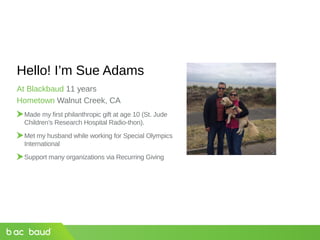
Hello! I’m Sue Adams
At Blackbaud 11 years
Hometown Walnut Creek, CA
Made my first philanthropic gift at age 10 (St. Jude
Children’s Research Hospital Radio-thon).
Met my husband while working for Special Olympics
International
Support many organizations via Recurring Giving
SESSION OBJECTIVES
Learn what makes sustainers so special
Understand how to build and grow a sustainer program
Gain information to convince your CFO that this is a good idea
Take away emerging Best Practices from Target Analytics’
Sustainer Benchmarking participants
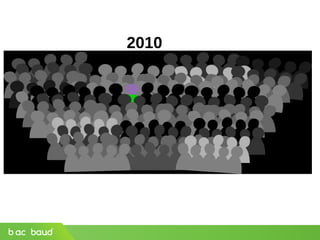
2010
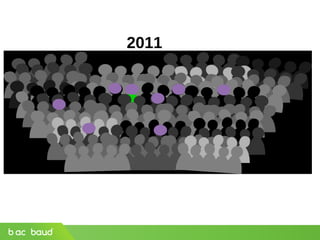
2011
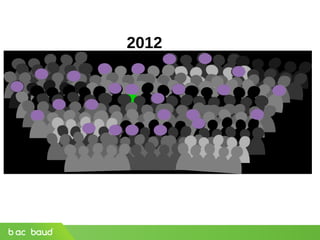
2012
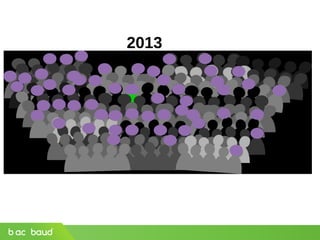
2013
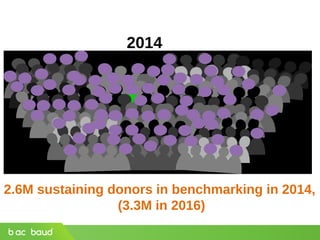
2014
2.6M sustaining donors in benchmarking in 2014,
(3.3M in 2016)
What are Sustainers?
Donors who give on a regular basis (most often this is monthly) without an end date are
called Sustainers, Regular Givers, Pledge Donors, Monthly Donors, or Recurring Donors.
They are not installment donors.
This is the way many pay for club memberships or other fee- based services.
Most of the world’s donors are sustainers.
Background
In most other countries, donors most often give by making monthly payments to their
charities.
Sustaining giving is fast becoming the norm here in the United States, as well.
Charitable giving is affected by culture and infrastructure.
Infrastructure is changing
− Banking
− Credit/Debit cards
− Mail
− Telephone
− Internet
Industry-Wide Focus
• Fundraising Success Magazine, 4 Nonprofit Donor Demographics Trends for 2015:
• “I’ve heard younger citizens are going for the sustainer monthly giving opportunity. It looks like we’re having a trend in sustainer giving. For many it’s a real
convenience and one-stop involvement in contributing without the concern about renewing one’s gift.” Carl Bloom, Chairman, Carl Bloom Associates
• Luminate Online Benchmark Report 2014*
− Online sustainer giving increased 16.8% in 2014
− % of online revenue from sustainer online donations was 8.59% - an 8% increase
•Erica Waasdorp, author, “Monthly Giving, the Sleeping Giant”
− “I think monthly giving needs to be as important as a major gift program.”
*Data from 800 Luminate clients, July 1, 2013 to June 30, 2014, includes event revenue – download report at www.blackbaud.com/luminatebenchmark
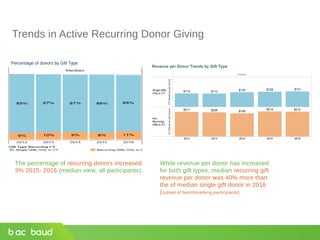
Trends in Active Recurring Donor Giving
The percentage of recurring donors increased
3% 2015- 2016 (median view, all participants).
While revenue per donor has increased
for both gift types, median recurring gift
revenue per donor was 40% more than
the of median single gift donor in 2016
(subset of benchmarking participants).
Percentage of donors by Gift Type
How Valuable Are They?
• Recurring donors are one of the most valuable segments in a direct marketing
fundraising program because of the compound effect of their giving.
• Twelve gifts of $10 or $15 given in one year is more cumulative revenue than the
majority of one-off donors (those who give individual gifts) will give annually.
• Sustainers out-perform other donors on the two drivers of long-term value: Revenue per
donor and retention.
• They are consistently worth four times as much as single gift donors years.
How Valuable Are They?
0
50000
100000
150000
200000
250000
300000
350000
400000
450000
500000
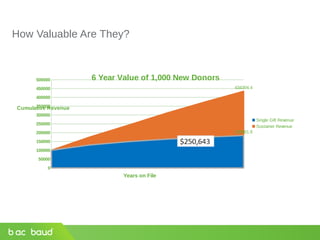
434304.4
183661.6
6 Year Value of 1,000 New Donors
Single Gift Revenue
Sustainer Revenue
Years on File
Cumulative Revenue
How Valuable Are They?
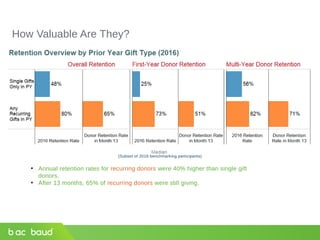
• Annual retention rates for recurring donors were 40% higher than single gift
donors.
• After 13 months, 65% of recurring donors were still giving.
(Subset of 2016 benchmarking participants)
Where are the Largest Programs?
• Public Broadcasting Media
• Child Sponsorship
• International Relief
• Catholic-related Organizations
• Animal Welfare
Building Your Sustainer Program
 Senior Staff Support
 Organization-Wide Training
 Setting Goals & Managing Expectations
 Building Your File – Acquisition
 Building Your File – Conversion
 Setting Up Systems
 Creating Your Message
Senior Staff Support
Do senior staff and the board support the conversion from an annual fundraising program to a sustainer
model?
• Use hard data and peer examples to tell the story.
• Provide projections based on long term value.
• Using campaign CPDR or annual net revenue will not result in a justifiable return for a new, growing
sustainer program.
• Present the program with the intent that this IS the new way to fundraise and grow the donor
population to return the highest net per donor with the lowest CPDR.
• Set expectations early - it will take time and it will take a consistent, steady commitment to growth.
• Encourage full commitment: Dipping the toe in the water of monthly giving and only acquiring a
few hundred donors and then having to manage, fulfill, and support the program will lead to
frustration.
Organization-Wide Training
 Early in your planning, everyone on the fundraising team
will need to be trained and educated in sustaining gift
programs and how their roles will change.
 Include staff in donor communications, marketing agencies,
finance, and the executive team in early conversations to
ensure that they are aware of any changes in their
programs, systems or procedures.
 Prior to launch, provide information and program overview
to the entire organization so that all staff are familiar with
sustained giving and the change in messaging.
Organization-Wide Training
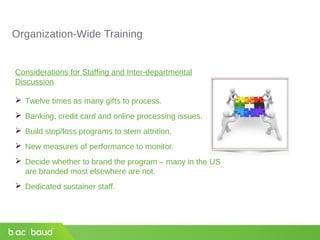
Considerations for Staffing and Inter-departmental
Discussion
 Twelve times as many gifts to process.
 Banking, credit card and online processing issues.
 Build stop/loss programs to stem attrition.
 New measures of performance to monitor.
 Decide whether to brand the program – many in the US
are branded most elsewhere are not.
 Dedicated sustainer staff.
Setting Goals for Year 1
 What is the total share of all donors that will be sustaining donors?
 What is the percentage of new donors being acquired directly to
sustained giving?
 What is the percentage of current donors converting to sustained giving?
 What share of recurring donors will be paying by credit card? Direct
debit?
 Prepare for the possibility of less cash collected in year one. Use accrual
to show full value of sustainers, but base collections on 5 gifts per
sustainer in their first fiscal year.
Managing Expectations
Be prepared for very little change in overall donor participation rates in year
one. It is not until year two or even three that the number of donors should begin to
increase due to increased retention.
The number of donors that are acquired in the year should not change simply
because a sustainer program has been put in place. It is not a new funding
source; merely a way to ensure that donors stay engaged and giving for longer than
one year at a time, and often at higher revenue per donor.
Revenue collected in year one will be affected by recurring giving. Being
prepared for less cash in the current FY will be very important for the success of the
program and on-going internal support. Staying the course will be easier and it will
be less tempting to revert back to single gift messaging if the organization is
prepared to take a hit in collections in the first year or so.
Building Your File – Sustainer Acquisition
Growing the number of recurring donors requires acquiring donors directly to the
sustained giving program – not ONLY converting.
Make sustained giving the expected way to give.
Put the sustainer option first online.
Put the sustainer ask on all forms.
Train frontline fundraisers and callers to ask for sustained gifts.
Most common channels of acquisition are:
Face to Face Direct Mail
Ads and Inserts Telemarketing
DRTV
Online
Building Your File – Sustainer Acquisition
Over five years the
median distribution
of cold acquired
recurring donors
and conversion
donors has changed
dramatically.
In 2016, for the first
time, a higher
percentage of first-
time recurring
donors were cold
acquired.
All organizations in the Summit convert donors to recurring. Although
the median % who are converted is 45%, the range covers from less
than 1% to 99% across the 36 organizations.
Building Your File – Sustainer Conversion
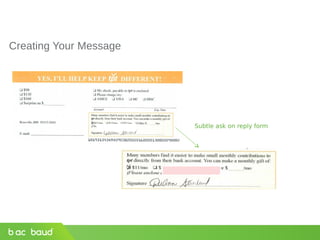
 If donors are given the option, on any direct mail reply slip, to donate one gift or to
donate monthly, a small number of donors will choose to give monthly.
 Telemarketing will convert more donors, either through two-step acquisition to
sustained giving or by converting multi-year members.
 The donors most likely to convert are those with a history of responding to
the first renewal notice (membership organizations).
 Online purchase behavior is an indicator of sustainer likelihood.
 Credit Card donors are also responsive to sustainer offers.
 Sustainers are younger and more female than the rest of your file.
●
40-something women are the top sustainer prospects
Tips for a Strong Online Sustainer Form
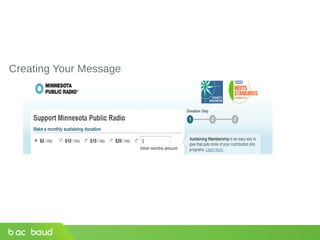
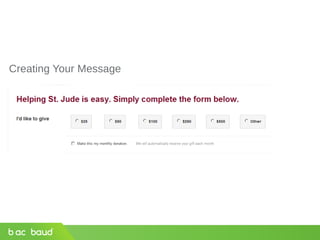
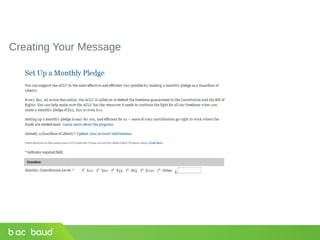
 It is 'one click' directly from multiple donate/support buttons in prominent locations
on the home page.
 Monthly giving is the default giving method.
 Don’t be afraid of high level asks, up to $100 a month or more.
 List checking account drafts (EFT) as the primary default option, with credit card
as a secondary option.
 Ask for only the bare minimum of information needed to set up a donor’s giving
plan.
 Have links to form(s) for upgrades, updating account information, converting from
credit card to EFT, etc.
 Link to sustainer FAQ's that are distinct from those for traditional donors.
Setting Up Systems
When starting a sustainer program – make sure all systems are go!
• If you have five, 500 or 500K sustainers, you need the systems in place.
• Be able to service the donor completely when the program is small.
●
Data entry
●
Payment processing and problems
●
Gift acknowledgements
• Clear coding for identification of direct-acquired and converted recurring gifts.
Set up for payment methods
• Credit Cards are most likely to be your most used payment method.
• Decide what you want to do with recurring check donors – convert to electronic.
• Set up both Credit Card and EFT processing.
• EFT is more time consuming to set up, but the value of EFT donors is
remarkable.
Setting Up Systems – Payment Methods
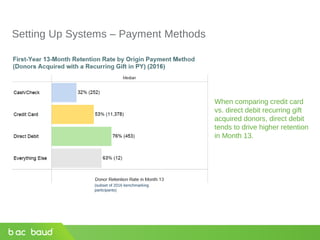
When comparing credit card
vs. direct debit recurring gift
acquired donors, direct debit
tends to drive higher retention
in Month 13.
(subset of 2016 benchmarking
participants)
Setting Up Systems – Payment Methods
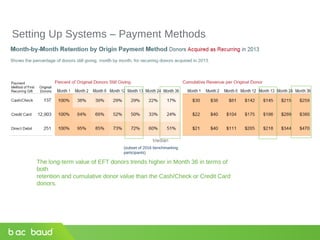
The long-term value of EFT donors trends higher in Month 36 in terms of
both
retention and cumulative donor value than the Cash/Check or Credit Card
donors.
(subset of 2016 benchmarking
participants)
Creating Your Message
Why Do Donors Become Sustainers?
 Knowing they are supporting the organizations they care about, giving becomes
automatic instead of having to think, “Did I send them a gift recently?”
 It is easy and convenient.
Donors do not choose to become sustainers to make it easier for your organization.
●
Not because it helps you
●
Not because it is green.
●
Not because they will never hear from you again.
(Never promise no mail.)
 They really care about the mission of the organization, and that their gift has more
impact.
 Makes them happy and is best for the organization
Creating Your Message
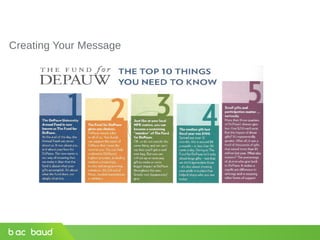
Subtle ask on reply form
Creating Your Message
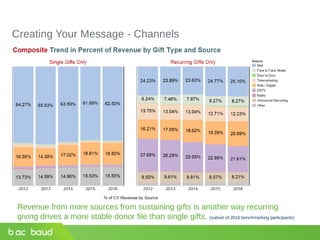
Creating Your Message - Channels
Revenue from more sources from sustaining gifts is another way recurring
giving drives a more stable donor file than single gifts. (subset of 2016 benchmarking participants)
Getting Full Value from Sustainers
 Do not promise no other asks. Do not promise no mail, or
phone, or email.
 Once or twice a year ask for upgrades.
 Include sustainers in your best appeals.
 Thank and cultivate them.
 Engagement is important.
Making good even better
Questions?
Making good even better
Thank you

Magic Monthly Giving - Sustainer Best Practices

  • 1.
    Sue Adams Target AnalyticsSenior Solutions Consultant Best Practices for Building and Growing A Sustainer Program: Insights from donorCentrics Sustainer Benchmarking
  • 2.
    Hello! I’m SueAdams At Blackbaud 11 years Hometown Walnut Creek, CA Made my first philanthropic gift at age 10 (St. Jude Children’s Research Hospital Radio-thon). Met my husband while working for Special Olympics International Support many organizations via Recurring Giving
  • 3.
    SESSION OBJECTIVES Learn whatmakes sustainers so special Understand how to build and grow a sustainer program Gain information to convince your CFO that this is a good idea Take away emerging Best Practices from Target Analytics’ Sustainer Benchmarking participants
  • 4.
  • 5.
  • 6.
  • 7.
  • 8.
    2014 2.6M sustaining donorsin benchmarking in 2014, (3.3M in 2016)
  • 9.
    What are Sustainers? Donorswho give on a regular basis (most often this is monthly) without an end date are called Sustainers, Regular Givers, Pledge Donors, Monthly Donors, or Recurring Donors. They are not installment donors. This is the way many pay for club memberships or other fee- based services. Most of the world’s donors are sustainers.
  • 10.
    Background In most othercountries, donors most often give by making monthly payments to their charities. Sustaining giving is fast becoming the norm here in the United States, as well. Charitable giving is affected by culture and infrastructure. Infrastructure is changing − Banking − Credit/Debit cards − Mail − Telephone − Internet
  • 11.
    Industry-Wide Focus • FundraisingSuccess Magazine, 4 Nonprofit Donor Demographics Trends for 2015: • “I’ve heard younger citizens are going for the sustainer monthly giving opportunity. It looks like we’re having a trend in sustainer giving. For many it’s a real convenience and one-stop involvement in contributing without the concern about renewing one’s gift.” Carl Bloom, Chairman, Carl Bloom Associates • Luminate Online Benchmark Report 2014* − Online sustainer giving increased 16.8% in 2014 − % of online revenue from sustainer online donations was 8.59% - an 8% increase •Erica Waasdorp, author, “Monthly Giving, the Sleeping Giant” − “I think monthly giving needs to be as important as a major gift program.” *Data from 800 Luminate clients, July 1, 2013 to June 30, 2014, includes event revenue – download report at www.blackbaud.com/luminatebenchmark
  • 12.
    Trends in ActiveRecurring Donor Giving The percentage of recurring donors increased 3% 2015- 2016 (median view, all participants). While revenue per donor has increased for both gift types, median recurring gift revenue per donor was 40% more than the of median single gift donor in 2016 (subset of benchmarking participants). Percentage of donors by Gift Type
  • 13.
    How Valuable AreThey? • Recurring donors are one of the most valuable segments in a direct marketing fundraising program because of the compound effect of their giving. • Twelve gifts of $10 or $15 given in one year is more cumulative revenue than the majority of one-off donors (those who give individual gifts) will give annually. • Sustainers out-perform other donors on the two drivers of long-term value: Revenue per donor and retention. • They are consistently worth four times as much as single gift donors years.
  • 14.
    How Valuable AreThey? 0 50000 100000 150000 200000 250000 300000 350000 400000 450000 500000 434304.4 183661.6 6 Year Value of 1,000 New Donors Single Gift Revenue Sustainer Revenue Years on File Cumulative Revenue
  • 15.
    How Valuable AreThey? • Annual retention rates for recurring donors were 40% higher than single gift donors. • After 13 months, 65% of recurring donors were still giving. (Subset of 2016 benchmarking participants)
  • 16.
    Where are theLargest Programs? • Public Broadcasting Media • Child Sponsorship • International Relief • Catholic-related Organizations • Animal Welfare
  • 17.
    Building Your SustainerProgram  Senior Staff Support  Organization-Wide Training  Setting Goals & Managing Expectations  Building Your File – Acquisition  Building Your File – Conversion  Setting Up Systems  Creating Your Message
  • 18.
    Senior Staff Support Dosenior staff and the board support the conversion from an annual fundraising program to a sustainer model? • Use hard data and peer examples to tell the story. • Provide projections based on long term value. • Using campaign CPDR or annual net revenue will not result in a justifiable return for a new, growing sustainer program. • Present the program with the intent that this IS the new way to fundraise and grow the donor population to return the highest net per donor with the lowest CPDR. • Set expectations early - it will take time and it will take a consistent, steady commitment to growth. • Encourage full commitment: Dipping the toe in the water of monthly giving and only acquiring a few hundred donors and then having to manage, fulfill, and support the program will lead to frustration.
  • 19.
    Organization-Wide Training  Earlyin your planning, everyone on the fundraising team will need to be trained and educated in sustaining gift programs and how their roles will change.  Include staff in donor communications, marketing agencies, finance, and the executive team in early conversations to ensure that they are aware of any changes in their programs, systems or procedures.  Prior to launch, provide information and program overview to the entire organization so that all staff are familiar with sustained giving and the change in messaging.
  • 20.
    Organization-Wide Training Considerations forStaffing and Inter-departmental Discussion  Twelve times as many gifts to process.  Banking, credit card and online processing issues.  Build stop/loss programs to stem attrition.  New measures of performance to monitor.  Decide whether to brand the program – many in the US are branded most elsewhere are not.  Dedicated sustainer staff.
  • 21.
    Setting Goals forYear 1  What is the total share of all donors that will be sustaining donors?  What is the percentage of new donors being acquired directly to sustained giving?  What is the percentage of current donors converting to sustained giving?  What share of recurring donors will be paying by credit card? Direct debit?  Prepare for the possibility of less cash collected in year one. Use accrual to show full value of sustainers, but base collections on 5 gifts per sustainer in their first fiscal year.
  • 22.
    Managing Expectations Be preparedfor very little change in overall donor participation rates in year one. It is not until year two or even three that the number of donors should begin to increase due to increased retention. The number of donors that are acquired in the year should not change simply because a sustainer program has been put in place. It is not a new funding source; merely a way to ensure that donors stay engaged and giving for longer than one year at a time, and often at higher revenue per donor. Revenue collected in year one will be affected by recurring giving. Being prepared for less cash in the current FY will be very important for the success of the program and on-going internal support. Staying the course will be easier and it will be less tempting to revert back to single gift messaging if the organization is prepared to take a hit in collections in the first year or so.
  • 23.
    Building Your File– Sustainer Acquisition Growing the number of recurring donors requires acquiring donors directly to the sustained giving program – not ONLY converting. Make sustained giving the expected way to give. Put the sustainer option first online. Put the sustainer ask on all forms. Train frontline fundraisers and callers to ask for sustained gifts. Most common channels of acquisition are: Face to Face Direct Mail Ads and Inserts Telemarketing DRTV Online
  • 24.
    Building Your File– Sustainer Acquisition Over five years the median distribution of cold acquired recurring donors and conversion donors has changed dramatically. In 2016, for the first time, a higher percentage of first- time recurring donors were cold acquired. All organizations in the Summit convert donors to recurring. Although the median % who are converted is 45%, the range covers from less than 1% to 99% across the 36 organizations.
  • 25.
    Building Your File– Sustainer Conversion  If donors are given the option, on any direct mail reply slip, to donate one gift or to donate monthly, a small number of donors will choose to give monthly.  Telemarketing will convert more donors, either through two-step acquisition to sustained giving or by converting multi-year members.  The donors most likely to convert are those with a history of responding to the first renewal notice (membership organizations).  Online purchase behavior is an indicator of sustainer likelihood.  Credit Card donors are also responsive to sustainer offers.  Sustainers are younger and more female than the rest of your file. ● 40-something women are the top sustainer prospects
  • 26.
    Tips for aStrong Online Sustainer Form  It is 'one click' directly from multiple donate/support buttons in prominent locations on the home page.  Monthly giving is the default giving method.  Don’t be afraid of high level asks, up to $100 a month or more.  List checking account drafts (EFT) as the primary default option, with credit card as a secondary option.  Ask for only the bare minimum of information needed to set up a donor’s giving plan.  Have links to form(s) for upgrades, updating account information, converting from credit card to EFT, etc.  Link to sustainer FAQ's that are distinct from those for traditional donors.
  • 27.
    Setting Up Systems Whenstarting a sustainer program – make sure all systems are go! • If you have five, 500 or 500K sustainers, you need the systems in place. • Be able to service the donor completely when the program is small. ● Data entry ● Payment processing and problems ● Gift acknowledgements • Clear coding for identification of direct-acquired and converted recurring gifts. Set up for payment methods • Credit Cards are most likely to be your most used payment method. • Decide what you want to do with recurring check donors – convert to electronic. • Set up both Credit Card and EFT processing. • EFT is more time consuming to set up, but the value of EFT donors is remarkable.
  • 28.
    Setting Up Systems– Payment Methods When comparing credit card vs. direct debit recurring gift acquired donors, direct debit tends to drive higher retention in Month 13. (subset of 2016 benchmarking participants)
  • 29.
    Setting Up Systems– Payment Methods The long-term value of EFT donors trends higher in Month 36 in terms of both retention and cumulative donor value than the Cash/Check or Credit Card donors. (subset of 2016 benchmarking participants)
  • 30.
    Creating Your Message WhyDo Donors Become Sustainers?  Knowing they are supporting the organizations they care about, giving becomes automatic instead of having to think, “Did I send them a gift recently?”  It is easy and convenient. Donors do not choose to become sustainers to make it easier for your organization. ● Not because it helps you ● Not because it is green. ● Not because they will never hear from you again. (Never promise no mail.)  They really care about the mission of the organization, and that their gift has more impact.  Makes them happy and is best for the organization
  • 31.
  • 32.
  • 33.
  • 34.
  • 35.
  • 36.
    Creating Your Message- Channels Revenue from more sources from sustaining gifts is another way recurring giving drives a more stable donor file than single gifts. (subset of 2016 benchmarking participants)
  • 37.
    Getting Full Valuefrom Sustainers  Do not promise no other asks. Do not promise no mail, or phone, or email.  Once or twice a year ask for upgrades.  Include sustainers in your best appeals.  Thank and cultivate them.  Engagement is important.
  • 38.
    Making good evenbetter Questions?
  • 39.
    Making good evenbetter Thank you