
Cancer Pain Concept
Husni Tanra, MD, PhD. Prof.
Ketua Sp2 Ilmu Anestesi, Perawataan Intensif
dan Manajemen Nyeri
Fakultas Kedokteran Universitas Hasanuddin
Makassar
Dibawakan pada 16 Februari di Makassar
What is Pain?
• Pain is the production (out put ) of the brain.
• Pain is invisible disease, we can’t see it like other
disease, such as struma, fracture or blind.
• What you have to do is to believe what ever the
patient says.
• Pain is what ever the patient says it is
• Pain is invisible diseases, but is real for patient.
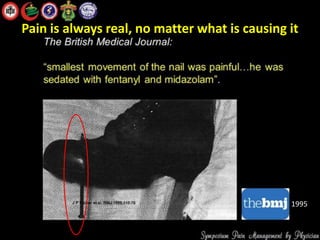
Pain is always real, no matter what is causing it
1995
Of all the symptoms caused
by Cancer
PAIN is the most feared
 69 % of severe cancer pain patient to cause consideration
of suicide. (Wisconsin 1985)
(Wisconsin 1985)
How about cancer pain?
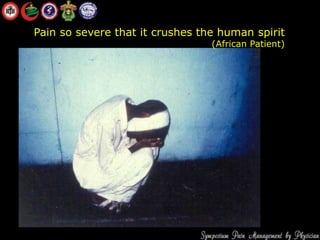
Pain so severe that it crushes the human spirit
(African Patient)
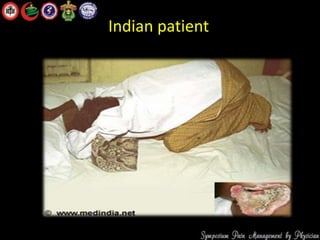
Indian patient
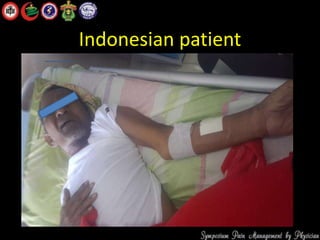
Indonesian patient
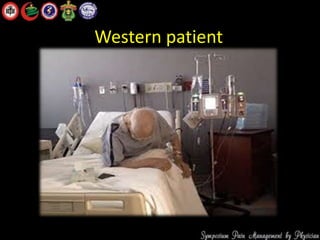
Western patient
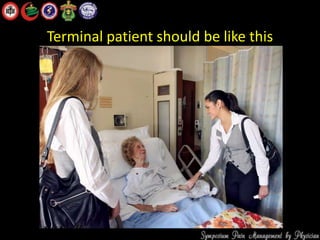
Terminal patient should be like this
Just as Cancer is not 1 disease
Cancer Pain is not 1 entity
Why cancer pain so severe ?
Dame
Cicely Mary Sounders
 Nurse
 Social worker
 Physician
 Writer
She is the founder of the 1st modern
Hospice in London in 1967
Christopher’s Hospice
She also introduced idea of
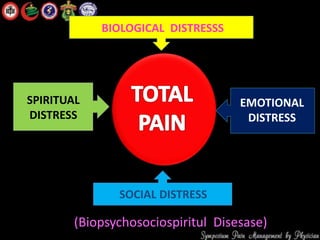
TOTAL PAIN (physical, emotional,
Social and spiritual  distress)
“BIOPSYCHOSOCIOSPIRITUAL PAIN”
BIOLOGICAL DISTRESSS
SOCIAL DISTRESS
EMOTIONAL
DISTRESS
SPIRITUAL
DISTRESS
(Biopsychosociospiritul Disesase)
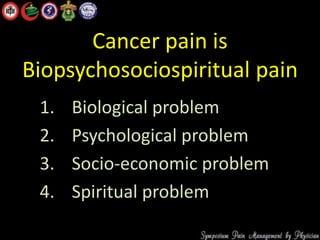
Cancer pain is
Biopsychosociospiritual pain
1. Biological problem
2. Psychological problem
3. Socio-economic problem
4. Spiritual problem
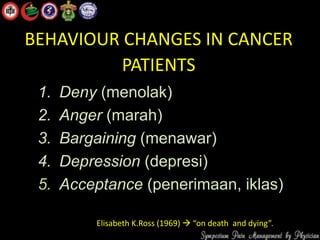
BEHAVIOUR CHANGES IN CANCER
PATIENTS
1. Deny (menolak)
2. Anger (marah)
3. Bargaining (menawar)
4. Depression (depresi)
5. Acceptance (penerimaan, iklas)
Elisabeth K.Ross (1969)  “on death and dying”.
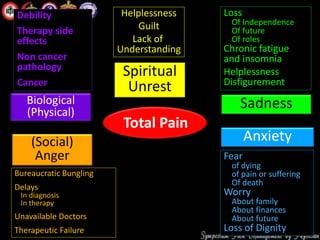
Total Pain
Spiritual
Unrest
Sadness
Anxiety
Biological
(Physical)
(Social)
Anger
Helplessness
Guilt
Lack of
Understanding
Loss
Of Independence
Of future
Of roles
Chronic fatigue
and insomnia
Helplessness
Disfigurement
Fear
of dying
of pain or suffering
Of death
Worry
About family
About finances
About future
Loss of Dignity
Bureaucratic Bungling
Delays
In diagnosis
In therapy
Unavailable Doctors
Therapeutic Failure
Debility
Therapy side
effects
Non cancer
pathology
Cancer
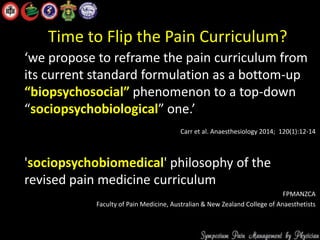
Time to Flip the Pain Curriculum?
‘we propose to reframe the pain curriculum from
its current standard formulation as a bottom-up
“biopsychosocial” phenomenon to a top-down
“sociopsychobiological” one.’
Carr et al. Anaesthesiology 2014; 120(1):12-14
'sociopsychobiomedical' philosophy of the
revised pain medicine curriculum
FPMANZCA
Faculty of Pain Medicine, Australian & New Zealand College of Anaesthetists
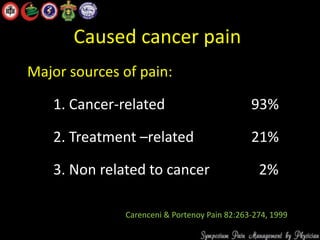
Caused cancer pain
Major sources of pain:
1. 1. Cancer-related 93%
2. 2. Treatment –related 21%
3. 3. Non related to cancer 2%
Carenceni & Portenoy Pain 82:263-274, 1999
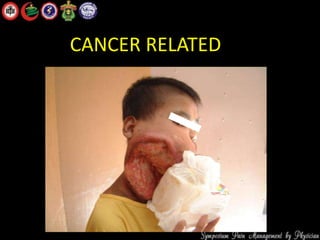
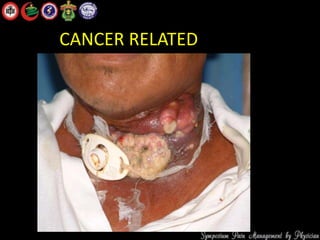
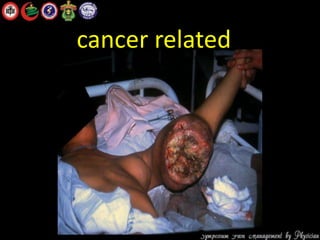
Cancer related pain
Due to cancer invasion or metastases:
1. 1. Local tissue damage with inflammation
2. 2. Invading nerves or nerve complexes
3. 3. Pressure effects on nerves/hollow organs
4. 4. Eating into bone / fracture
CANCER RELATED
CANCER RELATED
cancer related
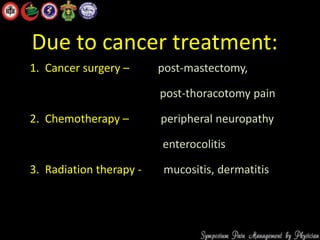
Due to cancer treatment:
1. Cancer surgery – post-mastectomy,
post-thoracotomy pain
2. Chemotherapy – peripheral neuropathy
enterocolitis
3. Radiation therapy - mucositis, dermatitis
post-radiation fibrosis
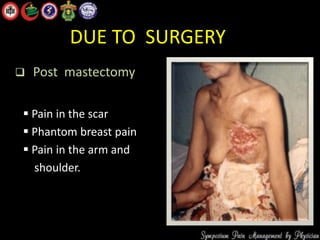
DUE TO SURGERY
 Post mastectomy
 Pain in the scar
 Phantom breast pain
 Pain in the arm and
shoulder.
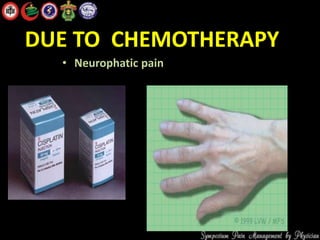
DUE TO CHEMOTHERAPY
• Neurophatic pain
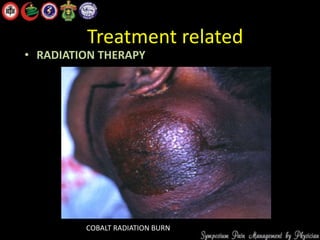
Treatment related
• RADIATION THERAPY
COBALT RADIATION BURN
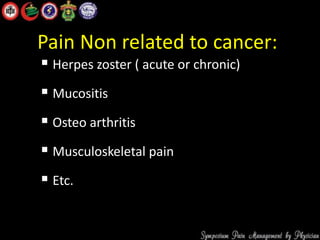
Pain Non related to cancer:
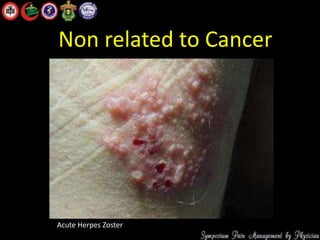
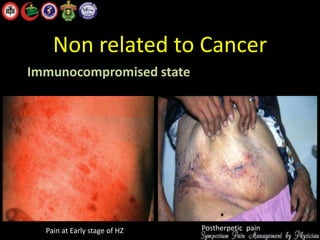
 Herpes zoster ( acute or chronic)
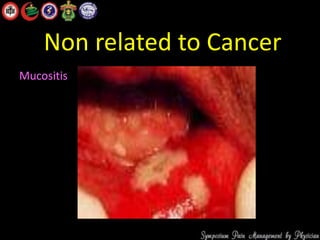
 Mucositis
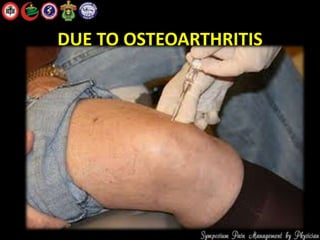
 Osteo arthritis
 Musculoskeletal pain
 Etc.
Non related to Cancer
Acute Herpes Zoster
Non related to Cancer
Immunocompromised state
Pain at Early stage of HZ Postherpetic pain
Non related to Cancer
Mucositis
DUE TO OSTEOARTHRITIS
1/5 yang hanya 1 nyerinya
4/5 yang memiliki 2 atau lebih
1/3 memiliki 4 atau lebih nyeri
Nyeri kanker bukan hanya satu
macam nyerinya .
Key success in cancer pain
management is
• Evaluasi dan asesmen yang berulang-
ulang  “With attention to detail”
• Assessment- Treatment and
Reassessment.
• At least once a day.
Kenapa nyeri harus di ases
sebelum diobati?
• Karena nyeri itu adalah simptom/penyakit yang
tidak bisa dilihat (Pain is invisible disease).
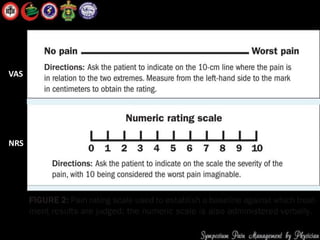
• Tujuan utama dari Asesmen nyeri adalah meng-
visualisasikan nyeri serta mengdiagnosenya:
A. Jenis nyerinya (type of Pain).
B. Intensitas nyerinya (intensity of pain)
VAS
NRS
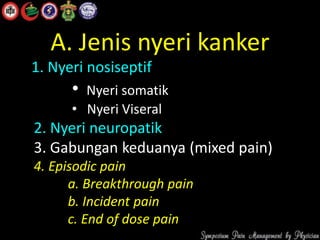
A. Jenis nyeri kanker
1. Nyeri nosiseptif
• Nyeri somatik
• Nyeri Viseral
2. Nyeri neuropatik
3. Gabungan keduanya (mixed pain)
4. Episodic pain
a. Breakthrough pain
b. Incident pain
c. End of dose pain
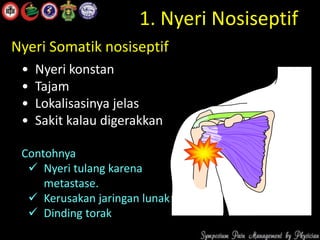
1. Nyeri Nosiseptif
• Nyeri konstan
• Tajam
• Lokalisasinya jelas
• Sakit kalau digerakkan
Contohnya
 Nyeri tulang karena
metastase.
 Kerusakan jaringan lunak
 Dinding torak
Nyeri Somatik nosiseptif
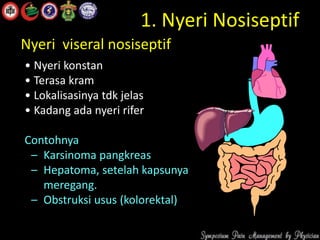
1. Nyeri Nosiseptif
• Nyeri konstan
• Terasa kram
• Lokalisasinya tdk jelas
• Kadang ada nyeri rifer
Contohnya
– Karsinoma pangkreas
– Hepatoma, setelah kapsunya
meregang.
– Obstruksi usus (kolorektal)
Nyeri viseral nosiseptif
2. Nyeri Neuropatik
• Nyeri neuropatik adalah nyeri akibat adanya
kerusakan , lesi atau disfunsi dari SS saraf
perifer atau sentral.
• Umumnya pasien menyatakannya sebagai
nyeri yang lain dari biasanya.
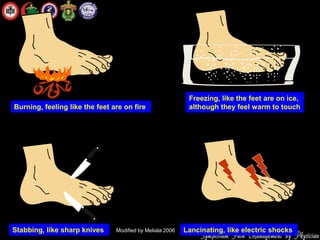
• Paling sering drasakan sebagai nyeri yang
terbakar, seperti memegang es, kontak listrik
atau seperti tertusuk-tusuk.
Burning, feeling like the feet are on fire
Stabbing, like sharp knives Lancinating, like electric shocks
Freezing, like the feet are on ice,
although they feel warm to touch
Modified by Meliala 2006
3. Breakthrough pain
(terjadi tiba-tiba dan dramatis)
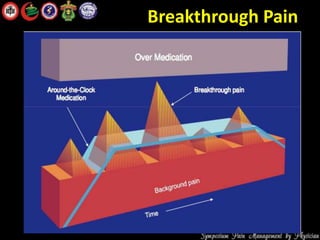
“Is pain that comes on very quickly and
severely in patient who are already
being treated with long acting opioid”.
Around-the-Clock
Medication
Breakthrough pain
Over Medication
Breakthrough Pain
4. Incident pain
• Pain that occur when patient Coughing,
moving or walking
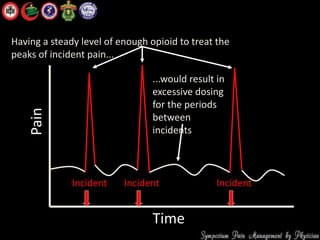
Time
Incident Incident Incident
PainHaving a steady level of enough opioid to treat the
peaks of incident pain...
...would result in
excessive dosing
for the periods
between
incidents
5. End of dose Pain
1. Inadequate dose
2. Interval is longer
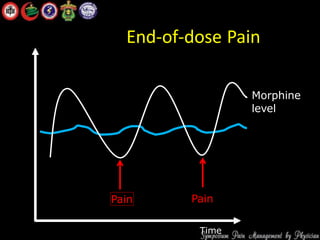
End-of-dose Pain
Time
Morphine
level
Pain Pain
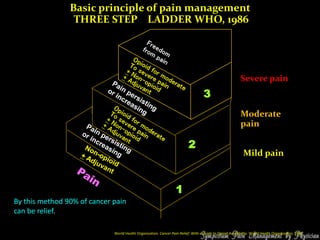
Basic principle of pain management
THREE STEP LADDER WHO, 1986
1
2
3
Severe pain
Moderate
pain
Mild pain
World Health Organization. Cancer Pain Relief: With a Guide to Opioid Availability. World Health Organization; 1986.
By this method 90% of cancer pain
can be relief.
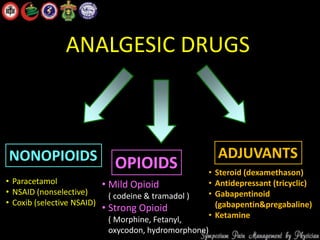
ANALGESIC DRUGS
NONOPIOIDS OPIOIDS
ADJUVANTS
• Mild Opioid
( codeine & tramadol )
• Strong Opioid
( Morphine, Fetanyl,
oxycodon, hydromorphone)
• Paracetamol
• NSAID (nonselective)
• Coxib (selective NSAID)
• Steroid (dexamethason)
• Antidepressant (tricyclic)
• Gabapentinoid
(gabapentin&pregabaline)
• Ketamine
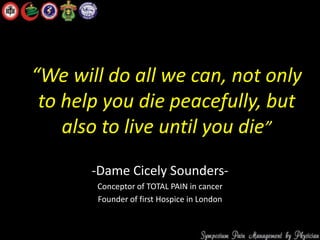
“We will do all we can, not only
to help you die peacefully, but
also to live until you die”
-Dame Cicely Sounders-
Conceptor of TOTAL PAIN in cancer
Founder of first Hospice in London
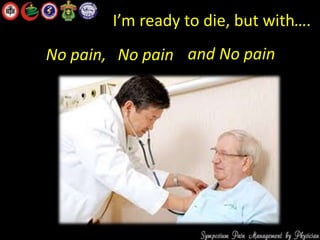
I’m ready to die, but with….
No pain, No pain and No pain
Thank you so much
for listening me

Cancer pain concept

  • 1.
    Cancer Pain Concept HusniTanra, MD, PhD. Prof. Ketua Sp2 Ilmu Anestesi, Perawataan Intensif dan Manajemen Nyeri Fakultas Kedokteran Universitas Hasanuddin Makassar Dibawakan pada 16 Februari di Makassar
  • 2.
    What is Pain? •Pain is the production (out put ) of the brain. • Pain is invisible disease, we can’t see it like other disease, such as struma, fracture or blind. • What you have to do is to believe what ever the patient says. • Pain is what ever the patient says it is • Pain is invisible diseases, but is real for patient.
  • 3.
    Pain is alwaysreal, no matter what is causing it 1995
  • 4.
    Of all thesymptoms caused by Cancer PAIN is the most feared  69 % of severe cancer pain patient to cause consideration of suicide. (Wisconsin 1985) (Wisconsin 1985) How about cancer pain?
  • 5.
    Pain so severethat it crushes the human spirit (African Patient)
  • 6.
  • 7.
  • 8.
  • 9.
  • 10.
    Just as Canceris not 1 disease Cancer Pain is not 1 entity Why cancer pain so severe ?
  • 11.
    Dame Cicely Mary Sounders Nurse  Social worker  Physician  Writer She is the founder of the 1st modern Hospice in London in 1967 Christopher’s Hospice She also introduced idea of TOTAL PAIN (physical, emotional, Social and spiritual  distress) “BIOPSYCHOSOCIOSPIRITUAL PAIN”
  • 12.
  • 13.
    Cancer pain is Biopsychosociospiritualpain 1. Biological problem 2. Psychological problem 3. Socio-economic problem 4. Spiritual problem
  • 14.
    BEHAVIOUR CHANGES INCANCER PATIENTS 1. Deny (menolak) 2. Anger (marah) 3. Bargaining (menawar) 4. Depression (depresi) 5. Acceptance (penerimaan, iklas) Elisabeth K.Ross (1969)  “on death and dying”.
  • 15.
    Total Pain Spiritual Unrest Sadness Anxiety Biological (Physical) (Social) Anger Helplessness Guilt Lack of Understanding Loss OfIndependence Of future Of roles Chronic fatigue and insomnia Helplessness Disfigurement Fear of dying of pain or suffering Of death Worry About family About finances About future Loss of Dignity Bureaucratic Bungling Delays In diagnosis In therapy Unavailable Doctors Therapeutic Failure Debility Therapy side effects Non cancer pathology Cancer
  • 16.
    Time to Flipthe Pain Curriculum? ‘we propose to reframe the pain curriculum from its current standard formulation as a bottom-up “biopsychosocial” phenomenon to a top-down “sociopsychobiological” one.’ Carr et al. Anaesthesiology 2014; 120(1):12-14 'sociopsychobiomedical' philosophy of the revised pain medicine curriculum FPMANZCA Faculty of Pain Medicine, Australian & New Zealand College of Anaesthetists
  • 17.
    Caused cancer pain Majorsources of pain: 1. 1. Cancer-related 93% 2. 2. Treatment –related 21% 3. 3. Non related to cancer 2% Carenceni & Portenoy Pain 82:263-274, 1999
  • 18.
    Cancer related pain Dueto cancer invasion or metastases: 1. 1. Local tissue damage with inflammation 2. 2. Invading nerves or nerve complexes 3. 3. Pressure effects on nerves/hollow organs 4. 4. Eating into bone / fracture
  • 19.
  • 20.
  • 21.
  • 22.
    Due to cancertreatment: 1. Cancer surgery – post-mastectomy, post-thoracotomy pain 2. Chemotherapy – peripheral neuropathy enterocolitis 3. Radiation therapy - mucositis, dermatitis post-radiation fibrosis
  • 23.
    DUE TO SURGERY Post mastectomy  Pain in the scar  Phantom breast pain  Pain in the arm and shoulder.
  • 24.
    DUE TO CHEMOTHERAPY •Neurophatic pain
  • 25.
    Treatment related • RADIATIONTHERAPY COBALT RADIATION BURN
  • 26.
    Pain Non relatedto cancer:  Herpes zoster ( acute or chronic)  Mucositis  Osteo arthritis  Musculoskeletal pain  Etc.
  • 27.
    Non related toCancer Acute Herpes Zoster
  • 28.
    Non related toCancer Immunocompromised state Pain at Early stage of HZ Postherpetic pain
  • 29.
    Non related toCancer Mucositis
  • 30.
  • 31.
    1/5 yang hanya1 nyerinya 4/5 yang memiliki 2 atau lebih 1/3 memiliki 4 atau lebih nyeri Nyeri kanker bukan hanya satu macam nyerinya .
  • 32.
    Key success incancer pain management is • Evaluasi dan asesmen yang berulang- ulang  “With attention to detail” • Assessment- Treatment and Reassessment. • At least once a day.
  • 33.
    Kenapa nyeri harusdi ases sebelum diobati? • Karena nyeri itu adalah simptom/penyakit yang tidak bisa dilihat (Pain is invisible disease). • Tujuan utama dari Asesmen nyeri adalah meng- visualisasikan nyeri serta mengdiagnosenya: A. Jenis nyerinya (type of Pain). B. Intensitas nyerinya (intensity of pain)
  • 34.
  • 35.
    A. Jenis nyerikanker 1. Nyeri nosiseptif • Nyeri somatik • Nyeri Viseral 2. Nyeri neuropatik 3. Gabungan keduanya (mixed pain) 4. Episodic pain a. Breakthrough pain b. Incident pain c. End of dose pain
  • 36.
    1. Nyeri Nosiseptif •Nyeri konstan • Tajam • Lokalisasinya jelas • Sakit kalau digerakkan Contohnya  Nyeri tulang karena metastase.  Kerusakan jaringan lunak  Dinding torak Nyeri Somatik nosiseptif
  • 37.
    1. Nyeri Nosiseptif •Nyeri konstan • Terasa kram • Lokalisasinya tdk jelas • Kadang ada nyeri rifer Contohnya – Karsinoma pangkreas – Hepatoma, setelah kapsunya meregang. – Obstruksi usus (kolorektal) Nyeri viseral nosiseptif
  • 38.
    2. Nyeri Neuropatik •Nyeri neuropatik adalah nyeri akibat adanya kerusakan , lesi atau disfunsi dari SS saraf perifer atau sentral. • Umumnya pasien menyatakannya sebagai nyeri yang lain dari biasanya. • Paling sering drasakan sebagai nyeri yang terbakar, seperti memegang es, kontak listrik atau seperti tertusuk-tusuk.
  • 39.
    Burning, feeling likethe feet are on fire Stabbing, like sharp knives Lancinating, like electric shocks Freezing, like the feet are on ice, although they feel warm to touch Modified by Meliala 2006
  • 40.
    3. Breakthrough pain (terjaditiba-tiba dan dramatis) “Is pain that comes on very quickly and severely in patient who are already being treated with long acting opioid”.
  • 41.
  • 42.
    4. Incident pain •Pain that occur when patient Coughing, moving or walking
  • 43.
    Time Incident Incident Incident PainHavinga steady level of enough opioid to treat the peaks of incident pain... ...would result in excessive dosing for the periods between incidents
  • 44.
    5. End ofdose Pain 1. Inadequate dose 2. Interval is longer
  • 45.
  • 46.
    Basic principle ofpain management THREE STEP LADDER WHO, 1986 1 2 3 Severe pain Moderate pain Mild pain World Health Organization. Cancer Pain Relief: With a Guide to Opioid Availability. World Health Organization; 1986. By this method 90% of cancer pain can be relief.
  • 47.
    ANALGESIC DRUGS NONOPIOIDS OPIOIDS ADJUVANTS •Mild Opioid ( codeine & tramadol ) • Strong Opioid ( Morphine, Fetanyl, oxycodon, hydromorphone) • Paracetamol • NSAID (nonselective) • Coxib (selective NSAID) • Steroid (dexamethason) • Antidepressant (tricyclic) • Gabapentinoid (gabapentin&pregabaline) • Ketamine
  • 48.
    “We will doall we can, not only to help you die peacefully, but also to live until you die” -Dame Cicely Sounders- Conceptor of TOTAL PAIN in cancer Founder of first Hospice in London
  • 49.
    I’m ready todie, but with…. No pain, No pain and No pain
  • 50.
    Thank you somuch for listening me