
CURRICULUM VITAE
Officer Position/Rank : Senior Lecturer/ IV e
Phone : Office : 0411- 585705, 0411-585 706,
Home : 0411- 586-545, Fax: 0411.586 984
Email : pudji_taslim@yahoo.com
EDUCATION : Dokter (FK UNHAS, 1984)
Diploma Community Nutrition (SEAMEO UI, 1990)
MPH Nutrition (Univ. of Carolina at ChapeI Hill, USA (1994)
Doktor, Pasca Sarjana Universitas Hasanuddin (2004)
Guru Besar UNHAS (2006)
Job Description: Ketua Perhimpunan Dokter Gizi Klinik Indonesia
Ketua SMF Gizi Klinik RS Wahidin Sudirohusodo, Makassar
Ketua Komisi 2 Senat Akademk Bidang Penelitian & Pengabdian Masyarakat
Ketua Senat Fakultas Kedokteran Univ Hasanuddin
Anggota Pokja Ahli Dewan Ketahanan Pangan Nasional, Kementerian Pertanian RI
Anggota Panel Ahli HIV/AIDS Kementerian Kesehatan RI
Ketua SP3T Prov.Sulawesi Selatan
Prof DR dr Nurpudji A Taslim, MPH, SpGK (K)
NUTRITIONAL ASSESSMENT
AND APLICATION IN CRITICAL
ILL PATIENTS
Nurpudji A. Taslim
Dept. of Nutrition School of Medicine Universitas Hasanuddin
Clinical Nutrition Functional Unit Wahidin Sudirohusodo Hospital
2017
Workshop Update in Nutrition : Optimizing Nutrition
Therapy in Critical Care, 12/11/2017
2
OUTLINE
• Learning objective
• Overview
• Screening and assessment of nutrition in critical
ill patients
• Nutritional management on critical ill patients
11/13/2017
Workshop Update in Nutrition : Optimizing Nutrition
Therapy in Critical Care 3
LEARNING OBJECTIVE
• able to know nutritional screening and
nutritional assessment in critical ill patients
• able to do nutritional screening and nutritional
assessment in critical ill patients
• able to know nutritional therapy in critical ill
patients
11/13/2017
Workshop Update in Nutrition : Optimizing Nutrition
Therapy in Critical Care 4
OVERVIEW
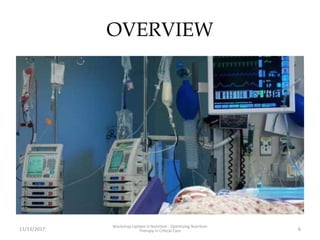
• Identifying patients at nutrition risk difficult in
the intensive care unit (ICU) due to the nature of
critical illness.
• Traditional screens and assessments are often
limited due to their subjective nature.
• Accurately identifying patients at risk for
malnutrition is essential to decrease negative
outcomes during hospitalization.
• Inflammation was the importance factor cause
malnutrition.
11/13/2017
Workshop Update in Nutrition : Optimizing Nutrition
Therapy in Critical Care 5
OVERVIEW
11/13/2017
Workshop Update in Nutrition : Optimizing Nutrition
Therapy in Critical Care 6
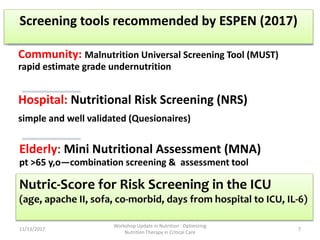
Screening tools recommended by ESPEN (2017)
Community: Malnutrition Universal Screening Tool (MUST)
rapid estimate grade undernutrition
Hospital: Nutritional Risk Screening (NRS)
simple and well validated (Quesionaires)
Elderly: Mini Nutritional Assessment (MNA)
pt >65 y,o—combination screening & assessment tool
11/13/2017
Workshop Update in Nutrition : Optimizing
Nutrition Therapy in Critical Care
7
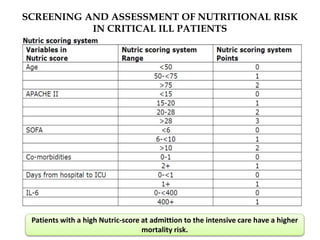
Nutric-Score for Risk Screening in the ICU
(age, apache II, sofa, co-morbid, days from hospital to ICU, IL-6)
SCREENING AND ASSESSMENT OF
NUTRITIONAL RISK IN CRITICAL ILL
PATIENTS
• Many of criteria to identifying nutrition risk
were difficult to obtain such as :
– food intake histories
– functional status and gastrointestinal (GI) symptoms
because it require patient interview or previous
knowledge of body habitus.
• Many traditional tools do not provide
information regarding inflammatory status.
11/13/2017
Workshop Update in Nutrition : Optimizing Nutrition
Therapy in Critical Care 8
SCREENING AND ASSESSMENT OF
NUTRITIONAL RISK IN CRITICAL ILL
PATIENTS
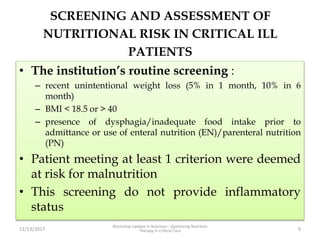
• The institution’s routine screening :
– recent unintentional weight loss (5% in 1 month, 10% in 6
month)
– BMI < 18.5 or > 40
– presence of dysphagia/inadequate food intake prior to
admittance or use of enteral nutrition (EN)/parenteral nutrition
(PN)
• Patient meeting at least 1 criterion were deemed
at risk for malnutrition
• This screening do not provide inflammatory
status
11/13/2017
Workshop Update in Nutrition : Optimizing Nutrition
Therapy in Critical Care 9
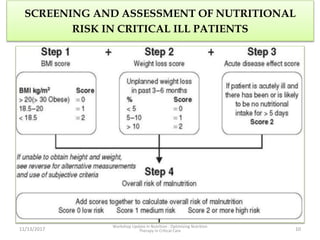
SCREENING AND ASSESSMENT OF NUTRITIONAL
RISK IN CRITICAL ILL PATIENTS
11/13/2017
Workshop Update in Nutrition : Optimizing Nutrition
Therapy in Critical Care 10
SCREENING AND ASSESSMENT OF NUTRITIONAL
RISK IN CRITICAL ILL PATIENTS
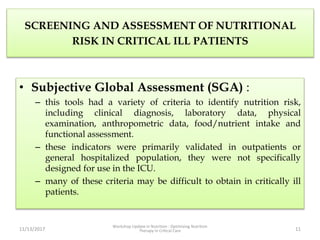
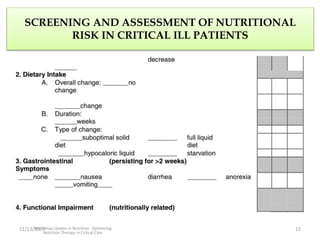
• Subjective Global Assessment (SGA) :
– this tools had a variety of criteria to identify nutrition risk,
including clinical diagnosis, laboratory data, physical
examination, anthropometric data, food/nutrient intake and
functional assessment.
– these indicators were primarily validated in outpatients or
general hospitalized population, they were not specifically
designed for use in the ICU.
– many of these criteria may be difficult to obtain in critically ill
patients.
11/13/2017
Workshop Update in Nutrition : Optimizing Nutrition
Therapy in Critical Care 11
SCREENING AND ASSESSMENT OF NUTRITIONAL
RISK IN CRITICAL ILL PATIENTS
11/13/2017Workshop Update in Nutrition : Optimizing
Nutrition Therapy in Critical Care
12
SCREENING AND ASSESSMENT OF
NUTRITIONAL RISK IN CRITICAL ILL
PATIENTS
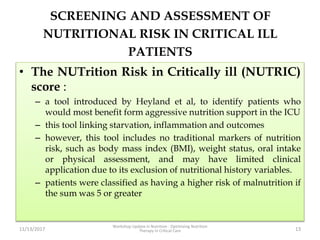
• The NUTrition Risk in Critically ill (NUTRIC)
score :
– a tool introduced by Heyland et al, to identify patients who
would most benefit form aggressive nutrition support in the ICU
– this tool linking starvation, inflammation and outcomes
– however, this tool includes no traditional markers of nutrition
risk, such as body mass index (BMI), weight status, oral intake
or physical assessment, and may have limited clinical
application due to its exclusion of nutritional history variables.
– patients were classified as having a higher risk of malnutrition if
the sum was 5 or greater
11/13/2017
Workshop Update in Nutrition : Optimizing Nutrition
Therapy in Critical Care 13
SCREENING AND ASSESSMENT OF NUTRITIONAL RISK
IN CRITICAL ILL PATIENTS
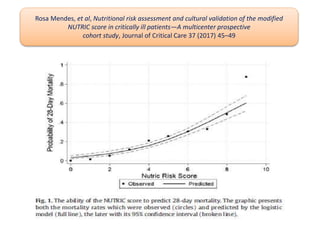
Patients with a high Nutric-score at admittion to the intensive care have a higher
mortality risk.
Rosa Mendes, et al, Nutritional risk assessment and cultural validation of the modified
NUTRIC score in critically ill patients—A multicenter prospective
cohort study, Journal of Critical Care 37 (2017) 45–49
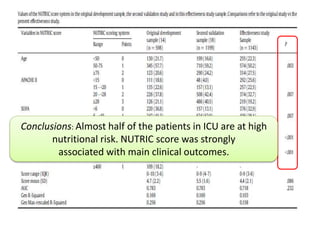
Conclusions: Almost half of the patients in ICU are at high
nutritional risk. NUTRIC score was strongly
associated with main clinical outcomes.
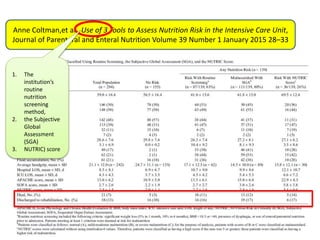
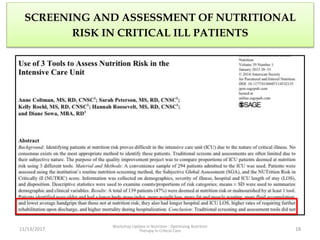
Anne Coltman,et al, Use of 3 Tools to Assess Nutrition Risk in the Intensive Care Unit,
Journal of Parenteral and Enteral Nutrition Volume 39 Number 1 January 2015 28–33
1. The
institution’s
routine
nutrition
screening
method,
2. the Subjective
Global
Assessment
(SGA)
3. NUTRIC) score
SCREENING AND ASSESSMENT OF NUTRITIONAL
RISK IN CRITICAL ILL PATIENTS
11/13/2017
Workshop Update in Nutrition : Optimizing Nutrition
Therapy in Critical Care 18
SCREENING AND ASSESSMENT OF NUTRITIONAL
RISK IN CRITICAL ILL PATIENTS
11/13/2017
Workshop Update in Nutrition : Optimizing Nutrition
Therapy in Critical Care 19
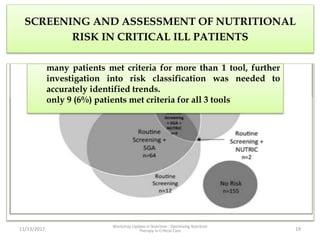
many patients met criteria for more than 1 tool, further
investigation into risk classification was needed to
accurately identified trends.
only 9 (6%) patients met criteria for all 3 tools
SCREENING AND ASSESSMENT OF NUTRITIONAL RISK IN
CRITICAL ILL PATIENTS
11/13/2017
Workshop Update in Nutrition : Optimizing Nutrition
Therapy in Critical Care 20
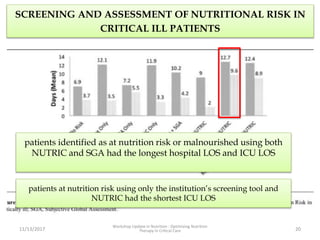
patients identified as at nutrition risk or malnourished using both
NUTRIC and SGA had the longest hospital LOS and ICU LOS
patients at nutrition risk using only the institution’s screening tool and
NUTRIC had the shortest ICU LOS
NUTRITIONAL THERAPY IN
CRITICAL ILL PATIENTS
• Nutrition care is considered to be a basic and
mandatory (essential) element of modern intensive
care treatment
• Nutrition care in the ICU has several challenges :
– the usual control mechanism such as hunger and thirst may be
missing during critical illness
– the control of intake is under external control, nutrients may have a
complex interactions with various organ systems
– acute illness triggers internal production of nutrients, usually called
catabolism, that does not immediately stop when external nutrient
were given
11/13/2017
Workshop Update in Nutrition : Optimizing Nutrition
Therapy in Critical Care 21
NUTRITIONAL THERAPY IN
CRITICAL ILL PATIENTS
• The challenge of nutrition science and nutrition
care is to define to margin :
– the minimal requirement for macro and micronutrient
necessary for acute illness and the maximum tolerable margin
– a new concept is that minimal requirements and maximum
tolerable concentrations vary during the course of acute illness
11/13/2017
Workshop Update in Nutrition : Optimizing Nutrition
Therapy in Critical Care 22
NUTRITIONAL THERAPY IN
CRITICAL ILL PATIENTS
11/13/2017
Workshop Update in Nutrition : Optimizing Nutrition
Therapy in Critical Care 23
Figure 3. Margins for macronutrient between minimum and danger zone
*during health conditions, minimum and danger zone was constantly
*but in acute illness, there is a change and endogenous mobilization of
macronutrients combined with external supply of nutrients , thus the
danger limit and minimum may be changed
NUTRITIONAL THERAPY IN
CRITICAL ILL PATIENTS
• The ESPEN guidelines state that :
– 20-25 kcal/kg/d in the acute and initial phase of
critical illness
– 25-30 kcal/kg/d in the anabolic recovery phase
11/13/2017
Workshop Update in Nutrition : Optimizing Nutrition
Therapy in Critical Care 24
NUTRITIONAL THERAPY IN
CRITICAL ILL PATIENTS
11/13/2017
Workshop Update in Nutrition : Optimizing Nutrition
Therapy in Critical Care 25
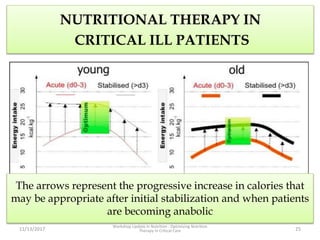
Figure 4. actual body weight vs calorie intake
The arrows represent the progressive increase in calories that
may be appropriate after initial stabilization and when patients
are becoming anabolic
NUTRITIONAL THERAPY IN
CRITICAL ILL PATIENTS
• Amount of protein needed :
– In principle the amount of protein needed should be
sufficient to cover usual protein turn-over plus the
additional needs related to the increased protein
synthesis in the liver and in injured tissues.
– 1.0 -1.5 g/kg/d is sufficient
– Protein breakdown associated with starvation needs
several days before a decrease occurs.
– There is an additional breakdown associated with the
inflammatory process but also with bed-rest and disuse of
muscle.
11/13/2017
Workshop Update in Nutrition : Optimizing Nutrition
Therapy in Critical Care 26
NUTRITIONAL THERAPY IN
CRITICAL ILL PATIENTS
• Modifications in the composition of the diet are considered
in three clinical situations:
Difficult to handle hyperglycaemia
Excessive hyperlipidaemia ( > 400 mg.dl-1)
High CO2 values and weaning problems
• Increased nutritional requirements during critical illness
must be matched by appropriate infusion of calories and
nitrogen, especially when severe malnutrition is present, in
the case of insufficient oral intake or expected delay before
recovery of eating;
11/13/2017
Workshop Update in Nutrition : Optimizing Nutrition
Therapy in Critical Care 27
NUTRITIONAL THERAPY IN
CRITICAL ILL PATIENTS
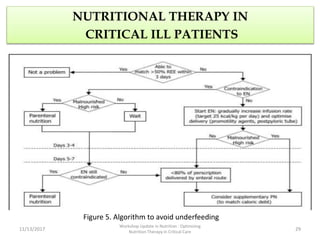
• Early enteral nutrition can be systematically considered in
patients unlikely to recover their ability to eat within 48
hours after injury; if not achievable, parenteral nutrition
should be considered soon or later;
• Inappropriately high amounts of energy-yielding substrates
can lead to detrimental effects, especially after a long period
of fasting;
• Avoid underfeeding in critical ill patients
• The administration of an appropriate amount of nutrients by
the oral or enteral route is preferred over a parenteral
infusion.
11/13/2017
Workshop Update in Nutrition : Optimizing Nutrition
Therapy in Critical Care 28
NUTRITIONAL THERAPY IN
CRITICAL ILL PATIENTS
11/13/2017
Workshop Update in Nutrition : Optimizing
Nutrition Therapy in Critical Care
29
Figure 5. Algorithm to avoid underfeeding
NUTRITIONAL THERAPY IN
CRITICAL ILL PATIENTS
• However, significant barriers can impede the enteral
administration of nutrients, including gastroduodenal
dysfunction reflected by high gastric residual volumes, and
diarrhoea and constipation.
• Possible solutions are suggested. In case of contraindication
or failure of enteral nutrition, parenteral nutrition is
indicated -----as a replacement or a supplement to failing
enteral feeding.
• The perfect timing of supplemental parenteral nutrition
(early or late) remains uncertain, and parenteral nutrition
should be carefully monitored.
11/13/2017
Workshop Update in Nutrition : Optimizing
Nutrition Therapy in Critical Care
30
THANK YOU
Have a nice day
11/13/2017 31
Workshop Update in Nutrition : Optimizing Nutrition Therapy in Critical Care

Nutrition risk assessment 2017

  • 1.
    CURRICULUM VITAE Officer Position/Rank: Senior Lecturer/ IV e Phone : Office : 0411- 585705, 0411-585 706, Home : 0411- 586-545, Fax: 0411.586 984 Email : pudji_taslim@yahoo.com EDUCATION : Dokter (FK UNHAS, 1984) Diploma Community Nutrition (SEAMEO UI, 1990) MPH Nutrition (Univ. of Carolina at ChapeI Hill, USA (1994) Doktor, Pasca Sarjana Universitas Hasanuddin (2004) Guru Besar UNHAS (2006) Job Description: Ketua Perhimpunan Dokter Gizi Klinik Indonesia Ketua SMF Gizi Klinik RS Wahidin Sudirohusodo, Makassar Ketua Komisi 2 Senat Akademk Bidang Penelitian & Pengabdian Masyarakat Ketua Senat Fakultas Kedokteran Univ Hasanuddin Anggota Pokja Ahli Dewan Ketahanan Pangan Nasional, Kementerian Pertanian RI Anggota Panel Ahli HIV/AIDS Kementerian Kesehatan RI Ketua SP3T Prov.Sulawesi Selatan Prof DR dr Nurpudji A Taslim, MPH, SpGK (K)
  • 2.
    NUTRITIONAL ASSESSMENT AND APLICATIONIN CRITICAL ILL PATIENTS Nurpudji A. Taslim Dept. of Nutrition School of Medicine Universitas Hasanuddin Clinical Nutrition Functional Unit Wahidin Sudirohusodo Hospital 2017 Workshop Update in Nutrition : Optimizing Nutrition Therapy in Critical Care, 12/11/2017 2
  • 3.
    OUTLINE • Learning objective •Overview • Screening and assessment of nutrition in critical ill patients • Nutritional management on critical ill patients 11/13/2017 Workshop Update in Nutrition : Optimizing Nutrition Therapy in Critical Care 3
  • 4.
    LEARNING OBJECTIVE • ableto know nutritional screening and nutritional assessment in critical ill patients • able to do nutritional screening and nutritional assessment in critical ill patients • able to know nutritional therapy in critical ill patients 11/13/2017 Workshop Update in Nutrition : Optimizing Nutrition Therapy in Critical Care 4
  • 5.
    OVERVIEW • Identifying patientsat nutrition risk difficult in the intensive care unit (ICU) due to the nature of critical illness. • Traditional screens and assessments are often limited due to their subjective nature. • Accurately identifying patients at risk for malnutrition is essential to decrease negative outcomes during hospitalization. • Inflammation was the importance factor cause malnutrition. 11/13/2017 Workshop Update in Nutrition : Optimizing Nutrition Therapy in Critical Care 5
  • 6.
    OVERVIEW 11/13/2017 Workshop Update inNutrition : Optimizing Nutrition Therapy in Critical Care 6
  • 7.
    Screening tools recommendedby ESPEN (2017) Community: Malnutrition Universal Screening Tool (MUST) rapid estimate grade undernutrition Hospital: Nutritional Risk Screening (NRS) simple and well validated (Quesionaires) Elderly: Mini Nutritional Assessment (MNA) pt >65 y,o—combination screening & assessment tool 11/13/2017 Workshop Update in Nutrition : Optimizing Nutrition Therapy in Critical Care 7 Nutric-Score for Risk Screening in the ICU (age, apache II, sofa, co-morbid, days from hospital to ICU, IL-6)
  • 8.
    SCREENING AND ASSESSMENTOF NUTRITIONAL RISK IN CRITICAL ILL PATIENTS • Many of criteria to identifying nutrition risk were difficult to obtain such as : – food intake histories – functional status and gastrointestinal (GI) symptoms because it require patient interview or previous knowledge of body habitus. • Many traditional tools do not provide information regarding inflammatory status. 11/13/2017 Workshop Update in Nutrition : Optimizing Nutrition Therapy in Critical Care 8
  • 9.
    SCREENING AND ASSESSMENTOF NUTRITIONAL RISK IN CRITICAL ILL PATIENTS • The institution’s routine screening : – recent unintentional weight loss (5% in 1 month, 10% in 6 month) – BMI < 18.5 or > 40 – presence of dysphagia/inadequate food intake prior to admittance or use of enteral nutrition (EN)/parenteral nutrition (PN) • Patient meeting at least 1 criterion were deemed at risk for malnutrition • This screening do not provide inflammatory status 11/13/2017 Workshop Update in Nutrition : Optimizing Nutrition Therapy in Critical Care 9
  • 10.
    SCREENING AND ASSESSMENTOF NUTRITIONAL RISK IN CRITICAL ILL PATIENTS 11/13/2017 Workshop Update in Nutrition : Optimizing Nutrition Therapy in Critical Care 10
  • 11.
    SCREENING AND ASSESSMENTOF NUTRITIONAL RISK IN CRITICAL ILL PATIENTS • Subjective Global Assessment (SGA) : – this tools had a variety of criteria to identify nutrition risk, including clinical diagnosis, laboratory data, physical examination, anthropometric data, food/nutrient intake and functional assessment. – these indicators were primarily validated in outpatients or general hospitalized population, they were not specifically designed for use in the ICU. – many of these criteria may be difficult to obtain in critically ill patients. 11/13/2017 Workshop Update in Nutrition : Optimizing Nutrition Therapy in Critical Care 11
  • 12.
    SCREENING AND ASSESSMENTOF NUTRITIONAL RISK IN CRITICAL ILL PATIENTS 11/13/2017Workshop Update in Nutrition : Optimizing Nutrition Therapy in Critical Care 12
  • 13.
    SCREENING AND ASSESSMENTOF NUTRITIONAL RISK IN CRITICAL ILL PATIENTS • The NUTrition Risk in Critically ill (NUTRIC) score : – a tool introduced by Heyland et al, to identify patients who would most benefit form aggressive nutrition support in the ICU – this tool linking starvation, inflammation and outcomes – however, this tool includes no traditional markers of nutrition risk, such as body mass index (BMI), weight status, oral intake or physical assessment, and may have limited clinical application due to its exclusion of nutritional history variables. – patients were classified as having a higher risk of malnutrition if the sum was 5 or greater 11/13/2017 Workshop Update in Nutrition : Optimizing Nutrition Therapy in Critical Care 13
  • 14.
    SCREENING AND ASSESSMENTOF NUTRITIONAL RISK IN CRITICAL ILL PATIENTS Patients with a high Nutric-score at admittion to the intensive care have a higher mortality risk.
  • 15.
    Rosa Mendes, etal, Nutritional risk assessment and cultural validation of the modified NUTRIC score in critically ill patients—A multicenter prospective cohort study, Journal of Critical Care 37 (2017) 45–49
  • 16.
    Conclusions: Almost halfof the patients in ICU are at high nutritional risk. NUTRIC score was strongly associated with main clinical outcomes.
  • 17.
    Anne Coltman,et al,Use of 3 Tools to Assess Nutrition Risk in the Intensive Care Unit, Journal of Parenteral and Enteral Nutrition Volume 39 Number 1 January 2015 28–33 1. The institution’s routine nutrition screening method, 2. the Subjective Global Assessment (SGA) 3. NUTRIC) score
  • 18.
    SCREENING AND ASSESSMENTOF NUTRITIONAL RISK IN CRITICAL ILL PATIENTS 11/13/2017 Workshop Update in Nutrition : Optimizing Nutrition Therapy in Critical Care 18
  • 19.
    SCREENING AND ASSESSMENTOF NUTRITIONAL RISK IN CRITICAL ILL PATIENTS 11/13/2017 Workshop Update in Nutrition : Optimizing Nutrition Therapy in Critical Care 19 many patients met criteria for more than 1 tool, further investigation into risk classification was needed to accurately identified trends. only 9 (6%) patients met criteria for all 3 tools
  • 20.
    SCREENING AND ASSESSMENTOF NUTRITIONAL RISK IN CRITICAL ILL PATIENTS 11/13/2017 Workshop Update in Nutrition : Optimizing Nutrition Therapy in Critical Care 20 patients identified as at nutrition risk or malnourished using both NUTRIC and SGA had the longest hospital LOS and ICU LOS patients at nutrition risk using only the institution’s screening tool and NUTRIC had the shortest ICU LOS
  • 21.
    NUTRITIONAL THERAPY IN CRITICALILL PATIENTS • Nutrition care is considered to be a basic and mandatory (essential) element of modern intensive care treatment • Nutrition care in the ICU has several challenges : – the usual control mechanism such as hunger and thirst may be missing during critical illness – the control of intake is under external control, nutrients may have a complex interactions with various organ systems – acute illness triggers internal production of nutrients, usually called catabolism, that does not immediately stop when external nutrient were given 11/13/2017 Workshop Update in Nutrition : Optimizing Nutrition Therapy in Critical Care 21
  • 22.
    NUTRITIONAL THERAPY IN CRITICALILL PATIENTS • The challenge of nutrition science and nutrition care is to define to margin : – the minimal requirement for macro and micronutrient necessary for acute illness and the maximum tolerable margin – a new concept is that minimal requirements and maximum tolerable concentrations vary during the course of acute illness 11/13/2017 Workshop Update in Nutrition : Optimizing Nutrition Therapy in Critical Care 22
  • 23.
    NUTRITIONAL THERAPY IN CRITICALILL PATIENTS 11/13/2017 Workshop Update in Nutrition : Optimizing Nutrition Therapy in Critical Care 23 Figure 3. Margins for macronutrient between minimum and danger zone *during health conditions, minimum and danger zone was constantly *but in acute illness, there is a change and endogenous mobilization of macronutrients combined with external supply of nutrients , thus the danger limit and minimum may be changed
  • 24.
    NUTRITIONAL THERAPY IN CRITICALILL PATIENTS • The ESPEN guidelines state that : – 20-25 kcal/kg/d in the acute and initial phase of critical illness – 25-30 kcal/kg/d in the anabolic recovery phase 11/13/2017 Workshop Update in Nutrition : Optimizing Nutrition Therapy in Critical Care 24
  • 25.
    NUTRITIONAL THERAPY IN CRITICALILL PATIENTS 11/13/2017 Workshop Update in Nutrition : Optimizing Nutrition Therapy in Critical Care 25 Figure 4. actual body weight vs calorie intake The arrows represent the progressive increase in calories that may be appropriate after initial stabilization and when patients are becoming anabolic
  • 26.
    NUTRITIONAL THERAPY IN CRITICALILL PATIENTS • Amount of protein needed : – In principle the amount of protein needed should be sufficient to cover usual protein turn-over plus the additional needs related to the increased protein synthesis in the liver and in injured tissues. – 1.0 -1.5 g/kg/d is sufficient – Protein breakdown associated with starvation needs several days before a decrease occurs. – There is an additional breakdown associated with the inflammatory process but also with bed-rest and disuse of muscle. 11/13/2017 Workshop Update in Nutrition : Optimizing Nutrition Therapy in Critical Care 26
  • 27.
    NUTRITIONAL THERAPY IN CRITICALILL PATIENTS • Modifications in the composition of the diet are considered in three clinical situations: Difficult to handle hyperglycaemia Excessive hyperlipidaemia ( > 400 mg.dl-1) High CO2 values and weaning problems • Increased nutritional requirements during critical illness must be matched by appropriate infusion of calories and nitrogen, especially when severe malnutrition is present, in the case of insufficient oral intake or expected delay before recovery of eating; 11/13/2017 Workshop Update in Nutrition : Optimizing Nutrition Therapy in Critical Care 27
  • 28.
    NUTRITIONAL THERAPY IN CRITICALILL PATIENTS • Early enteral nutrition can be systematically considered in patients unlikely to recover their ability to eat within 48 hours after injury; if not achievable, parenteral nutrition should be considered soon or later; • Inappropriately high amounts of energy-yielding substrates can lead to detrimental effects, especially after a long period of fasting; • Avoid underfeeding in critical ill patients • The administration of an appropriate amount of nutrients by the oral or enteral route is preferred over a parenteral infusion. 11/13/2017 Workshop Update in Nutrition : Optimizing Nutrition Therapy in Critical Care 28
  • 29.
    NUTRITIONAL THERAPY IN CRITICALILL PATIENTS 11/13/2017 Workshop Update in Nutrition : Optimizing Nutrition Therapy in Critical Care 29 Figure 5. Algorithm to avoid underfeeding
  • 30.
    NUTRITIONAL THERAPY IN CRITICALILL PATIENTS • However, significant barriers can impede the enteral administration of nutrients, including gastroduodenal dysfunction reflected by high gastric residual volumes, and diarrhoea and constipation. • Possible solutions are suggested. In case of contraindication or failure of enteral nutrition, parenteral nutrition is indicated -----as a replacement or a supplement to failing enteral feeding. • The perfect timing of supplemental parenteral nutrition (early or late) remains uncertain, and parenteral nutrition should be carefully monitored. 11/13/2017 Workshop Update in Nutrition : Optimizing Nutrition Therapy in Critical Care 30
  • 31.
    THANK YOU Have anice day 11/13/2017 31 Workshop Update in Nutrition : Optimizing Nutrition Therapy in Critical Care

Editor's Notes

  • #7 In ICU patients, many aids tools to help the organ.
  • #15 APACHE II ----Acute Physiology And Chronic Health Evaluation SOFA---------- Sequential Organ Failure Assessment