
Oncology Nursing Nurse Licensure Examination Review pinoynursing.webkotoh.com
Oncology defined Branch of medicine that deals with the study, detection, treatment and management of cancer and neoplasia
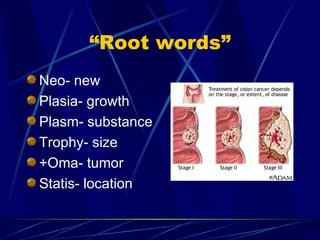
“Root words” Neo- new Plasia- growth Plasm- substance Trophy- size +Oma- tumor Statis- location
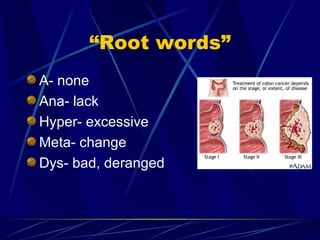
“Root words” A- none Ana- lack Hyper- excessive Meta- change Dys- bad, deranged
Characteristics of Neoplasia Uncontrolled growth of Abnormal cells 1. Benign 2. Malignant 3. Borderline
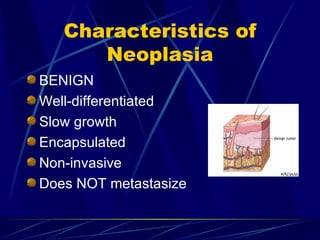
Characteristics of Neoplasia BENIGN Well-differentiated Slow growth Encapsulated  Non-invasive Does NOT metastasize
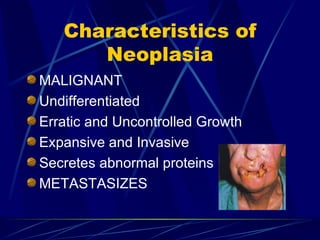
Characteristics of Neoplasia MALIGNANT Undifferentiated Erratic and Uncontrolled Growth Expansive and Invasive Secretes abnormal proteins METASTASIZES
 
 
Nomenclature of Neoplasia Tumor is named according to: 1. Parenchyma, Organ or Cell Hepatoma- liver Osteoma- bone Myoma- muscle
Nomenclature of Neoplasia Tumor is named according to: 2. Pattern and Structure, either GROSS or MICROSCOPIC Fluid-filled   CYST Glandular   ADENO Finger-like   PAPILLO Stalk   POLYP
Nomenclature of Neoplasia Tumor is named according to: 3. Embryonic origin Ectoderm ( usually gives rise to epithelium) Endoderm (usually gives rise to glands) Mesoderm (usually gives rise to Connective tissues)
BENIGN TUMORS Suffix- “OMA” is used Adipose tissue- LipOMA Bone- osteOMA Muscle- myOMA Blood vessels- angiOMA Fibrous tissue- fibrOMA
MALIGNANT TUMOR Named according to embryonic cell origin 1. Ectodermal, Endodermal, Glandular, Epithelial Use the suffix- “CARCINOMA” Pancreatic AdenoCarcinoma Squamos cell Carcinoma
MALIGNANT TUMOR Named according to embryonic cell origin 2. Mesodermal, connective tissue origin Use the suffix “SARCOMA FibroSarcoma Myosarcoma AngioSarcoma
“PASAWAY” 1. “OMA” but Malignant HepatOMA, lymphOMA, gliOMA, melanOMA 2. THREE germ layers “ TERATOMA” 3. Non-neoplastic but “OMA” Choristoma Hamatoma
CANCER NURSING Review of Normal Cell Cycle 3 types of cells 1. PERMANENT cells- out of the cell cycle Neurons, cardiac muscle cell 2. STABLE cells- Dormant/Resting (G0) Liver, kidney 3. LABILE cells- continuously dividing GIT cells, Skin, endometrium , Blood cells
CANCER NURSING Cell Cycle G0------------------G1  S  G2  M G0- Dormant or resting G1- normal cell activities S-  DNA Synthesis G2- pre-mitotic, synthesis of proteins for cellular division M- Mitotic phase (I-P-M-A-T)
CANCER NURSING Proposed Molecular cause of CANCER: Change in the DNA structure   altered DNA function   Cellular aberration    cellular death    neoplastic change Genes in the DNA- “proto-oncogene” And “anti-oncogene”
CANCER NURSING Etiology of cancer 1. PHYSICAL AGENTS Radiation Exposure to irritants Exposure to sunlight Altitude, humidity
CANCER NURSING Etiology of cancer 2. CHEMICAL AGENTS Smoking Dietary ingredients Drugs
CANCER NURSING Etiology of cancer 3. Genetics and Family History Colon Cancer Premenopausal breast cancer
CANCER NURSING Etiology of cancer 4. Dietary Habits Low-Fiber High-fat Processed foods alcohol
CANCER NURSING Etiology of cancer 5. Viruses and Bacteria DNA viruses- HepaB, Herpes, EBV, CMV, Papilloma Virus RNA Viruses- HIV, HTCLV Bacterium- H. pylori
CANCER NURSING Etiology of cancer 6. Hormonal agents DES OCP especially estrogen
CANCER NURSING Etiology of cancer 7. Immune Disease AIDS
CANCER NURSING CARCINOGENSIS Malignant transformation I  P  P Initiation Promotion Progression
CANCER NURSING CARCINOGENSIS INITIATION Carcinogens alter the DNA of the cell Cell will either die or repair
CANCER NURSING CARCINOGENSIS PROMOTION Repeated exposure to carcinogens Abnormal gene will express Latent period
CANCER NURSING CARCINOGENSIS PROGRESSION Irreversible period Cells undergo NEOPLASTIC transformation then malignancy
CANCER NURSING Spread of Cancer 1. LYMPHATIC Most common 2. HEMATOGENOUS Blood-borne, commonly to Liver and Lungs 3. DIRECT SPREAD Seeding of tumors
CANCER NURSING Body Defenses Against TUMOR 1. T cell System/ Cellular Immunity Cytotoxic T cells kill tumor cells 2. B cell System/ Humoral immunity B cells can produce antibody 3. Phagocytic cells Macrophages can engulf cancer cell debris
CANCER NURSING Cancer Diagnosis 1. BIOPSY  The most definitive 2. CT, MRI 3. Tumor Markers
CANCER NURSING Cancer Grading  The degree of DIFFERENTIATION Grade 1- Low grade Grade 4- high grade
CANCER NURSING Cancer Staging 1. Uses the T-N-M staging system T- tumor N- Node M- Metastasis 2. Stage 1 to Stage 4
CANCER NURSING GENERAL MEDICAL MANAGEMENT 1. Surgery- cure, control, palliate 2. Chemotherapy 3. Radiation therapy 4. Immunotherapy 5. Bone Marrow Transplant
CANCER NURSING GENERAL Promotive and Preventive Nursing Management 1. Lifestyle Modification 2. Nutritional management 3. Screening 4. Early detection
SCREENING 1. Male and female- Occult Blood, CXR, and DRE 2. Female- SBE, CBE, Mammography and Pap’s Smear 3. Male- DRE for prostate, Testicular self-exam
Nursing Assessment Utilize the ACS 7 Warning Signals CAUTION C- Change in bowel/bladder habits A- A sore that does not heal U- Unusual bleeding T- Thickening or lump in the breast I- Indigestion O- Obvious change in warts N- Nagging cough and hoarseness
Nursing Assessment Weight loss Frequent infection Skin problems Pain Hair Loss Fatigue Disturbance in body image/ depression
Nursing Intervention MAINTAIN TISSUE INTEGRITY Handle skin gently Do NOT rub affected area Lotion may be applied Wash skin only with SOAP and Water
Nursing Intervention MANAGEMENT OF STOMATITIS Use soft-bristled toothbrush  Oral rinses with saline gargles/ tap water Avoid ALCOHOL-based rinses
Nursing Intervention MANAGEMENT OF ALOPECIA Alopecia begins within 2 weeks of therapy Regrowth within 8 weeks of termination Encourage to acquire wig before hair loss occurs Encourage use of attractive scarves and hats Provide information that hair loss is temporary BUT anticipate change in texture and color
Nursing Intervention PROMOTE NUTRITION Serve food in ways to make it appealing Consider patient’s preferences Provide small frequent meals Avoids giving fluids while eating Oral hygiene PRIOR to mealtime Vitamin supplements
Nursing Intervention RELIEVE PAIN Mild pain- NSAIDS Moderate pain- Weak opiods Severe pain- Morphine Administer analgesics round the clock with additional dose for breakthrough pain
Nursing Intervention DECREASE FATIGUE Plan daily activities to allow alternating rest periods Light exercise is encouraged Small frequent meals
Nursing Intervention IMPROVE BODY IMAGE Therapeutic communication is essential Encourage independence in self-care and decision making Offer cosmetic material like make-up and wigs
Nursing Intervention ASSIST IN THE GRIEVING PROCESS Some cancers are curable Grieving can be due to loss of health, income, sexuality, and body image Answer and clarify information about cancer and treatment options Identify resource people Refer to support groups
Nursing Intervention MANAGE COMPLICATION: INFECTION Fever is the most important sign (38.3) Administer prescribed antibiotics X 2weeks Maintain aseptic technique  Avoid exposure to crowds  Avoid giving fresh fruits and veggie Handwashing Avoid frequent invasive procedures
Nursing Intervention MANAGE COMPLICATION: Septic shock Monitor VS, BP, temp Administer IV antibiotics Administer supplemental O2
Nursing Intervention MANAGE COMPLICATION: Bleeding Thrombocytopenia (<100,000) is the most common cause  <20, 000   spontaneous bleeding Use soft toothbrush Use electric razor Avoid frequent IM, IV, rectal and catheterization Soft foods and stool softeners
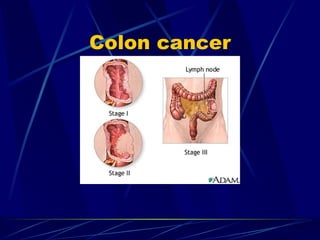
Colon cancer
COLON CANCER Risk factors 1. Increasing age 2. Family history 3. Previous colon CA or polyps 4.  History of IBD 5. High fat, High protein, LOW fiber 6. Breast Ca and Genital Ca
COLON CANCER Sigmoid colon is the most common site Predominantly adenocarcinoma If early   90% survival 34 % diagnosed early 66% late diagnosis
COLON CANCER PATHOPHYSIOLOGY Benign neoplasm   DNA alteration   malignant transformation   malignant neoplasm    cancer growth and invasion    metastasis (liver)
COLON CANCER ASSESSMENT FINDINGS 1.  Change in bowel habits- Most common 2. Blood in the stool 3. Anemia 4. Anorexia and weight loss 5. Fatigue 6. Rectal lesions- tenesmus, alternating D and C
Colon cancer Diagnostic findings 1. Fecal occult blood 2. Sigmoidoscopy and colonoscopy 3. BIOPSY 4. CEA- carcino-embryonic antigen
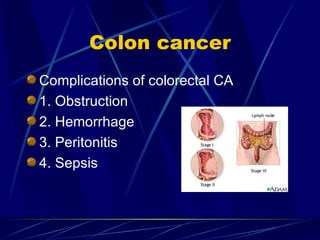
Colon cancer Complications of colorectal CA 1. Obstruction 2. Hemorrhage 3. Peritonitis 4. Sepsis
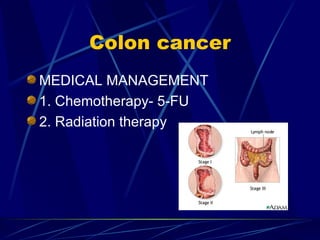
Colon cancer MEDICAL MANAGEMENT 1. Chemotherapy- 5-FU 2. Radiation therapy
Colon cancer SURGICAL MANAGEMENT Surgery is the primary treatment Based on location and tumor size Resection, anastomosis, and colostomy (temporary or permanent)
Colon cancer NURSING INTERVENTION Pre-Operative care 1. Provide HIGH protein, HIGH calorie and LOW residue diet 2.Provide information about post-op care and stoma care 3. Administer antibiotics 1 day prior
Colon cancer NURSING INTERVENTION Pre-Operative care 4. Enema or colonic irrigation the evening and the morning of surgery 5. NGT is inserted to prevent distention 6. Monitor UO, F and E, Abdomen PE
Colon cancer NURSING INTERVENTION Post-Operative care 1. Monitor for complications Leakage from the site, prolapse of stoma, skin irritation and pulmo complication 2. Assess the abdomen for return of peristalsis
Colon cancer NURSING INTERVENTION Post-Operative care 3. Assess wound dressing for bleeding 4. Assist patient in ambulation after 24H 5.provide nutritional teaching Limit foods that cause gas-formation and odor Cabbage, beans, eggs, fish, peanuts Low-fiber diet in the early stage of recovery
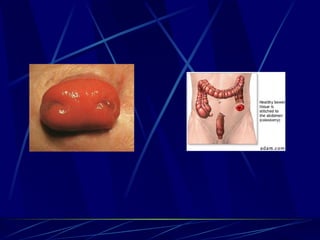
Colon cancer NURSING INTERVENTION Post-Operative care 6. Instruct to splint the incision and administer pain meds before exercise 7. The stoma is PINKISH to cherry red, Slightly edematous with minimal pinkish drainage 8. Manage post-operative complication
 
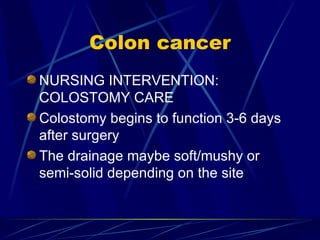
Colon cancer NURSING INTERVENTION: COLOSTOMY CARE Colostomy begins to function 3-6 days after surgery The drainage maybe soft/mushy or semi-solid depending on the site
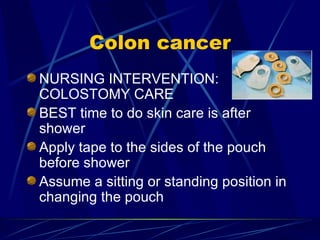
Colon cancer NURSING INTERVENTION: COLOSTOMY CARE BEST time to do skin care is after shower Apply tape to the sides of the pouch before shower Assume a sitting or standing position in changing the pouch
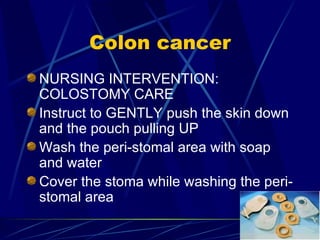
Colon cancer NURSING INTERVENTION: COLOSTOMY CARE Instruct to GENTLY push the skin down and the pouch pulling UP Wash the peri-stomal area with soap and water Cover the stoma while washing the peri-stomal area
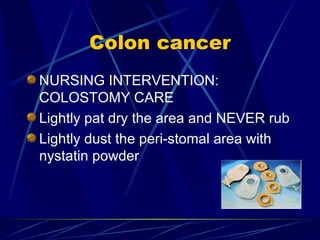
Colon cancer NURSING INTERVENTION: COLOSTOMY CARE Lightly pat dry the area and NEVER rub Lightly dust the peri-stomal area with nystatin powder
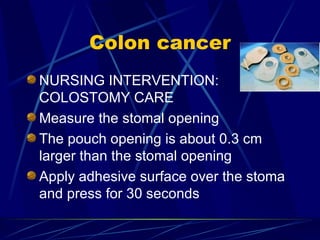
Colon cancer NURSING INTERVENTION: COLOSTOMY CARE Measure the stomal opening The pouch opening is about 0.3 cm larger than the stomal opening Apply adhesive surface over the stoma and press for 30 seconds
Colon cancer NURSING INTERVENTION: COLOSTOMY CARE Empty the pouch or change the pouch when 1/3 to ¼ full (Brunner) ½ to 1/3 full (Kozier)
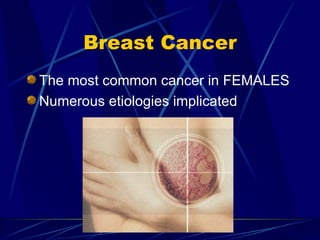
Breast Cancer The most common cancer in FEMALES Numerous etiologies implicated
Breast Cancer RISK FACTORS 1. Genetics- BRCA1 And BRCA 2 2. Increasing age ( > 50yo) 3. Family History of breast cancer 4. Early menarche and late menopause 5. Nulliparity 6. Late age at pregnancy
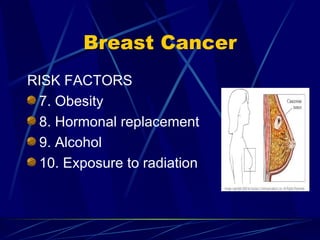
Breast Cancer RISK FACTORS 7. Obesity 8. Hormonal replacement 9. Alcohol 10. Exposure to radiation
Breast Cancer PROTECTIVE FACTORS 1. Exercise 2. Breast feeding 3. Pregnancy before 30 yo
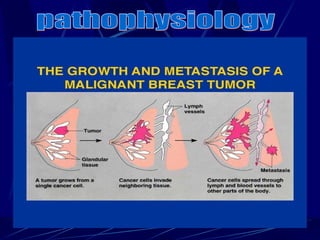
pathophysiology
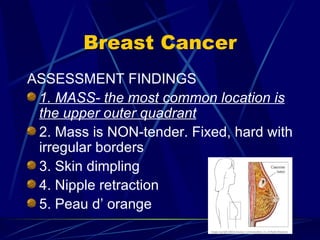
Breast Cancer ASSESSMENT FINDINGS 1. MASS- the most common location is the upper outer quadrant 2. Mass is NON-tender. Fixed, hard with irregular borders 3. Skin dimpling 4. Nipple retraction 5. Peau d’ orange
Breast Cancer LABORATORY FINDINGS 1. Biopsy procedures 2. Mammography
Breast Cancer Breast cancer Staging TNM staging I  -  < 2cm II -  2 to 5 cm, (+) LN III - > 5 cm, (+) LN IV- metastasis
Breast Cancer MEDICAL MANAGEMENT 1. Chemotherapy 2. Tamoxifen therapy 3. Radiation therapy
Breast Cancer SURGICAL MANAGEMENT 1. Radical mastectomy 2. Modified radical mastectomy 3. Lumpectomy 4. Quadrantectomy
Breast Cancer NURSING INTERVENTION : PRE-OP 1. Explain breast cancer and treatment options 2. Reduce fear and anxiety and improve coping abilities 3. Promote decision making abilities 4. Provide routine pre-op care: Consent, NPO, Meds, Teaching about breathing exercise
Breast Cancer NURSING INTERVENTION :  Post-OP 1. Position patient:  Supine Affected extremity elevated to reduce edema
Breast Cancer NURSING INTERVENTION : Post-OP 2. Relieve pain and discomfort Moderate elevation of extremity IM/IV injection of pain meds Warm shower on 2 nd  day post-op
Breast Cancer NURSING INTERVENTION : Post-OP 3. Maintain skin integrity Immediate post-op: snug dressing with drainage Maintain patency of drain (JP) Monitor for hematoma w/in 12H and apply bandage and ice, refer to surgeon
Breast Cancer NURSING INTERVENTION : Post-OP 3. Maintain skin integrity Drainage is removed when the discharge is less than 30 ml in 24 H Lotions, Creams are applied ONLY when the incision is healed in 4-6 weeks
Breast Cancer NURSING INTERVENTION : Post-OP Promote activity Support operative site when moving Hand, shoulder exercise done on 2 nd day Post-op mastectomy exercise 20 mins TID NO BP or IV procedure on operative site
Breast Cancer NURSING INTERVENTION : Post-OP Promote activity Heavy lifting is avoided Elevate the arm at the level of the heart On a pillow for 45 minutes  TID to relieve transient edema
Breast Cancer NURSING INTERVENTION : Post-OP MANAGE COMPLICATIONS Lymphedema 10-20% of patients Elevate arms, elbow above shoulder and hand above elbow Hand exercise while elevated Refer to surgeon and physical therapist
Breast Cancer NURSING INTERVENTION : Post-OP MANAGE COMPLICATIONS Hematoma Notify the surgeon Apply bandage wrap (Ace wrap) and ICE pack
Breast Cancer NURSING INTERVENTION : Post-OP MANAGE COMPLICATIONS Infection Monitor temperature, redness, swelling and foul-odor IV antibiotics No procedure on affected extremity
Breast Cancer NURSING INTERVENTION : Post-OP TEACH FOLLOW-UP care Regular check-up Monthly BSE on the other breast Annual mammography

Cancer Nursing

  • 1.
    Oncology Nursing NurseLicensure Examination Review pinoynursing.webkotoh.com
  • 2.
    Oncology defined Branchof medicine that deals with the study, detection, treatment and management of cancer and neoplasia
  • 3.
    “Root words” Neo-new Plasia- growth Plasm- substance Trophy- size +Oma- tumor Statis- location
  • 4.
    “Root words” A-none Ana- lack Hyper- excessive Meta- change Dys- bad, deranged
  • 5.
    Characteristics of NeoplasiaUncontrolled growth of Abnormal cells 1. Benign 2. Malignant 3. Borderline
  • 6.
    Characteristics of NeoplasiaBENIGN Well-differentiated Slow growth Encapsulated Non-invasive Does NOT metastasize
  • 7.
    Characteristics of NeoplasiaMALIGNANT Undifferentiated Erratic and Uncontrolled Growth Expansive and Invasive Secretes abnormal proteins METASTASIZES
  • 8.
  • 9.
  • 10.
    Nomenclature of NeoplasiaTumor is named according to: 1. Parenchyma, Organ or Cell Hepatoma- liver Osteoma- bone Myoma- muscle
  • 11.
    Nomenclature of NeoplasiaTumor is named according to: 2. Pattern and Structure, either GROSS or MICROSCOPIC Fluid-filled  CYST Glandular  ADENO Finger-like  PAPILLO Stalk  POLYP
  • 12.
    Nomenclature of NeoplasiaTumor is named according to: 3. Embryonic origin Ectoderm ( usually gives rise to epithelium) Endoderm (usually gives rise to glands) Mesoderm (usually gives rise to Connective tissues)
  • 13.
    BENIGN TUMORS Suffix-“OMA” is used Adipose tissue- LipOMA Bone- osteOMA Muscle- myOMA Blood vessels- angiOMA Fibrous tissue- fibrOMA
  • 14.
    MALIGNANT TUMOR Namedaccording to embryonic cell origin 1. Ectodermal, Endodermal, Glandular, Epithelial Use the suffix- “CARCINOMA” Pancreatic AdenoCarcinoma Squamos cell Carcinoma
  • 15.
    MALIGNANT TUMOR Namedaccording to embryonic cell origin 2. Mesodermal, connective tissue origin Use the suffix “SARCOMA FibroSarcoma Myosarcoma AngioSarcoma
  • 16.
    “PASAWAY” 1. “OMA”but Malignant HepatOMA, lymphOMA, gliOMA, melanOMA 2. THREE germ layers “ TERATOMA” 3. Non-neoplastic but “OMA” Choristoma Hamatoma
  • 17.
    CANCER NURSING Reviewof Normal Cell Cycle 3 types of cells 1. PERMANENT cells- out of the cell cycle Neurons, cardiac muscle cell 2. STABLE cells- Dormant/Resting (G0) Liver, kidney 3. LABILE cells- continuously dividing GIT cells, Skin, endometrium , Blood cells
  • 18.
    CANCER NURSING CellCycle G0------------------G1  S  G2  M G0- Dormant or resting G1- normal cell activities S- DNA Synthesis G2- pre-mitotic, synthesis of proteins for cellular division M- Mitotic phase (I-P-M-A-T)
  • 19.
    CANCER NURSING ProposedMolecular cause of CANCER: Change in the DNA structure  altered DNA function  Cellular aberration  cellular death  neoplastic change Genes in the DNA- “proto-oncogene” And “anti-oncogene”
  • 20.
    CANCER NURSING Etiologyof cancer 1. PHYSICAL AGENTS Radiation Exposure to irritants Exposure to sunlight Altitude, humidity
  • 21.
    CANCER NURSING Etiologyof cancer 2. CHEMICAL AGENTS Smoking Dietary ingredients Drugs
  • 22.
    CANCER NURSING Etiologyof cancer 3. Genetics and Family History Colon Cancer Premenopausal breast cancer
  • 23.
    CANCER NURSING Etiologyof cancer 4. Dietary Habits Low-Fiber High-fat Processed foods alcohol
  • 24.
    CANCER NURSING Etiologyof cancer 5. Viruses and Bacteria DNA viruses- HepaB, Herpes, EBV, CMV, Papilloma Virus RNA Viruses- HIV, HTCLV Bacterium- H. pylori
  • 25.
    CANCER NURSING Etiologyof cancer 6. Hormonal agents DES OCP especially estrogen
  • 26.
    CANCER NURSING Etiologyof cancer 7. Immune Disease AIDS
  • 27.
    CANCER NURSING CARCINOGENSISMalignant transformation I  P  P Initiation Promotion Progression
  • 28.
    CANCER NURSING CARCINOGENSISINITIATION Carcinogens alter the DNA of the cell Cell will either die or repair
  • 29.
    CANCER NURSING CARCINOGENSISPROMOTION Repeated exposure to carcinogens Abnormal gene will express Latent period
  • 30.
    CANCER NURSING CARCINOGENSISPROGRESSION Irreversible period Cells undergo NEOPLASTIC transformation then malignancy
  • 31.
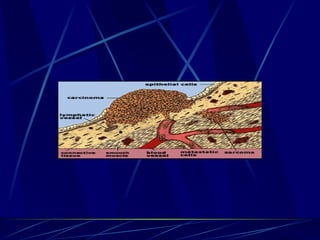
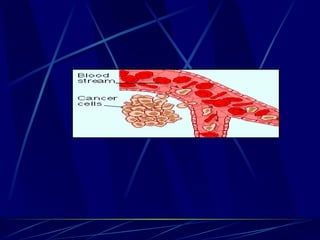
    CANCER NURSING Spreadof Cancer 1. LYMPHATIC Most common 2. HEMATOGENOUS Blood-borne, commonly to Liver and Lungs 3. DIRECT SPREAD Seeding of tumors
  • 32.
    CANCER NURSING BodyDefenses Against TUMOR 1. T cell System/ Cellular Immunity Cytotoxic T cells kill tumor cells 2. B cell System/ Humoral immunity B cells can produce antibody 3. Phagocytic cells Macrophages can engulf cancer cell debris
  • 33.
    CANCER NURSING CancerDiagnosis 1. BIOPSY The most definitive 2. CT, MRI 3. Tumor Markers
  • 34.
    CANCER NURSING CancerGrading The degree of DIFFERENTIATION Grade 1- Low grade Grade 4- high grade
  • 35.
    CANCER NURSING CancerStaging 1. Uses the T-N-M staging system T- tumor N- Node M- Metastasis 2. Stage 1 to Stage 4
  • 36.
    CANCER NURSING GENERALMEDICAL MANAGEMENT 1. Surgery- cure, control, palliate 2. Chemotherapy 3. Radiation therapy 4. Immunotherapy 5. Bone Marrow Transplant
  • 37.
    CANCER NURSING GENERALPromotive and Preventive Nursing Management 1. Lifestyle Modification 2. Nutritional management 3. Screening 4. Early detection
  • 38.
    SCREENING 1. Maleand female- Occult Blood, CXR, and DRE 2. Female- SBE, CBE, Mammography and Pap’s Smear 3. Male- DRE for prostate, Testicular self-exam
  • 39.
    Nursing Assessment Utilizethe ACS 7 Warning Signals CAUTION C- Change in bowel/bladder habits A- A sore that does not heal U- Unusual bleeding T- Thickening or lump in the breast I- Indigestion O- Obvious change in warts N- Nagging cough and hoarseness
  • 40.
    Nursing Assessment Weightloss Frequent infection Skin problems Pain Hair Loss Fatigue Disturbance in body image/ depression
  • 41.
    Nursing Intervention MAINTAINTISSUE INTEGRITY Handle skin gently Do NOT rub affected area Lotion may be applied Wash skin only with SOAP and Water
  • 42.
    Nursing Intervention MANAGEMENTOF STOMATITIS Use soft-bristled toothbrush Oral rinses with saline gargles/ tap water Avoid ALCOHOL-based rinses
  • 43.
    Nursing Intervention MANAGEMENTOF ALOPECIA Alopecia begins within 2 weeks of therapy Regrowth within 8 weeks of termination Encourage to acquire wig before hair loss occurs Encourage use of attractive scarves and hats Provide information that hair loss is temporary BUT anticipate change in texture and color
  • 44.
    Nursing Intervention PROMOTENUTRITION Serve food in ways to make it appealing Consider patient’s preferences Provide small frequent meals Avoids giving fluids while eating Oral hygiene PRIOR to mealtime Vitamin supplements
  • 45.
    Nursing Intervention RELIEVEPAIN Mild pain- NSAIDS Moderate pain- Weak opiods Severe pain- Morphine Administer analgesics round the clock with additional dose for breakthrough pain
  • 46.
    Nursing Intervention DECREASEFATIGUE Plan daily activities to allow alternating rest periods Light exercise is encouraged Small frequent meals
  • 47.
    Nursing Intervention IMPROVEBODY IMAGE Therapeutic communication is essential Encourage independence in self-care and decision making Offer cosmetic material like make-up and wigs
  • 48.
    Nursing Intervention ASSISTIN THE GRIEVING PROCESS Some cancers are curable Grieving can be due to loss of health, income, sexuality, and body image Answer and clarify information about cancer and treatment options Identify resource people Refer to support groups
  • 49.
    Nursing Intervention MANAGECOMPLICATION: INFECTION Fever is the most important sign (38.3) Administer prescribed antibiotics X 2weeks Maintain aseptic technique Avoid exposure to crowds Avoid giving fresh fruits and veggie Handwashing Avoid frequent invasive procedures
  • 50.
    Nursing Intervention MANAGECOMPLICATION: Septic shock Monitor VS, BP, temp Administer IV antibiotics Administer supplemental O2
  • 51.
    Nursing Intervention MANAGECOMPLICATION: Bleeding Thrombocytopenia (<100,000) is the most common cause <20, 000  spontaneous bleeding Use soft toothbrush Use electric razor Avoid frequent IM, IV, rectal and catheterization Soft foods and stool softeners
  • 52.
  • 53.
    COLON CANCER Riskfactors 1. Increasing age 2. Family history 3. Previous colon CA or polyps 4. History of IBD 5. High fat, High protein, LOW fiber 6. Breast Ca and Genital Ca
  • 54.
    COLON CANCER Sigmoidcolon is the most common site Predominantly adenocarcinoma If early  90% survival 34 % diagnosed early 66% late diagnosis
  • 55.
    COLON CANCER PATHOPHYSIOLOGYBenign neoplasm  DNA alteration  malignant transformation  malignant neoplasm  cancer growth and invasion  metastasis (liver)
  • 56.
    COLON CANCER ASSESSMENTFINDINGS 1. Change in bowel habits- Most common 2. Blood in the stool 3. Anemia 4. Anorexia and weight loss 5. Fatigue 6. Rectal lesions- tenesmus, alternating D and C
  • 57.
    Colon cancer Diagnosticfindings 1. Fecal occult blood 2. Sigmoidoscopy and colonoscopy 3. BIOPSY 4. CEA- carcino-embryonic antigen
  • 58.
    Colon cancer Complicationsof colorectal CA 1. Obstruction 2. Hemorrhage 3. Peritonitis 4. Sepsis
  • 59.
    Colon cancer MEDICALMANAGEMENT 1. Chemotherapy- 5-FU 2. Radiation therapy
  • 60.
    Colon cancer SURGICALMANAGEMENT Surgery is the primary treatment Based on location and tumor size Resection, anastomosis, and colostomy (temporary or permanent)
  • 61.
    Colon cancer NURSINGINTERVENTION Pre-Operative care 1. Provide HIGH protein, HIGH calorie and LOW residue diet 2.Provide information about post-op care and stoma care 3. Administer antibiotics 1 day prior
  • 62.
    Colon cancer NURSINGINTERVENTION Pre-Operative care 4. Enema or colonic irrigation the evening and the morning of surgery 5. NGT is inserted to prevent distention 6. Monitor UO, F and E, Abdomen PE
  • 63.
    Colon cancer NURSINGINTERVENTION Post-Operative care 1. Monitor for complications Leakage from the site, prolapse of stoma, skin irritation and pulmo complication 2. Assess the abdomen for return of peristalsis
  • 64.
    Colon cancer NURSINGINTERVENTION Post-Operative care 3. Assess wound dressing for bleeding 4. Assist patient in ambulation after 24H 5.provide nutritional teaching Limit foods that cause gas-formation and odor Cabbage, beans, eggs, fish, peanuts Low-fiber diet in the early stage of recovery
  • 65.
    Colon cancer NURSINGINTERVENTION Post-Operative care 6. Instruct to splint the incision and administer pain meds before exercise 7. The stoma is PINKISH to cherry red, Slightly edematous with minimal pinkish drainage 8. Manage post-operative complication
  • 66.
  • 67.
    Colon cancer NURSINGINTERVENTION: COLOSTOMY CARE Colostomy begins to function 3-6 days after surgery The drainage maybe soft/mushy or semi-solid depending on the site
  • 68.
    Colon cancer NURSINGINTERVENTION: COLOSTOMY CARE BEST time to do skin care is after shower Apply tape to the sides of the pouch before shower Assume a sitting or standing position in changing the pouch
  • 69.
    Colon cancer NURSINGINTERVENTION: COLOSTOMY CARE Instruct to GENTLY push the skin down and the pouch pulling UP Wash the peri-stomal area with soap and water Cover the stoma while washing the peri-stomal area
  • 70.
    Colon cancer NURSINGINTERVENTION: COLOSTOMY CARE Lightly pat dry the area and NEVER rub Lightly dust the peri-stomal area with nystatin powder
  • 71.
    Colon cancer NURSINGINTERVENTION: COLOSTOMY CARE Measure the stomal opening The pouch opening is about 0.3 cm larger than the stomal opening Apply adhesive surface over the stoma and press for 30 seconds
  • 72.
    Colon cancer NURSINGINTERVENTION: COLOSTOMY CARE Empty the pouch or change the pouch when 1/3 to ¼ full (Brunner) ½ to 1/3 full (Kozier)
  • 73.
    Breast Cancer Themost common cancer in FEMALES Numerous etiologies implicated
  • 74.
    Breast Cancer RISKFACTORS 1. Genetics- BRCA1 And BRCA 2 2. Increasing age ( > 50yo) 3. Family History of breast cancer 4. Early menarche and late menopause 5. Nulliparity 6. Late age at pregnancy
  • 75.
    Breast Cancer RISKFACTORS 7. Obesity 8. Hormonal replacement 9. Alcohol 10. Exposure to radiation
  • 76.
    Breast Cancer PROTECTIVEFACTORS 1. Exercise 2. Breast feeding 3. Pregnancy before 30 yo
  • 77.
  • 78.
    Breast Cancer ASSESSMENTFINDINGS 1. MASS- the most common location is the upper outer quadrant 2. Mass is NON-tender. Fixed, hard with irregular borders 3. Skin dimpling 4. Nipple retraction 5. Peau d’ orange
  • 79.
    Breast Cancer LABORATORYFINDINGS 1. Biopsy procedures 2. Mammography
  • 80.
    Breast Cancer Breastcancer Staging TNM staging I - < 2cm II - 2 to 5 cm, (+) LN III - > 5 cm, (+) LN IV- metastasis
  • 81.
    Breast Cancer MEDICALMANAGEMENT 1. Chemotherapy 2. Tamoxifen therapy 3. Radiation therapy
  • 82.
    Breast Cancer SURGICALMANAGEMENT 1. Radical mastectomy 2. Modified radical mastectomy 3. Lumpectomy 4. Quadrantectomy
  • 83.
    Breast Cancer NURSINGINTERVENTION : PRE-OP 1. Explain breast cancer and treatment options 2. Reduce fear and anxiety and improve coping abilities 3. Promote decision making abilities 4. Provide routine pre-op care: Consent, NPO, Meds, Teaching about breathing exercise
  • 84.
    Breast Cancer NURSINGINTERVENTION : Post-OP 1. Position patient: Supine Affected extremity elevated to reduce edema
  • 85.
    Breast Cancer NURSINGINTERVENTION : Post-OP 2. Relieve pain and discomfort Moderate elevation of extremity IM/IV injection of pain meds Warm shower on 2 nd day post-op
  • 86.
    Breast Cancer NURSINGINTERVENTION : Post-OP 3. Maintain skin integrity Immediate post-op: snug dressing with drainage Maintain patency of drain (JP) Monitor for hematoma w/in 12H and apply bandage and ice, refer to surgeon
  • 87.
    Breast Cancer NURSINGINTERVENTION : Post-OP 3. Maintain skin integrity Drainage is removed when the discharge is less than 30 ml in 24 H Lotions, Creams are applied ONLY when the incision is healed in 4-6 weeks
  • 88.
    Breast Cancer NURSINGINTERVENTION : Post-OP Promote activity Support operative site when moving Hand, shoulder exercise done on 2 nd day Post-op mastectomy exercise 20 mins TID NO BP or IV procedure on operative site
  • 89.
    Breast Cancer NURSINGINTERVENTION : Post-OP Promote activity Heavy lifting is avoided Elevate the arm at the level of the heart On a pillow for 45 minutes TID to relieve transient edema
  • 90.
    Breast Cancer NURSINGINTERVENTION : Post-OP MANAGE COMPLICATIONS Lymphedema 10-20% of patients Elevate arms, elbow above shoulder and hand above elbow Hand exercise while elevated Refer to surgeon and physical therapist
  • 91.
    Breast Cancer NURSINGINTERVENTION : Post-OP MANAGE COMPLICATIONS Hematoma Notify the surgeon Apply bandage wrap (Ace wrap) and ICE pack
  • 92.
    Breast Cancer NURSINGINTERVENTION : Post-OP MANAGE COMPLICATIONS Infection Monitor temperature, redness, swelling and foul-odor IV antibiotics No procedure on affected extremity
  • 93.
    Breast Cancer NURSINGINTERVENTION : Post-OP TEACH FOLLOW-UP care Regular check-up Monthly BSE on the other breast Annual mammography