CANCER (NEOPLASM)
PRESENTED BY-
DEFINITION
• NEO — New
PLASIA — Growth (Growth of new tissues)
An abnormal growth of tissue which may benign
or malignant
• Cancer is the term which is use for describs
wide variety of malignant disease.
• Cancer is a disease that begins when an
abnormal cell is transformed by the genetic
mutation of cellular DNA.
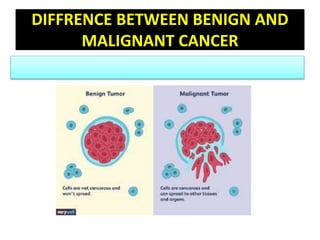
DIFFRENCE BETWEEN BENIGN AND
MALIGNANT CANCER
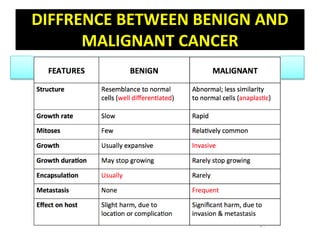
DIFFRENCE BETWEEN BENIGN AND
MALIGNANT CANCER
AETIOLOGY/CAUSE
Cancer have no specific causes but some causes are:
1. Viruses
Human papilloma virus.
Herpes virus.
2. Chemical Agents
Cigarette smoking
Air pollutants etc.
Vinyl chloride which is used in plastic surgery
CONT…
3. Physical Agents
X-rays Radioactive isotopes
Sunlight Ultraviolet
Radiations etc.
4. Hormones: Some hormones leads to develop cancer, e.g.,
Diethylstilbestrol (DES)
is administer in pregnancy, it may cause vaginal carcinoma in
female child.
5. Genetic Predisposition: If in a family, anybody have
retinoblastoma or breast
cancer then there is more chance of getting cancer to
sister/daughter of that
lady
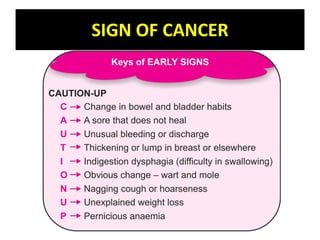
SIGN OF CANCER
OTHER SYMPTOMS…..
Manifestations are related to system affected and degree of
distruption.
Some symptoms are:
• Anaemia
• Weakness
• Weight loss
• Dysphagia
• Anorexia
• Blockage
• Pain
• Excess adrenal steroid production.
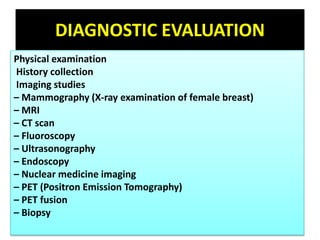
DIAGNOSTIC EVALUATION
Physical examination
History collection
Imaging studies
– Mammography (X-ray examination of female breast)
– MRI
– CT scan
– Fluoroscopy
– Ultrasonography
– Endoscopy
– Nuclear medicine imaging
– PET (Positron Emission Tomography)
– PET fusion
– Biopsy
CONT….
• Cytologic examination (pap smear)
• Carcino embryonic antigen (CEA)
• Breast self examination
• Xerography
• Proctoscopic and sigmoidoscopy examination
• Barium enema
• Radio isotopes study.
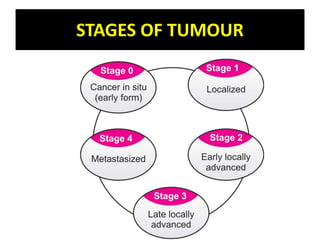
STAGES OF TUMOUR
CONT….
Stage 0: Carcinoma in situ.
Stage 1: Cancer are localized to one part of the body, can
surgically removed if small.
Stage 2: It is locally advanced stage, this type of cancer can be
treated by chemotherapy, radiation therapy and surgeries.
Stage 3: It also locally advanced stage, affected lymphnodes.
Stage 3 can be treated by chemotherapy, radiation therapy and
surgeries.
Stage 4: Cancer have often metastasized or spread to other
organs or throughout the body.
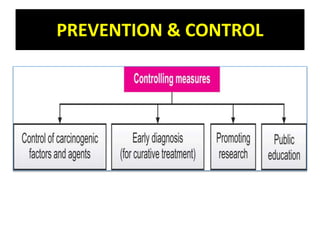
PREVENTION & CONTROL
CONT….
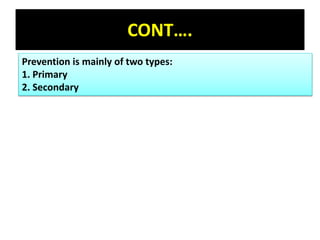
Prevention is mainly of two types:
1. Primary
2. Secondary
CONT….
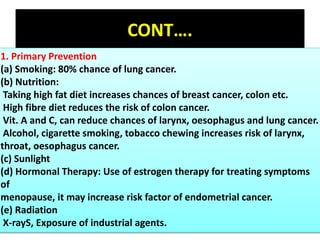
1. Primary Prevention
(a) Smoking: 80% chance of lung cancer.
(b) Nutrition:
Taking high fat diet increases chances of breast cancer, colon etc.
High fibre diet reduces the risk of colon cancer.
Vit. A and C, can reduce chances of larynx, oesophagus and lung cancer.
Alcohol, cigarette smoking, tobacco chewing increases risk of larynx,
throat, oesophagus cancer.
(c) Sunlight
(d) Hormonal Therapy: Use of estrogen therapy for treating symptoms
of
menopause, it may increase risk factor of endometrial cancer.
(e) Radiation
X-rayS, Exposure of industrial agents.
CONT….
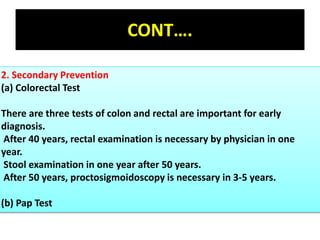
2. Secondary Prevention
(a) Colorectal Test
There are three tests of colon and rectal are important for early
diagnosis.
After 40 years, rectal examination is necessary by physician in one
year.
Stool examination in one year after 50 years.
After 50 years, proctosigmoidoscopy is necessary in 3-5 years.
(b) Pap Test
MANAGEMENT
1. Surgery
2. Radiotherapy
3. Chemotherapy
4. Hormonal therapy
5. Immune therapy
6. Bone marrow therapy
SURGERY
1. Surgery
(a) Preventive Surgery: Removal of benign tumour.
(b) Diagnostic Surgery: Take a sample of tissues for
diagnostic findings.
(c) Curative Surgery: Removal of malignant tumours
before metastasis.
(d) Palliative Surgery: It is done when cancer is out of
control. This is only done for controlling signs and
symptoms like pain.
RADIOTHERAPY
Under this therapy, radioactive isotopes beams of
radiation may be directed at a diseased part from a
distance or radioactive material in the form of
needles, wires or pellets may be implanted in the
body. Many forms of cancer are destroyed by
radiotherapy
CHEMOTHERAPY
Chemotherapy agents destroys malignant tumour cell
without destroying normal cells
Chemotherapic agents, e.g.,
• Cyclophosphamide
• Methotrexate
• Prednisolone
Side Effects
• Stomatitis
• Alopecia
• Weight gain
• Nausea/Vomiting
CONT….
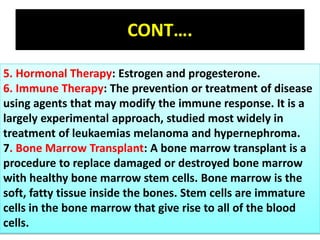
5. Hormonal Therapy: Estrogen and progesterone.
6. Immune Therapy: The prevention or treatment of disease
using agents that may modify the immune response. It is a
largely experimental approach, studied most widely in
treatment of leukaemias melanoma and hypernephroma.
7. Bone Marrow Transplant: A bone marrow transplant is a
procedure to replace damaged or destroyed bone marrow
with healthy bone marrow stem cells. Bone marrow is the
soft, fatty tissue inside the bones. Stem cells are immature
cells in the bone marrow that give rise to all of the blood
cells.
CONT….
NURSING MANAGEMENT
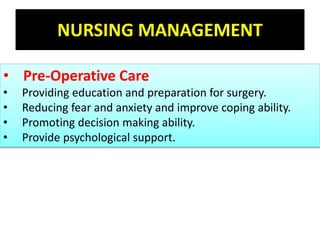
• Pre-Operative Care
• Providing education and preparation for surgery.
• Reducing fear and anxiety and improve coping ability.
• Promoting decision making ability.
• Provide psychological support.
NURSING MANAGEMENT
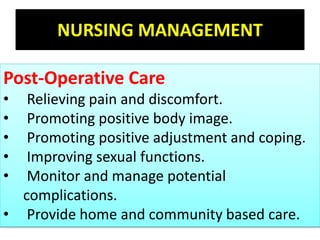
Post-Operative Care
• Relieving pain and discomfort.
• Promoting positive body image.
• Promoting positive adjustment and coping.
• Improving sexual functions.
• Monitor and manage potential
complications.
• Provide home and community based care.
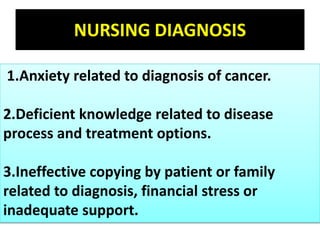
NURSING DIAGNOSIS
1.Anxiety related to diagnosis of cancer.
2.Deficient knowledge related to disease
process and treatment options.
3.Ineffective copying by patient or family
related to diagnosis, financial stress or
inadequate support.
Cancer

Cancer

  • 1.
  • 2.
    DEFINITION • NEO —New PLASIA — Growth (Growth of new tissues) An abnormal growth of tissue which may benign or malignant • Cancer is the term which is use for describs wide variety of malignant disease. • Cancer is a disease that begins when an abnormal cell is transformed by the genetic mutation of cellular DNA.
  • 3.
    DIFFRENCE BETWEEN BENIGNAND MALIGNANT CANCER
  • 4.
    DIFFRENCE BETWEEN BENIGNAND MALIGNANT CANCER
  • 5.
    AETIOLOGY/CAUSE Cancer have nospecific causes but some causes are: 1. Viruses Human papilloma virus. Herpes virus. 2. Chemical Agents Cigarette smoking Air pollutants etc. Vinyl chloride which is used in plastic surgery
  • 6.
    CONT… 3. Physical Agents X-raysRadioactive isotopes Sunlight Ultraviolet Radiations etc. 4. Hormones: Some hormones leads to develop cancer, e.g., Diethylstilbestrol (DES) is administer in pregnancy, it may cause vaginal carcinoma in female child. 5. Genetic Predisposition: If in a family, anybody have retinoblastoma or breast cancer then there is more chance of getting cancer to sister/daughter of that lady
  • 7.
  • 8.
    OTHER SYMPTOMS….. Manifestations arerelated to system affected and degree of distruption. Some symptoms are: • Anaemia • Weakness • Weight loss • Dysphagia • Anorexia • Blockage • Pain • Excess adrenal steroid production.
  • 9.
    DIAGNOSTIC EVALUATION Physical examination Historycollection Imaging studies – Mammography (X-ray examination of female breast) – MRI – CT scan – Fluoroscopy – Ultrasonography – Endoscopy – Nuclear medicine imaging – PET (Positron Emission Tomography) – PET fusion – Biopsy
  • 10.
    CONT…. • Cytologic examination(pap smear) • Carcino embryonic antigen (CEA) • Breast self examination • Xerography • Proctoscopic and sigmoidoscopy examination • Barium enema • Radio isotopes study.
  • 11.
  • 12.
    CONT…. Stage 0: Carcinomain situ. Stage 1: Cancer are localized to one part of the body, can surgically removed if small. Stage 2: It is locally advanced stage, this type of cancer can be treated by chemotherapy, radiation therapy and surgeries. Stage 3: It also locally advanced stage, affected lymphnodes. Stage 3 can be treated by chemotherapy, radiation therapy and surgeries. Stage 4: Cancer have often metastasized or spread to other organs or throughout the body.
  • 13.
  • 14.
    CONT…. Prevention is mainlyof two types: 1. Primary 2. Secondary
  • 15.
    CONT…. 1. Primary Prevention (a)Smoking: 80% chance of lung cancer. (b) Nutrition: Taking high fat diet increases chances of breast cancer, colon etc. High fibre diet reduces the risk of colon cancer. Vit. A and C, can reduce chances of larynx, oesophagus and lung cancer. Alcohol, cigarette smoking, tobacco chewing increases risk of larynx, throat, oesophagus cancer. (c) Sunlight (d) Hormonal Therapy: Use of estrogen therapy for treating symptoms of menopause, it may increase risk factor of endometrial cancer. (e) Radiation X-rayS, Exposure of industrial agents.
  • 16.
    CONT…. 2. Secondary Prevention (a)Colorectal Test There are three tests of colon and rectal are important for early diagnosis. After 40 years, rectal examination is necessary by physician in one year. Stool examination in one year after 50 years. After 50 years, proctosigmoidoscopy is necessary in 3-5 years. (b) Pap Test
  • 17.
    MANAGEMENT 1. Surgery 2. Radiotherapy 3.Chemotherapy 4. Hormonal therapy 5. Immune therapy 6. Bone marrow therapy
  • 18.
    SURGERY 1. Surgery (a) PreventiveSurgery: Removal of benign tumour. (b) Diagnostic Surgery: Take a sample of tissues for diagnostic findings. (c) Curative Surgery: Removal of malignant tumours before metastasis. (d) Palliative Surgery: It is done when cancer is out of control. This is only done for controlling signs and symptoms like pain.
  • 19.
    RADIOTHERAPY Under this therapy,radioactive isotopes beams of radiation may be directed at a diseased part from a distance or radioactive material in the form of needles, wires or pellets may be implanted in the body. Many forms of cancer are destroyed by radiotherapy
  • 20.
    CHEMOTHERAPY Chemotherapy agents destroysmalignant tumour cell without destroying normal cells Chemotherapic agents, e.g., • Cyclophosphamide • Methotrexate • Prednisolone Side Effects • Stomatitis • Alopecia • Weight gain • Nausea/Vomiting
  • 21.
    CONT…. 5. Hormonal Therapy:Estrogen and progesterone. 6. Immune Therapy: The prevention or treatment of disease using agents that may modify the immune response. It is a largely experimental approach, studied most widely in treatment of leukaemias melanoma and hypernephroma. 7. Bone Marrow Transplant: A bone marrow transplant is a procedure to replace damaged or destroyed bone marrow with healthy bone marrow stem cells. Bone marrow is the soft, fatty tissue inside the bones. Stem cells are immature cells in the bone marrow that give rise to all of the blood cells.
  • 22.
  • 23.
    NURSING MANAGEMENT • Pre-OperativeCare • Providing education and preparation for surgery. • Reducing fear and anxiety and improve coping ability. • Promoting decision making ability. • Provide psychological support.
  • 24.
    NURSING MANAGEMENT Post-Operative Care •Relieving pain and discomfort. • Promoting positive body image. • Promoting positive adjustment and coping. • Improving sexual functions. • Monitor and manage potential complications. • Provide home and community based care.
  • 25.
    NURSING DIAGNOSIS 1.Anxiety relatedto diagnosis of cancer. 2.Deficient knowledge related to disease process and treatment options. 3.Ineffective copying by patient or family related to diagnosis, financial stress or inadequate support.