Presented By,
Ms.Tejal Rathva
MSc.Nursing (oncology)
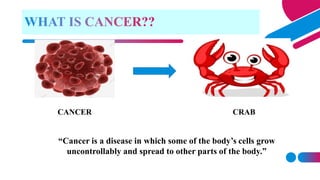
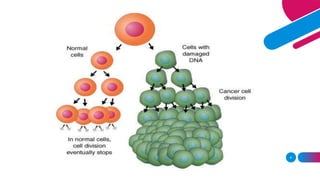
“Cancer is a disease in which some of the body’s cells grow
uncontrollably and spread to other parts of the body.”
CANCER CRAB
4
According to WHO,
“CANCER is a large group of diseases that can start in
almost any organ or tissue of the body when abnormal
cells grow uncontrollably, go beyond their usual
boundaries to invade adjoining parts of the body and/or
spread to other organs.”
10
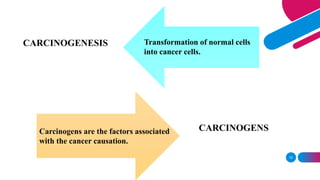
CARCINOGENESIS
CARCINOGENS
Transformation of normal cells
into cancer cells.
Carcinogens are the factors associated
with the cancer causation.
11
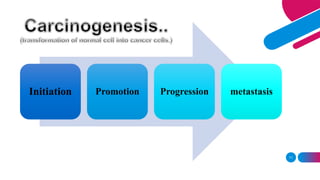
Initiation Promotion Progression metastasis
12
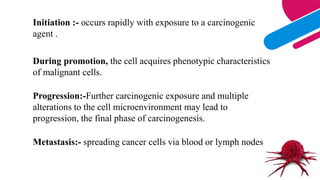
Initiation :- occurs rapidly with exposure to a carcinogenic
agent .
During promotion, the cell acquires phenotypic characteristics
of malignant cells.
Progression:-Further carcinogenic exposure and multiple
alterations to the cell microenvironment may lead to
progression, the final phase of carcinogenesis.
Metastasis:- spreading cancer cells via blood or lymph nodes.
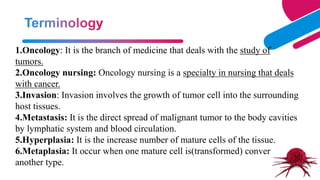
1.Oncology: It is the branch of medicine that deals with the study of
tumors.
2.Oncology nursing: Oncology nursing is a specialty in nursing that deals
with cancer.
3.Invasion: Invasion involves the growth of tumor cell into the surrounding
host tissues.
4.Metastasis: It is the direct spread of malignant tumor to the body cavities
by lymphatic system and blood circulation.
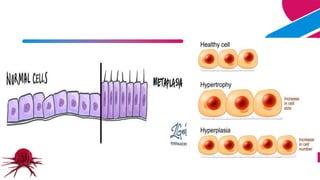
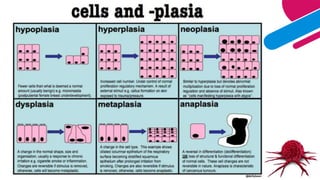
5.Hyperplasia: It is the increase number of mature cells of the tissue.
6.Metaplasia: It occur when one mature cell is(transformed) converted to
another type.
15
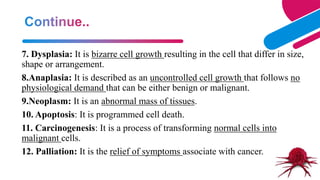
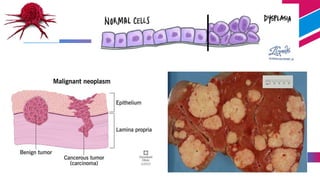
7. Dysplasia: It is bizarre cell growth resulting in the cell that differ in size,
shape or arrangement.
8.Anaplasia: It is described as an uncontrolled cell growth that follows no
physiological demand that can be either benign or malignant.
9.Neoplasm: It is an abnormal mass of tissues.
10. Apoptosis: It is programmed cell death.
11. Carcinogenesis: It is a process of transforming normal cells into
malignant cells.
12. Palliation: It is the relief of symptoms associate with cancer.
ADD A FOOTER 17
18
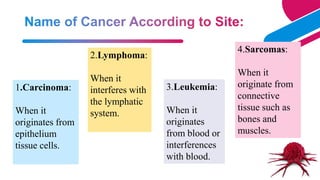
1.Carcinoma:
When it
originates from
epithelium
tissue cells.
2.Lymphoma:
When it
interferes with
the lymphatic
system.
3.Leukemia:
When it
originates
from blood or
interferences
with blood.
4.Sarcomas:
When it
originate from
connective
tissue such as
bones and
muscles.
22
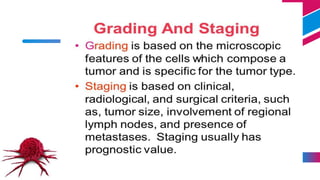
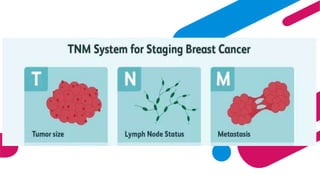
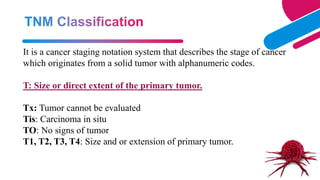
It is a cancer staging notation system that describes the stage of cancer
which originates from a solid tumor with alphanumeric codes.
T: Size or direct extent of the primary tumor.
Tx: Tumor cannot be evaluated
Tis: Carcinoma in situ
TO: No signs of tumor
T1, T2, T3, T4: Size and or extension of primary tumor.
23
 Stage-0/Carcinoma in situ: The abnormal cells are
found only in first layer of cells.
 Stage-I: Cancer involves the primary site.
 Stage-IA: A very small amount of cancer-visible under
microscope.
 Stage-IB: A large number of cancer cell or tissue ford.
 Stage-II: Cancer has spread to nearby areas.
 Stage-IIA: Cancer has spread beyond the primary site.
 Stage-IIB: It spread to other tissue.
24
N:- Degree of spread to regional lymph nodes.
Nx: Lymph nodes cannot be evaluated.
NO: Tumor cells absent from regional lymph nodes.
N1: Regional lymph node metastasis present (at some sites; tumor
spread to closest or small number of regional lymph nodes).
N2: Tumor spread to an extent between N1and N3 (N2 is not used at
all sites).
N3: Tumor spread to more distant or numerous regional lymph nodes
(N3 is not used at all sites).
M:- Presence of distant metastasis
MO: no distant metastasis
M1: Metastasis to distant organs beyond regional lymph nodes.
25
 Stage-III: Cancer has spread throughout the
nearby area.
 Stage-IV: It spread to other facts of body.
 Stage-IVA: It spread to organs close to pelvic
area.
 Stage-IVB: It spread to distant organ, such as
lungs.
Cancer [medical surgical nursing] basic information

Cancer [medical surgical nursing] basic information

  • 1.
  • 3.
    “Cancer is adisease in which some of the body’s cells grow uncontrollably and spread to other parts of the body.” CANCER CRAB
  • 4.
  • 7.
    According to WHO, “CANCERis a large group of diseases that can start in almost any organ or tissue of the body when abnormal cells grow uncontrollably, go beyond their usual boundaries to invade adjoining parts of the body and/or spread to other organs.”
  • 10.
    10 CARCINOGENESIS CARCINOGENS Transformation of normalcells into cancer cells. Carcinogens are the factors associated with the cancer causation.
  • 11.
  • 12.
    12 Initiation :- occursrapidly with exposure to a carcinogenic agent . During promotion, the cell acquires phenotypic characteristics of malignant cells. Progression:-Further carcinogenic exposure and multiple alterations to the cell microenvironment may lead to progression, the final phase of carcinogenesis. Metastasis:- spreading cancer cells via blood or lymph nodes.
  • 13.
    1.Oncology: It isthe branch of medicine that deals with the study of tumors. 2.Oncology nursing: Oncology nursing is a specialty in nursing that deals with cancer. 3.Invasion: Invasion involves the growth of tumor cell into the surrounding host tissues. 4.Metastasis: It is the direct spread of malignant tumor to the body cavities by lymphatic system and blood circulation. 5.Hyperplasia: It is the increase number of mature cells of the tissue. 6.Metaplasia: It occur when one mature cell is(transformed) converted to another type.
  • 15.
    15 7. Dysplasia: Itis bizarre cell growth resulting in the cell that differ in size, shape or arrangement. 8.Anaplasia: It is described as an uncontrolled cell growth that follows no physiological demand that can be either benign or malignant. 9.Neoplasm: It is an abnormal mass of tissues. 10. Apoptosis: It is programmed cell death. 11. Carcinogenesis: It is a process of transforming normal cells into malignant cells. 12. Palliation: It is the relief of symptoms associate with cancer.
  • 17.
  • 18.
    18 1.Carcinoma: When it originates from epithelium tissuecells. 2.Lymphoma: When it interferes with the lymphatic system. 3.Leukemia: When it originates from blood or interferences with blood. 4.Sarcomas: When it originate from connective tissue such as bones and muscles.
  • 22.
    22 It is acancer staging notation system that describes the stage of cancer which originates from a solid tumor with alphanumeric codes. T: Size or direct extent of the primary tumor. Tx: Tumor cannot be evaluated Tis: Carcinoma in situ TO: No signs of tumor T1, T2, T3, T4: Size and or extension of primary tumor.
  • 23.
    23  Stage-0/Carcinoma insitu: The abnormal cells are found only in first layer of cells.  Stage-I: Cancer involves the primary site.  Stage-IA: A very small amount of cancer-visible under microscope.  Stage-IB: A large number of cancer cell or tissue ford.  Stage-II: Cancer has spread to nearby areas.  Stage-IIA: Cancer has spread beyond the primary site.  Stage-IIB: It spread to other tissue.
  • 24.
    24 N:- Degree ofspread to regional lymph nodes. Nx: Lymph nodes cannot be evaluated. NO: Tumor cells absent from regional lymph nodes. N1: Regional lymph node metastasis present (at some sites; tumor spread to closest or small number of regional lymph nodes). N2: Tumor spread to an extent between N1and N3 (N2 is not used at all sites). N3: Tumor spread to more distant or numerous regional lymph nodes (N3 is not used at all sites). M:- Presence of distant metastasis MO: no distant metastasis M1: Metastasis to distant organs beyond regional lymph nodes.
  • 25.
    25  Stage-III: Cancerhas spread throughout the nearby area.  Stage-IV: It spread to other facts of body.  Stage-IVA: It spread to organs close to pelvic area.  Stage-IVB: It spread to distant organ, such as lungs.