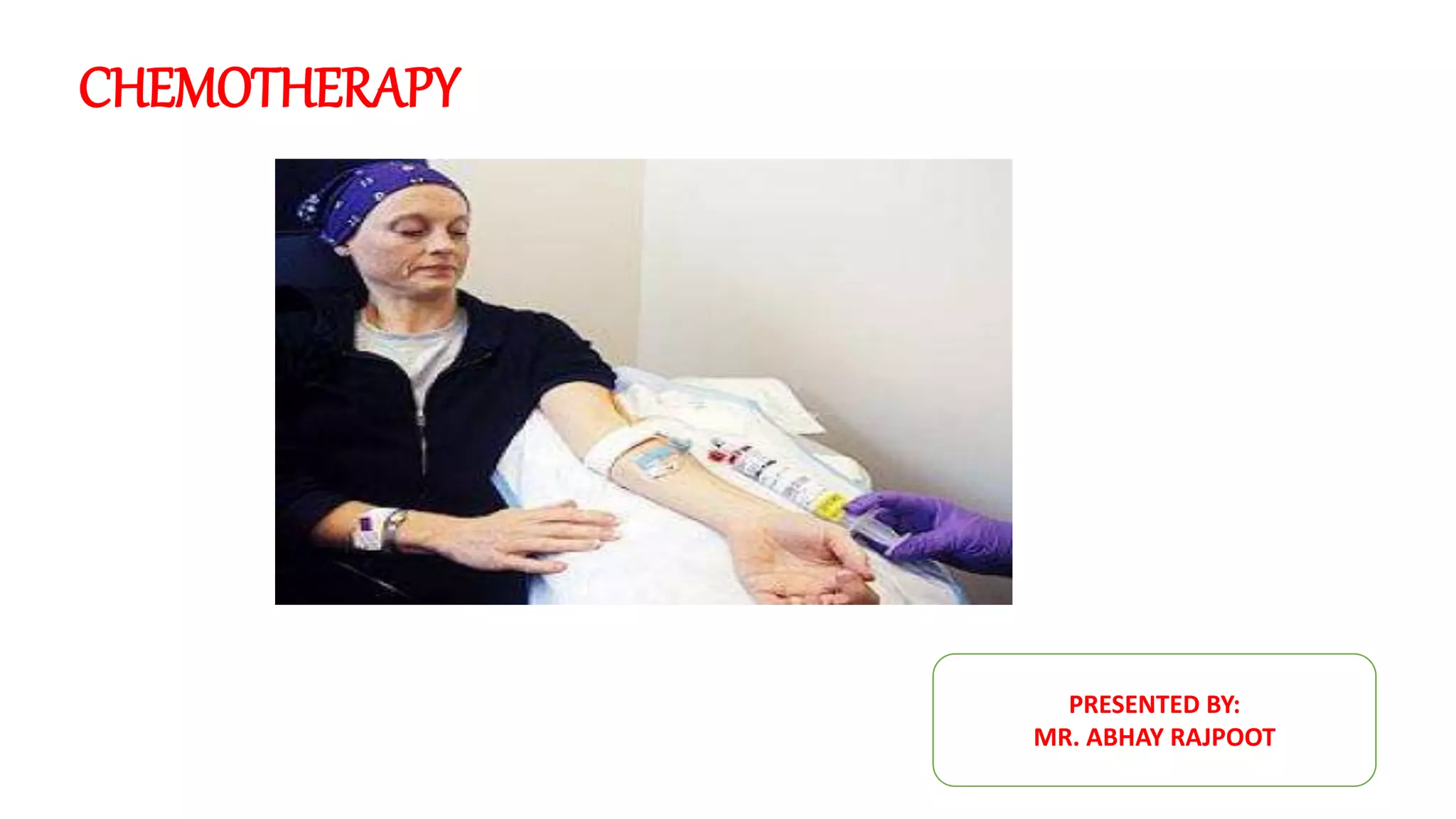
CHEMOTHERAPY
PRESENTED BY:
MR. ABHAY RAJPOOT
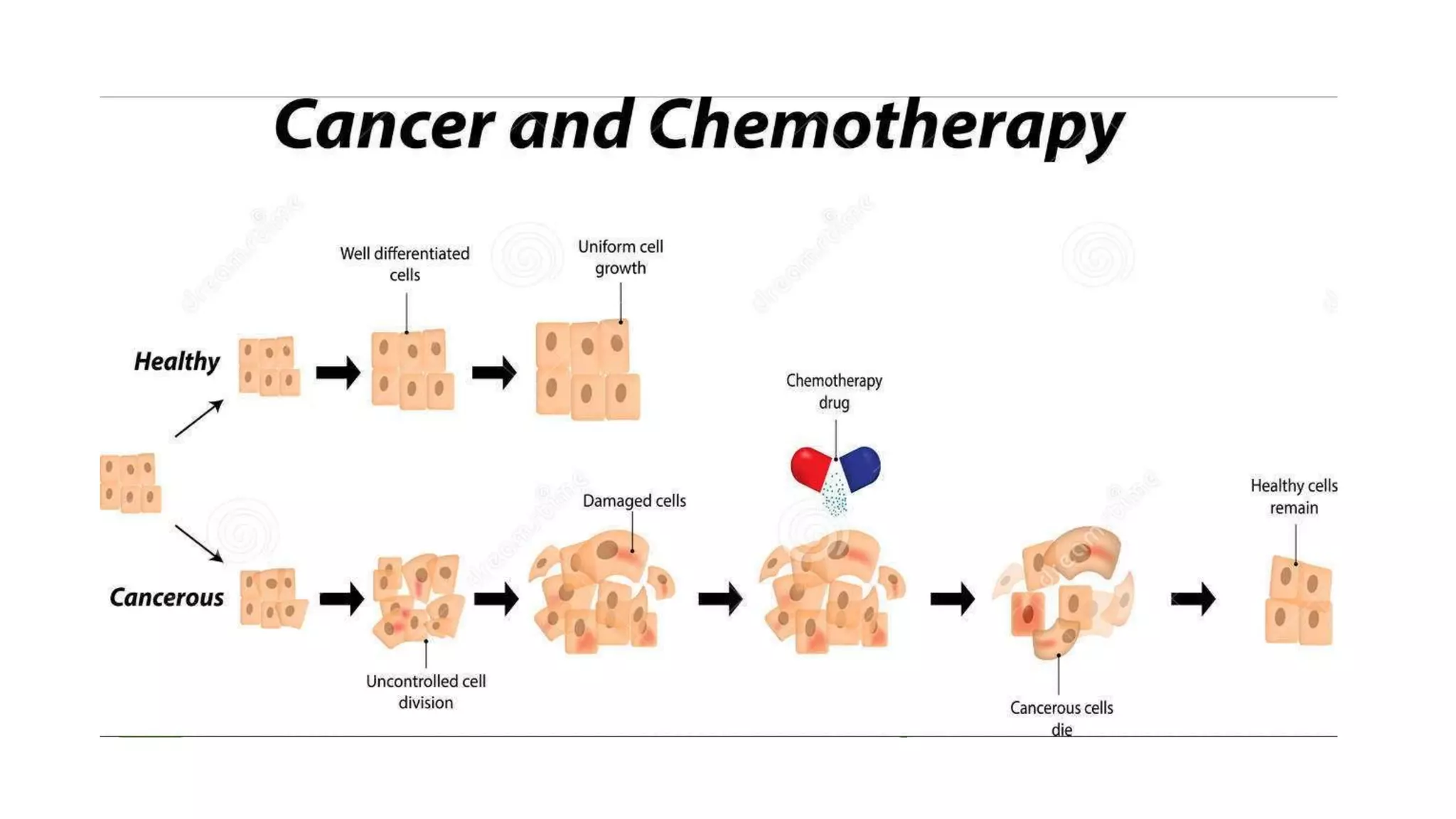
Definition: Chemotherapy is a drug treatment that uses powerful chemicals to kill fast-
growing cells in your body. Chemotherapy is most often used to treat cancer, since
cancer cells grow and multiply much more quickly than most cells in the body.
It involves the use of cytotoxic medication to cure cancers, such as
leukemias,lymphomas, & some solid tumors; to decrease the tumor size, adjunctive to
surgery & radiation therapy; or to prevent & treat suspected metastases.
Action: chemotherapy disrupts the cell cycle in various phases by interrupting cell
metabolism & replication.
• It also works by interfering with the ability of the malignant cell to synthesize the
vital enzymes & chemicals.
• Phase specific drugs work during only some phases of the cell cycle ; non-cell
specific drugs work through entire cell cycle.
CHEMOTHERAPY
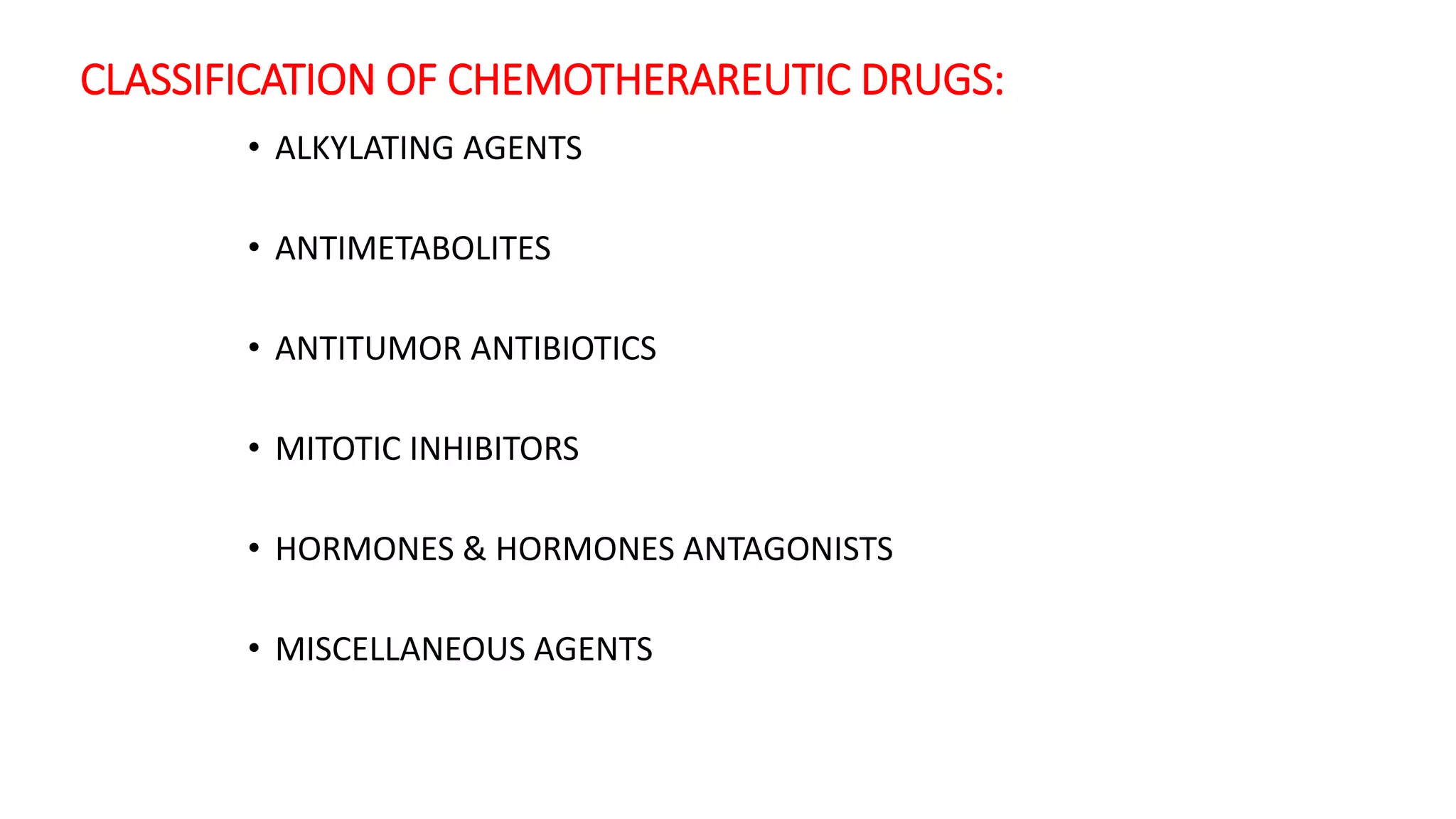
• ALKYLATING AGENTS
• ANTIMETABOLITES
• ANTITUMOR ANTIBIOTICS
• MITOTIC INHIBITORS
• HORMONES & HORMONES ANTAGONISTS
• MISCELLANEOUS AGENTS
CLASSIFICATION OF CHEMOTHERAREUTIC DRUGS:
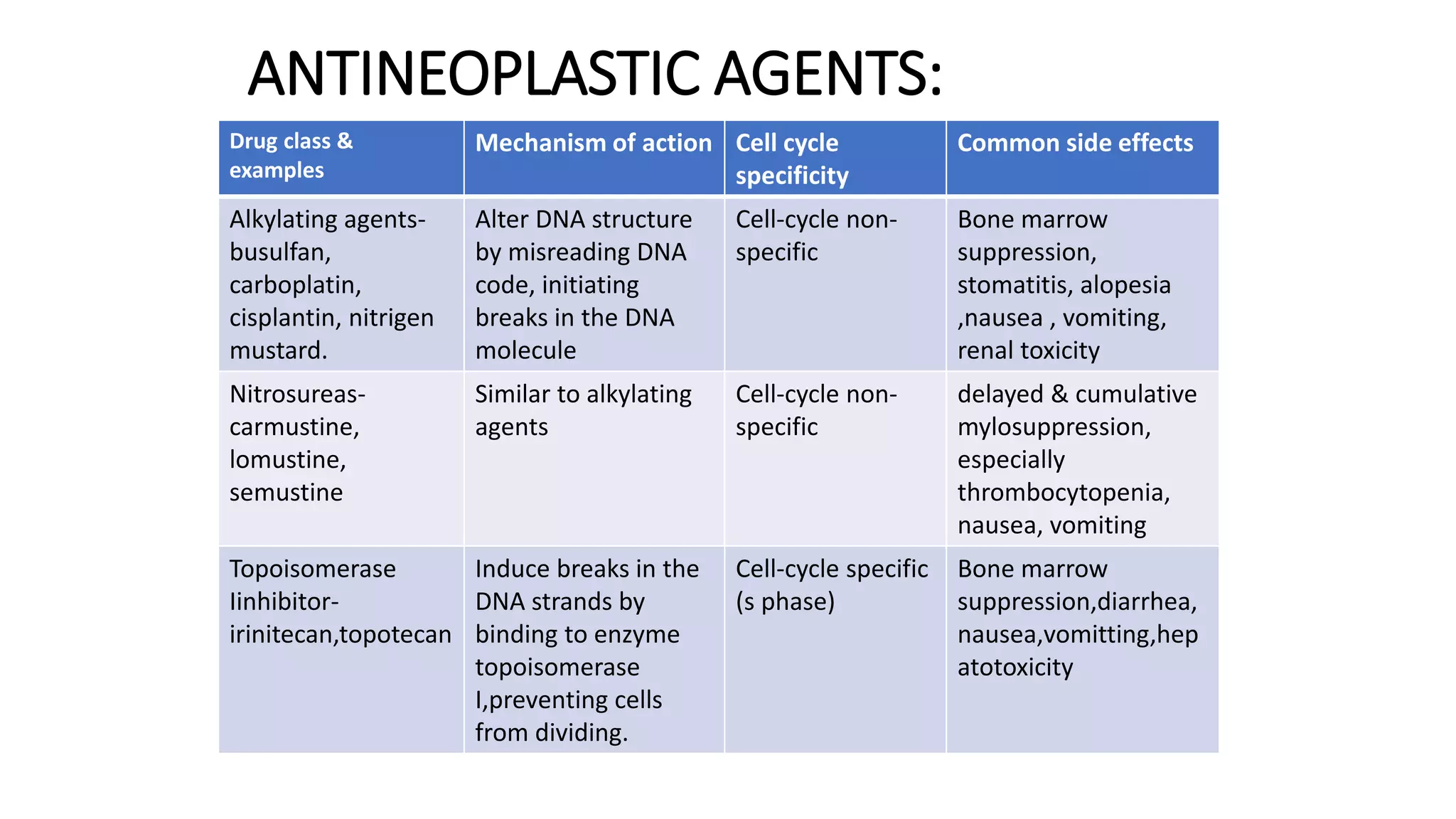
Drug class &
examples
Mechanism of action Cell cycle
specificity
Common side effects
Alkylating agents-
busulfan,
carboplatin,
cisplantin, nitrigen
mustard.
Alter DNA structure
by misreading DNA
code, initiating
breaks in the DNA
molecule
Cell-cycle non-
specific
Bone marrow
suppression,
stomatitis, alopesia
,nausea , vomiting,
renal toxicity
Nitrosureas-
carmustine,
lomustine,
semustine
Similar to alkylating
agents
Cell-cycle non-
specific
delayed & cumulative
mylosuppression,
especially
thrombocytopenia,
nausea, vomiting
Topoisomerase
Iinhibitor-
irinitecan,topotecan
Induce breaks in the
DNA strands by
binding to enzyme
topoisomerase
I,preventing cells
from dividing.
Cell-cycle specific
(s phase)
Bone marrow
suppression,diarrhea,
nausea,vomitting,hep
atotoxicity
ANTINEOPLASTIC AGENTS:
Antimetabolites-
5azacytadine,5-
fluorouracil,methot
rexate
Interfere with the
biosynthesis of
metabolites or
nucleic acids
necessary for
RNA& DNA
synthesis
Cell-cycle specific (s
phase)
Bone marrow
suppression,
diarrhea, nausea,
vomiting
,hepatotoxicity
,stomatitis, renal
toxicity
Antitumor
antibiotics-
bleomycin,
doxorubicin ,
mitomycin,
licamycin
Interfere with the
DNA synthesis by
binding DNA;
prevent RNA
synthesis
Cell-cycle non-
specific
Bone marrow
suppression,
nausea, vomiting,
cardiac toxicity
,stomatitis , renal
toxicity , alopecia
Mitotic spindle
poisons: plant
alkaloids
vinblastine,
vincristine ,
etoposide.
Taxanes: dosetaxel
Arrest metaphase
by inhibiting mitotic
tubular formation;
inhibit DNA &
protein synthesis
Cell-cycle specific
(m-phase)
Bone marrow
suppression,
neuropathies,
stomatitis.
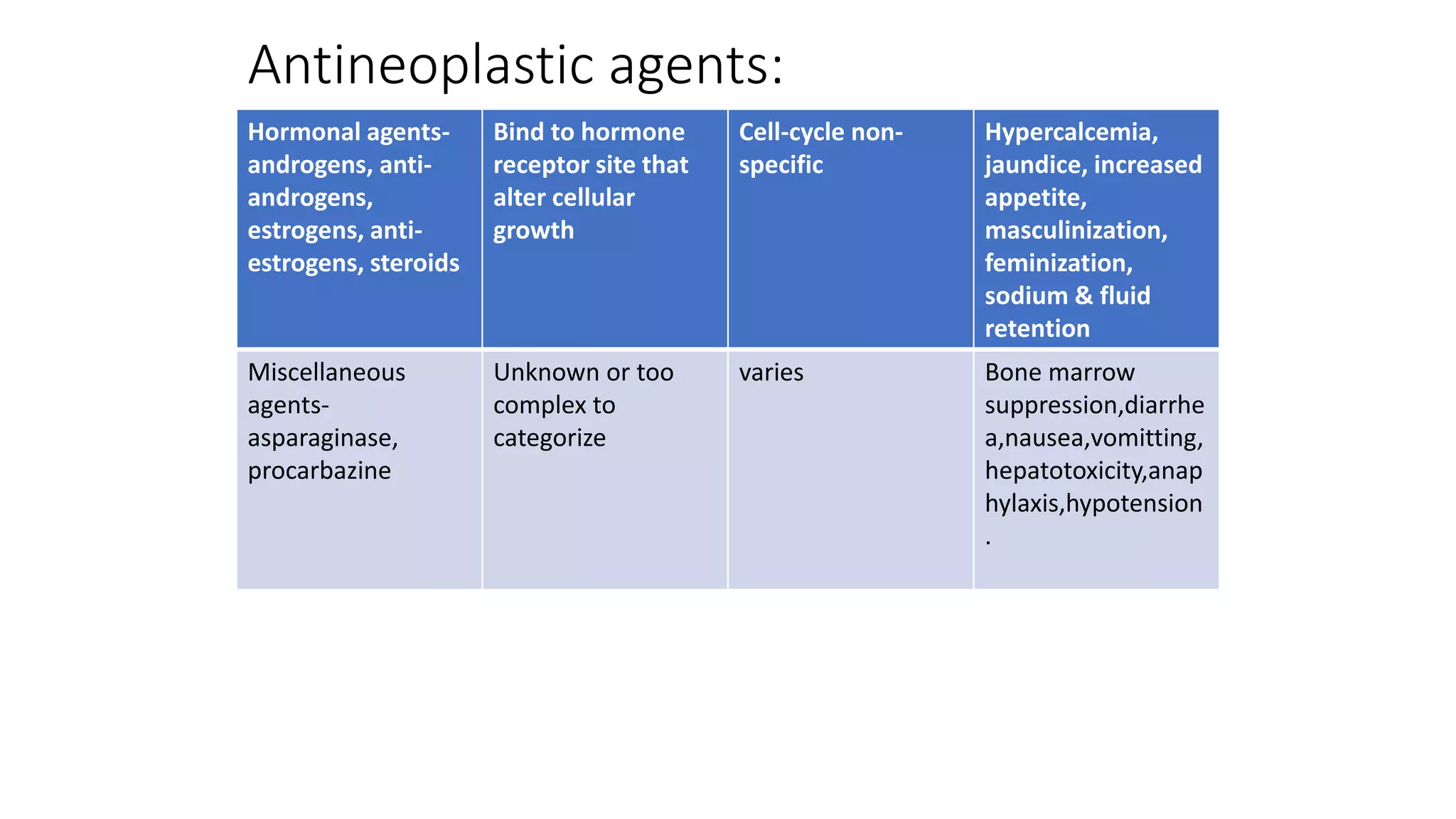
Hormonal agents-
androgens, anti-
androgens,
estrogens, anti-
estrogens, steroids
Bind to hormone
receptor site that
alter cellular
growth
Cell-cycle non-
specific
Hypercalcemia,
jaundice, increased
appetite,
masculinization,
feminization,
sodium & fluid
retention
Miscellaneous
agents-
asparaginase,
procarbazine
Unknown or too
complex to
categorize
varies Bone marrow
suppression,diarrhe
a,nausea,vomitting,
hepatotoxicity,anap
hylaxis,hypotension
.
Antineoplastic agents:
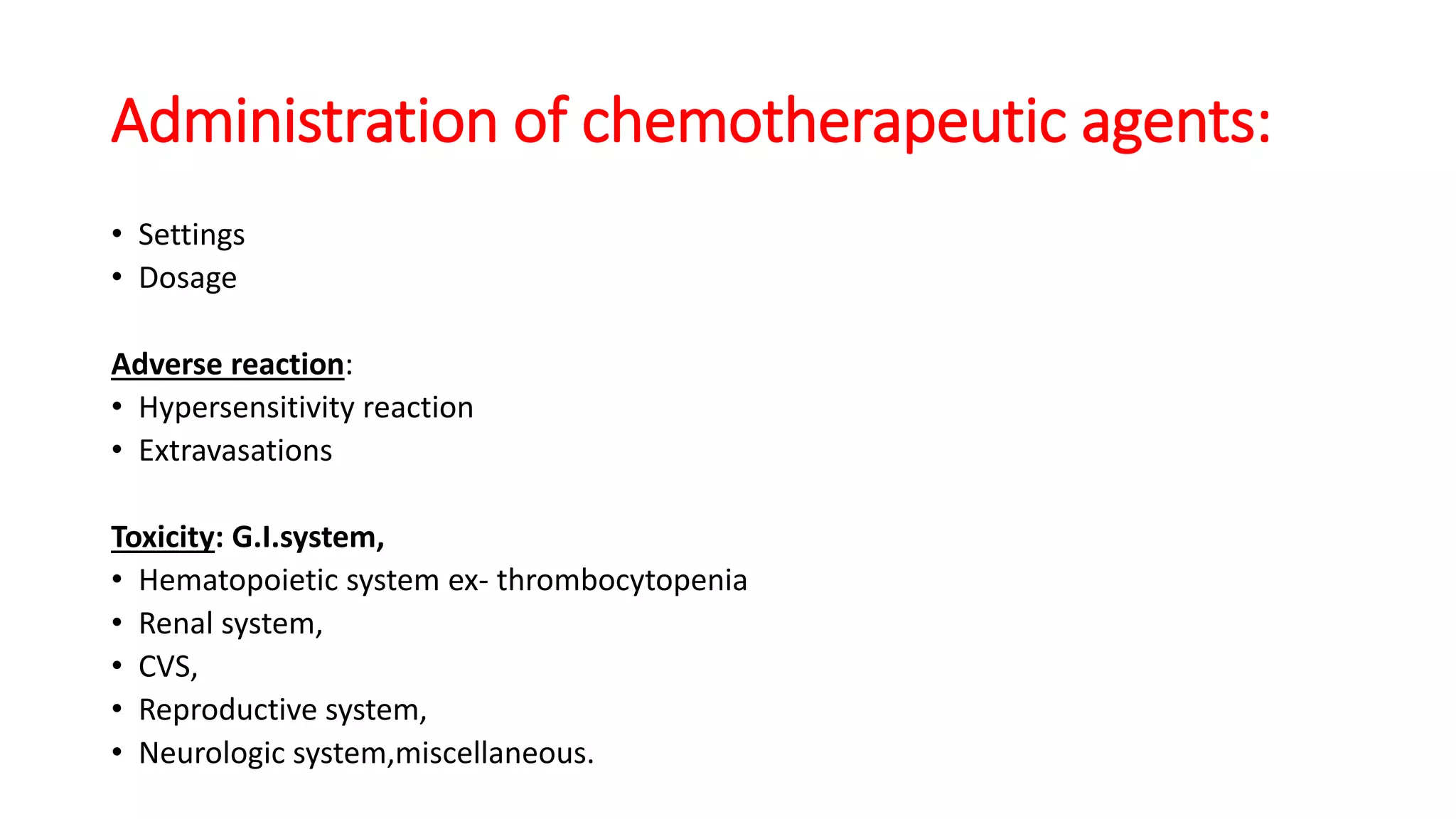
• Settings
• Dosage
Adverse reaction:
• Hypersensitivity reaction
• Extravasations
Toxicity: G.I.system,
• Hematopoietic system ex- thrombocytopenia
• Renal system,
• CVS,
• Reproductive system,
• Neurologic system,miscellaneous.
Administration of chemotherapeutic agents:
EXTRAVASATION
Side effect
• Hair loss
• Nausea
• Vomiting
• Mouth sores
• Loss of appetite
• Tiredness, easy bruising or bleeding, and an increased chance of
infection.
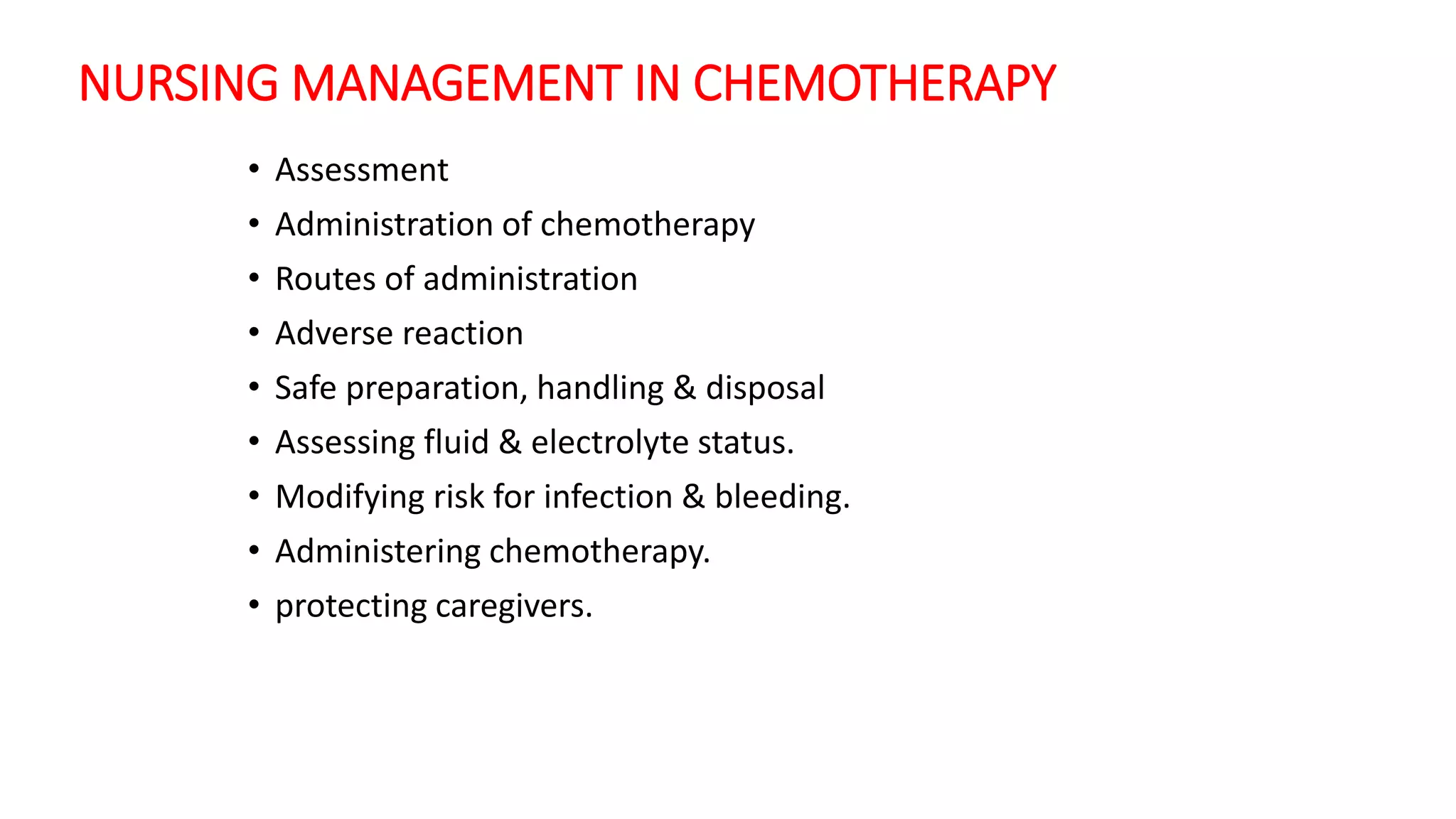
• Assessment
• Administration of chemotherapy
• Routes of administration
• Adverse reaction
• Safe preparation, handling & disposal
• Assessing fluid & electrolyte status.
• Modifying risk for infection & bleeding.
• Administering chemotherapy.
• protecting caregivers.
NURSING MANAGEMENT IN CHEMOTHERAPY
Targeted therapy:
• Targeted therapies are drugs that interfere with one specific property
or function of a cancer cell, rather than acting to kill all rapidly
growing cells indiscriminately.
Radiation therapy:
Radiation therapy uses high energy radiation to target cancer cells.
Radiation therapy may be used in the treatment of leukemia that has
spread to the brain, or it may be used to target the spleen or other areas
where leukemia cells have accumulated.
Stem cell transplant:
• It includes approaches that correct genetic defects or manipulate
genes to induce tumor cell destruction in the hope of preventing or
combating disease.
• Three general approaches have been used in the development of
gene therapy-
HORMONAL THERAPY
• Hormone therapy can be used before or after surgery or other
treatments to decrease the chance of your cancer returning. If the
cancer has already spread, hormone therapy may shrink and control it
• Oestrogen and progesterone for breast cancer
IMMUNOTHERAPY
• Hormone therapy can be used before or after surgery or other
treatments to decrease the chance of your cancer returning. If the
cancer has already spread, hormone therapy may shrink and control it
• Oestrogen and progesterone for breast cancer
Bone marrow transplantation
• Bone marrow is the flexible tissue found in the hollow interior of
bones. In adults, marrow in large bones produces new blood cells. It
constitutes 4% of the total body weight of humans, i.e. approximately
2.6 kg (5.7 lbs.) in adults.
• BMT is very much effective in the treatment of hematologic cancers.
• Donor cells can be obtained by the traditional harvesting of large
amount of bone marrow tissue under general anesthesia in the OT.
THANK YOU

Chemotherapy

  • 1.
  • 2.
    Definition: Chemotherapy isa drug treatment that uses powerful chemicals to kill fast- growing cells in your body. Chemotherapy is most often used to treat cancer, since cancer cells grow and multiply much more quickly than most cells in the body. It involves the use of cytotoxic medication to cure cancers, such as leukemias,lymphomas, & some solid tumors; to decrease the tumor size, adjunctive to surgery & radiation therapy; or to prevent & treat suspected metastases. Action: chemotherapy disrupts the cell cycle in various phases by interrupting cell metabolism & replication. • It also works by interfering with the ability of the malignant cell to synthesize the vital enzymes & chemicals. • Phase specific drugs work during only some phases of the cell cycle ; non-cell specific drugs work through entire cell cycle. CHEMOTHERAPY
  • 3.
    • ALKYLATING AGENTS •ANTIMETABOLITES • ANTITUMOR ANTIBIOTICS • MITOTIC INHIBITORS • HORMONES & HORMONES ANTAGONISTS • MISCELLANEOUS AGENTS CLASSIFICATION OF CHEMOTHERAREUTIC DRUGS:
  • 4.
    Drug class & examples Mechanismof action Cell cycle specificity Common side effects Alkylating agents- busulfan, carboplatin, cisplantin, nitrigen mustard. Alter DNA structure by misreading DNA code, initiating breaks in the DNA molecule Cell-cycle non- specific Bone marrow suppression, stomatitis, alopesia ,nausea , vomiting, renal toxicity Nitrosureas- carmustine, lomustine, semustine Similar to alkylating agents Cell-cycle non- specific delayed & cumulative mylosuppression, especially thrombocytopenia, nausea, vomiting Topoisomerase Iinhibitor- irinitecan,topotecan Induce breaks in the DNA strands by binding to enzyme topoisomerase I,preventing cells from dividing. Cell-cycle specific (s phase) Bone marrow suppression,diarrhea, nausea,vomitting,hep atotoxicity ANTINEOPLASTIC AGENTS:
  • 5.
    Antimetabolites- 5azacytadine,5- fluorouracil,methot rexate Interfere with the biosynthesisof metabolites or nucleic acids necessary for RNA& DNA synthesis Cell-cycle specific (s phase) Bone marrow suppression, diarrhea, nausea, vomiting ,hepatotoxicity ,stomatitis, renal toxicity Antitumor antibiotics- bleomycin, doxorubicin , mitomycin, licamycin Interfere with the DNA synthesis by binding DNA; prevent RNA synthesis Cell-cycle non- specific Bone marrow suppression, nausea, vomiting, cardiac toxicity ,stomatitis , renal toxicity , alopecia Mitotic spindle poisons: plant alkaloids vinblastine, vincristine , etoposide. Taxanes: dosetaxel Arrest metaphase by inhibiting mitotic tubular formation; inhibit DNA & protein synthesis Cell-cycle specific (m-phase) Bone marrow suppression, neuropathies, stomatitis.
  • 6.
    Hormonal agents- androgens, anti- androgens, estrogens,anti- estrogens, steroids Bind to hormone receptor site that alter cellular growth Cell-cycle non- specific Hypercalcemia, jaundice, increased appetite, masculinization, feminization, sodium & fluid retention Miscellaneous agents- asparaginase, procarbazine Unknown or too complex to categorize varies Bone marrow suppression,diarrhe a,nausea,vomitting, hepatotoxicity,anap hylaxis,hypotension . Antineoplastic agents:
  • 8.
    • Settings • Dosage Adversereaction: • Hypersensitivity reaction • Extravasations Toxicity: G.I.system, • Hematopoietic system ex- thrombocytopenia • Renal system, • CVS, • Reproductive system, • Neurologic system,miscellaneous. Administration of chemotherapeutic agents:
  • 9.
  • 10.
    Side effect • Hairloss • Nausea • Vomiting • Mouth sores • Loss of appetite • Tiredness, easy bruising or bleeding, and an increased chance of infection.
  • 11.
    • Assessment • Administrationof chemotherapy • Routes of administration • Adverse reaction • Safe preparation, handling & disposal • Assessing fluid & electrolyte status. • Modifying risk for infection & bleeding. • Administering chemotherapy. • protecting caregivers. NURSING MANAGEMENT IN CHEMOTHERAPY
  • 12.
    Targeted therapy: • Targetedtherapies are drugs that interfere with one specific property or function of a cancer cell, rather than acting to kill all rapidly growing cells indiscriminately.
  • 13.
    Radiation therapy: Radiation therapyuses high energy radiation to target cancer cells. Radiation therapy may be used in the treatment of leukemia that has spread to the brain, or it may be used to target the spleen or other areas where leukemia cells have accumulated.
  • 14.
    Stem cell transplant: •It includes approaches that correct genetic defects or manipulate genes to induce tumor cell destruction in the hope of preventing or combating disease. • Three general approaches have been used in the development of gene therapy-
  • 16.
    HORMONAL THERAPY • Hormonetherapy can be used before or after surgery or other treatments to decrease the chance of your cancer returning. If the cancer has already spread, hormone therapy may shrink and control it • Oestrogen and progesterone for breast cancer
  • 17.
    IMMUNOTHERAPY • Hormone therapycan be used before or after surgery or other treatments to decrease the chance of your cancer returning. If the cancer has already spread, hormone therapy may shrink and control it • Oestrogen and progesterone for breast cancer
  • 18.
    Bone marrow transplantation •Bone marrow is the flexible tissue found in the hollow interior of bones. In adults, marrow in large bones produces new blood cells. It constitutes 4% of the total body weight of humans, i.e. approximately 2.6 kg (5.7 lbs.) in adults. • BMT is very much effective in the treatment of hematologic cancers. • Donor cells can be obtained by the traditional harvesting of large amount of bone marrow tissue under general anesthesia in the OT.
  • 19.