Developing online English language
courses in Jordanian universities
Jyväskylä, August 26th 2016
Laia Canals | UOC
Centre for Modern Languages
ecanalsf@uoc.edu
Outline
1. Brief introduction on how we teach languages online at
the Open University of Catalonia
2. Overview of the EQTEL project
3. Experience designing the first English pilot in the
Jordanian context
4. Experimental study on language attitudes towards
learning English
5. Conclusions
6. Further steps
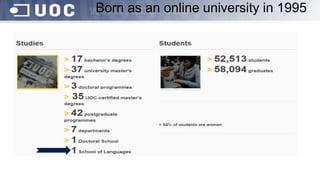
Born as an online university in 1995
6,000 students each term
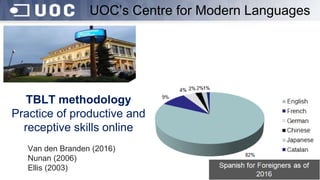
UOC’s Centre for Modern Languages
TBLT methodology
Practice of productive and
receptive skills online
Van den Branden (2016)
Nunan (2006)
Ellis (2003)
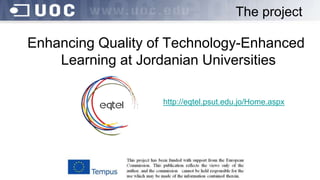
The project
Enhancing Quality of Technology-Enhanced
Learning at Jordanian Universities
http://eqtel.psut.edu.jo/Home.aspx
Objectives
1. Accreditation standards, guidelines and
procedures for quality assurance of online
courses
2. TEL quality and eLearning methods
3. Training public authorities for accreditation
and evaluation of online programs
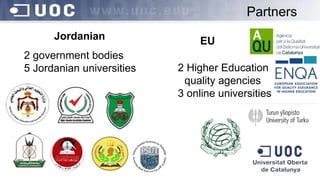
Jordanian
Partners
2 government bodies
5 Jordanian universities
EU
2 Higher Education
quality agencies
3 online universities
Piloting courses
• Development of 3 Pilot Courses: English 101, Renewable
Energies, Communication Engineering Remote Lab
• International quality assurance methodology and training (by
EU partners)
• Delivery and reporting (by Jordanian Universities)
1. How effective is the e-learning method in improving
students attitudes towards English?
2. Are there any statistical differences in students’
evaluation of instructors teaching the online class
compared with its f2f counterpart?
3. Are there any statistical differences in students’ course
grades in the 2 delivery modes?
4. What are the challenges the online instructors faced?
English course
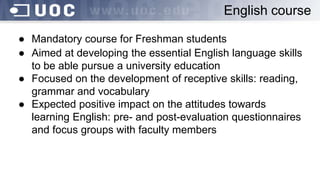
● Mandatory course for Freshman students
● Aimed at developing the essential English language skills
to be able pursue a university education
● Focused on the development of receptive skills: reading,
grammar and vocabulary
● Expected positive impact on the attitudes towards
learning English: pre- and post-evaluation questionnaires
and focus groups with faculty members
English course
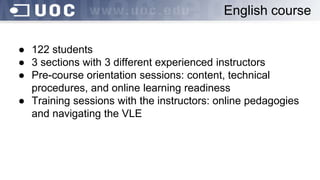
● 122 students
● 3 sections with 3 different experienced instructors
● Pre-course orientation sessions: content, technical
procedures, and online learning readiness
● Training sessions with the instructors: online pedagogies
and navigating the VLE
English course
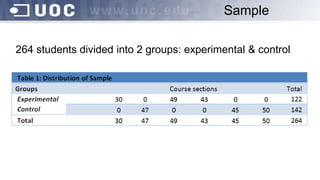
264 students divided into 2 groups: experimental & control
Sample
1. Students’ Attitudes toward Learning English
Questionnaire
2. E-Learning English Course Evaluation Questionnaire
3. Yarmouk University Instructor Evaluation
4. Students’ Grades
5. Instructors’ Feedback
Instruments
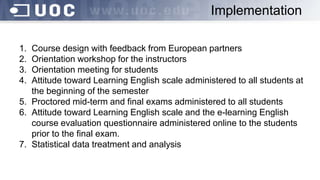
1. Course design with feedback from European partners
2. Orientation workshop for the instructors
3. Orientation meeting for students
4. Attitude toward Learning English scale administered to all students at
the beginning of the semester
5. Proctored mid-term and final exams administered to all students
6. Attitude toward Learning English scale and the e-learning English
course evaluation questionnaire administered online to the students
prior to the final exam.
7. Statistical data treatment and analysis
Implementation
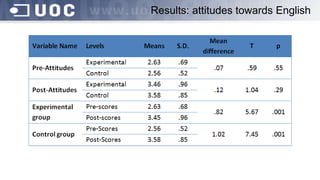
Results: attitudes towards English
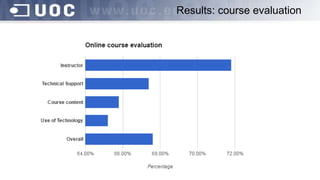
Results: course evaluation
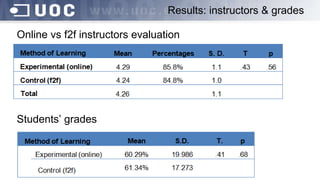
Online vs f2f instructors evaluation
Students’ grades
Results: instructors & grades
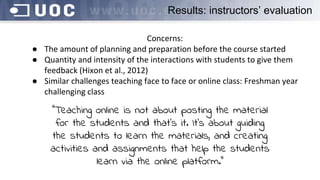
Concerns:
● The amount of planning and preparation before the course started
● Quantity and intensity of the interactions with students to give them
feedback (Hixon et al., 2012)
● Similar challenges teaching face to face or online class: Freshman year
challenging class
Results: instructors’ evaluation
"Teaching online is not about posting the material
for the students and that’s it. It’s about guiding
the students to learn the materials, and creating
activities and assignments that help the students
learn via the online platform.”
Recommendations:
● Teaching online requires recruiting faculty who believe in this approach (Mitchell,
2104)
● It’s essential to provide e-learning training for faculty: strategies to engage students
online
● It’s important to allocate enough time for faculty to prepare for the class
● It’s essential to provide technical/computer orientation for the students and
sustained tech support while running the course
● It’s advisable to provide some supporting materials in Arabic to help the students
navigate the VLE
● It’s important to ensuring that those who register are computer literate or are trained
before taking this class (Van Rooij & Zirkle, 2016, and Prior et al., 2016)
Results: instructors’ focus groups
Summary & conclusions
1. Students’ attitudes toward learning English were improved
equally in both groups
2. Students’ evaluated the online course in terms of content,
design, use of technology, and technical assistant with an
average of 67.6%
3. Students in both groups evaluated the instructors very positively
4. Students’ grades were similar
5. Faculty members regard it as a positive experience and
emphasize the importance of providing orientation to students
and training and technical support to faculty members.
Future steps
● The course will be offered again in the Fall term incorporating
new features
● Offered eventually at all universities of the consortium (5
Jordanian universities)
● Yarmouk University will be in charge of training faculty members
at other Jordanian universities
● The following iterations of the course will continuously
incorporate new elements and instruments to continuously
improve the quality and effectiveness of the course
Ellis, R. (2003). Task-based language learning and teaching. Oxford University Press.
Hixon, E., Buckenmeyer, J., Barczyk, C., Feldman, L., & Zamojski, H. (2012). Beyond the early adopters of
online instruction: Motivating the reluctant majority. The Internet and Higher Education, 15(2), 102-107.
Mitchell, L.D., Parlamis, J.D., & Clairborne, S.A. (2014). Overcoming faculty avoidance
of online education: From resistance to support to active participation. Journal of Management Education.
Nunan, D. (2006). Task-based language teaching. Ernst Klett Sprachen.
Prior, D. D., Mazanov, J., Meacheam, D., Heaslip, G., & Hanson, J. (2016). Attitude, digital literacy and
Self efficacy: Flow-on effects for online learning behavior. The Internet and Higher Education.
Van den Branden, K. (2016). Task-based language teaching. The Routledge Handbook of English
Language Teaching, 238.
Van Rooij, S. W., & Zirkle, K. (2016). Balancing pedagogy, student readiness and accessibility: A case
study in collaborative online course development.The Internet and Higher Education, 28, 1-7.
References
Kiitos! Thank you!
Laia Canals
ecanalsf@uoc.edu
@laiacanals

Canals eurosla'16

  • 1.
    Developing online Englishlanguage courses in Jordanian universities Jyväskylä, August 26th 2016 Laia Canals | UOC Centre for Modern Languages ecanalsf@uoc.edu
  • 2.
    Outline 1. Brief introductionon how we teach languages online at the Open University of Catalonia 2. Overview of the EQTEL project 3. Experience designing the first English pilot in the Jordanian context 4. Experimental study on language attitudes towards learning English 5. Conclusions 6. Further steps
  • 3.
    Born as anonline university in 1995
  • 4.
    6,000 students eachterm UOC’s Centre for Modern Languages TBLT methodology Practice of productive and receptive skills online Van den Branden (2016) Nunan (2006) Ellis (2003)
  • 5.
    The project Enhancing Qualityof Technology-Enhanced Learning at Jordanian Universities http://eqtel.psut.edu.jo/Home.aspx
  • 6.
    Objectives 1. Accreditation standards,guidelines and procedures for quality assurance of online courses 2. TEL quality and eLearning methods 3. Training public authorities for accreditation and evaluation of online programs
  • 7.
    Jordanian Partners 2 government bodies 5Jordanian universities EU 2 Higher Education quality agencies 3 online universities
  • 8.
    Piloting courses • Developmentof 3 Pilot Courses: English 101, Renewable Energies, Communication Engineering Remote Lab • International quality assurance methodology and training (by EU partners) • Delivery and reporting (by Jordanian Universities)
  • 9.
    1. How effectiveis the e-learning method in improving students attitudes towards English? 2. Are there any statistical differences in students’ evaluation of instructors teaching the online class compared with its f2f counterpart? 3. Are there any statistical differences in students’ course grades in the 2 delivery modes? 4. What are the challenges the online instructors faced? English course
  • 10.
    ● Mandatory coursefor Freshman students ● Aimed at developing the essential English language skills to be able pursue a university education ● Focused on the development of receptive skills: reading, grammar and vocabulary ● Expected positive impact on the attitudes towards learning English: pre- and post-evaluation questionnaires and focus groups with faculty members English course
  • 11.
    ● 122 students ●3 sections with 3 different experienced instructors ● Pre-course orientation sessions: content, technical procedures, and online learning readiness ● Training sessions with the instructors: online pedagogies and navigating the VLE English course
  • 12.
    264 students dividedinto 2 groups: experimental & control Sample
  • 13.
    1. Students’ Attitudestoward Learning English Questionnaire 2. E-Learning English Course Evaluation Questionnaire 3. Yarmouk University Instructor Evaluation 4. Students’ Grades 5. Instructors’ Feedback Instruments
  • 14.
    1. Course designwith feedback from European partners 2. Orientation workshop for the instructors 3. Orientation meeting for students 4. Attitude toward Learning English scale administered to all students at the beginning of the semester 5. Proctored mid-term and final exams administered to all students 6. Attitude toward Learning English scale and the e-learning English course evaluation questionnaire administered online to the students prior to the final exam. 7. Statistical data treatment and analysis Implementation
  • 15.
  • 16.
  • 17.
    Online vs f2finstructors evaluation Students’ grades Results: instructors & grades
  • 18.
    Concerns: ● The amountof planning and preparation before the course started ● Quantity and intensity of the interactions with students to give them feedback (Hixon et al., 2012) ● Similar challenges teaching face to face or online class: Freshman year challenging class Results: instructors’ evaluation "Teaching online is not about posting the material for the students and that’s it. It’s about guiding the students to learn the materials, and creating activities and assignments that help the students learn via the online platform.”
  • 19.
    Recommendations: ● Teaching onlinerequires recruiting faculty who believe in this approach (Mitchell, 2104) ● It’s essential to provide e-learning training for faculty: strategies to engage students online ● It’s important to allocate enough time for faculty to prepare for the class ● It’s essential to provide technical/computer orientation for the students and sustained tech support while running the course ● It’s advisable to provide some supporting materials in Arabic to help the students navigate the VLE ● It’s important to ensuring that those who register are computer literate or are trained before taking this class (Van Rooij & Zirkle, 2016, and Prior et al., 2016) Results: instructors’ focus groups
  • 20.
    Summary & conclusions 1.Students’ attitudes toward learning English were improved equally in both groups 2. Students’ evaluated the online course in terms of content, design, use of technology, and technical assistant with an average of 67.6% 3. Students in both groups evaluated the instructors very positively 4. Students’ grades were similar 5. Faculty members regard it as a positive experience and emphasize the importance of providing orientation to students and training and technical support to faculty members.
  • 21.
    Future steps ● Thecourse will be offered again in the Fall term incorporating new features ● Offered eventually at all universities of the consortium (5 Jordanian universities) ● Yarmouk University will be in charge of training faculty members at other Jordanian universities ● The following iterations of the course will continuously incorporate new elements and instruments to continuously improve the quality and effectiveness of the course
  • 22.
    Ellis, R. (2003).Task-based language learning and teaching. Oxford University Press. Hixon, E., Buckenmeyer, J., Barczyk, C., Feldman, L., & Zamojski, H. (2012). Beyond the early adopters of online instruction: Motivating the reluctant majority. The Internet and Higher Education, 15(2), 102-107. Mitchell, L.D., Parlamis, J.D., & Clairborne, S.A. (2014). Overcoming faculty avoidance of online education: From resistance to support to active participation. Journal of Management Education. Nunan, D. (2006). Task-based language teaching. Ernst Klett Sprachen. Prior, D. D., Mazanov, J., Meacheam, D., Heaslip, G., & Hanson, J. (2016). Attitude, digital literacy and Self efficacy: Flow-on effects for online learning behavior. The Internet and Higher Education. Van den Branden, K. (2016). Task-based language teaching. The Routledge Handbook of English Language Teaching, 238. Van Rooij, S. W., & Zirkle, K. (2016). Balancing pedagogy, student readiness and accessibility: A case study in collaborative online course development.The Internet and Higher Education, 28, 1-7. References
  • 23.
    Kiitos! Thank you! LaiaCanals ecanalsf@uoc.edu @laiacanals