

Welcome to TIRF’s 2013
Presentation at the TESOL
  Convention in Dallas!
Task
• How do you define online in the
  context of an education course?
• Share your definition with a
  neighbor.
A Case for Online Language Teacher
Education
IMPETUS FOR THE STUDY
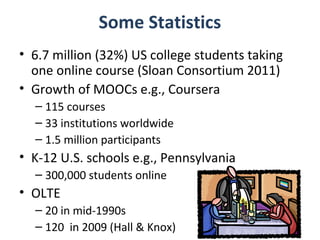
Some Statistics
• 6.7 million (32%) US college students taking
  one online course (Sloan Consortium 2011)
• Growth of MOOCs e.g., Coursera
  – 115 courses
  – 33 institutions worldwide
  – 1.5 million participants
• K-12 U.S. schools e.g., Pennsylvania
  – 300,000 students online
• OLTE
  – 20 in mid-1990s
  – 120 in 2009 (Hall & Knox)
Research Questions
(1) What language teacher education
programs, workshops, and/or courses are
currently being offered online, and what are
their key characteristics?
(2) At what levels is such education being
offered (e.g., undergraduate, diploma,
certificate, master’s degree, doctoral studies, or
individual workshops or courses for professional
development)?
(3) What issues arise in delivering language
teacher education online? How have institutions
addressed these issues?
A Case for Online Language Teacher
Education
CLARIFYING THE STUDY
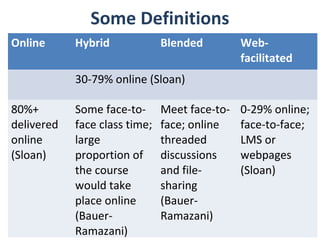
Some Definitions
Online      Hybrid             Blended         Web-
                                               facilitated
            30-79% online (Sloan)

80%+        Some face-to-      Meet face-to-   0-29% online;
delivered   face class time;   face; online    face-to-face;
online      large              threaded        LMS or
(Sloan)     proportion of      discussions     webpages
            the course         and file-       (Sloan)
            would take         sharing
            place online       (Bauer-
            (Bauer-            Ramazani)
            Ramazani)
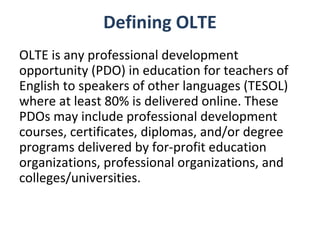
Defining OLTE
OLTE is any professional development
opportunity (PDO) in education for teachers of
English to speakers of other languages (TESOL)
where at least 80% is delivered online. These
PDOs may include professional development
courses, certificates, diplomas, and/or degree
programs delivered by for-profit education
organizations, professional organizations, and
colleges/universities.
Defining OLTE
OLTE is any professional development
opportunity (PDO) in education for teachers of
English to speakers of other languages (TESOL)
where at least 80% is delivered online. These
PDOs may include professional development
courses, certificates, diplomas, and/or degree
programs delivered by for-profit education
organizations, professional organizations, and
colleges/universities.
A Case for Online Language Teacher
Education
WHO DOES OLTE?
Task
• Describe any OLTE you are engaged
  in or are familiar with.
• Share with a neighbor.
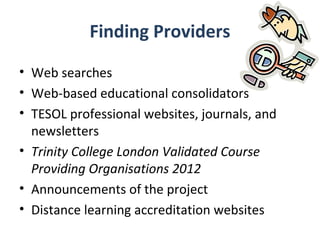
Finding Providers
• Web searches
• Web-based educational consolidators
• TESOL professional websites, journals, and
  newsletters
• Trinity College London Validated Course
  Providing Organisations 2012
• Announcements of the project
• Distance learning accreditation websites
Finding Providers
• 186 potentials
  – 106 universities; 80 non-universities
  – Asia, Australasia, Europe, North America, and
    South America
  – Not-for-profit and for-profit organizations
  – Large and small
• 140 contacted
  – 97 universities
  – 43 non-universities
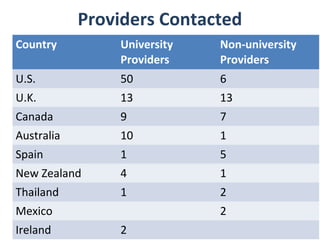
Providers Contacted
Country         University   Non-university
                Providers    Providers
U.S.            50           6
U.K.            13           13
Canada          9            7
Australia       10           1
Spain           1            5
New Zealand     4            1
Thailand        1            2
Mexico                       2
Ireland         2
A Case for Online Language Teacher
Education
WHAT DATA IS NEEDED TO
ANSWER THE QUESTIONS?
Research Questions
(1) What language teacher education
programs, workshops, and/or courses are
currently being offered online, and what are
their key characteristics?
(2) At what levels is such education being
offered (e.g., undergraduate, diploma,
certificate, master’s degree, doctoral studies, or
individual workshops or courses for professional
development)?
(3) What issues arise in delivering language
teacher education online? How have institutions
addressed these issues?
Data Sets
• Literature review

• Review of Websites offering OLTE

• Case Reports
Data
LITERATURE REVIEW
Literature Review
• Online learning

• OLTE


• Distance Education

• CALL
Key Issues in Literature Review
• Access
• Building Community
• Intersection of technology and pedagogy
• Student life online
• Professional development for teacher
  educators
• Administrative support
Data
REVIEW OF WEBPAGES OF OLTE
PROVIDERS
Task
• What do you think are essential
  features of an OLTE webpage?
• Share your ideas with a neighbor.
Analysis of Webpages of OLTE
             Providers
• Design
• Program content
• Home page
     • Sales pitch
     • Enquiry desk
     • Edifice
• Appeals to audience
     • Quality
     • Job placement
     • Travel
Data
CASE REPORTS
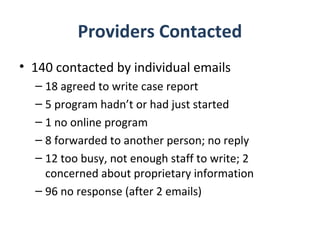
Providers Contacted
• 140 contacted by individual emails
  – 18 agreed to write case report
  – 5 program hadn’t or had just started
  – 1 no online program
  – 8 forwarded to another person; no reply
  – 12 too busy, not enough staff to write; 2
    concerned about proprietary information
  – 96 no response (after 2 emails)
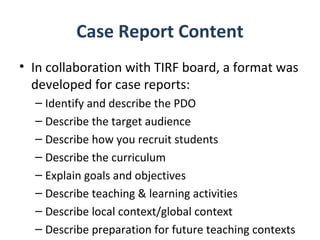
Case Report Content
• In collaboration with TIRF board, a format was
  developed for case reports:
  – Identify and describe the PDO
  – Describe the target audience
  – Describe how you recruit students
  – Describe the curriculum
  – Explain goals and objectives
  – Describe teaching & learning activities
  – Describe local context/global context
  – Describe preparation for future teaching contexts
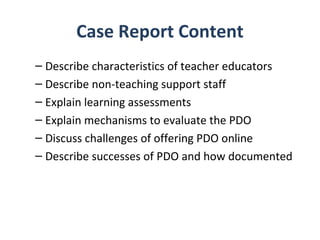
Case Report Content
– Describe characteristics of teacher educators
– Describe non-teaching support staff
– Explain learning assessments
– Explain mechanisms to evaluate the PDO
– Discuss challenges of offering PDO online
– Describe successes of PDO and how documented
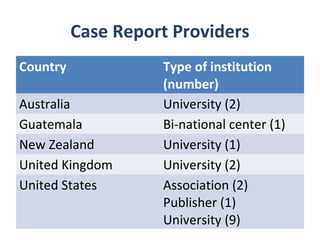
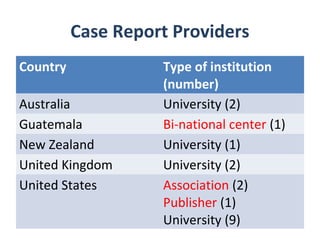
Case Report Providers
Country             Type of institution
                    (number)
Australia           University (2)
Guatemala           Bi-national center (1)
New Zealand         University (1)
United Kingdom      University (2)
United States       Association (2)
                    Publisher (1)
                    University (9)
Case Report Providers
Country             Type of institution
                    (number)
Australia           University (2)
Guatemala           Bi-national center (1)
New Zealand         University (1)
United Kingdom      University (2)
United States       Association (2)
                    Publisher (1)
                    University (9)
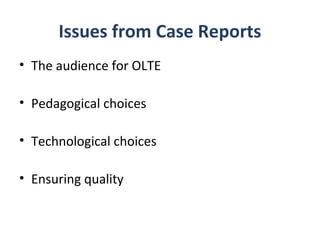
Issues from Case Reports
• The audience for OLTE

• Pedagogical choices

• Technological choices

• Ensuring quality
A Case for Online Language Teacher
Education
IN CONCLUSION
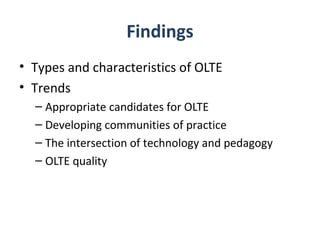
Findings
• Types and characteristics of OLTE
• Trends
  – Appropriate candidates for OLTE
  – Developing communities of practice
  – The intersection of technology and pedagogy
  – OLTE quality
Where to now?
• Further research:
  – Instructor attitudes and experiences;
  – Participant attitudes and experiences;
  – Technical support staff attitudes and experiences;
  – Peer-peer interaction;
  – Instructor-participant interaction;
  – Learning outcomes;
  – Cost effectiveness; and
  – Washback of online pedagogical strategies to
    classroom practice.
the complexity of the issues involved in
  technology and learning is pushing us to look
  beyond gross decontextualized measures of
  effectiveness to understand effectiveness in
  terms of the specifics of what people do with
  computers, how they do it, and what it means
  to them (Kern 2006: 189).
the complexity of the issues involved in
  technology and learning is pushing us to look
  beyond gross decontextualized measures of
  effectiveness to understand effectiveness in
  terms of the specifics of what people do with
  computers, how they do it, and what it
  means to them (Kern 2006: 189).
Prof. Denise E. Murray

denise.murray@tirfonline.edu
Access to OLTE Paper
Visit www.tirfonline.org
  - Click on “English in the Workforce”

Direct link
  -
  http://www.tirfonline.org/wp-content/uploads/20
Focused discussion
•   Appropriate candidates for OLTE
•   Developing communities of practice
•   The intersection of technology and pedagogy
•   OLTE quality
•   Teacher qualifications

TIRF at 2013 TESOL - A Case for Online English Language Teacher Education

  • 1.
    Welcome to TIRF’s2013 Presentation at the TESOL Convention in Dallas!
  • 3.
    Task • How doyou define online in the context of an education course? • Share your definition with a neighbor.
  • 4.
    A Case forOnline Language Teacher Education IMPETUS FOR THE STUDY
  • 5.
    Some Statistics • 6.7million (32%) US college students taking one online course (Sloan Consortium 2011) • Growth of MOOCs e.g., Coursera – 115 courses – 33 institutions worldwide – 1.5 million participants • K-12 U.S. schools e.g., Pennsylvania – 300,000 students online • OLTE – 20 in mid-1990s – 120 in 2009 (Hall & Knox)
  • 6.
    Research Questions (1) Whatlanguage teacher education programs, workshops, and/or courses are currently being offered online, and what are their key characteristics? (2) At what levels is such education being offered (e.g., undergraduate, diploma, certificate, master’s degree, doctoral studies, or individual workshops or courses for professional development)? (3) What issues arise in delivering language teacher education online? How have institutions addressed these issues?
  • 7.
    A Case forOnline Language Teacher Education CLARIFYING THE STUDY
  • 8.
    Some Definitions Online Hybrid Blended Web- facilitated 30-79% online (Sloan) 80%+ Some face-to- Meet face-to- 0-29% online; delivered face class time; face; online face-to-face; online large threaded LMS or (Sloan) proportion of discussions webpages the course and file- (Sloan) would take sharing place online (Bauer- (Bauer- Ramazani) Ramazani)
  • 9.
    Defining OLTE OLTE isany professional development opportunity (PDO) in education for teachers of English to speakers of other languages (TESOL) where at least 80% is delivered online. These PDOs may include professional development courses, certificates, diplomas, and/or degree programs delivered by for-profit education organizations, professional organizations, and colleges/universities.
  • 10.
    Defining OLTE OLTE isany professional development opportunity (PDO) in education for teachers of English to speakers of other languages (TESOL) where at least 80% is delivered online. These PDOs may include professional development courses, certificates, diplomas, and/or degree programs delivered by for-profit education organizations, professional organizations, and colleges/universities.
  • 11.
    A Case forOnline Language Teacher Education WHO DOES OLTE?
  • 12.
    Task • Describe anyOLTE you are engaged in or are familiar with. • Share with a neighbor.
  • 13.
    Finding Providers • Websearches • Web-based educational consolidators • TESOL professional websites, journals, and newsletters • Trinity College London Validated Course Providing Organisations 2012 • Announcements of the project • Distance learning accreditation websites
  • 14.
    Finding Providers • 186potentials – 106 universities; 80 non-universities – Asia, Australasia, Europe, North America, and South America – Not-for-profit and for-profit organizations – Large and small • 140 contacted – 97 universities – 43 non-universities
  • 15.
    Providers Contacted Country University Non-university Providers Providers U.S. 50 6 U.K. 13 13 Canada 9 7 Australia 10 1 Spain 1 5 New Zealand 4 1 Thailand 1 2 Mexico 2 Ireland 2
  • 16.
    A Case forOnline Language Teacher Education WHAT DATA IS NEEDED TO ANSWER THE QUESTIONS?
  • 17.
    Research Questions (1) Whatlanguage teacher education programs, workshops, and/or courses are currently being offered online, and what are their key characteristics? (2) At what levels is such education being offered (e.g., undergraduate, diploma, certificate, master’s degree, doctoral studies, or individual workshops or courses for professional development)? (3) What issues arise in delivering language teacher education online? How have institutions addressed these issues?
  • 18.
    Data Sets • Literaturereview • Review of Websites offering OLTE • Case Reports
  • 19.
  • 20.
    Literature Review • Onlinelearning • OLTE • Distance Education • CALL
  • 21.
    Key Issues inLiterature Review • Access • Building Community • Intersection of technology and pedagogy • Student life online • Professional development for teacher educators • Administrative support
  • 22.
    Data REVIEW OF WEBPAGESOF OLTE PROVIDERS
  • 23.
    Task • What doyou think are essential features of an OLTE webpage? • Share your ideas with a neighbor.
  • 24.
    Analysis of Webpagesof OLTE Providers • Design • Program content • Home page • Sales pitch • Enquiry desk • Edifice • Appeals to audience • Quality • Job placement • Travel
  • 25.
  • 26.
    Providers Contacted • 140contacted by individual emails – 18 agreed to write case report – 5 program hadn’t or had just started – 1 no online program – 8 forwarded to another person; no reply – 12 too busy, not enough staff to write; 2 concerned about proprietary information – 96 no response (after 2 emails)
  • 27.
    Case Report Content •In collaboration with TIRF board, a format was developed for case reports: – Identify and describe the PDO – Describe the target audience – Describe how you recruit students – Describe the curriculum – Explain goals and objectives – Describe teaching & learning activities – Describe local context/global context – Describe preparation for future teaching contexts
  • 28.
    Case Report Content –Describe characteristics of teacher educators – Describe non-teaching support staff – Explain learning assessments – Explain mechanisms to evaluate the PDO – Discuss challenges of offering PDO online – Describe successes of PDO and how documented
  • 29.
    Case Report Providers Country Type of institution (number) Australia University (2) Guatemala Bi-national center (1) New Zealand University (1) United Kingdom University (2) United States Association (2) Publisher (1) University (9)
  • 30.
    Case Report Providers Country Type of institution (number) Australia University (2) Guatemala Bi-national center (1) New Zealand University (1) United Kingdom University (2) United States Association (2) Publisher (1) University (9)
  • 31.
    Issues from CaseReports • The audience for OLTE • Pedagogical choices • Technological choices • Ensuring quality
  • 32.
    A Case forOnline Language Teacher Education IN CONCLUSION
  • 33.
    Findings • Types andcharacteristics of OLTE • Trends – Appropriate candidates for OLTE – Developing communities of practice – The intersection of technology and pedagogy – OLTE quality
  • 34.
    Where to now? •Further research: – Instructor attitudes and experiences; – Participant attitudes and experiences; – Technical support staff attitudes and experiences; – Peer-peer interaction; – Instructor-participant interaction; – Learning outcomes; – Cost effectiveness; and – Washback of online pedagogical strategies to classroom practice.
  • 35.
    the complexity ofthe issues involved in technology and learning is pushing us to look beyond gross decontextualized measures of effectiveness to understand effectiveness in terms of the specifics of what people do with computers, how they do it, and what it means to them (Kern 2006: 189).
  • 36.
    the complexity ofthe issues involved in technology and learning is pushing us to look beyond gross decontextualized measures of effectiveness to understand effectiveness in terms of the specifics of what people do with computers, how they do it, and what it means to them (Kern 2006: 189).
  • 37.
    Prof. Denise E.Murray denise.murray@tirfonline.edu
  • 38.
    Access to OLTEPaper Visit www.tirfonline.org - Click on “English in the Workforce” Direct link - http://www.tirfonline.org/wp-content/uploads/20
  • 39.
    Focused discussion • Appropriate candidates for OLTE • Developing communities of practice • The intersection of technology and pedagogy • OLTE quality • Teacher qualifications