Massive Open Online Courses: Past,
Present, and Future in India
Ms. Disha P. Kariya
MA Semester IV
Department of English
Bhakta Kavi Narsinh Mehta University, Junagadh
Review of Related Literature
Motivation to learn in massive open online courses: Examining
aspects of language and social engagement by Miri Barak,
Abeer Watted, Hossam Haick
Critical discussions on the Massive Open Online Course
(MOOC) in India and China by Sangeeta Trehan , Janesh
Sanzgiri and Chenxi Li, Rongsheng Wang, and Rakesh Mohan
Joshi
“Turn on, Tune in, Drop out”: Anticipating student dropouts in
Massive Open Online Courses by Diyi Yang, Tanmay Sinha,
David Adamson, and Carolyn Penstein Rose
Massive Open Online Courses (MOOCs) in Higher
Education – Unleashing the Potential in India by Parag
Chatterjee and Asoke Nath
MOOCs: Changing Trend Towards Open Distance
Learning with Special Reference to India by Faizul
Nisha* and V. Senthil
Present Status of Massive Open Online Course (MOOC)
initiatives for Open Education Systems in India – An
Analytical Study by Amit Kumar Das, Anamika Das and
Soumit Das
Objectives
To know the origin of Massive Open Online Courses
To know the present status of Massive Open Online
Courses in India
To know the future of Massive Open Online Courses in
India
Hypothesis
The future of Massive Open Online Courses in
India shall be better.
Research Design
Research Method: Historical
Tools and techniques: Interview technique
Procedure of the Study
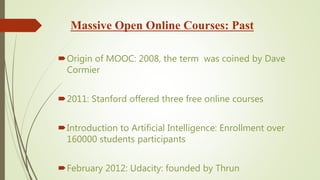
Massive Open Online Courses: Past
Origin of MOOC: 2008, the term was coined by Dave
Cormier
2011: Stanford offered three free online courses
Introduction to Artificial Intelligence: Enrollment over
160000 students participants
February 2012: Udacity: founded by Thrun
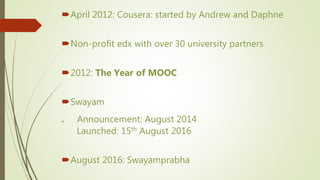
April 2012: Cousera: started by Andrew and Daphne
Non-profit edx with over 30 university partners
2012: The Year of MOOC
Swayam
. Announcement: August 2014
Launched: 15th August 2016
August 2016: Swayamprabha
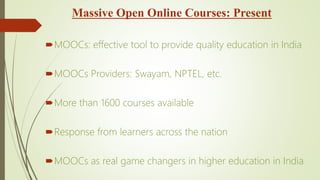
Massive Open Online Courses: Present
MOOCs: effective tool to provide quality education in India
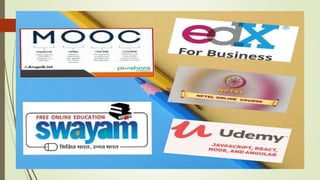
MOOCs Providers: Swayam, NPTEL, etc.
More than 1600 courses available
Response from learners across the nation
MOOCs as real game changers in higher education in India
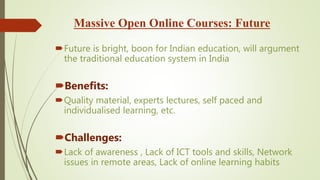
Massive Open Online Courses: Future
Future is bright, boon for Indian education, will argument
the traditional education system in India
Benefits:
Quality material, experts lectures, self paced and
individualised learning, etc.
Challenges:
Lack of awareness , Lack of ICT tools and skills, Network
issues in remote areas, Lack of online learning habits
Summary of Findings
MOOC was emerged in India from 2014 onwards with the aim
of departing educational benefits to huge number of learners
with access, equity, and quality.
At present, MOOCs are developing gradually but effectively in
the field of higher education in India.
There are different challenges for MOOCs in India i.e. lack
of awareness, technical issues, and so on.
The future of MOOCs is very bright in India.
MOOCs will augment the University education in India in
terms of qualitative education.
Conclusion
MOOCs as real game changers in Indian education
system
Developing stage at present
Bright future of MOOCs in India
Suggestions for the Further Study
Further study can be done to know the reasons why drop
out ratio is high in MOOCs.
Further research can be pursued to know the benefits and
challenges of Massive Open Online Courses in India.
Works Cited
Barak, Miri, et al. “Motivation to Learn in Massive Open Online Courses: Examining Aspects of Language and Social
Engagement.” Computers & Education, Pergamon, 25 Nov. 2015,
www.sciencedirect.com/science/article/pii/S0360131515300828.
Chatterjee, Parag, and Asoke Nath. "Massive open online courses (MOOCs) in higher education—Unleashing the
potential in India." 2014 IEEE International Conference on MOOC, Innovation and Technology in Education (MITE).
IEEE, 2014.
Chatterjee, Parag, and Asoke Nath. "Massive open online courses (MOOCs) in education—A case study in Indian
context and vision to ubiquitous learning." 2014 IEEE International Conference on MOOC, Innovation and Technology
in Education (MITE). IEEE, 2014.
Das, Amit Kumar, A. Das, and S. Das. "Present status of Massive Open Online Course (MOOC) initiatives for Open
Education Systems in India–An analytical study." Asian Journal of Multidisciplinary Studies 3.7 (2015): 67-80.
Gibaldi, Joseph, Walter S. Achtert, and Modern Language Association of America. MLA handbook for writers of
research papers. New York: Modern Language Association of America, 2003.
Kothari, C. R. and Gaurav Garg. RESEARCH METHODOLOGY: METHODS AND TECHNIQUES. New Delhi: NEW
AGE INTERNATIONAL PUBLISHERS, 2019. Print.
MAUT. “A Brief History of MOOCs.” MAUT, 16 Nov. 2015, www.mcgill.ca/maut/current-issues/moocs/history.
Mehta , Deepak. “The Future Of Massively Open Online Courses (MOOCs).” Forbes, Forbes Magazine, 23 Mar.
2017, www.forbes.com/sites/quora/2017/03/23/the-future-of-massively-open-online-courses-moocs/.
Mendez, Manoel Cortes. “In India, MOOCs Are Now Part of the Education System - Class
Central.” Class Central's MOOCReport, 31 Dec. 2019, www.classcentral.com/report/swayam-
for-credit/.
Nisha, Faizul, and V. Senthil. "MOOCs: Changing trend towards open distance learning with
special reference to India." DESIDOC Journal of Library & Information Technology 35.2 (2015):
82-89.
“President Launches Revolutionary Digital Learning Initiatives.” SWAYAM and SWAYAM
Prabha: New Online Learning Platforms by Central Govt. | My India, 10 July 2017,
www.mapsofindia.com/my-india/government/president-launches-revolutionary-digital-learning-
initiatives.
Trehan, Sangeeta, et al. "Critical discussions on the massive open online course (MOOC) in India
and China." International Journal of Education and Development using ICT 13.2 (2017).
Wiki. “Massive Open Online Course.” Wikipedia, Wikimedia Foundation, 28 Feb. 2020,
en.wikipedia.org/wiki/Massive_open_online_course.
Yang, Diyi, et al. "Turn on, tune in, drop out: Anticipating student dropouts in massive open
online courses." Proceedings of the 2013 NIPS Data-driven education workshop. Vol. 11. 2013.
Time
for
Questi⏱️ns
Thank
You✍️

MOOCs Past Present and Future in India

  • 1.
    Massive Open OnlineCourses: Past, Present, and Future in India Ms. Disha P. Kariya MA Semester IV Department of English Bhakta Kavi Narsinh Mehta University, Junagadh
  • 3.
    Review of RelatedLiterature Motivation to learn in massive open online courses: Examining aspects of language and social engagement by Miri Barak, Abeer Watted, Hossam Haick Critical discussions on the Massive Open Online Course (MOOC) in India and China by Sangeeta Trehan , Janesh Sanzgiri and Chenxi Li, Rongsheng Wang, and Rakesh Mohan Joshi “Turn on, Tune in, Drop out”: Anticipating student dropouts in Massive Open Online Courses by Diyi Yang, Tanmay Sinha, David Adamson, and Carolyn Penstein Rose
  • 4.
    Massive Open OnlineCourses (MOOCs) in Higher Education – Unleashing the Potential in India by Parag Chatterjee and Asoke Nath MOOCs: Changing Trend Towards Open Distance Learning with Special Reference to India by Faizul Nisha* and V. Senthil Present Status of Massive Open Online Course (MOOC) initiatives for Open Education Systems in India – An Analytical Study by Amit Kumar Das, Anamika Das and Soumit Das
  • 5.
    Objectives To know theorigin of Massive Open Online Courses To know the present status of Massive Open Online Courses in India To know the future of Massive Open Online Courses in India
  • 6.
    Hypothesis The future ofMassive Open Online Courses in India shall be better.
  • 7.
    Research Design Research Method:Historical Tools and techniques: Interview technique Procedure of the Study
  • 8.
    Massive Open OnlineCourses: Past Origin of MOOC: 2008, the term was coined by Dave Cormier 2011: Stanford offered three free online courses Introduction to Artificial Intelligence: Enrollment over 160000 students participants February 2012: Udacity: founded by Thrun
  • 9.
    April 2012: Cousera:started by Andrew and Daphne Non-profit edx with over 30 university partners 2012: The Year of MOOC Swayam . Announcement: August 2014 Launched: 15th August 2016 August 2016: Swayamprabha
  • 10.
    Massive Open OnlineCourses: Present MOOCs: effective tool to provide quality education in India MOOCs Providers: Swayam, NPTEL, etc. More than 1600 courses available Response from learners across the nation MOOCs as real game changers in higher education in India
  • 11.
    Massive Open OnlineCourses: Future Future is bright, boon for Indian education, will argument the traditional education system in India Benefits: Quality material, experts lectures, self paced and individualised learning, etc. Challenges: Lack of awareness , Lack of ICT tools and skills, Network issues in remote areas, Lack of online learning habits
  • 12.
    Summary of Findings MOOCwas emerged in India from 2014 onwards with the aim of departing educational benefits to huge number of learners with access, equity, and quality. At present, MOOCs are developing gradually but effectively in the field of higher education in India.
  • 13.
    There are differentchallenges for MOOCs in India i.e. lack of awareness, technical issues, and so on. The future of MOOCs is very bright in India. MOOCs will augment the University education in India in terms of qualitative education.
  • 14.
    Conclusion MOOCs as realgame changers in Indian education system Developing stage at present Bright future of MOOCs in India
  • 15.
    Suggestions for theFurther Study Further study can be done to know the reasons why drop out ratio is high in MOOCs. Further research can be pursued to know the benefits and challenges of Massive Open Online Courses in India.
  • 16.
    Works Cited Barak, Miri,et al. “Motivation to Learn in Massive Open Online Courses: Examining Aspects of Language and Social Engagement.” Computers & Education, Pergamon, 25 Nov. 2015, www.sciencedirect.com/science/article/pii/S0360131515300828. Chatterjee, Parag, and Asoke Nath. "Massive open online courses (MOOCs) in higher education—Unleashing the potential in India." 2014 IEEE International Conference on MOOC, Innovation and Technology in Education (MITE). IEEE, 2014. Chatterjee, Parag, and Asoke Nath. "Massive open online courses (MOOCs) in education—A case study in Indian context and vision to ubiquitous learning." 2014 IEEE International Conference on MOOC, Innovation and Technology in Education (MITE). IEEE, 2014. Das, Amit Kumar, A. Das, and S. Das. "Present status of Massive Open Online Course (MOOC) initiatives for Open Education Systems in India–An analytical study." Asian Journal of Multidisciplinary Studies 3.7 (2015): 67-80. Gibaldi, Joseph, Walter S. Achtert, and Modern Language Association of America. MLA handbook for writers of research papers. New York: Modern Language Association of America, 2003. Kothari, C. R. and Gaurav Garg. RESEARCH METHODOLOGY: METHODS AND TECHNIQUES. New Delhi: NEW AGE INTERNATIONAL PUBLISHERS, 2019. Print. MAUT. “A Brief History of MOOCs.” MAUT, 16 Nov. 2015, www.mcgill.ca/maut/current-issues/moocs/history. Mehta , Deepak. “The Future Of Massively Open Online Courses (MOOCs).” Forbes, Forbes Magazine, 23 Mar. 2017, www.forbes.com/sites/quora/2017/03/23/the-future-of-massively-open-online-courses-moocs/.
  • 17.
    Mendez, Manoel Cortes.“In India, MOOCs Are Now Part of the Education System - Class Central.” Class Central's MOOCReport, 31 Dec. 2019, www.classcentral.com/report/swayam- for-credit/. Nisha, Faizul, and V. Senthil. "MOOCs: Changing trend towards open distance learning with special reference to India." DESIDOC Journal of Library & Information Technology 35.2 (2015): 82-89. “President Launches Revolutionary Digital Learning Initiatives.” SWAYAM and SWAYAM Prabha: New Online Learning Platforms by Central Govt. | My India, 10 July 2017, www.mapsofindia.com/my-india/government/president-launches-revolutionary-digital-learning- initiatives. Trehan, Sangeeta, et al. "Critical discussions on the massive open online course (MOOC) in India and China." International Journal of Education and Development using ICT 13.2 (2017). Wiki. “Massive Open Online Course.” Wikipedia, Wikimedia Foundation, 28 Feb. 2020, en.wikipedia.org/wiki/Massive_open_online_course. Yang, Diyi, et al. "Turn on, tune in, drop out: Anticipating student dropouts in massive open online courses." Proceedings of the 2013 NIPS Data-driven education workshop. Vol. 11. 2013.
  • 18.
  • 19.