

Best Practices & Products in
Basic Online Language Learning
     2012 FLAVA Pre-Conference Workshop
         October 4 Strand D 3:15-4:30
          General Lonstreet’s Redoubt
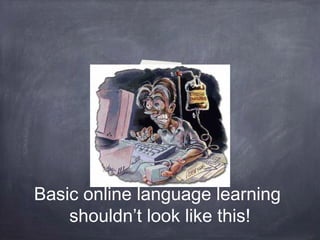
Basic online language learning
    shouldn’t look like this!
then again, not entirely like
       this, either!
Our itinerary

Introductory remarks

Current online programs, tools, languages: selecting the
best fit for the overall goals and learning objectives.

Foundational design and delivery considerations

Teacher training and learner preparation

Implementation issues and (debunking mis)perceptions
Introductory comments

Why is online language learning important to us?
Some factoids:
✓ Over 90% of HEI offer Internet courses (JOLT 2011)
✓ "More public colleges than private for-profits—74.9 percent versus 60.5
    percent—say it’s part of their long-term plans." CHE, 2010
✓   At CCs in 2010, "Campuses reported a 22 percent increase for distance
    education enrollments" which is "substantially higher" than overall
    national post-secondary rates.
    Rate of growth in online learning and 6.6% in FL enrollments (MLA 2010)
✓   CALL explosion in online T&L: BOLDD Collaboratory, CARLA Ning,
    NFLC survey, COERLL online materials (see: CHE 11/2011)
poses general challenges
because . . .


 o it may be (mis)construed as an 'easy' cashcow

   that allows educating without real faculty;

 o ads show learners learning online while asleep or

   while working, raising a family, and/or partying full

   time.
teaching & learning poses
specific challenges
because . . .


o the loss of some channels of meaningful input
  complicates/increases the foreignness of the new language
  for the novice learner;
o learners are often also novices at learning strategies and
  effective practices;
o pre-ordained, highly structured delivery mechanisms might
  not always correctly address individual learner needs and
  differences;
o technical/technological issues for schools, teachers, and
  students (FYI digital natives are NOT all that e-competent).
Current online programs, tools,
languages: selecting the best fit for
your program


   Programs

   Tools

   What’s available in which languages

   Selecting based on your program
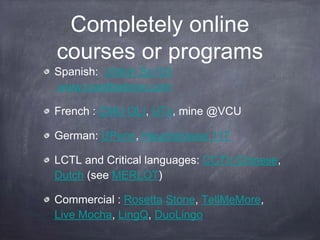
Completely online
courses or programs
Spanish: UMich Sp103
www.rosettastone.com

French : CMU OLI, UTx, mine @VCU

German: UPenn, Hauptstrasse 117

LCTL and Critical languages: CCTV Chinese,
Dutch (see MERLOT)

Commercial : Rosetta Stone, TellMeMore,
Live Mocha, LingQ, DuoLingo
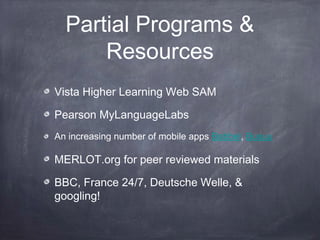
Partial Programs &
      Resources
Vista Higher Learning Web SAM

Pearson MyLanguageLabs
An increasing number of mobile apps Babbel, Busuu

MERLOT.org for peer reviewed materials

BBC, France 24/7, Deutsche Welle, &
googling!
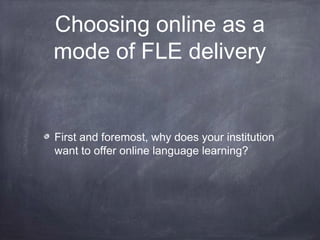
Choosing online as a
mode of FLE delivery


First and foremost, why does your institution
want to offer online language learning?
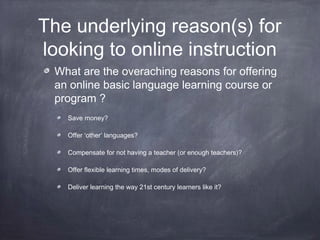
The underlying reason(s) for
looking to online instruction
 What are the overaching reasons for offering
 an online basic language learning course or
 program ?
   Save money?

   Offer ‘other’ languages?

   Compensate for not having a teacher (or enough teachers)?

   Offer flexible learning times, modes of delivery?

   Deliver learning the way 21st century learners like it?
Some responses...
... a good, standards based, communicative online course may actually
cost more and costs do not diminish over time.

... there are many languages, but there still need to be ‘live’ teachers and
real communication.

... there still need to be live teachers....

... although time and space is flexible, there still must be learning objectives
met and progress made: learning in bed, asleep, is not possible even if one
is a hard-working, full time professional trying to earn a degree.

... definitely can optimize digital media, constructivist and active learning,
and social media interactions with peers and native interlocutors.
Design issues

Is your institution and are you ready to offer online
courses?

Is the technology backbone robust enough to deliver
online materials?

Where will the students be? If on campus, is the
infrastructure robust and ubiquitous enough?

If they are to learn at home, do they have sufficiently
performative technology and skills?
Design: start here!

Synchronous, asynchronous or both? (includes decisions
about in a regular semester; an autonomous, self-paced
environment; credit-bearing; developmental; other)

Platform: your LMS, social media, a blend, an available
online package? (grading, credit, accreditation)

 Location: within the language program, in a separate online
education sector, other

Numbers: how many learners are you talking about?
Heart & Soul of an effective
 online language course

 Basing T&L on the 5C’s; guiding learning within
 appropriate proficiency (CEFR) levels; & using active,
 communicative, differentiated strategies.

 Recognizing and compensating for the loss of face-to-
 face communicational channels.

 Creating community, engagement, risk-taking (all the
 while exercising safe-hex!) thanks to the online
 environment.
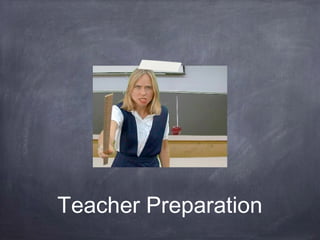
Teacher Preparation
Teacher Preparation
Teaching online is a learned skill

New teacher behaviors include but are not limited to:

• realizing that teaching online is not 'simply' mapping a
  traditional approach on to an online environment

• learning to allow students room to grow, make errors, but
  being available to them for input, correction...

• learning to build community
• the same goals apply i.e. content knowledge, skill getting
  (the '4' skills at expected proficiency levels)...
Teacher Preparation
 Instructor/facilitator profiles and habits
Illinois Online Network


Penn State online offers a profiler!


SUNY, too, offers a personal review of readiness/style


Good habits:


CALICO/ACTFL(regional)/IALLT(regional) /other Workshops


Marlene Johnshoy's Ning


Joining or creating a collective.
Learner Preparation
Learner Preparation
Student success rates in online learning:

CHE 5/2011 "
  only 50 per cent—as opposed to 70-to-75 percent for comparable face-to-face
   successfully complete their courses.

• Over 20% more students withdraw from online courses than from
  f2f at community colleges where e-learning is ubiquitous and
  accelerating.

• Couple regular online learning success/failure rates to the
  complication of onlined-ness + novice low/mid/high reading, writing,
  listening and speaking proficiency levels + the lack of
  visual/sensory cueing active in the f2f environment+ student
  attitude/(bad)habits of 'doing' online work 'whenever'=recipe for
  disaster.
Learner Preparation
•   Qualities & habits of the successful online learner in general:

• Autonomous, a.k.a., self-directed

• Collaborative and willing to buddy-up with other online learners in your class

• Motivated

• Computer literate and excited to acquire more and better computer skills

• Able to use email, an internet browser, online programs

• Able to read and write online (good typing skills help a lot)

• Curious and eager to learn new things

• Focused and task-oriented

• Independent but also willing to ask for help before it's too late!!
Implementation


ADDIE model
Questions? Comments?


 kmurphyj@me.com

Flava workshop 2012

  • 1.
    Best Practices &Products in Basic Online Language Learning 2012 FLAVA Pre-Conference Workshop October 4 Strand D 3:15-4:30 General Lonstreet’s Redoubt
  • 2.
    Basic online languagelearning shouldn’t look like this!
  • 3.
    then again, notentirely like this, either!
  • 4.
    Our itinerary Introductory remarks Currentonline programs, tools, languages: selecting the best fit for the overall goals and learning objectives. Foundational design and delivery considerations Teacher training and learner preparation Implementation issues and (debunking mis)perceptions
  • 5.
    Introductory comments Why isonline language learning important to us? Some factoids: ✓ Over 90% of HEI offer Internet courses (JOLT 2011) ✓ "More public colleges than private for-profits—74.9 percent versus 60.5 percent—say it’s part of their long-term plans." CHE, 2010 ✓ At CCs in 2010, "Campuses reported a 22 percent increase for distance education enrollments" which is "substantially higher" than overall national post-secondary rates. Rate of growth in online learning and 6.6% in FL enrollments (MLA 2010) ✓ CALL explosion in online T&L: BOLDD Collaboratory, CARLA Ning, NFLC survey, COERLL online materials (see: CHE 11/2011)
  • 6.
    poses general challenges because. . . o it may be (mis)construed as an 'easy' cashcow that allows educating without real faculty; o ads show learners learning online while asleep or while working, raising a family, and/or partying full time.
  • 7.
    teaching & learningposes specific challenges because . . . o the loss of some channels of meaningful input complicates/increases the foreignness of the new language for the novice learner; o learners are often also novices at learning strategies and effective practices; o pre-ordained, highly structured delivery mechanisms might not always correctly address individual learner needs and differences; o technical/technological issues for schools, teachers, and students (FYI digital natives are NOT all that e-competent).
  • 8.
    Current online programs,tools, languages: selecting the best fit for your program Programs Tools What’s available in which languages Selecting based on your program
  • 9.
    Completely online courses orprograms Spanish: UMich Sp103 www.rosettastone.com French : CMU OLI, UTx, mine @VCU German: UPenn, Hauptstrasse 117 LCTL and Critical languages: CCTV Chinese, Dutch (see MERLOT) Commercial : Rosetta Stone, TellMeMore, Live Mocha, LingQ, DuoLingo
  • 10.
    Partial Programs & Resources Vista Higher Learning Web SAM Pearson MyLanguageLabs An increasing number of mobile apps Babbel, Busuu MERLOT.org for peer reviewed materials BBC, France 24/7, Deutsche Welle, & googling!
  • 11.
    Choosing online asa mode of FLE delivery First and foremost, why does your institution want to offer online language learning?
  • 12.
    The underlying reason(s)for looking to online instruction What are the overaching reasons for offering an online basic language learning course or program ? Save money? Offer ‘other’ languages? Compensate for not having a teacher (or enough teachers)? Offer flexible learning times, modes of delivery? Deliver learning the way 21st century learners like it?
  • 13.
    Some responses... ... agood, standards based, communicative online course may actually cost more and costs do not diminish over time. ... there are many languages, but there still need to be ‘live’ teachers and real communication. ... there still need to be live teachers.... ... although time and space is flexible, there still must be learning objectives met and progress made: learning in bed, asleep, is not possible even if one is a hard-working, full time professional trying to earn a degree. ... definitely can optimize digital media, constructivist and active learning, and social media interactions with peers and native interlocutors.
  • 14.
    Design issues Is yourinstitution and are you ready to offer online courses? Is the technology backbone robust enough to deliver online materials? Where will the students be? If on campus, is the infrastructure robust and ubiquitous enough? If they are to learn at home, do they have sufficiently performative technology and skills?
  • 15.
    Design: start here! Synchronous,asynchronous or both? (includes decisions about in a regular semester; an autonomous, self-paced environment; credit-bearing; developmental; other) Platform: your LMS, social media, a blend, an available online package? (grading, credit, accreditation) Location: within the language program, in a separate online education sector, other Numbers: how many learners are you talking about?
  • 16.
    Heart & Soulof an effective online language course Basing T&L on the 5C’s; guiding learning within appropriate proficiency (CEFR) levels; & using active, communicative, differentiated strategies. Recognizing and compensating for the loss of face-to- face communicational channels. Creating community, engagement, risk-taking (all the while exercising safe-hex!) thanks to the online environment.
  • 17.
  • 18.
    Teacher Preparation Teaching onlineis a learned skill New teacher behaviors include but are not limited to: • realizing that teaching online is not 'simply' mapping a traditional approach on to an online environment • learning to allow students room to grow, make errors, but being available to them for input, correction... • learning to build community • the same goals apply i.e. content knowledge, skill getting (the '4' skills at expected proficiency levels)...
  • 19.
    Teacher Preparation Instructor/facilitatorprofiles and habits Illinois Online Network Penn State online offers a profiler! SUNY, too, offers a personal review of readiness/style Good habits: CALICO/ACTFL(regional)/IALLT(regional) /other Workshops Marlene Johnshoy's Ning Joining or creating a collective.
  • 20.
  • 21.
    Learner Preparation Student successrates in online learning: CHE 5/2011 " only 50 per cent—as opposed to 70-to-75 percent for comparable face-to-face successfully complete their courses. • Over 20% more students withdraw from online courses than from f2f at community colleges where e-learning is ubiquitous and accelerating. • Couple regular online learning success/failure rates to the complication of onlined-ness + novice low/mid/high reading, writing, listening and speaking proficiency levels + the lack of visual/sensory cueing active in the f2f environment+ student attitude/(bad)habits of 'doing' online work 'whenever'=recipe for disaster.
  • 22.
    Learner Preparation • Qualities & habits of the successful online learner in general: • Autonomous, a.k.a., self-directed • Collaborative and willing to buddy-up with other online learners in your class • Motivated • Computer literate and excited to acquire more and better computer skills • Able to use email, an internet browser, online programs • Able to read and write online (good typing skills help a lot) • Curious and eager to learn new things • Focused and task-oriented • Independent but also willing to ask for help before it's too late!!
  • 23.
  • 24.