TECH-CAMERA
Instructions on the types of
CAMERA ANGLES, SHOTS & MOVEMENTS
You will need to identify in the assessment.
Camera Shots, Angles and Movement
Camera & Lens Movements
1. Tracking Shot (Dollying): Camera on track moving in and out (Tracking) of the subject
2. Tilt Shot: Fixed camera position, moving up and down (Tilting) the subject
3. Pan Shot: Fixed camera position, swiveling (Panning) left to right of (or with) the subject
4. Zoom Shot: Fixed camera position, zooming in and out of the subject (Lens not camera)
5. Steadicam: Camera attached to a person, which follows the subject's movement.
6. Hand-Held Cam: A light camera, often giving a jerky, ragged effect. Gives the sense of realism
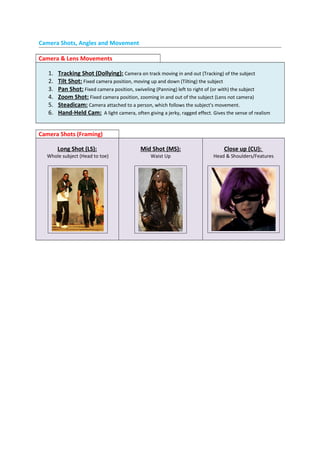
Camera Shots (Framing)
Long Shot (LS):
Whole subject (Head to toe)
Mid Shot (MS):
Waist Up
Close up (CU):
Head & Shoulders/Features
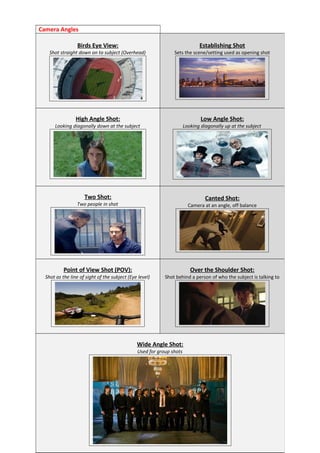
Camera Angles
Birds Eye View:
Shot straight down on to subject (Overhead)
Establishing Shot
Sets the scene/setting used as opening shot
High Angle Shot:
Looking diagonally down at the subject
Low Angle Shot:
Looking diagonally up at the subject
Two Shot:
Two people in shot
Canted Shot:
Camera at an angle, off balance
Point of View Shot (POV):
Shot as the line of sight of the subject (Eye level)
Over the Shoulder Shot:
Shot behind a person of who the subject is talking to
Wide Angle Shot:
Used for group shots
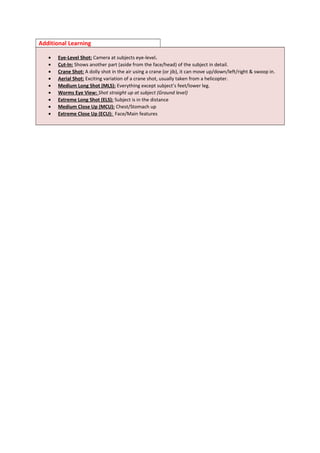
Additional Learning
• Eye-Level Shot: Camera at subjects eye-level.
• Cut-In: Shows another part (aside from the face/head) of the subject in detail.
• Crane Shot: A dolly shot in the air using a crane (or jib), it can move up/down/left/right & swoop in.
• Aerial Shot: Exciting variation of a crane shot, usually taken from a helicopter.
• Medium Long Shot (MLS): Everything except subject’s feet/lower leg.
• Worms Eye View: Shot straight up at subject (Ground level)
• Extreme Long Shot (ELS): Subject is in the distance
• Medium Close Up (MCU): Chest/Stomach up
• Extreme Close Up (ECU): Face/Main features

Camera overview

  • 1.
    TECH-CAMERA Instructions on thetypes of CAMERA ANGLES, SHOTS & MOVEMENTS You will need to identify in the assessment.
  • 2.
    Camera Shots, Anglesand Movement Camera & Lens Movements 1. Tracking Shot (Dollying): Camera on track moving in and out (Tracking) of the subject 2. Tilt Shot: Fixed camera position, moving up and down (Tilting) the subject 3. Pan Shot: Fixed camera position, swiveling (Panning) left to right of (or with) the subject 4. Zoom Shot: Fixed camera position, zooming in and out of the subject (Lens not camera) 5. Steadicam: Camera attached to a person, which follows the subject's movement. 6. Hand-Held Cam: A light camera, often giving a jerky, ragged effect. Gives the sense of realism Camera Shots (Framing) Long Shot (LS): Whole subject (Head to toe) Mid Shot (MS): Waist Up Close up (CU): Head & Shoulders/Features
  • 3.
    Camera Angles Birds EyeView: Shot straight down on to subject (Overhead) Establishing Shot Sets the scene/setting used as opening shot High Angle Shot: Looking diagonally down at the subject Low Angle Shot: Looking diagonally up at the subject Two Shot: Two people in shot Canted Shot: Camera at an angle, off balance Point of View Shot (POV): Shot as the line of sight of the subject (Eye level) Over the Shoulder Shot: Shot behind a person of who the subject is talking to Wide Angle Shot: Used for group shots
  • 4.
    Additional Learning • Eye-LevelShot: Camera at subjects eye-level. • Cut-In: Shows another part (aside from the face/head) of the subject in detail. • Crane Shot: A dolly shot in the air using a crane (or jib), it can move up/down/left/right & swoop in. • Aerial Shot: Exciting variation of a crane shot, usually taken from a helicopter. • Medium Long Shot (MLS): Everything except subject’s feet/lower leg. • Worms Eye View: Shot straight up at subject (Ground level) • Extreme Long Shot (ELS): Subject is in the distance • Medium Close Up (MCU): Chest/Stomach up • Extreme Close Up (ECU): Face/Main features