Camera Angles
Name: Alfie Millar
Deadline: Friday 16th September
Sent to G Teasdale via email before the
lesson
Challenge
You are to independently research the following
camera angles and movements and create a
visual representation, as well as a description of
how the technique is used within the film
industry.
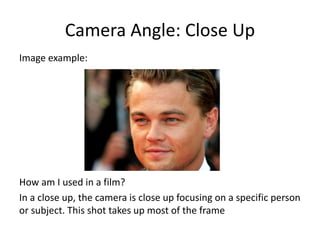
Camera Angle: Close Up
Image example:
How am I used in a film?
In a close up, the camera is close up focusing on a specific person
or subject. This shot takes up most of the frame
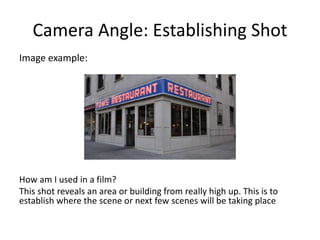
Camera Angle: Establishing Shot
Image example:
How am I used in a film?
This shot reveals an area or building from really high up. This is to
establish where the scene or next few scenes will be taking place
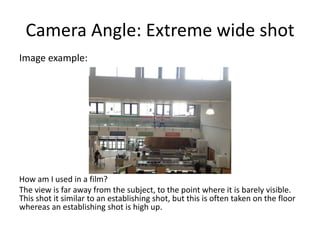
Camera Angle: Extreme wide shot
Image example:
How am I used in a film?
The view is far away from the subject, to the point where it is barely visible.
This shot it similar to an establishing shot, but this is often taken on the floor
whereas an establishing shot is high up.
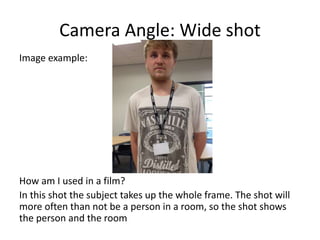
Camera Angle: Wide shot
Image example:
How am I used in a film?
In this shot the subject takes up the whole frame. The shot will
more often than not be a person in a room, so the shot shows
the person and the room
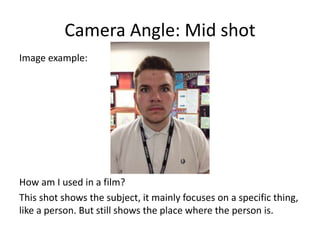
Camera Angle: Mid shot
Image example:
How am I used in a film?
This shot shows the subject, it mainly focuses on a specific thing,
like a person. But still shows the place where the person is.
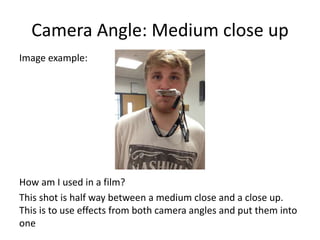
Camera Angle: Medium close up
Image example:
How am I used in a film?
This shot is half way between a medium close and a close up.
This is to use effects from both camera angles and put them into
one
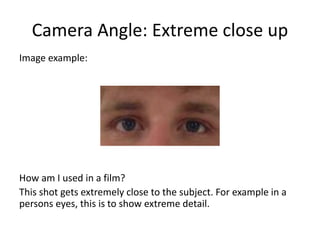
Camera Angle: Extreme close up
Image example:
How am I used in a film?
This shot gets extremely close to the subject. For example in a
persons eyes, this is to show extreme detail.
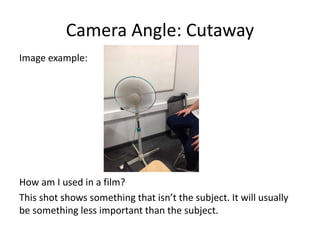
Camera Angle: Cutaway
Image example:
How am I used in a film?
This shot shows something that isn’t the subject. It will usually
be something less important than the subject.
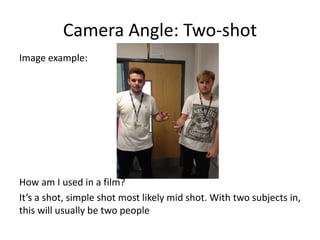
Camera Angle: Two-shot
Image example:
How am I used in a film?
It’s a shot, simple shot most likely mid shot. With two subjects in,
this will usually be two people
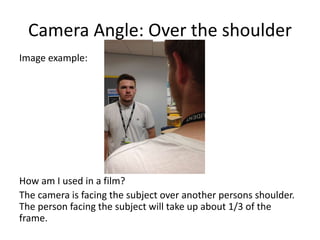
Camera Angle: Over the shoulder
Image example:
How am I used in a film?
The camera is facing the subject over another persons shoulder.
The person facing the subject will take up about 1/3 of the
frame.
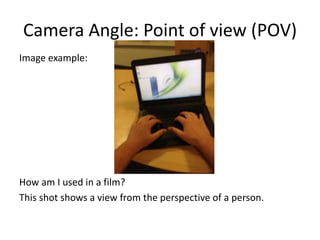
Camera Angle: Point of view (POV)
Image example:
How am I used in a film?
This shot shows a view from the perspective of a person.
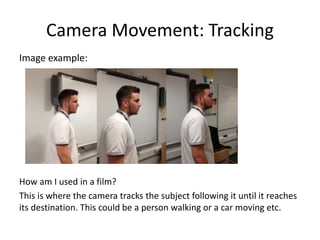
Camera Movement: Tracking
Image example:
How am I used in a film?
This is where the camera tracks the subject following it until it reaches
its destination. This could be a person walking or a car moving etc.
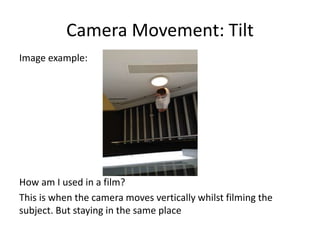
Camera Movement: Tilt
Image example:
How am I used in a film?
This is when the camera moves vertically whilst filming the
subject. But staying in the same place
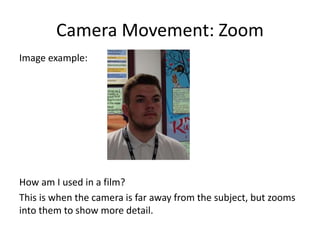
Camera Movement: Zoom
Image example:
How am I used in a film?
This is when the camera is far away from the subject, but zooms
into them to show more detail.
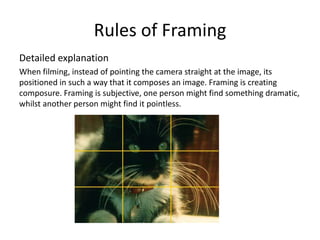
Rules of Framing
Detailed explanation
When filming, instead of pointing the camera straight at the image, its
positioned in such a way that it composes an image. Framing is creating
composure. Framing is subjective, one person might find something dramatic,
whilst another person might find it pointless.
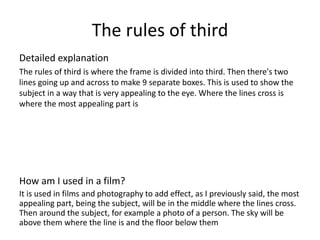
The rules of third
Detailed explanation
The rules of third is where the frame is divided into third. Then there's two
lines going up and across to make 9 separate boxes. This is used to show the
subject in a way that is very appealing to the eye. Where the lines cross is
where the most appealing part is
How am I used in a film?
It is used in films and photography to add effect, as I previously said, the most
appealing part, being the subject, will be in the middle where the lines cross.
Then around the subject, for example a photo of a person. The sky will be
above them where the line is and the floor below them

Camera angles

  • 1.
    Camera Angles Name: AlfieMillar Deadline: Friday 16th September Sent to G Teasdale via email before the lesson
  • 2.
    Challenge You are toindependently research the following camera angles and movements and create a visual representation, as well as a description of how the technique is used within the film industry.
  • 3.
    Camera Angle: CloseUp Image example: How am I used in a film? In a close up, the camera is close up focusing on a specific person or subject. This shot takes up most of the frame
  • 4.
    Camera Angle: EstablishingShot Image example: How am I used in a film? This shot reveals an area or building from really high up. This is to establish where the scene or next few scenes will be taking place
  • 5.
    Camera Angle: Extremewide shot Image example: How am I used in a film? The view is far away from the subject, to the point where it is barely visible. This shot it similar to an establishing shot, but this is often taken on the floor whereas an establishing shot is high up.
  • 6.
    Camera Angle: Wideshot Image example: How am I used in a film? In this shot the subject takes up the whole frame. The shot will more often than not be a person in a room, so the shot shows the person and the room
  • 7.
    Camera Angle: Midshot Image example: How am I used in a film? This shot shows the subject, it mainly focuses on a specific thing, like a person. But still shows the place where the person is.
  • 8.
    Camera Angle: Mediumclose up Image example: How am I used in a film? This shot is half way between a medium close and a close up. This is to use effects from both camera angles and put them into one
  • 9.
    Camera Angle: Extremeclose up Image example: How am I used in a film? This shot gets extremely close to the subject. For example in a persons eyes, this is to show extreme detail.
  • 10.
    Camera Angle: Cutaway Imageexample: How am I used in a film? This shot shows something that isn’t the subject. It will usually be something less important than the subject.
  • 11.
    Camera Angle: Two-shot Imageexample: How am I used in a film? It’s a shot, simple shot most likely mid shot. With two subjects in, this will usually be two people
  • 12.
    Camera Angle: Overthe shoulder Image example: How am I used in a film? The camera is facing the subject over another persons shoulder. The person facing the subject will take up about 1/3 of the frame.
  • 13.
    Camera Angle: Pointof view (POV) Image example: How am I used in a film? This shot shows a view from the perspective of a person.
  • 14.
    Camera Movement: Tracking Imageexample: How am I used in a film? This is where the camera tracks the subject following it until it reaches its destination. This could be a person walking or a car moving etc.
  • 15.
    Camera Movement: Tilt Imageexample: How am I used in a film? This is when the camera moves vertically whilst filming the subject. But staying in the same place
  • 16.
    Camera Movement: Zoom Imageexample: How am I used in a film? This is when the camera is far away from the subject, but zooms into them to show more detail.
  • 17.
    Rules of Framing Detailedexplanation When filming, instead of pointing the camera straight at the image, its positioned in such a way that it composes an image. Framing is creating composure. Framing is subjective, one person might find something dramatic, whilst another person might find it pointless.
  • 18.
    The rules ofthird Detailed explanation The rules of third is where the frame is divided into third. Then there's two lines going up and across to make 9 separate boxes. This is used to show the subject in a way that is very appealing to the eye. Where the lines cross is where the most appealing part is How am I used in a film? It is used in films and photography to add effect, as I previously said, the most appealing part, being the subject, will be in the middle where the lines cross. Then around the subject, for example a photo of a person. The sky will be above them where the line is and the floor below them

Editor's Notes

  • #4 This needs to be redone, look at the website mediacollege.com then go to videos page for assistance
  • #5 This should be an external show of the building, to ESTABLISH the location.
  • #7 Please redo as this is a MIDSHOT
  • #10 Can you use a better picture, such as eyes as written in your description.
  • #18 Can you add a google image that represents this please.