Camera Shots
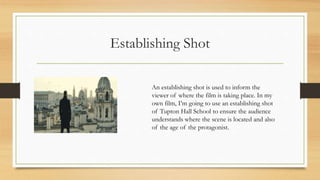
Establishing Shot
An establishing shot is used to inform the
viewer of where the film is taking place. In my
own film, I’m going to use an establishing shot
of Tupton Hall School to ensure the audience
understands where the scene is located and also
of the age of the protagonist.
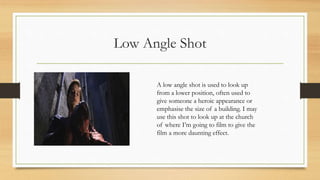
Low Angle Shot
A low angle shot is used to look up
from a lower position, often used to
give someone a heroic appearance or
emphasise the size of a building. I may
use this shot to look up at the church
of where I’m going to film to give the
film a more daunting effect.
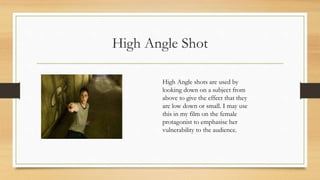
High Angle Shot
High Angle shots are used by
looking down on a subject from
above to give the effect that they
are low down or small. I may use
this in my film on the female
protagonist to emphasise her
vulnerability to the audience.
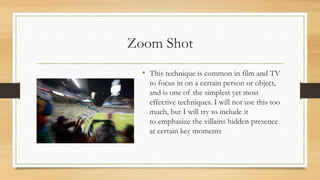
Zoom Shot
• This technique is common in film and TV
to focus in on a certain person or object,
and is one of the simplest yet most
effective techniques. I will not use this too
much, but I will try to include it
to emphasize the villains hidden presence
at certain key moments
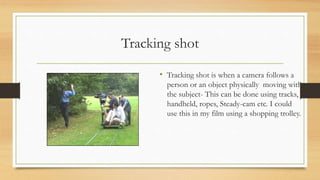
Tracking shot
• Tracking shot is when a camera follows a
person or an object physically moving with
the subject- This can be done using tracks,
handheld, ropes, Steady-cam etc. I could
use this in my film using a shopping trolley.
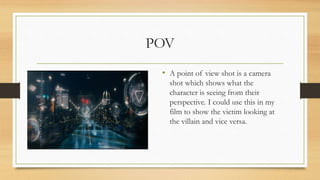
POV
• A point of view shot is a camera
shot which shows what the
character is seeing from their
perspective. I could use this in my
film to show the victim looking at
the villain and vice versa.
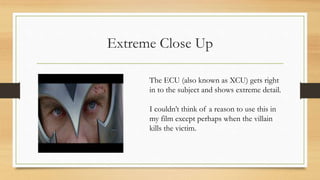
Extreme Close Up
The ECU (also known as XCU) gets right
in to the subject and shows extreme detail.
I couldn’t think of a reason to use this in
my film except perhaps when the villain
kills the victim.
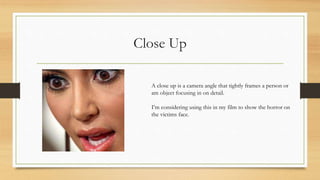
Close Up
A close up is a camera angle that tightly frames a person or
am object focusing in on detail.
I’m considering using this in my film to show the horror on
the victims face.
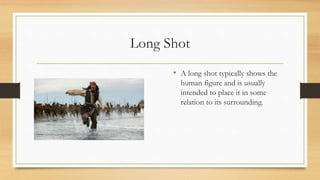
Long Shot
• A long shot typically shows the
human figure and is usually
intended to place it in some
relation to its surrounding.

Camera shots

  • 1.
  • 2.
    Establishing Shot An establishingshot is used to inform the viewer of where the film is taking place. In my own film, I’m going to use an establishing shot of Tupton Hall School to ensure the audience understands where the scene is located and also of the age of the protagonist.
  • 3.
    Low Angle Shot Alow angle shot is used to look up from a lower position, often used to give someone a heroic appearance or emphasise the size of a building. I may use this shot to look up at the church of where I’m going to film to give the film a more daunting effect.
  • 4.
    High Angle Shot HighAngle shots are used by looking down on a subject from above to give the effect that they are low down or small. I may use this in my film on the female protagonist to emphasise her vulnerability to the audience.
  • 5.
    Zoom Shot • Thistechnique is common in film and TV to focus in on a certain person or object, and is one of the simplest yet most effective techniques. I will not use this too much, but I will try to include it to emphasize the villains hidden presence at certain key moments
  • 6.
    Tracking shot • Trackingshot is when a camera follows a person or an object physically moving with the subject- This can be done using tracks, handheld, ropes, Steady-cam etc. I could use this in my film using a shopping trolley.
  • 7.
    POV • A pointof view shot is a camera shot which shows what the character is seeing from their perspective. I could use this in my film to show the victim looking at the villain and vice versa.
  • 8.
    Extreme Close Up TheECU (also known as XCU) gets right in to the subject and shows extreme detail. I couldn’t think of a reason to use this in my film except perhaps when the villain kills the victim.
  • 9.
    Close Up A closeup is a camera angle that tightly frames a person or am object focusing in on detail. I’m considering using this in my film to show the horror on the victims face.
  • 10.
    Long Shot • Along shot typically shows the human figure and is usually intended to place it in some relation to its surrounding.